


Parental Misperceptions of Their Offspring’s Weight and Their Strategies for Child’s Eating Behavior: A Narrative Review of the Recent Evidence

 ,
,  , and
, and
Abstract
1. Introduction
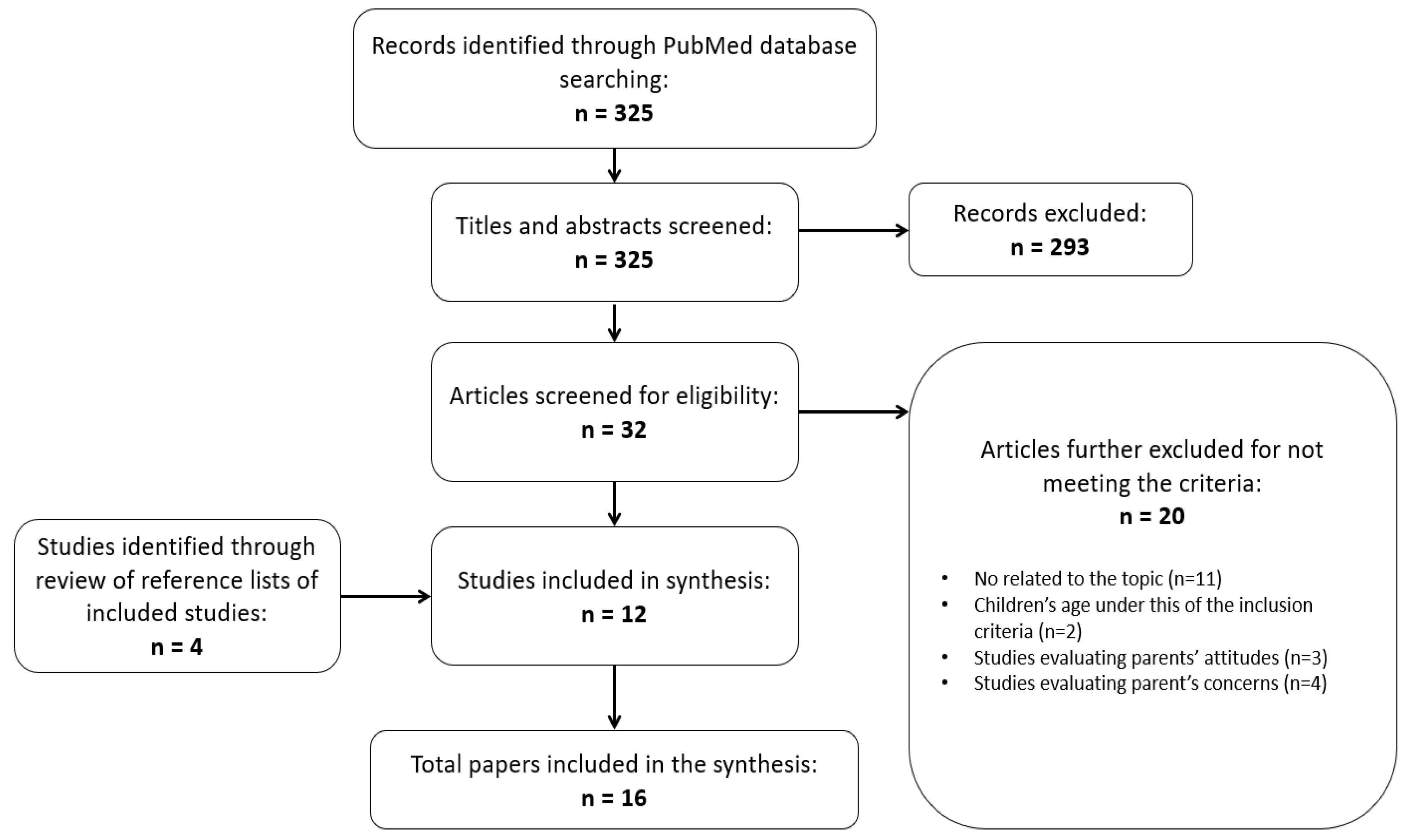
2. Literature Search
2.1. Eligibility Criteria
2.2. Data Extraction
3. Study’s Findings
3.1. General Characteristics of the Studies
3.2. Parental Weight Misperceptions Assessment
3.3. Evaluation of Dietary Habits
3.4. Prevalence of Parental Weight Misperception
3.5. Association between Parental Weight Misperception and Eating Habits/Weight Loss Attempts
3.6. Perceptions and Strategies Based on Sex, Age Group and Study Design
4. Discussion and Concluding Remarks
Author Contributions
Funding
Institutional Review Board Statement
Informed Consent Statement
Data Availability Statement
Conflicts of Interest
References
- Serdula, M.K.; Ivery, D.; Coates, R.J.; Freedman, D.S.; Williamson, D.F.; Byers, T. Do Obese Children Become Obese Adults? A Review of the Literature. Prev. Med. 1993, 22, 167–177. [Google Scholar] [CrossRef] [PubMed]
- Simmonds, M.; Llewellyn, A.; Owen, C.G.; Woolacott, N. Predicting Adult Obesity from Childhood Obesity: A Systematic Review and Meta-Analysis. Obes. Rev. 2016, 17, 95–107. [Google Scholar] [CrossRef]
- Cohen, J.; Alexander, S.; Signorelli, C.; Williams, K.; Sim, K.A.; Chennariyil, L.; Baur, L.A. Clinician and Healthcare Managers’ Perspectives on the Delivery of Secondary and Tertiary Pediatric Weight Management Services. J. Child Health Care 2021, 13674935211052148. [Google Scholar] [CrossRef] [PubMed]
- Lytle, L.A.; Hearst, M.O.; Fulkerson, J.; Murray, D.M.; Martinson, B.; Klein, E.; Pasch, K.; Samuelson, A. Examining the Relationships between Family Meal Practices, Family Stressors, and the Weight of Youth in the Family. Ann. Behav. Med. 2011, 41, 353–362. [Google Scholar] [CrossRef] [PubMed][Green Version]
- Danford, C.A.; Schultz, C.; Marvicsin, D. Parental Roles in the Development of Obesity in Children: Challenges and Opportunities. Res. Rep. Biol. 2015, 6, 39–53. [Google Scholar] [CrossRef]
- Mei, H.; Guo, S.; Lu, H.; Pan, Y.; Mei, W.; Zhang, B.; Zhang, J. Impact of Parental Weight Status on Childrens Body Mass Index in Early Life: Evidence from a Chinese Cohort. BMJ Open 2018, 8, e018755. [Google Scholar] [CrossRef] [PubMed]
- Ludhal, A.; Kidwell, K.M.; Nelson, T.M. Parental Misperceptions of Children’s Underweight Status: A Meta-Analysis. Ann. Behav. Med. 2014, 48, 184–193. [Google Scholar]
- Xhonneux, A.; Langhendries, J.P.; Martin, F.; Seidel, L.; Albert, A.; Dain, E.; Totzauer, M.; Grote, V.; Luque, V.; Closa-Monasterolo, R.; et al. European Childhood Obesity Trial Study Group. Parental Perception of Body Weight Status of Their 8-Year-Old Children: Findings from the European CHOP Study. Matern. Child Health J. 2022, 26, 1274–1282. [Google Scholar] [CrossRef]
- Rietmeijer-Mentink, M.; Paulis, W.D.; van Middelkoop, M.; Bindels, P.J.; van der Wouden, J.C. Difference between Parental Perception and Actual Weight Status of Children: A Systematic Review. Matern. Child Nutr. 2013, 9, 3–22. [Google Scholar] [CrossRef]
- Neumark-Sztainer, D.; Wall, M.; Story, M.; van den Berg, P. Accurate Parental Classification of Overweight Adolescents Weight Status: Does It Matter? Pediatrics 2008, 121, e1495–e1502. [Google Scholar] [CrossRef]
- García-Blanco, L.; Berasaluce, A.; Romanos-Nanclares, A.; Martínez-González, M.Á.; Moreno-Galarraga, L.; Martín-Calvo, N. Parental Perception of Childs Weight, their Attitudes Towards Child’s Dietary Habits and the Risk of Obesity. World J. Pediatr. 2022, 18, 482–489. [Google Scholar] [CrossRef] [PubMed]
- May, A.L.; Donohue, M.; Scanlon, K.S.; Sherry, B.; Dalenius, K.; Faulkner, P.; Birch, L.L. Child-Feeding Strategies are Associated with Maternal Concern about Children Becoming Overweight, but not Childrens Weight Status. J. Am. Diet. Assoc. 2007, 107, 1167–1175. [Google Scholar] [CrossRef] [PubMed]
- Robinson, E.; Sutin, A.R. Parental Perception of Weight Status and Weight Gain Across Childhood. Pediatrics 2016, 137, e20153957. [Google Scholar] [CrossRef] [PubMed]
- Blanchet, R.; Kengneson, C.C.; Bodnaruc, A.M.; Gunter, A.; Giroux, I. Factors Influencing Parents and Childrens Misperception of Children’s Weight Status: A Systematic Review of Current Research. Curr. Obes. Rep. 2019, 8, 373–412. [Google Scholar] [CrossRef]
- Rogoff, B.; Sellers, M.; Pirrotta, S.; Fox, N.; White, S. Age of Assignment of Roles and Responsibilities in Children: A Cross-Cultural Survey. Hum. Dev. 1975, 18, 353–369. [Google Scholar] [CrossRef]
- Crawford, D.; Timperio, A.; Telford, A.; Salmon, J. Parental Concerns about Childhood Obesity and the Strategies Employed to Prevent Unhealthy Weight Gain in Children. Public Health Nutr. 2006, 9, 889–895. [Google Scholar] [CrossRef]
- Hong, S.A.; Peltzer, K.; Jalayondeja, C. Parental Misperception of Child’s Weight and Related Factors within Family Norms. Eat Weight Disord. 2019, 24, 557–564. [Google Scholar] [CrossRef]
- Xiang, C.; Zhang, Y.; Yong, C.; Xi, Y.; Huo, J.; Zou, H.; Liang, J.; Jiang, Z.; Lin, Q. Association between Parents Perceptions of Preschool Childrens Weight, Feeding Practices and Childrens Dietary Patterns: A Cross-Sectional Study in China. Nutrients 2021, 13, 3767. [Google Scholar] [CrossRef]
- Zhang, T.; Cai, L.; Jing, J.; Ma, L.; Ma, J.; Chen, Y. Parental Perception of Child Weight and Its Association with Weight-Related Parenting Behaviours and Child Behaviours: A Chinese National Study. Public Health Nutr. 2018, 21, 1671–1680. [Google Scholar] [CrossRef]
- UNICEF. Programming Guidance for Parenting of Adolescents. Available online: https://www.unicef.org/media/97831/file/Parenting%20of%20Adolescents.pdf (accessed on 5 September 2022).
- Brann, L.S.; Skinner, J.D. More Controlling Child-Feeding Practices are Found Among Parents of Boys with an Average Body Mass Index Compared with Parents of Boys with a High Body Mass Index. J. Am. Diet. Assoc. 2005, 105, 1411–1416. [Google Scholar] [CrossRef]
- Webber, L.; Hill, C.; Cooke, L.; Carnell, S.; Wardle, J. Associations between Child Weight and Maternal Feeding Styles Are Mediated by Maternal Perceptions and Concerns. Eur. J. Clin. Nutr. 2010, 64, 259–265. [Google Scholar] [CrossRef] [PubMed]
- Wen, X.; Hui, S.S. Chinese Parents Perceptions of their Childrens Weights and their Relationship to Parenting Behaviours. Child Care Health Dev. 2011, 37, 343–351. [Google Scholar] [CrossRef] [PubMed]
- Polfuss, M.; Frenn, M. Parenting Behaviors of African American and Caucasian Families: Parent and Child Perceptions, Associations with Child Weight, and Ability to Identify Abnormal Weight Status. J. Pediatr. Nurs. 2012, 27, 195–205. [Google Scholar] [CrossRef] [PubMed]
- Chen, H.Y.; Lemon, S.C.; Pagoto, S.L.; Barton, B.A.; Lapane, K.L.; Goldberg, R.J. Personal and Parental Weight Misperception and Self-Reported Attempted Weight Loss in US Children and Adolescents, National Health and Nutrition Examination Survey, 2007–2008 and 2009–2010. Prev. Chronic Dis. 2014, 11, E132. [Google Scholar] [CrossRef] [PubMed]
- Tarasenko, Y.N.; Rossen, L.M.; Schoendorf, K.C. Children’s, their Guardians, and Health care Professionals Perceptions of Child Overweight in Relation to Children’s Weight Loss Attempts. Am. J. Health Promot. 2014, 29, e73–e81. [Google Scholar] [CrossRef] [PubMed]
- Lydecker, J.A.; Grilo, C.M. The Apple of their Eye: Attitudinal and Behavioral Correlates of Parents’ Perceptions of Child Obesity. Obesity 2016, 24, 1124–1131. [Google Scholar] [CrossRef]
- Vangeepuram, N.; Ramos, M.A.; Fei, K.; Fox, A.M.; Horowitz, C.R.; Kleinman, L.C.; Galvez, M.P. Are Parental Perceptions of Child Activity Levels and overall Health More Important than Perceptions of Weight? Matern. Child Health J. 2016, 20, 1456–1463. [Google Scholar] [CrossRef]
- Almoosawi, S.; Jones, A.R.; Parkinson, K.N.; Pearce, M.S.; Collins, H.; Adamson, A.J. Parental Perception of Weight Status: Influence on Childrens Diet in the Gateshead Millennium Study. PLoS ONE 2016, 11, e0144931. [Google Scholar] [CrossRef]
- Altenburg, T.M.; Singh, A.S.; Te Velde, S.; De Bourdeaudhuij, I.; Lien, N.; Bere, E.; Molnár, D.; Jan, N.; Fernández-Alvira, J.M.; Manios, Y.; et al. Actual and Perceived Weight Status and Its Association with Slimming and Energy-Balance Related Behaviours in 10- to 12-Year-old European Children: The ENERGY-Project. Pediatr. Obes. 2017, 12, 137–145. [Google Scholar] [CrossRef]
- Min, J.; Wang, V.H.; Xue, H.; Mi, J.; Wang, Y. Maternal Perception of Child Overweight Status and its Association with Weight-Related Parenting Practices, their Childrens Health Behaviours and Weight Change in China. Public Health Nutr. 2017, 20, 2096–2103. [Google Scholar] [CrossRef]
- Robinson, E.; Sutin, A.R. Parents Perceptions of Their Children as Overweight and Childrens Weight Concerns and Weight Gain. Psychol. Sci. 2017, 28, 320–329. [Google Scholar] [CrossRef] [PubMed]
- Loth, K.A.; Mohamed, N.; Trofholz, A.; Tate, A.; Berge, J.M. Associations between Parental Perception of- and Concern about-Child Weight and Use of Specific Food-Related Parenting Practices. Appetite 2021, 160, 105068. [Google Scholar] [CrossRef] [PubMed]
- Yee, A.Z.; Lwin, M.O.; Ho, S.S. The Influence of Parental Practices on Child Promotive and Preventive Food Consumption Behaviors: A Systematic Review and Meta-Analysis. Int. J. Behav. Nutr. Phys. Act. 2017, 14, 47. [Google Scholar] [CrossRef] [PubMed]
- Mahmood, L.; Flores-Barrantes, P.; Moreno, L.A.; Manios, Y.; Gonzalez-Gil, E.M. The Influence of Parental Dietary Behaviors and Practices on Children’s Eating Habits. Nutrients 2021, 13, 1138. [Google Scholar] [CrossRef]
- Ramos Salas, X.; Buoncristiano, M.; Williams, J.; Kebbe, M.; Spinelli, A.; Nardone, P.; Breda, J. Parental Perceptions of Children’s Weight Status in 22 Countries: The WHO European Childhood Obesity Suerveillance Initiative: COSI 2015/2017. Obes. Facts 2021, 14, 658–674. [Google Scholar] [CrossRef]
- Scaglioni, S.; De Cosmi, V.; Ciappolino, V.; Parazzini, F.; Brambilla, P.; Agostoni, C. Factors Influencing Children’s Eating Behaviours. Nutrients 2018, 10, 706. [Google Scholar] [CrossRef]
- Wang, Y. Cross-National Comparison of Childhood Obesity: The Epidemic and the Relationship between Obesity and Socioeconomic Status. Int. J. Epidemiol. 2001, 30, 1129–1136. [Google Scholar] [CrossRef]
- Hosseini, S.A.; Ranjit, K.P. Body Image Distortion; StatPearls Publishing: Tampa, FL, USA, 2022. [Google Scholar]
- Savage, J.S.; Fisher, J.O.; Birch, L.L. Parental Influence on Eating Behavior: Conception to Adolescence. J. Law Med. Ethics 2007, 35, 22–34. [Google Scholar] [CrossRef]
- Kanellopoulou, A.; Kosti, R.I.; Notara, V.; Antonogeorgos, G.; Rojas-Gil, A.P.; Kornilaki, E.N.; Lagiou, A.; Yannakoulia, M.; Panagiotakos, D.B. Dietary Patterns, Weight Perception and Obesity Status, Among 10–12-Year-Old Children; an Epidemiological Study in Greece. Children 2021, 8, 626. [Google Scholar] [CrossRef]

| Source (Chronological Order) | Study Design | Subjects (Age, Country) | Parental Perception Assessment | Dietary Habits Assessment | BMI Reference Norms | Perception Results | Strategies | Key Results/Conclusions |
|---|---|---|---|---|---|---|---|---|
| 1. Brann & Skinner, 2005 [21] | Cross-sectional | 8–10 years old (n = 49/USA) | n/a | Child Feeding Questionnaire | Centers for Disease Control charts | High BMI vs. Average BMI boys Both parents saw them as more overweight | Average BMI boys Both parents: Controlling feeding practices Mothers: Pressure to eat Fathers: Pressure to eat & monitoring More often than mothers/fathers of boys with a high BMI | Boys with average BMI have parents using more controlling child-feeding practices compared to boys of high BMI. |
| 2. Crawford et al., 2006 [16] | Cross-sectional | 5–6 years old, 10–12 years old (n = 1205/Australia) | Classification using a 5-point scale: “Markedly underweight”, “Underweight”, “Average”, “Overweight”, “Markedly overweight” | n/a | International Obesity Task Force, 2000 | 5–6 years old children 3% of parents perceived their children as overweight/obese (23% of the children were actually overweight/obese) 10–12 years old children 14% of parents perceived their children as overweight/obese (29% of the children were actually overweight/obese) | 5–6 years old girls vs. boys: More often weight gain prevention strategies (39% vs. 24%, p < 0.005) 10–12 years old vs. 5–6 years old More parents reported using preventive strategies for weight gain (31% vs. 43%, p < 0.001) | Overall, preventive strategies were not associated with current child-weight perception. |
| 3. Neumark-Sztainer et al., 2008 [10] | Cross-sectional and Longitudinal | Mean age 14.4 ± 1.7 years old (n = 314 included in cross-sectional analyses and n = 170 in longitudinal analyses/USA) | Classification using a 6-point scale: “Very underweight”, “Somewhat underweight”, “About right”, “Somewhat overweight”, “Very overweight”, “Don’t know” | Questionnaire on lifestyle behavior and eating habits | n/a | 48.5% of obese parents misperceived the overweight body of their children 55.2% of non-obese parents misperceived the overweight body of their children 45.9% and 60% of parents misclassified their daughters and sons, respectively, as being of normal weight | 50% and 43.9% of boys and girls, respectively, who had not been encouraged to diet remained overweight vs. 74% and 66.1% who had been encouraged | Overall, parents who recognized that their children were overweight were more likely to encourage them to diet. |
| 4. Webber et al., 2010 [22] | Cross sectional | 7–9 years old (n = 213/UK) | Classification using a 5-point scale: “very underweight”, “underweight”, “normal”, “overweight”, “very overweight” | Child Feeding Questionnaire | 1990 British reference data | 59% vs. 56% maternal misperception of their underweight and overweight/obese children, respectively | Pressure to eat was the most common strategy for mothers who perceived their children as being underweight. | Maternal practices depend on their perception of their child’s weight, especially when mothers perceive their children as being underweight. |
| 5. Wen & Hui, 2011 [23] | Cross-sectional | 10–15 years old (n = 2143 adolescents and n = 1869 parents/China) | Classification using a 5-point scale: “Very underweight”, “Slightly Underweight”, “Normal”, “Slightly Overweight”, “Very overweight” | Lifestyle and nutritional questions | International growth standards of WHO | 44% of parental misperception Parents are more likely wrongly identify their son’s weight than that of their daughter’s OR: 1.61, 95%CI: 1.29–2.01 | Parents who correctly classified their children: “monitoring diet and physical activity” “positive reinforcement” vs. “pressure to eat” for parents who misperceived their child’s weight | Parents with incorrect perception of their children’s weights were more likely to select the feeding strategy of ‘pressure to eat’ compared with parents with correct perception. |
| 6. Polfuss & Frenn, 2012 [24] | Cross-sectional | 9–15 years old (n = 176 child parent dyads/USA) | Classification using a 5-point scale: “Markedly underweight”, “Underweight”, “Average”, “Overweight”, “Markedly overweight” | Child Feeding Questionnaire | BMI z scores standardized for age and gender according to the national norms from the USDA/ARS Children’s Nutrition Research Center | Parental perception of their child’s weight was significantly correlated with BMI z scores (p < 0.001). | Psychological control and pressure to eat were significantly associated with the child’s weight status. | Overall, parents who accurately perceived their child as being overweight used controlling behaviors. |
| 7. Chen et al., 2014 [25] | Cross-sectional | 8–15 years old (n = 2613/USA) | Computer-Assisted Personal Interview (CAPI) questions. Classification: “overweight”, “underweight”, “about the right weight” | Weight loss attempts | Centers for Disease Control charts | 6.3% of parents perceived their child’s weight as underweight, 74.4% as about right, 19.3% as overweight | Only correct personal weight perception was positively associated with self-reported attempted weight loss for overweight or obese children. | Parental misperceptions were not significantly associated with attempted weight loss of children/adolescents. |
| 8. Tarasenko et al., 2014 [26] | Cross-sectional | 8–15 years old (n = 4691/UK) | Early childhood questionnaire Classification: “overweight”, “underweight”, “about the right weight” | Weight loss | US growth charts | Probability that an overweight child is perceived as such by their guardians 0.25 (95%CI: 0.20–0.30) vs. an obese child: 0.41 (95% CI: 0.38–0.45) | Overweight children 63% more likely (95% CI: 1.30–2.04) to attempt weight loss when only one person accurately recognizes them as such vs. overweight children misclassified by at least one person (p = 0.001) | Overweight children perceived as such by two people [i.e., themselves and their guardians or health care professionals (HCPs), or both their guardians and HCPs] were twice as likely to attempt weight loss compared to their counterparts perceived as such by nobody. |
| 9. Lydecker & Grilo, 2016 [27] | Cross-sectional | 5–15 years old (n = 1007/Mechanical Turk website -multiracial) | Classification using a 4-point scale: “Underweight”, “Healthy weight”, “Overweight”, “Obesity” | - Child Feeding Questionnaire - Eating Disorder Examination Questionnaire - Fat Talk Questionnaire | Age-, sex- specific growth curves | 47.7% misclassified their underweight child 24.3% misclassified their healthy weight child 73.1% misclassified their overweight child | Perceived child weight-status was related to “restriction” (p < 0.001), “pressure to eat” (p < 0.001) and “monitoring” (p = 0.003). | Parents restricted the eating of children with perceived overweight and obesity more than perceived underweight and healthy weight children. Besides, they pressured underweight children to eat more than those with healthy weight, overweight, and obesity, while they monitored obese children more than underweight ones. |
| 10. Vangeepuram et al., 2016 [28] | Cross-sectional | 3–15 years old (n = 116, USA) | Classification using a 4-point scale: “Underweight”, “About the right weight”, “Somewhat overweight”, “Very overweight” | Questions on lifestyle behavior, no standardized questionnaire reported | n/a | 12% and 81% of parents underestimated their children’s healthy and overweight/obese weight, respectively | Perceiving the child’s weight as normal was associated with more hours of daily walking (p = 0.08). | Perceptions of a child’s weight may be related with parental perception of child health and physical activity status. |
| 11. Almoosawi et al., 2016 [29] | Cross-sectional | 6–8 years old (n = 361/UK) | Interview (quantitative techniques) Classification: “very underweight”, “underweight”, “normal” “overweight” “very overweight” | Food Assessment in Schools Tool | International Obesity Task Force | 17% of parents misperceived their child as being of normal weight 0% of parents overestimated their child’s weight | More children with misperceived weight consumed reduced sugar carbonated drinks (p = 0.005). | Parents who misperceived their child’s weight had children with a lower ‘healthy’ dietary pattern score compared to children whose parents correctly perceived their weight |
| 12. Altenburg et al., 2017 [30] | Cross-sectional | 10–12 years old, (n = 7708/Belgium, Greece, Hungary, Netherlands, Norway, Slovenia, Spain, Switzerland—ENERGY project) | Classification using a 5-point Likert scale: “My child’s weight is OK”, “My child’s weight is a bit too much”, “My child’s weight is way too much”, “My child’s weight is a bit too little”, “My child’s weight is way too little”, | Standardized battery/weight loss-slimming behavior | Slimming and energy-balance related behaviors | 22% of parents perceived their children’s weight as “a bit or way too much” when 23% of children were actually overweight or obese | Children whose parents perceive them as overweight reported less physical activity (β = −3.4). | Children whose parents perceive them as overweight reported less physical activity. |
| 13. Min et al., 2017 [31] | Cross-sectional | 6–18 years old (n = 816/China) | Classification using a 3-point scale: “Underweight”, “Normal weight”, “Overweight” | 24 h recall and same-day interview | Obesity Task Force BMI cut-offs | 36.2% of mothers misperceived their child’s weight, 22.2% under-perceived and 14% over-perceived their child’s weight | Mothers who perceived their child’s weight as overweight -encourage the child to exercise more (Odds Ratio = 1.8, 95%CI: 1.0–3.3) -encourage the child to change weight with diet (Odds Ratio = 4.3, 95%CI: 2.3–7.8) | Mothers who perceive their child as overweight are more likely to encourage their child to exercise and modify their diet for weight management. |
| 14. Robinson & Sutin, 2017 [32] | Longitudinal * | Study 1 4–5 years old→ 14–15 years old (n = 2823/UK) Study 2 9 years old→ 13 years old (n = 5886/UK) | Study 1 Classification using a 4-point scale: “Underweight”, “Normal weight”, “Somewhat overweight”, “Very overweight” Study 2 Classification using a 7-point scale: “Very underweight”, “Moderately underweight”, “Slightly underweight”, “About the right weight”, “Somewhat overweight” “Moderately overweight”, “Very overweight” | Weight loss attempts | Centers for Disease Control charts | Baseline 4–5 years old 19% of actually overweight or obese children were identified as such by their parents 9 years old 44% of actually overweight or obese children were identified as such by their parents Overall 80% of overweight/obese children were identified as normal by their parents | Children perceived as overweight Point estimate: 0.155 ± SE: 045 (p < 0.01) for child weight-loss attempts | Children whose parents perceive them to be overweight were more likely to actively try to lose weight. |
| 15. Zhang et al., 2018 [19] | Cross-sectional | 6–17 years old (n = 47,417/China) | Classification using a 3-point scale: “thin”, “about the right weight”, “fat” | Standardized behavioral and nutritional questionnaires | BMI Z-score using WHO standards | 30.5% of parental underestimation and 8.7% of parental overestimation of their child’s weight The weight of girls was less likely to be underestimated than that of boys (25.1% vs. 35.8%, p < 0.001) | Parents use healthy strategies towards their child’s dietary habits (breakfast, exercise, screen time and soft drinks restriction) if they classify them as of normal weight. | Parents who perceived that their child has normal weight use healthy strategies towards child’s dietary habits |
| 16. Loth et al., 2021 [33] | Cross-sectional | 5–7 years old (n = 150/USA) | Classification using a 6-point scale: “Very underweight”, “Somewhat underweight”, “About right”, “Somewhat overweight”, “Very overweight”, “Don’t know” | Child Feeding Questionnaire (CFQ) | Centers of Disease Control calculator | n/a | Parents who perceived their child to be somewhat/very overweight reported more restrictive feeding practices compared to those who perceived their child to be very or somewhat underweight or about right weight. | Parental perception of their child’s weight was associated with parental report of restrictive feeding practices |
Publisher’s Note: MDPI stays neutral with regard to jurisdictional claims in published maps and institutional affiliations. |
© 2022 by the authors. Licensee MDPI, Basel, Switzerland. This article is an open access article distributed under the terms and conditions of the Creative Commons Attribution (CC BY) license (https://creativecommons.org/licenses/by/4.0/).
Share and Cite
Gketsios, I.; Foscolou, A.; Vassilakou, T.; Panagiotakos, D.B.; Kosti, R.I. Parental Misperceptions of Their Offspring’s Weight and Their Strategies for Child’s Eating Behavior: A Narrative Review of the Recent Evidence. Children 2022, 9, 1565. https://doi.org/10.3390/children9101565
Gketsios I, Foscolou A, Vassilakou T, Panagiotakos DB, Kosti RI. Parental Misperceptions of Their Offspring’s Weight and Their Strategies for Child’s Eating Behavior: A Narrative Review of the Recent Evidence. Children. 2022; 9(10):1565. https://doi.org/10.3390/children9101565
Chicago/Turabian StyleGketsios, Ioannis, Alexandra Foscolou, Tonia Vassilakou, Demosthenes B. Panagiotakos, and Rena I. Kosti. 2022. "Parental Misperceptions of Their Offspring’s Weight and Their Strategies for Child’s Eating Behavior: A Narrative Review of the Recent Evidence" Children 9, no. 10: 1565. https://doi.org/10.3390/children9101565
APA StyleGketsios, I., Foscolou, A., Vassilakou, T., Panagiotakos, D. B., & Kosti, R. I. (2022). Parental Misperceptions of Their Offspring’s Weight and Their Strategies for Child’s Eating Behavior: A Narrative Review of the Recent Evidence. Children, 9(10), 1565. https://doi.org/10.3390/children9101565

