Impacts of COVID-19 Restrictions on Young Children’s Outdoor Activity: A Systematic Review



Abstract
1. Introduction
2. Materials and Methods
2.1. Search Strategy
2.2. Eligibility Criteria
2.3. Selection Process
2.4. Data Extraction
2.5. Study Quality Assessment
3. Results
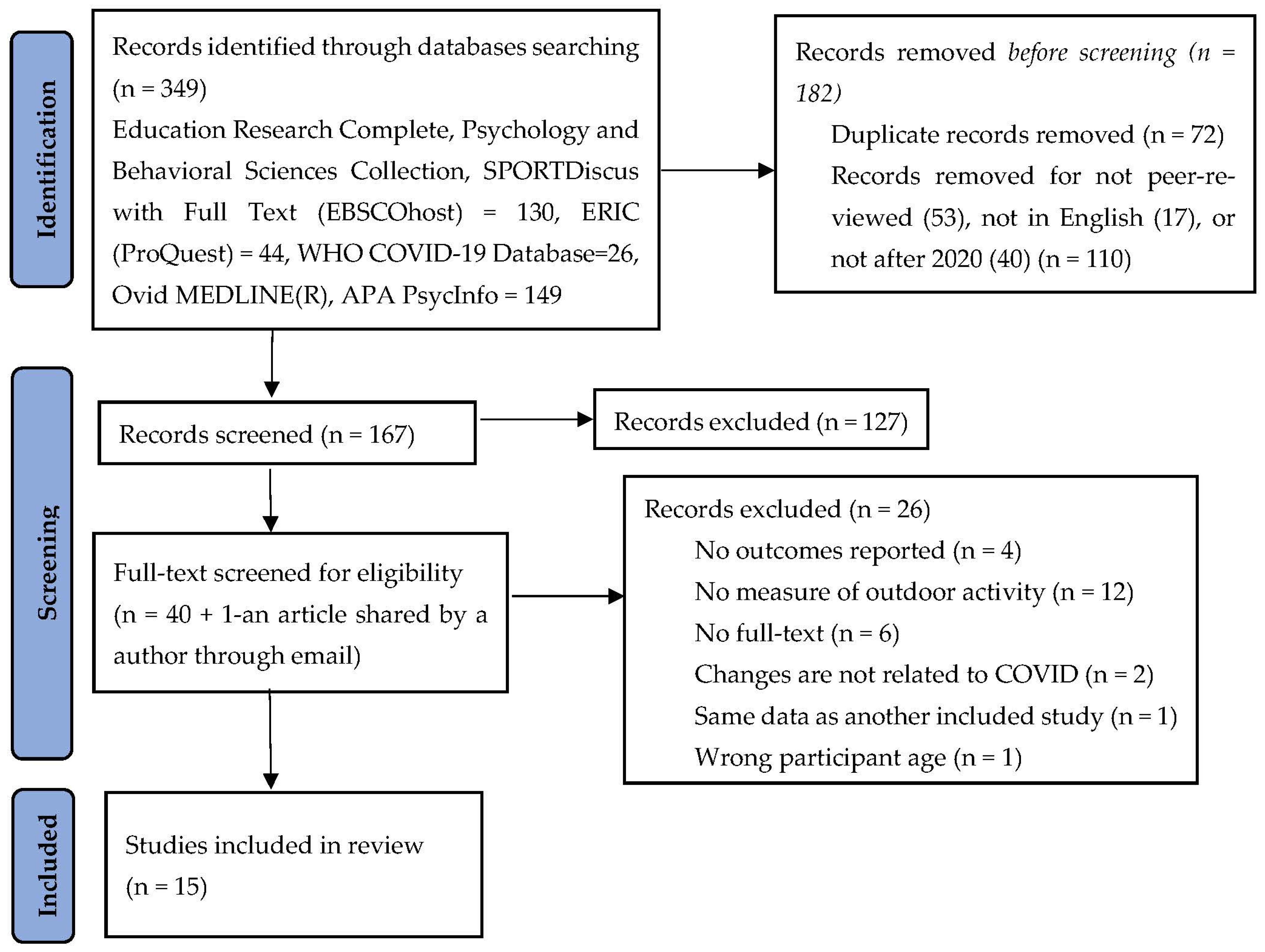
3.1. Study Selection
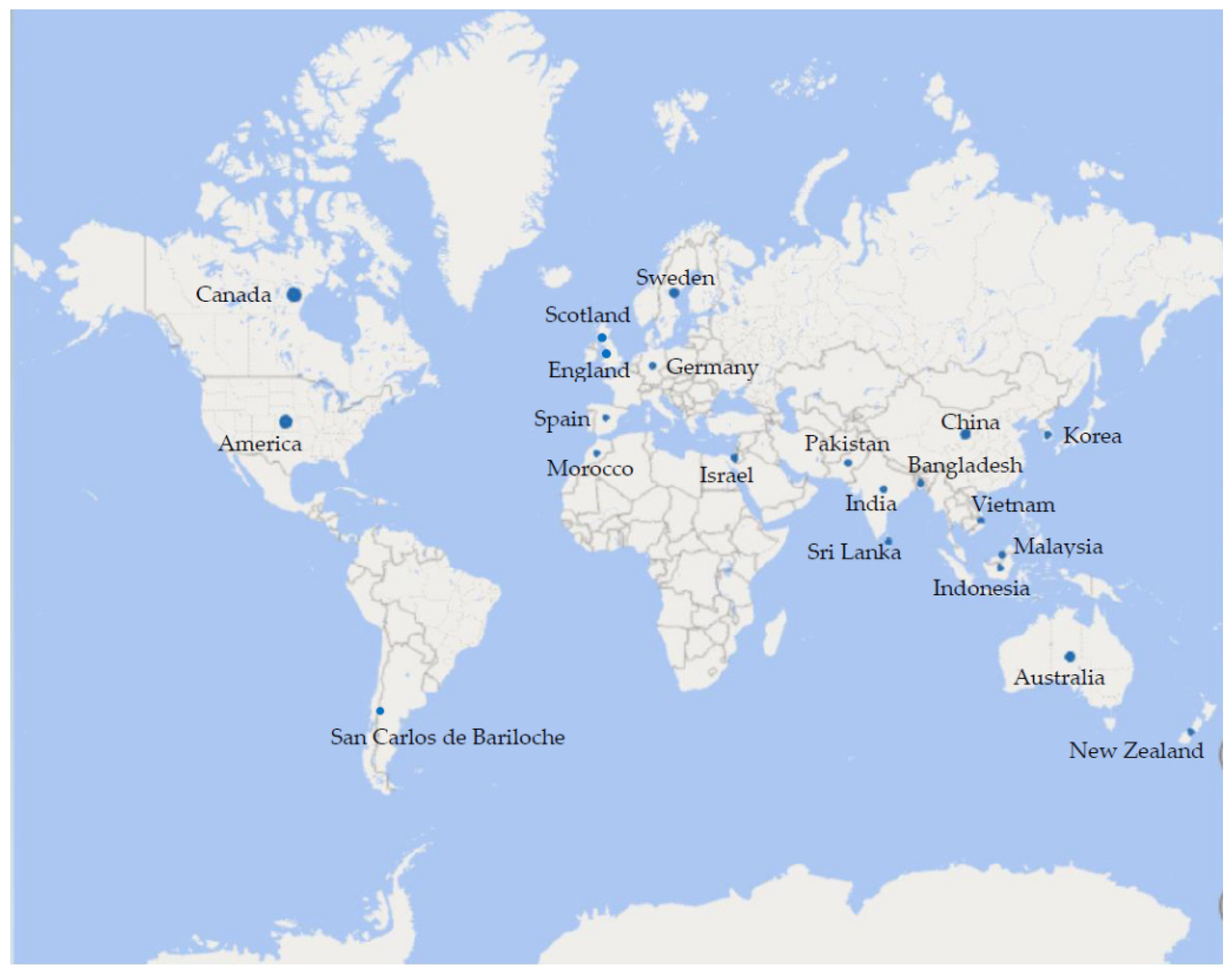
3.2. Study Characteristic
3.3. Findings
3.3.1. Outdoor Activity in Educational Settings
3.3.2. Outdoor Activity at Home Settings
3.3.3. Outdoor Activity nearby Home/in Public Venues
3.3.4. Increased Outdoor Hobbies or Activities
3.3.5. Families in Outdoor Activities
3.3.6. Outdoor Activity and Level of COVID-19 Restriction
3.3.7. Summary of Findings
4. Discussion
4.1. In Educational Settings and at Home
4.2. Family Demographic, Parental Support, Social and Home Environment Factors
4.3. Implications for Interventions
4.4. Recommendations for Future Researchers
4.5. Strengths and Limitations
5. Conclusions
Supplementary Materials
Author Contributions
Funding
Institutional Review Board Statement
Informed Consent Statement
Data Availability Statement
Conflicts of Interest
References
- World Health Organization. WHO Director-General’s Opening Remarks at the Media Briefing on COVID-19—11 March 2020. Available online: https://www.who.int/director-general/speeches/detail/who-director-general-s-opening-remarks-at-the-media-briefing-on-covid-19---11-march-2020 (accessed on 22 July 2022).
- Kraemer, M.U.G.; Yang, C.-H.; Gutierrez, B.; Wu, C.-H.; Klein, B.; Pigott, D.M.; du Plessis, L.; Faria, N.R.; Li, R.; Hanage, W.P.; et al. The effect of human mobility and control measures on the COVID-19 epidemic in China. Science 2020, 368, 493–497. [Google Scholar] [CrossRef]
- Freeman, S.; Eykelbosh, A. COVID-19 and Outdoor Safety: Considerations for Use of Outdoor Recreational Spaces. Available online: https://ncceh.ca/documents/guide/covid-19-and-outdoor-safety-considerations-use-outdoor-recreational-spaces (accessed on 27 January 2022).
- Lee, H.; Bayoumi, I.; Watson, A.; Davison, C.M.; Fu, M.; Nolan, D.; Mitchell, D.; Traviss, S.; Kehoe, J.; Purkey, E. Impacts of the COVID-19 Pandemic on Children and Families from Marginalized Groups: A Qualitative Study in Kingston, Ontario. COVID 2021, 1, 704–716. [Google Scholar] [CrossRef]
- Riazi, N.A.; Wunderlich, K.; Gierc, M.; Brussoni, M.; Moore, S.A.; Tremblay, M.S.; Faulkner, G. “You can’t go to the park, you can’t go here, you can’t go there”: Exploring parental experiences of COVID-19 and its impact on their children’s movement behaviours. Children 2021, 8, 219. [Google Scholar] [CrossRef] [PubMed]
- Emmett, M.-J.; Barron, C. Back gardens and friends: The impact of COVID-19 on children and adolescents use of, and access to, outdoor spaces. Ir. Geogr. 2020, 53, 173–178. [Google Scholar]
- Greenfield, C. Transcript: ‘Can run, play on bikes, jump the zoom slide, and play on the swings’: Exploring the value of outdoor play. Australas. J. Early Child. 2004, 29, 1–5. [Google Scholar] [CrossRef]
- Hinkley, T.; Brown, H.; Carson, V.; Teychenne, M. Cross sectional associations of screen time and outdoor play with social skills in preschool children. PLoS ONE 2018, 13, e0193700. [Google Scholar] [CrossRef]
- Little, H.; Wyver, S. Individual differences in children’s risk perception and appraisals in outdoor play environments. Int. J. Early Years Educ. 2010, 18, 297–313. [Google Scholar] [CrossRef]
- Waite, S.; Rogers, S.; Evans, J. Freedom, flow and fairness: Exploring how children develop socially at school through outdoor play. J. Adventure Educ. Outdoor Learn. 2013, 13, 255–276. [Google Scholar] [CrossRef]
- Al-Balushi, B.; Essa, M.M. The impact of COVID-19 on children−parent’s perspective. Int. J. Nutr. Pharmacol. Neurol. Dis. 2020, 10, 164. [Google Scholar]
- Xiang, M.; Zhang, Z.; Kuwahara, K. Impact of COVID-19 pandemic on children and adolescents’ lifestyle behavior larger than expected. Prog. Cardiovasc. Dis. 2020, 63, 531. [Google Scholar] [CrossRef]
- Joshi, N.; Stone, M. Playing during a Pandemic: Why children need outdoor play more than ever. Healthy Popul. J. 2021, 1, 1–19. [Google Scholar] [CrossRef]
- Mitra, R.; Moore, S.A.; Gillespie, M.; Faulkner, G.; Vanderloo, L.M.; Chulak-Bozzer, T.; Rhodes, R.E.; Brussoni, M.; Tremblay, M.S. Healthy movement behaviours in children and youth during the COVID-19 pandemic: Exploring the role of the neighbourhood environment. Health Place 2020, 65, 102418. [Google Scholar] [CrossRef] [PubMed]
- Government of Canada. Available online: https://www.canada.ca/en/public-health/services/diseases/2019-novel-coronavirus-infection/canadas-reponse.html (accessed on 27 January 2022).
- Fitzpatrick, K.M.; Harris, C.; Drawve, G. Fear of COVID-19 and the mental health consequences in America. Psychol. Trauma Theory Res. Pract. Policy 2020, 12, S17. [Google Scholar] [CrossRef] [PubMed]
- Lee, J. Mental health effects of school closures during COVID-19. Lancet Child Adolesc. Health 2020, 4, 421. [Google Scholar] [CrossRef]
- Orgilés, M.; Morales, A.; Delvecchio, E.; Mazzeschi, C.; Espada, J.P. Immediate psychological effects of the COVID-19 quarantine in youth from Italy and Spain. Front. Psychol. 2020, 11, 579038. [Google Scholar] [CrossRef]
- Stockwell, S.; Trott, M.; Tully, M.; Shin, J.; Barnett, Y.; Butler, L.; McDermott, D.; Schuch, F.; Smith, L. Changes in physical activity and sedentary behaviours from before to during the COVID-19 pandemic lockdown: A systematic review. BMJ Open Sport Exerc. Med. 2021, 7, e000960. [Google Scholar] [CrossRef]
- Rossi, L.; Behme, N.; Breuer, C. Physical activity of children and adolescents during the COVID-19 pandemic—A scoping review. Int. J. Environ. Res. Public Health 2021, 18, 11440. [Google Scholar] [CrossRef] [PubMed]
- Caputo, E.L.; Reichert, F.F. Studies of physical activity and COVID-19 during the pandemic: A scoping review. J. Phys. Act. Health 2020, 17, 1275–1284. [Google Scholar] [CrossRef]
- Page, M.J.; McKenzie, J.E.; Bossuyt, P.M.; Boutron, I.; Hoffmann, T.C.; Mulrow, C.D.; Shamseer, L.; Tetzlaff, J.M.; Akl, E.A.; Brennan, S.E. The PRISMA 2020 statement: An updated guideline for reporting systematic reviews. Syst. Rev. 2021, 10, 89. [Google Scholar] [CrossRef]
- Moore, S.A.; Faulkner, G.; Rhodes, R.E.; Brussoni, M.; Chulak-Bozzer, T.; Ferguson, L.J.; Mitra, R.; O’Reilly, N.; Spence, J.C.; Vanderloo, L.M.; et al. Impact of the COVID-19 virus outbreak on movement and play behaviours of Canadian children and youth: A national survey. Int. J. Behav. Nutr. Phys. Act. 2020, 17, 85. [Google Scholar] [CrossRef]
- Su, J.; Ng, D.T.K.; Yang, W.; Li, H. Global Trends in the Research on Early Childhood Education during the COVID-19 Pandemic: A Bibliometric Analysis. Educ. Sci. 2022, 12, 331. [Google Scholar] [CrossRef]
- Rayyan. Faster Systematic Reviews. Available online: https://www.rayyan.ai/ (accessed on 1 September 2021).
- JBI. Critical Appraisal Tools. Available online: https://jbi.global/critical-appraisal-tools (accessed on 1 October 2021).
- Barroso, D.H.; Brandão, J.G.; Andrade, E.S.N.; Correia, A.C.B.; Aquino, D.C.; Chen, A.C.R.; Vernal, S.; de Araújo, W.N.; da Mota, L.M.H.; Sampaio, R.N.R. Leprosy detection rate in patients under immunosuppression for the treatment of dermatological, rheumatological, and gastroenterological diseases: A systematic review of the literature and meta-analysis. BMC Infect. Dis. 2021, 21, 347. [Google Scholar] [CrossRef] [PubMed]
- Yum, H.R.; Park, S.H.; Shin, S.Y. Influence of coronavirus disease 2019 on myopic progression in children treated with low-concentration atropine. PLoS ONE 2021, 16, e0257480. [Google Scholar] [CrossRef] [PubMed]
- Poulain, T.; Meigen, C.; Sobek, C.; Ober, P.; Igel, U.; Körner, A.; Kiess, W.; Vogel, M. Loss of childcare and classroom teaching during the COVID-19-related lockdown in spring 2020: A longitudinal study on consequences on leisure behavior and schoolwork at home. PLoS ONE 2021, 16, e0247949. [Google Scholar] [CrossRef]
- Okely, A.D.; Kariippanon, K.E.; Guan, H.; Taylor, E.K.; Suesse, T.; Cross, P.L.; Chong, K.H.; Suherman, A.; Turab, A.; Staiano, A.E.; et al. Global effect of COVID-19 pandemic on physical activity, sedentary behaviour and sleep among 3- to 5-year-old children: A longitudinal study of 14 countries. BMC Public Health 2021, 21, 940. [Google Scholar] [CrossRef]
- Shneor, E.; Doron, R.; Levine, J.; Zimmerman, D.R.; Benoit, J.S.; Ostrin, L.A.; Gordon-Shaag, A. Objective Behavioral Measures in Children before, during, and after the COVID-19 Lockdown in Israel. Int. J. Environ. Res. Public Health 2021, 18, 8732. [Google Scholar] [CrossRef]
- Nathan, A.; George, P.; Ng, M.; Wenden, E.; Bai, P.; Phiri, Z.; Christian, H. Impact of COVID-19 Restrictions on Western Australian Children’s Physical Activity and Screen Time. Int. J. Environ. Res. Public Health 2021, 18, 2583. [Google Scholar] [CrossRef]
- Delisle Nyström, C.; Alexandrou, C.; Henström, M.; Nilsson, E.; Okely, A.D.; Wehbe El Masri, S.; Löf, M. International study of movement behaviors in the early years (Sunrise): Results from sunrise sweden’s pilot and covid-19 study. Int. J. Environ. Res. Public Health 2020, 17, 8491. [Google Scholar] [CrossRef]
- Moore, S.A.; Faulkner, G.; Rhodes, R.E.; Vanderloo, L.M.; Ferguson, L.J.; Guerrero, M.D.; Brussoni, M.; Mitra, R.; O’Reilly, N.; Spence, J.C.; et al. Few Canadian children and youth were meeting the 24-hour movement behaviour guidelines 6-months into the COVID-19 pandemic: Follow-up from a national study. Appl. Physiol. Nutr. Metab. 2021, 46, 1225–1240. [Google Scholar] [CrossRef] [PubMed]
- Schnaiderman, D.; Bailac, M.; Borak, L.; Comar, H.; Eisner, A.; Ferrari, A.; Giannini, G.; Risso, F.; Vetere, C.; Garibotti, G. Psychological impact of COVID-19 lockdown in children and adolescents from San Carlos de Bariloche, Argentina: Parents’ perspective. Arch. Argent. Pediatr. 2021, 119, 170–176. [Google Scholar]
- Dunton, G.F.; Do, B.; Wang, S.D. Early effects of the COVID-19 pandemic on physical activity and sedentary behavior in children living in the US. BMC Public Health 2020, 20, 1351. [Google Scholar] [CrossRef] [PubMed]
- Ma, M.; Xiong, S.; Zhao, S.; Zheng, Z.; Sun, T.; Li, C. COVID-19 Home Quarantine Accelerated the Progression of Myopia in Children Aged 7 to 12 Years in China. Investig. Ophthalmol. Vis. Sci. 2021, 62, 37. [Google Scholar] [CrossRef] [PubMed]
- Lafave, L.; Webster, A.D.; McConnell, C. Impact of COVID-19 on early childhood educator’s perspectives and practices in nutrition and physical activity: A qualitative study. Early Child. Educ. J. 2021, 49, 935–945. [Google Scholar] [CrossRef] [PubMed]
- Pascal, C.; Bertram, T. What do young children have to say? Recognising their voices, wisdom, agency and need for companionship during the COVID pandemic. Eur. Early Child. Educ. Res. J. 2021, 29, 21–34. [Google Scholar] [CrossRef]
- Pelletier, C.A.; Cornish, K.; Sanders, C. Children’s independent mobility and physical activity during the covid-19 pandemic: A qualitative study with families. Int. J. Environ. Res. Public Health 2021, 18, 4481. [Google Scholar] [CrossRef]
- Neshteruk, C.D.; Zizzi, A.; Suarez, L.; Erickson, E.; Kraus, W.E.; Li, J.S.; Skinner, A.C.; Story, M.; Zucker, N.; Armstrong, S.C. Weight-Related Behaviors of Children with Obesity during the COVID-19 Pandemic. Child. Obes. 2021, 17, 371–378. [Google Scholar] [CrossRef]
- Ritchie, H.; Mathieu, E.; Rodés-Guirao, L.; Appel, C.; Giattino, C.; Ortiz-Ospina, E.; Hasell, J.; Macdonald, B.; Beltekian, D.; Roser, M. Coronavirus Pandemic (COVID-19). Published Online at OurWorldInData.org. 2020. Available online: https://ourworldindata.org/coronavirus (accessed on 17 August 2022).
- McCormack, G.R.; Petersen, J.; Naish, C.; Ghoneim, D.; Doyle-Baker, P.K. Neighbourhood environment facilitators and barriers to outdoor activity during the first wave of the COVID-19 pandemic in Canada: A qualitative study. Cities Health, 2022; online first. [Google Scholar] [CrossRef]
- Perez, D.; Thalken, J.K.; Ughelu, N.E.; Knight, C.J.; Massey, W.V. Nowhere to go: Parents’ descriptions of children’s physical activity during a global pandemic. Front. Public Health 2021, 9, 642932. [Google Scholar] [CrossRef]
- Cordovil, R.; Ribeiro, L.; Moreira, M.; Pombo, A.; Rodrigues, L.P.; Luz, C.; Veiga, G.; Lopes, F. Effects of the COVID-19 pandemic on preschool children and preschools in Portugal. J. Phys. Educ. Sport 2021, 21, 492–499. [Google Scholar]


| PICO | Booleans | Search Terms |
|---|---|---|
| Population | “child*” OR “kid” OR “boy” OR “girl” OR “infant” OR “toddler” OR “early years” OR “youth” | |
| Intervention/interest | AND | “COVID-19” OR “coronavirus” OR “COVID-19 pandemic” OR “2019-ncov” OR “SARS-CoV-2” OR “cov-19” OR “pandemic” OR “lockdown” OR “social distanc*” OR “School clos*” |
| Outcome | AND | (“outdoor” OR “outdoor spaces” OR “outside” OR “nature” OR “park” OR “playground” OR “garden” OR “front yard” OR “green space*” OR “neighborhood” OR “street*”) AND (“play” OR “free play” OR “unstructured play” OR “independent mobilit*” OR “activit*” OR “unorganized physical activit*” OR “organized physical activit*”) |
| Search strategy example | ||
| Education Research Complete, Psychology and Behavioral Sciences Collection, SPORTDiscus with Full Text (EBSCOhost) | Limited to peer-reviewed; limited after 2020; limited to English | (COVID-19 or coronavirus or “COVID-19 pandemic” or 2019-ncov or SARS-CoV-2 or cov-19 or pandemic or lockdown or “social distanc*” or “School clos*”) AND (outdoor or “outdoor spaces” or outside or nature or park or playground or garden or “front yard” or “green space*” or neighborhood or street*) AND (play or “free play” or “unstructured play” or “independent mobilit*” or activit* or “unorganized physical activit*” or “organized physical activit*”) AND (child* or kid or boy or girl or infant or toddler or “early years” or youth) |
| Author | Study Design | Country | Mean Age and Range (Years) | Sample Size | Outcomes Assessed | Research Aims |
|---|---|---|---|---|---|---|
| Delisle et al., 2020 [33] | cross-sectional | Sweden | During the pandemic 4.0 ± 0.5, 3–5 | 100 | Outdoor time, COVID-19 questionnaire | To examine the impact of the COVID-19 pandemic on preschool children’s movement behaviours and the proportion of them meeting the guidelines and evaluate the viability of the SUNRISE study’s methodology. |
| Dunton et al., 2020 [36] | cross-sectional | The United States | During the pandemic 8.71, 5–13 | 211 | Outdoor physical activity, online survey | To assess how U.S. children’s (ages 5–13 years) physical activity and sedentary behaviours have been affected by the COVID-19 pandemic during the spring of 2020. |
| Lafave, L. et al., 2021 [38] | qualitative | Canada | During the pandemic Educator 42.65, children (2–5 years) | 17 | Outdoor time, semistructured, individual interviews through an online communication platform (Google Meet) | To investigate the perspectives of early childhood educators on the effects of COVID-19 guidelines on nutrition and physical activity practices in their ECEC settings. |
| Ma et al., 2021 [37] | cross-sectional | China | Pre- and during the pandemic 9.9 ± 1.7, 7.0–12.0 | 201 | Outdoor time, paper questionnaire | To investigate the effect of home quarantine during the COVID-19 pandemic on myopia progression in children and its associated factors. |
| Moore et al., 2020 [23] | cross-sectional | Canada | During the pandemic Children (8.1, 5–11) youth (14.9, 12–17) | 1503 | Outdoor activity, online survey (French or English) | To assess how Canadian young children’s physical activity, play, screen use for leisure, and sleep changed using a rapid and large-scale method during the early COVID-19 crisis. |
| Moore et al., 2021 [34] | cross-sectional | Canada | During the pandemic 11.5, 5–17 | T1:1472 T2:1568 Participants in T1 and T2 are a similar sample of parents | Outdoor activity, online survey | To explore young children’s movement behaviours in October 2020 compared with the beginning of COVID-19 in Canada. |
| Nathan et al., 2021 [32] | retrospective cohort | Australia | During the pandemic 6.9, 5–9 | 157 | Outdoor play, online survey | To investigate the impact of COVID-19 restrictions on Western Australian young 5–9-year-old children’s physical activity behaviour and related movement behaviours. |
| Okely et al., 2021 [30] | longitudinal | Australia, Bangladesh, China, Hongkong (China), India, Indonesia, Malaysia, Morocco, Pakistan, Spain, Sri Lanka, Sweden, United States, Vietnam | T1 pre- and during the pandemic: 4.4, T2 during the pandemic: 5.2; 3–5 | 948 | Outdoor time, Time1: survey (via interview or self-administered) Time2: telephone interview or online survey | To examine how, compared with the time period pre COVID, the COVID-19 pandemic influenced physical activity, sedentary behaviour, screen time, and sleep among preschoolers. Further, to examine the relationship between COVID-related restriction levels, parent and family factors, and changes in young children’s physical activity, sedentary behaviour, and sleep. |
| Pascal et al., 2021 [39] | qualitative | England, Scotland, and New Zealand | During the pandemic None, 2–4 years | 58 | Outdoors, a Froebelian approach to storytelling | To support children to express their narratives about their experiences of the COVID pandemic. |
| Pelletier et al., 2021 [40] | qualitative | Canada | During the pandemic 9.6, 8–12 | 45 | Outdoor time, interviews | To investigate how children and parents perceive children’s independent mobility and physical activity during the pandemic. |
| Poulain et al., 2021 [29] | longitudinal | Germany | During the pandemic 5.56, 1.44–10.69 | 285 | Outdoor play, online questionnaires | To investigate the leisure behaviour and the attitudes towards schoolwork in German children during the initial COVID-19-related lockdown, at the start and the end of school closings, respectively. |
| Schnaiderman et al., 2021 [35] | prospective, descriptive, cross-sectional | San Carlos de Bariloche | During the pandemic 11.1, 6.2–18.1 | 267 | Outdoor activity, online, self-administered survey | To assess the impact of COVID-19 lockdown on the emotional health of children and adolescents attending primary or secondary school. |
| Shneor et al., 2021 [31] | longitudinal | Israel | Pre-pandemic 10.2 ± 0.9, during the pandemic 11.5 ± 0.9, 8–12 | 19 | Outdoor time, questionnaires | To examine how COVID-19 restrictions affected 19 boys’ physical activity, outdoor time, and sleep before and during the outbreak and after the pandemic social restrictions were lifted by applying objective measures. |
| Yum et al., 2021 [28] | retrospective cohort | Korea | Pre- and during the pandemic, 10.1 ± 2.5, 5–15 | 103 | Outdoor activity, questionnaires | To assess how COVID-19 restrictions affected the development of myopia. |
| Neshteruk et al., 2021 [41] | qualitative | America | During the pandemic 9.7 (±2.8), 5–17 | 51 | Outdoor time, interviews using secure phone or video conferencing software. | To explore changes in the weight-associated behaviours in obese children after the pandemic. |
| Outcome | Data Collection Time | Reference | Context | Outdoor Activity Findings |
|---|---|---|---|---|
| Decreased outdoor activity | Approximately 1 month after the WHO declared COVID-19 a global pandemic, 2020 | Moore et al., 2020 [23] | Home in Canada with parents |
|
| Pre-COVID-19: January 2019 to May 2019, March 2020. Post-COVID-19: March 2020, January 2021 to March 2021. | Yum et al., 2021 [28] | Home in Korea with parents | The times of outdoor activity (h/week) post-COVID-19 (6.1) were significantly lower than pre-COVID-19 (11.8) in all groups (all p < 0.05). | |
| 25 April–16 May 2020. | Dunton et al., 2020 [36] | Home in the U.S. with a parent or legal guardian |
| |
| April 2019 and March 2020, May–June 2020 | Okely et al., 2021 [30] | In urban and rural areas, parents were recruited through early-childhood education and care (ECEC) services and villages in Australia, Bangladesh, China, Hongkong (China), India, Indonesia, Malaysia, Morocco, Pakistan, Spain, Sri Lanka, Sweden, United States, Vietnam | On weekdays and weekends, children spent 81 min (p = 0.021) and 105 min (p = 0.003) less time outside, respectively. | |
| Pre-pandemic: June 2019 to March 2020. During social restrictions: November 2020 to March 2021. Post- restrictions: April to June 2021 | Shneor et al., 2021 [31] | All schooling was online (9 children); when school was partially online and partially classroom based (10 children) | Time spent outside significantly decreased from 1.8 ± 0.8 h (pre-pandemic, p = 0.002) to 0.5 ± 0.3 h (during restrictions), and then went back to 1.6 ± 0.6 h after the restrictions were lifted. (post-restrictions vs. pandemic restrictions p = 0.001; post-restrictions vs. pre-pandemic p > 0.99). | |
| April and May 2019, October and November 2019, May 2020 | Ma et al., 2021 [37] | Home in China with parents/caregivers | Parents/caregivers indicated that children spent much less time outside during visit 2 (0.49 ± 0.23 h/d; p < 0.001) than they did during visit 1 (1.11 ± 0.35 h/d, p < 0.001), showing a dramatic decline in outdoor time from February 2020. | |
| Increased outdoor activity | March and May of 2019, May/June 2020 | Delisle et al., 2020 [33] | Preschools and home in Sweden with parents | Swedish children spent significantly more time outside during the COVID-19 pandemic on weekdays (+124 min/day) and weekends (+124 min/day; all p-values ≤ 0.001). |
| July to August 2020 | Lafave, L.et al., 2021 [38] | Early-childhood education and care centres with educators in Canada | Educators perceived more time spent outdoors and more physical activity time for children. | |
| Pre-COVID-19: April 2020. Post-COVID-19: October 2020. | Moore et al., 2021 [34] | Home in Canada with parents |
| |
| 15 May to 5 June 2020. | Nathan et al., 2021 [32] | Home in Australia with parents | Time playing outdoors around the house (yard or street), in public venues (park or playground), or in outdoor recreation areas (with a 95% increase, the greatest percentage difference found for weekly minutes) indicated a significant increase from pre-COVID to keeping distances during COVID-19 period. | |
| Unclear | Pascal et al., 2021 [39] | Early-childhood education and care centres in England, Scotland and New Zealand with practitioners | Practitioners in all settings have reported that the children appeared to prefer being in outdoor spaces when at nursery, with many more choosing to spend time outside at the time of the study than before COVID. | |
| September–December 2020 | Pelletier et al., 2021 [40] | Home in small urban and rural areas in Canada with parents or guardians | Unstructured, imaginative, and unscheduled playtime increased as perceived by parents and children, including an increased dependency on children’s independent mobility to remain active, resulting in more time playing outdoors in the yard. | |
| March/April 2020, t1, April/May 2020, t2 | Poulain et al., 2021 [29] | Home in Germany with parents |
| |
| September and October 2020 | Schnaiderman et al., 2021 [35] | Home in Argentina with parents | Being outdoors increased from 22.1% in April (when there was complete lockdown) to 74.2% in August (People were permitted to walk and cycle in the neighbourhood in June; and the ski resorts, bars, and restaurants reopened in July.). | |
| April to June 2020 | Neshteruk et al., 2021 [41] | Home in the U.S. with parents |
|
Publisher’s Note: MDPI stays neutral with regard to jurisdictional claims in published maps and institutional affiliations. |
© 2022 by the authors. Licensee MDPI, Basel, Switzerland. This article is an open access article distributed under the terms and conditions of the Creative Commons Attribution (CC BY) license (https://creativecommons.org/licenses/by/4.0/).
Share and Cite
Liu, J.; Wyver, S.; Chutiyami, M. Impacts of COVID-19 Restrictions on Young Children’s Outdoor Activity: A Systematic Review. Children 2022, 9, 1564. https://doi.org/10.3390/children9101564
Liu J, Wyver S, Chutiyami M. Impacts of COVID-19 Restrictions on Young Children’s Outdoor Activity: A Systematic Review. Children. 2022; 9(10):1564. https://doi.org/10.3390/children9101564
Chicago/Turabian StyleLiu, Junjie, Shirley Wyver, and Muhammad Chutiyami. 2022. "Impacts of COVID-19 Restrictions on Young Children’s Outdoor Activity: A Systematic Review" Children 9, no. 10: 1564. https://doi.org/10.3390/children9101564
APA StyleLiu, J., Wyver, S., & Chutiyami, M. (2022). Impacts of COVID-19 Restrictions on Young Children’s Outdoor Activity: A Systematic Review. Children, 9(10), 1564. https://doi.org/10.3390/children9101564