1. Introduction
Children undergoing chemotherapy for malignancies are profoundly susceptible to infections due to treatment-induced myelosuppression. Among these patients, bloodstream infections (BSI) represent a critical complication associated with substantial morbidity and mortality if not promptly identified and managed. Consequently, fever serves as a cardinal sign that necessitates immediate clinical evaluation and the initiation of empiric broad-spectrum antibiotics, which constitute the standard of care [
1].
Alongside infection management, these children require extensive supportive care to mitigate treatment toxicity. Frequent transfusions of red blood cells (RBCs) and platelets are a cornerstone of this support for anemia and thrombocytopenia. However, transfusion itself acts as a confounding factor, being a well-established cause of non-infectious fever, most commonly febrile non-hemolytic transfusion reactions (FNHTRs). Differentiating these reactions from true infection presents a complex diagnostic challenge. Biologically, FNHTRs are often characterized by a rapid, passive inflammatory response to cytokines accumulated in the transfused product, whereas BSIs involve a slower, host-driven immune response to replicating pathogens. Despite these potential temporal and mechanistic differences, the clinical presentation—often high fever and rigors occurring during or shortly after transfusion—can be indistinguishable, making it difficult to rule out a life-threatening infection [
2,
3,
4].
This diagnostic uncertainty is particularly problematic in the emergency department (ED), where rapid risk stratification is essential. It creates a dilemma of competing risks: misattributing an infectious fever to a transfusion reaction may delay crucial antimicrobial therapy, while presuming that infection in all cases contributes to antibiotic overuse, prolonged hospitalizations, and unnecessary expenditure of medical resources [
5,
6]. Accurate discrimination is therefore vital not only to ensure patient safety but also to optimize healthcare resource utilization. Although risk stratification tools exist for general febrile neutropenia (FN), there is a distinct lack of evidence-based guidance specifically for differentiating infectious from non-infectious etiologies in the specific niche of post-transfusion fever [
1,
7,
8,
9].
To address this clinical gap, we conducted a retrospective single-center diagnostic prediction study of post-transfusion febrile episodes in pediatric cancer patients. The primary objective was to identify key clinical and laboratory predictors distinguishing culture-confirmed BSIs from non-infectious fevers—with a specific focus on the validity of the transfusion-to-ED presentation interval. Based on these findings, we aimed to derive and internally validate a simple bedside risk score to facilitate rapid, evidence-based decision-making at the point of care.
2. Materials and Methods
2.1. Study Design and Population
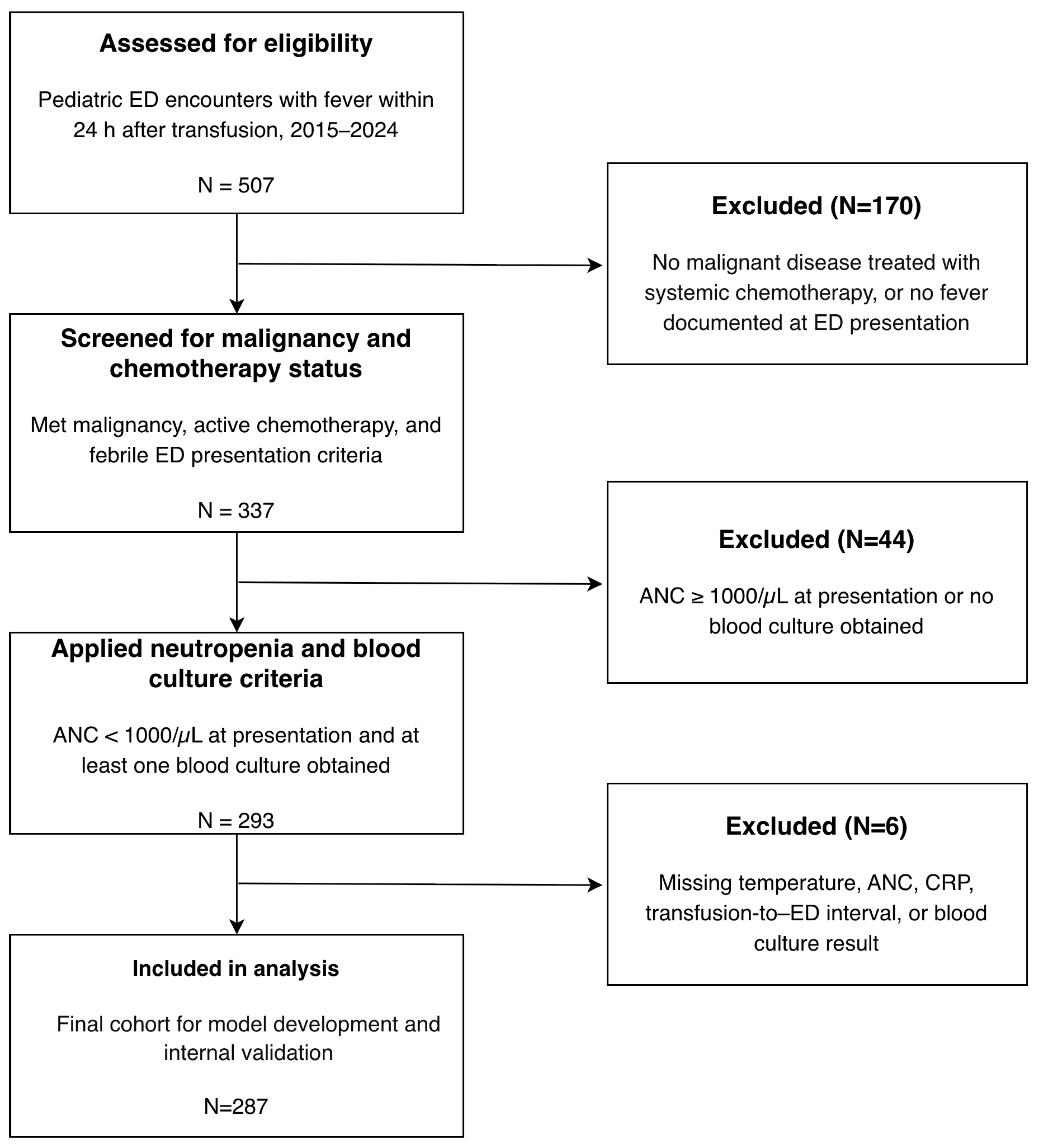
This study was a retrospective, single-center diagnostic prediction study based on a consecutive cohort of pediatric ED encounters at a tertiary children’s hospital. We included all eligible encounters between 1 January 2015 and 31 December 2024. Eligible encounters met the following criteria: (1) an underlying malignant disease with the child actively receiving systemic chemotherapy; (2) presentation to the ED with fever occurring within 24 h of a documented red blood cell or platelet transfusion; and (3) documented neutropenia at or shortly after ED arrival, with at least one blood culture obtained to evaluate for bloodstream infection. Encounters were excluded if (1) the underlying diagnosis was not clearly a malignant disease treated with systemic chemotherapy; (2) the ED visit was not for a transfusion-related febrile neutropenia episode (e.g., no fever documented at presentation or during the initial ED assessment); or (3) essential investigations required for this study, such as the neutrophil count at presentation or blood culture results, were missing. The flow of patient selection and the numbers excluded at each step are summarized in
Figure 1.
2.2. Definitions
The primary outcome was bloodstream infection. BSI was defined as the isolation of at least one clinically significant pathogenic organism from a blood culture obtained within 48 h of ED presentation in the setting of fever. Blood cultures were processed and interpreted according to standard institutional microbiology procedures. Organisms that were judged by the microbiology laboratory and the treating clinical team to represent contamination or colonizing flora were not considered evidence of BSI. Episodes in which blood cultures yielded only such organisms were adjudicated as contamination or colonization and were therefore classified as non-BSI in the primary analysis.
According to the institutional protocol for the evaluation of suspected febrile neutropenia in the pediatric ED, blood cultures are obtained from all available vascular access sites whenever technically feasible. This routinely includes at least two separate peripheral venipuncture sites and all indwelling central venous catheters present at the time of ED evaluation.
Neutropenia was defined as an absolute neutrophil count (ANC) < 1000/µL measured at or shortly after ED arrival. This threshold reflects the institutional clinical pathway for pediatric oncology patients with suspected febrile neutropenia and is routinely used in our center to trigger standardized evaluation and empiric antibiotic therapy. ANC values reported by the laboratory as undetectable were treated as zero for analysis.
Candidate predictors were selected a priori based on clinical relevance and routine availability at ED presentation. The transfusion-to-ED arrival interval was defined as the elapsed time in hours from the start of the most recent transfusion episode to the patient’s arrival in the ED. When multiple transfusions were administered within the 24-h window before presentation, the interval was calculated from the start time of the last transfused component, which we considered the most proximate transfusion exposure to the ED visit and a pragmatic way to handle overlapping transfusion episodes.
Body temperature was defined as the first documented temperature at ED triage, measured using standard digital thermometry, predominantly tympanic routes according to institutional protocol. C-reactive protein (CRP) was defined as the first serum concentration measured at ED presentation or within the first hour of ED care. Additional clinical and laboratory variables, including age, underlying diagnosis, transfused blood product type, and other routine chemistry and coagulation parameters, were recorded for descriptive and exploratory analyses.
2.3. Data Collection and Statistical Analysis
Data for all eligible encounters were extracted from the electronic medical record into an anonymized analysis dataset. Clinical, laboratory, and transfusion-related variables were collected according to the definitions described above. Continuous variables were summarized as medians with interquartile ranges (IQRs), and categorical variables as counts with percentages. For descriptive and univariable comparisons between encounters with and without BSI, continuous variables were compared using the Mann–Whitney U test, and categorical variables using the Chi-square test or Fisher’s exact test when expected cell counts were small. For multivariable model development, we focused on predictors that were routinely available at ED presentation (transfusion-to-ED arrival interval, temperature, ANC, and CRP). A complete-case approach was applied: encounters with missing values in any of these predictors or in the outcome (blood culture result) were excluded from the multivariable logistic regression and score derivation analyses. For descriptive tables, available data were used for each variable, and the extent of missingness for key variables is reported.
No formal a priori sample size calculation was performed; instead, all consecutive encounters that met the eligibility criteria during the study period were included. All statistical analyses and figure generation were performed using Python version 3.13 (Python Software Foundation) and standard scientific libraries.
2.4. Model Development and Score Derivation
The prediction model was developed using multivariable logistic regression with BSI as the dependent variable. Four predictors were specified in advance based on clinical plausibility and routine availability at ED presentation: transfusion-to-ED arrival interval, body temperature at triage, ANC, and CRP. These variables were entered into the model as continuous covariates. Encounters with missing values in any of these predictors or in the blood culture outcome were excluded from the multivariable analysis. We examined pairwise correlations among the candidate predictors and found no evidence of problematic collinearity (all variance inflation factors < 1.1). For each predictor, adjusted odds ratios (ORs) and 95% confidence intervals (CIs) were estimated, and overall model discrimination was assessed using the area under the receiver operating characteristic curve (AUC).
A simplified bedside score was then derived from the same four predictors. Each continuous predictor was converted to a binary indicator using prespecified cut-off values informed by clinical practice and inspection of receiver operating characteristic curves, selecting thresholds close to the maximum Youden’s index when feasible. Indicators were defined for higher temperature (≥38.5 °C), elevated CRP (≥2.5 mg/dL), profound neutropenia (ANC = 0/µL), and a longer transfusion-to-ED arrival interval (≥7 h). Integer point values were assigned according to the relative strength of association in the multivariable model: 2 points for ANC = 0/µL and 1 point each for higher temperature, elevated CRP, and a longer transfusion-to-ED interval, yielding a total score ranging from 0 to 5.
To relate the total score to the probability of BSI, a logistic regression model with the integer score as the single predictor was fitted in the study cohort. This model was used to estimate the predicted probability of BSI for each score value and to evaluate the diagnostic performance of selected score thresholds for risk stratification.
2.5. Performance Evaluation and Validation
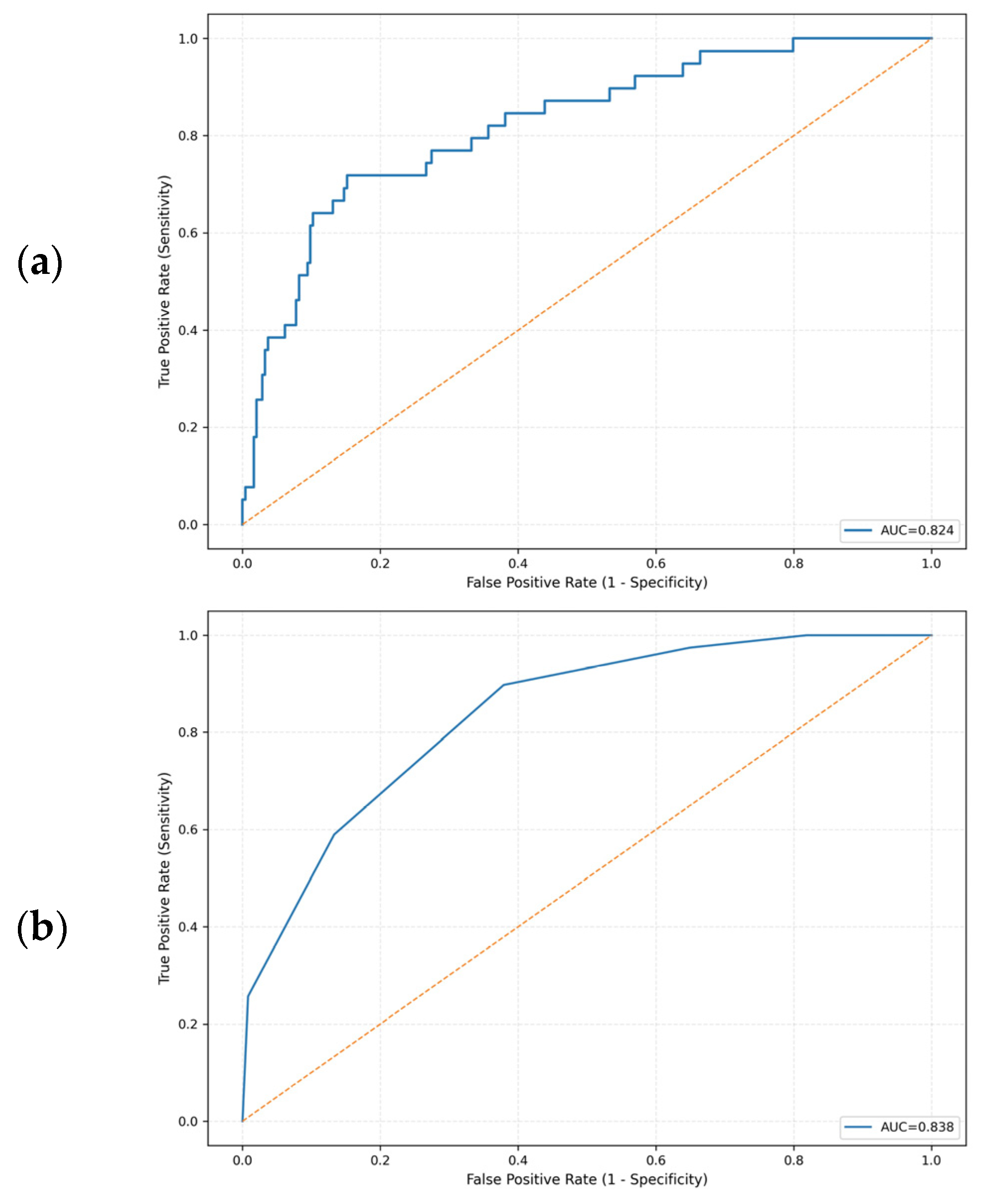
For the multivariable logistic regression model, predicted probabilities of BSI were obtained for each encounter. Discrimination was assessed by constructing receiver operating characteristic (ROC) curves and calculating the AUC. The same approach was used to evaluate the discrimination of the simplified bedside score, treating the total score as a continuous predictor.
For the bedside score, diagnostic performance was further evaluated at selected integer cut-off values. At each threshold, sensitivity, specificity, positive predictive value, and negative predictive value were calculated, with particular attention to thresholds intended for ruling out BSI and for identifying higher-risk patients.
Internal validation was performed using bootstrap resampling. In each of 1000 bootstrap samples, the model was refitted and its performance was evaluated in the corresponding out-of-bootstrap observations to obtain optimism-corrected estimates of discrimination and calibration. Calibration for both the full model and the bedside score was assessed using calibration plots and Brier scores.
All performance measures were calculated in the same cohort used for model development. No separate external validation dataset was available.
2.6. Ethical Approval
This study was approved by the Institutional Review Board of Seoul National University Hospital, and the requirement for informed consent was waived because of its retrospective design.
4. Discussion
Our study of pediatric patients receiving chemotherapy who developed fever within 24 h after transfusion showed that four routinely available parameters at ED presentation—transfusion-to-ED arrival interval, body temperature, ANC, and CRP—can be combined into a simple bedside score to stratify BSI risk. In the multivariable model, higher temperature and a longer transfusion-to-ED arrival interval were associated with increased odds of culture-confirmed BSI, while lower ANC and higher CRP showed similar directions of association. The resulting 0–5 point score demonstrated good discrimination and strong rule-out performance in this cohort; at a threshold of ≥2 points, only 1 of 39 BSI encounters was classified as low risk. Because the score relies solely on information obtained during the initial ED evaluation, it has the potential to support more structured early risk assessment in children with post-transfusion febrile neutropenia.
Early and accurate risk stratification in pediatric FN is central to supportive care because BSI is a major driver of morbidity. Contemporary pediatric FN guidelines recommend prompt empiric antibiotics and the use of validated risk assessment tools to guide management [
1]. Several pediatric FN risk tools (e.g., the SPOG 2003 adverse event score and the PICNICC model) have been developed and evaluated; however, their performance and calibration vary across settings, endpoints are heterogeneous, and some require data not readily available at ED presentation [
7,
8,
10]. These models have substantially advanced risk-adapted care in pediatric oncology, but they were primarily designed for general episodes of febrile neutropenia rather than specifically for post-transfusion fever, and they do not explicitly incorporate transfusion-to-presentation timing, which is the focus of the present study.
We focused on a small core set of routinely available predictors at ED presentation. Temperature, ANC, and CRP are obtained as part of the initial evaluation in virtually all pediatric FN episodes in our setting and allow a rapid, objective appraisal of infection risk. These parameters are also among the most consistently reported predictors of adverse outcomes in pediatric FN, as shown in meta-analyses and biomarker reviews [
8,
11,
12]. Although newer markers such as procalcitonin and interleukins (e.g., IL-6, IL-10) may provide additional information, they are not uniformly available and are less integrated into real-time ED workflows. In this context, we chose to base model development and score derivation only on temperature, ANC, CRP, and transfusion-to-presentation timing, aiming for a pragmatic tool that can be implemented in routine ED practice rather than an optimized model that depends on a wider array of less accessible predictors.
Recent transfusions can substantially complicate the clinical picture in children receiving chemotherapy. FNHTRs remain among the most common non-infectious reactions and typically occur during or within approximately 4 h after component administration, particularly with platelet and RBC transfusions. In this context, our finding that a longer transfusion-to-ED arrival interval is associated with BSI is biologically plausible. We hypothesize that this pattern reflects two partially overlapping processes: a rapid, passive inflammatory response to cytokines in the transfused product that characterizes FNHTR, and a slower, host-driven immune response to replicating pathogens that underlies true infection. At the same time, the observed association may also be influenced by behavioral and logistical factors in this retrospective cohort—for example, children who develop fever very soon after transfusion can only present with short intervals by definition, whereas those who remain febrile or unwell for several hours may arrive later. These mechanisms could contribute to the apparent risk gradient across the transfusion-to-presentation interval and underline the need for cautious interpretation and prospective evaluation of this predictor.
Interestingly, although previous hemovigilance data suggest that reaction profiles can vary by component [
13,
14], the transfusion type itself did not clearly stratify BSI risk in our cohort. Instead, the transfusion-to-ED arrival interval appeared to be a more informative predictor. Taken together, these observations suggest that, in children who develop fever after transfusion, episodes occurring outside the typical FNHTR time window may warrant greater clinical suspicion for BSI and closer diagnostic evaluation.
In developing the prediction model, we deliberately restricted the candidate predictors to four variables that are obtained in almost all episodes of pediatric febrile neutropenia at ED presentation in our setting and had very little missingness. This choice reflects a pragmatic emphasis on routine availability and simplicity rather than statistical optimization alone. ANC was prioritized over other hematologic indices such as hemoglobin or platelet count because it more directly reflects the depth of chemotherapy-induced myelosuppression and has consistently been associated with infection risk in prior FN studies. The decision to treat ANC = 0/µL as a separate category and to assign it greater weight in the score was informed by the univariable distribution in our cohort, in which the vast majority of BSI episodes occurred in encounters with an undetectable ANC, and by the clinical rationale that profound neutrophil depletion may mark a subgroup with particularly limited host defense.
Taken together, these clinical and practical considerations shaped the development of a focused, bedside-oriented prediction tool. Although not all four predictors retained strong independent associations with BSI at conventional significance thresholds in the multivariable model, their directions of effect were consistent with prior evidence and with the pathophysiology of infection in this population, and the overall model demonstrated good discrimination (AUC 0.82). The simplified 0–5 point score derived from these variables showed comparable performance (AUC 0.84) with close agreement between predicted and observed BSI risk. At the lower threshold of ≥2 points, the score achieved high sensitivity and a very high negative predictive value suitable for ruling out BSI, whereas a higher threshold of ≥3 points provided greater specificity for identifying higher-risk encounters. These operating characteristics are consistent with the principles of pediatric FN guidance, which combine prompt empiric antibiotics with risk-adapted management at presentation [
1].
This study has several limitations. It was a retrospective, single-center analysis conducted in a specific pediatric oncology and transfusion practice environment, which may limit generalizability. The number of BSI events was modest, and all model development and performance assessment were conducted in the same cohort, so some overfitting and misclassification of BSI status remain possible despite predefined outcome criteria and bootstrap internal validation. In addition, routinely collected data did not allow us to fully reconstruct the clinical course (for example, initial diagnostic impressions, suspected infection foci, pre-ED antipyretic use, transfusion dosing, and downstream outcomes such as length of stay or mortality), which limits direct evaluation of how the score relates to subsequent illness severity and recovery. Finally, the model and score were derived in a single institutional setting with local laboratory reporting and practice patterns and have not yet been externally validated; prospective evaluation in independent pediatric cohorts, particularly in children with post-transfusion fever, will therefore be important before the score is used to guide routine clinical decisions.
In summary, among children receiving chemotherapy who develop post-transfusion fever, a simple 0–5 point bedside score based on temperature, ANC, CRP, and the transfusion-to-ED arrival interval provided useful early risk stratification for BSI in our single-center cohort. The score combined high negative predictive value at a lower threshold with greater specificity at a higher threshold, offering a straightforward framework for classifying encounters as lower or higher risk at ED presentation. Rather than directly changing management, our findings suggest that this approach could inform future risk-adapted pathways that aim to identify children who might safely be considered for less intensive strategies while maintaining vigilance for those at higher risk. Prospective multicenter validation and implementation studies should evaluate the clinical impact, antibiotic stewardship implications, and safety outcomes of incorporating this score into routine care.