Point Prevalence of Complementary or Alternative Medicine Use among Children Attending a Tertiary Care Hospital
.png)


Abstract
1. Introduction
2. Materials and Methods
2.1. Study Recruitment
2.2. Study Population
2.3. Outcome Measures
2.3.1. Demographic, Health and CAM Information
2.3.2. Child CAM Use
2.3.3. Parent Opinion Survey
2.4. Ethics and Consent
2.5. Statistical Analysis
3. Results
3.1. Participant Demographics
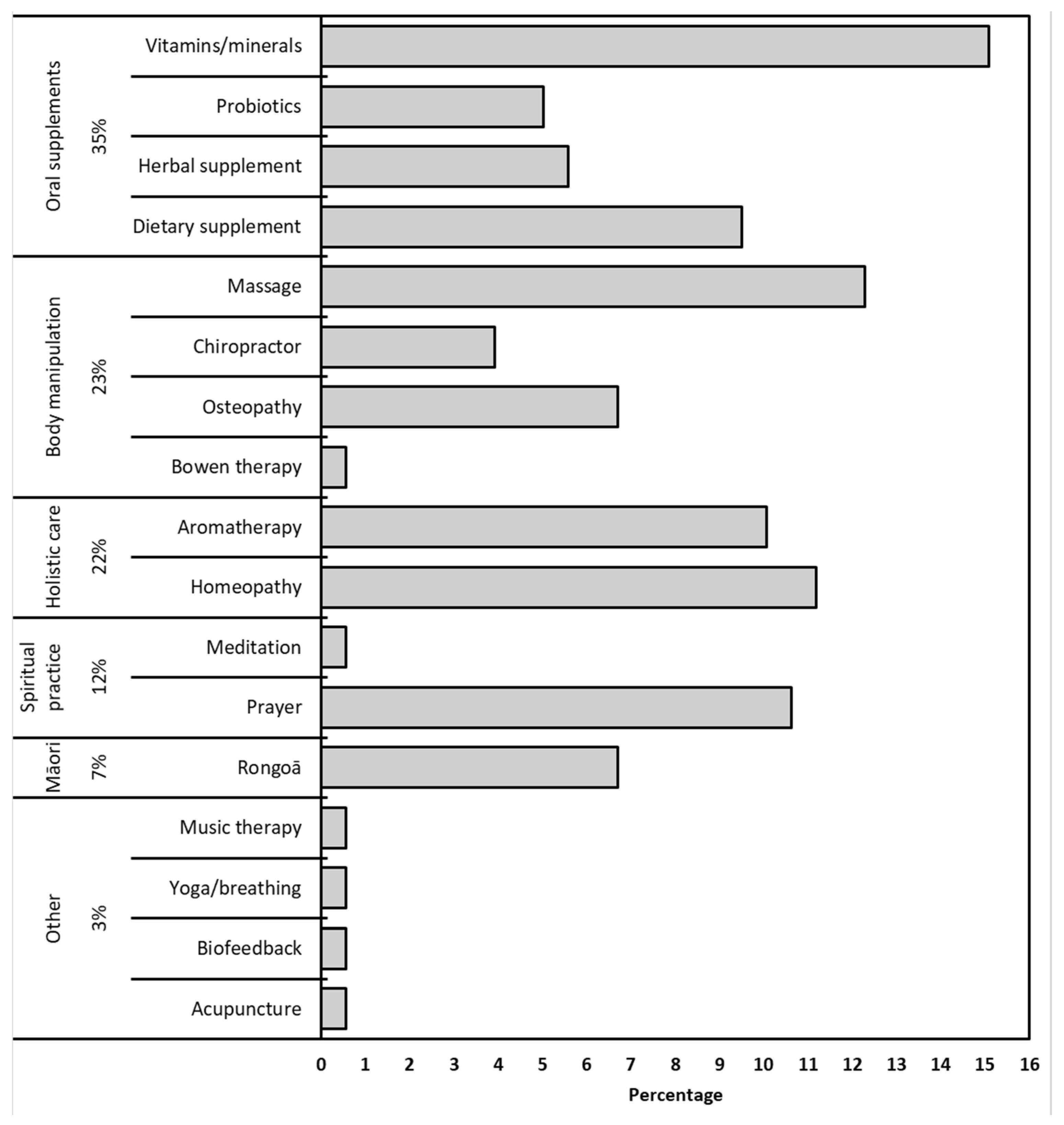
3.2. The Use of Complementary Alternative Medicines by Children
3.3. Factors Associated with CAM Use by Children
3.4. Parental Opinion Survey
3.5. Associations with Non-Disclosure of CAM
- #6. Enough is known about the effectiveness of CAM (χ2 9.3, Phi 0.2, p = 0.01)
- #7. Enough is known about the safety of CAM (χ2 8.8, Phi 0.2, p = 0.01)
- #8. Enough is known about the side effects of CAM (χ2 6.8, Phi 0.2, p = 0.03)
4. Discussion
4.1. Strengths
4.2. Limitations
5. Conclusions
Supplementary Materials
Author Contributions
Funding
Institutional Review Board Statement
Informed Consent Statement
Data Availability Statement
Conflicts of Interest
References
- Cincotta, D.R.; Crawford, N.W.; Lim, A.; Cranswick, N.E.; Skull, S.; South, M.; Powell, C.V.E. Comparison of complementary and alternative medicine use: Reasons and motivations between two tertiary children’s hospitals. Arch. Dis. Child. 2006, 91, 153–158. [Google Scholar] [CrossRef]
- Day, A.S. Use of complementary and alternative therapies and probiotic agents by children attending gastroenterology outpatient clinics. J. Paediatr. Child Health 2002, 38, 343–346. [Google Scholar] [CrossRef] [PubMed]
- Italia, S.; Wolfenstetter, S.; Teuner, C. Patterns of Complementary and Alternative Medicine (CAM) use in children: A systematic review. Eur. J. Pediatr. 2014, 173, 1413–1428. [Google Scholar] [CrossRef] [PubMed]
- Day, A.S.; Whitten, K.E.; Bohane, T.D. Use of complementary and alternative medicines by children and adolescents with inflammatory bowel disease. J. Paediatr. Child Health 2004, 40, 681–684. [Google Scholar] [CrossRef] [PubMed]
- Ding, J.-L.; Taylor, D.M.; Lee, M.; Johnson, O.G.; Ashok, A.; Griffiths, M.; Simma, L.; Craig, S.S.; Cheek, J.A.; Babl, F.E. Observational study of alternative therapies among paediatric emergency department patients. Emerg. Med. Australas. 2017, 29, 136–142. [Google Scholar] [CrossRef]
- Wilson, K.; Dowson, C.; Mangin, D. Prevalence of complementary and alternative medicine use in Christchurch, New Zealand: Children attending general practice versus paediatric outpatients. N. Z. Med. J. 2007, 120, U2464. [Google Scholar]
- Adams, D.; Dagenais, S.; Clifford, T.; Baydala, L.; King, W.J.; Hervas-Malo, M.; Moher, D.; Vohra, S. Complementary and alternative medicine use by pediatric specialty outpatients. Pediatrics 2013, 131, 225–232. [Google Scholar] [CrossRef]
- Uysal, G.; Duzkaya, D.; Karakoc, A. Knowledge and opinions of parents of children hospitalized in hematology/oncology units regarding complementary and alternative medicine. SHS Web Conf. 2017, 37, 01055. [Google Scholar] [CrossRef]
- Wadhera, V.; Lemberg, D.A.; Leach, S.T.; Day, A.S. Complementary and alternative medicine in children attending gastroenterology clinics: Usage patterns and reasons for use. J. Paediatr. Child Health 2011, 47, 904–910. [Google Scholar] [CrossRef]
- Sathiyan, J.; Faeyza, N.; Ramasamy, K.; Ng, W.S.; Ganapathy, S. Complementary and Alternative Medicine Use Among Pediatric Emergency Department Patients in Singapore. Pediatr. Emerg. Care 2021, 37, e1566–e1570. [Google Scholar] [CrossRef]
- Oren-Amit, A.; Berkovitch, M.; Bahat, H.; Goldman, M.; Kozer, E.; Ziv-Baran, T.; Abu-Kishk, I. Complementary and alternative medicine among hospitalized pediatric patients. Complement. Ther. Med. 2017, 31, 49–52. [Google Scholar] [CrossRef] [PubMed]
- Ustuner Top, F.; Konuk Sener, D.; Cangur, S. Parental attitudes toward pediatric use of complementary/alternative medicine in Turkey. J. Spec. Pediatr. Nurs. 2017, 22, e12186. [Google Scholar] [CrossRef] [PubMed]
- Hunt, K.; Ernst, E. The evidence-base for complementary medicine in children: A critical overview of systematic reviews. Arch. Dis. Child. 2011, 96, 769–776. [Google Scholar] [CrossRef]
- Sams, D.N.; Russell, A. Alternative and complementary medicines in pediatric care. Contemp. Pediatr. 2022, 39, 26–28. [Google Scholar]
- Nguyen, C.G.; Croitoru, S.K.; Silverberg, H.M.; Steinhart, V.A.; Weizman, V.A. Use of Complementary and Alternative Medicine for Inflammatory Bowel Disease Is Associated with Worse Adherence to Conventional Therapy: The COMPLIANT Study. Inflamm. Bowel. Dis. 2016, 22, 1412–1417. [Google Scholar] [CrossRef] [PubMed]
- Meyer, S.; Schroeder, N.; Gottschling, S. Complementary and alternative medicine in children. Eur. J. Pediatr. 2013, 172, 419–420. [Google Scholar] [CrossRef]
- Lim, A.; Cranswick, N.; South, M. Adverse events associated with the use of complementary and alternative medicine in children. Arch. Dis. Child. 2011, 96, 297–300. [Google Scholar] [CrossRef]
- Barnes, J.; Butler, R. Community pharmacists’ views on the regulation of complementary medicines and complementary-medicines practitioners: A qualitative study in New Zealand. Int. J. Pharm. Pract. 2018, 26, 485–493. [Google Scholar] [CrossRef]
- IBM SPSS Statistics for Windows; Version 27.0; IBM Corp.: Armonk, NY, USA, 2020.
- Zuzak, T.J.; Boňková, J.; Careddu, D.; Garami, M.; Hadjipanayis, A.; Jazbec, J.; Merrick, J.; Miller, J.; Ozturk, C.; Persson, I.A.L.; et al. Use of complementary and alternative medicine by children in Europe: Published data and expert perspectives. Complement. Ther. Med. 2013, 21, S34–S47. [Google Scholar] [CrossRef]
- Jenkins, B.N.; Vincent, N.; Fortier, M.A. Differences in referral and use of complementary and alternative medicine between pediatric providers and patients. Complement. Ther. Med. 2015, 23, 462–468. [Google Scholar] [CrossRef]
- Gottschling, S.; Gronwald, B.; Schmitt, S.; Schmitt, C.; Längler, A.; Leidig, E.; Meyer, S.; Baan, A.; Shamdeen, M.G.; Berrang, J.; et al. Use of complementary and alternative medicine in healthy children and children with chronic medical conditions in Germany. Complement. Ther. Med. 2013, 21, S61–S69. [Google Scholar] [CrossRef]
- Ng, J.Y.; Dhawan, T.; Dogadova, E.; Taghi-Zada, Z.; Vacca, A.; Wieland, L.S.; Moher, D. Operational definition of complementary, alternative, and integrative medicine derived from a systematic search. BMC Complement. Med. Ther. 2022, 22, 104. [Google Scholar] [CrossRef] [PubMed]
- Nicholson, T. Complementary and alternative medicines (including traditional Maori treatments) used by presenters to an emergency department in New Zealand: A survey of prevalence and toxicity. N. Z. Med. J. 2006, 119, U1954. [Google Scholar] [PubMed]
- Gall, A.; Butler, T.L.; Lawler, S.; Garvey, G. Traditional, complementary and integrative medicine use among Indigenous peoples with diabetes in Australia, Canada, New Zealand and the United States. Aust. N. Z. J. Public Health 2021, 45, 664–671. [Google Scholar] [CrossRef]
- Gall, A.; Leske, S.; Adams, J.; Matthews, V.; Anderson, K.; Lawler, S.; Garvey, G. Traditional and Complementary Medicine Use Among Indigenous Cancer Patients in Australia, Canada, New Zealand, and the United States: A Systematic Review. Integr. Cancer Ther. 2018, 17, 568–581. [Google Scholar] [CrossRef]
- Thomas, C.; Weller, J.; Rahiri, J.-L.; Harwood, M.; Pitama, S. Māori experiences of hospital care: A qualitative systematic review. AlterNative Int. J. Indig. Peoples 2022, 18, 455–464. [Google Scholar] [CrossRef]
- McCall, C. New Zealand launches new Māori health authority. Lancet 2022, 400, 16. [Google Scholar] [CrossRef]
- Wilson, D.; Moloney, E.; Parr, J.M.; Aspinall, C.; Slark, J. Creating an Indigenous Māori-centred model of relational health: A literature review of Māori models of health. J. Clin. Nurs. 2021, 30, 3539–3555. [Google Scholar] [CrossRef] [PubMed]
- Rolleston, A.; Miskelly, P.; McDonald, M.; Wiles, J.; Poppe, K.; Doughty, R. Cultural context in New Zealand: Incorporating kaupapa Māori values in clinical research and practice. Health Promot. Int. 2022, 37, daac065. [Google Scholar] [CrossRef]
- Huia, M.T.; Mercer, C. Relationships and implications for complementary and alternative medicine in Aotearoa New Zealand: A discussion paper/Nga hononga me nga putanga ake mo te rongoa tapiri, kaupapa tuarua hoki i Aotearoa: He puka korerorero. Nurs. Prax. N. Z. Inc. 2019, 35, 25–32. [Google Scholar] [CrossRef]
- Koea, J.; Mark, G. Is there a role for Rongoā Māori in public hospitals? The results of a hospital staff survey. N. Z. Med. J. 2020, 133, 73–80. [Google Scholar] [PubMed]
- Mark, G.; Chamberlain, K.; Boulton, A. Acknowledging the Māori cultural values and beliefs embedded in rongoā Māori healing. Int. J. Indig. Health 2017, 12, 75–92. [Google Scholar] [CrossRef]
- Frawley, J.E.; Anheyer, D.; Davidson, S.; Jackson, D. Prevalence and characteristics of complementary and alternative medicine use by Australian children. J. Paediatr. Child Health 2017, 53, 782–787. [Google Scholar] [CrossRef]
- Taylor, D.M.; Dhir, R.; Craig, S.S.; Lammers, T.; Gardiner, K.; Hunter, K.; Joffe, P.; Krieser, D.; Babl, F.E. Complementary and alternative medicine use among paediatric emergency department patients. J. Paediatr. Child Health 2015, 51, 895–900. [Google Scholar] [CrossRef]
- Zorzela, L.; Boon, H.; Mior, S.; Yager, J.; Gross, A.; Vohra, S. Serious adverse events associated with pediatric complementary and alternative medicine. Eur. J. Integr. Med. 2014, 6, 467–472. [Google Scholar] [CrossRef]
- Vos, B.; Rake, J.P.; Vlieger, A. Adverse events associated with pediatric complementary and alternative medicine in the Netherlands: A national surveillance study. Eur. J. Pediatr. 2021, 180, 2165–2171. [Google Scholar] [CrossRef]
- Vohra, S.; Cohen, M.H. Ethics of complementary and alternative medicine use in children. Pediatr. Clin. N. Am. 2007, 54, 875–884. [Google Scholar] [CrossRef] [PubMed]
- Liu, L.; Tang, Y.; Baxter, G.D.; Yin, H.; Tumilty, S. Complementary and alternative medicine—Practice, attitudes, and knowledge among healthcare professionals in New Zealand: An integrative review. BMC Complement. Med. Ther. 2021, 21, 63. [Google Scholar] [CrossRef]
- Barnes, J.; Butler, R. Community pharmacists’ professional practices for complementary medicines: A qualitative study in New Zealand. Int. J. Clin. Pharm. 2020, 42, 1109–1117. [Google Scholar] [CrossRef]
- Shorofi, S.A.; Arbon, P. Complementary and alternative medicine (CAM) among Australian hospital-based nurses: Knowledge, attitude, personal and professional use, reasons for use, CAM referrals, and socio-demographic predictors of CAM users. Complement. Ther. Clin. Pract. 2017, 27, 37–45. [Google Scholar] [CrossRef]


| Variable | Category | All Mean (SD) or N (%) | CAM Used Mean (SD) or N (% *) | No CAM Mean (SD) or N (% *) |
|---|---|---|---|---|
| Child age | Years | 6.8 (4.8) | 6.9 (4.9) | 6.9 (5.0) |
| Child gender | Female | 97 (41) | 62 (64) | 35 (36) |
| Family ethnicity ** | NZ European Māori Pasifika Asian MELA | 203 (86) 46 (20) 13 (6) 9 (4) 4 (2) | 110 (54) 33 (72) 5 (48) 7 (78) 2 (50) | 93 (46) 13 (28) 8 (62) 2 (22) 2 (50) |
| Child chronic health condition | Yes No Don’t know | 76 (32) 137 (58) 23 (10) | 48 (63) 68 (50) 16 (70) | 28 (37) 69 (50) 7 (30) |
| Child on prescription medications | Yes | 86 (36) | 54 (63) | 32 (37) |
| Reason for attending hospital | Investigations Treatment: new diagnosis Treatment: existing diagnosis Accident/injury Other | 48 (20) 69 (29) 58 (25) 39 (17) 22 (9) | 31 (65) 37 (54) 30 (52) 23 (59) 11 (50) | 17 (35) 32 (46) 28 (48) 16 (41) 11 (50) |
| Parent age | Years | 37.4 (8.9) | 37.7 (8.1) | 37.0 (9.9) |
| Parent gender | Female | 189 (80) | 117 (62) | 72 (38) |
| Parent education level | High School College University Post-graduate | 92 (39) 43 (18) 72 (31) 29 (12) | 40 (43) 30 (70) 42 (58) 20 (69) | 52 (57) 13 (30) 30 (42) 9 (31) |
| Household income (NZD) | <$50 k $50–100 k $100–150 k $150–200 k >$200 k Not reported | 36 (15) 67 (28) 49 (21) 30 (13) 17 (7) 37 (16) | 22 (61) 35 (52) 30 (61) 13 (43) 9 (53) 23 (62) | 14 (39) 32 (48) 19 (39) 17 (57) 8 (47) 14 (38) |
| CAM used by study children CAM used by parents CAM used by siblings | Yes Yes Yes | 132 (56) 162 (69) 148 (63) | - 125 (77) 128 (86) | - 37 (23) 20 (14) |
| Child health in last week | 1–10 scale (10 = best health) | 7.2 (2.7) | 6.7 (2.7) | 7.8 (2.5) |
| Variable | Category | Result N (%) |
|---|---|---|
| Source of CAM * | Pharmacy Online CAM Specialist Family member Supermarket CAM shop Friend Myself | 47 (26) 35 (20) 34 (19) 30 (17) 28 (16) 26 (15) 19 (11) 18 (10) |
| Source of information on individual CAM * | Family member Friend Online Health professional Pharmacy CAM Specialist Book/magazine/newspaper CAM shop Church | 67 (37) 49 (27) 48 (27) 42 (23) 36 (20) 18 (10) 18 (10) 15 (8) 10 (6) |
| Cost of current CAM | Free <$20 $20–50 $50–100 >$100 | 48 (27) 29 (16) 58 (32) 33 (18) 12 (7) |
| Frequency CAM taken | Daily Weekly Monthly When needed | 83 (46) 41 (23) 8 (5) 46 (26) |
| Duration current CAM utilized | < 1 month 1–6 months 6–12 months >12 months Sporadic | 16 (9) 35 (20) 25 (14) 99 (55) 4 (2) |
| Why use CAM * | Treatment of symptoms Prevention of symptoms Knowledge of it working for other people To complement conventional/prescription treatment Worry about side effects of conventional/prescription treatment More effective than conventional/prescription treatment Lack of confidence in conventional/prescription treatment Other | 75 (42) 60 (34) 45 (25) 35 (20) 9 (5) 8 (4) 2 (1) 51 (28) |
| Side effects | Mild No | 2 (1) 177 (99) |
| Benefit | Improved lots Improved slightly No change | 72 (40) 82 (46) 25 (14) |
| Used for chronic condition | Yes | 40 (22) |
| Variable | Mean Diff | p Value |
|---|---|---|
| Child age | 0.023 | 0.97 |
| Parent age | −0.69 | 0.56 |
| Overall health rating | 1.1 | 0.001 |
| Variable | χ2 (Phi) | p |
| Child gender (female) | 4.0 (0.14) | 0.05 |
| Family ethnicity: NZ European | 1.8 (0.09) | 0.18 |
| Family ethnicity: Māori | 4.4 (0.16) | 0.037 |
| Family ethnicity: Pacific Peoples | 1.7 (0.09) | 0.19 |
| Family ethnicity: Asian | 1.8 (0.09) | 0.18 |
| Family ethnicity: MELA | 0.06 (0.02) | 0.81 |
| Child chronic illness | 4.7 (0.14) | 0.10 |
| Child prescription meds | 3.9 (0.13) | 0.05 |
| Parent gender | 4.8 (0.14) | 0.029 |
| Parent education | 15.4 (0.26) | 0.002 |
| Parent CAM | 137.5 (0.76) | <0.001 |
| Siblings CAM | 150.3 (1.0) | <0.001 |
| Household income | 6.4 (0.17) | 0.27 |
| Reason for attending hospital | 2.1 (0.1) | 0.71 |
| Opinion Statement | CAM Use | Disagree N (%) | Neutral N (%) | Agree N (%) | χ2 (Phi) | p Value |
|---|---|---|---|---|---|---|
| 1. Doctors should be supportive of people using CAM | No CAM Use CAM | 5 (50) 5 (50) | 28 (62) 17 (38) | 71 (39) 110 (61) | 7.9 (0.18) | 0.019 |
| 2. Doctors should ask patients if they are using CAM | No CAM Use CAM | 1 (50) 1 (50) | 32 (49) 33 (51) | 71 (42) 98 (58) | (0.07) | 0.60 |
| 3. Doctors should know about CAM and be able to give advice | No CAM Use CAM | 1 (20) 4 (80) | 29 (50) 29 (50) | 74 (43) 99 (57) | 2.1 (0.1) | 0.346 |
| 4. I would only use CAM for my child if a doctor recommended it | No CAM Use CAM | 29 (30) 91 (70) | 38 (62) 23 (38) | 37 (67) 18 (33) | 39.5 (0.41) | <0.001 |
| 5. CAM do not interfere with prescribed drugs | No CAM Use CAM | 12 (27) 33 (73) | 60 (48) 64 (52) | 32 (48) 35 (52) | 6.8 (0.17) | 0.033 |
| 6. Enough is known about the effectiveness of CAM | No CAM Use CAM | 35 (40) 52 (60) | 49 (50) 49 (50) | 20 (39) 31 (61) | 2.4 (0.10) | 0.30 |
| 7. Enough is known about the safety of CAM | No CAM Use CAM | 27 (40) 41 (60) | 51 (48) 56 (52) | 26 (43) 35 (57) | 1.1 (0.07) | 0.566 |
| 8. Enough is known about the side effects of CAM | No CAM Use CAM | 25 (36) 44 (64) | 55 (49) 56 (51) | 24 (43) 32 (57) | 3.1 (0.12) | 0.212 |
| 9. There is sufficient information available about CAM | No CAM Use CAM | 22 (31) 50 (69) | 56 (62) 34 (38) | 26 (35) 48 (65) | 19.8 (0.29) | <0.001 |
| 10. CAM have fewer side effects than prescribed or conventional treatment | No CAM Use CAM | 10 (42) 12 (58) | 65 (48) 56 (52) | 29 (31) 64 (69) | 10.9 (0.21) | 0.004 |
| 11. CAM is more effective than prescribed or conventional treatment | No CAM Use CAM | 27 (42) 38 (58) | 64 (48) 70 (52) | 13 (35) 24 (65) | 2.1 (0.10) | 0.349 |
| 12. CAM therapists/practitioners should be qualified and registered | No CAM Use CAM | 7 (54) 6 (46) | 29 (45) 36 (55) | 68 (43) 90 (57) | 0.6 (0.05) | 0.748 |
| 13. CAM is used by people who lack confidence in conventional treatment | No CAM Use CAM | 41 (40) 62 (60) | 44 (49) 45 (51) | 19 (43) 25 (57) | 1.8 (0.09) | 0.404 |
| 14. CAM is used by people due to a lack of conventional treatment for an illness or condition | No CAM Use CAM | 31 (42) 43 (58) | 55 (51) 53 (49) | 18 (33) 36 (67) | 4.7 (0.14) | 0.094 |
| 15. CAM can be used to replace conventional treatment | No CAM Use CAM | 38 (42) 53 (58) | 48 (55) 40 (45) | 18 (32) 39 (68) | 7.7 (0.18) | 0.021 |
| 16. The cost of CAM puts people off using it | No CAM Use CAM | 10 (28) 26 (72) | 58 (59) 40 (41) | 36 (35) 66 (65) | 16.1 (0.26) | <0.001 |
| CAM Type | Disclosure Rate (N (%)) | χ2 (Phi) | p Value |
|---|---|---|---|
| Oral supplements | 29 (49) | 11.3 (0.3) | <0.001 |
| Body manipulation | 11 (27) | 0.8 (0.1) | 0.39 |
| Holistic care | 13 (31) | 0.1 ((0.02) | 0.82 |
| Spiritual practice | 2 (10) | 5.2 (0.2) | 0.023 |
| Rongoā | 2 (17) | 1.5 (0.01) | 0.23 |
| Other | 1 (25) | 0.1 (0.02) | 0.75 |
Disclaimer/Publisher’s Note: The statements, opinions and data contained in all publications are solely those of the individual author(s) and contributor(s) and not of MDPI and/or the editor(s). MDPI and/or the editor(s) disclaim responsibility for any injury to people or property resulting from any ideas, methods, instructions or products referred to in the content. |
© 2023 by the authors. Licensee MDPI, Basel, Switzerland. This article is an open access article distributed under the terms and conditions of the Creative Commons Attribution (CC BY) license (https://creativecommons.org/licenses/by/4.0/).
Share and Cite
Vernon-Roberts, A.; Denny, A.; Day, A.S. Point Prevalence of Complementary or Alternative Medicine Use among Children Attending a Tertiary Care Hospital. Children 2023, 10, 132. https://doi.org/10.3390/children10010132
Vernon-Roberts A, Denny A, Day AS. Point Prevalence of Complementary or Alternative Medicine Use among Children Attending a Tertiary Care Hospital. Children. 2023; 10(1):132. https://doi.org/10.3390/children10010132
Chicago/Turabian StyleVernon-Roberts, Angharad, Abida Denny, and Andrew S. Day. 2023. "Point Prevalence of Complementary or Alternative Medicine Use among Children Attending a Tertiary Care Hospital" Children 10, no. 1: 132. https://doi.org/10.3390/children10010132
APA StyleVernon-Roberts, A., Denny, A., & Day, A. S. (2023). Point Prevalence of Complementary or Alternative Medicine Use among Children Attending a Tertiary Care Hospital. Children, 10(1), 132. https://doi.org/10.3390/children10010132