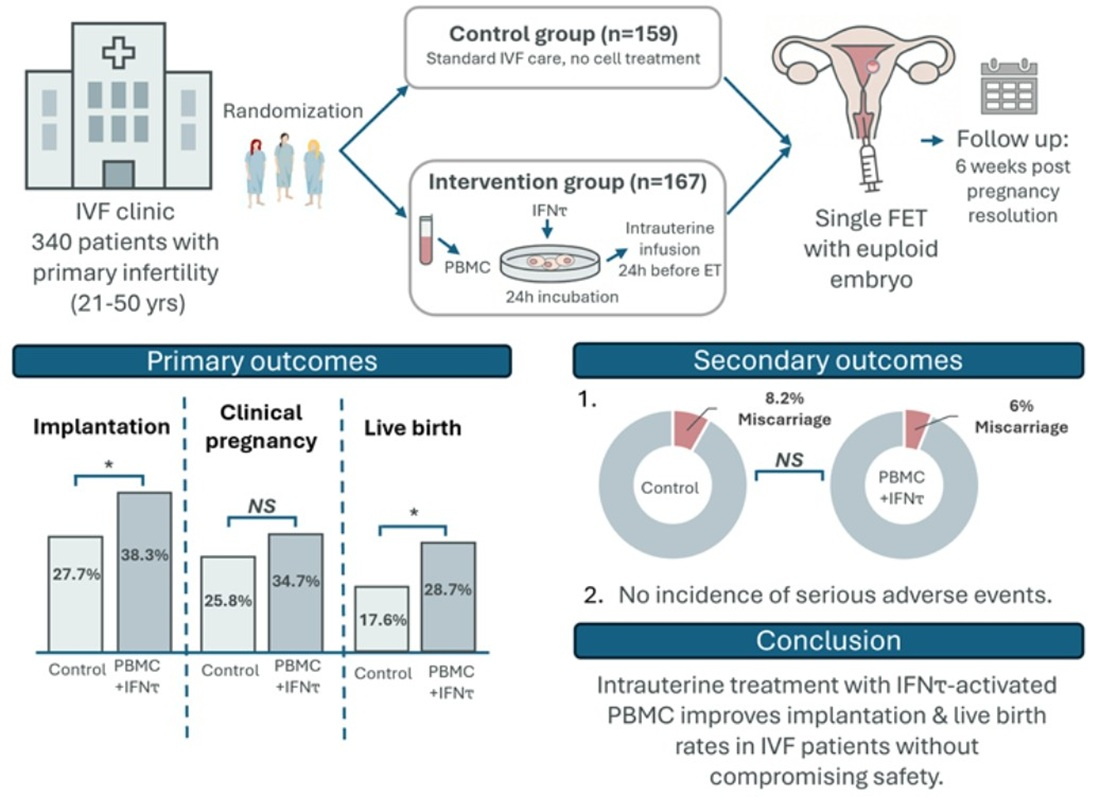
Intrauterine Administration of PBMC Modulated with IFN-τ Before Embryo Transfer Improves Clinical Outcomes of IVF Patients—A Randomized Control Trial
 , , , ,
Abstract
1. Introduction
2. Materials and Methods
2.1. Study Design, Randomization, and Study Groups
2.2. Participants
2.3. PBMC Isolation and in Vitro Modulation
2.4. Intrauterine Administration of Modulated Cells
2.5. IVF Protocol and Embryo Transfer
2.6. Outcome Measures
2.7. Statistical Analysis
3. Results
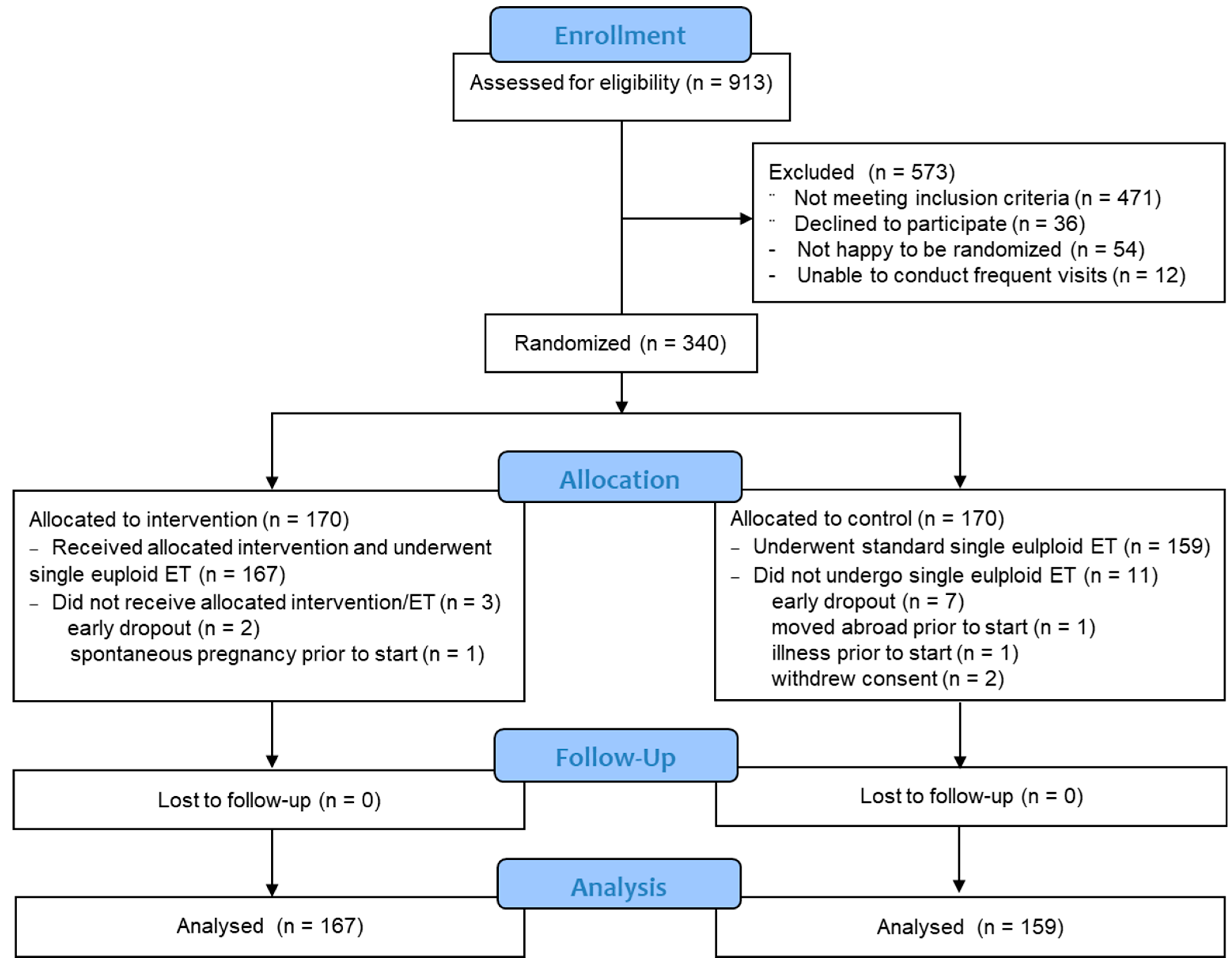
3.1. Patient Flow and Baseline Characteristics
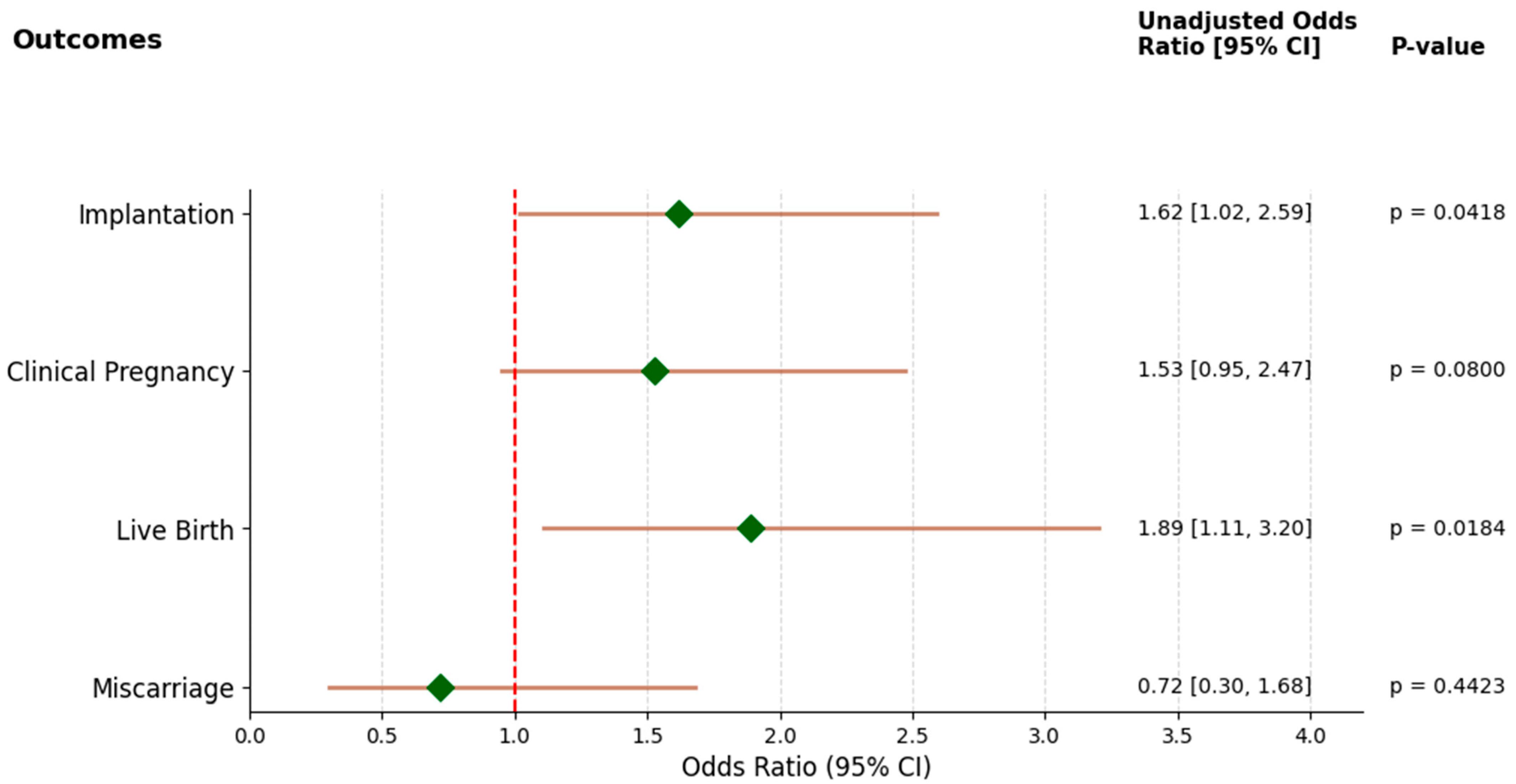
3.2. Primary Outcomes
3.3. Secondary Outcomes
4. Discussion
5. Conclusions
Author Contributions
Funding
Institutional Review Board Statement
Informed Consent Statement
Data Availability Statement
Conflicts of Interest
Abbreviations
| PBMCs | Peripheral Blood Mononuclear Cells |
| IFN-τ | Interferon tau |
| IVF | In Vitro Fertilization |
| ART | Assisted Reproductive Technology |
| RIF | Recurrent Implantation Failure |
| NK | Natural Killer |
| hCG | Human Chorionic Gonadotropin |
| IL | Interleukin |
| TNF-α | Tumor Necrosis Factor alpha |
| GM-CSF | Granulocyte-Macrophage Colony-Stimulating Factor |
| IFNAR | Interferon Alpha/Beta Receptor |
| PGT-A | Preimplantation Genetic Testing for Aneuploidy |
| HSA | Human Serum Albumin |
| RPMI | Roswell Park Memorial Institute medium |
| ET | Embryo Transfer |
| CPR | Clinical Pregnancy Rate |
| LBR | Live Birth Rate |
| AEs | Adverse Events |
| SAEs | Serious Adverse Events |
| EUROCAT | European Surveillance of Congenital Anomalies |
| SD | Standard Deviation |
| IQR | Interquartile Range |
| OR | Odds Ratio |
| CI | Confidence Interval |
| ISGs | Interferon-Stimulated Genes |
Appendix A

| Category and Type of Adverse Event (AE) | Notes | |
|---|---|---|
| Mild to moderate 1 | ||
| Abdominal discomfort or bloating | Common post ovarian stimulation | |
| Mild pelvic pain or cramping | Possible after egg retrieval, intrauterine infusion, ET | |
| Breast tenderness | Due to hormonal changes | |
| Nausea | Common with fertility medications | |
| Fatigue | Hormonal and stress-related | |
| Headache | Side effect of gonadotropins or stress | |
| Mood changes | Usually hormone-related | |
| Hot flushes | Often related to GnRH agonists or antagonists | |
| Vaginal spotting or bleeding | Especially post egg retrieval or ET | |
| Injection site reactions | Pain, redness, or swelling | |
| Acne | Due to hormone fluctuations | |
| Constipation | Caused by reduced activity, hormones, and stress | |
| Sleep disturbances | Stress or medication-related | |
| Fluid retention | Due to high estrogen levels | |
| Weight gain | Can be fluid-related or hormonal | |
| Changes in libido | Hormonal and psychological factors | |
| Mild allergic reactions | To progesterone or other medications | |
| Serious or significant 2 | ||
| Ovarian hyperstimulation syndrome (OHSS) | Complication after ovarian stimulation | |
| Hospitalization for rest | Due to OHSS or early pregnancy symptoms | |
| Gestational diabetes | Can occur during IVF pregnancy | |
| Preeclampsia | Can occur during IVF pregnancy | |
| Fever | Possible inflammation after treatment | |
| Outcome | Intervention Group (n = 170) | Control Group (n = 170) | Absolute Difference | p-Value |
|---|---|---|---|---|
| Implantation, n (%) | 64 (37.6%) | 44 (25.9%) | +11.7% | 0.04 |
| Clinical Pregnancy, n (%) | 58 (34.1%) | 41 (24.1%) | +10.0% | NS |
| Live Birth, n (%) | 48 (28.2%) | 28 (16.5%) | +11.7% | 0.02 |
| Miscarriage, n (%) | 10 (5.9%) | 13 (7.6%) | –1.7% | NS |
References
- Cimadomo, D.; Rienzi, L.; Conforti, A.; Forman, E.; Canosa, S.; Innocenti, F.; Poli, M.; Hynes, J.; Gemmell, L.; Vaiarelli, A.; et al. Opening the black box: Why do euploid blastocysts fail to implant? A systematic review and meta-analysis. Hum. Reprod. Update 2023, 29, 570–633. [Google Scholar] [CrossRef]
- Busnelli, A.; Reschini, M.; Cardellicchio, L.; Vegetti, W.; Somigliana, E.; Vercellini, P. How common is real repeated implantation failure? An indirect estimate of the prevalence. Reprod. Biomed. Online 2020, 40, 91–97. [Google Scholar] [CrossRef] [PubMed]
- Ma, J.; Gao, W.; Li, D. Recurrent Implantation Failure: A Comprehensive Summary from Etiology to Treatment. Front. Endocrinol. 2023, 13, 1061766. [Google Scholar] [CrossRef]
- Robertson, S.A.; Moldenhauer, L.M.; Green, E.S.; Care, A.S.; Hull, M.L. Immune determinants of endometrial receptivity: A biological perspective. Fertil. Steril. 2022, 117, 1107–1120. [Google Scholar] [CrossRef] [PubMed]
- Saito, S. Role of immune cells in the establishment of implantation and maintenance of pregnancy and immunomodulatory therapies for patients with repeated implantation failure and recurrent pregnancy loss. Reprod. Med. Biol. 2024, 23, e12600. [Google Scholar] [CrossRef] [PubMed]
- Kleiveland, C.R. Peripheral Blood Mononuclear Cells. In The Impact of Food Bioactives on Health: In Vitro and Ex Vivo Models; Verhoeckx, K., Cotter, P., López-Expósito, I., Kleiveland, C., Lea, T., Mackie, A., Requena, T., Swiatecka, D., Wichers, H., Eds.; Springer: Cham, Switzerland, 2015; Chapter 15. Available online: https://www.ncbi.nlm.nih.gov/books/NBK500157/ (accessed on 23 July 2025).
- Liu, S.; Diao, L.; Huang, C.; Li, Y.; Zeng, Y.; Kwak-Kim, J.Y.H. The role of decidual immune cells on human pregnancy. J. Reprod. Immunol. 2017, 124, 44–53. [Google Scholar] [CrossRef]
- Yu, N.; Yang, J.; Guo, Y.; Fang, J.; Yin, T.; Luo, J.; Li, X.; Li, W.; Zhao, Q.; Zou, Y.; et al. Intrauterine administration of peripheral blood mononuclear cells (PBMCs) improves endometrial receptivity in mice with embryonic implantation dysfunction. Am. J. Reprod. Immunol. 2014, 71, 24–33. [Google Scholar] [CrossRef]
- Kitawaki, Y.; Horie, A.; Ikeda, A.; Shitanaka, S.; Yanai, A.; Ohara, T.; Nakakita, B.; Sagae, Y.; Okunomiya, A.; Tani, H.; et al. Intrauterine administration of peripheral blood mononuclear cells helps manage recurrent implantation failure by normalizing dysregulated gene expression including estrogen-responsive genes in mice. Cell Commun. Signal. 2024, 22, 587. [Google Scholar] [CrossRef]
- Yakin, K.; Oktem, O.; Urman, B. Intrauterine administration of peripheral mononuclear cells in recurrent implantation failure: A systematic review and meta-analysis. Sci. Rep. 2019, 9, 3897. [Google Scholar] [CrossRef]
- Schumacher, A.; Zenclussen, A.C. Human Chorionic Gonadotropin-Mediated Immune Responses That Facilitate Embryo Implantation and Placentation. Front. Immunol. 2019, 10, 2896. [Google Scholar] [CrossRef]
- Yu, N.; Zhang, B.; Xu, M.; Wang, S.; Liu, R.; Wu, J.; Yang, J.; Feng, L. Intrauterine administration of autologous peripheral blood mononuclear cells (PBMCs) activated by HCG improves the implantation and pregnancy rates in patients with repeated implantation failure: A prospective randomized study. Am. J. Reprod. Immunol. 2016, 76, 212–216. [Google Scholar] [CrossRef]
- Busnelli, A.; Somigliana, E.; Cirillo, F.; Baggiani, A.; Levi-Setti, P.E. Efficacy of therapies and interventions for repeated embryo implantation failure: A systematic review and meta-analysis. Sci. Rep. 2021, 11, 1747. [Google Scholar] [CrossRef]
- Liu, M.; Yuan, Y.; Qiao, Y.; Tang, Y.; Sui, X.; Yin, P.; Yang, D. The effectiveness of immunomodulatory therapies for patients with repeated implantation failure: A systematic review and network meta-analysis. Sci. Rep. 2022, 12, 18434. [Google Scholar] [CrossRef] [PubMed]
- Jiang, L.; Wen, L.; Lv, X.; Tang, N.; Yuan, Y. Comparative efficacy of intrauterine infusion treatments for recurrent implantation failure: A network meta-analysis of randomized controlled trials. J. Assist. Reprod. Genet. 2025, 42, 1177–1190. [Google Scholar] [CrossRef]
- Murira, A.; Lamarre, A. Type-I Interferon Responses: From Friend to Foe in the Battle against Chronic Viral Infection. Front. Immunol. 2016, 7, 609. [Google Scholar] [CrossRef] [PubMed]
- Bazer, F.W.; Thatcher, W.W. Chronicling the discovery of interferon tau. Reproduction 2017, 154, F11–F20. [Google Scholar] [CrossRef]
- Graber, J.; Dhib-Jalbut, S. Interferons. In Encyclopedia of the Neurological Sciences, 2nd ed.; Aminoff, M.J., Daroff, R.B., Eds.; Academic Press: San Diego, CA, USA, 2014; pp. 718–723. [Google Scholar] [CrossRef]
- Basavaraja, R.; Madusanka, S.T.; Drum, J.N.; Shrestha, K.; Farberov, S.; Wiltbank, M.C.; Sartori, R.; Meidan, R. Interferon-Tau Exerts Direct Prosurvival and Antiapoptotic Actions in Luteinized Bovine Granulosa Cells. Sci. Rep. 2019, 9, 14682. [Google Scholar] [CrossRef]
- Li, S.; Gong, M.; Zhao, F.; Shao, J.; Xie, Y.; Zhang, Y.; Chang, H. Type I Interferons: Distinct Biological Activities and Current Applications for Viral Infection. Cell. Physiol. Biochem. 2018, 51, 2377–2396. [Google Scholar] [CrossRef] [PubMed]
- Gardner, D.K.; Schoolcraft, W.B. In vitro culture of human blastocysts. In Towards Reproductive Certainty: Fertility and Genetics Beyond; Jansen, R., Mortimer, D., Eds.; Parthenon Press: Carnforth, Lancashire, UK, 1999; pp. 378–388. [Google Scholar]
- European Commission. EUROCAT Guide 1.5: Instructions for the Registration of Congenital Anomalies—Updated Version, August 2025; European Commission: Brussels, Belgium, 2025; Available online: https://eu-rd-platform.jrc.ec.europa.eu/system/files/public/eurocat/EUROCAT_Guide_1.5.pdf (accessed on 19 September 2025).
- Human Fertilisation & Embryology Authority (HFEA). Fertility Treatment 2022: Preliminary Trends and Figures; HFEA: London, UK, 2024. Available online: https://www.hfea.gov.uk/about-us/publications/research-and-data/fertility-treatment-2022-preliminary-trends-and-figures/ (accessed on 23 September 2025).
- Chaney, H.L.; Grose, L.F.; Charpigny, G.; Behura, S.K.; Sheldon, I.M.; Cronin, J.G.; Lonergan, P.; E Spencer, T.; Mathew, D.J. Conceptus-induced, interferon tau-dependent gene expression in bovine endometrial epithelial and stromal cells. Biol. Reprod. 2021, 104, 669–683. [Google Scholar] [CrossRef]
- Jiang, K.; Cai, J.; Jiang, Q.; Loor, J.J.; Deng, G.; Li, X.; Yang, J. Interferon-Tau Protects Bovine Endometrial Epithelial Cells against Inflammatory Injury by Regulating the PI3K/AKT/β-Catenin/FoxO1 Signaling Axis. J. Dairy Sci. 2024, 107, 555–572. [Google Scholar] [CrossRef]
- Feng, X.; Yang, C.; Wang, T.; Zhang, J.; Zhou, H.; Ma, B.; Xu, M.; Deng, G. IFN-τ Maintains Immune Tolerance by Promoting M2 Macrophage Polarization via Modulation of Bta-miR-30b-5p in Early Uterine Pregnancy in Dairy Cows. Cells 2025, 14, 87. [Google Scholar] [CrossRef]
- Zannikou, M.; Fish, E.N.; Platanias, L.C. Signaling by Type I Interferons in Immune Cells: Disease Consequences. Cancers 2024, 16, 1600. [Google Scholar] [CrossRef]
- Park, Y.; Han, S.J. Interferon Signaling in the Endometrium and in Endometriosis. Biomolecules 2022, 12, 1554. [Google Scholar] [CrossRef] [PubMed]
- Rashid, M.B.; Talukder, A.K.; Kusama, K.; Haneda, S.; Takedomi, T.; Yoshino, H.; Moriyasu, S.; Matsui, M.; Shimada, M.; Imakawa, K.; et al. Evidence that interferon-tau secreted from Day-7 embryo in vivo generates anti-inflammatory immune response in the bovine uterus. Biochem. Biophys. Res. Commun. 2018, 500, 879–884. [Google Scholar] [CrossRef]
- Casano, A.B.; Barile, V.L.; Menchetti, L.; Guelfi, G.; Brecchia, G.; Agradi, S.; De Matteis, G.; Scatà, M.C.; Grandoni, F.; Barbato, O. Interferon Tau (IFNt) and Interferon-Stimulated Genes (ISGs) Expression in Peripheral Blood Leukocytes and Correlation with Circulating Pregnancy-Associated Glycoproteins (PAGs) during Peri-Implantation and Early Pregnancy in Buffalo Cows. Animals 2022, 12, 3068. [Google Scholar] [CrossRef]
- Chaouat, G.; Ledée-Bataille, N.; Dubanchet, S.; Zourbas, S.; Sandra, O.; Martal, J. Th1/Th2 Paradigm in Pregnancy: Paradigm Lost? Cytokines in Pregnancy/Early Abortion: Reexamining the Th1/Th2 Paradigm. Int. Arch. Allergy Immunol. 2004, 134, 93–119. [Google Scholar] [CrossRef]
- Soos, J.M.; Stuve, O.; Youssef, S.; Bravo, M.; Johnson, H.M.; Weiner, H.L.; Zamvil, S.S. Cutting edge: Oral type I IFN-tau promotes a Th2 bias and enhances suppression of autoimmune encephalomyelitis by oral glutiramer acetate. J. Immunol. 2002, 169, 2231–2235. [Google Scholar] [CrossRef]
- Sobel, D.O.; Ahvazi, B.; Amjad, F.; Mitnaul, L.; Pontzer, C. Interferon-Tau Inhibits the Development of Diabetes in NOD Mice. Autoimmunity 2008, 41, 543–553. [Google Scholar] [CrossRef]
- Tekwe, C.D.; Lei, J.; Yao, K.; Rezaei, R.; Li, X.; Dahanayaka, S.; Carroll, R.J.; Meininger, C.J.; Bazer, F.W.; Wu, G. Oral Administration of Interferon Tau Enhances Oxidation of Energy Substrates and Reduces Adiposity in Zucker Diabetic Fatty Rats. BioFactors 2013, 39, 552–563. [Google Scholar] [CrossRef] [PubMed]
- Sobel, D.; Ahvazi, B.; Pontzer, C. The Role of Type I Interferon Subtypes and Interferon-Gamma in Type I Interferon Diabetes Inhibitory Activity in the NOD Mouse. J. Interferon Cytokine Res. 2016, 36, 241–249. [Google Scholar] [CrossRef] [PubMed]
- Ying, W.; Kanameni, S.; Chang, C.A.; Nair, V.; Safe, S.; Bazer, F.W.; Zhou, B. Interferon Tau Alleviates Obesity-Induced Adipose Tissue Inflammation and Insulin Resistance by Regulating Macrophage Polarization. PLoS ONE 2014, 9, e98835. [Google Scholar] [CrossRef] [PubMed]
- Tanikawa, N.; Seno, K.; Kawahara-Miki, R.; Kimura, K.; Matsuyama, S.; Iwata, H.; Kuwayama, T.; Shirasuna, K. Interferon Tau Regulates Cytokine Production and Cellular Function in Human Trophoblast Cell Line. J. Interferon Cytokine Res. 2017, 37, 456–466. [Google Scholar] [CrossRef] [PubMed]
- Ruseva, M.; Parvanov, D.; Ganeva, R.; Handzhiyska, M.; Safir, J.; Metodiev, D.; Stamenov, G.; Hadjidekova, S. IFN-τ Modulates PBMC Cytokine Profile and T Cell Phenotype to Improve Endometrial Immune Composition in the Implantation Window: A Combined In Vitro and In Vivo Study. Immuno 2025, 5, 51. [Google Scholar] [CrossRef]


| Characteristic | Intervention Group (n = 170) | Control Group (n = 170) | p-Value |
|---|---|---|---|
| Age at ET, y | 38.2 ± 6.4 | 38.0 ± 5.5 | NS |
| Reproductive history | |||
| Prior unsuccessful IVF attempts | NS | ||
| 0, n (%) | 15 (8.8%) | 18 (10.6%) | |
| 1, n (%) | 33 (19.4%) | 27 (15.9%) | |
| 2, n (%) | 47 (27.6%) | 45 (26.5%) | |
| ≥3, n (%) | 75 (44.1%) | 80 (47.1%) | |
| Duration of infertility, y | 6.0 (5.0) | 5.0 (5.0) | NS |
| Current attempt characteristics | |||
| Oocytes collected, n | 8.5 (5.0) | 9.0 (5.0) | NS |
| Blastocysts, n | 2.8 ± 1.3 | 2.9 ± 1.4 | NS |
| Euploid embryos, n | 1.6 ± 0.7 | 1.7 ± 0.7 | NS |
| Outcome | Intervention Group (n = 167) | Control Group (n = 159) | Absolute Difference | p-Value |
|---|---|---|---|---|
| Implantation, n (%) | 64 (38.3%) | 44 (27.7%) | +10.6% | 0.04 |
| Clinical Pregnancy, n (%) | 58 (34.7%) | 41 (25.8%) | +8.9% | NS |
| Live Birth, n (%) | 48 (28.7%) | 28 (17.6%) | +11.1% | 0.02 |
| Miscarriage, n (%) | 10 (6.0%) | 13 (8.2%) | −2.2% | NS |
| Incidence of AEs | ||||
| Expected | ||||
| Mild to moderate, n (%) | 28 (16.8%) | 31 (19.5%) | −2.7% | NS |
| Severe, n (%) | 0 (0%) | 0 (0%) | 0% | NS |
| Unexpected, n/N | 0 (0%) | 0 (0%) | 0% | NS |
Disclaimer/Publisher’s Note: The statements, opinions and data contained in all publications are solely those of the individual author(s) and contributor(s) and not of MDPI and/or the editor(s). MDPI and/or the editor(s) disclaim responsibility for any injury to people or property resulting from any ideas, methods, instructions or products referred to in the content. |
© 2025 by the authors. Licensee MDPI, Basel, Switzerland. This article is an open access article distributed under the terms and conditions of the Creative Commons Attribution (CC BY) license.
Share and Cite
Ruseva, M.; Parvanov, D.; Ganeva, R.; Handzhiyska, M.; Safir, J.; Nikolova, S.; Tihomirova, T.; Metodiev, D.; Stamenov, G.; Hadjidekova, S. Intrauterine Administration of PBMC Modulated with IFN-τ Before Embryo Transfer Improves Clinical Outcomes of IVF Patients—A Randomized Control Trial. Biomedicines 2026, 14, 61. https://doi.org/10.3390/biomedicines14010061
Ruseva M, Parvanov D, Ganeva R, Handzhiyska M, Safir J, Nikolova S, Tihomirova T, Metodiev D, Stamenov G, Hadjidekova S. Intrauterine Administration of PBMC Modulated with IFN-τ Before Embryo Transfer Improves Clinical Outcomes of IVF Patients—A Randomized Control Trial. Biomedicines. 2026; 14(1):61. https://doi.org/10.3390/biomedicines14010061
Chicago/Turabian StyleRuseva, Margarita, Dimitar Parvanov, Rumiana Ganeva, Maria Handzhiyska, Jinahn Safir, Stefka Nikolova, Teodora Tihomirova, Dimitar Metodiev, Georgi Stamenov, and Savina Hadjidekova. 2026. "Intrauterine Administration of PBMC Modulated with IFN-τ Before Embryo Transfer Improves Clinical Outcomes of IVF Patients—A Randomized Control Trial" Biomedicines 14, no. 1: 61. https://doi.org/10.3390/biomedicines14010061
APA StyleRuseva, M., Parvanov, D., Ganeva, R., Handzhiyska, M., Safir, J., Nikolova, S., Tihomirova, T., Metodiev, D., Stamenov, G., & Hadjidekova, S. (2026). Intrauterine Administration of PBMC Modulated with IFN-τ Before Embryo Transfer Improves Clinical Outcomes of IVF Patients—A Randomized Control Trial. Biomedicines, 14(1), 61. https://doi.org/10.3390/biomedicines14010061