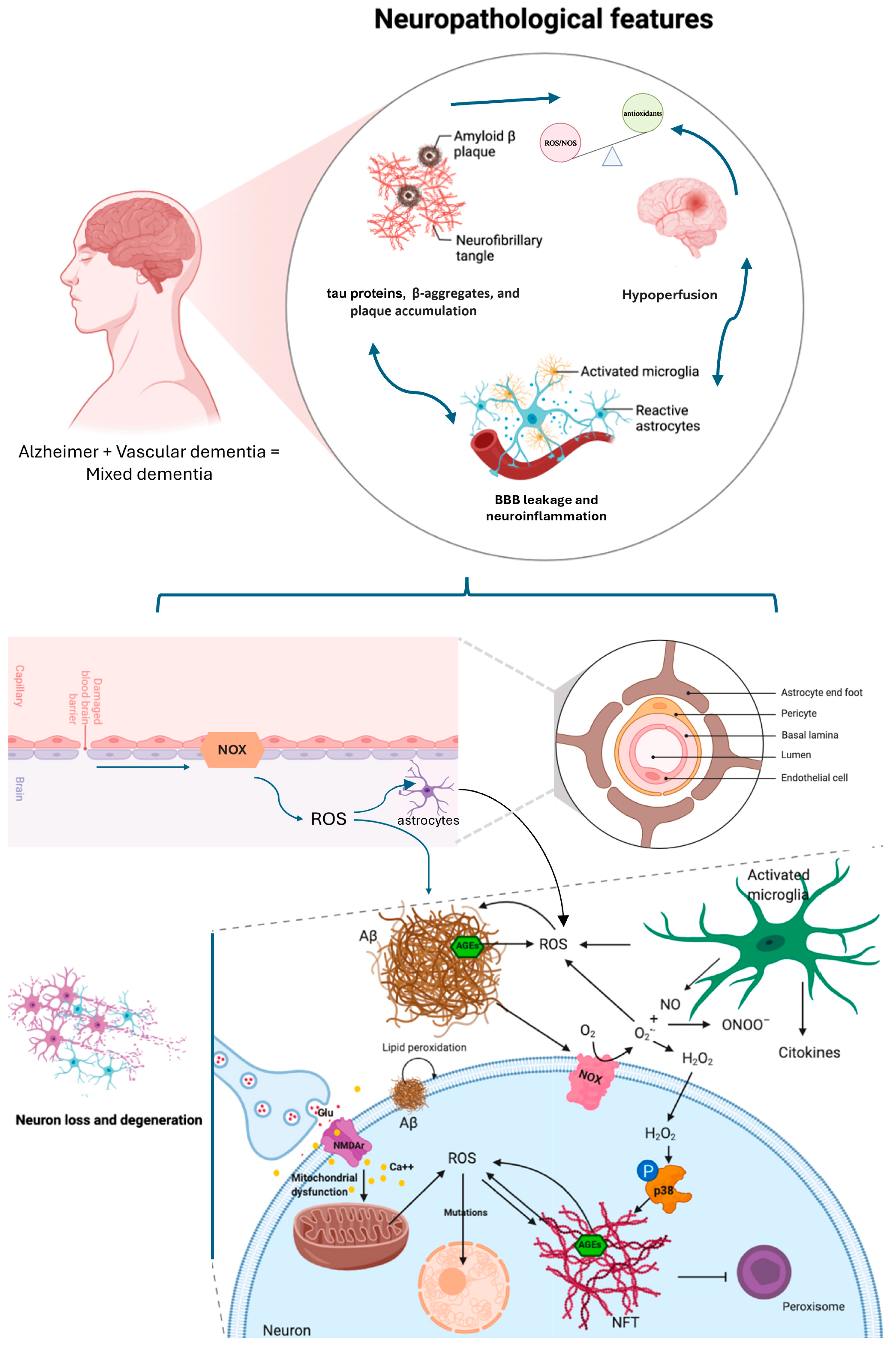
Oxidative Stress as a Central Mechanistic Bridge Between Alzheimer’s and Vascular Pathologies in Mixed Dementia: Emerging Evidence and Therapeutic Perspectives




Abstract
Share and Cite
Beretti, F.; Malenchini, M.; Gatti, M.; Maraldi, T. Oxidative Stress as a Central Mechanistic Bridge Between Alzheimer’s and Vascular Pathologies in Mixed Dementia: Emerging Evidence and Therapeutic Perspectives. Biomedicines 2026, 14, 59. https://doi.org/10.3390/biomedicines14010059
Beretti F, Malenchini M, Gatti M, Maraldi T. Oxidative Stress as a Central Mechanistic Bridge Between Alzheimer’s and Vascular Pathologies in Mixed Dementia: Emerging Evidence and Therapeutic Perspectives. Biomedicines. 2026; 14(1):59. https://doi.org/10.3390/biomedicines14010059
Chicago/Turabian StyleBeretti, Francesca, Marta Malenchini, Martina Gatti, and Tullia Maraldi. 2026. "Oxidative Stress as a Central Mechanistic Bridge Between Alzheimer’s and Vascular Pathologies in Mixed Dementia: Emerging Evidence and Therapeutic Perspectives" Biomedicines 14, no. 1: 59. https://doi.org/10.3390/biomedicines14010059
APA StyleBeretti, F., Malenchini, M., Gatti, M., & Maraldi, T. (2026). Oxidative Stress as a Central Mechanistic Bridge Between Alzheimer’s and Vascular Pathologies in Mixed Dementia: Emerging Evidence and Therapeutic Perspectives. Biomedicines, 14(1), 59. https://doi.org/10.3390/biomedicines14010059