Evaluation of the Antibacterial, Antioxidant, Anticancer, and Antidiabetic Activities of the Leaves and Inflorescences of Crassula capitella

 , , and
Abstract
1. Introduction
2. Materials and Methods
2.1. Preparation of the Leaves and Inflorescences of C. capitella
2.2. Determination of Bioactive Components
2.3. Determination of Total Phenolic Content (TPC) and Total Flavonoid Content (TFC)
2.4. Antibacterial Activity
2.4.1. Disc Diffusion Method
2.4.2. Determination of Minimum Inhibitory Concentration (MIC) and Minimum Bactericidal Concentration (MBC) Values
2.5. Antioxidant Activity
2.5.1. 2,2-DDiphenyl-1–Picrylhydrazyl (DPPH) Radical Scavenging Activity
2.5.2. 2,2′-Azino-Bis (3-Ethylbenzothiazoline-6-Sulfonic Acid (ABTS)) Assay
2.6. Cell Culture and Cytotoxicity Assays
2.7. Antidiabetic Activity
2.7.1. Determination of α-Amylase Inhibitory Activity
2.7.2. Determination of α-Glucosidase Inhibitory Activity
2.7.3. Statistical Analysis
3. Results
3.1. Extraction Yields
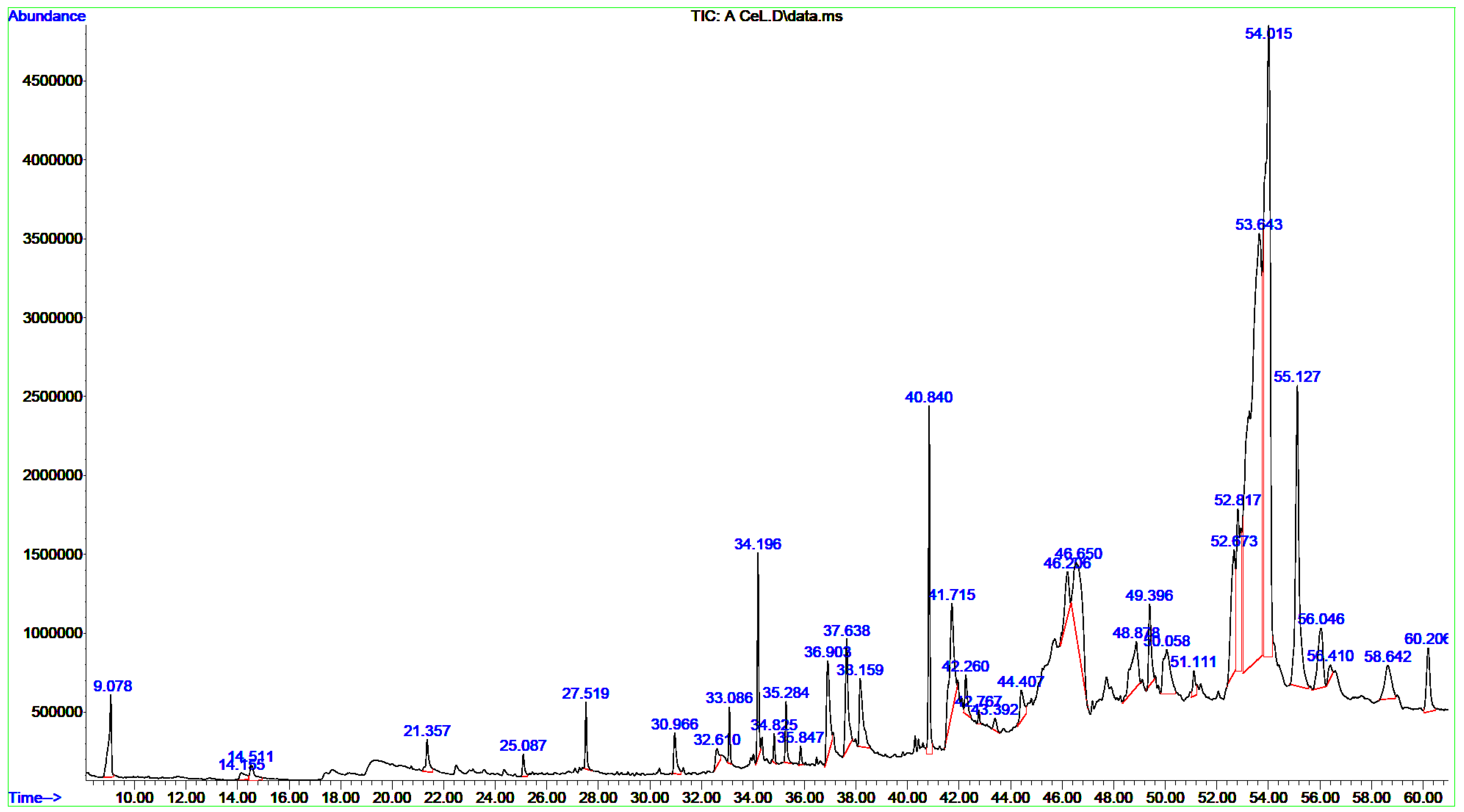
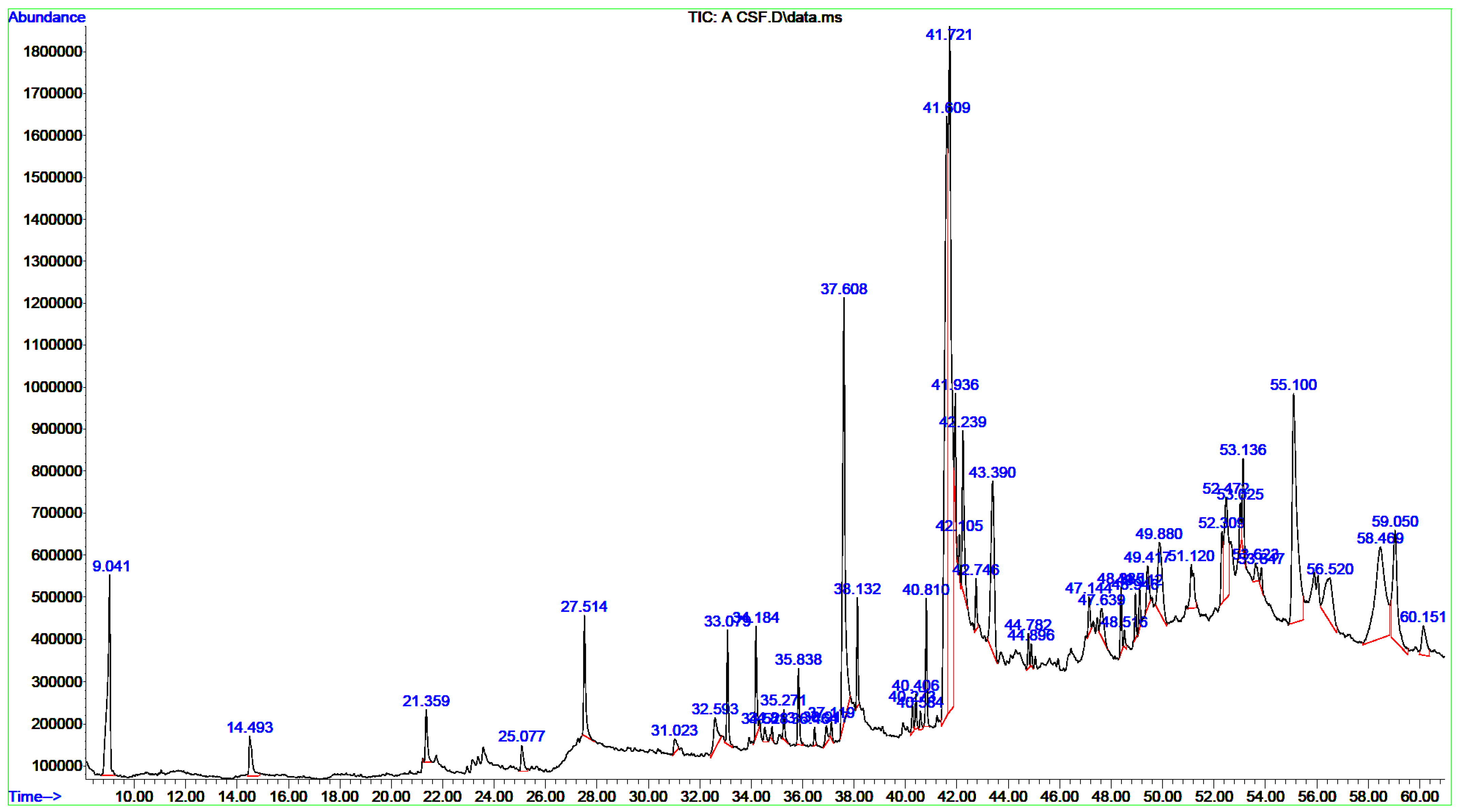
3.2. Chemical Composition of the CCLE and CCIE
3.3. TPC and TFC of the CCLE and CCIE
3.4. Antibacterial Effects of CCLE and CCIE
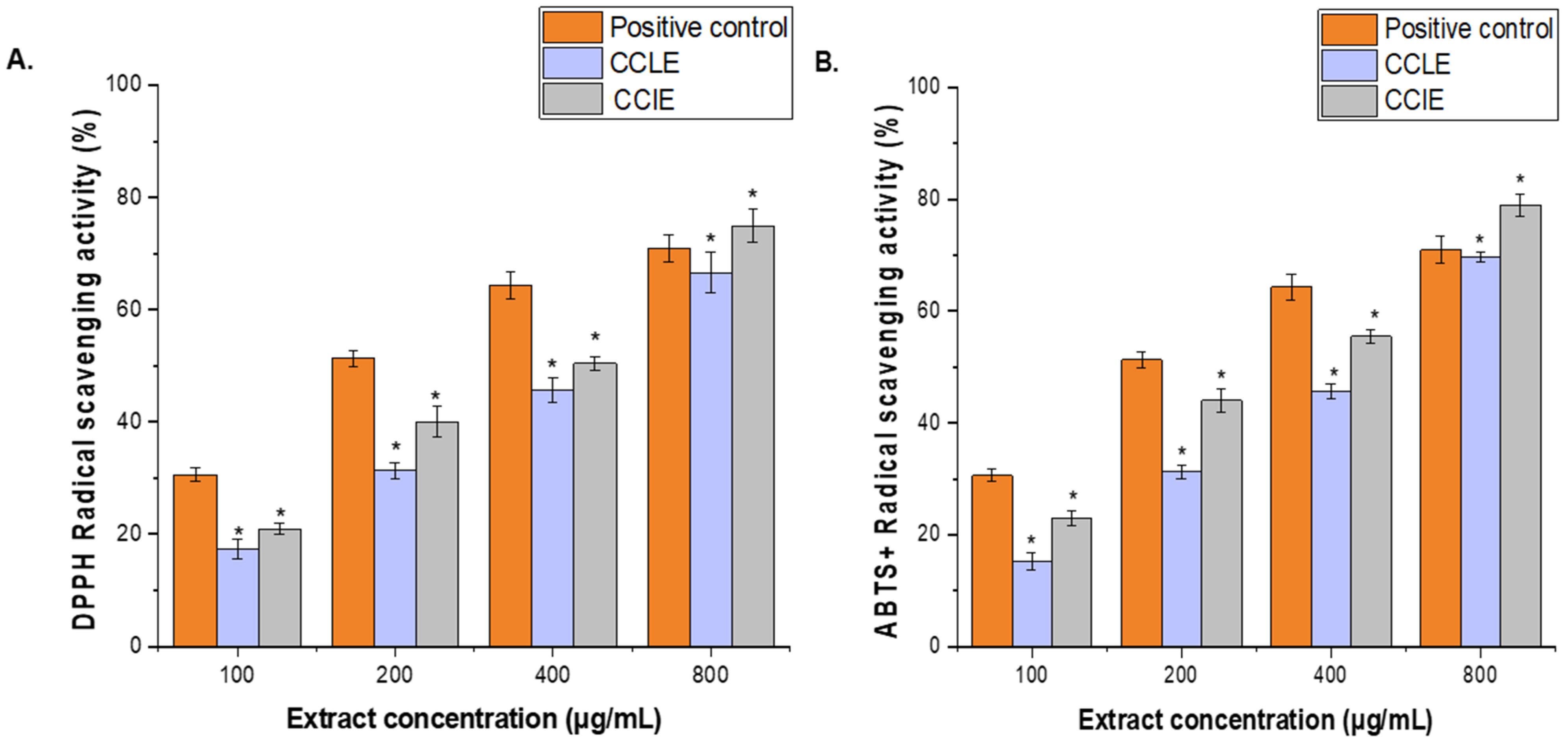
3.5. DPPH and ABTS+ Radical Scavenging Activity
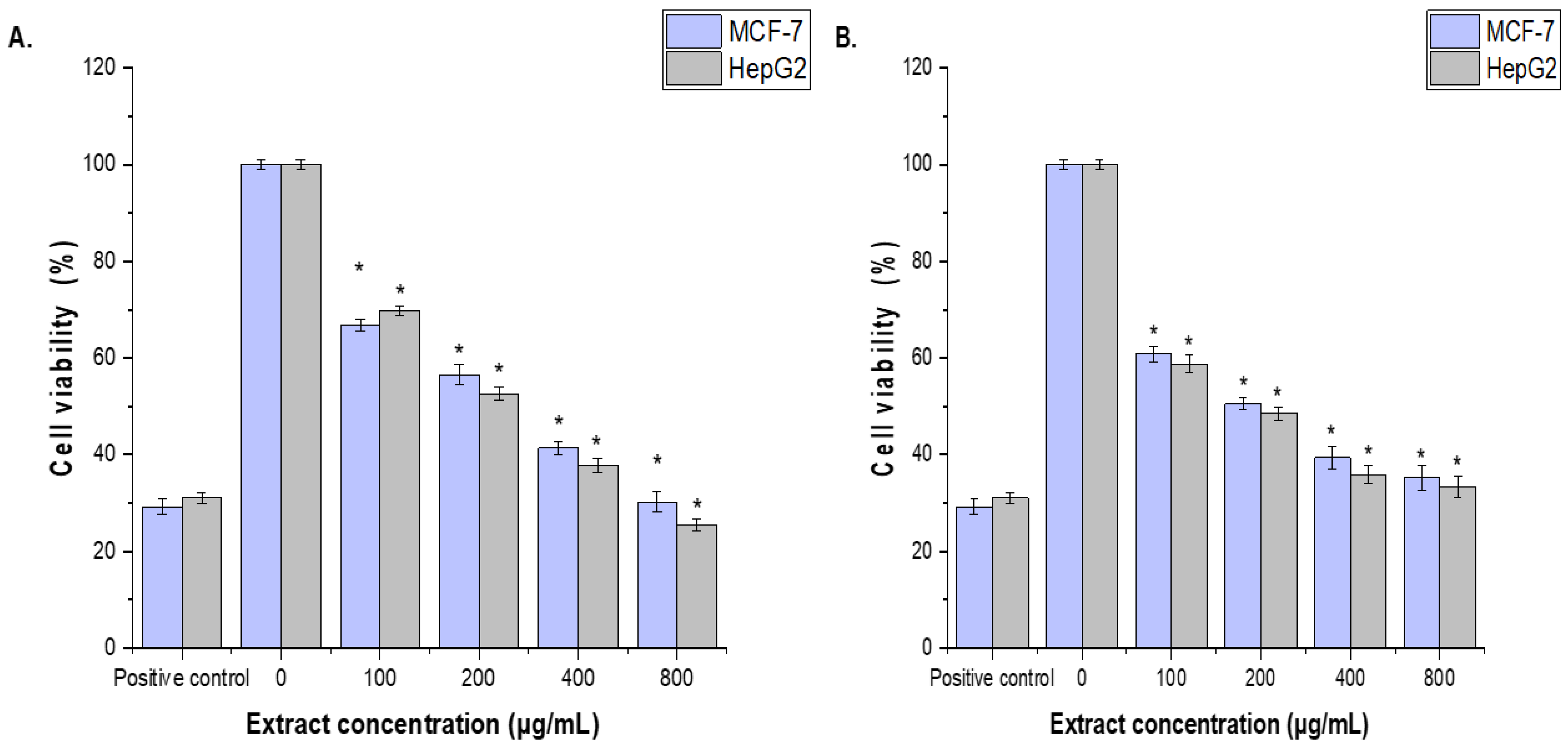
3.6. Cell Cytotoxicity
3.7. In Vitro Antidiabetic Activities of CCLE and CCIE
4. Discussion
5. Conclusions
Author Contributions
Funding
Institutional Review Board Statement
Informed Consent Statement
Data Availability Statement
Acknowledgments
Conflicts of Interest
References
- Bruyns, P.; Hanáček, P.; Klak, C. Crassula, insights into an old, arid-adapted group of southern African leaf-succulents. Mol. Phylogenet. Evol. 2019, 131, 35–47. [Google Scholar] [CrossRef] [PubMed]
- Hassan, M.H.; Elwekeel, A.; Moawad, A.; Afifi, N.; Amin, E.; El Amir, D. Phytochemical constituents and biological activity of selected genera of family Crassulaceae: A review. S. Afr. J. Bot. 2021, 141, 383–404. [Google Scholar] [CrossRef]
- Ding, H.; Han, S.; Ye, Y.; Bi, D.; Zhang, S.; Yi, R.; Gao, J.; Yang, J.; Wu, L.; Kan, X. Ten plastomes of Crassula (Crassulaceae) and phylogenetic implications. Biology 2022, 11, 1779. [Google Scholar] [CrossRef]
- Muiruri, M.D.; Mwangi, W. Phytochemical and antimicrobial activity of (Crassula ovata) jade plant on different strains of bacteria. Eur. J. Med. Plants 2015, 11, 1–12. [Google Scholar] [CrossRef]
- El-Hawary, S.S.; Mohammed, R.; Abouzid, S.; Ali, Z.Y.; Elwekeel, A. Anti-arthritic activity of 11-O-(4′-O-methyl galloyl)-bergenin and Crassula capitella extract in rats. J. Pharm. Pharmacol. 2016, 68, 834–844. [Google Scholar] [CrossRef] [PubMed]
- Eid, O.; Ezzat, S.; Gonaid, M.; Choucry, M. Crassulaceae (chemistry and pharmacology)-A review. Future J. Pharm. Sci. 2018, 4, 234–240. [Google Scholar] [CrossRef]
- Diatta, K.; Diatta, W.; Fall, A.D.; Dieng, S.I.M.; Mbaye, A.I.; Ly, R. Ethno apicultural survey of Melliferous plant species in the great Green Wall Widou and Koyli alpha, Senegal. Asian Plant Res. J. 2019, 3, 1–9. [Google Scholar] [CrossRef]
- Kumar, S.; Choudhury, T.; Kumar, R.; Kushwaha, S.; Gulam, S. A Review on Discovering the Satisfying Potentials of Crassula Ovata: From Modern Usages to Medication Presentations. Int. J. Sci. Technol. (IJST) 2025, 2, 36–46. [Google Scholar] [CrossRef]
- Spigno, G.; Tramelli, L.; De Faveri, D.M. Effects of extraction time, temperature and solvent on concentration and antioxidant activity of grape marc phenolics. J. Food Eng. 2007, 81, 200–208. [Google Scholar] [CrossRef]
- Carrera, C.; Ruiz-Rodríguez, A.; Palma, M.; Barroso, C.G. Ultrasound assisted extraction of phenolic compounds from grapes. Anal. Chim. Acta 2012, 732, 100–104. [Google Scholar] [CrossRef]
- Abbas, A.; Naqvi, S.A.R.; Rasool, M.H.; Noureen, A.; Mubarik, M.S.; Tareen, R.B. Phytochemical analysis, antioxidant and antimicrobial screening of Seriphidium oliverianum plant extracts. Dose-Response 2021, 19, 15593258211004739. [Google Scholar] [CrossRef]
- Wolfe, K.L.; Liu, R.H. Apple peels as a value-added food ingredient. J. Agric. Food Chem. 2003, 51, 1676–1683. [Google Scholar] [CrossRef]
- Woisky, R.G.; Salatino, A. Analysis of propolis: Some parameters and procedures for chemical quality control. J. Apic. Res. 1998, 37, 99–105. [Google Scholar] [CrossRef]
- Salem, N.; Kefi, S.; Tabben, O.; Ayed, A.; Jallouli, S.; Feres, N.; Hammami, M.; Khammassi, S.; Hrigua, I.; Nefisi, S.; et al. Variation in chemical composition of Eucalyptus globulus essential oil under phenological stages and evidence synergism with antimicrobial standards. Ind. Crops Prod. 2018, 124, 115–125. [Google Scholar] [CrossRef]
- Aljeldah, M.M.; Yassin, M.T.; Mostafa, A.A.-F.; Aboul-Soud, M.A. Synergistic Antibacterial Potential of Greenly Synthesized Silver Nanoparticles with Fosfomycin Against Some Nosocomial Bacterial Pathogens. Infect. Drug Resist. 2022, 16, 125–142. [Google Scholar] [CrossRef] [PubMed]
- Tian, M.; Wu, X.; Lu, T.; Zhao, X.; Wei, F.; Deng, G.; Zhou, Y. Phytochemical analysis, antioxidant, antibacterial, cytotoxic, and enzyme inhibitory activities of Hedychium flavum rhizome. Front. Pharmacol. 2020, 11, 572659. [Google Scholar] [CrossRef] [PubMed]
- Yu, X.; Zhao, M.; Liu, F.; Zeng, S.; Hu, J. Antioxidants in volatile Maillard reaction products: Identification and interaction. LWT-Food Sci. Technol. 2013, 53, 22–28. [Google Scholar] [CrossRef]
- Mosmann, T. Rapid colorimetric assay for cellular growth and survival: Application to proliferation and cytotoxicity assays. J. Immunol. Methods 1983, 65, 55–63. [Google Scholar] [CrossRef]
- Alkhudhayri, A.A.; Wahab, R.; Siddiqui, M.A.; Ahmad, J. Selenium nanoparticles induce cytotoxicity and apoptosis in human breast cancer (MCF-7) and liver (HEPG2) cell lines. Nanosci. Nanotechnol. Lett. 2020, 12, 324–330. [Google Scholar] [CrossRef]
- Ghasemi, M.; Turnbull, T.; Sebastian, S.; Kempson, I. The MTT assay: Utility, limitations, pitfalls, and interpretation in bulk and single-cell analysis. Int. J. Mol. Sci. 2021, 22, 12827. [Google Scholar] [CrossRef] [PubMed]
- Al-Dhabi, N.A.; Valan Arasu, M. Quantification of phytochemicals from commercial Spirulina products and their antioxidant activities. Evid.-Based Complement. Altern. Med. 2016, 2016, 7631864. [Google Scholar] [CrossRef]
- Wickramaratne, M.N.; Punchihewa, J.; Wickramaratne, D. In-vitro alpha amylase inhibitory activity of the leaf extracts of Adenanthera pavonina. BMC Complement. Altern. Med. 2016, 16, 466. [Google Scholar] [CrossRef]
- Kim, Y.-M.; Wang, M.-H.; Rhee, H.-I. A novel α-glucosidase inhibitor from pine bark. Carbohydr. Res. 2004, 339, 715–717. [Google Scholar] [CrossRef]
- Simpson, M.G. Diversity and classification of flowering plants. Plant Syst. 2010, 181–274. [Google Scholar] [CrossRef]
- Mimi, N.; Madani, L.; Kerrouche, D.; Boucherit, N.; Touzout, N.; Zhang, J.; Amrane, A.; Tahraoui, H. Comparison of Antioxidant and Antibacterial Properties of Five Plants with Anti-Diabetes and Anti-Cancer Potential. Microbiol. Res. 2025, 16, 108. [Google Scholar] [CrossRef]
- Sharifi-Rad, M.; Camele, I.; Pohl, P.; Mohanta, Y.K.; Elshafie, H.S. Comparative analysis of solvent and advanced extraction techniques for optimizing phytochemical yield and bioactivity of Matthiola ovatifolia (Boiss.) Aerial parts. Sci. Rep. 2025, 15, 39978. [Google Scholar] [CrossRef]
- Kandeda, A.K.; Mezui, C.; Kengni, S.; Baldagai, N.; Mabou, S.T. Kalanchoe crenata Haw. (Crassulacea) Decreases Hippocampal Neuron Loss and Improves Memory and Executive Function in Aged Rats: Implications for Anti-Inflammatory and Antioxidant Mechanisms. Brain Behav. 2025, 15, e70261. [Google Scholar] [CrossRef]
- López-Angulo, G.; Montes-Avila, J.; Díaz-Camacho, S.P.; Vega-Aviña, R.; López-Valenzuela, J.Á.; Delgado-Vargas, F. Comparison of terpene and phenolic profiles of three wild species of Echeveria (Crassulaceae). J. Appl. Bot. Food Qual. 2018, 91, 145–154. [Google Scholar]
- Liu, K.; Zhang, X.; Xie, L.; Deng, M.; Chen, H.; Song, J.; Long, J.; Li, X.; Luo, J. Lupeol and its derivatives as anticancer and anti-inflammatory agents: Molecular mechanisms and therapeutic efficacy. Pharmacol. Res. 2021, 164, 105373. [Google Scholar] [CrossRef] [PubMed]
- Bakrim, S.; Benkhaira, N.; Bourais, I.; Benali, T.; Lee, L.-H.; El Omari, N.; Sheikh, R.A.; Goh, K.W.; Ming, L.C.; Bouyahya, A. Health benefits and pharmacological properties of stigmasterol. Antioxidants 2022, 11, 1912. [Google Scholar] [CrossRef] [PubMed]
- Adepoju, F.O.; Duru, K.C.; Li, E.; Kovaleva, E.G.; Tsurkan, M.V. Pharmacological potential of betulin as a multitarget compound. Biomolecules 2023, 13, 1105. [Google Scholar] [CrossRef] [PubMed]
- Dalimunthe, A.; Gunawan, M.C.; Utari, Z.D.; Dinata, M.R.; Halim, P.; Pakpahan, N.E.S.; Sitohang, A.I.; Sukarno, M.A.; Harahap, Y.; Setyowati, E.P.; et al. In-depth analysis of lupeol: Delving into the diverse pharmacological profile. Front. Pharmacol. 2024, 15, 1461478. [Google Scholar] [CrossRef]
- Lou, S.; Dai, C.; Wu, Y.; Wang, L.; Jin, Y.; Shen, N.; Lv, W.; Wu, M.; Xu, X.; Han, J.; et al. Betulonic acid: A review on its sources, biological activities, and molecular mechanisms. Eur. J. Pharmacol. 2025, 998, 177518. [Google Scholar] [CrossRef] [PubMed]
- Mbhele, N.; Ncube, B.; Ndhlala, A.; Moteetee, A. Pro-inflammatory enzyme inhibition and antioxidant activity of six scientifically unexplored indigenous plants traditionally used in South Africa to treat wounds. S. Afr. J. Bot. 2022, 147, 119–129. [Google Scholar] [CrossRef]
- Kolodziejczyk-Czepas, J.; Nowak, P.; Wachowicz, B.; Piechocka, J.; Głowacki, R.; Moniuszko-Szajwaj, B.; Stochmal, A. Antioxidant efficacy of Kalanchoe daigremontiana bufadienolide-rich fraction in blood plasma in vitro. Pharm. Biol. 2016, 54, 3182–3188. [Google Scholar] [CrossRef] [PubMed]
- De Araújo, E.R.D.; Guerra, G.C.B.; Araújo, D.F.d.S.; De Araújo, A.A.; Fernandes, J.M.; de Araújo Júnior, R.F.; Da Silva, V.C.; De Carvalho, T.G.; Ferreira, L.d.S.; Zucolotto, S.M. Gastroprotective and antioxidant activity of Kalanchoe brasiliensis and Kalanchoe pinnata leaf juices against indomethacin and ethanol-induced gastric lesions in rats. Int. J. Mol. Sci. 2018, 19, 1265. [Google Scholar] [CrossRef]
- Quintero, E.J.; De León, E.G.; Morán-Pinzón, J.; Mero, A.; León, E.; Cano, L.P.P. Evaluation of the leaf extracts of Kalanchoe pinnata and Kalanchoe daigremontiana chemistry antioxidant and anti-inflammatory activity. Eur. J. Med. Plants 2021, 32, 45–54. [Google Scholar] [CrossRef]
- Asif, S.; Deepthi, N.; Sai Deepika, L.; Bhavani, K.; Hyma, A.; Sailaja, B.; Udaya, J.; Jagadeesh, P.; Swathi, P. Phytochemical screening and evaluation of antioxidant activity of Callisia repens and Crassula ovata: An in-vitro study. World J. Biol. Pharm. Health Sci. 2024, 19, 24–33. [Google Scholar] [CrossRef]
- Ungurianu, A.; Zanfirescu, A.; Nițulescu, G.; Margină, D. Vitamin E beyond its antioxidant label. Antioxidants 2021, 10, 634. [Google Scholar] [CrossRef]
- Lopez-Angulo, G.; Montes-Avila, J.; Díaz-Camacho, S.P.; Vega-Avina, R.; Ahumada-Santos, Y.P.; Delgado-Vargas, F. Chemical composition antioxidant α-glucosidase inhibitory antibacterial activities of three Echeveria, D.C. species from Mexico. Arab. J. Chem. 2019, 12, 1964–1973. [Google Scholar] [CrossRef]
- Wen, T.; Hao, Y.-J.; An, X.-L.; Sun, H.-D.; Li, Y.-R.; Chen, X.; Piao, X.-C.; Lian, M.-L. Improvement of bioactive compound accumulation in cell cultures of Orostachys cartilaginous, A. Bor. through elicitation with salicylic acid and effect of cell extract on bioactive activity. Ind. Crops Prod. 2019, 139, 111570. [Google Scholar] [CrossRef]
- Kim, J.-H.; Choi, J.-H.; Cheon, M.; Lee, J.-S. MAMNet: Multi-path adaptive modulation network for image super-resolution. Neurocomputing 2020, 402, 38–49. [Google Scholar] [CrossRef]
- Xu, F.; Wang, C.; Wang, H.; Xiong, Q.; Wei, Y.; Shao, X. Antimicrobial action of flavonoids from Sedum aizoon L. against lactic acid bacteria in vitro and in refrigerated fresh pork meat. J. Funct. Foods 2018, 40, 744–750. [Google Scholar] [CrossRef]
- Lobiuc, A.; Pavăl, N.-E.; Mangalagiu, I.I.; Gheorghiță, R.; Teliban, G.-C.; Amăriucăi-Mantu, D.; Stoleru, V. Future antimicrobials: Natural and functionalized phenolics. Molecules 2023, 28, 1114. [Google Scholar] [CrossRef]
- Cháirez-Ramírez, M.; Moreno-Jiménez, M.; González-Laredo, R.; Gallegos-Infante, J.; Rocha-Guzmán, N.E. Lupane-type triterpenes and their anti-cancer activities against most common malignant tumors: A review. EXCLI J. 2016, 15, 758. [Google Scholar]
- Hordyjewska, A.; Ostapiuk, A.; Horecka, A.; Kurzepa, J. Betulin and betulinic acid: Triterpenoids derivatives with a powerful biological potential. Phytochem. Rev. 2019, 18, 929–951. [Google Scholar] [CrossRef]
- Mahata, S.; Maru, S.; Shukla, S.; Pandey, A.; Mugesh, G.; Das, B.C.; Bharti, A.C. Anticancer property of Bryophyllum pinnata (Lam.) Oken. leaf on human cervical cancer cells. BMC Complement. Altern. Med. 2012, 12, 15. [Google Scholar] [CrossRef] [PubMed]
- Kaewpiboon, C.; Srisuttee, R.; Malilas, W.; Moon, J.; Kaowinn, S.; Cho, I.-R.; Johnston, R.N.; Assavalapsakul, W.; Chung, Y.-H. Extract of Bryophyllum laetivirens reverses etoposide resistance in human lung A549 cancer cells by downregulation of N.F.-κ.B. Oncol. Rep. 2014, 31, 161–168. [Google Scholar]
- Xu, T.; Wang, Z.; Lei, T.; Lv, C.; Wang, J.; Lu, J. New flavonoid glycosides from Sedum aizoon L. Fitoterapia 2015, 101, 125–132. [Google Scholar] [CrossRef]
- Armonavičius, D.; Maruška, A.; Jakštys, B.; Stankevičius, M.; Drevinskas, T.; Bimbiraitė-Survilienė, K.; Čaplikaitė, M.; Ihara, H.; Takafuji, M.; Skrzydlewska, E.; et al. Evaluation of the Anticancer Activity of Medicinal Plants Predominantly Accumulating Ellagic Acid Compounds. Antioxidants 2025, 14, 1339. [Google Scholar] [CrossRef] [PubMed]
- Déciga-Campos, M.; González-Trujano, M.E.; Ventura-Martínez, R.; Montiel-Ruiz, R.M.; Ángeles-López, G.E.; Brindis, F. Antihyperalgesic Activity of R hodiola r osea in a Diabetic Rat Model. Drug Dev. Res. 2016, 77, 29–36. [Google Scholar] [CrossRef] [PubMed]
- Da Silva, D.; Casanova, L.M.; Marcondes, M.C.; Espindola-Netto, J.M.; Paixão, L.P.; De Melo, G.O.; Zancan, P.; Sola-Penna, M.; Costa, S.S. Antidiabetic activity of Sedum dendroideum: Metabolic enzymes as putative targets for the bioactive flavonoid kaempferitrin. IUBMB Life 2014, 66, 361–370. [Google Scholar] [CrossRef]
- Patil, S.B.; Dongare, V.R.; Kulkarni, C.R.; Joglekar, M.M.; Arvindekar, A.U. Antidiabetic activity of Kalanchoe pinnata in streptozotocin-induced diabetic rats by glucose independent insulin secretagogue action. Pharm. Biol. 2013, 51, 1411–1418. [Google Scholar] [PubMed]
- Lee, S.J.; Zhang, G.F.; Sung, N.J. Hypolipidemic and hypoglycemic effects of Orostachys japonicus, A. Berger extracts in streptozotocin-induced diabetic rats. Nutr. Res. Pract. 2011, 5, 301–307. [Google Scholar] [PubMed]
- Salehi, B.; Ata, A.; Anil Kumar, N.V.; Sharopov, F.; Ramírez-Alarcón, K.; Ruiz-Ortega, A.; Ayatollahi, S.A.; Fokou, P.V.T.; Kobarfard, F.; Zakaria, Z.A.; et al. Antidiabetic potential of medicinal plants and their active components. Biomolecules 2019, 9, 551. [Google Scholar] [CrossRef] [PubMed]



| Peak | RT | Area | Area% | Name | MF | MW | q-Ions | Classification |
|---|---|---|---|---|---|---|---|---|
| 1 | 9.07 | 39,431,389 | 1.37 | β-Terpinyl acetate | C12H2O2 | 196 | 136؛121؛93 | Monoterpenoids |
| 2 | 14.15 | 7,229,089 | 0.25 | Falcarinol | C17H24O | 244 | 159؛129؛115 | Fatty alcohols |
| 3 | 14.51 | 13,298,334 | 0.46 | 2-Tridecene, (Z)- | C13H26 | 182 | 182؛97؛55 | Unsaturated aliphatic hydrocarbons |
| 4 | 21.35 | 15,480,975 | 0.54 | Phenol, 2,6-bis(1,1-dimethylethyl)- | C14H22O | 206 | 206؛191 | Phenylpropanes |
| 5 | 25.09 | 7,763,895 | 0.27 | 2,4-Di-tert-butylphenol | C14H22O | 206 | 206؛191؛57 | Phenylpropanes |
| 6 | 27.52 | 17,416,714 | 0.61 | 2-Hexadecanol | C16H34O | 242 | 242؛196؛69؛55 | Fatty alcohols |
| 7 | 30.96 | 18,859,834 | 0.65 | 11-Dodecenoic acid, 10-hydroxy-, methyl ester | C13H24O3 | 228 | 210؛172؛87؛57 | Hydroxy acids and derivatives |
| 8 | 32.61 | 9,894,501 | 0.34 | Estra-1,3,5(10)-trien-17β-ol | C18H24O | 256 | 256؛185؛57 | Steroids and steroid derivatives |
| 9 | 33.08 | 13,401,063 | 0.46 | 1-Hexadecanol, 2-methyl- | C17H36O | 256 | 238؛228؛111؛55 | Fatty alcohols |
| 10 | 34.19 | 50,447,383 | 1.75 | Neophytadiene | C20H38 | 278 | 278؛263؛123؛68 | Sesquiterpenoids |
| 11 | 34.82 | 6,468,493 | 0.22 | Z,E-2,13-Octadecadien-1-ol | C18H34O | 266 | 256؛248؛96؛55 | Fatty alcohols |
| 12 | 35.28 | 17,176,823 | 0.59 | Desulphosinigrin | C10H17NO6S | 279 | 262؛145؛73؛60 | Carbohydrates and carbohydrate conjugates |
| 13 | 35.84 | 5,300,915 | 0.18 | 7,9-Di-tert-butyl-1-oxaspiro(4,5)deca-6,9-diene-2,8-dione | C17H24O3 | 276 | 276؛261؛205 | Gamma butyrolactones |
| 14 | 36.90 | 50,161,836 | 1.74 | 2-Hexadecenoic acid, methyl ester, (E)- | C17H32O2 | 268 | 237؛194؛113؛87 | Fatty acid esters |
| 15 | 37.63 | 52,882,053 | 1.83 | n-Hexadecanoic acid | C16H32O2 | 256 | 256؛213؛129؛73 | Fatty acids and conjugates |
| 16 | 38.15 | 42,950,679 | 1.49 | Hexadecanoic acid, ethyl ester | C18H36O2 | 284 | 284؛239؛101؛88 | Fatty acid esters |
| 17 | 40.84 | 88,459,573 | 3.07 | Phytol | C20H40O | 296 | 296؛123؛71 | Diterpenoids |
| 18 | 41.71 | 85,640,092 | 2.98 | cis-Linoleic acid | C18H32O2 | 280 | 280؛124؛67 | Lineolic acids and derivatives |
| 19 | 42.26 | 16,551,066 | 0.57 | [1,1′-Bicyclopropyl]-2-octanoic acid, 2′-hexyl-, methyl ester | C21H38O2 | 322 | 322؛291؛73 | Fatty acid esters |
| 20 | 42.76 | 3,243,239 | 0.11 | Oxiraneoctanoic acid, 3-octyl-, cis- | C18H34O3 | 298 | 298؛185؛155 | Lineolic acids and derivatives |
| 21 | 43.39 | 6,100,049 | 0.21 | Linolenic acid, methyl ester | C21H36O4 | 352 | 352؛261؛155؛79 | Lineolic acids and derivatives |
| 22 | 44.407 | 20,170,336 | 0.701116 | 2H-Pyran, 2-(7-heptadecynyloxy)tetrahydro- | C22H40O2 | 336 | 334؛231؛91؛55 | Oxanes |
| 23 | 46.21 | 33,445,205 | 1.162 | β-Sitosterol | C29H50O | 414 | 414؛396؛213؛55 | Steroids and steroid derivatives |
| 24 | 46.65 | 121,315,019 | 4.21 | γ-Sitosterol | C29H50O | 414 | 414؛396؛213؛55؛43 | Steroids and steroid derivatives |
| 25 | 48.87 | 56,155,458 | 1.95 | Propanoic acid, 2-methyl-, (dodecahydro-6a-hydroxy-9a-methyl-3-methylene-2,9-dioxoazuleno [4,5-b]furan | C19H26O6 | 350 | 262؛250؛232 | Sesquiterpene lactones |
| 26 | 49.39 | 35,380,759 | 1.22 | cis-11-Eicosenoic acid | C20H38O2 | 310 | 310؛292؛55 | Long-chain fatty acids |
| 27 | 50.05 | 53,839,532 | 1.87 | i-Propyl 5,8,11,14,17-eicosapentaenoate | C23H36O2 | 344 | 301؛201؛175؛79 | Fatty acid methyl esters |
| 28 | 51.11 | 11,271,888 | 0.39 | 2-[4-methyl-6-(2,6,6-trimethylcyclohex-1-enyl)hexa-1,3,5-trienyl]cyclohex-1-en-1-carboxaldehyde | C23H32O | 324 | 324؛173؛135؛43 | Retinoids |
| 29 | 52.67 | 85,161,002 | 2.96 | Vitamin E | C29H50O2 | 430 | 430؛165 | Vitamin E compounds |
| 30 | 52.81 | 116,970,643 | 4.06 | Betulin | C30H50O2 | 442 | 442؛411 | Triterpenoids |
| 31 | 53.64 | 878,250,217 | 30.52 | Betulinaldehyde | C30H48O2 | 440 | 440؛207؛189 | Triterpenoids |
| 32 | 54.02 | 568,962,985 | 19.78 | Lupeol | C30H50O | 426 | 426؛218؛189؛95 | Triterpenoids |
| 33 | 55.12 | 188,984,461 | 6.56 | Oleamide | C18H35NO | 281 | 281؛264؛72؛59 | Fatty amides |
| 34 | 56.04 | 52,568,959 | 1.827 | Cycloartenol acetate | C33H54O3 | 498 | 498؛438؛423 | Cycloartanols and derivatives |
| 35 | 56.41 | 7,963,550 | 0.27 | Cholest-22-ene-21-ol, 3,5-dehydro-6-methoxy-, pivalate | C33H54O3 | 498 | 498؛499؛283؛85؛57 | Cholestane steroids |
| 36 | 58.64 | 38,477,491 | 1.33 | Stigmasterol | C29H48O | 412 | 412؛351؛300؛255؛55 | Steroids and steroid derivatives |
| 37 | 60.21 | 39,813,652 | 1.38 | δ-Tocopherol | C27H46O2 | 402 | 402؛177؛137 | Quinone and hydroquinone lipids |
| Peak | RT | Area | Area% | Name | MF | MW | q-Ions | Classification |
|---|---|---|---|---|---|---|---|---|
| 1 | 9.04 | 36,114,417 | 4.07 | β-Terpinyl acetate | C12H2O2 | 196 | 136؛121؛93 | Monoterpenoids |
| 2 | 14.49 | 8,063,277 | 0.90 | 2-Undecanol | C11H24O | 172 | 171؛154؛126؛45 | Fatty alcohols |
| 3 | 21.35 | 6,918,755 | 0.77 | Phenol, 2,6-bis(1,1-dimethylethyl)- | C14H22O | 206 | 206؛191 | Phenylpropanes |
| 4 | 25.07 | 4,419,966 | 0.49 | 2,4-Di-tert-butylphenol | C14H22O | 206 | 206؛191؛57 | Phenylpropanes |
| 5 | 27.51 | 14,987,381 | 1.68 | Olealdehyde | C18H34O | 266 | 266؛248؛182؛69؛55 | Fatty aldehydes |
| 6 | 31.02 | 2,637,007 | 0.29 | 7-Ethyl-4-decen-6-one | C12H22O | 182 | 126؛97؛55 | Carbonyl compounds |
| 7 | 32.59 | 7,830,307 | 0.88 | Estra-1,3,5(10)-trien-17β-ol | C18H24O | 256 | 256؛185؛57 | Steroids and steroid derivatives |
| 8 | 33.07 | 11,437,702 | 1.28 | 1-Hexadecanol, 2-methyl- | C17H36O | 256 | 238؛228؛111؛55 | Fatty alcohols |
| 9 | 34.18 | 11,473,302 | 1.29 | 10-Methyl-E-11-tridecen-1-ol propionate | C17H32O2 | 268 | 268؛253؛96؛82؛57 | Fatty alcohol esters |
| 10 | 34.52 | 2,098,725 | 0.23 | 7-Methyl-Z-tetradecen-1-ol acetate | C17H32O2 | 268 | 268؛129؛55؛43 | Fatty alcohol esters |
| 11 | 34.81 | 1,064,966 | 0.12 | Heptadecyl acetate | C19H38O2 | 298 | 238؛210؛87؛43 | Fatty alcohol esters |
| 12 | 35.27 | 3,185,425 | 0.35 | 12-Methyl-E,E-2,13-octadecadien-1-ol | C19H36O | 280 | 280؛262؛220؛211؛55 | Fatty alcohols |
| 13 | 35.83 | 8,369,893 | 0.94 | 7,9-Di-tert-butyl-1-oxaspiro(4,5)deca-6,9-diene-2,8-dione | C17H24O3 | 276 | 276؛261؛217؛205؛175؛57 | Gamma butyrolactones |
| 14 | 36.46 | 1,636,582 | 0.18 | 11-Dodecenoic acid, 10-hydroxy-, methyl ester | C13H24O3 | 228 | 172؛143؛87؛57 | Hydroxy acids and derivatives |
| 15 | 36.91 | 2,509,817 | 0.28 | Theaspirane (Isomer 2) | C13H24O2 | 212 | 212؛170؛126؛85 | Tetrahydrofurans |
| 16 | 37.12 | 1,606,989 | 0.18 | Hexadecenoic acid, Z-11- | C16H30O2 | 254 | 254؛236؛97؛83؛69؛55 | Long-chain fatty acids |
| 17 | 37.61 | 69,490,912 | 7.84 | n-Hexadecanoic acid | C16H32O2 | 256 | 256؛213؛129؛73 | Fatty acids and conjugates |
| 18 | 38.13 | 8,992,293 | 1.01 | Hexadecanoic acid, ethyl ester | C18H36O2 | 284 | 284؛239؛101؛88 | Fatty acid esters |
| 19 | 40.27 | 2,563,673 | 0.28 | Palmitoleic acid | C16H30O2 | 254 | 254؛236؛152؛137؛55 | Long-chain fatty acids |
| 20 | 40.41 | 2,959,956 | 0.33 | 9,12-Octadecadienoyl chloride, (Z,Z)- | C18H31ClO | 298 | 298؛262؛81؛67 | Acyl chlorides |
| 21 | 40.58 | 1,813,772 | 0.20 | Phytol | C20H40O | 296 | 296؛123؛71 | Diterpenoids |
| 22 | 40.81 | 11,585,198 | 1.31 | Erucic acid | C22H42O2 | 338 | 320؛181 | Long-chain fatty acids |
| 23 | 41.61 | 128,284,519 | 14.45 | cis-Linoleic acid | C18H32O2 | 280 | 280؛124؛67 | Lineolic acids and derivatives |
| 24 | 41.72 | 144,352,463 | 16.26 | cis-9-Tetradecenoic acid, isobutyl ester | C18H34O2 | 282 | 282؛209؛57 | Very long-chain fatty acids |
| 25 | 41.93 | 9,212,060 | 1.03 | 17-Octadecynoic acid | C18H32O2 | 280 | 123؛109؛81؛55 | Fatty acid esters |
| 26 | 42.11 | 3,359,860 | 0.37 | Ethanol, 2-(9,12-octadecadienyloxy)-, (Z,Z)- | C20H38O2 | 310 | 310؛248؛67 | Long-chain fatty acids |
| 27 | 42.23 | 20,556,698 | 2.31 | Oleic Acid | C18H34O2 | 282 | 282؛264؛220؛55؛41 | Dialkyl ethers |
| 28 | 42.74 | 4,769,101 | 0.53 | Oxiraneoctanoic acid, 3-octyl-, cis- | C18H34O3 | 298 | 298؛185؛155 | Lineolic acids and derivatives |
| 29 | 43.39 | 37,279,887 | 4.21 | Linolenic acid, methyl ester | C21H36O4 | 352 | 352؛261؛155؛79 | Lineolic acids and derivatives |
| 30 | 44.78 | 3,007,109 | 0.33 | 5,8,11,14-Eicosatetraenoic acid, methyl ester, (all-Z)- | C21H34O2 | 318 | 318؛203؛175؛150؛91؛79 | Fatty acid methyl esters |
| 31 | 44.89 | 1,819,417 | 0.21 | cis-5,8,11-Eicosatrienoic acid, methyl ester | C21H36O2 | 320 | 320؛161؛106؛93؛79 | Fatty acid methyl esters |
| 32 | 47.14 | 4,147,120 | 0.46 | 6,9,12,15-Docosatetraenoic acid, methyl ester | C23H38O2 | 346 | 346؛264؛235؛149 | Fatty acid methyl esters |
| 33 | 47.63 | 6,755,888 | 0.76 | psi.-Diosgenin | C27H42O3 | 414 | 414؛396؛357؛317 | Steroids and steroid derivatives |
| 34 | 48.38 | 5,911,898 | 0.66 | 9,12,15-Octadecatrienoic acid, 2-(acetyloxy)-1-[(acetyloxy)methyl]ethyl | C25H40O6 | 436 | 171؛159؛43 | Lineolic acids and derivatives |
| 35 | 48.51 | 1,462,102 | 0.16 | Tricyclo [20.8.0.0(7,16)]triacontane, 1(22),7(16)-diepoxy- | C30H52O2 | 440 | 444؛426؛95؛55 | Epoxides |
| 36 | 48.94 | 3,884,597 | 0.437 | Propanoic acid, 2-methyl-, (dodecahydro-6a-hydroxy-9a-methyl-3-methylene-2,9-dioxoazuleno [4,5-b]furan | C19H26O6 | 350 | 262؛250؛232 | Sesquiterpene lactones |
| 37 | 49.12 | 3,668,293 | 0.41 | cis-11-Eicosenoic acid | C20H38O2 | 310 | 310؛292؛55 | Long-chain fatty acids |
| 38 | 49.41 | 6,580,710 | 0.74 | i-Propyl 5,8,11,14,17-eicosapentaenoate | C23H36O2 | 344 | 301؛201؛175؛79 | Fatty acid esters |
| 39 | 49.88 | 20,523,091 | 2.31 | Cholestan-3-ol, 2-methylene-, (3β,5α)- | C28H48O | 400 | 400؛329؛315؛95؛69 | Steroids and steroid derivatives |
| 40 | 51.12 | 10,221,715 | 1.15 | Cholest-22-ene-21-ol, 3,5-dehydro-6-methoxy-, pivalate | C33H54O3 | 498 | 498؛283؛85؛57 | Cholestane steroids |
| 41 | 52.31 | 9,361,266 | 1.05 | Androstan-17-one, 3-ethyl-3-hydroxy-, (5α)- | C21H34O2 | 318 | 300؛282؛271؛105؛91 | Steroids and steroid derivatives |
| 42 | 52.47 | 24,870,581 | 2.80 | Spiro[androstane-3,2′-thiazolidine], (5α)- | C21H35NS | 333 | 332؛286؛273؛258 | Steroids and steroid derivatives |
| 43 | 53.02 | 4,601,229 | 0.51 | Eicosanoic acid, phenylmethyl ester | C27H46O2 | 402 | 311؛281؛108؛91 | Benzene and substituted derivatives |
| 44 | 53.13 | 9,611,225 | 1.08 | Hexadecane, 1,1-bis(dodecyloxy | C40H82O2 | 594 | 440؛408؛257؛57؛43 | Ethers |
| 45 | 53.62 | 3,299,552 | 0.37 | 2-Monolinolenin, 2TMS derivative | C25H40O6 | 436 | 159؛43 | Lineolic acids and derivatives |
| 46 | 53.84 | 2,362,268 | 0.26 | Lupeol | C30H50O | 426 | 426؛218؛189؛95 | Triterpenoids |
| 47 | 55.10 | 70,850,428 | 7.98 | Oleamide | C18H35NO | 281 | 281؛72؛59 | Fatty amides |
| 48 | 56.52 | 21,896,133 | 2.46 | Campesterol | C28H48O | 400 | 400؛382؛315 | Steroids and steroid derivatives |
| 49 | 58.46 | 60,150,775 | 6.77 | Stigmasterol | C29H48O | 412 | 412؛351؛300؛255؛55 | Stigmastanes and derivatives |
| 50 | 59.05 | 33,997,766 | 3.83 | Campesterol | C28H48O | 400 | 400؛382؛367 | Steroids and steroid derivatives |
| 51 | 60.15 | 8,701,951 | 0.98 | δ-Tocopherol | C27H46O2 | 402 | 402؛177؛137 | Quinone and hydroquinone lipids |
| Bacterium/Dilution | Positive Control | 800 μg/mL | 400 μg/mL | 200 μg/mL | 100 μg/mL | MIC (μg/mL) | MBC (μg/mL) |
|---|---|---|---|---|---|---|---|
| S. aureus | 24 ± 0.00 | 23 ± 0.00 * | 20 ± 0.00 * | 17 ± 0.00 * | 12 ± 0.00 * | 6.25 ± 0.00 | 12.50 ± 0.00 |
| S. epidermidis | 30 ± 0.00 | 24 ± 0.00 * | 20 ± 0.00 * | 16 ± 0.00 * | 11 ± 0.00 * | 12.50 ± 0.00 | 25 ± 0.00 |
| B. subtilis | 21 ± 0.00 | 21 ± 0.00 * | 19 ± 0.00 * | 15 ± 0.00 * | 12 ± 0.00 * | 25 ± 0.00 | 50 ± 0.00 |
| E. coli | 32 ± 0.00 | 24 ± 0.00 * | 21 ± 0.00 * | 17 ± 0.00 * | 12 ± 0.00 * | 25 ± 0.00 | 50 ± 0.00 |
| K. pneumoniae | 23 ± 0.00 | 20 ± 0.00 * | 15 ± 0.00 * | 11 ± 0.00 * | 9 ± 10.00 | 50 ± 0.00 | 100 ± 0.00 |
| P. aeruginosa | 21 ± 0.00 | 22 ± 0.00 * | 20 ± 0.00 * | 15 ± 0.00 * | 12 ± 0.00 * | 25 ± 0.00 | 50 ± 0.00 |
| Bacterium/Dilution | Positive Control | 800 μg/mL | 400 μg/mL | 200 μg/mL | 100 μg/mL | MIC (μg/mL) | MBC (μg/mL) |
|---|---|---|---|---|---|---|---|
| S. aureus | 24 ± 0.00 | 23 ± 0.00 * | 19 ± 0.00 * | 16 ± 0.00 * | 14 ± 0.00 * | 6.25 ± 0.00 | 12.50 ± 0.00 |
| S. epidermidis | 30 ± 0.00 | 25 ± 0.00 * | 20 ± 0.00 * | 18 ± 0.00 * | 15 ± 0.00 * | 12.50 ± 0.00 | 50.00 ± 0.00 |
| B. subtilis | 21 ± 0.00 | 20 ± 0.00 * | 17 ± 0.00 * | 15 ± 0.00 * | 13 ± 0.00 * | 12.50 ± 0.00 | 50 ± 0.00 |
| E. coli | 32 ± 0.00 | 22 ± 0.00 * | 19 ± 0.00 * | 15 ± 0.00 * | 10 ± 0.00 * | 12.50 ± 0.00 | 50.00 ± 0.00 |
| K. pneumoniae | 23 ± 0.00 | 19 ± 0.00 * | 17 ± 0.00 * | 15 ± 0.00 * | 11 ± 10.00 * | 25 ± 0.00 | 50 ± 0.00 |
| P. aeruginosa | 21 ± 0.00 | 26 ± 0.00 | 22 ± 0.00 * | 18 ± 0.00 * | 15 ± 0.00 * | 25 ± 0.00 | 50 ± 0.00 |
Disclaimer/Publisher’s Note: The statements, opinions and data contained in all publications are solely those of the individual author(s) and contributor(s) and not of MDPI and/or the editor(s). MDPI and/or the editor(s) disclaim responsibility for any injury to people or property resulting from any ideas, methods, instructions or products referred to in the content. |
© 2026 by the authors. Licensee MDPI, Basel, Switzerland. This article is an open access article distributed under the terms and conditions of the Creative Commons Attribution (CC BY) license.
Share and Cite
AlSedairy, S.A.; Binobead, M.A.; Alanazi, F.; Aziz, I.M. Evaluation of the Antibacterial, Antioxidant, Anticancer, and Antidiabetic Activities of the Leaves and Inflorescences of Crassula capitella. Biomedicines 2026, 14, 121. https://doi.org/10.3390/biomedicines14010121
AlSedairy SA, Binobead MA, Alanazi F, Aziz IM. Evaluation of the Antibacterial, Antioxidant, Anticancer, and Antidiabetic Activities of the Leaves and Inflorescences of Crassula capitella. Biomedicines. 2026; 14(1):121. https://doi.org/10.3390/biomedicines14010121
Chicago/Turabian StyleAlSedairy, Sahar Abdulaziz, Manal Abdulaziz Binobead, Fuad Alanazi, and Ibrahim M. Aziz. 2026. "Evaluation of the Antibacterial, Antioxidant, Anticancer, and Antidiabetic Activities of the Leaves and Inflorescences of Crassula capitella" Biomedicines 14, no. 1: 121. https://doi.org/10.3390/biomedicines14010121
APA StyleAlSedairy, S. A., Binobead, M. A., Alanazi, F., & Aziz, I. M. (2026). Evaluation of the Antibacterial, Antioxidant, Anticancer, and Antidiabetic Activities of the Leaves and Inflorescences of Crassula capitella. Biomedicines, 14(1), 121. https://doi.org/10.3390/biomedicines14010121