Artificial Intelligence Applications in Chronic Obstructive Pulmonary Disease: A Global Scoping Review of Diagnostic, Symptom-Based, and Outcome Prediction Approaches

 , , , , and
Abstract
1. Introduction
2. Materials and Methods
2.1. Study Design
- Population: Patients diagnosed with COPD.
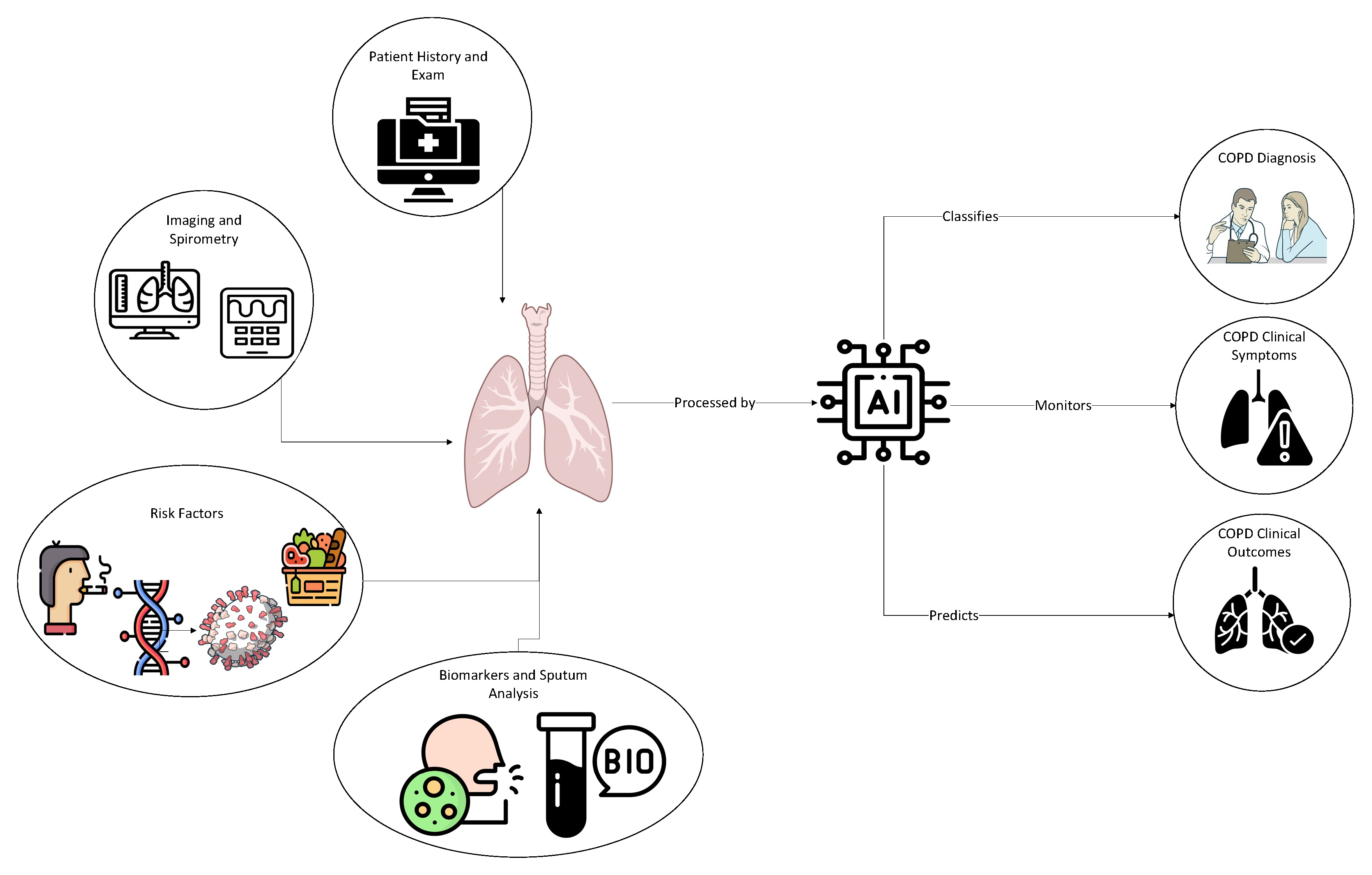
- Concept: Application of AI, including but not limited to ML and DL algorithms, for diagnosis, monitoring, symptoms evaluation or prediction of clinical outcomes.
- Context: Clinical or research setting across any demographic location.
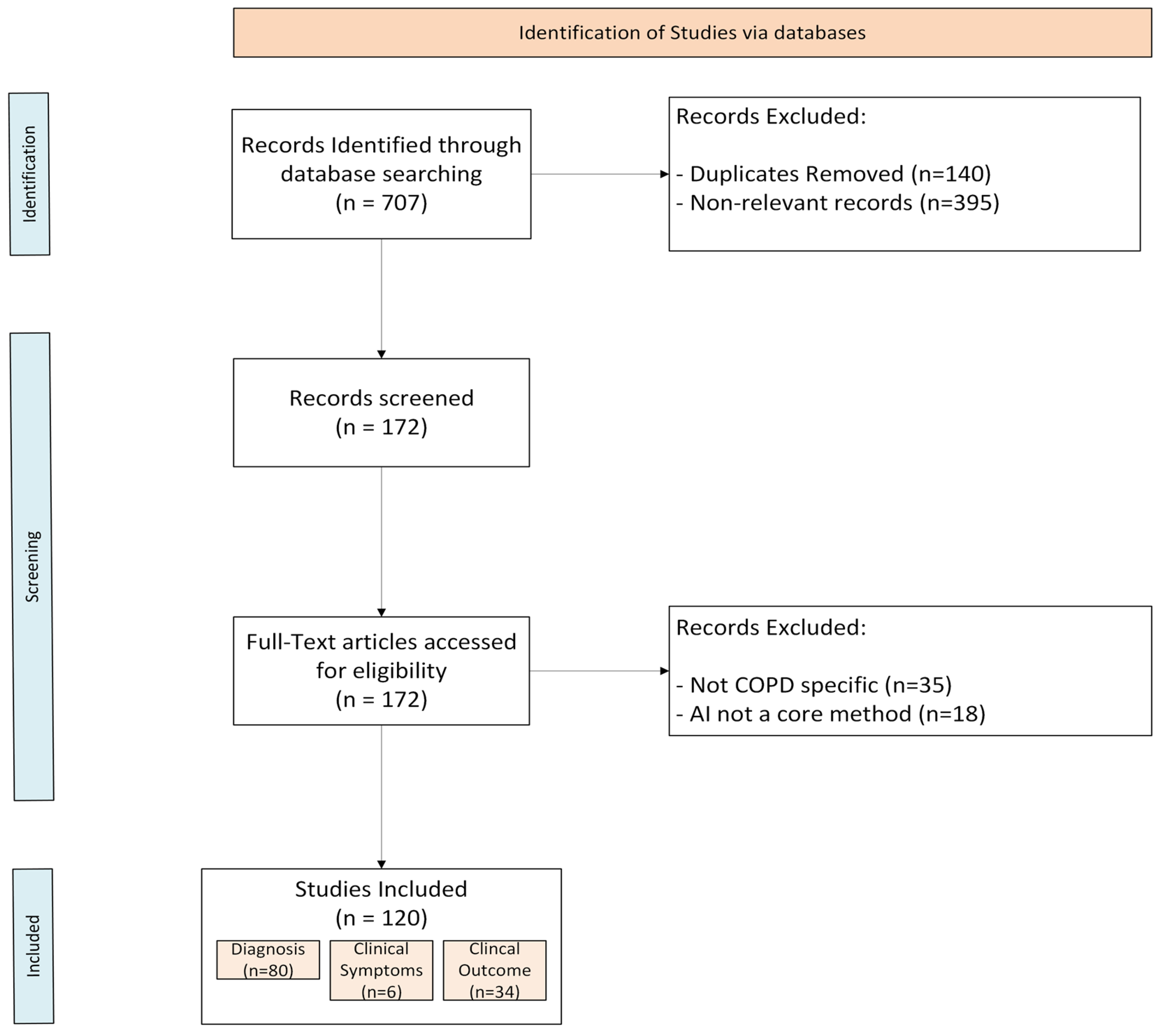
- studies focused primarily on diseases other than COPD without providing COPD-specific results,
- studies that did not employ AI as a core methodological component.
2.2. Identification and Selection of Studies
3. Results
3.1. Study Selection
3.2. Diagnostic Applications of AI in COPD
3.3. Outcome Prediction and Prognostic Modeling
3.4. Symptom-Based and Monitoring Applications

| Author | Purpose | AI Model | Data Source | Main Result |
|---|---|---|---|---|
| Lin et al. [41] | Diagnosis | CatBoost, XGBoost, LightGBM, Gradient Boosting Classifier | Electronic Health Records and outpatient medical records | CatBoost was highlighted as the most effective model in terms of accuracy and sensitivity for detecting high-risk populations for COPD. |
| Heyman et al. [77] | Diagnosis (Early detection, differentiation) | CatBoost, CareNet | Dyspnea patients | CareNet model performed better than CatBoost. Sensitivity: 0.919 (CareNet) vs. 0.871 (CatBoost). |
| Saad et al. [39] | Diagnosis | DT, SVM, KNN, Naive Bayes, Neural Networks | Pulmonary function tests | DT provided the best results. Accuracy: 0.8659. |
| Rivas-Navarrete et al. [52] | Diagnosis | 1D-CNN, SVM | Cough and breath sounds | 1D-CNN provided the best results. Accuracy: 0.8947, Precision: 0.80, Recall: 1.00, F1-score: 0.8889. |
| Zhang et al. [78] | Diagnosis | GPT-4, Rule-based Classifier, Traditional ML Classifier, ChatGPT, LLaMA3 (8B) | Electronic Health Records | Rule-based and Traditional ML Classifiers performed best. F1-score (Rule-based): 0.9600, F1-score (ML): 0.9600, F1-score (GPT-4): ~0.9444. |
| Maldonado-Franco et al. [79] | Diagnosis | Neural Networks | Patient records | Accuracy: 0.929, Sensitivity: 0.882, Specificity: 0.943. |
| Guan et al. [42] | Diagnosis | Gradient Boosting Decision Tree (GBDT), CNN | CT imaging features, lung density parameters, and clinical characteristics | GBDT model (using radiomic, lung density, and clinical data) provided best results. AUC: 0.73, Accuracy: 0.81, Sensitivity: 0.84. |
| Almeida et al. [80] | Diagnosis | Anomaly Detection, PCA | CT scans | Anomaly scores improved predictive power. Adjusted R2: 0.56 (from 0.22), Correlation (Emphysema): 0.66, Correlation (Small Airway Disease): 0.61. |
| Davies et al. [81] | Diagnosis | CNN | Surrogate data, Photoplethysmography (PPG) Data, Real-World COPD Data | AUC (Surrogate data): 0.75, AUC (Real-world data): 0.63, Accuracy Range: 0.40 to 0.88, AUC (2 cycles): 0.75. |
| Zhang et al. [49] | Diagnosis | CNN, LSTM, CNN-LSTM, CNN-BLSTM | Audio data | LSTM provided the best results. Accuracy: 0.9882, F1-score: 0.97. |
| Albiges et al. [82] | Disease classification | RF, SVM, Gaussian Mixture Model (GMM), DT | Audio data | RF provided best results. COPD vs. Healthy: Accuracy: 0.80, F1-score: 0.785. COPD vs. Healthy vs. Pneumonia: Accuracy: 0.70, F1-score: 0.597. |
| Melekoglu et al. [53] | Diagnosis | SVM, KNN, Ensemble Trees, hybrid models | Photoplethysmography (PPG) signal | Hybrid model (40% features): Sensitivity: 0.942, Accuracy: 0.963. Hybrid model (45% features): AUC: 0.952. |
| Vollmer et al. [51] | Diagnosis (Case vs. control) | LR, Random Forest Classifier, SGD Classifier, KNN, Decision Tree Classifier, GaussianNB, SVM, Custom CNN, MLP | Patient data | Custom CNN provided the best results. Accuracy: 0.887, AUC: 0.953. |
| Bracht et al. [83] | Disease differentiation | Random Forest, SVM, Linear Discriminant Analysis | Mass spectrometry analysis of plasma samples | RF presented best results. AUC (Adenocarcinoma vs. COPD): 0.935, AUC (COPD w/ Adenocarcinoma vs. COPD): 0.916. |
| Joumaa et al. [33] | Disease differentiation | Multinomial Regression, Gradient Boosting, RNN | Patient data from medico-administrative databases | Boosting model results: Recall (Asthma): 0.83, Recall (COPD): 0.64, Precision (Asthma): 0.71, Precision (COPD): 0.66. |
| Zafari et al. [84] | Diagnosis (Case vs. control) | Multilayer Neural Networks (MLNN), XGBoost | Electronic Health Records | XGBoost provided the best results. Overall Accuracy: 0.86, AUC (Structured data): 0.919, AUC (Text data): 0.882, AUC (Mixed data): 0.932. |
| Zheng et al. [50] | Diagnosis (Case vs. control) | LS-SVM (linear and polynomial kernels) | Patient data | Both kernels provided optimal results. Linear kernel: Accuracy: 0.8077, AUC: 0.87. Polynomial kernel: Accuracy: 0.8462, AUC: 0.90. |
| Tang et al. [47] | Diagnosis | ResNet | Chest CT | AUC: 0.86, PPV: 0.847, NPV: 0.755. |
| González et al. [46] | Diagnosis, staging, and prediction (ARD, mortality) | CNN | Chest Computed Tomography from COPDGene participants | AUC (Mortality): 0.72, AUC (Diagnosis): 0.856, AUC (Exacerbation): 0.64. |
| El-Magd et al. [56] | Diagnosis (Early detection) | GoogleNet | Sensor data and patient data | Model achieved perfect classification. Accuracy: 1.00, Precision: 1.00, Recall: 1.00, F1-score: 1.00. |
| Mahmood et al. [57] | Diagnosis | Random Forest, MobileNetV2 | Audio data | Accuracy: 1.00, Sensitivity: 1.00, Precision: 1.00, F1-score: 1.00. |
| Choi et al. [85] | Diagnosis | Modified VGGish, LACM, Grad-CAM | Respiratory sounds | Accuracy: 0.9256, Precision: 0.9281, Sensitivity: 0.9222, Specificity: 0.9850, F1-score: 0.9229, Balanced Accuracy: 0.954. |
| Brunese et al. [86] | Diagnosis | k-Nearest Neighbors (kNN), SVM, Neural Networks, Logistic Regression | Respiratory sounds | Neural network provided the best results. F1-score: 0.960, Sensitivity: 0.95, Specificity: 0.970. |
| McDowell et al. [87] | Diagnosis | Generalized Linear Model (GLM), Gradient Boosting Model, ANN, Ensemble Method (ANN/GBM) | Patient serum samples | The ensemble model (ANN/GBM) provided the best results. Mean AUC: 0.93. |
| Yahyaoui et al. [88] | Diagnosis | SVM, ASVM (Adaptive SVM) | Patient data | Adaptive SVM provided better results than SVM. Accuracy (ASVM): 0.9263, Accuracy (SVM): 0.9059. |
| Saleh et al. [89] | Diagnosis | DT, NB, Bayesian Networks, Wrapper Methods, Discretization Algorithms | Patient data | Bayesian network with the TAN algorithm performed best. AUC: 0.815. |
| Rukumani Khandhan et al. [90] | Diagnosis | Inception, ResNet, VGGNet | Respiratory sounds | InceptionNet performed the best. F1-Score: 0.99, Precision: 1.00, Recall: 0.98, Accuracy: 0.99. |
| Gökçen [38] | Diagnosis | SVM, AdaBoost, RF, J48 Decision Tree | Lung sounds | AdaBoost achieved the highest performance. Accuracy: 0.9528, Sensitivity: 0.9032, Specificity: 0.9987. |
| Hung et al. [91] | Diagnosis | CNN | Cough sounds | Accuracy: 0.91. |
| Chawla et al. [92] | Diagnosis | SVM, ResNet50 | Chest X-Ray | SVM + ResNet50 model results: Accuracy: 0.93, Precision: 0.94, Recall: 0.928, F1-score: 0.933. |
| Kousalya et al. [54] | Diagnosis | SVM, LR, DT, KNN, MLP, XGBoost | Patient data including genetic data | XGBoost provided the best results. Accuracy: 0.97, Mean AUC: 0.94, Sensitivity: 0.99. |
| Wu et al. [36] | Diagnosis | SVM, Random Forest, Deep Neural Networks | CT scans | RF provided the best results. Sensitivity: 0.925, Specificity: 0.902, Accuracy: 0.9149. |
| Archana et al. [55] | Diagnosis and disease differentiation | VGG16 Model, LSTM | Lung sounds | Overall Accuracy: 0.9962. |
| Zhu et al. [93] | Disease classification | Bidirectional Gated Recurrent Units (BiGRU), CNN | Respiratory sounds | COPD model performance: Precision: 1.00, Recall: 0.87, F1-score: 0.93. Overall Accuracy: 0.919. |
| Jayadharshini et al. [37] | Diagnosis and severity assessment | InceptionV3, VGG16, ResNet, DenseNet, XGBoost | Chest X-rays | Severity (XGBoost): Precision: 0.95, Recall: 0.92, F1-score: 0.96. Diagnosis (InceptionV3): Accuracy: 0.9285. |
| Raju et al. [44] | Disease classification | CNN | Respiratory sounds | COPD Diagnosis results: AUC: 0.98, F1-score: 0.90, Recall: 0.89, Precision: 0.95. Overall Accuracy: 0.93. |
| Türkçetin et al. [94] | Diagnosis | DenseNet201, VGG16, CNN | CT scans | Accuracy: 0.99, Recall: 0.98, Precision: 1.00, F1-Score: 0.99. |
| Wang et al. [95] | Diagnosis | Transfer learning | Patient data and Electronic Health Records | AUC: 0.952, Accuracy: 0.905, F1-score: 0.887. |
| Choudhary et al. [96] | Diagnosis and disease differentiation | Ensemble learning (CNN, XGBoost, RF, SVM, LR) | X-ray images | Ensemble model performed best. Accuracy: 0.948, Sensitivity: 0.936, Specificity: 0.959, AUC: 0.97. (Outperformed standalone CNN Accuracy: 0.902). |
| Ooko et al. [97] | Diagnosis | TinyML, Synthetic Data model | Synthetic data generated from exhaled breath samples | TinyML model provided the best results. Accuracy: 0.9778. |
| Rohit et al. [98] | Diagnosis and disease differentiation | BiLSTM | Respiratory sounds | Accuracy: 0.96, F1-score: 0.96. |
| Islam et al. [99] | Diagnosis and disease differentiation | LR, Random Forest, GB, SVM, Naive Bayes, ANN, CNN, 1D-CNN, LSTM | Respiratory sounds + clinical data | Respiratory dataset (ANN): Accuracy: 0.485, Precision: 0.50, F1-score: 0.465, Recall: 0.485. ICHBI dataset (1D-CNN): Accuracy: 0.92, Precision: 0.89, Recall: 0.91, F1-score: 0.93. |
| Ikechukwu et al. [100] | Diagnosis | ResNet50, Xception, Transfer Learning | Chest X-Rays | Highest performance in Lung Nodule detection. Accuracy: 0.930, Precision: 0.97, Recall: 0.965, F1-score: 0.967. |
| Jenefa et al. [101] | Diagnosis | CNN-LSTM | Lung function measurements, clinical history, and image data | Accuracy: 0.963, Precision: 0.948, Recall: 0.972, F1-score: 0.959. |
| Moran et al. [40] | Diagnosis | Xception, VGG-19, InceptionResNetV2, DenseNet-121 | ECG Signals | Xception Model provided the best results. Accuracy: 0.999, Sensitivity: 0.996. |
| Anupama et al. [102] | Diagnosis | CNN | Lung sounds | Accuracy: 0.833. |
| Sahu et al. [45] | Diagnosis and disease differentiation | 1D-CNN (Adam and RMSprop optimizers) | Respiratory sounds | 1D-CNN with Adam optimizer performed best. Accuracy: 0.94, Precision: 0.90, Recall: 0.86, F1-score: 0.88. |
| Ooko et al. [103] | Diagnosis | TinyML (NN, K-means) | Exhaled breath data | Validation Accuracy: 0.953. |
| Sanjana et al. [104] | Diagnosis | Convolutional Recurrent Neural Networks (CRNN) | Lung sounds | CRNN-BiLSTM provided the best results. Accuracy: 0.98601, F1-score: 0.99, Recall: 0.98. |
| Jha et al. [105] | Diagnosis (Early detection) | 1D-CNN (Adam and RMSprop optimizers) | Respiratory sounds | 1D-CNN with Adam optimizer performed best. Accuracy: 0.94, Precision: 0.90, Recall: 0.86, F1-score: 0.88. |
| Mridha et al. [106] | Diagnosis | CNN | Respiratory sounds | Accuracy: 0.95, AUC: 1.00. |
| Ikechukwu et al. [107] | Diagnosis | ResNet50 | Chest X-Ray | Pneumothorax case provided best results. Accuracy: 0.986, Precision: 0.994, Recall: 0.986, F1-score: 0.973. |
| T. Ha et al. [108] | Diagnosis | Random Forest, CNN | Respiratory sounds | Accuracy: 0.9604, Recall: 0.9847, Precision: 0.9905, F1-Score: 0.9775, Specificity: 0.9846. |
| Dhar [109] | Diagnosis | XGBoost, Extra Trees, Random Forest, GB, LR, SVC, KNN, NuSVC | Dielectric and demographic data | Ensemble learning model results: Accuracy: 0.9820, Precision: 0.98, Recall: 0.96, F1-score: 0.9667, AUC: 0.9912. |
| Khade [110] | Diagnosis and disease differentiation | Deep CNN | Breathing patterns and chest X-ray pictures | Accuracy: 0.98, Precision: 0.99, Recall: 0.98, F1-score: 0.98. |
| Fang et al. [43] | Diagnosis | DSA-SVM | Electronic Health Records | Accuracy: 0.951, Recall: 0.9793, F1-score: 0.9771. |
| Li et al. [111] | Diagnosis | CNN, Fuzzy decision trees | Respiratory sounds | CNN provided high classification accuracy. Fuzzy decision tree provided interpretable predictions. Confidence Level: 0.84. |
| Bulucu et al. [112] | Diagnosis | Recurrent Trend Predictive Neural Network | E-Nose sensor data | Overall Accuracy: 0.97, Recall: 0.9896, Specificity: 0.9455, F1-score: 0.9726, MCC: 0.9416. |
| Aulia et al. [113] | Diagnosis | Graph Convolutional Network, PCA | Exhaled breath data | Accuracy: 0.975, Precision: 0.972, Recall: 0.974, F1-score: 0.975. |
| Amudala Puchakayala et al. [114] | Diagnosis | CatBoost | CT scans | Standard-Dose CT: AUC: 0.90, PPV: 0.83, NPV: 0.83. Low-Dose CT: AUC: 0.87, PPV: 0.79, NPV: 0.80. Combined CT + Clinical: AUC: 0.88, PPV: 0.79, NPV: 0.80. |
| Zhang et al. [115] | Diagnosis | LASSO regression model, SVM-RFE | Gene expression data | SLC27A3 and STAU1 achieved highest AUCs. AUC (SLC27A3): 0.900, AUC (STAU1): 0.971. |
| Sun et al. [58] | Diagnosis | ResNet18 | Chest CT scans and clinical data | AUC (Internal test set): 0.934, AUC (External validation): 0.866. |
| Zhang et al. [116] | Diagnosis | Bagged DT | Respiratory signals | Accuracy: 0.933. |
| Wu et al. [117] | Diagnosis | Random Forest, DT, KNN, Linear Discriminant Analysis, AdaBoost, DNN | Wearable device data | DNN performed the best. Accuracy: 0.914, F2-score: 0.914, AUC: 0.9886, Sensitivity: 0.877, Specificity: 0.955, Precision: 0.955. |
| Srivastava et al. [118] | Diagnosis | CNN | Respiratory sounds | MFCC data (post-augmentation): Sensitivity: 0.92, Specificity: 0.92, ICBHI Score: 0.92. Mel-Spectrogram data: Sensitivity: 0.73, Specificity: 0.91, ICBHI Score: 0.82. |
| Zakaria et al. [119] | Diagnosis (differentiation, case vs. control) | ResNet50, ResNet101, ResNet152 | Respiratory sounds | ResNet50 provided best accuracy/time trade-off. Accuracy: 0.9037. |
| Bodduluri et al. [120] | Diagnosis and classification | Fully Convolutional Network (FCN), Random Forest Classifier (RFC) | Spirometry data | Both models were promising. FCN: AUC: 0.80, F1-score: 0.79. RFC: AUC: 0.90, F1-score: 0.76. |
| Ma et al. [121] | Diagnosis | LR, KNN, SVM, DT, MLP, XGboost | Clinical and genetic data | XGBoost provided the best results. AUC: 0.94, Accuracy: 0.91, Precision: 0.94, Sensitivity: 0.94, F1-score: 0.94, MCC: 0.77, Specificity: 0.84. |
| Naqvi et al. [34] | Diagnosis and disease differentiation | SVM, Quadratic Discriminant Classifier, KNN, RF, Rule-based Systems | Lung sounds | Quadratic Discriminant Classifier performed best. Accuracy: 0.997, TPR (Recall): >0.99. |
| Basu et al. [122] | Diagnosis and disease differentiation | Deep Neural Network | Respiratory sounds | Overall Accuracy: 0.9567, Precision: 0.9589, Recall: 0.9565, F1-score: 0.9566. COPD-specific: Precision: 1.0, Recall: 0.91, F1-score: 0.95. |
| Altan et al. [123] | Diagnosis (Early detection) | Deep Belief Network | Lung sounds | Accuracy: 0.9367, Sensitivity: 0.91, Specificity: 0.9633. |
| Spathis et al. [35] | Diagnosis and disease differentiation | Random Forest, NB, LR, NN, SVM, KNN, DT | Patient data | RF model provided the best results. Precision: 0.977. |
| Xu et al. [124] | Diagnosis (Symptom detection) | ANN | Electronic Health Records | Accuracy: 0.8645, F1-score: 0.8293. |
| Haider et al. [125] | Diagnosis (Case vs. control) | SVM, KNN, LR, DT, Discriminant Analysis | Respiratory sounds | LR and SVM (linear and quadratic) performed best. Accuracy: 1.00, Sensitivity: 1.00, Specificity: 1.00, AUC: 1.00. |
| Gupta et al. [126] | Diagnosis and disease differentiation | KNN, SVM (Linear), Random Forest, Decision Tree | Chest CT scans | IGWA with KNN classifier achieved highest accuracy. Accuracy: 0.994. |
| Badnjevic et al. [127] | Diagnosis and disease differentiation | ANN, Fuzzy Logic | Patient data and clinical data | Sensitivity: 0.9622, Specificity: 0.9871. |
| Windmon et al. [128] | Diagnosis and disease differentiation | Random Forest | Cough recordings | Lvl 1 (Disease vs. Control): AUC: 0.83, Accuracy: 0.8067, Sensitivity: 0.80, Specificity: 0.82. Lvl 2 (COPD vs. CHF): AUC: 0.80, Accuracy: 0.7805, Sensitivity: 0.82, Specificity: 0.75. |
| Pizzini et al. [129] | Diagnosis (Case vs. control) | Random Forest | Breath samples | AUC: 0.97, Sensitivity: 0.78, Specificity: 0.91, PPV: 0.86, NPV: 0.86. |
| Cheng et al. [130] | Diagnosis | SPADE | Clinical data | Model demonstrated high sensitivity and specificity. (No numerical values provided). |
| Cheplygina et al. [48] | Diagnosis (Case vs. control) | Transfer learning | CT scans | Best performance on Frederikshavn dataset. AUC: 0.938–0.953. AUC (COPDGene2): 0.956, AUC (COPDGene1): 0.917, AUC (DLCST): 0.79. |
| Author | Purpose | AI Model | Data Source | Main Result |
|---|---|---|---|---|
| Almeida et al. [65] | Severity | Self-supervised DL anomaly detection | Paired inspiratory/expiratory CT and clinical data (COPDGene, COSYCONET) | AUC (COPDGene): 0.843, AUC (COSYCONET): 0.763. |
| Wang et al. [71] | Risk Prediction | CatBoost, NGBoost, XGBoost, LightGBM, RF, SVM, LR | Clinical data | CatBoost model performed best. AUC: 0.727, F1-score: 0.425, Accuracy: 0.736. |
| Dogu et al. [70] | Length of hospital stay | SBFCM, ANN | Clinical findings, socio-demographic information, comorbidities, medical records | Accuracy: 0.7995 (outperformed other models). |
| González et al. [46] | Detect/stage COPD, predict ARD events & mortality | CNN | Chest CT (COPDGene) | AUROC (Mortality): 0.72, AUROC (Diagnosis): 0.856, AUROC (Exacerbation): 0.64. |
| Huang et al. [63] | Hospital readmission | NLP, DT | Patient discharge reports | Accuracy: 0.772 (in terms of readmission risk). |
| Zheng et al. [64] | Severity | HFL-COPRAS | Patient data | Sensitivity analysis showed rankings can vary but the method remains robust. |
| Baechle et al. [131] | Hospital readmission | NB, RF, SVM, KNN, C4.5, Bagging, Boosting | Patient discharge reports | RF achieved highest AUC: 0.657. Naïve Bayes had lowest mean misclassification cost. |
| Wang et al. [132] | Treatment | Association Rules, Cluster Analysis, Complex Network Analysis | Prescription data | Identified key traditional Chinese medicines and associations for holistic treatment. |
| Jayadharshini et al. [37] | Severity, Diagnosis | InceptionV3, VGG16, ResNet, DenseNet, XGBoost | Chest X-rays | Severity (XGBoost): Precision: 0.95, Recall: 0.92, F1-score: 0.96. Diagnosis (InceptionV3): Accuracy: 0.9285. |
| Shaikat et al. [72] | Severity, Quality of life | XGBoost, RF, XAI | Patient data | Severity (XGBoost): Accuracy: 0.9955. Quality of Life (RF): MSE: 94.95, MAE: 7.06. |
| Nam et al. [66] | Survival | CNN | Post-bronchodilator spirometry and chest radiography | TD AUC (DLSP CXR): 0.73, TD AUC (DLSP integ): 0.87. (Outperformed FEV1). |
| Hasenstab et al. [133] | Mortality/Severity | CNN | CT images | AUC (%EM): >0.82 (GOLD 1-3), AUC (%EM): >0.92 (GOLD 4). |
| Hussain et al. [134] | Severity | RF, SVM, GBM, XGBoost, KNN, SVE | Patient data | SVE performed best. Accuracy: 0.9108, Precision: 0.9077, Recall: 0.9136, F-measure: 0.9107, AUC: 0.9687. |
| Peng et al. [135] | Severity | DT | Radiology reports | Sensitivity: 0.869. Model with %LAV-950 and AWT3-8 was superior to %LAV-950 alone (AUC: 0.92 vs. 0.79). |
| Altan et al. [136] | Severity | DELM | Lung sounds | COPD0: Accuracy: 0.9333. COPD1: Accuracy: 0.9003. COPD2: Accuracy: 0.9523. COPD3: Accuracy: 0.8571. COPD4: Accuracy: 0.9902. |
| Young et al. [68] | Progression | Clustering | COPDGene | Identified two distinct COPD subtypes: Tissue → Airway (70%) and Airway → Tissue (30%). |
| Goto et al. [137] | Hospital readmission | LR, Lasso, DNN | Patient data | Sensitivity (LR): 0.75 vs. Sensitivity (DNN): 0.67. Specificity (Lasso): 0.51 vs. Specificity (LR): 0.37. |
| Orchard et al. [138] | Hospital admission risk | MT-NN, SVM, RF | Trial data | Multi-task neural nets performed best for 24-hour admission prediction. AUC: 0.74. |
| Swaminathan et al. [139] | Triage | SVM, RF, NB, LR, KNN, GBRF, ET | Patient data | Logistic Regression and Gradient Boosted Random Forest provided the best accuracy. |
| Casal-Guisande et al. [69] | Mortality | SqueezeNet | Patient data | AUROC: 0.85. |
| Casal-Guisande et al. [140] | Exacerbation characterization | k-prototypes, RF | Patient data | Identified four unique clusters. AUROC: 0.91. |
| López-Canay et al. [141] | Hospital readmission | RF, NB, MLP, Fuzzy Logic | Patient data | AUC: ~0.80, Sensitivity: 0.67, Specificity: 0.75. |
| Jeon et al. [142] | Severity | 1D-Transformer, MLP, LR | Clinical data with spirometry images | Transformer + MLP outperformed LR. AUROC (Mod-Sev): 0.755 vs. 0.730. AUROC (Severe): 0.713 vs. 0.675. |
| Pegoraro et al. [143] | Exacerbation prediction | HMM | Remote monitoring device data | HMM improved detection of pre-exacerbation periods. Sensitivity: up to 0.768. |
| Atzeni et al. [144] | Exacerbation prediction | k-means, LR, RF, XGBoost | Air quality, health records, lifestyle info | RF performed best. Cluster 1: AUC: 0.90, AUPRC: 0.70. Cluster 2: AUC: 0.82, AUPRC: 0.56. |
| Wu et al. [145] | Exacerbation prediction | RF, DT, LDA, AdaBoost, DNN | Lifestyle, environmental, clinical, wearable, interview data | RF model performed best. Accuracy: 0.914, Precision: 0.686, F1-score: 0.680. |
| Bhowmik et al. [146] | Exacerbation prediction | STAIN, CNN, RNN, CRNN | Audio files | STAIN model performed best. Accuracy: 0.9340, Sensitivity: 0.9270, Specificity: 0.9420, MCC: 0.8691. |
| Vishalatchi et al. [147] | Exacerbation prediction | NLP, RF, LR, NB, SVM, DT, DNN | Electronic Health Records, Clinical Notes | RF model performed best. Accuracy: 0.80, F1-Score: 0.73. |
| Kor et al. [59] | Exacerbation prediction | SVM, RF, GBM, XGB | Clinical Data | GBM model performed best. AUC: 0.832, Sensitivity: 0.7941, Specificity: 0.7794, PPV: 0.6429. |
| Wamg et al. [60] | Exacerbation prediction | RF, SVM, LR, KNN, NB | Electronic Health Records | SVM model performed best. AUROC: 0.90, Sensitivity: 0.80, Specificity: 0.83, PPV: 0.81, NPV: 0.85. |
| Fernandez-Granero et al. [61] | Exacerbation prediction | Random Forest | Respiratory sounds | Accuracy: 0.878, Sensitivity: 0.781, Specificity: 0.959, PPV: 0.941, NPV: 0.839, F1-score: 0.80, MCC: 0.80. |
| Shah et al. [62] | Exacerbation prediction | LR, SVM, DT, KNN | Vital signs, symptoms, medication data | LR (using vital signs) performed best. Mean AUC: 0.682. |
| Enríquez-Rodríguez et al. [67] | Mortality | RF, PLS, KNN | Clinical data, biological samples, follow-up data, comorbidity | RF performed best. Accuracy: 0.99. |
| Pinheira et al. [148] | Length of hospital stay | CNN | Patient Data | AUC (6-day threshold): 0.77, AUC (10-day threshold): 0.75. |
| Authors | Purpose | AI Model | Data Source | Main Result |
|---|---|---|---|---|
| Pant et al. [75] | Predict smoking status | RF, DT, Gaussian Naive Bayes, KNN, AdaBoost, MLP, TabNet, ResNN | Demographic, behavioral, and clinical data | ResNN outperformed other models. (Metrics: AUROC, Sensitivity, Specificity, F1-score). |
| Amado-Caballero et al. [149] | Analyze cough patterns | CNN | Audio data | Distinctions in cough patterns were observed between COPD and other respiratory pathologies. |
| Yamane et al. [73] | Recognize activities causing dyspnea | RF | Tri-axial accelerometer | The wrist + hip classifier successfully recognized most daily activities that caused shortness of breath. |
| Weikert et al. [150] | Analyze/quantify airway wall thickness | 3D U-Net | Chest CT | Airway centerline detection: Sensitivity: 0.869. Airway wall segmentation: Dice score: 0.86. |
| Peng et al. [76] | Remote monitoring | LLM | Sensor data | Average model Accuracy: 0.74. The LLM generated short, interpretable rules despite data variations. |
| Hirai et al. [74] | Differentiate ACOS from asthma/COPD | k-means | Patient data | Identified 4 biological clusters, including a distinct cluster for Asthma-COPD Overlap (ACOS) patients. |
4. Discussion
4.1. Summary of Findings by Category
4.1.1. AI in COPD Diagnosis
4.1.2. AI in COPD Outcome Prediction
4.1.3. AI in COPD Symptom Analysis
4.1.4. Cross-Study Methodological Concerns
4.2. Limitations of This Review
4.3. Future Research Directions
5. Conclusions
Author Contributions
Funding
Institutional Review Board Statement
Informed Consent Statement
Data Availability Statement
Acknowledgments
Conflicts of Interest
Abbreviations
| %EM | Percent Emphysema |
| %LAV-950 | Percentage of Low Attenuation Volume at -950 Hounsfield units |
| ACOS | Asthma-COPD Overlap Syndrome |
| AE-COPD | Acute Exacerbation of COPD |
| AI | Artificial Intelligence |
| ANN | Artificial Neural Network |
| ARD | Acute Respiratory Disease |
| ASVM | Adaptive Support Vector Machine |
| AUC/AUROC | Area Under the (Receiver Operating Characteristic) Curve |
| AUPRC | Area Under the Precision-Recall Curve |
| BiGRU | Bidirectional Gated Recurrent Units |
| BiLSTM | Bidirectional Long Short-Term Memory |
| BODE | Body-mass index, airflow Obstruction, Dyspnea, and Exercise capacity |
| CDSS | Clinical Decision Support Systems |
| CHF | Congestive Heart Failure |
| CNN | Convolutional Neural Network |
| COPD | Chronic Obstructive Pulmonary Disease |
| CRNN | Convolutional Recurrent Neural Network |
| CT | Computed Tomography |
| DL | Deep Learning |
| DLSP | Deep Learning-based Survival Prediction |
| DNN | Deep Neural Network |
| DT | Decision Tree |
| EHR | Electronic Health Records |
| FCN | Fully Convolutional Network |
| FEV1 | Forced Expiratory Volume in 1 s |
| GB/GBC | Gradient Boosting/Gradient Boosting Classifier |
| GBDT | Gradient Boosting Decision Tree |
| GBM | Gradient Boosting Machine |
| GLM | Generalized Linear Model |
| GMM | Gaussian Mixture Model |
| GOLD | Global Initiative for Chronic Obstructive Lung Disease |
| GPT-4 | Generative Pre-trained Transformer 4 |
| Grad-CAM | Gradient-weighted Class Activation Mapping |
| HFL-COPRAS | Hesitant Fuzzy Linguistic COmplex PRoportional ASsessment |
| ICBHI | International Conference on Biomedical and Health Informatics dataset |
| KNN/kNN | K-Nearest Neighbors |
| LACM | Light Attention Connected Module |
| LIME | Local Interpretable Model-agnostic Explanations |
| LLM | Large Language Model |
| LR | Logistic Regression |
| LS-SVM | Least-Squares Support Vector Machine |
| LSTM | Long Short-Term Memory |
| MAE | Mean Absolute Error |
| MCC | Matthews Correlation Coefficient |
| MFCC | Mel-Frequency Cepstral Coefficients |
| ML | Machine Learning |
| MLNN | Multilayer Neural Networks |
| MLP | Multilayer Perceptron |
| MLR | Multivariable Logistic Regression |
| MSE | Mean Squared Error |
| NB | Naive Bayes |
| NGBoost | Natural Gradient Boosting |
| NLP | Natural Language Processing |
| NPV | Negative Predictive Value |
| PCA | Principal Component Analysis |
| PPG | Photoplethysmography |
| PPV | Positive Predictive Value |
| PRM | Parametric Response Mapping |
| R2 | R-squared |
| ResNN | Residual Neural Network |
| RF | Random Forest |
| RFC | Random Forest Classifier |
| RNN | Recurrent Neural Network |
| SBFCM | Subtractive-Based Fuzzy C-Means |
| SGD | Stochastic Gradient Descent |
| SHAP | SHapley Additive exPlanations |
| STAIN | Spatio-Temporal Artificial Intelligence Network |
| SVE | State Vector Estimation |
| SVM | Support Vector Machine |
| TD AUC | Time-Dependent Area Under the Curve |
| TinyML | Tiny Machine Learning |
| TPR | True Positive Rate |
| XAI | Explainable Artificial Intelligence |
| XGBoost | Extreme Gradient Boosting |
References
- GBD 2023 Causes of Death Collaborators. Global burden of 292 causes of death in 204 countries and territories and 660 subnational locations, 1990–2023: A systematic analysis for the Global Burden of Disease Study 2023. Lancet 2025, 406, 1811–1872. [Google Scholar] [CrossRef]
- Dicpinigaitis, P.V.; Lim, L.; Farmakidis, C. Cough syncope. Respir. Med. 2014, 108, 244–251. [Google Scholar] [CrossRef]
- Agustí, A.; Celli, B.R.; Criner, G.J.; Halpin, D.; Anzueto, A.; Barnes, P.; Bourbeau, J.; Han, M.K.; Martinez, F.J.; de Oca, M.M.; et al. Global Initiative for Chronic Obstructive Lung Disease 2023 Report: GOLD Executive Summary. Arch. Bronconeumol. 2023, 59, 232–248. [Google Scholar] [CrossRef] [PubMed]
- Miravitlles, M.; Ribera, A. Understanding the impact of symptoms on the burden of COPD. Respir. Res. 2017, 18, 67. [Google Scholar] [CrossRef]
- Wang, F.; Li, S.; Gao, Y.; Li, S. Computed tomography-based artificial intelligence in lung disease—Chronic obstructive pulmonary disease. MedComm–Future Med. 2024, 3, e73. [Google Scholar] [CrossRef]
- Topalovic, M.; Das, N.; Burgel, P.-R.; Daenen, M.; Derom, E.; Haenebalcke, C.; Janssen, R.; Kerstjens, H.A.; Liistro, G.; Louis, R.; et al. Artificial intelligence outperforms pulmonologists in the interpretation of pulmonary function tests. Eur. Respir. J. 2019, 53, 1801660. [Google Scholar] [CrossRef] [PubMed]
- Snyder, L.D.; DePietro, M.; Reich, M.; Neely, M.L.; Lugogo, N.; Pleasants, R.; Li, T.; Granovsky, L.; Brown, R.; Safioti, G. Predictive machine learning algorithm for COPD exacerbations using a digital inhaler with integrated sensors. BMJ Open Respir. Res. 2025, 12, e002577. [Google Scholar] [CrossRef]
- Wu, C.-Y.; Hsu, C.-N.; Wang, C.; Chien, J.-Y.; Wang, C.-C.; Lin, F.-J. Predicting outcomes after hospitalisation for COPD exacerbation using machine learning. ERJ Open Res. 2024, 11, 00651-2024. [Google Scholar] [CrossRef] [PubMed]
- Yin, H.; Wang, K.; Yang, R.; Tan, Y.; Li, Q.; Zhu, W.; Sung, S. A machine learning model for predicting acute exacerbation of in-home chronic obstructive pulmonary disease patients. Comput. Methods Programs Biomed. 2024, 246, 108005. [Google Scholar] [CrossRef]
- Pinheira, A.G.; Casal-Guisande, M.; Comesaña-Campos, A.; Dutra, I.; Nascimento, C.; Cerqueiro-Pequeño, J. Proposal and Definition of a Novel Intelligent System for the Diagnosis of Bipolar Disorder Based on the Use of Quick Response Codes Containing Single Nucleotide Polymorphism Data. In Proceedings of TEEM 2023; Gonçalves, J.A.d.C., Lima, J.L.S.d.M., Coelho, J.P., García-Peñalvo, F.J., García-Holgado, A., Eds.; Springer Nature: Singapore, 2024; pp. 241–250. [Google Scholar]
- Casal-Guisande, M.; Comesaña-Campos, A.; Núñez-Fernández, M.; Torres-Durán, M.; Fernández-Villar, A. Proposal and Definition of an Intelligent Clinical Decision Support System Applied to the Prediction of Dyspnea after 12 Months of an Acute Episode of COVID-19. Biomedicines 2024, 12, 854. [Google Scholar] [CrossRef]
- Muñoz-Martínez, M.-J.; Casal-Guisande, M.; Torres-Durán, M.; Sopeña, B.; Fernández-Villar, A. Clinical Characterization of Patients with Syncope of Unclear Cause Using Unsupervised Machine-Learning Tools: A Pilot Study. Appl. Sci. 2025, 15, 7176. [Google Scholar] [CrossRef]
- Casal-Guisande, M.; Villar-Aguilar, L.; Fernández-Villar, A.; García-Rodríguez, E.; Casal, A.; Torres-Durán, M. Applications of Artificial Intelligence in Alpha-1 Antitrypsin Deficiency: A Systematic Review from a Respiratory Medicine Perspective. Medicina 2025, 61, 1768. [Google Scholar] [CrossRef]
- Villar-Aguilar, L.; Casal-Guisande, M.; Fernández-Villar, A.; García-Rodríguez, E.; Priegue-Carrera, A.; Miravitlles, M.; Torres-Durán, M. Characterisation of patients with Alpha-1 antitrypsin deficiency using unsupervised machine learning tools. Respir. Med. 2025, 247, 108278. [Google Scholar] [CrossRef]
- Emssaad, I.; Ben-Bouazza, F.-E.; Tafala, I.; El Mezali, M.C.; Jioudi, B. Trustworthy Multimodal AI Agents for Early Breast Cancer Detection and Clinical Decision Support. Eng. Proc. 2025, 112, 52. [Google Scholar] [CrossRef]
- Chen, Y.; Wang, C.; Liu, X.; Duan, M.; Xiang, T.; Huang, H. Machine learning-based coronary heart disease diagnosis model for type 2 diabetes patients. Front. Endocrinol. 2025, 16, 1550793. [Google Scholar] [CrossRef] [PubMed]
- Baca, H.A.H.; Valdivia, F.d.L.P. Efficient Deep Learning-Based Arrhythmia Detection Using Smartwatch ECG Electrocardiograms. Sensors 2025, 25, 5244. [Google Scholar] [CrossRef] [PubMed]
- Sheng, J.; Zhang, Q.; Zhang, Q.; Wang, L.; Yang, Z.; Xin, Y.; Wang, B. A hybrid multimodal machine learning model for Detecting Alzheimer’s disease. Comput. Biol. Med. 2024, 170, 108035. [Google Scholar] [CrossRef]
- Altobelli, E.; Angeletti, P.M.; Ciancaglini, M.; Petrocelli, R. The Future of Breast Cancer Organized Screening Program Through Artificial Intelligence: A Scoping Review. Healthcare 2025, 13, 378. [Google Scholar] [CrossRef]
- Vrdoljak, J.; Boban, Z.; Vilović, M.; Kumrić, M.; Božić, J. A Review of Large Language Models in Medical Education, Clinical Decision Support, and Healthcare Administration. Healthcare 2025, 13, 603. [Google Scholar] [CrossRef]
- Casal-Guisande, M.; Mosteiro-Añón, M.; Torres-Durán, M.; Comesaña-Campos, A.; Fernández-Villar, A. Application of artificial intelligence for the detection of obstructive sleep apnea based on clinical and demographic data: A systematic review. Expert Rev. Respir. Med. 2025, 1–18. [Google Scholar] [CrossRef]
- Mosteiro-Añón, M.; Casal-Guisande, M.; Fernández-Villar, A.; Torres-Durán, M. AI-driven clinical decision support for early diagnosis and treatment planning in patients with suspected sleep apnea using clinical and demographic data before sleep studies. npj Prim. Care Respir. Med. 2025, 35, 51. [Google Scholar] [CrossRef] [PubMed]
- Shrishail Basvant, M.; Kamatchi, K.S.; Deepak, A.; Sharma, M.; Kumar, R.; Kumar Yadav, V.; Sankhyan, A.; Shrivastava, A. Fuzzy Logic Based Decision Support Systems for Medical Diagnosis. Int. J. Intell. Syst. Appl. Eng. 2024, 12, 1–7. [Google Scholar]
- Casal-Guisande, M.; Cerqueiro-Pequeño, J.; Bouza-Rodríguez, J.-B.; Comesaña-Campos, A. Integration of the Wang & Mendel Algorithm into the Application of Fuzzy Expert Systems to Intelligent Clinical Decision Support Systems. Mathematics 2023, 11, 2469. [Google Scholar] [CrossRef]
- Casal-Guisande, M.; Fernández-Villar, A.; Mosteiro-Añón, M.; Comesaña-Campos, A.; Cerqueiro-Pequeño, J.; Torres-Durán, M. Integrating tabular data through image conversion for enhanced diagnosis: A novel intelligent decision support system for stratifying obstructive sleep apnoea patients using convolutional neural networks. Digit. Health 2024, 10. [Google Scholar] [CrossRef]
- Chen, Z.; Hao, J.; Sun, H.; Li, M.; Zhang, Y.; Qian, Q. Applications of digital health technologies and artificial intelligence algorithms in COPD: Systematic review. BMC Med. Inform. Decis. Mak. 2025, 25, 77. [Google Scholar] [CrossRef] [PubMed]
- Wu, Q.; Guo, H.; Li, R.; Han, J. Deep learning and machine learning in CT-based COPD diagnosis: Systematic review and meta-analysis. Int. J. Med. Inform. 2025, 196, 105812. [Google Scholar] [CrossRef]
- A Smith, L.; Oakden-Rayner, L.; Bird, A.; Zeng, M.; To, M.-S.; Mukherjee, S.; Palmer, L.J. Machine learning and deep learning predictive models for long-term prognosis in patients with chronic obstructive pulmonary disease: A systematic review and meta-analysis. Lancet Digit. Health 2023, 5, e872–e881. [Google Scholar] [CrossRef] [PubMed]
- Arksey, H.; O’Malley, L. Scoping studies: Towards a methodological framework. Int. J. Soc. Res. Methodol. 2005, 8, 19–32. [Google Scholar] [CrossRef]
- Levac, D.; Colquhoun, H.; O’Brien, K.K. Scoping studies: Advancing the methodology. Implement. Sci. 2010, 5, 69. [Google Scholar] [CrossRef]
- Aromataris, E.; Lockwood, C.; Porritt, K.; Pilla, B.; Jordan, Z. JBI Manual for Evidence Synthesis; JBI: Adelaide, Australia, 2024. [Google Scholar] [CrossRef]
- Ouzzani, M.; Hammady, H.; Fedorowicz, Z.; Elmagarmid, A. Rayyan—A web and mobile app for systematic reviews. Syst. Rev. 2016, 5, 210. [Google Scholar] [CrossRef]
- Joumaa, H.; Sigogne, R.; Maravic, M.; Perray, L.; Bourdin, A.; Roche, N. Artificial intelligence to differentiate asthma from COPD in medico-administrative databases. BMC Pulm. Med. 2022, 22, 357. [Google Scholar] [CrossRef]
- Naqvi, S.Z.H.; Choudhry, M.A. An Automated System for Classification of Chronic Obstructive Pulmonary Disease and Pneumonia Patients Using Lung Sound Analysis. Sensors 2020, 20, 6512. [Google Scholar] [CrossRef]
- Spathis, D.; Vlamos, P. Diagnosing asthma and chronic obstructive pulmonary disease with machine learning. Health Inform. J. 2017, 25, 811–827. [Google Scholar] [CrossRef]
- Wu, Z.; Zhao, H.; Yang, P.; He, B.; Shen, N. The assistant diagnosis system for chronic obstructive pulmonary disease based on random forest with quantitative CT parameters. In Proceedings of the 2022 8th International Conference on Control, Decision and Information Technologies, CoDIT 2022, Istanbul, Turkey, 17–20 May 2022; Institute of Electrical and Electronics Engineers Inc.: Piscataway, NJ, USA, 2022; pp. 1348–1352. [Google Scholar] [CrossRef]
- Jayadharshini, P.; Santhiya, S.; Rakshitaa, J.; Nithika, K.; Kannan, N.; Tharun, P. Advancing COPD Diagnosis through Deep Learning, GANs, and Chest X-Ray Analysis for Precise Detection and Severity. In Proceedings of the 2023 Intelligent Computing and Control for Engineering and Business Systems (ICCEBS), Chennai, India, 14–15 December 2023; pp. 1–6. [Google Scholar] [CrossRef]
- Gökçen, A. Computer-Aided Diagnosis System for Chronic Obstructive Pulmonary Disease Using Empirical Wavelet Transform on Auscultation Sounds. Comput. J. 2021, 64, 1775–1783. [Google Scholar] [CrossRef]
- Saad, T.; Pandey, R.; Padarya, S.; Singh, P.; Singh, S.; Mishra, N. Application of Artificial Intelligence in the Interpretation of Pulmonary Function Tests. Cureus 2025, 17, e82056. [Google Scholar] [CrossRef]
- Moran, I.; Altilar, D.T.; Ucar, M.K.; Bilgin, C.; Bozkurt, M.R. Deep Transfer Learning for Chronic Obstructive Pulmonary Disease Detection Utilizing Electrocardiogram Signals. IEEE Access 2023, 11, 40629–40644. [Google Scholar] [CrossRef]
- Lin, X.; Lei, Y.; Chen, J.; Xing, Z.; Yang, T.; Wang, Q.; Wang, C. A Case-Finding Clinical Decision Support System to Identify Subjects with Chronic Obstructive Pulmonary Disease Based on Public Health Data. Tsinghua Sci. Technol. 2023, 28, 525–540. [Google Scholar] [CrossRef]
- Guan, Y.; Zhang, D.; Zhou, X.; Xia, Y.; Lu, Y.; Zheng, X.; He, C.; Liu, S.; Fan, L. Comparison of deep-learning and radiomics-based machine-learning methods for the identification of chronic obstructive pulmonary disease on low-dose computed tomography images. Quant. Imaging Med. Surg. 2024, 14, 2485–2498. [Google Scholar] [CrossRef] [PubMed]
- Fang, Y.; Wang, H.; Wang, L.; Di, R.; Song, Y. Diagnosis of COPD Based on a Knowledge Graph and Integrated Model. IEEE Access 2019, 7, 46004–46013. [Google Scholar] [CrossRef]
- Raju, O.; Ramesh, D. An Enhanced Deep Learning Approach for Disease Classification from Respiratory Sound. In Proceedings of the 2nd IEEE International Conference on Device Intelligence, Computing and Communication Technologies, DICCT 2024, Dehradun, India, 15–16 March 2024; Institute of Electrical and Electronics Engineers Inc.: Piscataway, NJ, USA, 2024; pp. 264–269. [Google Scholar] [CrossRef]
- Sahu, P.; Jha, S.; Kumar, S. Optimized 1D CNNs for Enhanced Early Detection and Accurate Prediction of COPD and Other Pulmonary Diseases. In Proceedings of the 2024 IEEE Region 10 Symposium, TENSYMP 2024, New Delhi, India, 27–29 September 2024; Institute of Electrical and Electronics Engineers Inc.: Piscataway, NJ, USA, 2024. [Google Scholar] [CrossRef]
- González, G.; Ash, S.Y.; Vegas-Sánchez-Ferrero, G.; Onieva, J.O.; Rahaghi, F.N.; Ross, J.C.; Díaz, A.; Estépar, R.S.J.; Washko, G.R.; Copdgene, F.T. Disease staging and prognosis in smokers using deep learning in chest computed tomography. Am. J. Respir. Crit. Care Med. 2018, 197, 193–203. [Google Scholar] [CrossRef] [PubMed]
- Tang, L.Y.W.; O Coxson, H.; Lam, S.; Leipsic, J.; Tam, R.C.; Sin, D.D. Towards large-scale case-finding: Training and validation of residual networks for detection of chronic obstructive pulmonary disease using low-dose CT. Lancet Digit. Heal. 2020, 2, e259–e267. [Google Scholar] [CrossRef] [PubMed]
- Cheplygina, V.; Peña, I.P.; Pedersen, J.J.H.; Lynch, D.A.; Sørensen, L.; de Bruijne, M. Transfer learning for multi-center classification of chronic obstructive pulmonary disease. arXiv 2017, arXiv:1701.05013. [Google Scholar] [CrossRef]
- Zhang, P.; Swaminathan, A.; Uddin, A.A. Pulmonary disease detection and classification in patient respiratory audio files using long short-term memory neural networks. Front. Med. 2023, 10, 1269784. [Google Scholar] [CrossRef]
- Zheng, H.; Hu, Y.; Dong, L.; Shu, Q.; Zhu, M.; Li, Y.; Chen, C.; Gao, H.; Yang, L. Predictive diagnosis of chronic obstructive pulmonary disease using serum metabolic biomarkers and least-squares support vector machine. J. Clin. Lab. Anal. 2020, 35, e23641. [Google Scholar] [CrossRef]
- Vollmer, A.; Vollmer, M.; Lang, G.; Straub, A.; Shavlokhova, V.; Kübler, A.; Gubik, S.; Brands, R.; Hartmann, S.; Saravi, B. Associations between Periodontitis and COPD: An Artificial Intelligence-Based Analysis of NHANES III. J. Clin. Med. 2022, 11, 7210. [Google Scholar] [CrossRef] [PubMed]
- Rivas-Navarrete, J.A.; Pérez-Espinosa, H.; Padilla-Ortiz, A.L.; Rodríguez-González, A.Y.; García-Cambero, D.C. Edge Computing System for Automatic Detection of Chronic Respiratory Diseases Using Audio Analysis. J. Med Syst. 2025, 49, 33. [Google Scholar] [CrossRef]
- Melekoglu, E.; Kocabicak, U.; Uçar, M.K.; Bilgin, C.; Bozkurt, M.R.; Cunkas, M. A new diagnostic method for chronic obstructive pulmonary disease using the photoplethysmography signal and hybrid artificial intelligence. PeerJ Comput. Sci. 2022, 8, e1188. [Google Scholar] [CrossRef]
- Kousalya, K.; Dinesh, K.; Krishnakumar, B.; Kavyapriya, J.G.; Kowsika, C.; Ponmathi, K. Prediction of Optimal Algorithm for Diagnosis of Chronic Obstructive Pulmonary Disease. In Proceedings of the 2023 2nd International Conference on Electrical, Electronics, Information and Communication Technologies, ICEEICT 2023, Trichirappalli, India, 5–7 April 2023; Institute of Electrical and Electronics Engineers Inc.: Piscataway, NJ, USA, 2023. [Google Scholar] [CrossRef]
- Archana, M.; Dash, S.; Sindhu Shree, H.R.; Shree Deeksha, V. Predicting the Severity of Pulmonary Disease from Respiratory Sounds using ML Algorithms. In Proceedings of the 6th International Conference on Mobile Computing and Sustainable Informatics, ICMCSI 2025, Goathgaun, Nepal, 7–8 January 2025; Institute of Electrical and Electronics Engineers Inc.: Piscataway, NJ, USA, 2025; pp. 1750–1755. [Google Scholar] [CrossRef]
- El-Magd, L.M.A.; Dahy, G.; Farrag, T.A.; Darwish, A.; Hassnien, A.E. An interpretable deep learning based approach for chronic obstructive pulmonary disease using explainable artificial intelligence. Int. J. Inf. Technol. 2024, 17, 4077–4092. [Google Scholar] [CrossRef]
- Mahmood, A.F.; Alkababji, A.M.; Daood, A. Resilient embedded system for classification respiratory diseases in a real time. Biomed. Signal Process. Control. 2023, 90, 105876. [Google Scholar] [CrossRef]
- Sun, J.; Liao, X.; Yan, Y.; Zhang, X.; Sun, J.; Tan, W.; Liu, B.; Wu, J.; Guo, Q.; Gao, S.; et al. Correction to: Detection and staging of chronic obstructive pulmonary disease using a computed tomography–based weakly supervised deep learning approach. Eur. Radiol. 2022, 32, 5785. [Google Scholar] [CrossRef] [PubMed]
- Kor, C.-T.; Li, Y.-R.; Lin, P.-R.; Lin, S.-H.; Wang, B.-Y.; Lin, C.-H. Explainable Machine Learning Model for Predicting First-Time Acute Exacerbation in Patients with Chronic Obstructive Pulmonary Disease. J. Pers. Med. 2022, 12, 228. [Google Scholar] [CrossRef] [PubMed]
- Wang, C.; Chen, X.; Du, L.; Zhan, Q.; Yang, T.; Fang, Z. Comparison of machine learning algorithms for the identification of acute exacerbations in chronic obstructive pulmonary disease. Comput. Methods Programs Biomed. 2020, 188, 105267. [Google Scholar] [CrossRef]
- Fernandez-Granero, M.A.; Sanchez-Morillo, D.; Leon-Jimenez, A. An artificial intelligence approach to early predict symptom-based exacerbations of COPD. Biotechnol. Biotechnol. Equip. 2018, 32, 778–784. [Google Scholar] [CrossRef]
- Shah, S.A.; Velardo, C.; Farmer, A.; Tarassenko, L. Exacerbations in Chronic Obstructive Pulmonary Disease: Identification and Prediction Using a Digital Health System. J. Med. Internet Res. 2017, 19, e69. [Google Scholar] [CrossRef] [PubMed]
- Huang, C.D.; Goo, J.; Behara, R.S.; Agarwal, A. Clinical Decision Support System for Managing COPD-Related Readmission Risk. Inf. Syst. Front. 2018, 22, 735–747. [Google Scholar] [CrossRef]
- Zheng, Y.; Xu, Z.; He, Y.; Liao, H. Severity assessment of chronic obstructive pulmonary disease based on hesitant fuzzy linguistic COPRAS method. Appl. Soft Comput. 2018, 69, 60–71. [Google Scholar] [CrossRef]
- Almeida, S.D.; Norajitra, T.; Lüth, C.T.; Wald, T.; Weru, V.; Nolden, M.; Jäger, P.F.; von Stackelberg, O.; Heußel, C.P.; Weinheimer, O.; et al. Prediction of disease severity in COPD: A deep learning approach for anomaly-based quantitative assessment of chest CT. Eur. Radiol. 2023, 34, 4379–4392. [Google Scholar] [CrossRef]
- Nam, J.G.; Kang, H.-R.; Lee, S.M.; Kim, H.; Rhee, C.; Goo, J.M.; Oh, Y.-M.; Lee, C.-H.; Park, C.M. Deep Learning Prediction of Survival in Patients with Chronic Obstructive Pulmonary Disease Using Chest Radiographs. Radiology 2022, 305, 199–208. [Google Scholar] [CrossRef]
- Enríquez-Rodríguez, C.J.; Casadevall, C.; Faner, R.; Pascual-Guardia, S.; Castro-Acosta, A.; López-Campos, J.L.; Peces-Barba, G.; Seijo, L.; Caguana-Vélez, O.A.; Monsó, E.; et al. A Pilot Study on Proteomic Predictors of Mortality in Stable COPD. Cells 2024, 13, 1351. [Google Scholar] [CrossRef]
- Young, A.L.; Bragman, F.J.S.; Rangelov, B.; Han, M.K.; Galbán, C.J.; Lynch, D.A.; Hawkes, D.J.; Alexander, D.C.; Hurst, J.R. Disease Progression Modeling in Chronic Obstructive Pulmonary Disease. Am. J. Respir. Crit. Care Med. 2020, 201, 294–302. [Google Scholar] [CrossRef]
- Casal-Guisande, M.; Represas-Represas, C.; Golpe, R.; Comesaña-Campos, A.; Fernández-García, A.; Torres-Durán, M.; Fernández-Villar, A. Improving End-of-Life Care for COPD Patients: Design and Development of an Intelligent Clinical Decision Support System to Predict One-Year Mortality After Acute Exacerbations. Int. J. Intell. Syst. 2025, 2025, 5556476. [Google Scholar] [CrossRef]
- Dogu, E.; Albayrak, Y.E.; Tuncay, E. Length of hospital stay prediction with an integrated approach of statistical-based fuzzy cognitive maps and artificial neural networks. Med. Biol. Eng. Comput. 2021, 59, 483–496. [Google Scholar] [CrossRef] [PubMed]
- Wang, X.; Qiao, Y.; Cui, Y.; Ren, H.; Zhao, Y.; Linghu, L.; Ren, J.; Zhao, Z.; Chen, L.; Qiu, L. An explainable artificial intelligence framework for risk prediction of COPD in smokers. BMC Public Health 2023, 23, 2164. [Google Scholar] [CrossRef] [PubMed]
- Shaikat, T.A.; Chowdhury, S.H.; Shovon; Hossain, M.M.; Hussain, M.I.; Mamun, M. Explainability Elevated Obstructive Pulmonary Disease Care: Severity Classification, Quality of Life Prediction, and Treatment Impact Assessment. In Proceedings of the 2025 International Conference on Electrical, Computer and Communication Engineering (ECCE), Chittagong, Bangladesh, 13–15 February 2025; pp. 1–6. [Google Scholar] [CrossRef]
- Yamane, T.; Yamasaki, Y.; Nakashima, W.; Morita, M. Tri-Axial Accelerometer-Based Recognition of Daily Activities Causing Shortness of Breath in COPD Patients. Phys. Act. Health 2023, 7, 64–75. [Google Scholar] [CrossRef]
- Hirai, K.; Shirai, T.; Suzuki, M.; Akamatsu, T.; Suzuki, T.; Hayashi, I.; Yamamoto, A.; Akita, T.; Morita, S.; Asada, K.; et al. A clustering approach to identify and characterize the asthma and chronic obstructive pulmonary disease overlap phenotype. Clin. Exp. Allergy 2017, 47, 1374–1382. [Google Scholar] [CrossRef] [PubMed]
- Pant, S.; Yang, H.J.; Cho, S.; Ryu, E.; Choi, J.Y. Development of a deep learning model to predict smoking status in patients with chronic obstructive pulmonary disease: A secondary analysis of cross-sectional national survey. Digit. Health 2025, 11. [Google Scholar] [CrossRef]
- Peng, G.; Liu, J.; Lu, Z. COPD Healthcare Platform Based on IoT and AI. In Proceedings of the 2024 International Symposium on Internet of Things and Smart Cities, ISITSC 2024, Nanjing, China, 21–23 June 2024; Institute of Electrical and Electronics Engineers Inc.: Piscataway, NJ, USA, 2024; pp. 49–53. [Google Scholar] [CrossRef]
- Heyman, E.T.; Ashfaq, A.; Ekelund, U.; Ohlsson, M.; Björk, J.; Schubert, A.M.; Lingman, M.; Khoshnood, A.M. Utilizing artificial intelligence and medical experts to identify predictors for common diagnoses in dyspneic adults: A cross-sectional study of consecutive emergency department patients from Southern Sweden. Int. J. Med. Inform. 2025, 202, 105969. [Google Scholar] [CrossRef]
- Zhang, J.; Sun, K.; Jagadeesh, A.; Falakaflaki, P.; Kayayan, E.; Tao, G.; Ghahfarokhi, M.H.; Gupta, D.; Gupta, A.; Gupta, V.; et al. The potential and pitfalls of using a large language model such as ChatGPT, GPT-4, or LLaMA as a clinical assistant. J. Am. Med. Inform. Assoc. 2024, 31, 1884–1891. [Google Scholar] [CrossRef]
- Maldonado-Franco, A.; Giraldo-Cadavid, L.F.; Tuta-Quintero, E.; Cagy, M.; Goyes, A.R.B.; Botero-Rosas, D. Curve-Modelling and Machine Learning for a Better COPD Diagnosis. Int. J. Chronic Obstr. Pulm. Dis. 2024, 19, 1333–1343. [Google Scholar] [CrossRef]
- Almeida, S.D.; Norajitra, T.; Lüth, C.T.; Wald, T.; Weru, V.; Nolden, M.; Jäger, P.F.; von Stackelberg, O.; Heußel, C.P.; Weinheimer, O.; et al. Capturing COPD heterogeneity: Anomaly detection and parametric response mapping comparison for phenotyping on chest computed tomography. Front. Med. 2024, 11, 1360706. [Google Scholar] [CrossRef]
- Davies, H.J.; Hammour, G.; Xiao, H.; Bachtiger, P.; Larionov, A.; Molyneaux, P.L.; Peters, N.S.; Mandic, D.P. Physically Meaningful Surrogate Data for COPD. IEEE Open J. Eng. Med. Biol. 2024, 5, 148–156. [Google Scholar] [CrossRef] [PubMed]
- Albiges, T.; Sabeur, Z.; Arbab-Zavar, B. Compressed Sensing Data with Performing Audio Signal Reconstruction for the Intelligent Classification of Chronic Respiratory Diseases. Sensors 2023, 23, 1439. [Google Scholar] [CrossRef] [PubMed]
- Bracht, T.; Kleefisch, D.; Schork, K.; Witzke, K.E.; Chen, W.; Bayer, M.; Hovanec, J.; Johnen, G.; Meier, S.; Ko, Y.-D.; et al. Plasma Proteomics Enable Differentiation of Lung Adenocarcinoma from Chronic Obstructive Pulmonary Disease (COPD). Int. J. Mol. Sci. 2022, 23, 11242. [Google Scholar] [CrossRef]
- Zafari, H.; Langlois, S.; Zulkernine, F.; Kosowan, L.; Singer, A. AI in predicting COPD in the Canadian population. Biosystems 2022, 211, 104585. [Google Scholar] [CrossRef]
- Choi, Y.; Lee, H. Interpretation of lung disease classification with light attention connected module. Biomed. Signal Process. Control. 2023, 84, 104695. [Google Scholar] [CrossRef]
- Brunese, L.; Mercaldo, F.; Reginelli, A.; Santone, A. A Neural Network-Based Method for Respiratory Sound Analysis and Lung Disease Detection. Appl. Sci. 2022, 12, 3877. [Google Scholar] [CrossRef]
- McDowell, A.; Kang, J.; Yang, J.; Jung, J.; Oh, Y.-M.; Kym, S.-M.; Shin, T.-S.; Kim, T.-B.; Jee, Y.-K.; Kim, Y.-K. Machine-learning algorithms for asthma, COPD, and lung cancer risk assessment using circulating microbial extracellular vesicle data and their application to assess dietary effects. Exp. Mol. Med. 2022, 54, 1586–1595. [Google Scholar] [CrossRef]
- Yahyaoui, A.; Yumusak, N. Decision support system based on the support vector machines and the adaptive support vector machines algorithm for solving chest disease diagnosis problems. Biomed. Res. 2018, 29, 1474–1480. [Google Scholar] [CrossRef]
- Saleh, L.; Mcheick, H.; Ajami, H.; Mili, H.; Dargham, J. Comparison of machine learning algorithms to increase prediction accuracy of COPD domain. In Enhanced Quality of Life and Smart Living; Lecture Notes in Computer Science (including subseries Lecture Notes in Artificial Intelligence and Lecture Notes in Bioinformatics); Springer: Berlin/Heidelberg, Germany, 2017; Volume 10461 LNCS, pp. 247–254. [Google Scholar] [CrossRef]
- Rukumani Khandhan, C.; Gothai, E.; Arun, G.; Bharathi Priya, R. Early Prediction of Chronic Obstructive Pulmonary Disease: A Deep Transfer Learning Approach. In Proceedings of the 2nd International Conference on Self Sustainable Artificial Intelligence Systems, ICSSAS 2024, Erode, India, 23–25 October 2024; Institute of Electrical and Electronics Engineers Inc.: Piscataway, NJ, USA, 2024; pp. 379–387. [Google Scholar] [CrossRef]
- Hung, S.H.; Tseng, T.-I. Exploring Cough Sounds in Chronic Obstructive Pulmonary Disease (COPD) Patients Using Machine Learning Techniques. In Proceedings of the 2024 IEEE 6th Eurasia Conference on Biomedical Engineering, Healthcare and Sustainability, ECBIOS 2024, Tainan, Taiwan, 14–16 June 2024; Institute of Electrical and Electronics Engineers Inc.: Piscataway, NJ, USA, 2024; pp. 371–373. [Google Scholar] [CrossRef]
- Chawla, J.; Walia, N.K. A Novel Artificial Intelligence based Approach for Diagnosis of Chronic Obstructive Pulmonary Disease. In Proceedings of the 2024 3rd International Conference for Innovation in Technology, INOCON 2024, Bangalore, India, 1–3 March 2024; Institute of Electrical and Electronics Engineers Inc.: Piscataway, NJ, USA, 2024. [Google Scholar] [CrossRef]
- Zhu, Y.; Xu, W. Research on Classification of Respiratory Diseases Based on BiGRU and CNN Cascade Neural Network. In Proceedings of the 2021 2nd International Conference on Artificial Intelligence and Computer Engineering, ICAICE 2021, Hangzhou, China, 5–7 November 2021; Institute of Electrical and Electronics Engineers Inc.: Piscataway, NJ, USA, 2021; pp. 468–471. [Google Scholar] [CrossRef]
- Türkçetin, A.Ö.; Koç, T.; Çilekar, Ş.; İnkaya, Y.; Kaya, F.; Konya, P.Ş. Artificial Intelligence Approach in the Detection of Lung Diseases Developing Post-COVID-19 with Lung Images. In Proceedings of the 14th International Conference on Electrical and Electronics Engineering, ELECO 2023, Bursa, Turkiye, 30 November–2 December 2023; Institute of Electrical and Electronics Engineers Inc.: Piscataway, NJ, USA, 2023. [Google Scholar] [CrossRef]
- Wang, Q.; Wang, H.; Wang, L.; Yu, F. Diagnosis of Chronic Obstructive Pulmonary Disease Based on Transfer Learning. IEEE Access 2020, 8, 47370–47383. [Google Scholar] [CrossRef]
- Choudhary, S.; Singh, A.P.; Tiwari, A. Development of Ensemble Learning Algorithms for Pulmonary Disease Detection System. In Proceedings of the 2025 International Conference on Data Science, Agents and Artificial Intelligence, ICDSAAI 2025, Chennai, India, 28–29 March 2025; Institute of Electrical and Electronics Engineers Inc.: Piscataway, NJ, USA, 2025. [Google Scholar] [CrossRef]
- Ooko, S.O.; Mukanyiligira, D.; Munyampundu, J.P.; Nsenga, J. Synthetic Exhaled Breath Data-Based Edge AI Model for the Prediction of Chronic Obstructive Pulmonary Disease. In Proceedings of the 2021 International Conference on Computing and Communications Applications and Technologies, I3CAT 2021, Ipswich, UK, 15 September 2021; Institute of Electrical and Electronics Engineers Inc.: Piscataway, NJ, USA, 2021; pp. 76–81. [Google Scholar] [CrossRef]
- Rohit, V.P.; Swaroop, M.V.V.S.; Mithin Dev, A.; Suriya, K.P.; Veluppal, A. Leveraging Spectral Signatures and Attention Enhanced BiLSTM Network for Comprehensive Respiratory Sound Analysis. In Proceedings of the 11th International Conference on Bio Signals, Images, and Instrumentation, ICBSII 2025, Chennai, India, 26–28 March 2025; Institute of Electrical and Electronics Engineers Inc.: Piscataway, NJ, USA, 2025. [Google Scholar] [CrossRef]
- Islam, M.B.E.; Khan, M.S. Classification of Lung Diseases Through Artificial Intelligence Models: A Multi-Dataset Evaluation. In Proceedings of the 2024 IEEE International Conference on Signal Processing, Communications and Computing, ICSPCC 2024, Bali, Indonesia, 19–22 August 2024; Institute of Electrical and Electronics Engineers Inc.: Piscataway, NJ, USA, 2024. [Google Scholar] [CrossRef]
- Ikechukwu, A.V.; Murali, S. xAI: An Explainable AI Model for the Diagnosis of COPD from CXR Images. In Proceedings of the 2023 IEEE 2nd International Conference on Data, Decision and Systems, ICDDS 2023, Mangaluru, India, 1–2 December 2023; Institute of Electrical and Electronics Engineers Inc.: Piscataway, NJ, USA, 2023. [Google Scholar] [CrossRef]
- Jenefa, A.; Edward Naveen, V.; Ebenezer, V.; Rajkumar, K.; Vargheese, M.; Jeyaraj, K.A. COPD Assessment Through Multimodal Analysis: Exploiting the Synergy of CNNs and LSTM Networks. In Proceedings of the International Conference on Self Sustainable Artificial Intelligence Systems, ICSSAS 2023, Erode, India, 18–20 October 2023; Institute of Electrical and Electronics Engineers Inc.: Piscataway, NJ, USA, 2023; pp. 13–18. [Google Scholar] [CrossRef]
- Anupama, H.S.; Pradeep, K.R.; Shreeya, G.; Rao, P.; Tejasvi, S.K. Detection of Chronic Lung Disorders using Deep Learning. In Proceedings of the 2022 4th International Conference on Cognitive Computing and Information Processing, CCIP 2022, Bengaluru, India, 23–24 December 2022; Institute of Electrical and Electronics Engineers Inc.: Piscataway, NJ, USA, 2022. [Google Scholar] [CrossRef]
- Ooko, S.O.; Mukanyiligira, D.; Munyampundu, J.P.; Nsenga, J. Edge AI-based Respiratory Disease Recognition from Exhaled Breath Signatures. In Proceedings of the 2021 IEEE Jordan International Joint Conference on Electrical Engineering and Information Technology, JEEIT 2021, Amman, Jordan, 16–18 November 2021; Institute of Electrical and Electronics Engineers Inc.: Piscataway, NJ, USA, 2021; pp. 89–94. [Google Scholar] [CrossRef]
- Sanjana, J.; Naik, P.P.; Padukudru, M.A.; Koolagudi, S.G.; Rajan, J. Attention-Based CRNN Models for Identification of Respiratory Diseases from Lung Sounds. In Proceedings of the 2023 14th International Conference on Computing Communication and Networking Technologies, ICCCNT 2023, Delhi, India, 6–8 July 2023; Institute of Electrical and Electronics Engineers Inc.: Piscataway, NJ, USA, 2023. [Google Scholar] [CrossRef]
- Jha, S.; Sahu, P.; Kumar, S. Enhanced Predictive Modeling Techniques for Early Detection of COPD Utilizing 1D Convolutional Neural Networks. In Proceedings of the 2024 15th International Conference on Computing Communication and Networking Technologies, ICCCNT 2024, Kamand, India, 24–28 June 2024; Institute of Electrical and Electronics Engineers Inc.: Piscataway, NJ, USA, 2024. [Google Scholar] [CrossRef]
- Mridha, K.; Sarkar, S.; Kumar, D. Respiratory Disease Classification by CNN using MFCC. In Proceedings of the 2021 IEEE 6th International Conference on Computing, Communication and Automation, ICCCA 2021, Arad, Romania, 17–19 December 2021; Institute of Electrical and Electronics Engineers Inc.: Piscataway, NJ, USA, 2021; pp. 517–523. [Google Scholar] [CrossRef]
- Ikechukwu, A.V.; Murali, S.; Honnaraju, B. COPDNet: An Explainable ResNet50 Model for the Diagnosis of COPD from CXR Images. In Proceedings of the 2023 IEEE 4th Annual Flagship India Council International Subsections Conference: Computational Intelligence and Learning Systems, INDISCON 2023, Mysore, India, 5–7 August 2023; Institute of Electrical and Electronics Engineers Inc.: Piscataway, NJ, USA, 2023. [Google Scholar] [CrossRef]
- Han, T.T.; Le Trung, K.; Nguyen Anh, P.; Do Trung, A. Hierarchical Embedded System Based on FPGA for Classification of Respiratory Diseases. IEEE Access 2025, 13, 93017–93032. [Google Scholar] [CrossRef]
- Dhar, J. Multistage Ensemble Learning Model with Weighted Voting and Genetic Algorithm Optimization Strategy for Detecting Chronic Obstructive Pulmonary Disease. IEEE Access 2021, 9, 48640–48657. [Google Scholar] [CrossRef]
- Khade, A.A. A hybrid model for predicting COPD using CNN. In Proceedings of the 2023 International Conference on Advancement in Computation and Computer Technologies, InCACCT 2023, Gharuan, India, 5–6 May 2023; Institute of Electrical and Electronics Engineers Inc.: Piscataway, NJ, USA, 2023; pp. 52–57. [Google Scholar] [CrossRef]
- Li, J.; Wang, C.; Chen, J.; Zhang, H.; Dai, Y.; Wang, L.; Wang, L.; Nandi, A.K. Explainable CNN with Fuzzy Tree Regularization for Respiratory Sound Analysis. IEEE Trans. Fuzzy Syst. 2022, 30, 1516–1528. [Google Scholar] [CrossRef]
- Bulucu, P.; Nakip, M.; Güzeliș, C. Multi-Sensor E-Nose Based on Online Transfer Learning Trend Predictive Neural Network. IEEE Access 2024, 12, 71442–71452. [Google Scholar] [CrossRef]
- Aulia, D.; Sarno, R.; Hidayati, S.C.; Rosyid, A.N.; Rivai, M. Identification of chronic obstructive pulmonary disease using graph convolutional network in electronic nose. Indones. J. Electr. Eng. Comput. Sci. 2024, 34, 264–275. [Google Scholar] [CrossRef]
- Puchakayala, P.R.A.; Sthanam, V.L.; Nakhmani, A.; Chaudhary, M.F.A.; Puliyakote, A.K.; Reinhardt, J.M.; Zhang, C.; Bhatt, S.P.; Bodduluri, S. Radiomics for Improved Detection of Chronic Obstructive Pulmonary Disease in Low-Dose and Standard-Dose Chest CT Scans. Radiology 2023, 307, e222998. [Google Scholar] [CrossRef]
- Zhang, Y.; Xia, R.; Lv, M.; Li, Z.; Jin, L.; Chen, X.; Han, Y.; Shi, C.; Jiang, Y.; Jin, S. Machine-Learning Algorithm-Based Prediction of Diagnostic Gene Biomarkers Related to Immune Infiltration in Patients with Chronic Obstructive Pulmonary Disease. Front. Immunol. 2022, 13, 740513. [Google Scholar] [CrossRef]
- Zhang, K.; Li, Z.; Zhang, J.; Zhao, D.; Pi, Y.; Shi, Y.; Wang, R.; Chen, P.; Li, C.; Chen, G.; et al. Biodegradable Smart Face Masks for Machine Learning-Assisted Chronic Respiratory Disease Diagnosis. ACS Sens. 2022, 7, 3135–3143. [Google Scholar] [CrossRef]
- Wu, C.-T.; Li, G.-H.; Huang, C.-T.; Cheng, Y.-C.; Chen, C.-H.; Chien, J.-Y.; Kuo, P.-H.; Kuo, L.-C.; Lai, F. Acute exacerbation of a chronic obstructive pulmonary disease prediction system using wearable device data, machine learning, and deep learning: Development and cohort study. JMIR mHealth uHealth 2021, 9, e22591. [Google Scholar] [CrossRef]
- Srivastava, A.; Jain, S.; Miranda, R.; Patil, S.; Pandya, S.; Kotecha, K. Deep learning based respiratory sound analysis for detection of chronic obstructive pulmonary disease. PeerJ Comput. Sci. 2021, 7, e369. [Google Scholar] [CrossRef] [PubMed]
- Zakaria, N.; Mohamed, F.; Abdelghani, R.; Sundaraj, K. Three ResNet Deep Learning Architectures Applied in Pulmonary Pathologies Classification. In Proceedings of the International Conference on Artificial Intelligence for Cyber Security Systems and Privacy, AI-CSP 2021, El Oued, Algeria, 20–21 November 2021; Institute of Electrical and Electronics Engineers Inc.: Piscataway, NJ, USA, 2021. [Google Scholar] [CrossRef]
- Bodduluri, S.; Nakhmani, A.; Reinhardt, J.M.; Wilson, C.G.; McDonald, M.L.; Rudraraju, R.; Jaeger, B.C.; Bhakta, N.R.; Castaldi, P.J.; Sciurba, F.C.; et al. Deep neural network analyses of spirometry for structural phenotyping of chronic obstructive pulmonary disease. JCI Insight 2020, 5, 132781. [Google Scholar] [CrossRef] [PubMed]
- Ma, X.; Wu, Y.; Zhang, L.; Yuan, W.; Yan, L.; Fan, S.; Lian, Y.; Zhu, X.; Gao, J.; Zhao, J.; et al. Comparison and development of machine learning tools for the prediction of chronic obstructive pulmonary disease in the Chinese population. J. Transl. Med. 2020, 18, 146. [Google Scholar] [CrossRef] [PubMed]
- Basu, V.; Rana, S. Respiratory diseases recognition through respiratory sound with the help of deep neural network. In Proceedings of the 4th International Conference on Computational Intelligence and Networks, CINE 2020, Kolkata, India, 27–29 February 2020; Institute of Electrical and Electronics Engineers Inc.: Piscataway, NJ, USA, 2020. [Google Scholar] [CrossRef]
- Altan, G.; Kutlu, Y.; Allahverdi, N. Deep Learning on Computerized Analysis of Chronic Obstructive Pulmonary Disease. IEEE J. Biomed. Health Inform. 2020, 24, 1344–1350. [Google Scholar] [CrossRef] [PubMed]
- Xu, Q.; Tang, W.; Teng, F.; Peng, W.; Zhang, Y.; Li, W.; Wen, C.; Guo, J. Intelligent Syndrome Differentiation of Traditional Chinese Medicine by ANN: A Case Study of Chronic Obstructive Pulmonary Disease. IEEE Access 2019, 7, 76167–76175. [Google Scholar] [CrossRef]
- Haider, N.S.; Singh, B.K.; Periyasamy, R.; Behera, A.K. Respiratory Sound Based Classification of Chronic Obstructive Pulmonary Disease: A Risk Stratification Approach in Machine Learning Paradigm. J. Med. Syst. 2019, 43, 255. [Google Scholar] [CrossRef]
- Gupta, N.; Gupta, D.; Khanna, A.; Rebouças Filho, P.P.; de Albuquerque, V.H.C. Evolutionary algorithms for automatic lung disease detection. Measurement 2019, 140, 590–608. [Google Scholar] [CrossRef]
- Badnjevic, A.; Gurbeta, L.; Custovic, E. An Expert Diagnostic System to Automatically Identify Asthma and Chronic Obstructive Pulmonary Disease in Clinical Settings. Sci. Rep. 2018, 8, 11645. [Google Scholar] [CrossRef]
- Windmon, A.; Minakshi, M.; Bharti, P.; Chellappan, S.; Johansson, M.; Jenkins, B.A.; Athilingam, P.R. TussisWatch: A Smart-Phone System to Identify Cough Episodes as Early Symptoms of Chronic Obstructive Pulmonary Disease and Congestive Heart Failure. IEEE J. Biomed. Health Inform. 2019, 23, 1566–1573. [Google Scholar] [CrossRef]
- Pizzini, A.; Filipiak, W.; Wille, J.; Ager, C.; Wiesenhofer, H.; Kubinec, R.; Blaško, J.; Tschurtschenthaler, C.; A Mayhew, C.; Weiss, G.; et al. Analysis of volatile organic compounds in the breath of patients with stable or acute exacerbation of chronic obstructive pulmonary disease. J. Breath Res. 2018, 12, 036002. [Google Scholar] [CrossRef]
- Cheng, Y.T.; Lin, Y.F.; Chiang, K.H.; Tseng, V.S. Mining Sequential Risk Patterns from Large-Scale Clinical Databases for Early Assessment of Chronic Diseases: A Case Study on Chronic Obstructive Pulmonary Disease. IEEE J. Biomed. Health Inform. 2017, 21, 303–311. [Google Scholar] [CrossRef]
- Baechle, C.; Agarwal, A.; Behara, R.; Zhu, X. A cost sensitive approach to predicting 30-day hospital readmission in COPD patients. In Proceedings of the 2017 IEEE EMBS International Conference on Biomedical & Health Informatics (BHI), Orlando, FL, USA, 16–19 February 2017; pp. 317–320. [Google Scholar] [CrossRef]
- Wang, Y.; Zhang, T.; Wang, L.; Zhang, S.; Yang, C.; Wang, W.; Li, W.; Xu, H.; Wang, H.; Guo, F. Research on the Medication Rules of Ancient and Modern Prescriptions for the Treatment of Chronic Obstructive Pulmonary Disease Based on Data Mining. In Proceedings of the 2024 5th International Conference on Artificial Intelligence and Computer Engineering (ICAICE), Wuhu, China, 8–10 November 2024; pp. 239–249. [Google Scholar] [CrossRef]
- Hasenstab, K.A.; Yuan, N.; Retson, T.; Conrad, D.J.; Kligerman, S.; Lynch, D.A.; Hsiao, A. Automated ct staging of chronic obstructive pulmonary disease severity for predicting disease progression and mortality with a deep learning convolutional neural network. Radiol. Cardiothorac. Imaging 2021, 3, e200477. [Google Scholar] [CrossRef] [PubMed]
- Hussain, A.; Choi, H.-E.; Kim, H.-J.; Aich, S.; Saqlain, M.; Kim, H.-C. Forecast the Exacerbation in Patients of Chronic Obstructive Pulmonary Disease with Clinical Indicators Using Machine Learning Techniques. Diagnostics 2021, 11, 829. [Google Scholar] [CrossRef]
- Peng, J.; Chen, C.; Zhou, M.; Xie, X.; Zhou, Y.; Luo, C.H. A Machine-learning Approach to Forecast Aggravation Risk in Patients with Acute Exacerbation of Chronic Obstructive Pulmonary Disease with Clinical Indicators. Sci. Rep. 2020, 10, 3118. [Google Scholar] [CrossRef] [PubMed]
- Altan, G.; Kutlu, Y.; Gökçen, A. Chronic obstructive pulmonary disease severity analysis using deep learning on multi-channel lung sounds. Turk. J. Electr. Eng. Comput. Sci. 2020, 28, 2979–2996. [Google Scholar] [CrossRef]
- Goto, T.; Jo, T.; Matsui, H.; Fushimi, K.; Hayashi, H.; Yasunaga, H. Machine Learning-Based Prediction Models for 30-Day Readmission after Hospitalization for Chronic Obstructive Pulmonary Disease. COPD J. Chronic Obstr. Pulm. Dis. 2019, 16, 338–343. [Google Scholar] [CrossRef] [PubMed]
- Orchard, P.; Agakova, A.; Pinnock, H.; Burton, C.D.; Sarran, C.; Agakov, F.; McKinstry, B. Improving prediction of risk of hospital admission in chronic obstructive pulmonary disease: Application of machine learning to telemonitoring data. J. Med. Internet. Res. 2018, 20, e263. [Google Scholar] [CrossRef]
- Swaminathan, S.; Qirko, K.; Smith, T.; Corcoran, E.; Wysham, N.G.; Bazaz, G.; Kappel, G.; Gerber, A.N. A machine learning approach to triaging patients with chronic obstructive pulmonary disease. PLoS ONE 2017, 12, e0188532. [Google Scholar] [CrossRef]
- Casal-Guisande, M.; Represas-Represas, C.; Golpe, R.; Fernández-García, A.; González-Montaos, A.; Comesaña-Campos, A.; Ruano-Raviña, A.; Fernández-Villar, A. Clinical and Social Characterization of Patients Hospitalized for COPD Exacerbation Using Machine Learning Tools. Arch. Bronconeumol. 2024, 61, 264–273. [Google Scholar] [CrossRef]
- López-Canay, J.; Casal-Guisande, M.; Pinheira, A.; Golpe, R.; Comesaña-Campos, A.; Fernández-García, A.; Represas-Represas, C.; Fernández-Villar, A. Predicting COPD Readmission: An Intelligent Clinical Decision Support System. Diagnostics 2025, 15, 318. [Google Scholar] [CrossRef]
- Jeon, E.T.; Park, H.; Lee, J.K.; Heo, E.Y.; Lee, C.H.; Kim, D.K.; Kim, D.H.; Lee, H.W. Deep Learning–Based Chronic Obstructive Pulmonary Disease Exacerbation Prediction Using Flow-Volume and Volume-Time Curve Imaging: Retrospective Cohort Study. J. Med. Internet Res. 2025, 27, e69785. [Google Scholar] [CrossRef]
- Alves Pegoraro, J.; Guerder, A.; Similowski, T.; Salamitou, P.; Gonzalez-Bermejo, J.; Birmelé, E. Detection of COPD exacerbations with continuous monitoring of breathing rate and inspiratory amplitude under oxygen therapy. BMC Med. Inform. Decis. Mak. 2025, 25, 101. [Google Scholar] [CrossRef]
- Atzeni, M.; Cappon, G.; Quint, J.K.; Kelly, F.; Barratt, B.; Vettoretti, M. A machine learning framework for short-term prediction of chronic obstructive pulmonary disease exacerbations using personal air quality monitors and lifestyle data. Sci. Rep. 2025, 15, 2385. [Google Scholar] [CrossRef]
- Wu, C.-T.; Wang, S.-M.; Su, Y.-E.; Hsieh, T.-T.; Chen, P.-C.; Cheng, Y.-C.; Tseng, T.-W.; Chang, W.-S.; Su, C.-S.; Kuo, L.-C.; et al. A Precision Health Service for Chronic Diseases: Development and Cohort Study Using Wearable Device, Machine Learning, and Deep Learning. IEEE J. Transl. Eng. Health Med. 2022, 10, 2700414. [Google Scholar] [CrossRef] [PubMed]
- Bhowmik, R.T.; Most, S.P. A Personalized Respiratory Disease Exacerbation Prediction Technique Based on a Novel Spatio-Temporal Machine Learning Architecture and Local Environmental Sensor Networks. Electronics 2022, 11, 2562. [Google Scholar] [CrossRef]
- Vishalatchi, K.; Thenmoezhi, N.; Shobica, K.; Rajan, S.; Sivagurunathan, P.T.; Udhayamoorthi, M. AI-Powered NLP Systems for Differential Diagnosis: Improving COPD Exacerbation Detection. In Proceedings of the 8th International Conference on Trends in Electronics and Informatics, ICOEI 2025, Tirunelveli, India, 24–26 April 2025; Institute of Electrical and Electronics Engineers Inc.: Piscataway, NJ, USA, 2025; pp. 1287–1295. [Google Scholar] [CrossRef]
- Pinheira, A.; Casal-Guisande, M.; López-Canay, J.; Fernández-García, A.; Golpe, R.; Represas-Represas, C.; Torres-Durán, M.; Cerqueiro-Pequeño, J.; Comesaña-Campos, A.; Fernández-Villar, A. Image-Based Formalization of Tabular Data for Threshold-Based Prediction of Hospital Stay Using Convolutional Neural Networks: An Intelligent Decision Support System Applied in COPD. Appl. Syst. Innov. 2025, 8, 128. [Google Scholar] [CrossRef]
- Amado-Caballero, P.; Garmendia-Leiza, J.R.; Aguilar-García, M.D.; Fernández-Martínez-De-Septiem, C.; San-José-Revuelta, L.M.; García-Ruano, A.; Alberola-López, C.; Casaseca-De-La-Higuera, P. Audio Cough Analysis by Parametric Modelling of Weighted Spectrograms to Interpret the Output of Convolutional Neural Networks. In Proceedings of the 2024 46th Annual International Conference of the IEEE Engineering in Medicine and Biology Society (EMBC), Orlando, FL, USA, 15–19 July 2024; pp. 1–4. [Google Scholar] [CrossRef]
- Weikert, T.; Friebe, L.; Wilder-Smith, A.; Yang, S.; Sperl, J.I.; Neumann, D.; Balachandran, A.; Bremerich, J.; Sauter, A.W. Automated quantification of airway wall thickness on chest CT using retina U-Nets—Performance evaluation and application to a large cohort of chest CTs of COPD patients. Eur. J. Radiol. 2022, 155, 110460. [Google Scholar] [CrossRef]

Disclaimer/Publisher’s Note: The statements, opinions and data contained in all publications are solely those of the individual author(s) and contributor(s) and not of MDPI and/or the editor(s). MDPI and/or the editor(s) disclaim responsibility for any injury to people or property resulting from any ideas, methods, instructions or products referred to in the content. |
© 2025 by the authors. Licensee MDPI, Basel, Switzerland. This article is an open access article distributed under the terms and conditions of the Creative Commons Attribution (CC BY) license (https://creativecommons.org/licenses/by/4.0/).
Share and Cite
Pinheira, A.; Casal-Guisande, M.; Represas-Represas, C.; Torres-Durán, M.; Comesaña-Campos, A.; Fernández-Villar, A. Artificial Intelligence Applications in Chronic Obstructive Pulmonary Disease: A Global Scoping Review of Diagnostic, Symptom-Based, and Outcome Prediction Approaches. Biomedicines 2025, 13, 3053. https://doi.org/10.3390/biomedicines13123053
Pinheira A, Casal-Guisande M, Represas-Represas C, Torres-Durán M, Comesaña-Campos A, Fernández-Villar A. Artificial Intelligence Applications in Chronic Obstructive Pulmonary Disease: A Global Scoping Review of Diagnostic, Symptom-Based, and Outcome Prediction Approaches. Biomedicines. 2025; 13(12):3053. https://doi.org/10.3390/biomedicines13123053
Chicago/Turabian StylePinheira, Alberto, Manuel Casal-Guisande, Cristina Represas-Represas, María Torres-Durán, Alberto Comesaña-Campos, and Alberto Fernández-Villar. 2025. "Artificial Intelligence Applications in Chronic Obstructive Pulmonary Disease: A Global Scoping Review of Diagnostic, Symptom-Based, and Outcome Prediction Approaches" Biomedicines 13, no. 12: 3053. https://doi.org/10.3390/biomedicines13123053
APA StylePinheira, A., Casal-Guisande, M., Represas-Represas, C., Torres-Durán, M., Comesaña-Campos, A., & Fernández-Villar, A. (2025). Artificial Intelligence Applications in Chronic Obstructive Pulmonary Disease: A Global Scoping Review of Diagnostic, Symptom-Based, and Outcome Prediction Approaches. Biomedicines, 13(12), 3053. https://doi.org/10.3390/biomedicines13123053