Psychological Needs and Problematic Social Media Use in Adolescents: A Gender-Moderated Mediation via Sensation Seeking and Cognitive Flexibility

 ,
,  ,
,  , , and
Abstract
1. Introduction
2. Literature Review
2.1. Basic Psychological Needs and Problematic Social Media Use
2.2. The Mediating Role of Cognitive Flexibility
2.3. The Mediating Role of Sensation Seeking
2.4. The Moderating Role of Gender
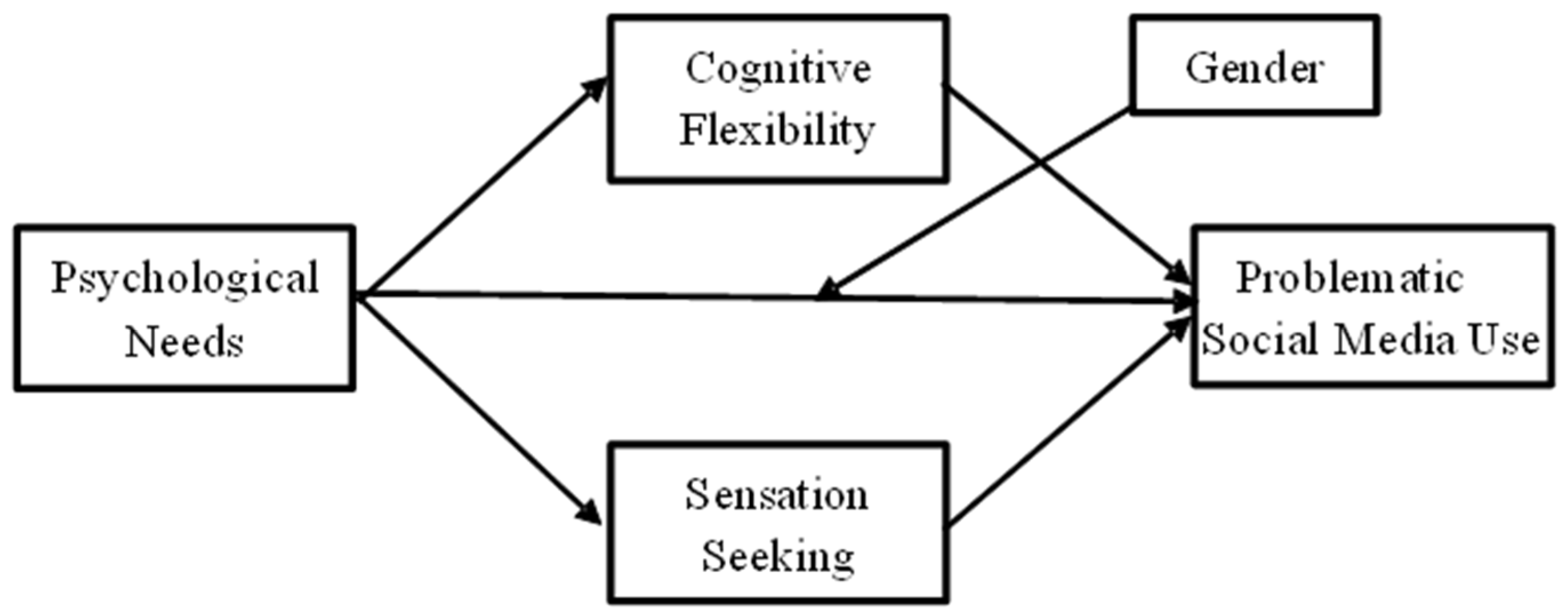
2.5. Present Study
3. Method
3.1. Participants
3.2. Measures
3.2.1. Bergen Social Media Addiction Scale
3.2.2. The Basic Psychological Needs Scale
3.2.3. Brief Sensation Seeking Scale
3.2.4. Cognitive Flexibility Scale
3.3. Procedure
3.4. Data Analysis
4. Results
4.1. Preliminary Analyses
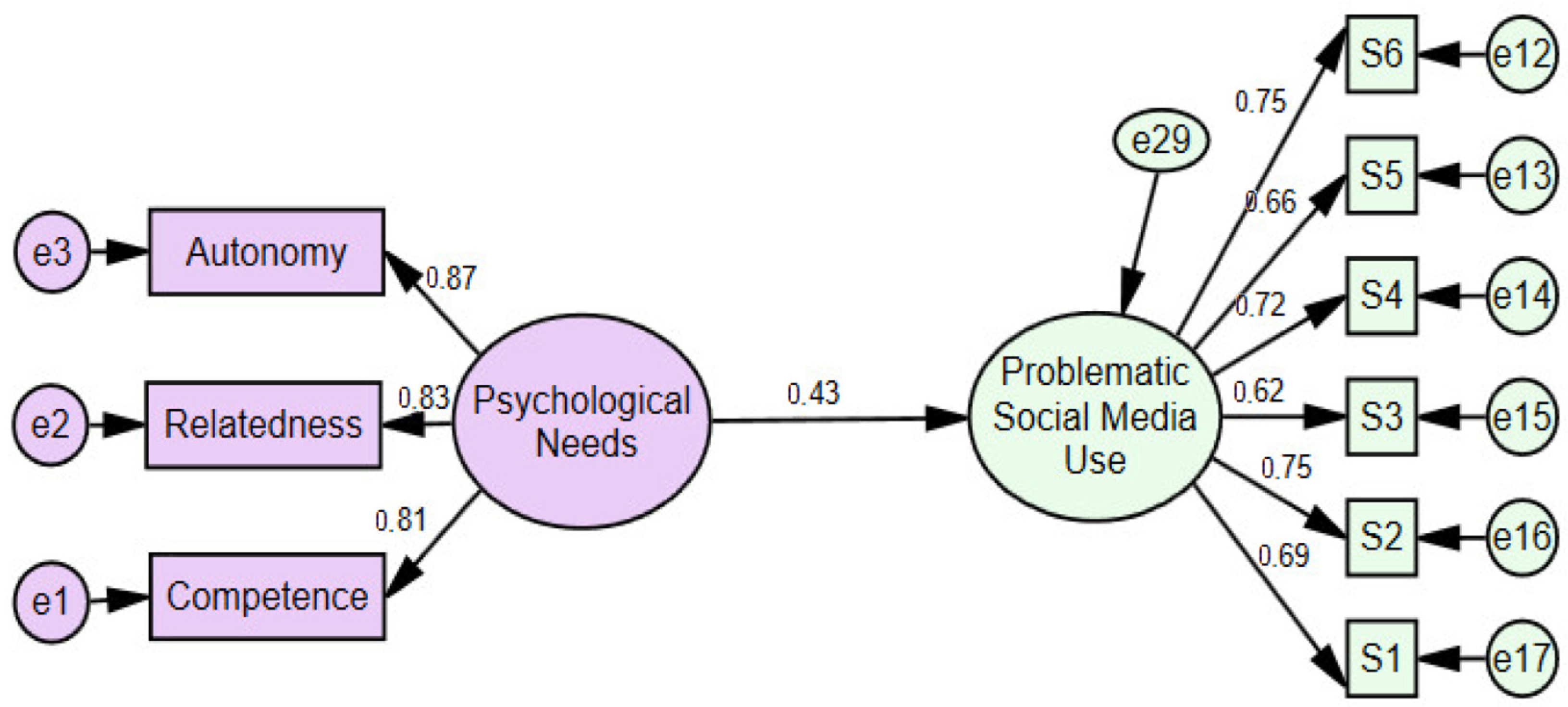
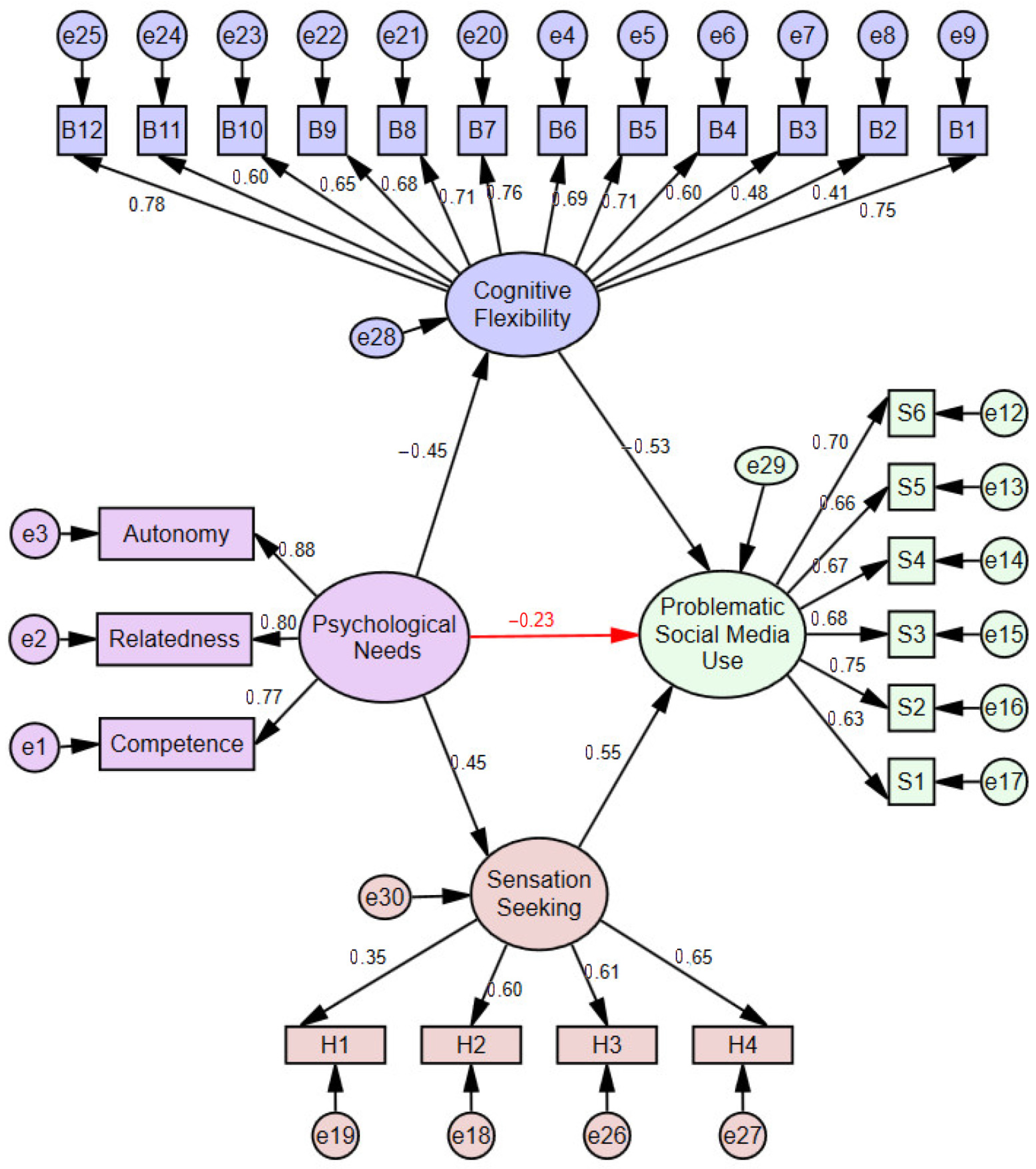
4.2. Structural Equation Model
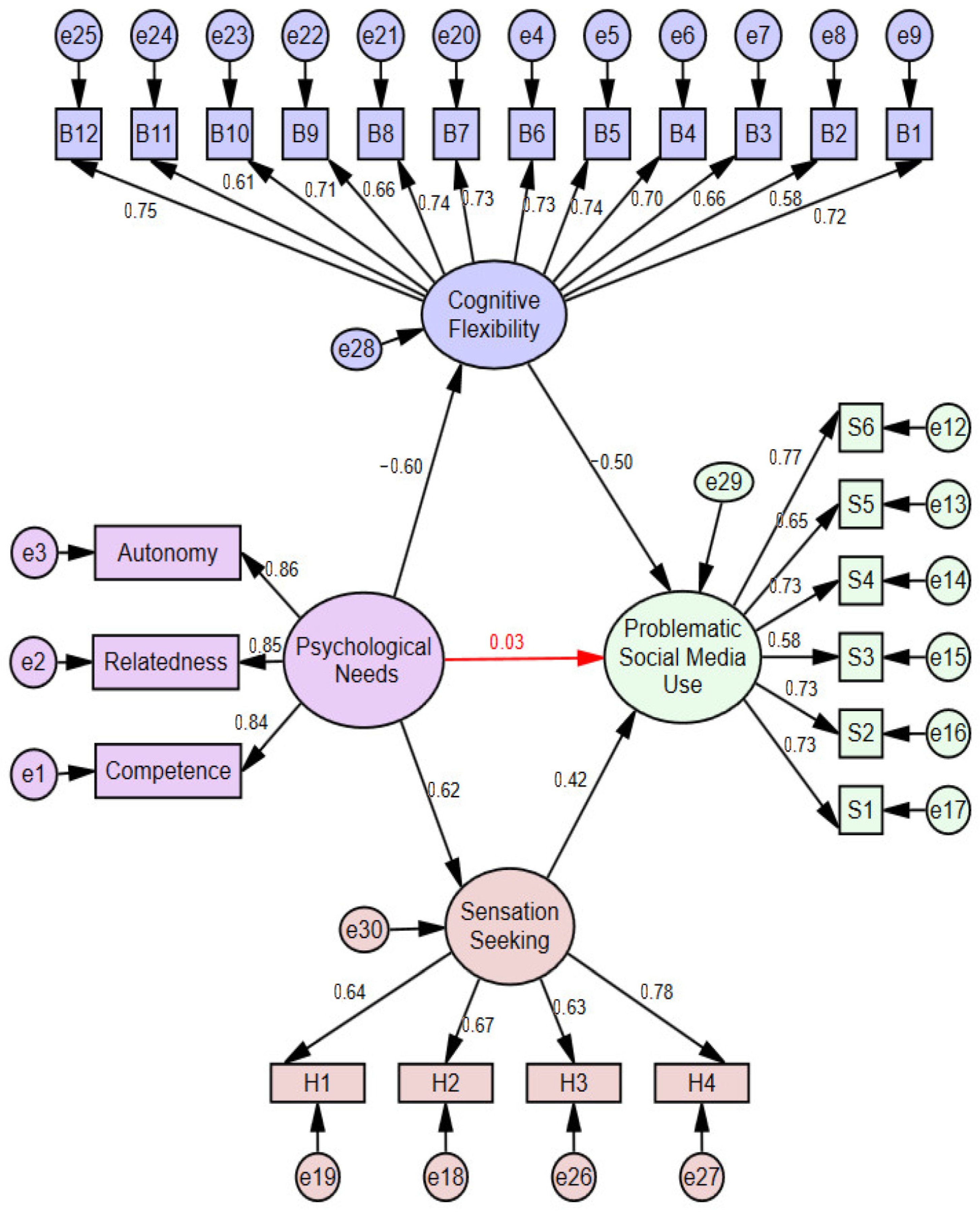
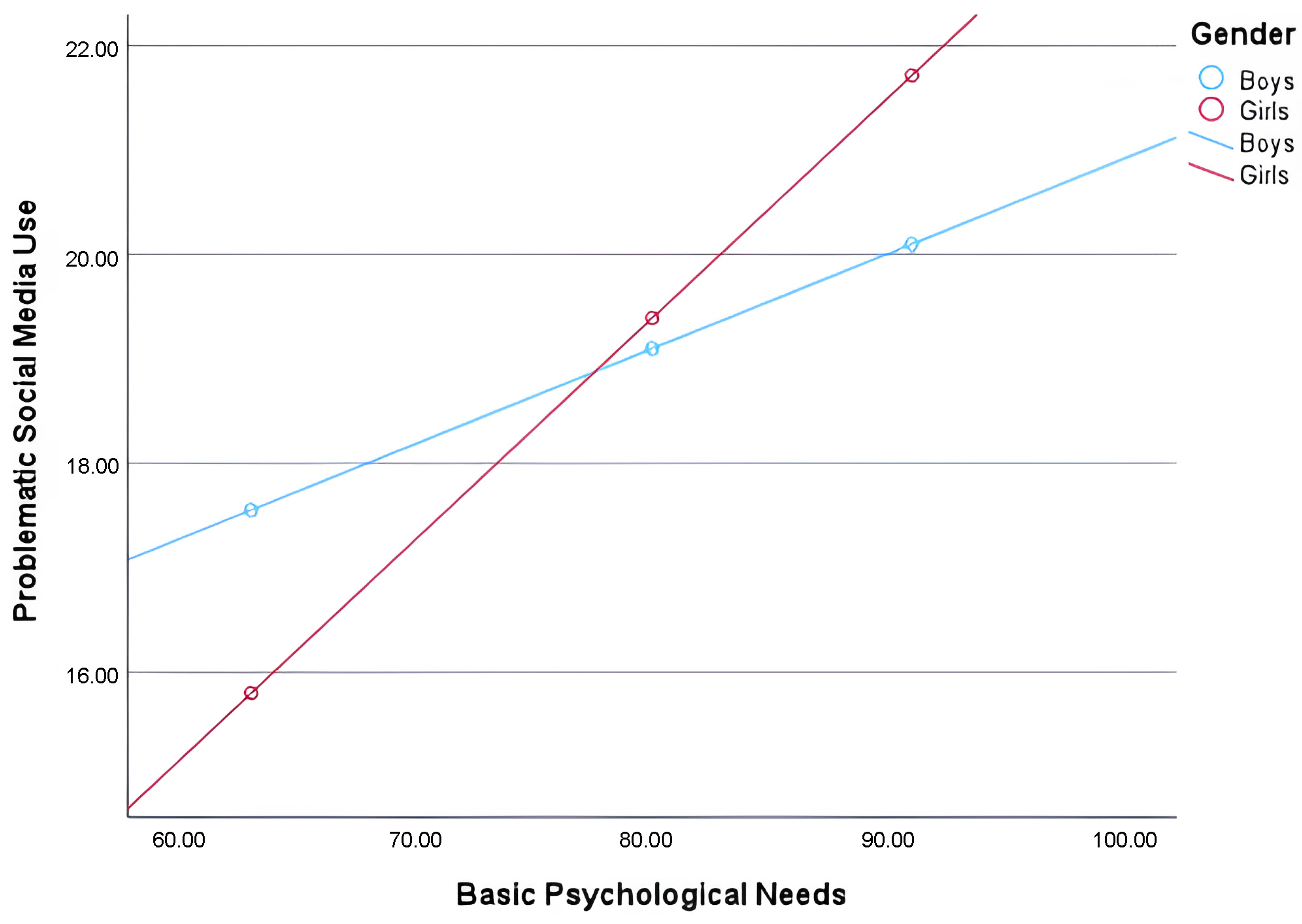
4.3. Moderated Mediation Analysis
5. Discussion
5.1. Basic Psychological Needs Are Associated with Problematic Social Media Use
5.2. Cognitive Flexibility Mediates the Relationship Between Basic Psychological Needs and Problematic Social Media Use
5.3. Sensation Seeking Mediates the Relationship Between Basic Psychological Needs and Problematic Social Media Use
5.4. Cognitive Flexibility and Sensation Seeking Mediates the Relationship Between Basic Psychological Needs and Problematic Social Media Use
5.5. Discussion of the Moderating Role of Gender
5.6. Contribution and Limitations
6. Conclusions
Author Contributions
Funding
Institutional Review Board Statement
Informed Consent Statement
Data Availability Statement
Acknowledgments
Conflicts of Interest
References
- Liao, S.H.; Widowati, R.; Tang, W. Social media, mobile payment, and mobile gaming for intentional and behavioral recommendations. Int. J. Hum.-Comput. Interact. 2025, 41, 2560–2578. [Google Scholar] [CrossRef]
- DataReportal. Digital 2025: Turkey. Available online: https://datareportal.com/reports/digital-2025-turkey (accessed on 3 March 2025).
- We Are Social. Digital 2025: Global Overview Report. 2025. Available online: https://wearesocial.com/wp-content/uploads/2025/02/GDR-2025-v2.pdf (accessed on 4 March 2025).
- Turkish Statistical Institute. Household Information Technologies (IT) Usage Survey. 2024. Available online: https://data.tuik.gov.tr/Bulten/Index?p=Hanehalki-BilisimTeknolojileri-(BT)-Kullanim-Arastirmasi-2024-53492 (accessed on 18 August 2025).
- Aydın, D.; Göncü, H.B. From childhood experiences to social media addiction: Unraveling the impact on adolescents. Children 2025, 12, 385. [Google Scholar] [CrossRef] [PubMed]
- Price, M.; Legrand, A.C.; Brier, Z.M.; van Stolk-Cooke, K.; Peck, K.; Dodds, P.S.; Danforth, C.M.; Adams, Z.W. Doomscrolling during COVID-19: The negative association between daily social and traditional media consumption and mental health symptoms during the COVID-19 pandemic. Psychol. Trauma 2022, 14, 1338. [Google Scholar] [CrossRef] [PubMed]
- Salari, N.; Zarei, H.; Hosseinian-Far, A.; Rasoulpoor, S.; Shohaimi, S.; Mohammadi, M. The global prevalence of social media addiction among university students: A systematic review and meta-analysis. J. Public Health 2025, 33, 223–236. [Google Scholar] [CrossRef]
- American Psychiatric Association. Diagnostic and Statistical Manual of Mental Disorders: DSM-5; American Psychiatric Association: Washington, DC, USA, 2022. [Google Scholar] [CrossRef]
- Al-Samarraie, H.; Bello, K.A.; Alzahrani, A.I.; Smith, A.P.; Emele, C. Young users’ social media addiction: Causes, consequences and preventions. Inf. Technol. People 2022, 35, 2314–2343. [Google Scholar] [CrossRef]
- Ji, Y.; Liu, S.; Xu, H.; Zhang, B. The causes, effects, and interventions of social media addiction. J. Educ. Humanit. Soc. Sci. 2023, 8, 897–903. [Google Scholar] [CrossRef]
- Zhang, K.; Li, P.; Zhao, Y.; Griffiths, M.D.; Wang, J.; Zhang, M.X. Effect of social media addiction on executive functioning among young adults: The mediating roles of emotional disturbance and sleep quality. Psychol. Res. Behav. Manag. 2023, 16, 1911–1920. [Google Scholar] [CrossRef]
- Arrivillaga, C.; Rey, L.; Extremera, N. A mediated path from emotional intelligence to problematic social media use in adolescents: The serial mediation of perceived stress and depressive symptoms. Addict. Behav. 2022, 124, 107095. [Google Scholar] [CrossRef]
- Saladino, V.; Verrastro, V.; Cannavò, M.; Calaresi, D.; Barberis, N. Emotion dysregulation and problematic social media use: The role of need fulfillment and fear of missing out. Curr. Psychol. 2024, 43, 22200–22211. [Google Scholar] [CrossRef]
- Cleofas, J.V. Social media disorder during community quarantine: A mixed methods study among rural young college students during the COVID-19 pandemic. Arch. Psychiatry Nurs. 2022, 40, 97–105. [Google Scholar] [CrossRef]
- Luo, T.; Qin, L.; Cheng, L.; Wang, S.; Zhu, Z.; Xu, J.; Chen, H.; Liu, Q.; Hu, M.; Tong, J.; et al. Determination of the cut-off point for the Bergen Social Media Addiction Scale (BSMAS): Diagnostic contribution of the six criteria of the components model of addiction for social media disorder. J. Behav. Addict. 2021, 10, 281–290. [Google Scholar] [CrossRef] [PubMed]
- Fournier, L.; Schimmenti, A.; Musetti, A.; Boursier, V.; Flayelle, M.; Cataldo, I.; Starcevic, V.; Billieux, J. Deconstructing the components model of addiction: An illustration through “addictive” use of social media. Addict. Behav. 2023, 143, 107694. [Google Scholar] [CrossRef] [PubMed]
- Sun, Y.; Zhang, Y. A review of theories and models applied in studies of social media addiction and implications for future research. Addict. Behav. 2021, 114, 106699. [Google Scholar] [CrossRef] [PubMed]
- Zhao, L. The impact of social media use types and social media addiction on subjective well-being of college students: A comparative analysis of addicted and non-addicted students. Comput. Hum. Behav. Rep. 2021, 4, 100122. [Google Scholar] [CrossRef]
- Keles, B.; McCrae, N.; Grealish, A. A systematic review: The influence of social media on depression, anxiety and psychological distress in adolescents. Int. J. Adolesc. Youth 2020, 25, 79–93. [Google Scholar] [CrossRef]
- Gansner, M.; Berson, C.; Javed, Z. Social media contagion of high-risk behaviors in youth. Pediatr. Clin. 2025, 72, 213–224. [Google Scholar] [CrossRef]
- Belen, H.; Yıldırım, M.; Korkmaz, Z.; Çiçek, İ.; Yıldırım, M.; Ünsal, F. The relationship between social media addiction and sleep quality: The impact of the virtual world on adolescents. J. Educ. Life 2023, 4, 844–856. [Google Scholar] [CrossRef]
- Quaglieri, A.; Biondi, S.; Roma, P.; Varchetta, M.; Fraschetti, A.; Burrai, J.; Lausi, G.; Martí-Vilar, M.; González-Sala, F.; Di Domenico, A. From emotional (Dys) regulation to internet addiction: A mediation model of problematic social media use among Italian young adults. J. Clin. Med. 2021, 11, 188. [Google Scholar] [CrossRef]
- Varchetta, M.; Tagliaferri, G.; Mari, E.; Quaglieri, A.; Cricenti, C.; Martí-Vilar, M. Cross-cultural examination of problematic internet use and associated psychological variables: A comparative study in Italy, Spain, Ecuador, and Peru. J. Clin. Med. 2024, 13, 3451. [Google Scholar] [CrossRef]
- Mari, E.; Biondi, S.; Varchetta, M.; Cricenti, C.; Fraschetti, A.; Pizzo, A.; Barchielli, B.; Roma, P.; Vilar, M.M.; Sala, F.G. Gender differences in internet addiction: A study on variables related to its possible development. Comput. Hum. Behav. Rep. 2023, 9, 100247. [Google Scholar] [CrossRef]
- Tagliaferri, G.; Martí-Vilar, M.; Frisari, F.V.; Quaglieri, A.; Mari, E.; Burrai, J.; Giannini, A.M.; Cricenti, C. Connected by boredom: A systematic review of the role of trait boredom in problematic technology use. Brain Sci. 2025, 15, 794. [Google Scholar] [CrossRef]
- Wang, J.; Wang, S. The emotional reinforcement mechanism of and phased intervention strategies for social media addiction. Behav. Sci. 2025, 15, 665. [Google Scholar] [CrossRef] [PubMed]
- Sneeden, J. Increasing Agency in Adolescent Social Media Use: An ACT-Based Intervention for Social Media Well-Being. Doctoral Dissertation, Widener University, Chester, PA, USA, 2024. Available online: https://www.proquest.com/docview/3020785143?pq-origsite=gscholar&fromopenview=true&sourcetype=Dissertations%20&%20Theses (accessed on 7 March 2025).
- Bayer, J.B.; Triệu, P.; Ellison, N.B. Social media elements, ecologies, and effects. Annu. Rev. Psychol. 2020, 71, 471–497. [Google Scholar] [CrossRef] [PubMed]
- Zhao, J.; Jia, T.; Wang, X.; Xiao, Y.; Wu, X. Risk factors associated with social media addiction: An exploratory study. Front. Psychol. 2022, 13, 837766. [Google Scholar] [CrossRef] [PubMed]
- Yee, N. The labor of fun: How video games blur the boundaries of work and play. Games Cult. 2006, 1, 68–71. [Google Scholar] [CrossRef]
- Kaba, İ. The research on the relationship between adolescents’ use of information technologies and their psychological needs in terms of Self-Determination Theory. Human. Pers. 2023, 5, 1258–1289. [Google Scholar] [CrossRef]
- Erkılıç, E. The Relationship Between Digital Game Addiction, Loneliness, and Self-Esteem Among Middle School Students, and an Examination of Digital Game Addiction in Terms of Various Demographics. Master’s Thesis, Bahçeşehir University, İstanbul, Türkiye, 2021. [Google Scholar]
- Arslan, C. A Comparison of Licensed Athletes and Sedentary Individuals in Terms of Digital Game Addiction: The Case of Ağrı Province. Master’s Thesis, Ağrı İbrahim Çeçen University, Ağrı, Türkiye, 2022. [Google Scholar]
- Koçoğlu, S. The Effect of University Students’ Digital Game Addiction on Their Communication Skills. Master’s Thesis, İnönü University, Malatya, Türkiye, 2021. [Google Scholar]
- Deci, E.L.; Ryan, R.M. The ‘what’ and ‘why’ of goal pursuits: Human needs and the self-determination of behavior. Psychol. Inq. 2000, 11, 227–268. [Google Scholar] [CrossRef]
- Uzun, M.S. An Investigation of the Relationship Between Middle School Students’ Psychological Needs at School and Their Level of School Attachment. Master’s Thesis, Karamanoğlu Mehmetbey University, Karaman, Türkiye, 2021. [Google Scholar]
- Vansteenkiste, M.; Ryan, R.M.; Soenens, B. Basic psychological need theory: Advancements, critical themes, and future directions. Motiv. Emot. 2020, 44, 1–31. [Google Scholar] [CrossRef]
- Lataster, J.; Reijnders, J.; Janssens, M.; Simons, M.; Peeters, S.; Jacobs, N. Basic psychological need satisfaction and well-being across age: A cross-sectional general population study among 1709 Dutch speaking adults. J. Happiness Stud. 2022, 23, 2259–2290. [Google Scholar] [CrossRef]
- Schutte, N.S.; Malouff, J.M. Thinking about the best possible self: A unique individual difference characteristic. Curr. Psychol. 2023, 42, 7336–7346. [Google Scholar] [CrossRef]
- Duchesne, S.; Ratelle, C.F.; Feng, B. Psychological need satisfaction and achievement goals: Exploring indirect effects of academic and social adaptation following the transition to secondary school. J. Early Adolesc. 2017, 37, 1280–1308. [Google Scholar] [CrossRef]
- Richards, D.K.; Schwebel, F.J.; Field, C.A.; Pearson, M.R.; Addictions Research Team. The associations of basic psychological need satisfaction and need frustration with cannabis-related outcomes in a multi-site sample of college students. J. Psychoact. Drugs 2024, 56, 177–186. [Google Scholar] [CrossRef]
- Ryan, R.M.; Deci, E.L. Intrinsic and extrinsic motivation from a selfdetermination theory perspective: Definitions, theory, practices, and future directions. Contemp. Educ. Psychol. 2020, 61, 101860. [Google Scholar] [CrossRef]
- Bozkurt, İ. An Investigation of the Relationship Between Social Media Addiction and Basic Psychological Needs: A Study on University Students. Master’s Thesis, Istanbul Gelisim University, Istanbul, Türkiye, 2021. [Google Scholar]
- Nigar, S. An Examination of Social Media Addiction in Terms of Attachment Styles, Emotion Regulation Difficulties, and Basic Psychological Needs. Master’s Thesis, Bolu Abant İzzet Baysal University, Bolu, Türkiye, 2023. [Google Scholar]
- Sözen, N. The Forming Role of Meeting Basic Psychological Needs in the Relationship Between Personality Traits and Social Media Addiction in Adults. Master’s Thesis, Istanbul Rumeli University, Istanbul, Türkiye, 2024. [Google Scholar]
- Fard, S.A.S.; Griffiths, M.D.; Mohseni, F.; Nabi Zadeh, S.; Ali Babaei, G. Basic psychological needs and psychological well-being: The mediating role of Instagram addiction. J. Technol. Behav. Sci. 2023, 9, 171–179. [Google Scholar] [CrossRef]
- Saeed, Q.; Zubair, A.; Mujeeb, A. Mediating role of fear of missing out in psychological needs satisfaction and social media engagement among university students. J. Behav. Sci. 2022, 32, 63–80. Available online: https://pu.edu.pk/images/journal/doap/PDF-FILES/4_V32-2-2022.pdf (accessed on 10 March 2025).
- Gugliandolo, M.C.; Costa, S.; Kuss, D.J.; Cuzzocrea, F.; Verrastro, V. Technological addiction in adolescents: The interplay between parenting and psychological basic needs. Int. J. Ment. Health Addict. 2020, 18, 1389–1402. [Google Scholar] [CrossRef]
- Ponnusamy, S.; Iranmanesh, M.; Foroughi, B.; Hyun, S.S. Drivers and outcomes of Instagram addiction: Psychological well-being as moderator. Comput. Hum. Behav. 2020, 107, 106294. [Google Scholar] [CrossRef]
- Chen, H.; Zhang, M.H. The relationship between basic psychological needs satisfaction and university students’ academic engagement: The mediating effect of emotional intelligence. Front. Psychol. 2022, 13, 917578. [Google Scholar] [CrossRef]
- Hohl, K.; Dolcos, S. Measuring cognitive flexibility: A brief review of neuropsychological, self-report, and neuroscientific approaches. Front. Hum. Neurosci. 2024, 18, 1331960. [Google Scholar] [CrossRef]
- Yu, X.; Zhao, X.; Hou, Y. Cognitive flexibility and entrepreneurial creativity: The chain mediating effect of entrepreneurial alertness and entrepreneurial self-efficacy. Front. Psychol. 2023, 14, 1292797. [Google Scholar] [CrossRef]
- Yildiz, M.; Eldeleklioglu, J. The relationship between decision-making and itolerance to uncertainty, cognitive flexibility and happiness. Eurasian J. Educ. Res. 2021, 91, 39–60. [Google Scholar] [CrossRef]
- Arán Filippetti, V.; Krumm, G. A hierarchical model of cognitive flexibility in children. Child Neuropsychol. 2020, 26, 770–800. [Google Scholar] [CrossRef] [PubMed]
- Gökçe, S.; Güner, P. Pathways from cognitive flexibility to academic achievement: Mediating roles of critical thinking disposition and mathematics anxiety. Curr. Psychol. 2024, 43, 18192–18206. [Google Scholar] [CrossRef]
- Verdejo-Garcia, A.; Clark, L.; Verdejo-Roman, J.; Albein-Urios, N.; Martinez-Gonzalez, J.M.; Gutierrez, B.; Soriano-Mas, C. Neural substrates of cognitive flexibility in cocaine and gambling addictions. Br. J. Psychiatry 2015, 207, 158–164. [Google Scholar] [CrossRef]
- İnal, Ö.; Serel Arslan, S. Investigating the effect of smartphone addiction on musculoskeletal system problems and cognitive flexibility in university students. Work 2021, 68, 107–113. [Google Scholar] [CrossRef]
- Güldal, Ş.; Kılıçoğlu, N.A.; Kasapoğlu, F. Psychological flexibility, coronavirus anxiety, humor and social media addiction during COVID-19 pandemic in Turkey. Int. J. Adv. Couns. 2022, 44, 220–242. [Google Scholar] [CrossRef]
- Yu, Y.; Yu, Y.; Lin, Y. Anxiety and depression aggravate impulsiveness: The mediating and moderating role of cognitive flexibility. Psychol. Health Med. 2020, 25, 25–36. [Google Scholar] [CrossRef]
- Corbo, I.; Troisi, G.; Marselli, G.; Casagrande, M. The role of cognitive flexibility on higher level executive functions in mild cognitive impairment and healthy older adults. BMC Psychol. 2024, 12, 317. [Google Scholar] [CrossRef]
- Kupis, L.B.; Uddin, L.Q. Developmental neuroimaging of cognitive flexibility: Update and future directions. Annu. Rev. Dev. Psychol. 2023, 5, 263–284. [Google Scholar] [CrossRef]
- Turan, S.; Çıray, R.O.; Tunçtürk, M.; Halac, E.; Bilgic, B.; Ağaç, N.; Ermiş, Ç. Social information processing and executive functions in male children and adolescents with internet gaming disorder. Child Psychiatry Hum. Dev. 2022, 55, 1063–1072. [Google Scholar] [CrossRef]
- He, Z.; Li, M. Executive function and social media addiction in female college students: The mediating role of affective state and stress. J. Genet. Psychol. 2022, 183, 279–293. [Google Scholar] [CrossRef] [PubMed]
- Gao, W.; Yan, X.; Chen, Y.; Yang, J.; Yuan, J. Situation covariation and goal adaptiveness? The promoting effect of cognitive flexibility on emotion regulation in depression. Emotion 2025, 25, 18–32. [Google Scholar] [CrossRef] [PubMed]
- Ioannidis, K.; Hook, R.; Goudriaan, A.E.; Vlies, S.; Fineberg, N.A.; Grant, J.E.; Chamberlain, S.R. Cognitive deficits in problematic internet use: Meta-analysis of 40 studies. Br. J. Psychiatry 2019, 215, 639–646. [Google Scholar] [CrossRef] [PubMed]
- Stepanyan, S.T.; Natsuaki, M.N.; Cheong, Y.; Hastings, P.D.; Zahn-Waxler, C.; Klimes-Dougan, B. Early pubertal maturation and externalizing behaviors: Examination of peer delinquency as mediator and cognitive flexibility as a moderator. J. Adolesc. 2020, 84, 45–55. [Google Scholar] [CrossRef]
- Menon, D. Updating ‘Stories’ on social media and its relationships to contextual age and narcissism: A tale of three platforms–WhatsApp, Instagram, and Facebook. Heliyon 2022, 8, e09412. [Google Scholar] [CrossRef]
- Avci, H.; Baams, L.; Kretschmer, T. A systematic review of social media use and adolescent identity development. Adolesc. Res. Rev. 2025, 10, 219–236. [Google Scholar] [CrossRef]
- Tei, S.; Fujino, J.; Murai, T. Navigating the self online. Front. Psychol. 2025, 16, 1499039. [Google Scholar] [CrossRef]
- Taşbaşı, İ.; Bakioğlu, F.; Korkmaz, O. Examining the mediating role of sensation seeking in the relationship between basic psychological needs and digital game addiction in adolescents. Kocaeli Univ. J. Educ. 2024, 7, 432–454. [Google Scholar] [CrossRef]
- Dursun, A.; Eraslan-Çapan, B. Ergenlerde dijital oyun bağimliliği ve psikolojik ihtiyaçlar. İnönü Univ. J. Educ. 2018, 19, 128–140. [Google Scholar] [CrossRef]
- Meng, Y.; Li, M.; He, J. Sensation seeking and social network addiction among college students: A moderated mediation model. Curr. Psychol. 2024, 43, 10979–10988. [Google Scholar] [CrossRef]
- 73; Tasman, D.R.; Aydoğmuş, M.E. The importance of basic psychological needs in relationship quality: A review on the basis of self-determination theory and main relationship categories. Nesne 2022, 10, 294–315. [Google Scholar] [CrossRef]
- West, M.; Rice, S.; Vella-Brodrick, D. Adolescent social media use through a self-determination theory lens: A systematic scoping review. Int. J. Environ. Res. Public Health 2024, 21, 862. [Google Scholar] [CrossRef]
- Annalakshmi, N.; Thasleema, N.; Pooja Sri, S. Sensation seeking and problematic use of technology among youth. Indian J. Ment. Health 2020, 7, 210–221. [Google Scholar] [CrossRef]
- Köksoy-Vayısoğlu, S.; Öncü, E.; Güven, Y. The frequency of gambling among university students and ıts relationships to their sensation-seeking behaviors. Addicta 2019, 6, 69–90. [Google Scholar] [CrossRef]
- Bányai, F.; Zsila, Á.; Király, O.; Maraz, A.; Elekes, Z.; Griffiths, M.D.; Andreassen, C.S.; Demetrovics, Z. Problematic social media use: Results from a large-scale nationally representative adolescent sample. PLoS ONE 2017, 12, e0169839. [Google Scholar] [CrossRef] [PubMed]
- Yue, H.; Zhang, X.; Cheng, X.; Liu, B.; Bao, H. Measurement invariance of the Bergen social media addiction scale across genders. Front. Psychol. 2022, 13, 879259. [Google Scholar] [CrossRef]
- Strang, N.M.; Chein, J.M.; Steinberg, L. The value of the dual systems model of adolescent risk-taking. Front. Hum. Neurosci. 2013, 7, 223. [Google Scholar] [CrossRef]
- Varchetta, M.; Tagliaferri, G.; Mari, E.; Quaglieri, A.; Cricenti, C.; Giannini, A.M.; Martí-Vilar, M. Exploring gender differences in ınternet addiction and psychological factors: A study in a Spanish sample. Brain Sci. 2024, 14, 1037. [Google Scholar] [CrossRef]
- García-Fernández, M.; Fuentes-Sánchez, N.; Escrig, M.A.; Eerola, T.; Pastor, M.C. Gender, emotion regulation, and cognitive flexibility as predictors of depression, anxiety, and affect in healthy adults. Curr. Psychol. 2025, 44, 5685–5694. [Google Scholar] [CrossRef]
- Wang, Z.L.; Song, K.R.; Zhou, N.; Potenza, M.N.; Zhang, J.T.; Dong, G.H. Gender-related differences in involvement of addiction brain networks in internet gaming disorder: Relationships with craving and emotional regulation. Prog. Neuro-Psychopharmacol. Biol. Psychiatry 2022, 118, 110574. [Google Scholar] [CrossRef]
- Zang, Z.; Dolcos, F.; Hohl, K.; Bogdan, P.C.; Dolcos, S. The role of sex differences in the link between emotion regulation and psychological well-being during a major mental health crisis. Behav. Sci. 2025, 15, 636. [Google Scholar] [CrossRef] [PubMed]
- Dong, G.H.; Potenza, M.N. Considering gender differences in the study and treatment of internet gaming disorder. J. Psychiatry Res. 2022, 153, 25–29. [Google Scholar] [CrossRef] [PubMed]
- Winds, K.; Aebi, M.; Plattner, B. Problematic internet use among adolescent male and female psychiatric inpatients: A gender perspective. Child Psychiatry Hum. Dev. 2024, 55, 497–509. [Google Scholar] [CrossRef] [PubMed]
- Aran-Ramspott, S.; Korres-Alonso, O.; Elexpuru-Albizuri, I.; Moro-Inchaurtieta, Á.; Bergillos-García, I. Young users of social media: A gender analysis. Front. Psychol. 2024, 15, 1375983. [Google Scholar] [CrossRef]
- Manago, A.M.; Walsh, A.S.; Barsigian, L.L. The contributions of gender identification and gender ideologies to the purposes of social media use in adolescence. Front. Psychol. 2023, 13, 1011951. [Google Scholar] [CrossRef]
- Şimşek, E.; Yılmaz, T.K. Systematic review of method and results of digital game addiction studies conducted in Turkey. Kastamonu Educ. J. 2020, 28, 1851–1866. [Google Scholar] [CrossRef]
- Andreassen, C.S.; Billieux, J.; Griffiths, M.D.; Kuss, D.J.; Demetrovics, Z.; Mazzoni, E.; Pallasen, S. The relationship between addictive use of social media and video games and symptoms of psychiatric disorders: A large-scale cross-sectional study. Psychol. Addict. Behav. 2016, 30, 252–262. [Google Scholar] [CrossRef]
- Demirci, İ. The adaptation of the Bergen Social Media Addiction Scale to Turkish and its evaluation of relationship with depression and anxiety symptoms. Anatol. J. Psychiatry 2019, 20, 15–22. [Google Scholar] [CrossRef]
- Kesici, Ş.; Üre, Ö.; Bozgeyikli, H.; Sünbül, A.M. Validity and reliability of the basic psychological needs scale. In Proceedings of the Book of Abstracts of the VIIth National Psychological Counseling and Guidance Congress, Malatya, Türkiye, 9–11 July 2023; p. 85. [Google Scholar]
- Stephenson, M.T.; Hoyle, R.H.; Palmgreen, P.; Slater, M.D. Brief measures of sensation seeking for screening and large-scale surveys. Drug Alcohol Depend. 2023, 72, 279–286. [Google Scholar] [CrossRef]
- Çelik, E. Psychometric properties of brief sensation seeking scale (BSSS-4) in a sample of Turkish adolescents. Sakarya Univ. J. Educ. 2015, 5, 42–51. [Google Scholar] [CrossRef]
- Martin, M.M.; Rubin, R.B. A new measure of cognitive flexibility. Psychol. Rep. 1995, 76, 623. [Google Scholar] [CrossRef]
- Çelikkaleli, Ö. Validity and reliability of the Cognitive Flexibility Scale. Educ. Sci. 2014, 39, 339–346. [Google Scholar] [CrossRef]
- Orakcı, Ş. Exploring the relationships between cognitive flexibility, learner autonomy, and reflective thinking. Think. Skills Creat. 2021, 41, 100838. [Google Scholar] [CrossRef]
- Tabachnick, B.G.; Fidell, L.S. The Use of Multivariate Statistics; Baloğlu, M., Ed.; Nobel: Ankara, Türkiye, 2015. [Google Scholar]
- Browne, M.W.; Cudeck, R. Alternative ways of assessing model fit. Sociol. Methods Res. 1992, 21, 230–258. [Google Scholar] [CrossRef]
- Hu, L.T.; Bentler, P.M. Fit indices in covariance structure modeling: Sensitivity to underparameterized model misspecification. Psychol. Methods 1998, 3, 424–453. [Google Scholar] [CrossRef]
- Hooper, D.; Coughlan, J.; Mullen, M. Evaluating model fit: A synthesis of the structural equation modelling literature. In Proceedings of the 7th European Conference on Research Methodology for Business and Management Studies, London, UK, 19–20 June 2008. [Google Scholar]
- Marsh, H.W.; Hau, K.T. Assessing goodness of fit: Is parsimony always desirable? J. Exp. Educ. 1996, 64, 364–390. [Google Scholar] [CrossRef]
- Kurker, F.; Surucu, A. Social media addiction mediates the relationship between basic psychological needs satisfaction and academic procrastination. Psychol. Sch. 2024, 61, 2701–2721. [Google Scholar] [CrossRef]
- Karaman, H.B.; Arslan, C. The mediating role of social media addiction and phubbing in basic psychological needs in relationships and relationship satisfaction. Front. Psychol. 2024, 15, 1291638. [Google Scholar] [CrossRef]
- Lin, S.; Mastrokoukou, S.; Longobardi, C. Social relationships and social media addiction among adolescents: Variable-centered and person-centered approaches. Comput. Hum. Behav. 2023, 147, 107840. [Google Scholar] [CrossRef]
- Sağar, M.E. Predictive role of cognitive flexibility and self-control on social media addiction in university students. Int. Educ. Stud. 2021, 14, 1–10. [Google Scholar] [CrossRef]
- Qayyum, S.A.; Sikandar, A.; Zahra, S.T. Mediating role of cognitive flexibility in the relationship between smartphone addiction and phubbing. Qlantic J. Soc. Sci. Humanit. 2024, 5, 198–212. [Google Scholar] [CrossRef]
- Çekiç, A.; Öz, T.A.; Yılmaz, Ü.; Yıldırım, A. The mediating role of cognitive flexibility in the relationship between social media addiction and mental well-being in young adults. Int. J. Prog. Educ. 2024, 20, 26–37. [Google Scholar] [CrossRef]
- Imran, M.; Akram, F.; Rabbani, A.; Kalim, M. Social media addiction and academic procrastination with mediating role of cognitive flexibility among university students. J. Asian Dev. Stud. 2025, 14, 1704–1712. [Google Scholar] [CrossRef]
- Tanhan, F.; Özok, H.İ.; Kaya, A.; Yıldırım, M. Mediating and moderating effects of cognitive flexibility in the relationship between social media addiction and phubbing. Curr. Psychol. 2024, 43, 192–203. [Google Scholar] [CrossRef]
- Wang, Q.; Chen, H.; Hu, W.; Zhao, F. Social networking sites addiction and depression among Chinese college students: The mediating role of cognitive flexibility and the moderating role of chronotype. Child. Youth Serv. Rev. 2023, 155, 107209. [Google Scholar] [CrossRef]
- Chaboki, S.A.; Belyad, M.R.; Kakavand, A.; Tajeri, B.; Zam, F. Developing a structural model of the relationship between sensation seeking and adolescent internet addiction: The mediating role of self-empowerment. Shenakht J. Psychol. Psychiatry 2021, 8, 75–84. [Google Scholar] [CrossRef]
- Cui, S.; Jiang, J.; Mu, L. The relationship between loneliness and the overuse of weChat among Chinese elderly: The chain mediation role of sensation seeking and fear of missing out. Psychol. Res. Behav. Manag. 2024, 17, 3067–3081. [Google Scholar] [CrossRef]
- Damirchi, E.S.; Pireinaladin, S.; Akbari, T.; Dargahi, S. The prediction of the student’s tendency to computer games based on the brain-behavioral functions, cognitive flexibility and sensation seeking. Arch. Psychiatry Psychother. 2020, 1, 70–76. [Google Scholar] [CrossRef]
- De, D.; El Jamal, M.; Aydemir, E.; Khera, A. Social media algorithms and teen addiction: Neurophysiological impact and ethical considerations. Cureus 2025, 17, e77145. [Google Scholar] [CrossRef]
- Yousef, A.M.F.; Alshamy, A.; Tlili, A.; Metwally, A.H.S. Demystifying the new dilemma of brain rot in the digital era: A review. Brain Sci. 2025, 15, 283. [Google Scholar] [CrossRef]
- Li, S.; Ren, P.; Chiu, M.M.; Wang, C.; Lei, H. The relationship between self-control and internet addiction among students: A meta-analysis. Front. Psychol. 2021, 12, 735755. [Google Scholar] [CrossRef]



| Scale Name | Instrument (Original/Turkish Version) | Items | Response Scale | Reliability (α) | Validity Evidence | Justification for Use |
|---|---|---|---|---|---|---|
| Bergen Social Media Addiction Scale | [89,90] | 6 | 5-point Likert | [90]; 0.85 (current) | χ2/df = 1.33, SRMR = 0.04; RMSEA = 0.05, CFI = 0.99, TLI = 0.98, p = 0.214 | Brief, validated Turkish version of a widely used scale for adolescents |
| The Basic Psychological Needs Scale | [35,91] | 21 | 5-point Likert | 0.73, 0.61, 0.73 [91]; 0.79, 0.75, 0.81 (current) | Expert review (content validity); significant correlations with Edwards Personal Preference Inventory (criterion validity) | Widely used, valid, and reliable Turkish measure of autonomy, competence, and relatedness needs |
| Brief Sensation Seeking Scale | [92,93] | 4 | 4-point Likert | 0.81 [93]; 0.72 (current) | EFA: single factor structure, explained variance = 64.02% | Brief, psychometrically sound measure of sensation seeking validated for Turkish adolescents |
| Cognitive Flexibility Scale | [94,95] | 12 | 6-point Likert | 0.87 [96]; 0.91 (current) | χ2/df = 2.79, RMSEA = 0.06, CFI = 0.94, GFI = 0.91, SRMR = 0.07 | Reliable, valid self-report tool for Turkish samples |
| Variable | a | b | c | d | e | f |
|---|---|---|---|---|---|---|
| a: Problematic Social Media Use | 1 | |||||
| b: Autonomy | 0.33 ** | 1 | ||||
| c: Relatedness | 0.33 ** | 0.73 ** | 1 | |||
| d: Competence | 0.33 ** | 0.71 ** | 0.67 ** | 1 | ||
| e: Cognitive Flexibility | −0.59 ** | −0.44 ** | −0.41 ** | −0.41 ** | 1 | |
| f: Sensation Seeking | 0.53 ** | 0.39 ** | 0.38 ** | 0.40 ** | −0.41 ** | 1 |
| Mean | 19.96 | 25.75 | 30.58 | 21.38 | 40.29 | 12.27 |
| SD | 6.20 | 5.30 | 5.93 | 4.60 | 13.08 | 3.14 |
| Skewness | −0.19 | −0.66 | −0.83 | −0.57 | 0.18 | −0.76 |
| Kurtosis | −1.16 | 0.09 | 0.24 | −0.12 | −1.17 | −0.43 |
| Condition Index | 1 | 6.32 | 11.89 | 20.42 | 23.62 | 24.62 |
| VIF | - | 2.28 | 2.42 | 2.30 | 1.37 | 1.32 |
| Tolerance | - | 0.373 | 0.413 | 0.435 | 0.728 | 0.757 |
| İndices | Perfect Fit Limit | Acceptable Fit Limit | Scale Indices | Result |
|---|---|---|---|---|
| X2/DF | 0–2.5 | ≤5 | 1.87 | Perfect |
| RMSEA | ≤0.05 | ≤0.08 | 0.03 | Perfect |
| SRMR | ≤0.05 | ≤0.08 | 0.06 | Perfect |
| CFI | ≥95 | ≥90 | 0.95 | Perfect |
| GFI | ≥90 | ≥85 | 0.91 | Perfect |
| IFI | ≥95 | ≥90 | 0.95 | Perfect |
| Path | Coefficient (β) | SE | 95% CI | |
|---|---|---|---|---|
| Standardized Total Effect | Lower | Upper | ||
| Psychological Needs → Problematic Social Media Use (Boys) | 0.58 | 0.04 | 0.498 | 0.663 |
| Psychological Needs → Problematic Social Media Use (Girls) | 0.25 | 0.06 | 0.124 | 0.373 |
| Standardized Direct Effect | ||||
| Psychological Needs → Problematic Social Media Use (Boys) | 0.03 | 0.07 | −0.112 | 0.163 |
| Psychological Needs → Problematic Social Media Use (Girls) | −0.23 | 0.06 | −0.365 | −0.114 |
| Standardized Indirect Effect | ||||
| Psychological Needs → Sensation Seeking + Cognitive Flexibility → Problematic Social Media Use (Boys) | 0.56 | 0.06 | 0.450 | 0.684 |
| Psychological Needs → Sensation Seeking + Cognitive Flexibility → Problematic Social Media Use (Girls) | 0.48 | 0.06 | 0.369 | 0.629 |
Disclaimer/Publisher’s Note: The statements, opinions and data contained in all publications are solely those of the individual author(s) and contributor(s) and not of MDPI and/or the editor(s). MDPI and/or the editor(s) disclaim responsibility for any injury to people or property resulting from any ideas, methods, instructions or products referred to in the content. |
© 2025 by the authors. Licensee MDPI, Basel, Switzerland. This article is an open access article distributed under the terms and conditions of the Creative Commons Attribution (CC BY) license.
Share and Cite
Dombak, K.; Yayla, İ.E.; Makas, S.; Çelik, E.; Sahranç, Ü.; Kaya, M. Psychological Needs and Problematic Social Media Use in Adolescents: A Gender-Moderated Mediation via Sensation Seeking and Cognitive Flexibility. Healthcare 2026, 14, 8. https://doi.org/10.3390/healthcare14010008
Dombak K, Yayla İE, Makas S, Çelik E, Sahranç Ü, Kaya M. Psychological Needs and Problematic Social Media Use in Adolescents: A Gender-Moderated Mediation via Sensation Seeking and Cognitive Flexibility. Healthcare. 2026; 14(1):8. https://doi.org/10.3390/healthcare14010008
Chicago/Turabian StyleDombak, Kübra, İbrahim Erdoğan Yayla, Samet Makas, Eyüp Çelik, Ümit Sahranç, and Mehmet Kaya. 2026. "Psychological Needs and Problematic Social Media Use in Adolescents: A Gender-Moderated Mediation via Sensation Seeking and Cognitive Flexibility" Healthcare 14, no. 1: 8. https://doi.org/10.3390/healthcare14010008
APA StyleDombak, K., Yayla, İ. E., Makas, S., Çelik, E., Sahranç, Ü., & Kaya, M. (2026). Psychological Needs and Problematic Social Media Use in Adolescents: A Gender-Moderated Mediation via Sensation Seeking and Cognitive Flexibility. Healthcare, 14(1), 8. https://doi.org/10.3390/healthcare14010008