From Dogs to Robots: Pet-Assisted Interventions for Depression in Older Adults—A Network Meta-Analysis of Randomized Controlled Trials

 , , and
Abstract
1. Introduction
2. Materials and Methods
2.1. Database Search and Identification
2.2. Inclusion and Exclusion Criteria
2.3. Model Construction for Network Meta-Analysis
2.4. Risk of Bias Assessment
2.5. Primary Outcome: Improvement of Depression in Older Adults
2.6. Secondary Outcomes: Intervention Modalities and Content
2.7. Data Extraction, Handling, and Transformation
2.8. Statistical Analysis
2.9. Sensitivity Analysis Methods
2.10. Assessment of Publication Bias
3. Results
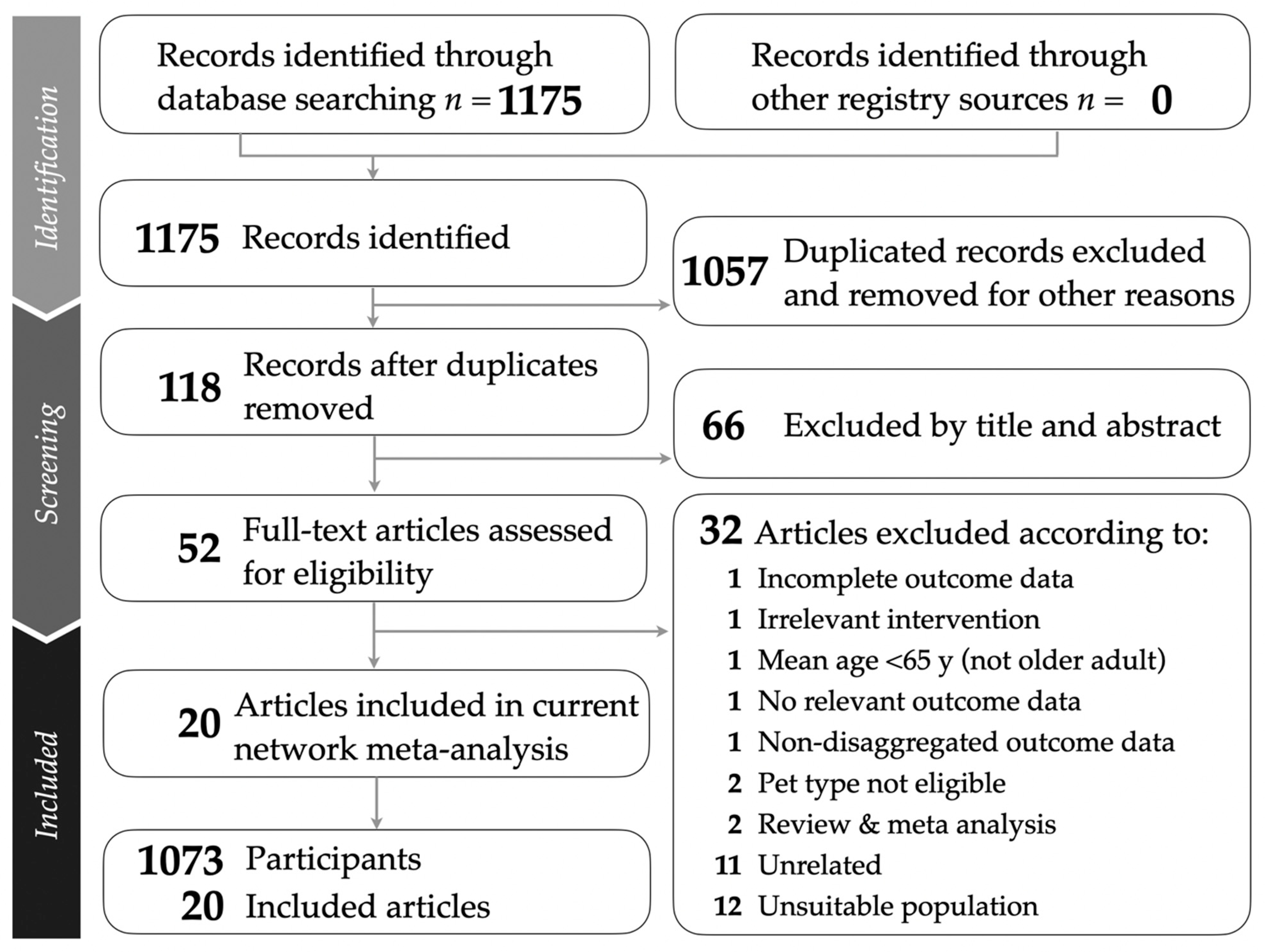
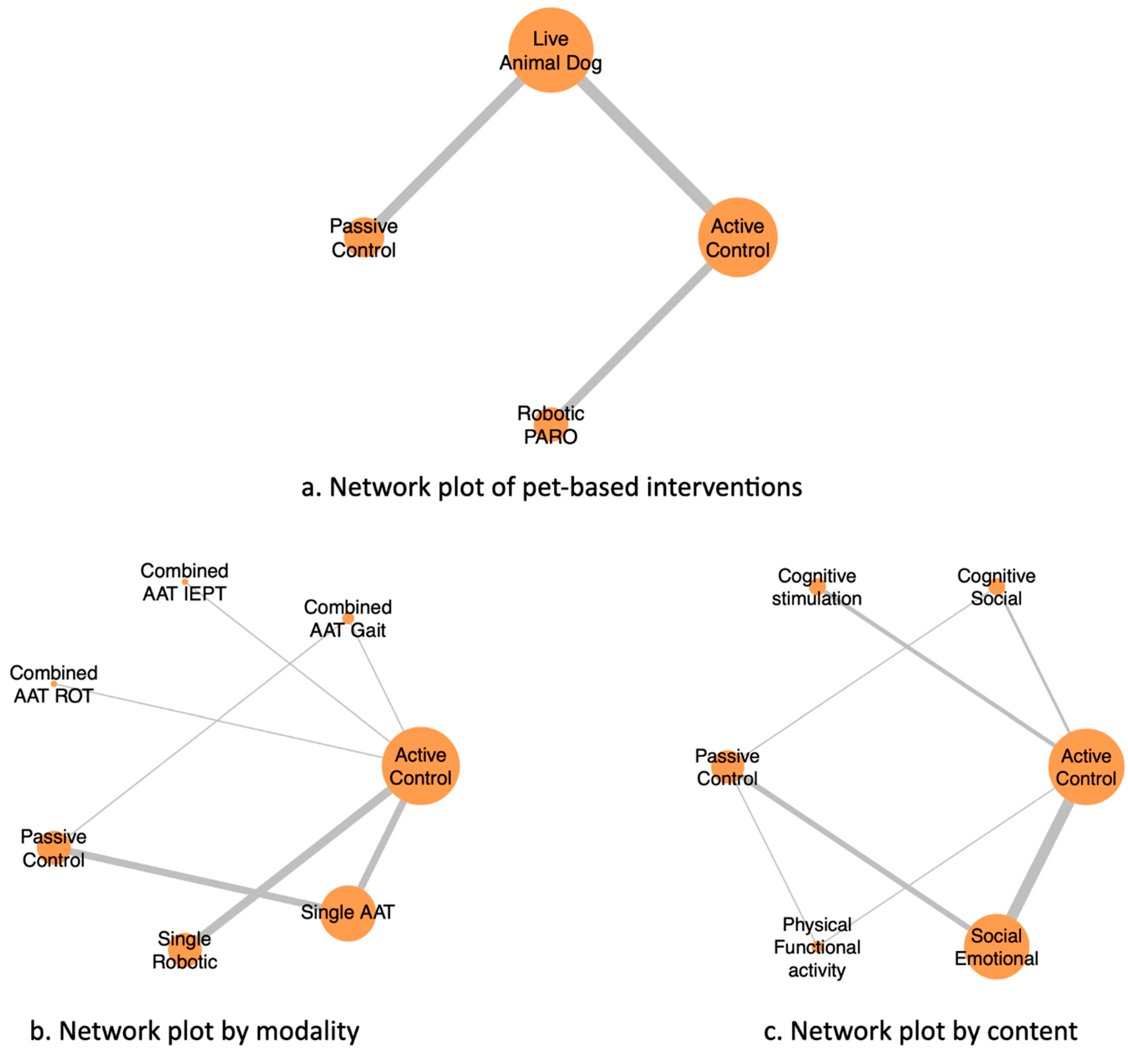
3.1. Study Identification and Network Model Construction
3.2. Studies’ Quality and Risk of Bias Assessment
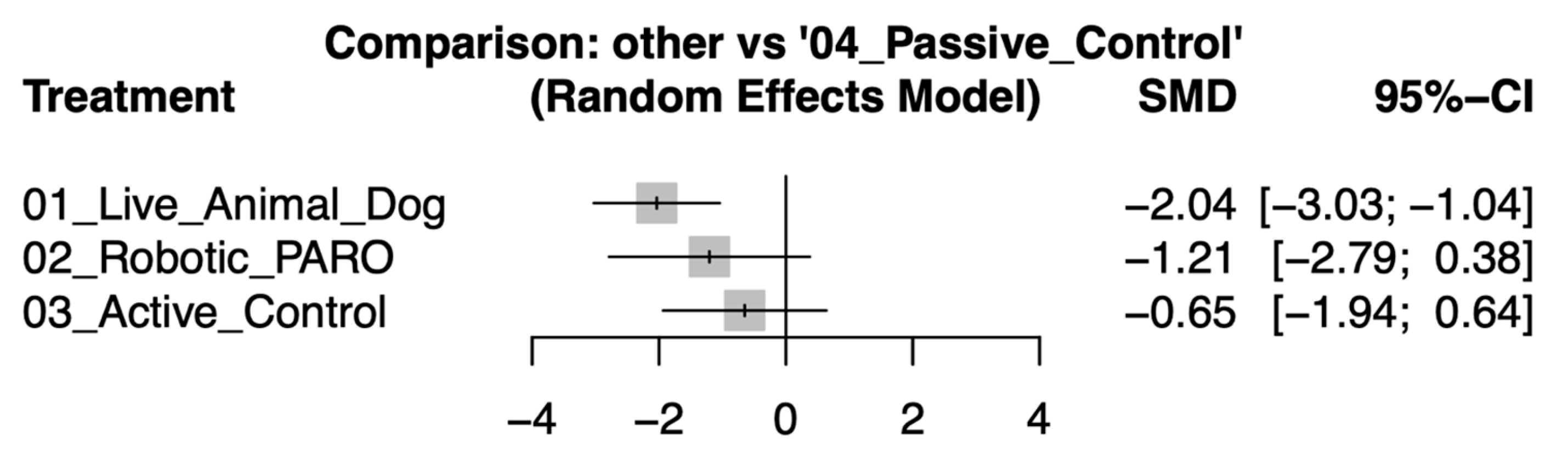
3.3. Main Outcome: Effectiveness of Pet-Assisted Interventions for Alleviating Depression in Older Adults
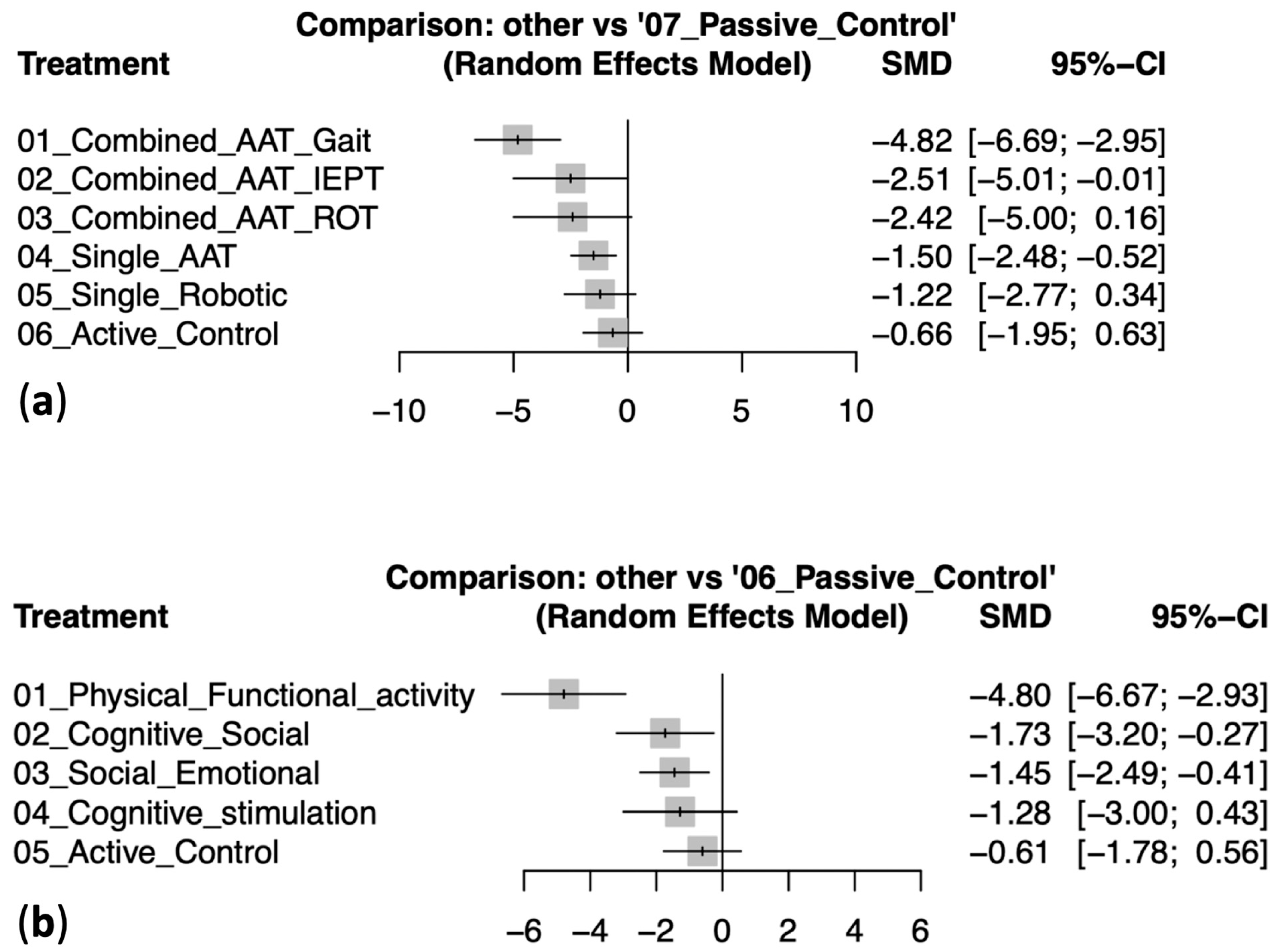
3.4. Secondary Outcomes: Network Meta-Analyses Stratified by Modality and Content
3.5. Inconsistency Testing
3.6. Sensitivity Analysis
3.7. Publication Bias
4. Discussion
4.1. Main Findings and Clinical Implications
4.2. Significance of Results in the Context of Current Research
4.3. Possible Explanations for the Observed Results
4.4. Study Limitations
5. Conclusions
Supplementary Materials
Author Contributions
Funding
Institutional Review Board Statement
Informed Consent Statement
Data Availability Statement
Conflicts of Interest
References
- Tang, T.; Jiang, J.; Tang, X. Prevalence of Depression among Older Adults Living in Care Homes in China: A Systematic Review and Meta-Analysis. Int. J. Nurs. Stud. 2022, 125, 104114. [Google Scholar] [CrossRef] [Scilit]
- Rivera, E.; Hirschman, K.B.; Naylor, M.D. Reported Needs and Depressive Symptoms among Older Adults Entering Long-Term Services and Supports. Innov. Aging 2020, 4, igaa021. [Google Scholar] [CrossRef] [Scilit] [PubMed]
- Wassink-Vossen, S.; Oude Voshaar, R.C.; Naarding, P.; Collard, R.M. Effectiveness of Late-Life Depression Interventions on Functional Limitations: A Systematic Review. Int. J. Ment. Health Nurs. 2022, 31, 823–842. [Google Scholar] [CrossRef] [Scilit] [PubMed]
- Forbes, M.; Lotfaliany, M.; Mohebbi, M.; Reynolds, C.F.; Woods, R.L.; Orchard, S.; Chong, T.; Agustini, B.; O’Neil, A.; Ryan, J.; et al. Depressive Symptoms and Cognitive Decline in Older Adults. Int. Psychogeriatr. 2024, 36, 1039–1050. [Google Scholar] [CrossRef] [Scilit] [PubMed]
- Ambrosi, C.; Zaiontz, C.; Peragine, G.; Sarchi, S.; Bona, F. Randomized Controlled Study on the Effectiveness of Animal-Assisted Therapy on Depression, Anxiety, and Illness Perception in Institutionalized Elderly. Psychogeriatrics 2019, 19, 55–64. [Google Scholar] [CrossRef] [Scilit]
- Baek, S.M.; Lee, Y.; Sohng, K.Y. The Psychological and Behavioural Effects of an Animal-Assisted Therapy Programme in Korean Older Adults with Dementia. Psychogeriatrics 2020, 20, 645–653. [Google Scholar] [CrossRef] [Scilit]
- Majić, T.; Gutzmann, H.; Heinz, A.; Lang, U.E.; Rapp, M.A. Animal-Assisted Therapy and Agitation and Depression in Nursing Home Residents with Dementia: A Matched Case-Control Trial. Am. J. Geriatr. Psychiatry 2013, 21, 1052–1059. [Google Scholar] [CrossRef] [Scilit]
- Jessen, J.; Cardiello, F.; Baun, M.M. Avian Companionship in Alleviation of Depression, Loneliness, and Low Morale of Older Adults in Skilled Rehabilitation Units. Psychol. Rep. 1996, 78, 339–348. [Google Scholar] [CrossRef] [Scilit]
- Villarreal-Zegarra, D.; Yllescas-Panta, T.; Malaquias-Obregon, S.; Dámaso-Román, A.; Mayo-Puchoc, N. Effectiveness of Animal-Assisted Therapy and Pet-Robot Interventions in Reducing Depressive Symptoms among Older Adults: A Systematic Review and Meta-Analysis. Complement. Ther. Med. 2024, 80, 103023. [Google Scholar] [CrossRef] [Scilit]
- An, H.J.; Park, S.J. Effects of Animal-Assisted Therapy on Gait Performance, Respiratory Function, and Psychological Variables in Patients Post-Stroke. Int. J. Environ. Res. Public Health 2021, 18, 5818. [Google Scholar] [CrossRef] [Scilit]
- Kil, T.; Yoon, K.A.; Ryu, H.; Kim, M. Effect of Group Integrated Intervention Program Combined Animal-Assisted Therapy and Integrated Elderly Play Therapy on Live Alone Elderly. J. Anim. Sci. Technol. 2019, 61, 379–387. [Google Scholar] [CrossRef] [Scilit] [PubMed]
- Sbrizzi, C.; Sapuppo, W. Effects of Pet Therapy in Elderly Patients with Neurocognitive Disorders: A Brief Review. Dement. Geriatr. Cogn. Dis. Extra 2021, 11, 198–206. [Google Scholar] [CrossRef] [Scilit] [PubMed]
- Arsovski, D. The Role of Animal Assisted Therapy in the Rehabilitation of Mental Health Disorders: A Systematic Literature Review. Perspect. Integr. Med. 2024, 3, 142–151. [Google Scholar] [CrossRef] [Scilit]
- Zhou, Z.; Mei, H.; Li, R.; Wang, C.; Fang, K.; Wang, W.; Tang, Y.; Dai, Z. Progresses of Animal Robots: A Historical Review and Perspectiveness. Heliyon 2022, 8, e11499. [Google Scholar] [CrossRef] [Scilit]
- Chen, S.-C.; Lin, M.-F.; Jones, C.; Chang, W.H.; Lin, S.-H.; Chien, C.-O.; Hsu, C.-F.; Qiu, H.-Y.; Moyle, W. Effect of a Group-Based Personal Assistive Robot (Paro) Robot Intervention on Cognitive Function, Autonomic Nervous System Function, and Mental Well-Being in Older Adults with Mild Dementia: A Randomized Controlled Trial. J. Am. Med. Dir. Assoc. 2024, 25, 105228. [Google Scholar] [CrossRef] [Scilit]
- Vegue Parra, E.; Hernández Garre, J.M.; Echevarría Pérez, P. Benefits of Dog-Assisted Therapy in Patients with Dementia Residing in Aged Care Centers in Spain. Int. J. Environ. Res. Public Health 2021, 18, 1471. [Google Scholar] [CrossRef] [Scilit]
- Orr, N.; Abbott, R.; Bethel, A.; Paviour, S.; Whear, R.; Garside, R.; Coon, J.T. What Are the Effects of Animals on the Health and Wellbeing of Residents in Care Homes? A Systematic Review of the Qualitative and Quantitative Evidence. BMC Geriatr. 2023, 23, 170. [Google Scholar] [CrossRef] [Scilit]
- Bradwell, H.L.; Edwards, K.; Shenton, D.; Winnington, R.; Thill, S.; Jones, R.B. User-Centered Design of Companion Robot Pets Involving Care Home Resident-Robot Interactions and Focus Groups with Residents, Staff, and Family: Qualitative Study. JMIR Rehabil. Assist. Technol. 2021, 8, e30337. [Google Scholar] [CrossRef] [Scilit]
- Dias, S.; Caldwell, D.M. Network Meta-Analysis Explained. Arch. Dis. Child. Fetal Neonatal Ed. 2019, 104, F8–F12. [Google Scholar] [CrossRef] [Scilit]
- Balduzzi, S.; Rücker, G.; Nikolakopoulou, A.; Papakonstantinou, T.; Salanti, G.; Efthimiou, O.; Schwarzer, G. Netmeta: An R Package for Network Meta-Analysis Using Frequentist Methods. J. Stat. Softw. 2023, 106, 1–40. [Google Scholar] [CrossRef] [Scilit]
- Hutton, B.; Salanti, G.; Caldwell, D.M.; Chaimani, A.; Schmid, C.H.; Cameron, C.; Ioannidis, J.P.; Straus, S.; Thorlund, K.; Jansen, J.P.; et al. The Prisma Extension Statement for Reporting of Systematic Reviews Incorporating Network Meta-Analyses of Health Care Interventions: Checklist and Explanations. Ann. Intern. Med. 2015, 162, 777–784. [Google Scholar] [CrossRef] [Scilit] [PubMed]
- Zhang, J.; Yuan, Y.; Chu, H. The Impact of Excluding Trials from Network Meta-Analyses—An Empirical Study. PLoS ONE 2016, 11, e0165889. [Google Scholar] [CrossRef] [Scilit] [PubMed]
- Sterne, J.A.C.; Savović, J.; Page, M.J.; Elbers, R.G.; Blencowe, N.S.; Boutron, I.; Cates, C.J.; Cheng, H.Y.; Corbett, M.S.; Eldridge, S.M.; et al. Rob 2: A Revised Tool for Assessing Risk of Bias in Randomised Trials. BMJ 2019, 366, l4898. [Google Scholar] [CrossRef] [Scilit] [PubMed]
- Greenberg, S.A. The Geriatric Depression Scale (GDS). Best Pract. Nurs. Care Older Adults 2012, 4, 1–2. [Google Scholar]
- Jackson-Koku, G. Beck Depression Inventory. Occup. Med. 2016, 66, 174–175. [Google Scholar] [CrossRef] [Scilit]
- Bech, P. Fifty Years with the Hamilton Scales for Anxiety and Depression: A Tribute to Max Hamilton. Psychother. Psychosom. 2009, 78, 202–211. [Google Scholar] [CrossRef] [Scilit]
- Chaimani, A.; Caldwell, D.M.; Li, T.; Higgins, J.P.; Salanti, G. Chapter 11: Undertaking Network Meta-Analyses. In Cochrane Handbook for Systematic Reviews of Interventions; Version 6.3; John Wiley and Sons: Hoboken, NJ, USA, 2019; pp. 285–320. [Google Scholar]
- Deeks, J.J.; Higgins, J.P.; Altman, D.G.; Group, C.S.M. Analysing Data and Undertaking Meta-Analyses. In Cochrane Handbook for Systematic Reviews of Interventions; John Wiley and Sons: Hoboken, NJ, USA, 2019; pp. 241–284. [Google Scholar]
- Higgins, J.P.; Eldridge, S.; Li, T. Including Variants on Randomized Trials. In Cochrane Handbook for Systematic Reviews of Interventions; John Wiley and Sons: Hoboken, NJ, USA, 2019; pp. 569–593. [Google Scholar]
- Page, M.J.; Higgins, J.P.; Sterne, J.A. Assessing Risk of Bias Due to Missing Results in a Synthesis. In Cochrane Handbook for Systematic Reviews of Interventions; John Wiley and Sons: Hoboken, NJ, USA, 2019; pp. 349–374. [Google Scholar]
- Borenstein, M.; Hedges, L.V.; Higgins, J.P.; Rothstein, H.R. Fixed-Effect Versus Random-Effects Models. Introd. Meta-Anal. 2009, 77, 85. [Google Scholar]
- Owen, R.K.; Bradbury, N.; Xin, Y.; Cooper, N.; Sutton, A. Metainsight: An Interactive Web-Based Tool for Analyzing, Interrogating, and Visualizing Network Meta-Analyses Using R-Shiny and Netmeta. Res. Synth. Methods 2019, 10, 569–581. [Google Scholar] [CrossRef] [Scilit]
- Becker, L.A. Effect Size (ES). 2000. Available online: https://www.uv.es/friasnav/EffectSizeBecker.pdf (accessed on 2 March 2024).
- Arevalo-Rodriguez, I.; Smailagic, N.; i Figuls, M.R.; Ciapponi, A.; Sanchez-Perez, E.; Giannakou, A.; Pedraza, O.L.; Cosp, X.B.; Cullum, S. Mini-Mental State Examination (MMSE) for the Detection of Alzheimer’s Disease and Other Dementias in People with Mild Cognitive Impairment (MCI). Cochrane Database Syst. Rev. 2015, CD010783. [Google Scholar]
- Bono, A.; Benvenuti, C.; Buzzi, M.; Ciatti, R.; Chiarelli, V.; Chiambretto, P.; Morelli, C.; Pinciroli, M.; Pini, A.; Prestigiacomo, T. Effects of Animal Assisted Therapy (Aat) Carried out with Dogs on the Evolution of Mild Cognitive Impairment. G. Gerontol. 2015, 63, 32–36. [Google Scholar]
- Friedmann, E.; Galik, E.; Thomas, S.A.; Hall, P.S.; Chung, S.Y.; McCune, S. Evaluation of a Pet-Assisted Living Intervention for Improving Functional Status in Assisted Living Residents with Mild to Moderate Cognitive Impairment: A Pilot Study. Am. J. Alzheimer’s Dis. Other Dement. 2015, 30, 276–289. [Google Scholar] [CrossRef] [Scilit]
- Jøranson, N.; Pedersen, I.; Rokstad, A.M.M.; Ihlebaek, C. Effects on Symptoms of Agitation and Depression in Persons with Dementia Participating in Robot-Assisted Activity: A Cluster-Randomized Controlled Trial. J. Am. Med. Dir. Assoc. 2015, 16, 867–873. [Google Scholar] [CrossRef] [Scilit]
- Kil, T.; Kim, H.-m.; Kim, M. The Effectiveness of Group Combined Intervention Using Animal-Assisted Therapy and Integrated Elderly Play Therapy. J. Anim. Sci. Technol. 2019, 61, 371. [Google Scholar] [CrossRef] [Scilit] [PubMed]
- Liang, A.; Piroth, I.; Robinson, H.; MacDonald, B.; Fisher, M.; Nater, U.M.; Skoluda, N.; Broadbent, E. A Pilot Randomized Trial of a Companion Robot for People with Dementia Living in the Community. J. Am. Med. Dir. Assoc. 2017, 18, 871–878. [Google Scholar] [CrossRef] [Scilit]
- Menna, L.F.; Santaniello, A.; Gerardi, F.; Sansone, M.; Di Maggio, A.; Di Palma, A.; Perruolo, G.; D’Esposito, V.; Formisano, P. Efficacy of Animal-Assisted Therapy Adapted to Reality Orientation Therapy: Measurement of Salivary Cortisol. Psychogeriatrics 2019, 19, 510–512. [Google Scholar] [CrossRef] [Scilit] [PubMed]
- Moretti, F.; De Ronchi, D.; Bernabei, V.; Marchetti, L.; Ferrari, B.; Forlani, C.; Negretti, F.; Sacchetti, C.; Atti, A.R. Pet Therapy in Elderly Patients with Mental Illness. Psychogeriatrics 2011, 11, 125–129. [Google Scholar] [CrossRef] [Scilit] [PubMed]
- Moyle, W.; Cooke, M.; Beattie, E.; Jones, C.; Klein, B.; Cook, G.; Gray, C. Exploring the Effect of Companion Robots on Emotional Expression in Older Adults with Dementia: A Pilot Randomized Controlled Trial. J. Gerontol. Nurs. 2013, 39, 46–53. [Google Scholar] [CrossRef] [Scilit]
- Olsen, C.; Pedersen, I.; Bergland, A.; Enders-Slegers, M.J.; Patil, G.; Ihlebæk, C. Effect of Animal-Assisted Interventions on Depression, Agitation and Quality of Life in Nursing Home Residents Suffering from Cognitive Impairment or Dementia: A Cluster Randomized Controlled Trial. Int. J. Geriatr. Psychiatry 2016, 31, 1312–1321. [Google Scholar] [CrossRef] [Scilit]
- Petersen, S.; Houston, S.; Qin, H.; Tague, C.; Studley, J. The Utilization of Robotic Pets in Dementia Care. J. Alzheimer’s Dis. 2016, 55, 569–574. [Google Scholar] [CrossRef] [Scilit]
- Pu, L.; Moyle, W.; Jones, C.; Todorovic, M. The Effect of Using Paro for People Living with Dementia and Chronic Pain: A Pilot Randomized Controlled Trial. J. Am. Med. Dir. Assoc. 2020, 21, 1079–1085. [Google Scholar] [CrossRef] [Scilit]
- Robinson, H.; MacDonald, B.; Kerse, N.; Broadbent, E. The Psychosocial Effects of a Companion Robot: A Randomized Controlled Trial. J. Am. Med. Dir. Assoc. 2013, 14, 661–667. [Google Scholar] [CrossRef] [Scilit]
- Travers, C.; Perkins, J.; Rand, J.; Bartlett, H.; Morton, J. An Evaluation of Dog-Assisted Therapy for Residents of Aged Care Facilities with Dementia. Anthrozoös 2013, 26, 213–225. [Google Scholar] [CrossRef] [Scilit]
- Borgi, M.; Collacchi, B.; Giuliani, A.; Cirulli, F. Dog Visiting Programs for Managing Depressive Symptoms in Older Adults: A Meta-Analysis. Gerontologist 2020, 60, e66–e75. [Google Scholar] [CrossRef] [Scilit]
- Chang, S.J.; Lee, J.; An, H.; Hong, W.H.; Lee, J.Y. Animal-Assisted Therapy as an Intervention for Older Adults: A Systematic Review and Meta-Analysis to Guide Evidence-Based Practice. Worldviews Evid.-Based Nurs. 2021, 18, 60–67. [Google Scholar] [CrossRef] [Scilit]
- Uvnäs-Moberg, K.; Gross, M.M.; Calleja-Agius, J.; Turner, J.D. The Yin and Yang of the Oxytocin and Stress Systems: Opposites, yet Interdependent and Intertwined Determinants of Lifelong Health Trajectories. Front. Endocrinol. 2024, 15, 1272270. [Google Scholar] [CrossRef] [Scilit]
- Flores-García, M.; Rizzo, A.; Garçon-Poca, M.Z.; Fernández-Dueñas, V.; Bonaventura, J. Converging Circuits between Pain and Depression: The Ventral Tegmental Area as a Therapeutic Hub. Front. Pharmacol. 2023, 14, 1278023. [Google Scholar] [CrossRef] [Scilit]
- Sanaeifar, F.; Pourranjbar, S.; Pourranjbar, M.; Ramezani, S.; Mehr, S.R.; Wadan, A.S.; Khazeifard, F. Beneficial Effects of Physical Exercise on Cognitive-Behavioral Impairments and Brain-Derived Neurotrophic Factor Alteration in the Limbic System Induced by Neurodegeneration. Exp. Gerontol. 2024, 195, 112539. [Google Scholar] [CrossRef] [Scilit]



| Intervention Group | Control Group | ||||||||||||
|---|---|---|---|---|---|---|---|---|---|---|---|---|---|
| Authors & Year | Country | Study Design | Comparison | n | Age | Cognition/MMSE | Intervention Type | Modality | Content | Control Type | Control Descriptions | Duration of Intervention | Outcome |
| Ambrosi (2019) [5] | Italy | parallel-group RTC | AAT Control | 17 14 | 82.6 87.1 | ≥19 | Live Animal–Dog | Single–AAT | Social & Emotional | Passive | Usual care only | 30 min/once weekly/10 weeks | GDS |
| An (2021) [10] | South Korea | parallel-group RTC | AAT Control | 15 15 | 60.93 63.93 | ≥23 | Live Animal–Dog | Combined–AAT + Gait | Physical/Functional activity | Active | Gait training only | 30 min/once weekly/8 weeks | BDI-II |
| Baek (2020) [6] | South Korea | parallel-group RTC | AAT Control | 14 14 | 82.3 82.1 | 10–19 | Live Animal–Dog | Single–AAT | Social & Emotional | Passive | Routine care only | 60 min/2× weekly/8 weeks | CSDD |
| Bono (2015) [35] | Italy | parallel-group RTC | AAT Control | 12 12 | 82.1 78.3 | 16–24 | Live Animal–Dog | Single–AAT | Cognitive stimulation | Passive | Usual care only | 60 min/2× weekly/8 months | CSDD |
| Chen (2024) [15] | Taiwan | RCT | PARO Control | 58 60 | 81.78 82.12 | 20.22 21.17 | Robotic–PARO | Single–Robotic | Cognitive + Social | Active | Reminiscence only | 30 min/once weekly/6 weeks | GDS-SF |
| Friedman (2015) [36] | USA | Pilot RCT | AAT Control | 22 18 | 80.72 | 9–22 | Live Animal–Dog | Combined–AAT + IEPT | Cognitive + Social | Passive | Usual care only | 60–90 min/2× weekly/12 weeks | CSDD |
| Joranson (2015) [37] | Norway | Cluster RCT | PARO Control | 27 26 | 83.9 84.1 | <25 | Robotic–PARO | Single–Robotic | Social & Emotional | Active | Normal activities only | 30 min/2× weekly/12 weeks | CSDD |
| Kil (2019a) [11] | South Korea | parallel-group RTC | AAT Control | 6 6 | 79.5 | N/A | Live Animal–Dog | Single–AAT | Social & Emotional | Passive | Routine care only | 50 min/once weekly/8 weeks | GDSSF-K |
| Kil (2019b) [38] | South Korea | parallel-group RTC | AAT Control | 10 10 | 76.8 | 21.7 19.6 | Live Animal–Dog | Combined–AAT + Gait | Physical/Functional activity | Active | IEPT only | 90 min/once weekly/8 weeks | GDSSF-K |
| Liang (2017) [39] | New Zealand | Pilot RCT | PARO Control | 13 11 | 67–98 | 38.5 34.9 (ACE-NZ) | Robotic–PARO | Single–Robotic | Social & Emotional | Passive | Usual care, no pet | 30 min/2× weekly/8 weeks | CSDD |
| Majic (2013) [7] | Germany | parallel-group RTC | AAT Control | 27 27 | 81.33 82.07 | 6.37 7.63 | Live Animal–Dog | Single–AAT | Social & Emotional | Passive | Routine care only | ≤45 min/once weekly/10 weeks | DMAS |
| Menna (2019) [40] | Italy | parallel-group RTC | AAT Control | 11 11 | N/A | 15–16 | Live Animal–Dog | Combined–AAT + ROT | Cognitive stimulation | Active | Leisure activity only | ~60 min/once weekly/12 weeks | GDS |
| Moretti (2010) [41] | Italy | parallel-group RTC | AAT Control | 10 11 | 86.5 83.0 | 15.3 18.3 | Live Animal–Dog | Single–AAT | Social & Emotional | Passive | Usual care only | 90 min/once weekly/6 weeks | GDS |
| Moyle (2013) [42] | Australia | Pilot crossover RCT | PARO Control | 9 9 | 85.3 | 7.4 | Robotic–PARO | Single–Robotic | Social & Emotional | Active | Human interaction only | 45 min/3× weekly/5 weeks | GDS |
| Olsen (2016) [43] | Norway | parallel-group RTC | AAT Control | 25 26 | 82.9 84.1 | <25 | Live Animal–Dog | Single–AAT | Social & Emotional | Passive | Routine care only | 30 min/2× weekly/12 weeks | CSDD |
| Petersen (2017) [44] | USA | RCT block design | AAT Control | 35 26 | 83.4 | N/A | Live Animal–Dog | Single–AAT | Social & Emotional | Active | Social group, no pet | 20 min/3× weekly/3 months | CSDD |
| Pu (2020) [45] | Australia | Pilot RCT | PARO Control | 21 22 | 86.48 85.55 | 7.71 12.05 | Robotic–PARO | Single–Robotic | Social & Emotional | Passive | Usual care, no pet | 30 min/2× weekly/12 weeks | CSDD |
| Robinson (2013) [46] | New Zealand | parallel-group RTC | PARO Control | 17 17 | 55–100 | N/A | Robotic–PARO | Single–Robotic | Social & Emotional | Passive | Usual care only | 60 min/2× weekly/12 weeks | GDS |
| Travers (2013) [47] | Australia | parallel-group RTC | AAT Control | 27 28 | 84.9 85.1 | 58.1 59.8 (3MS) | Live Animal–Dog | Single–AAT | Social & Emotional | Active | Non-pet social games | 40–50 min/2× weekly/11 weeks | GDS-SF |
| Vegue Parra (2021) [16] | Spain | parallel-group RTC | AAT Control | 171 163 | >65 | 13.54 13.04 | Live Animal–Dog | Single–AAT | Cognitive stimulation | Passive | Usual care, no pet | 45 min/once weekly/8 months | CSDD |
| Ranking of Pet-Assisted Interventions | |||
|---|---|---|---|
| Live Animal Dog | −1.39 [−2.21; −0.57] | −2.04 [−3.03; −1.04] | |
| −0.83 [−2.06; 0.40] | Robotic PARO | −0.56 [−1.48; 0.37] | |
| −1.39 [−2.21; −0.57] | −0.56 [1.48; 0.37] | Active Control | |
| −2.04 [−3.03; −1.04] | −1.21 [−2.79; 0.38] | −0.65 [−1.94; 0.64] | Passive Control |
| a. Ranking by modality. | ||||||
| Combined AAT Gait | −4.55 [−7.15; −1.95] | −4.49 [−6.90; −2.08] | ||||
| −2.31 [−5.17; 0.55] | Combined AAT IEPT | −1.85 [−3.99; 0.29] | ||||
| −2.40 [−5.33; 0.53] | −0.09 [−3.18; 3.00] | Combined AAT ROT | −1.76 [−4.00; 0.47] | |||
| −3.32 [−5.22; −1.42] | −1.01 [−3.33; 1.32] | −0.92 [−3.33; 1.49] | Single AAT | −0.79 [−1.74; 0.15] | −1.56 [−2.58; −0.54] | |
| −3.60 [−5.69; −1.52] | −1.29 [−3.60; 1.01] | −1.20 [−3.60; 1.19] | −0.28 [−1.54; 0.98] | Single Robotic | −0.56 [−1.42; 0.30] | |
| −4.16 [−6.06; −2.26] | −1.85 [−3.99; 0.29] | −1.76 [−4.00; 0.47] | −0.84 [−1.76; 0.07] | −0.56 [−1.42; 0.30] | Active Control | |
| −4.82 [−6.69; −2.95] | −2.51 [−5.01; −0.01] | −2.42 [−5.00; 0.16] | −1.50 [−2.48; −0.52] | −1.22 [−2.77; 0.34] | −0.66 [−1.95; 0.63] | Passive Control |
| b. Ranking by content. | ||||||
| Physical Functional activity | −4.55 [−7.18; −1.92] | −4.49 [−6.93; −2.05] | ||||
| −3.06 [−5.25; −0.87] | Cognitive Social | −1.64 [−3.14; −0.14] | −0.65 [−2.83; 1.52] | |||
| −3.35 [−5.27; −1.43] | −0.28 [−1.68; 1.11] | Social Emotional | −0.68 [−1.44; 0.09] | −1.83 [−3.00; −0.66] | ||
| −3.52 [−5.79; −1.24] | −0.45 [−2.25; 1.35] | −0.17 [−1.62; 1.29] | Cognitive stimulation | −0.68 [−1.93; 0.58] | ||
| −4.19 [−6.09; −2.30] | −1.13 [−2.42; 0.16] | −0.84 [−1.57; −0.11] | −0.68 [−1.93; 0.58] | Active Control | ||
| −4.80 [−6.67; −2.93] | −1.73 [−3.20; −0.27] | −1.45 [−2.49; −0.41] | −1.28 [−3.00; 0.43] | −0.61 [−1.78; 0.56] | Passive Control | |
Disclaimer/Publisher’s Note: The statements, opinions and data contained in all publications are solely those of the individual author(s) and contributor(s) and not of MDPI and/or the editor(s). MDPI and/or the editor(s) disclaim responsibility for any injury to people or property resulting from any ideas, methods, instructions or products referred to in the content. |
© 2025 by the authors. Licensee MDPI, Basel, Switzerland. This article is an open access article distributed under the terms and conditions of the Creative Commons Attribution (CC BY) license.
Share and Cite
Dai, M.-L.; Ting, B.; Tseng, R.J.-H.; Huang, Y.-L.; Lin, C.-C.; Chen, M.-H.; Lin, P.-Y.; Liu, T.-Y. From Dogs to Robots: Pet-Assisted Interventions for Depression in Older Adults—A Network Meta-Analysis of Randomized Controlled Trials. Healthcare 2026, 14, 38. https://doi.org/10.3390/healthcare14010038
Dai M-L, Ting B, Tseng RJ-H, Huang Y-L, Lin C-C, Chen M-H, Lin P-Y, Liu T-Y. From Dogs to Robots: Pet-Assisted Interventions for Depression in Older Adults—A Network Meta-Analysis of Randomized Controlled Trials. Healthcare. 2026; 14(1):38. https://doi.org/10.3390/healthcare14010038
Chicago/Turabian StyleDai, Mei-Ling, Berne Ting, Ray Jui-Hung Tseng, Yu-Ling Huang, Chia-Ching Lin, Min-Hsiung Chen, Pan-Yen Lin, and Tzu-Yu Liu. 2026. "From Dogs to Robots: Pet-Assisted Interventions for Depression in Older Adults—A Network Meta-Analysis of Randomized Controlled Trials" Healthcare 14, no. 1: 38. https://doi.org/10.3390/healthcare14010038
APA StyleDai, M.-L., Ting, B., Tseng, R. J.-H., Huang, Y.-L., Lin, C.-C., Chen, M.-H., Lin, P.-Y., & Liu, T.-Y. (2026). From Dogs to Robots: Pet-Assisted Interventions for Depression in Older Adults—A Network Meta-Analysis of Randomized Controlled Trials. Healthcare, 14(1), 38. https://doi.org/10.3390/healthcare14010038