Feasibility of Modified Mindfulness Training Program for Antenatal Depression and Perceived Stress Among Expectant Mothers with Male Child Preference

Abstract
1. Introduction
2. Materials and Methods
2.1. Study Design
2.2. Participants and Procedure
2.3. Measures
2.3.1. Phase I (Baseline Assessment)
2.3.2. Phase II (Intervention)
2.3.3. Phase III (Follow-Up Assessment)
2.4. Data Analysis Procedure
2.5. Ethical Considerations
2.6. Trial Registration
3. Results
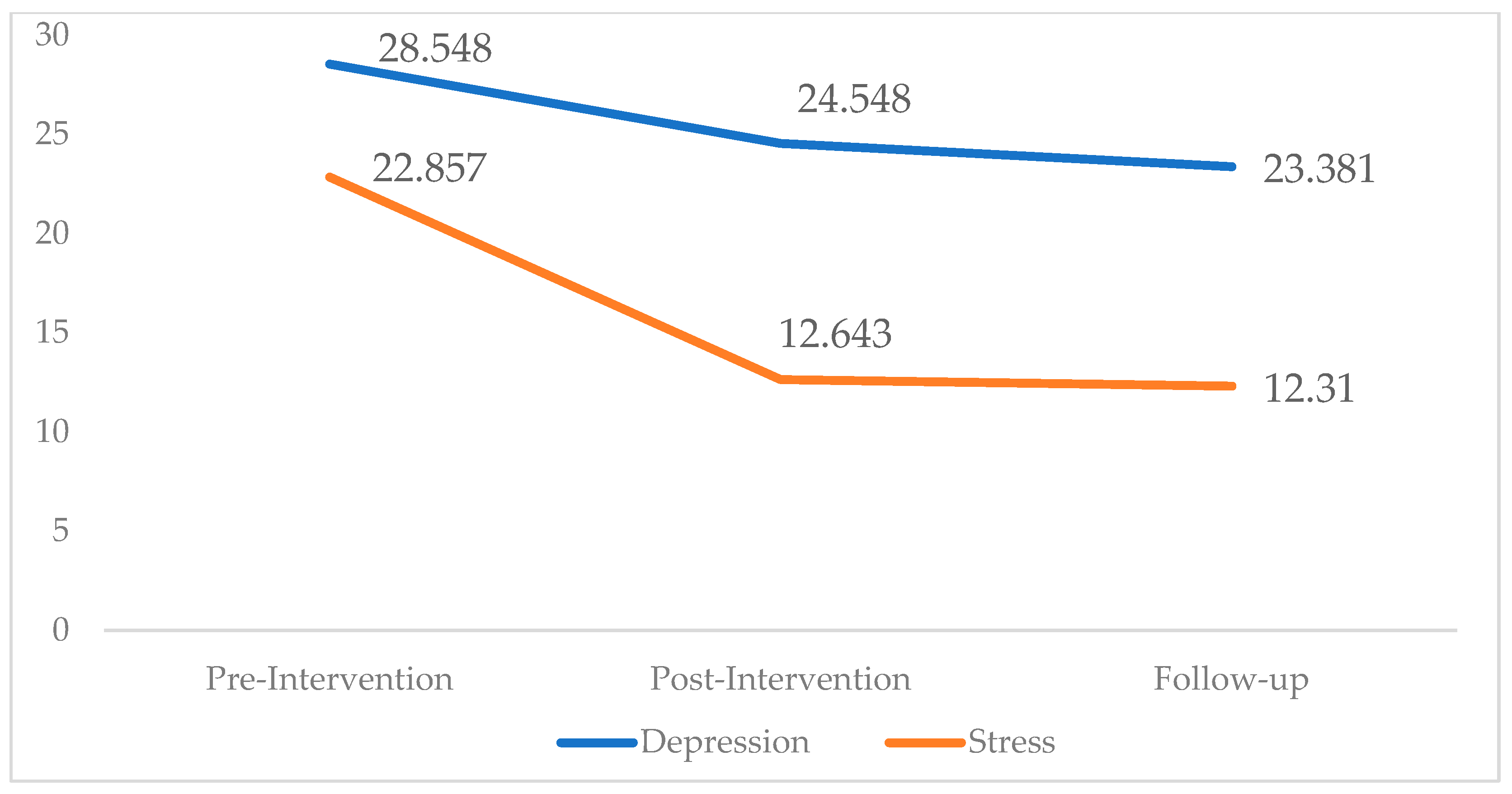
3.1. Post-Intervention and Follow-Up Results
3.2. Multivariate Test
3.3. Univariate Test
3.4. Post Hoc Comparisons
4. Discussion
Limitations
- The present exploratory and descriptive qualitative study explored pregnant mothers’ experiences, associated factors regarding antenatal depression, and their perceived stress in relation to male child preference in the public sector in a single setting; therefore, the results may differ in private and multicenter settings.
- The present exploratory and descriptive qualitative study explored pregnant mothers’ experiences, associated factors regarding antenatal depression, and their perceived stress in relation to male child preference in the urban setting; therefore, the findings could be varied in rural settings.
- Despite the MMTP being found to significantly improve mental health in pregnant women, particularly in terms of antenatal depression and perceived stress, possible differences may have been affected by the mothers’ trimester, whether they were primiparous or multiparous, and their age group, including younger and older mothers.
- A feasibility trial was accomplished in one setting in a public sector in an urban area.
5. Conclusions
Author Contributions
Funding
Institutional Review Board Statement
Informed Consent Statement
Data Availability Statement
Conflicts of Interest
Abbreviations
| EPDS | Edinburgh Postnatal Depression Scale |
| PSS | Perceived Stress Scale |
References
- Zikic, O.; Stojanov, J.; Kostic, J.; Nikolic, G.; Tosic, G.S.; Simonovic, M.; Djordjevic, V.; Binic, I. Depression in the 288 Perinatal Period: Course and Outcome of Depression in the Period from the Last Trimester of Pregnancy to One 289 Year after Delivery in Primiparous Mothers. Medicina 2024, 60, 970. [Google Scholar] [CrossRef]
- Ayano, G.; Tesfaw, G.; Shumet, S. Prevalence and determinants of antenatal depression in Ethiopia: A systematic review and meta-analysis. PLoS ONE 2019, 14, e0211764. [Google Scholar] [CrossRef] [PubMed]
- Guo, J.; Zheng, A.; He, J.; Ai, M.; Gan, Y.; Zhang, Q.; Chen, L.; Liang, S.; Yu, X.; Kuang, L. The prevalence of and factors associated with antenatal depression among all pregnant women first attending antenatal care: A cross-sectional study in a comprehensive teaching hospital. BMC Pregnancy Childbirth 2021, 21, 713. [Google Scholar] [CrossRef] [PubMed]
- Yin, X.; Sun, N.; Jiang, N.; Xu, X.; Gan, Y.; Zhang, J.; Qiu, L.; Yang, C.; Shi, X.; Chang, J.; et al. Prevalence and associated factors of antenatal depression: Systematic reviews and meta-analyses. Clin. Psychol. Rev. 2021, 83, 101932. [Google Scholar] [CrossRef] [PubMed]
- Huang, X.; Wang, Y.; Wang, Y.; Guo, X.; Zhang, L.; Wang, W.; Shen, J. Prevalence and factors associated with trajectories of antenatal depression: A prospective multi-centre cohort study in Chengdu, China. BMC Pregnancy Childbirth 2023, 23, 358–364. [Google Scholar] [CrossRef]
- Sikander, S.; Ahmad, I.; Bates, L.M.; Gallis, J.; Hagaman, A.; O’donnell, K.; Turner, E.L.; Zaidi, A.; Rahman, A.; Maselko, J. Cohort Profile: Perinatal depression and child socioemotional development; the Bachpan cohort study from rural Pakistan. BMJ Open 2019, 9, e025644. [Google Scholar] [CrossRef]
- Tesfaye, Y.; Agenagnew, L. Antenatal depression and associated factors among pregnant women attending antenatal care service in Kochi health centre, Jimma town, Ethiopia. J. Pregnancy 2021, 11, e2021. [Google Scholar]
- Franke, K.; van den Bergh, B.; de Rooij, S.R.; Roseboom, T.J.; Nathanielsz, P.W.; Witte, O.W.; Schwab, M. Effects of Prenatal Stress on Structural Brain Development and Aging in Humans. BioRxiv 2017, 4, 148916. [Google Scholar] [CrossRef]
- Letourneau, N.L.; Dennis, C.L.; Cosic, N.; Linder, J. The effect of perinatal depression treatment for mothers on parenting and child development: A systematic review. Depress. Anxiety 2017, 34, 928–966. [Google Scholar] [CrossRef]
- Xiao, J.; Xiong, R.; Wen, Y.; Liu, L.; Peng, Y.; Xiao, C.; Yin, C.; Liu, W.; Tao, Y.; Jiang, F.; et al. Antenatal depression is associated with perceived stress, family relations, educational and professional status among women in South of China: A multicenter cross-sectional survey. Front. Psychiatry 2023, 14, 1191152. [Google Scholar] [CrossRef]
- Ramohlola, M.C.; Maimela, E.; Ntuli, T.S. Prevalence of and sociodemographic factors associated with antenatal depression among women in Limpopo Province, South Africa. S. Afr. J. Obstet. Gynaecol. 2022, 28, 52–56. [Google Scholar] [CrossRef]
- Prabhu, S.; Guruvare, S.; George, L.S.; Nayak, B.S.; Mayya, S. Prevalence and associated risk factors of antenatal depression among pregnant women attending tertiary care hospitals in South India. Depress. Res. Treat. 2022, 2022, 9127358. [Google Scholar] [CrossRef] [PubMed]
- Umuziga, M.P.; Gishoma, D.; Hynie, M.; Nyirazinyoye, L. Antenatal depressive symptoms in Rwanda: Rates, risk factors, and social support. BMC Pregnancy Childbirth 2022, 22, 193. [Google Scholar] [CrossRef]
- Tabb, K.M.; Dalton, V.K.; Tilea, A.; Kolenic, G.E.; Admon, L.K.; Hall, S.V.; Zhang, X.; Ryckman, K.K.; Zivin, K. Trends in antenatal depression and suicidal ideation diagnoses among commercially insured childbearing individuals in the United States, 2008–2018. J. Affect. Disord. 2023, 320, 263–267. [Google Scholar] [CrossRef] [PubMed]
- Zaidi, T.H.; Zafar, M.; Ali, N.M.; Parveen, S.; Ashraf, H.; Awan, M.; Rashid, A.M.; Tariq, M. Quantifying and Evaluating Male Child Preference in Pakistan. J. Res. Soc. Sci. 2022, 9, e2022004. [Google Scholar] [CrossRef]
- Lagadec, N.; Steinecker, M.; Kapassi, A.; Magnier, A.M.; Chastang, J.; Robert, S.; Gaouaou, N.; Ibanez, G. Factors influencing the quality of life of pregnant women: A systematic review. BMC Pregnancy Childbirth 2018, 18, 455. [Google Scholar] [CrossRef]
- Thongsomboon, W.; Kaewkiattikun, K.; Kerdcharoen, N. Perceived stress and associated factors among pregnant women attending antenatal care in urban Thailand. Psychol. Res. Behav. Manag. 2020, ume 13, 1115–1122. [Google Scholar] [CrossRef]
- Kornfield, S.L.; Riis, V.M.; McCarthy, C.; Elovitz, M.A.; Burris, H.H. Maternal perceived stress and the increased risk of preterm birth in a majority non-Hispanic Black pregnancy cohort. J. Perinatol. 2022, 42, 708–713. [Google Scholar] [CrossRef]
- Waqas, A.; Zubair, M.; Zia, S.; Meraj, H.; Aedma, K.K.; Majeed, M.H.; Naveed, S. Psychosocial predictors of antenatal stress in Pakistan: Perspectives from a developing country. BMC Res. Notes 2020, 13, 160. [Google Scholar] [CrossRef]
- Farooq, R.; Afsar, S.; Mehdi, M.; Jaffar, M.A.; Ashfaq, S.; Hotiana, U.A. Factors of Depression and its Prevalence among Pregnant Females Attending Antenatal Clinics in Pakistan. Pak. J. Med. Health Sci. 2022, 16, 995–997. [Google Scholar] [CrossRef]
- Vardhan, Y.V.; Rao, D.S. Preference for a male child among married adults in rural and urban field practice areas of Narayana Medical College, Nellore, Andhra Pradesh, India. Int. J. Community Med. Public Health 2020, 7, 546–549. [Google Scholar] [CrossRef]
- Zaidi, B. Son preference and sex differentials in receipt of key dimensions of children’s healthcare: Evidence from Pakistan. Popul. Stud. 2022, 76, 309–328. [Google Scholar] [CrossRef] [PubMed]
- Hasan, U.; Hasan, A.; Tahir, H. Association of Antenatal Gender Preference with Perceived Stress among Pregnant Women: Pregnancy Stress and Gender Preference. Allied Med. Res. J. 2024, 2, 57–66. [Google Scholar]
- Atif, M.; Halaki, M.; Chow, C.M.; Raynes-Greenow, C. Risk factors of paternal postnatal depression in Pakistan: Findings from an urban sample. Nurs. Health Sci. 2022, 24, 618–624. [Google Scholar] [CrossRef] [PubMed]
- Li, J.; Li, C.; Puts, M.; Wu, Y.C.; Liu, M.M.; Yuan, B.; Zhang, J.P. Effectiveness of mindfulness-based interventions on anxiety, depression, and fatigue in people with lung cancer: A systematic review and meta-analysis. Int. J. Nurs. Stud. 2023, 140, 104447. [Google Scholar] [CrossRef]
- Charness, G.; Le Bihan, Y.; Villeval, M.C. Mindfulness training, cognitive performance, and stress reduction. J. Econ. Behav. Organ. 2024, 217, 207–226. [Google Scholar] [CrossRef]
- Kiyak, S. The relationship of depression, anxiety, and stress with pregnancy symptoms and coping styles in pregnant women: A multi-group structural equation modelling analysis. Midwifery 2024, 136, 104103. [Google Scholar] [CrossRef]
- Pan, W.L.; Gau, M.L.; Lee, T.Y.; Jou, H.J.; Liu, C.Y.; Wen, T.K. Mindfulness-based programme on the psychological health of pregnant women. Women Birth 2019, 32, e102–e109. [Google Scholar] [CrossRef] [PubMed]
- Amanvermez, Y.; Rahmadiana, M.; Karyotaki, E.; de Wit, L.; Ebert, D.D.; Kessler, R.C.; Cuijpers, P. Stress management interventions for college students: A systematic review and meta-analysis. Clin. Psychol. 2020, 30, 423–444. [Google Scholar] [CrossRef]
- Jiang, Y.; Xi, Y.; Tong, H.; Fang, B.; Bin, L.; Gong, Y.; Xin, M.; Zheng, J.; Yang, Z.; Chen, X.; et al. Meditation-Based Interventions Might Help Cope with the Coronavirus Disease. 2019. (COVID-19). Available online: https://osf.io/preprints/osf/f3xzq (accessed on 24 October 2024).
- Errazuriz, A.; Schmidt, K.; Undurraga, E.A.; Medeiros, S.; Baudrand, R.; Cussen, D.; Henriquez, M.; Celhay, P.; Figueroa, R.A. Effects of mindfulness-based stress reduction on psychological distress in health workers: A three-arm parallel randomized controlled trial. J. Psychiatr. Res. 2022, 145, 284–293. [Google Scholar] [CrossRef]
- Janzarik, G.; Wollschläger, D.; Wessa, M.; Lieb, K. A group intervention to promote resilience in nursing professionals: A randomized controlled trial. Int. J. Environ. Res. Public Health 2022, 9, 649. [Google Scholar] [CrossRef]
- Dawadi, S. Thematic analysis approach: A step by step guide for ELT research practitioners. J. Nelta. 2020, 25, 62–71. [Google Scholar] [CrossRef]
- Lim, W.M. What is qualitative research? An overview and guidelines. Australas. Mark. J. 2024, 25. Available online: https://journals.sagepub.com/doi/epub/10.1177/14413582241264619 (accessed on 20 October 2024). [CrossRef]
- Bitew, T.; Keynejad, R.; Honikman, S.; Sorsdahl, K.; Myers, B.; Fekadu, A.; Hanlon, C. Stakeholder perspectives on antenatal depression and the potential for psychological intervention in rural Ethiopia: A qualitative study. BMC Pregnancy Childbirth 2020, 20, 371. [Google Scholar] [CrossRef]
- Leng, L.L.; Yin, X.C.; Chan, C.L.; Ng, S.M. An antenatal mobile-delivered mindfulness-based intervention to reduce perinatal depression risk and improve obstetric and neonatal outcomes: A randomized controlled trial. J. Affect. Disord. 2023, 335, 216–227. [Google Scholar] [CrossRef] [PubMed]
- Chaudhary, K.; Rai, G.; Basnet, P.; Adhikari, B.R.; Lama, S. Prevalence of Depression among Women Attending Antenatal Clinic at BPKIHS. South Asian Res. J. Nurs. Health Care 2023, 5, 7–15. [Google Scholar] [CrossRef]
- Tembo, J.; Mambwe, P. Reasons for Male Gender Preference Among Pregnant Women in Chipata District-Zambia. Int. J. Res. Publ. Rev. 2024, 5, 3505–3509. [Google Scholar] [CrossRef]
- Jensen, K.H.; Krog, M.C.; Koert, E.; Hedegaard, S.; Chonovitsch, M.; Schmidt, L.; Kolte, A.M.; Nielsen, H.S. Meditation and mindfulness reduce perceived stress in women with recurrent pregnancy loss: A randomized controlled trial. Reprod. BioMed. Online 2021, 43, 246–256. [Google Scholar] [CrossRef] [PubMed]
- Lönnberg, G.; Jonas, W.; Unternaehrer, E.; Bränström, R.; Nissen, E.; Niemi, M. Effects of a mindfulness-based childbirth and parenting program on pregnant women’s perceived stress and risk of perinatal depression–Results from a randomized controlled trial. J. Affect. Disord. 2020, 262, 133–142. [Google Scholar] [CrossRef]
- Harrison, R.J.; Buckley, E.A.; Ross, N.J.; Witte, C.E.; Thompson, W.L. Multi-modal mindfulness training and well-being for healthcare students. Curr. Pharm. Teach. Learn. 2024, 16, 49–57. [Google Scholar] [CrossRef] [PubMed]
- Liu, H.; Cai, K.; Wang, J.; Zhang, H. The effects of mindfulness-based interventions on anxiety, depression, stress, and mindfulness in menopausal women: A systematic review and meta-analysis. Front. Public Health 2023, 10, 1045642. [Google Scholar] [CrossRef] [PubMed]
- Sansone, A.; Stapleton, P.; Patching, A.; Lawrence, Z. Participation in an Online Prenatal Mindfulness-Relationship-Based (PMRB) Program: Outcomes for Maternal Mindfulness, Mental Health, Interoception, and Mother-Infant Relationship during Pregnancy and Post-Partum. OBM Integr. Complement. Med. 2024, 1, 1–43. [Google Scholar] [CrossRef]
- Sari, Y.P.; Hsu, Y.-Y.; Nguyen, T.T. The effects of a mindfulness-based intervention on mental health outcomes in pregnant woman: A systematic review and meta-analysis. J. Nurs. Res. 2023, 31, e306. [Google Scholar] [CrossRef] [PubMed]
- Gelman, R.; Berg, M.; Ilan, Y. A subject-tailored variability-based platform for overcoming the plateau effect in sports training: A narrative review. Int. J. Environ. Res. Public Health 2022, 19, 1722. [Google Scholar] [CrossRef] [PubMed]
- Nejad, F.K.; Shahraki, K.A.; Nejad, P.S.; Moghaddam, N.K.; Jahani, Y.; Divsalar, P. The influence of mindfulness-based stress reduction (MBSR) on stress, anxiety and depression due to unwanted pregnancy: A randomized clinical trial. J. Prev. Med. Hyg. 2022, 62, E82–E88. [Google Scholar] [PubMed] [PubMed Central]
- Yousuf, S.; Akhtar, A. The relationship between religiosity and psychological wellbeing among college students: A meta-analysis. J. Relig. Health 2023, 15, 89–102. [Google Scholar]


| ADAPT-ITT Phases | Methodology |
|---|---|
| 1. Assessment | The community advisory board, consisting of six members, was formulated and included two patients, one nurse, one gynecologist, one psychiatrist, and one nutritionist. An assessment of needs was conducted through in-depth interviews with stakeholders such as pregnant women with antenatal depression and perceived stress. |
| 2. Decision | Decisions related to adapting the intervention were based on the community advisory board’s recommendations and the results of in-depth interviews. |
| 3. Adaptation | Theater testing (pretesting) of the original intervention was carried out. Furthermore, pretesting of the intervention with the target population was carried out to determine their thoughts related to the intervention, mobilize feedback on the content, and obtain recommendations for improving acceptability by target populations. Modifications were made according to the recommendations of the community advisory board; they focused on culture, ethnicity, language, cultural groups, and religions, reinforcing what is necessary to fit the country’s sociocultural context. PI demonstrated the intervention in five patients. The provider panel obtained feedback from the patients. The feedback was incorporated with the help of the community advisory team. |
| 4. Production | The first draft of the intervention was formulated and presented before the community advisory board for further feedback and approval. |
| 5. Topical experts | Topical experts were identified to review and provide feedback on the first draft of the intervention. The content area experts, comprising six members, were identified as two psychiatric nurses, one gynecologist, two psychiatrists, and one nutritionist. The topical experts were identified with the endorsement of the community advisory board team. |
| 6. Integration | Feedback from the topical experts was integrated to finalize the intervention. |
| 7. Training | Two graduate female nurses were trained to administer the intervention to the new population. The training consisted of three days of four-hour sessions. |
| 8. Testing | A feasibility trial was conducted to assess the feasibility of the intervention. It was conducted to determine the study’s primary outcome using quantitative baseline and post-intervention data from the study participants. |
| Major Themes | Sub-Themes |
|---|---|
| Theme 1: Psychosomatic response | Symptoms of antenatal depression |
| Symptoms of perceived stress | |
| Theme 2: Psychosocial determinants of maternal mental health | Reproductive factors |
| Family dynamics | |
| Financial constraints | |
| Cultural beliefs and related factors | |
| Theme 3: Influence of family dynamics on gender preference | Male gender preference |
| Roles of in-laws and family members on gender preference | |
| Theme 4: Coping mechanism for managing stress and antenatal depression | Faith-based coping |
| Seeking emotional support | |
| Relaxation through hobbies and communication with family members | |
| Theme 5: Contextualized health interventions in the Pakistan context | Culturally tailored approaches |
| Religious applicable methods |
| Variable | Control n (%) | Intervention n (%) | p-Value |
|---|---|---|---|
| Age Group (Years) | |||
| 18–24 | 13 (30.95) | 9 (21.42) | 0.468 |
| 25–31 | 14 (33.33) | 19 (45.23) | |
| ≥32 | 15 (35.71) | 14 (33.33) | |
| Education | |||
| Illiterate | 1 (2.38) | 3 (7.14) | 0.638 |
| Primary | 5 (11.90) | 7 (16.66) | |
| Middle/matric | 13 (30.95) | 15 (35.71) | |
| Intermediate | 20 (47.61) | 14 (33.33) | |
| Master’s and above | 3 (7.14) | 3 (7.14) | |
| Employment Status | |||
| Housewife | 32 (76.19) | 29 (69.05) | 0.08 |
| Working woman | 10 (23.81) | 13 (30.95) | |
| Husband Education | |||
| Illiterate | 2 (4.76) | 1 (2.38) | 0.065 |
| Primary | 8 (19.04) | 8 (19.04) | |
| Middle/matric | 2 (4.76) | 4 (9.52) | |
| Intermediate | 5 (11.90) | 7 (16.66) | |
| Master’s and above | 25 (59.52) | 22 (52.38) | |
| Household Income | |||
| Good | 30 (71.42) | 22 (52.38) | 0.058 |
| Poor | 12 (28.57) | 20 (47.61) | |
| Unplanned Pregnancy | |||
| Yes | 25 (59.52) | 32 (76.19) | 0.08 |
| No | 17 (40.47) | 10 (23.80) | |
| Gravity | |||
| 1–2 | 12 (28.57) | 12 (28.67) | 0.497 |
| 3–4 | 10 (23.80) | 14 (33.33) | |
| 5–6 | 20 (47.61) | 16 (38.09) | |
| History of Abortions | |||
| Yes | 11 (26.19) | 6 (14.28) | 0.175 |
| No | 31 (73.80) | 36 (85.71) |
| Question | Control n (%) | Intervention n (%) | p-Value |
|---|---|---|---|
| I have been able to laugh and see the funny side of things | |||
| As much as I always could | 9 (21.43) | 7 (16.67) | 0.081 |
| Not quite so much now | 3 (7.14) | 4 (9.52) | |
| Definitely not so much now | 18 (42.86) | 16 (38.10) | |
| Not at all | 12 (28.57) | 15 (35.71) | |
| I have looked forward with enjoyment to things | |||
| As much as I ever did | 5 (11.9) | 8 (19.05) | 0.071 |
| Rather less than I used to | 11 (26.19) | 8 (19.05) | |
| Definitely less than I used to | 15 (35.71) | 11 (26.19) | |
| Hardly at all | 11 (26.19) | 15 (35.71) | |
| I have blamed myself unnecessarily when things went wrong | |||
| Yes, most of the time | 8 (19.05) | 8 (19.05) | 0.636 |
| Yes, some of the time | 16 (38.10) | 21 (50) | |
| Not very often | 14 (33.3) | 11 (26.19) | |
| No, never | 4 (9.52) | 2 (4.76) | |
| I have been anxious or worried for no good reason | |||
| No, not at all | 2 (4.76) | 1 (2.38) | 0.36 |
| Hardly ever | 10 (23.81) | 7 (16.67) | |
| Yes, sometimes | 22 (52.38) | 19 (45.24) | |
| Yes, very often | 8 (19.05) | 15 (35.71) | |
| I have felt scared or panicky for no very good reason | |||
| Yes, most of the time | 3 (7.14) | 5 (11.9) | 0.145 |
| Yes, some of the time | 17 (40.48) | 10 (23.81) | |
| Not very often | 15 (35.71) | 19 (45.24) | |
| No, never | 7 (16.67) | 8 (19.05) | |
| Things have been getting on top of me | |||
| Yes, most of the time, I haven’t been able to cope at all | 6 (14.29) | 8 (19.05) | 0.221 |
| Yes, sometimes I haven’t been coping as well as usual | 9 (21.43) | 4 (9.52) | |
| No, most of the time, I have coped quite well | 12 (28.57) | 9 (21.43) | |
| No, I have been coping as well as ever | 15 (35.71) | 11 (26.19) | |
| I have been so unhappy that I have had difficulty sleeping | |||
| Yes, most of the time | 5 (11.9) | 13 (21.43) | 0.144 |
| Yes, some of the time | 13 (30.95) | 5 (11.9) | |
| Not very often | 17 (40.48) | 22 (52.38) | |
| No, never | 7 (16.67) | 6 (14.29) | |
| I have felt sad or miserable | |||
| Yes, most of the time | 9 (21.43) | 8 (19.05) | 0.69 |
| Yes, some of the time | 8 (19.05) | 7 (16.67) | |
| Not very often | 17 (40.48) | 22 (52.38) | |
| No, never | 8 (19.05) | 5 (11.9) | |
| I have been so unhappy that I have been crying | |||
| Yes, most of the time | 10 (23.81) | 6 (14.29) | 0.09 |
| Yes, some of the time | 8 (19.05) | 8 (19.05) | |
| Not very often | 15 (35.71) | 25 (59.52) | |
| No, never | 9 (21.43) | 3 (7.14) | |
| The thought of harming myself has occurred to me | |||
| Yes, most of the time | 8 (19.05) | 5 (11.9) | 0.055 |
| Yes, some of the time | 11 (26.19) | 8 (19.05) | |
| Not very often | 9 (21.43) | 21 (50) | |
| No, never | 14 (33.3) | 8 (19.05) |
| Question | Control n (%) | Intervention n (%) | p-Value |
|---|---|---|---|
| In the last month, how often have you been upset because of something that happened unexpectedly? | |||
| Almost Never | 0 (0) | 1 (2.38) | 0.07 |
| Sometimes | 13 (30.95) | 4 (9.52) | |
| Fairly Often | 16 (38.1) | 23 (54.76) | |
| Very Often | 13 (30.95) | 14 (33.33) | |
| In the last month, how often have you felt that you were unable to control the important things in your life? | |||
| Almost Never | 0 (0) | 1 (2.38) | 0.061 |
| Sometimes | 13 (30.95) | 4 (9.52) | |
| Fairly Often | 16 (38.1) | 23 (54.76) | |
| Very Often | 13 (30.95) | 14 (33.33) | |
| In the last month, how often have you felt nervous and “stressed”? | |||
| Almost Never | 1 (2.38) | 1 (2.38) | 0.144 |
| Sometimes | 8 (19.05) | 6 (14.29) | |
| Fairly Often | 23 (54.76) | 21 (50) | |
| Very Often | 10 (23.81) | 14 (33.33) | |
| In the last month, how often have you felt confident about your ability to handle your problems? | |||
| Never | 14 (33.33) | 9 (21.43) | |
| Almost Never | 12 (28.57) | 24 (57.14) | 0.064 |
| Sometimes | 13 (30.95) | 8 (19.05) | |
| Fairly Often | 3 (7.14) | 1 (2.38) | |
| Very Often | 0 (0) | 0(0) | |
| In the last month, how often have you felt that things were going your way? | |||
| Never | 4 (9.52) | 9 (21.43) | 0.088 |
| Almost Never | 16 (38.10) | 23 (54.76) | |
| Sometimes | 15 (35.71) | 7 (16.67) | |
| Fairly Often | 6 (14.29) | 3 (7.14) | |
| Very Often | 1 (2.38) | 0 (0) | |
| In the last month, how often have you found that you could not cope with all the things that you had to do? | |||
| Almost Never | 1 (2.38) | 0 (0) | 0.144 |
| Sometimes | 15 (35.71) | 10 (23.81) | |
| Fairly Often | 17 (40.48) | 27 (64.29) | |
| Very Often | 9 (21.43) | 5 (11.90) | |
| In the last month, how often have you been able to control irritations in your life? | |||
| Never | 5 (11.9) | 13 (30.95) | |
| Almost Never | 17 (40.48) | 16 (38.1) | 0.154 |
| Sometimes | 14 (14.29) | 10 (7.14) | |
| Fairly Often | 6 (14.29) | 3 (0) | |
| Very Often | 0 (0) | 0 (0) | |
| How often have you felt that you were on top of things in the last month? | |||
| Never | 15 (35.71) | 13 (30.95) | 0.159 |
| Almost Never | 16 (38.1) | 22 (52.38) | |
| Sometimes | 11 (26.19) | 5 (11.90) | |
| Fairly Often | 0 (0) | 1 (2.38) | |
| Very Often | 0 (0) | 1 (2.38) | |
| In the last month, how often have you been angered because of things that were outside of your control? | |||
| Almost Never | 1 (2.38) | 2 (4.76) | 0.254 |
| Sometimes | 20 (7.62) | 8 (19.05) | |
| Fairly Often | 16 (38.1) | 22 (52.38) | |
| Very Often | 5 (11.90) | 10 (23.81) | |
| In the last month, how often have you felt difficulties were piling up so high that you could not overcome them? | |||
| Almost Never | 1 (2.38) | 1 (2.38) | 0.479 |
| Sometimes | 0 (0) | 1 (2.38) | |
| Fairly Often | 12 (28.57) | 6 (14.29) | |
| Very Often | 19 (45.24) | 21 (50) |
| Scale | Group | Mean ± SD | p-Value |
|---|---|---|---|
| EPDS | Control | 26.73 ± 6.42 | 0.161 |
| Intervention | 28.54 ± 5.24 | ||
| PSS | Control | 22.33 ± 2.39 | 0.268 |
| Intervention | 22.85 ± 1.88 |
| Scale | Gender Preference | Mean ± SD | p-Value |
|---|---|---|---|
| EPDS Score | Female | 27.17 ± 6.85 | 0.171 |
| Male | 24.71 ± 3.89 | ||
| PSS Score | Female | 22.64 ± 2.66 | 0.92 |
| Male | 22.58 ± 2.03 |
| Measure | Source | Sum of Squares | df | Mean Square | F | p-Value |
|---|---|---|---|---|---|---|
| Antenatal Depression | Time | 434.738 | 2 | 217.369 | 21.244 | <0.001 |
| Perceived Stress | Time | 1771.665 | 2 | 885.837 | 310.748 | <0.001 |
| Group | Variable | Time (I) | Mean (I) | Mean (J) | Mean Difference (I − J) | p-Value |
|---|---|---|---|---|---|---|
| Intervention | Depression | T (1 vs. 2) | 28.548 | 24.548 | 4 | <0.001 |
| T (1 vs. 3) | 28.548 | 23.381 | 5.167 | <0.001 | ||
| T (2 vs. 3) | 24.548 | 23.381 | 1.167 | 0.001 | ||
| Stress | T (1 vs. 2) | 22.857 | 12.643 | 10.214 | <0.001 | |
| T (1 vs. 3) | 22.857 | 12.31 | 10.548 | <0.001 | ||
| T (2 vs. 3) | 12.643 | 12.31 | 0.333 | 0.043 | ||
| Control | Depression | T (1 vs. 2) | 26.734 | 26.332 | 0.402 | 0.514 |
| T (1 vs. 3) | 26.734 | 26.231 | 0.503 | 0.472 | ||
| T (2 vs. 3) | 26.332 | 26.231 | 0.101 | 0.765 | ||
| Stress | T (1 vs. 2) | 22.333 | 21.992 | 0.341 | 0.626 | |
| T (1 vs. 3) | 22.333 | 21.872 | 0.461 | 0.489 | ||
| T (2 vs. 3) | 21.992 | 21.872 | 0.12 | 0.758 |
Disclaimer/Publisher’s Note: The statements, opinions and data contained in all publications are solely those of the individual author(s) and contributor(s) and not of MDPI and/or the editor(s). MDPI and/or the editor(s) disclaim responsibility for any injury to people or property resulting from any ideas, methods, instructions or products referred to in the content. |
© 2025 by the authors. Licensee MDPI, Basel, Switzerland. This article is an open access article distributed under the terms and conditions of the Creative Commons Attribution (CC BY) license (https://creativecommons.org/licenses/by/4.0/).
Share and Cite
Badil; Naz, N.; Muhammad, D.; Rehman, K. Feasibility of Modified Mindfulness Training Program for Antenatal Depression and Perceived Stress Among Expectant Mothers with Male Child Preference. Healthcare 2025, 13, 584. https://doi.org/10.3390/healthcare13060584
Badil, Naz N, Muhammad D, Rehman K. Feasibility of Modified Mindfulness Training Program for Antenatal Depression and Perceived Stress Among Expectant Mothers with Male Child Preference. Healthcare. 2025; 13(6):584. https://doi.org/10.3390/healthcare13060584
Chicago/Turabian StyleBadil, Najma Naz, Dildar Muhammad, and Khalid Rehman. 2025. "Feasibility of Modified Mindfulness Training Program for Antenatal Depression and Perceived Stress Among Expectant Mothers with Male Child Preference" Healthcare 13, no. 6: 584. https://doi.org/10.3390/healthcare13060584
APA StyleBadil, Naz, N., Muhammad, D., & Rehman, K. (2025). Feasibility of Modified Mindfulness Training Program for Antenatal Depression and Perceived Stress Among Expectant Mothers with Male Child Preference. Healthcare, 13(6), 584. https://doi.org/10.3390/healthcare13060584