AI Applications to Reduce Loneliness Among Older Adults: A Systematic Review of Effectiveness and Technologies



Abstract
1. Introduction
2. Materials and Methods
2.1. Review Protocol and Registration
2.2. Study Selection Criteria
2.3. Search Strategy
2.4. Data Extraction and Synthesis
2.5. Study Quality Assessment
3. Results
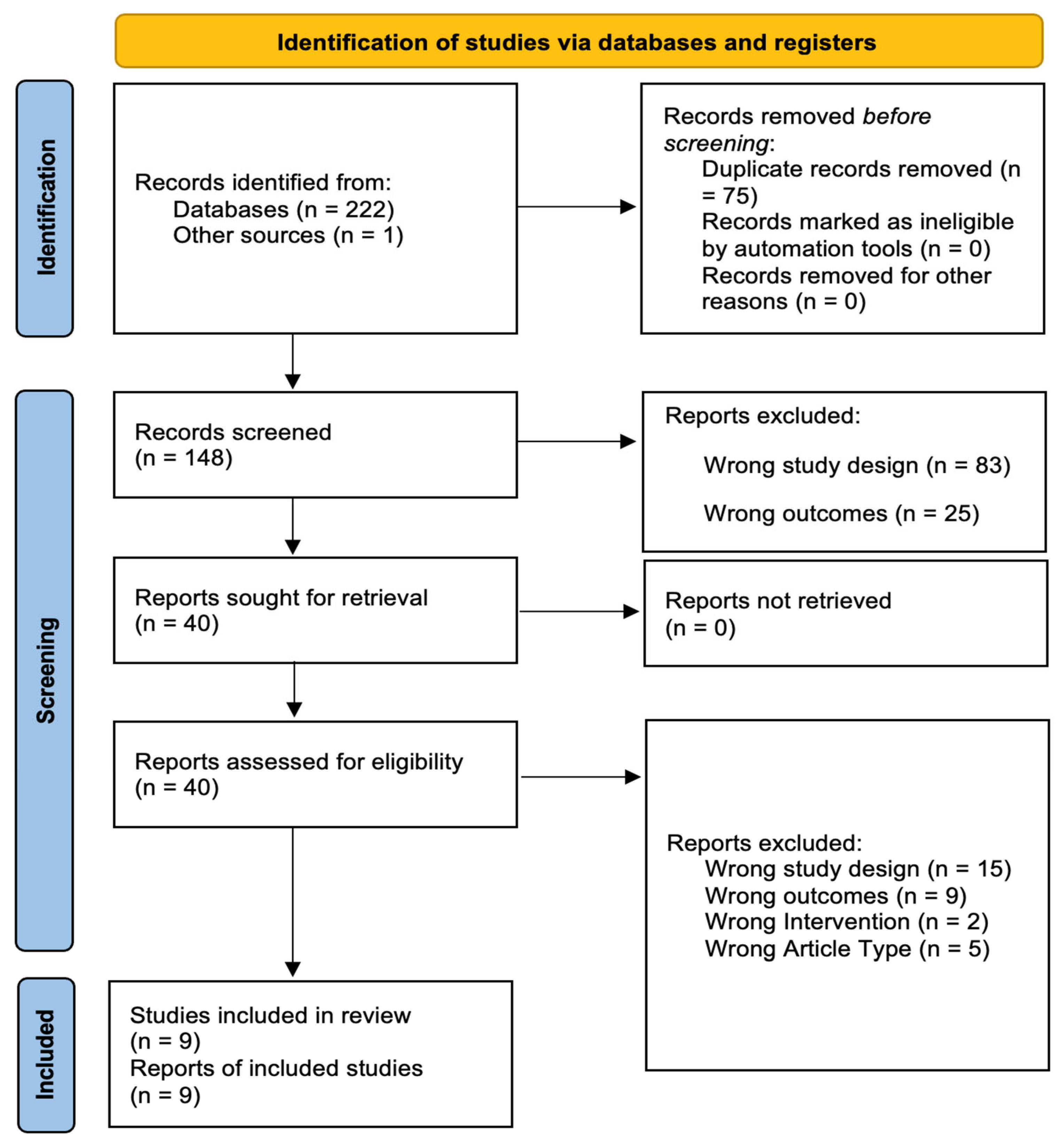
3.1. Identification of Studies
3.2. Characteristics of Study Participants
3.3. Characteristics of Interventions
3.4. Outcome Measures
3.5. Study Quality Evaluation Results
4. Discussion
5. Conclusions
Author Contributions
Funding
Institutional Review Board Statement
Informed Consent Statement
Data Availability Statement
Conflicts of Interest
Appendix A

| Search Algorithm |
|---|
| ((“artificial intelligence” OR “computational intelligence” OR “machine intelligence” OR “computer reasoning” OR “machine learning” OR “deep learning” OR “neural network” OR “neural networks” OR “reinforcement learning”) AND (“aged” OR “geriatrics” OR “geroscience” OR “elderly” OR “older adults” OR “seniors” OR “aging population” OR “senior citizens” OR “aging” OR “old age” OR “advanced age”) AND (“loneliness” OR “social isolation” OR “emotional isolation” OR “solitude” OR “social disconnection” OR “lack of social support”)):ti,ab,kw. |
References
- Russell, D.; Peplau, L.A.; Cutrona, C.E. The Revised UCLA Loneliness Scale: Concurrent and Discriminant Validity Evidence. J. Pers. Soc. Psychol. 1980, 39, 472–480. [Google Scholar] [CrossRef] [PubMed]
- Social Isolation and Loneliness. Available online: https://www.who.int/teams/social-determinants-of-health/demographic-change-and-healthy-ageing/social-isolation-and-loneliness (accessed on 26 August 2024).
- Badal, V.D.; Graham, S.A.; Depp, C.A.; Shinkawa, K.; Yamada, Y.; Palinkas, L.A.; Kim, H.-C.; Jeste, D.V.; Lee, E.E. Prediction of Loneliness in Older Adults Using Natural Language Processing: Exploring Sex Differences in Speech. Am. J. Geriatr. Psychiatry 2021, 29, 853–866. [Google Scholar] [CrossRef] [Scilit] [PubMed]
- Fakoya, O.A.; McCorry, N.K.; Donnelly, M. Loneliness and Social Isolation Interventions for Older Adults: A Scoping Review of Reviews. BMC Public Health 2020, 20, 129. [Google Scholar] [CrossRef] [Scilit] [PubMed]
- Ong, A.D.; Uchino, B.N.; Wethington, E. Loneliness and Health in Older Adults: A Mini-Review and Synthesis. Gerontology 2016, 62, 443–449. [Google Scholar] [CrossRef] [Scilit] [PubMed]
- Holt-Lunstad, J.; Smith, T.B.; Baker, M.; Harris, T.; Stephenson, D. Loneliness and Social Isolation as Risk Factors for Mortality: A Meta-Analytic Review. Perspect. Psychol. Sci. 2015, 10, 227–237. [Google Scholar] [CrossRef] [Scilit]
- Social Isolation and Loneliness in Older Adults: Opportunities for the Health Care System; National Academies Press: Washington, DC, USA, 2020; ISBN 978-0-309-67100-2.
- Jentoft, E.E.; Sandset, T.; Haldar, M. Problematizing Loneliness as a Public Health Issue: An Analysis of Policy in the United Kingdom. Crit. Policy Stud. 2024. [Google Scholar] [CrossRef] [Scilit]
- Masi, C.M.; Chen, H.-Y.; Hawkley, L.C.; Cacioppo, J.T. A Meta-Analysis of Interventions to Reduce Loneliness. Personal. Soc. Psychol. Rev. 2011, 15, 219–266. [Google Scholar] [CrossRef] [Scilit]
- Chua, C.M.S.; Chua, J.Y.X.; Shorey, S. Effectiveness of Home-Based Interventions in Improving Loneliness and Social Connectedness among Older Adults: A Systematic Review and Meta-Analysis. Aging Ment. Health 2024, 28, 1–10. [Google Scholar] [CrossRef] [Scilit]
- Patil, U.; Braun, K.L. Interventions for Loneliness in Older Adults: A Systematic Review of Reviews. Front. Public Health 2024, 12, 1427605. [Google Scholar] [CrossRef] [Scilit]
- Bringsjord, S.; Govindarajulu, N.S. Artificial Intelligence. In The Stanford Encyclopedia of Philosophy; Zalta, E.N., Nodelman, U., Eds.; Metaphysics Research Lab, Stanford University: Stanford, CA, USA, 2024. [Google Scholar]
- Deep Learning with Python, Second Edition. Available online: https://www.manning.com/books/deep-learning-with-python-second-edition (accessed on 15 January 2025).
- Alzubaidi, L.; Zhang, J.; Humaidi, A.J.; Al-Dujaili, A.; Duan, Y.; Al-Shamma, O.; Santamaría, J.; Fadhel, M.A.; Al-Amidie, M.; Farhan, L. Review of Deep Learning: Concepts, CNN Architectures, Challenges, Applications, Future Directions. J. Big Data 2021, 8, 53. [Google Scholar] [CrossRef] [Scilit]
- Chauhan, N.K.; Singh, K. A Review on Conventional Machine Learning vs. Deep Learning. In Proceedings of the 2018 International Conference on Computing, Power and Communication Technologies (GUCON), Greater Noida, India, 28–29 September 2018. [Google Scholar]
- Botvinick, M.; Ritter, S.; Wang, J.X.; Kurth-Nelson, Z.; Blundell, C.; Hassabis, D. Reinforcement Learning, Fast and Slow. Trends Cogn. Sci. 2019, 23, 408–422. [Google Scholar] [CrossRef] [Scilit] [PubMed]
- Reinforcement Learning for Control: Performance, Stability, and Deep Approximators—ScienceDirect. Available online: https://www.sciencedirect.com/science/article/pii/S1367578818301184 (accessed on 15 January 2025).
- Jacobs, C.; Johnson, H.; Rennie, T.; Lambert, J.; Joiner, R. Human-Computer Interaction and Artificial Intelligence: Advancing Care Through Extended Mind Theory. Cureus 2024, 16, e74968. [Google Scholar] [CrossRef] [Scilit] [PubMed]
- Soori, M.; Arezoo, B.; Dastres, R. Artificial Intelligence, Machine Learning and Deep Learning in Advanced Robotics, a Review. Cogn. Robot. 2023, 3, 54–70. [Google Scholar] [CrossRef] [Scilit]
- Human Computer Interaction—An Overview|ScienceDirect Topics. Available online: https://www.sciencedirect.com/topics/computer-science/human-computer-interaction (accessed on 19 January 2025).
- Abadir, P.M.; Chellappa, R.; Choudhry, N.; Demiris, G.; Ganesan, D.; Karlawish, J.; Li, R.M.; Moore, J.H.; Walston, J.D. The Promise of AI and Technology to Improve Quality of Life and Care for Older Adults. Nat. Aging 2023, 3, 629–631. [Google Scholar] [CrossRef] [Scilit]
- Use of Social Robots in Mental Health and Well-Being Research: Systematic Review. Available online: https://www.researchgate.net/publication/334664525_Use_of_Social_Robots_in_Mental_Health_and_Well-Being_Research_Systematic_Review (accessed on 17 December 2024).
- Hoang, P.; King, J.A.; Moore, S.; Moore, K.; Reich, K.; Sidhu, H.; Tan, C.V.; Whaley, C.; McMillan, J. Interventions Associated with Reduced Loneliness and Social Isolation in Older Adults. JAMA Netw. Open 2022, 5, e2236676. [Google Scholar] [CrossRef] [Scilit]
- Computational Linguistics Based Text Emotion Analysis Using Enhanced Beetle Antenna Search with Deep Learning During COVID-19 Pandemic—PMC. Available online: https://pmc.ncbi.nlm.nih.gov/articles/PMC10773760/ (accessed on 13 February 2025).
- Balasubramani, J.; Surendran, R. Utilizing Hybrid-Deep Learning for Autism Spectrum Disorder Detection in Children via Facial Emotion Recognition. In Proceedings of the 2024 2nd International Conference on Self Sustainable Artificial Intelligence Systems (ICSSAS), Erode, India, 23–25 October 2024; pp. 487–492. [Google Scholar]
- Balasubramani, J.; Surendran, R. An Innovative Gated Graph Recurrent Neural Network in Toddler Autism Prediction. In Proceedings of the 2024 2nd International Conference on Self Sustainable Artificial Intelligence Systems (ICSSAS), Erode, India, 23–25 October 2024; pp. 171–176. [Google Scholar]
- Broadbent, E.; Loveys, K.; Ilan, G.; Chen, G.; Chilukuri, M.M.; Boardman, S.G.; Doraiswamy, P.M.; Skuler, D. ElliQ, an AI-Driven Social Robot to Alleviate Loneliness: Progress and Lessons Learned. JAR Life 2024, 13, 22–28. [Google Scholar] [CrossRef] [Scilit]
- Apr 28, C.G./P.; 2022 AI-Powered Board Game Can Help Reduce Social Isolation in Older Adults. Available online: https://hub.jhu.edu/2022/04/28/ai-board-game-with-virtual-opponent-reduces-social-isolation/ (accessed on 17 January 2025).
- Cochrane Handbook for Systematic Reviews of Interventions. Available online: https://training.cochrane.org/handbook/current (accessed on 17 December 2024).
- Banks, M.R.; Willoughby, L.M.; Banks, W.A. Animal-Assisted Therapy and Loneliness in Nursing Homes: Use of Robotic versus Living Dogs. J. Am. Med. Dir. Assoc. 2008, 9, 173–177. [Google Scholar] [CrossRef] [Scilit]
- Chen, S.-C.; Moyle, W.; Jones, C.; Petsky, H. A Social Robot Intervention on Depression, Loneliness, and Quality of Life for Taiwanese Older Adults in Long-Term Care. Int. Psychogeriatr. 2020, 32, 981–991. [Google Scholar] [CrossRef] [Scilit]
- Fields, N.; Xu, L.; Greer, J.; Murphy, E. Shall I Compare Thee…to a Robot? An Exploratory Pilot Study Using Participatory Arts and Social Robotics to Improve Psychological Well-Being in Later Life. Aging Ment. Health 2021, 25, 575–584. [Google Scholar] [CrossRef] [Scilit]
- Jones, V.K.; Hanus, M.; Yan, C.; Shade, M.Y.; Blaskewicz Boron, J.; Maschieri Bicudo, R. Reducing Loneliness Among Aging Adults: The Roles of Personal Voice Assistants and Anthropomorphic Interactions. Front. Public Health 2021, 9, 750736. [Google Scholar] [CrossRef] [Scilit]
- Lim, J. Effects of a Cognitive-Based Intervention Program Using Social Robot PIO on Cognitive Function, Depression, Loneliness, and Quality of Life of Older Adults Living Alone. Front. Public Health 2023, 11, 1097485. [Google Scholar] [CrossRef] [Scilit] [PubMed]
- Loveys, K.; Sagar, M.; Pickering, I.; Broadbent, E. A Digital Human for Delivering a Remote Loneliness and Stress Intervention to At-Risk Younger and Older Adults During the COVID-19 Pandemic: Randomized Pilot Trial. JMIR Ment. Health 2021, 8, e31586. [Google Scholar] [CrossRef] [Scilit] [PubMed]
- Papadopoulos, C.; Castro, N.; Nigath, A.; Davidson, R.; Faulkes, N.; Menicatti, R.; Khaliq, A.A.; Recchiuto, C.; Battistuzzi, L.; Randhawa, G.; et al. The CARESSES Randomised Controlled Trial: Exploring the Health-Related Impact of Culturally Competent Artificial Intelligence Embedded Into Socially Assistive Robots and Tested in Older Adult Care Homes. Int. J. Soc. Robot. 2022, 14, 245–256. [Google Scholar] [CrossRef] [Scilit]
- Robinson, H.; MacDonald, B.; Kerse, N.; Broadbent, E. The Psychosocial Effects of a Companion Robot: A Randomized Controlled Trial. J. Am. Med. Dir. Assoc. 2013, 14, 661–667. [Google Scholar] [CrossRef] [Scilit]
- Jones, V.K.; Yan, C.; Shade, M.Y.; Boron, J.B.; Yan, Z.; Heselton, H.J.; Johnson, K.; Dube, V. Reducing Loneliness and Improving Social Support among Older Adults through Different Modalities of Personal Voice Assistants. Geriatrics 2024, 9, 22. [Google Scholar] [CrossRef] [Scilit]
- Russell, D.W. UCLA Loneliness Scale (Version 3): Reliability, Validity, and Factor Structure. J. Pers. Assess. 1996, 66, 20–40. [Google Scholar] [CrossRef] [Scilit]
- PARO Therapeutic Robot. Available online: http://www.parorobots.com/ (accessed on 17 December 2024).
- Effectiveness of Artificial Intelligence Robot Interventions on Psychological Health in Community-Dwelling Older Adults: A Systematic Review. Available online: https://jkgn.org/journal/view.php?doi=10.17079/jkgn.2024.00353 (accessed on 17 January 2025).
- Shah, S.G.S.; Nogueras, D.; van Woerden, H.C.; Kiparoglou, V. Evaluation of the Effectiveness of Digital Technology Interventions to Reduce Loneliness in Older Adults: Systematic Review and Meta-Analysis. J. Med. Internet Res. 2021, 23, e24712. [Google Scholar] [CrossRef] [Scilit]
- Tkatch, R.; Wu, L.; MacLeod, S.; Ungar, R.; Albright, L.; Russell, D.; Murphy, J.; Schaeffer, J.; Yeh, C.S. Reducing Loneliness and Improving Well-Being among Older Adults with Animatronic Pets. Aging Ment. Health 2021, 25, 1239–1245. [Google Scholar] [CrossRef] [Scilit]
- Kalil, M. Year of the Humanoid Robot: Top AI Robots to Watch in 2025. Available online: https://mikekalil.com/blog/2024-year-of-the-humanoid-robot/ (accessed on 19 January 2025).
- Emotion Detection for Social Robots Based on NLP Transformers and an Emotion Ontology—PMC. Available online: https://pmc.ncbi.nlm.nih.gov/articles/PMC7917797/ (accessed on 19 January 2025).
- Humanoid Era: List of All the Most Prominent Companies Building Humanoid Robots. Available online: https://roboticsandautomationnews.com/2024/12/30/humanoid-era-list-of-all-the-most-prominent-companies-building-humanoid-robots/87989/ (accessed on 17 January 2025).
- Sidner, C.L.; Bickmore, T.; Nooraie, B.; Rich, C.; Ring, L.; Shayganfar, M.; Vardoulakis, L. Creating New Technologies for Companionable Agents to Support Isolated Older Adults. ACM Trans. Interact. Intell. Syst. 2018, 8, 17. [Google Scholar] [CrossRef] [Scilit]
- Al Mazroui, K.; Alzyoudi, M. The Role of ChatGPT in Mitigating Loneliness among Older Adults: An Exploratory Study. Online J. Commun. Media Technol. 2024, 14, e202444. [Google Scholar] [CrossRef] [Scilit]
- Follmann, A.; Schollemann, F.; Arnolds, A.; Weismann, P.; Laurentius, T.; Rossaint, R.; Czaplik, M. Reducing Loneliness in Stationary Geriatric Care with Robots and Virtual Encounters—A Contribution to the COVID-19 Pandemic. Int. J. Environ. Res. Public Health 2021, 18, 4846. [Google Scholar] [CrossRef] [Scilit] [PubMed]
- Wang, N.; Goel, S.; Ibrahim, S.; Badal, V.D.; Depp, C.; Bilal, E.; Subbalakshmi, K.; Lee, E. Decoding Loneliness: Can Explainable AI Help in Understanding Language Differences in Lonely Older Adults? Psychiatry Res. 2024, 339, 116078. [Google Scholar] [CrossRef] [Scilit] [PubMed]
- Chen, N.; Song, J.; Li, B. Providing Aging Adults Social Robots’ Companionship in Home-Based Elder Care. J. Healthc. Eng. 2019, 2019, 2726837. [Google Scholar] [CrossRef] [Scilit] [PubMed]
- Hudson, J.; Ungar, R.; Albright, L.; Tkatch, R.; Schaeffer, J.; Wicker, E.R. Robotic Pet Use Among Community-Dwelling Older Adults. J. Gerontol. Ser. B 2020, 75, 2018–2028. [Google Scholar] [CrossRef] [Scilit]
- Yen, H.-Y.; Huang, C.W.; Chiu, H.-L.; Jin, G. Social Companion Robots for Alleviating Depression and Loneliness in Institutional Older Adults. Psychiatry Res. 2023, 328, 115425. [Google Scholar] [CrossRef] [Scilit]
- Igarashi, T.; Sugawara, I.; Inoue, T.; Nihei, M. Research Participant Selection Bias in the Workshop Using Socially Assistive Robots for Older Adults and Its Effect on Population Representativeness. Int. J. Environ. Res. Public Health 2023, 20, 5915. [Google Scholar] [CrossRef] [Scilit]

| Study ID | Author, Year | Country or Region | Study Design | Sample Size | Age Range (Years) | Mean Age ± SD * (Years) | % Males | Chronic Conditions | Grade Score |
|---|---|---|---|---|---|---|---|---|---|
| 1 | Banks, 2008 [30] | USA | RCT * | 38 | N/A * | N/A | N/A | Exclude severe cognitive impairment, severe loneliness, psychiatric diseases, or Alzheimer’s disease | Moderate |
| 2 | Chen, 2020 [31] | Taiwan | Pre–post | 20 | 65–93 | 81.1 ± 8.2 | 35.0% | 75% mild depression | Moderate |
| 3 | Fields, 2021 [32] | USA | Pre–post | 15 | 77–92 | 85.80 ± 4.47 | 26.7% | 46.6% dementia | Moderate |
| 4 | Jones, 2021 [33] | USA | Pre–post | 16 | 77–96 | 85.2 ± 5.02 | 31.0% | N/A | Moderate |
| 5 | Lim, 2023 [34] | Korea | RCT | 64 | 65–90 | Treatment: 70–74; Control: 75–79 | 11.0% | 20% Physical disability. Exclude history of psychiatric drug, having difficulty using their hands | High |
| 6 | Loveys, 2021 [35] | New Zealand | RCT | 30 | 18–69 (8 people); 70+ (22 people) | N/A | 20.0% | 18–69: with an underlying medical condition; 70+: Mini-Mental State Examination score of >24 | Moderate |
| 7 | Papadopoulos, 2022 [36] | England and Japan | RCT | 33 | 65–98 | 81.9 ± 9.82 | 33.3% | N/A | Moderate |
| 8 | Robinson, 2013 [37] | New Zealand | RCT | 40 | 55–100 | N/A | N/A | 48% cognitive impairment | Moderate |
| 9 | Jones, 2024 [38] | USA | RCT | 34 | 50–98 | 77 ± 11.52 | 38% | N/A | High |
| Study ID | Author, Year | AI Methodology Category | AI Implementation Fields | Intervention Type | Intervention Setting | Intervention Frequency (/Week) | Intervention Duration (Months) | Arm-Specific Sample Size |
|---|---|---|---|---|---|---|---|---|
| 1 | Banks, 2008 [30] | Symbolic AI, ML * | Speech recognition, vision recognition, autonomous decision-making, emotion recognition and simulation, learning and adaptation | Treatment arm: social robot Control arm1: living dog Control arm2: did not receive the intervention | LTCF * | 30 min | 2 | Treatment arm: 12 Control arm1: 13 Control arm2: 13 |
| 2 | Chen, 2020 [31] | Symbolic AI | Sensory processing and response, emotion recognition and simulation, learning and adaptation | Single arm: social robot | LTCF | Have 24-h access | 2 | Single arm: 20 |
| 3 | Fields, 2021 [32] | ML, DL * | CV *, NLP *, speech recognition, sound localization | Single arm: social robot | LTCF | 30 min | Once | Single arm: 15 |
| 4 | Jones, 2021 [33] | ML, DL | NLP, speech recognition, TTS * | Single arm: Amazon Echo personal voice assistant | LTCF | Avg 18 times daily (first 4 weeks), 10 times daily (next 4 weeks) | 2 | Single arm: 16 |
| 5 | Lim, 2023 [34] | Symbolic AI | Speech recognition, emotion recognition and simulation | Treatment arm: social robot Control arm: no intervention | Senior centers | 50 min × 2 | 1.5 | Treatment arm: 31 Control arm: 33 |
| 6 | Loveys, 2021 [35] | DL | Speech recognition, emotion recognition and simulation, learning and adaptation, TTS | Treatment arm: digital human facilitator Waitlist control arm: received the intervention 1 week later. | Conducted remotely, with participants recruited from mixed settings including community-dwelling, independent living, retirement communities, or nursing homes | 15 min/day | 1 week | Treatment arm: 15 Waitlist control arm1: 15 |
| 7 | Papadopoulos, 2022 [36] | ML, DL | Speech recognition, vision recognition, autonomous decision-making, emotion recognition, CV, NLP, sound localization, and TTS | Treatment arm: culturally competent Pepper robot; Control arm1: limited cultural competence Pepper robot; Control arm2: care as usual | LTCF | Up to 18 h across 2 weeks | 2 weeks | Treatment arm: 12 Control arm1: 11 Control arm2: 10 |
| 8 | Robinson, 2013 [37] | Symbolic AI | Sensory processing and response, emotion recognition and simulation, learning and adaptation | Treatment arm: interaction with Paro robot; Control arm: attendance at normal activities | LTCF | 2 times | 3 | Treatment arm: 17 Control arm: 17 |
| 9 | Jones, 2024 [38] | ML, DL | NLP, CV, speech recognition, TTS | Treatment arm: video-based personal voice assistant; Control arm: audio-based personal voice assistant | Independent living facilities | 30 min or more per day | 3 | Treatment arm: 16 Control arm: 18 |
| Study ID | Author, Year | Nature of Intervention | Outcome Measures | Other Outcome Measures | Intervention Effectiveness (Mean ± SD) |
|---|---|---|---|---|---|
| 1 | Banks, 2008 [30] | The intervention consisted of animal-assisted therapy sessions where participants interacted with either a robotic dog or a living dog, aimed at reducing loneliness among elderly residents of LTCF *. | UCLA-3 * | Modified Lexington Attachment to Pets Scale | Within-arm comparisons (baseline vs. 2 months): Robotic dog arm:
|
| 2 | Chen, 2020 [31] | The intervention consisted of each participant being given a Paro (Personal Assistive Robot), aimed to provide companionship and improve mental well-being among older adults with depression living in LTCF. | UCLA-3 | GDS-SF *, WHO-QOL-OLD * | Within-arm comparisons (a week before the start of the 8-week observation (T1) vs. immediately at the end of the 8-week observation (T2) vs. at the mid-point of the intervention (T3) vs. immediately at the end of the intervention (T4)):
|
| 3 | Fields, 2021 [32] | The intervention combined participatory arts and social robots, utilizing the social robot and Shakespearean text. Participants interacted with robot, performing Shakespeare’s Sonnet 18 together. | Short form revised UCLA loneliness scale | The Face Scale, GDS-15 * | Within-arm comparisons (pre-test vs. post-test):
|
| 4 | Jones, 2021 [33] | Use of Amazon Echo personal voice assistants for conversational interactions aimed at reducing loneliness among older adults. | Abridged eight-item UCLA loneliness scale | Anthropomorphic interactions with the personal voice assistants | Within-arm comparisons (pre-test vs. 4 weeks):
|
| 5 | Lim, 2023 [34] | The intervention consisted of 12 sessions engaging with robot PIO through storytelling and gymnastics to foster closeness and emotional engagement, transitioning from video-led to robot-led activities over 30-min sessions, concluding with participant reflections. | Russel Revised UCLA loneliness scale | Cognition function, depression, quality of life, mobility, self-care, usual activities, pain/discomfort, anxiety/depression | Within-arm comparisons (baseline vs. 6 weeks): Treatment arm:
|
| 6 | Loveys, 2021 [35] | The intervention was conducted with a Digital Human, named “Bella”, developed by Soul Machines Ltd. Bella was designed to engage participants in cognitive behavioral and positive psychology exercises through a website interface. The interaction was aimed to target loneliness, stress, and psychological well-being by encouraging daily engagement for at least 15 min over one week. | UCLA-3 | Perceived Stress Scale; Flourishing Scale for psychological well-being; Scale of Positive and Negative Experiences for positive and negative affect | Within-arm comparisons:
|
| 7 | Papadopoulos, 2022 [36] | The intervention involved the use of culturally competent AI embedded in Pepper robots to support the well-being of older adults in care homes. There were two versions of the AI: a fully culturally competent system (treatment arm) and a more limited version (control arm1). Control arm2 received care as usual without the robot. | ULS-8 * | SF-36 *, CCATool-Robotics * | Within-arm comparisons (baseline vs. 8 weeks): Treatment arm:
Treatment Arm vs. Control arm 2:
|
| 8 | Robinson, 2013 [37] | The intervention consisted of interaction sessions with Paro aimed at reducing loneliness among elderly residents in LTCF. | UCLA-3 | GDS, QoL-AD * | Within-arm comparisons (baseline vs. 8 weeks): Treatment Arm:
|
| 9 | Jones, 2024 [38] | AI-powered personal voice assistants (audio and video) were used for daily engagement to reduce loneliness and improve social support. | UCLA-3 | Multidimensional Scale of Perceived Social Support (MSPSS) | Within-arm comparisons: Treatment Arm (video-based personal voice assistant):
|
Disclaimer/Publisher’s Note: The statements, opinions and data contained in all publications are solely those of the individual author(s) and contributor(s) and not of MDPI and/or the editor(s). MDPI and/or the editor(s) disclaim responsibility for any injury to people or property resulting from any ideas, methods, instructions or products referred to in the content. |
© 2025 by the authors. Licensee MDPI, Basel, Switzerland. This article is an open access article distributed under the terms and conditions of the Creative Commons Attribution (CC BY) license (https://creativecommons.org/licenses/by/4.0/).
Share and Cite
Yang, Y.; Wang, C.; Xiang, X.; An, R. AI Applications to Reduce Loneliness Among Older Adults: A Systematic Review of Effectiveness and Technologies. Healthcare 2025, 13, 446. https://doi.org/10.3390/healthcare13050446
Yang Y, Wang C, Xiang X, An R. AI Applications to Reduce Loneliness Among Older Adults: A Systematic Review of Effectiveness and Technologies. Healthcare. 2025; 13(5):446. https://doi.org/10.3390/healthcare13050446
Chicago/Turabian StyleYang, Yuyi, Chenyu Wang, Xiaoling Xiang, and Ruopeng An. 2025. "AI Applications to Reduce Loneliness Among Older Adults: A Systematic Review of Effectiveness and Technologies" Healthcare 13, no. 5: 446. https://doi.org/10.3390/healthcare13050446
APA StyleYang, Y., Wang, C., Xiang, X., & An, R. (2025). AI Applications to Reduce Loneliness Among Older Adults: A Systematic Review of Effectiveness and Technologies. Healthcare, 13(5), 446. https://doi.org/10.3390/healthcare13050446