Patient-Reported Outcome Measures for Evaluating Body Awareness: A Systematic Review Using the COSMIN Methodology
 , , ,
, , , 
Abstract
1. Introduction
1.1. Methodology and Design
1.2. Search Strategy
1.3. Study Selection
1.4. Study Inclusion
1.5. Data Analysis
- 1.
- Evaluation of the methodological quality of the included studies using the COSMIN risk of bias checklist: During this phase, each measurement property in the chosen studies was evaluated. The risk of bias for each study was assigned a rating on a four-point scale, classifying it as either very good, adequate, doubtful, or inadequate quality. The lowest rating among the items was selected for each measurement property [17,18].
- 2.
- Quality criteria for good measurement properties: The findings from studies on all measurement properties were summarized qualitatively, and each result was assigned a rating of sufficient (+), insufficient (–), or indeterminate (?) [17,18]. More information is available in Table S2. Due to the great number of subscales in some PROMs, the symbol ± will be used when, in the analysis of subscales, a value from one subscale does not meet the cutoff point while the rest do. Additionally, for the property “Hypotheses testing for construct validity,” a cutoff point of r = 0.30 was used (positive for convergent validity and negative for divergent validity) to ensure that the measurement is relevant and confirms the hypothesis [19].
- 3.
- Summary of the evidence and GRADE quality of the evidence: The consistency of the measurement properties results was validated by scrutinizing all available studies. The outcomes were aggregated and assessed against the modified GRADE criteria, categorizing them as high, moderate, low, or very low according to the COSMIN manual. The GRADE approach employs five dimensions (risk of bias, inconsistency, indirectness, and imprecision) to determine and score the quality of evidence [17,18].
1.6. Data Extraction and Data Synthesis
2. Results
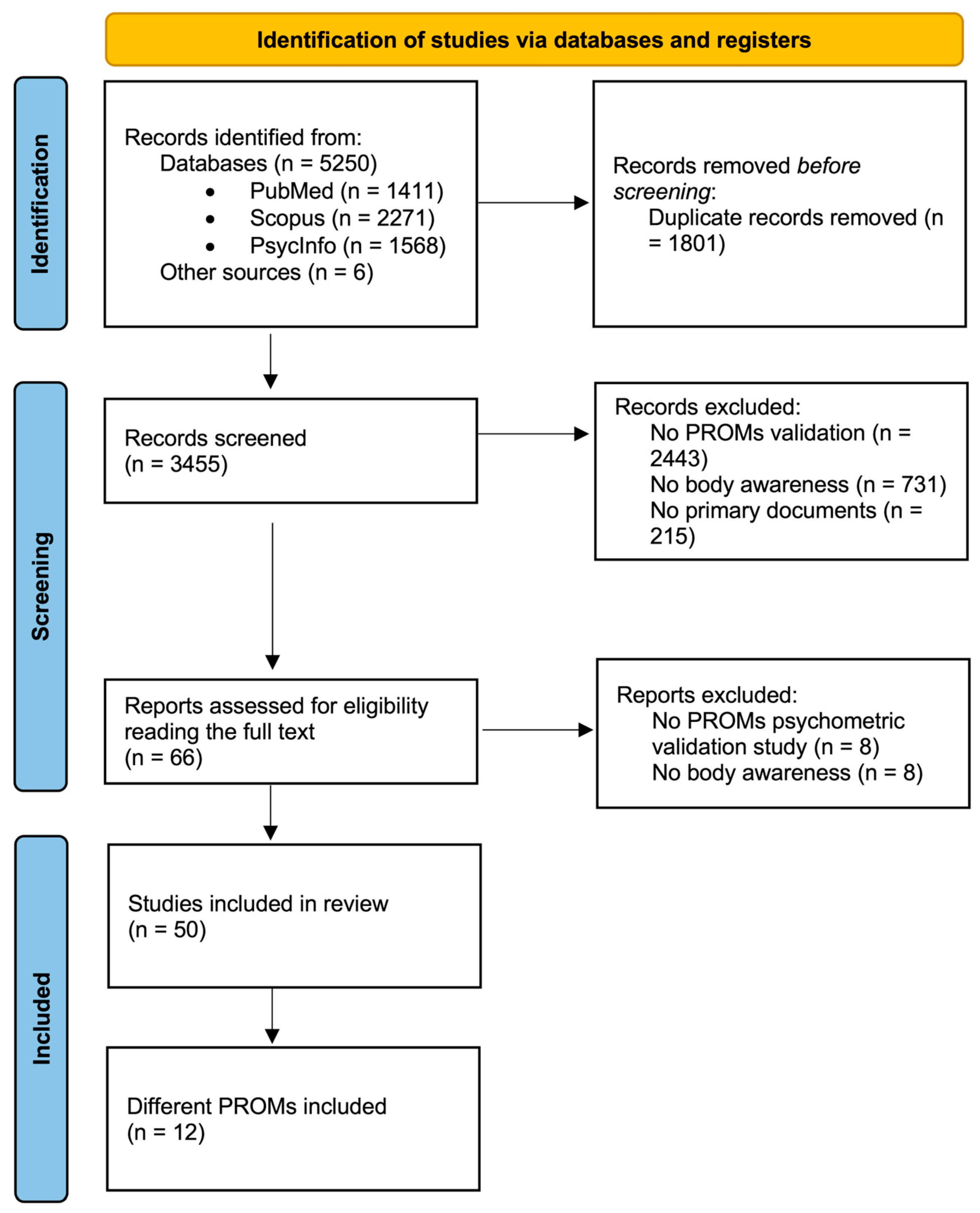
2.1. Systematic Literature Search
2.2. Descriptions of the Included PROMs
2.3. Characteristics of the Studies
2.4. Measurement Properties and Quality of Evidence of PROMs
2.5. ABC
2.6. BARQ and BARQ-R
2.7. BAQ
2.8. BPQ-SF and BPQ-VSF
2.9. MAIA, MAIA-2, and Brief MAIA-2
2.10. PABE and PBE-QAG
2.11. SBC
3. Discussion
3.1. Systematic Literature Search
3.2. ABC
3.3. BARQ and BARQ-R
3.4. BAQ
3.5. MAIA, MAIA-2, and Brief MAIA-2
3.6. PABE and PABE-QAG
3.7. SBC
3.8. Overall Discussion About All of the PROMs
3.9. Limitations and Strengths
4. Conclusions
Supplementary Materials
Author Contributions
Funding
Institutional Review Board Statement
Informed Consent Statement
Data Availability Statement
Acknowledgments
Conflicts of Interest
References
- Craig, A. How Do You Feel? An Interoceptive Moment with Your Neurobiological Self, 1st ed.; Princeton University Press: Princeton, NJ, USA, 2015. [Google Scholar]
- Ginzburg, K.; Tsur, N.; Barak-Nahum, A.; Defrin, R. Body Awareness: Differentiating between Sensitivity to and Monitoring of Bodily Signals. J. Behav. Med. 2014, 37, 564–575. [Google Scholar] [CrossRef] [PubMed]
- Horsburgh, A.; Summers, S.J.; Lewis, A.; Keegan, R.J.; Flood, A. The Relationship Between Pain and Interoception: A Systematic Review and Meta-Analysis. J. Pain 2024, 25, 104476. [Google Scholar] [CrossRef] [PubMed]
- Mehling, W.E.; Gopisetty, V.; Daubenmier, J.; Price, C.J.; Hecht, F.M.; Stewart, A. Body Awareness: Construct and Self-Report Measures. PLoS ONE 2009, 4, e5614. [Google Scholar] [CrossRef] [PubMed]
- Norman-Nott, N.; Hesam-Shariati, N.; Wewege, M.A.; Rizzo, R.R.N.; Cashin, A.G.; Wilks, C.R.; Quidé, Y.; McAuley, J.H.; Gustin, S.M. Emotion Regulation Skills-Focused Interventions for Chronic Pain: A Systematic Review and Meta-Analysis. Eur. J. Pain 2024, 28, 1276–1293. [Google Scholar] [CrossRef]
- Martínez-Calderon, J.; Casuso-Holgado, M.J.; Muñoz-Fernandez, M.J.; Garcia-Muñoz, C.; Heredia-Rizo, A.M. Yoga-Based Interventions May Reduce Anxiety Symptoms in Anxiety Disorders and Depression Symptoms in Depressive Disorders: A Systematic Review with Meta-Analysis and Meta-Regression. Br. J. Sports Med. 2023, 57, 1442–1449. [Google Scholar] [CrossRef]
- Khalsa, S.S.; Adolphs, R.; Cameron, O.G.; Critchley, H.D.; Davenport, P.W.; Feinstein, J.S.; Feusner, J.D.; Garfinkel, S.N.; Lane, R.D.; Mehling, W.E.; et al. Interoception and Mental Health: A Roadmap. Biol. Psychiatry Cogn. Neurosci. Neuroimaging 2018, 3, 501–513. [Google Scholar] [CrossRef]
- Wang, N.; Ren, F.; Zhou, X. Factor Structure and Psychometric Properties of the Body Perception Questionnaire-Short Form (BPQ-SF) Among Chinese College Students. Front. Psychol. 2020, 11, 1355. [Google Scholar] [CrossRef]
- van der Maas, L.C.C.; Köke, A.; Bosscher, R.J.; Twisk, J.W.R.; Janssen, T.W.J.; Peters, M. Body Awareness as an Important Target in Multidisciplinary Chronic Pain Treatment: Mediation and Subgroup Analyses. Clin. J. Pain 2016, 32, 763–772. [Google Scholar] [CrossRef]
- Oz, M.; Ulger, O. Body Awareness Disturbances in Patients with Low Back Pain: A Systematic Review. Acta Neurol. Belg. 2024, 124, 1477–1487. [Google Scholar] [CrossRef]
- Baskan, E.; Yagci, N.; Cavlak, U. Factors Affecting Body Awareness in Older Adults with Chronic Musculoskeletal Pain. Arch. Med. Sci. AMS 2021, 17, 934–939. [Google Scholar] [CrossRef]
- Cabrera, A.; Kolacz, J.; Pailhez, G.; Bulbena-Cabre, A.; Bulbena, A.; Porges, S.W. Assessing Body Awareness and Autonomic Reactivity: Factor Structure and Psychometric Properties of the Body Perception Questionnaire-Short Form (BPQ-SF). Int. J. Methods Psychiatr. Res. 2018, 27, e1596. [Google Scholar] [CrossRef]
- Page, M.J.; McKenzie, J.E.; Bossuyt, P.M.; Boutron, I.; Hoffmann, T.C.; Mulrow, C.D.; Shamseer, L.; Tetzlaff, J.M.; Akl, E.A.; Brennan, S.E.; et al. The PRISMA 2020 Statement: An Updated Guideline for Reporting Systematic Reviews. BMJ 2021, 372, n71. [Google Scholar] [CrossRef] [PubMed]
- Prinsen, C.a.C.; Mokkink, L.B.; Bouter, L.M.; Alonso, J.; Patrick, D.L.; de Vet, H.C.W.; Terwee, C.B. COSMIN Guideline for Systematic Reviews of Patient-Reported Outcome Measures. Qual. Life Res. 2018, 27, 1147–1157. [Google Scholar] [CrossRef] [PubMed]
- Ouzzani, M.; Hammady, H.; Fedorowicz, Z.; Elmagarmid, A. Rayyan—A Web and Mobile App for Systematic Reviews. Syst. Rev. 2016, 5, 210. [Google Scholar] [CrossRef] [PubMed]
- Landis, J.R.; Koch, G.G. The Measurement of Observer Agreement for Categorical Data. Biometrics 1977, 33, 159–174. [Google Scholar] [CrossRef]
- Terwee, C.B.; Bot, S.D.M.; de Boer, M.R.; van der Windt, D.A.W.M.; Knol, D.L.; Dekker, J.; Bouter, L.M.; de Vet, H.C.W. Quality Criteria Were Proposed for Measurement Properties of Health Status Questionnaires. J. Clin. Epidemiol. 2007, 60, 34–42. [Google Scholar] [CrossRef]
- Mokkink, L.B.; Elsman, E.B.M.; Terwee, C.B. COSMIN Guideline for Systematic Reviews of Patient-Reported Outcome Measures Version 2.0. Qual. Life Res. 2024, 33, 2929–2939. [Google Scholar] [CrossRef]
- Cohen, J. Statistical Power Analysis for the Behavioral Sciences, 2nd ed.; Routledge: New York, NY, USA, 2013; ISBN 978-0-203-77158-7. [Google Scholar]
- Beaton, D.E.; Bombardier, C.; Guillemin, F.; Ferraz, M.B. Guidelines for the Process of Cross-Cultural Adaptation of Self-Report Measures. Spine 2000, 25, 3186–3191. [Google Scholar] [CrossRef]
- Danner, U.; Avian, A.; Macheiner, T.; Salchinger, B.; Dalkner, N.; Fellendorf, F.T.; Birner, A.; Bengesser, S.A.; Platzer, M.; Kapfhammer, H.-P.; et al. “ABC”-The Awareness-Body-Chart: A New Tool Assessing Body Awareness. PLoS ONE 2017, 12, e0186597. [Google Scholar] [CrossRef]
- Mehling, W.E.; Price, C.; Daubenmier, J.J.; Acree, M.; Bartmess, E.; Stewart, A. The Multidimensional Assessment of Interoceptive Awareness (MAIA). PLoS ONE 2012, 7, e48230. [Google Scholar] [CrossRef]
- Menzel, J.E.; Thompson, J.K.; Levine, M.P. Development and Validation of the Physical Activity Body Experiences Questionnaire. Bull. Menn. Clin. 2019, 83, 53–83. [Google Scholar] [CrossRef] [PubMed]
- Price, C.J.; Thompson, E.A. Measuring Dimensions of Body Connection: Body Awareness and Bodily Dissociation. J. Altern. Complement. Med. 2007, 13, 945–953. [Google Scholar] [CrossRef] [PubMed]
- Rogowska, A.M.; Tataruch, R.; Klimowska, K. Validation of the Shortened 24-Item Multidimensional Assessment of Interoceptive Awareness, Version 2 (Brief MAIA-2). Sci. Rep. 2023, 13, 21270. [Google Scholar] [CrossRef]
- Mehling, W.E.; Acree, M.; Stewart, A.; Silas, J.; Jones, A. The Multidimensional Assessment of Interoceptive Awareness, Version 2 (MAIA-2). PLoS ONE 2018, 13, e0208034. [Google Scholar] [CrossRef] [PubMed]
- Dragesund, T.; Ljunggren, A.E.; Kvåle, A.; Strand, L.I. Body Awareness Rating Questionnaire—Development of a Self-Administered Questionnaire for Patients with Long-Lasting Musculoskeletal and Psychosomatic Disorders. Adv. Physiother. 2010, 12, 87–94. [Google Scholar] [CrossRef]
- Dragesund, T.; Strand, L.I.; Grotle, M. The Revised Body Awareness Rating Questionnaire: Development Into a Unidimensional Scale Using Rasch Analysis. Phys. Ther. 2018, 98, 122–132. [Google Scholar] [CrossRef]
- Shields, S.A.; Mallory, M.E.; Simon, A. The Body Awareness Questionnaire: Reliability and Validity. J. Pers. Assess. 1989, 53, 802–815. [Google Scholar] [CrossRef]
- Cossu, G.; Loi, E.; Carta, M.G.; Bramanti, A. The Physical Body Experiences Questionnaire Simplified for Active Aging (PBE-QAG). Clin. Pract. Epidemiol. Ment. Health CP EMH 2018, 14, 70–77. [Google Scholar] [CrossRef]
- Carpentier, S.; Deng, W.; Blackwood, J.; Van de Winckel, A. Rasch Validation of the Revised Body Awareness Rating Questionnaire (BARQ-R) in Adults with and without Musculoskeletal Pain. BMC Musculoskelet. Disord. 2024, 25, 799. [Google Scholar] [CrossRef]
- Tove, D.; Målfrid, R.; Liv Inger, S. Body Awareness Rating Questionnaire: Measurement Properties. Physiother. Theory Pract. 2012, 28, 515–528. [Google Scholar] [CrossRef]
- Demirel, A.; Onan, D.; Özel Asliyüce, Y.; Öz, M.; Berberoğlu, U.; Ülger, Ö. Body Awareness and Chronic Low Back Pain: Validity and Reliability Study of Turkish Version of Body Awareness Rating Scale. Turk. J. Med. Sci. 2020, 50, 849–854. [Google Scholar] [CrossRef] [PubMed]
- Lööf, H.; Johansson, U.-B.; Henriksson, E.W.; Lindblad, S.; Saboonchi, F. Development and Psychometric Testing of the Swedish Version of the Body Awareness Questionnaire. J. Adv. Nurs. 2013, 69, 1643–1651. [Google Scholar] [CrossRef] [PubMed]
- Cramer, H.; Lauche, R.; Daubenmier, J.; Mehling, W.; Büssing, A.; Saha, F.J.; Dobos, G.; Shields, S.A. Being Aware of the Painful Body: Validation of the German Body Awareness Questionnaire and Body Responsiveness Questionnaire in Patients with Chronic Pain. PLoS ONE 2018, 13, e0193000. [Google Scholar] [CrossRef] [PubMed]
- Karaca, S.; Bayar, B. Turkish Version of Body Awareness Questionnaire: Validity and Reliability Study. Türk Fiz. Rehabil. Derg. 2021, 32, 44–50. [Google Scholar] [CrossRef]
- Unal, A.; Altug, F.; Erden, A.; Cavlak, U.; Senol, H. Validity and Reliability of the Body Awareness Questionnaire in Patients with Non-Specific Chronic Low Back Pain. Acta Neurol. Belg. 2021, 121, 701–705. [Google Scholar] [CrossRef]
- Sánchez-Sánchez, L.C.; Klysing, A.; Steij Stålbrand, I.; Lundberg, T. Validation of the Spanish Version of the Body Awareness Questionnaire (BAQ) and an Exploration of Its Relationship to Meditation and Embodiment Variables. Healthcare 2025, 13, 628. [Google Scholar] [CrossRef]
- Carre, A.; Shankland, R.; Guillaume, P.; Duclos, J.; El-Jor, C.; Pellissier, S.; Flaudias, V. Validation of the French Version of the Body Awareness Questionnaire: Toward a Way to Assess Alexisomia. Front. Psychol. 2024, 15, 1261994. [Google Scholar] [CrossRef]
- Cerritelli, F.; Galli, M.; Consorti, G.; D’Alessandro, G.; Kolacz, J.; Porges, S.W. Cross-Cultural Adaptation and Psychometric Properties of the Italian Version of the Body Perception Questionnaire. PLoS ONE 2021, 16, e0251838. [Google Scholar] [CrossRef]
- Najari, S.; Rostami, R.; Kazemi, R.; Farahani, H. Factor Structure and Psychometric Properties of the Body Perception Questionnaire-Short Form (BPQ-SF); The Persian Version. PLoS ONE 2024, 19, e0306348. [Google Scholar] [CrossRef]
- Lin, F.-L.; Hsu, C.-C.; Mehling, W.; Yeh, M.-L. Translation and Psychometric Testing of the Chinese Version of the Multidimensional Assessment of Interoceptive Awareness. J. Nurs. Res. JNR 2017, 25, 76–84. [Google Scholar] [CrossRef]
- Bornemann, B.; Herbert, B.M.; Mehling, W.E.; Singer, T. Differential Changes in Self-Reported Aspects of Interoceptive Awareness through 3 Months of Contemplative Training. Front. Psychol. 2014, 5, 1504. [Google Scholar] [CrossRef] [PubMed]
- Vinni, E.; Karaivazoglou, K.; Tourkochristou, E.; Gourzis, P. Linguistic and Cultural Adaptation and Psychometric Validation of the Multidimensional Assessment of Interoceptive Awareness in Greek Individuals. Achaiki Iatriki 2021, 40, 191–197. [Google Scholar]
- Shoji, M.; Mehling, W.E.; Hautzinger, M.; Herbert, B.M. Investigating Multidimensional Interoceptive Awareness in a Japanese Population: Validation of the Japanese MAIA-J. Front. Psychol. 2018, 9, 1855. [Google Scholar] [CrossRef] [PubMed]
- Fujino, H. Further Validation of the Japanese Version of the Multidimensional Assessment of Interoceptive Awareness. BMC Res. Notes 2019, 12, 530. [Google Scholar] [CrossRef]
- Calì, G.; Ambrosini, E.; Picconi, L.; Mehling, W.E.; Committeri, G. Investigating the Relationship between Interoceptive Accuracy, Interoceptive Awareness, and Emotional Susceptibility. Front. Psychol. 2015, 6, 1202. [Google Scholar] [CrossRef]
- Valenzuela-Moguillansky, C.; Reyes-Reyes, A. Psychometric Properties of the Multidimensional Assessment of Interoceptive Awareness (MAIA) in a Chilean Population. Front. Psychol. 2015, 6, 120. [Google Scholar] [CrossRef]
- Montoya-Hurtado, O.; Gómez-Jaramillo, N.; Bermúdez-Jaimes, G.; Correa-Ortiz, L.; Cañón, S.; Juárez-Vela, R.; Santolalla-Arnedo, I.; Criado-Pérez, L.; Pérez, J.; Sancho-Sánchez, M.C.; et al. Psychometric Properties of the Multidimensional Assessment of Interoceptive Awareness (MAIA) Questionnaire in Colombian University Students. J. Clin. Med. 2023, 12, 2937. [Google Scholar] [CrossRef]
- Brown, T.A.; Berner, L.A.; Jones, M.D.; Reilly, E.E.; Cusack, A.; Anderson, L.K.; Kaye, W.H.; Wierenga, C.E. Psychometric Evaluation and Norms for the Multidimensional Assessment of Interoceptive Awareness (MAIA) in a Clinical Eating Disorders Sample. Eur. Eat. Disord. Rev. 2017, 25, 411–416. [Google Scholar] [CrossRef]
- Ferentzi, E.; Olaru, G.; Geiger, M.; Vig, L.; Köteles, F.; Wilhelm, O. Examining the Factor Structure and Validity of the Multidimensional Assessment of Interoceptive Awareness. J. Pers. Assess. 2021, 103, 675–684. [Google Scholar] [CrossRef]
- Baranauskas, M.; Grabauskaité, A.; Griðkova-Bulanova, I. Psychometric Characteristics of Lithuanian Version of Multidimensional Assessment of Interoceptive Awareness. Neurol. Semin. 2016, 20, 202–206. [Google Scholar]
- Todd, J.; Barron, D.; Aspell, J.E.; Toh, E.K.L.; Zahari, H.S.; Khatib, N.A.M.; Swami, V. Translation and Validation of a Bahasa Malaysia (Malay) Version of the Multidimensional Assessment of Interoceptive Awareness (MAIA). PLoS ONE 2020, 15, e0231048. [Google Scholar] [CrossRef]
- Machorrinho, J.; Veiga, G.; Fernandes, J.; Mehling, W.; Marmeleira, J. Multidimensional Assessment of Interoceptive Awareness: Psychometric Properties of the Portuguese Version. Percept. Mot. Skills 2019, 126, 87–105. [Google Scholar] [CrossRef] [PubMed]
- Chapman, H.E.; Stewart, A.E. Interoceptive Awareness in a Southeastern US College Sample: Validation of the Multidimensional Assessment of Interoceptive Awareness—Version 2. BMC Res. Notes 2024, 17, 236. [Google Scholar] [CrossRef] [PubMed]
- Da Costa Silva, L.; Belrose, C.; Trousselard, M.; Rea, B.; Seery, E.; Verdonk, C.; Duffaud, A.M.; Verdonk, C. Self-Reported Body Awareness: Validation of the Postural Awareness Scale and the Multidimensional Assessment of Interoceptive Awareness (Version 2) in a Non-Clinical Adult French-Speaking Sample. Front. Psychol. 2022, 13, 946271. [Google Scholar] [CrossRef] [PubMed]
- Fekih-Romdhane, F.; Malaeb, D.; Fawaz, M.; Chammas, N.; Soufia, M.; Obeid, S.; Hallit, S. Psychometric Properties of an Arabic Translation of the Multidimensional Assessment of Interoceptive Awareness (MAIA-2) Questionnaire in a Non-Clinical Sample of Arabic-Speaking Adults. BMC Psychiatry 2023, 23, 577. [Google Scholar] [CrossRef]
- Teng, B.; Wang, D.; Su, C.; Zhou, H.; Wang, T.; Mehling, W.E.; Hu, Y. The Multidimensional Assessment of Interoceptive Awareness, Version 2: Translation and Psychometric Properties of the Chinese Version. Front. Psychiatry 2022, 13, 970982. [Google Scholar] [CrossRef]
- Scheffers, M.; Coenen, J.; Moeijes, J.; de Haan, A.; van Busschbach, J.; Bellemans, T. The Multidimensional Assessment of Interoceptive Awareness, Version 2 (MAIA-2): Psychometric Properties in a Dutch Non-Clinical Sample. BMC Psychol. 2024, 12, 53. [Google Scholar] [CrossRef]
- Fiskum, C.; Eik-Nes, T.T.; Abdollahpour Ranjbar, H.; Andersen, J.; Habibi Asgarabad, M. Interoceptive Awareness in a Norwegian Population: Psychometric Properties of the Multidimensional Assessment of Interoceptive Awareness (MAIA) 2. BMC Psychiatry 2023, 23, 489. [Google Scholar] [CrossRef]
- Melhi, E.; Zarani, F.; Panaghi, L.; Harirchian, M.-H. Psychometric Properties of the Persian Version of the Multidimensional Assessment of Interoceptive Awareness, Version 2 MAIA-2. Int. J. Behav. Sci. 2023, 17, 165–173. [Google Scholar] [CrossRef]
- Vivas-Rivas, L.J.; Serpa-Barrientos, A.; Gálvez-Díaz, N.D.C.; Carranza-Cubas, S.P.; Saintila, J. Psychometric Network Analysis of the Multidimensional Assessment of Interoceptive Awareness, Version 2 (MAIA-2) in Peruvian Adults. BMC Psychol. 2025, 13, 125. [Google Scholar] [CrossRef]
- Deng, W.; Carpentier, S.; Van de Winckel, A. Physical Body Experiences Questionnaire Simplified for Active Aging (PBE-QAG): Rasch Validation. PLoS ONE 2023, 18, e0280198. [Google Scholar] [CrossRef]
- Neves, C.F.; Price, C.J.; Carvalheira, A. The Psychometric Properties of the Scale of Body Connection (SBC) in a Portuguese Sample. Psychol. Community Health 2017, 6, 158. [Google Scholar] [CrossRef]
- Price, C.J.; Thompson, E.A.; Cheng, S.C. Scale of Body Connection: A Multi-Sample Construct Validation Study. PLoS ONE 2017, 12, e0184757. [Google Scholar] [CrossRef] [PubMed]
- Cheng, S.C.; Thompson, E.A.; Price, C.J. The Scale of Body Connection: A Multisample Study to Examine Sensitivity to Change Among Mind-Body and Bodywork Interventions. J. Integr. Complement. Med. 2022, 28, 600–606. [Google Scholar] [CrossRef] [PubMed]
- Morganti, F.; Rezzonico, R.; Chieh Cheng, S.; Price, C.J. Italian Version of the Scale of Body Connection: Validation and Correlations with the Interpersonal Reactivity Index. Complement. Ther. Med. 2020, 51, 102400. [Google Scholar] [CrossRef]
- del Quezada-Berumen, L.C.; González-Ramírez, M.T.; Cebolla, A.; Soler, J.; Garcia-Campayo, J. Body Awareness and Mindfulness: Validation of the Spanish Version of the Scale of Body Connection. Actas Esp. Psiquiatr. 2014, 42, 57–67. [Google Scholar]
- Sze, J.A.; Gyurak, A.; Yuan, J.W.; Levenson, R.W. Coherence Between Emotional Experience and Physiology: Does Body Awareness Training Have an Impact? Emotion 2010, 10, 803–814. [Google Scholar] [CrossRef]
- Vig, L.; Köteles, F.; Ferentzi, E. Questionnaires of Interoception Do Not Assess the Same Construct. PLoS ONE 2022, 17, e0273299. [Google Scholar] [CrossRef]
- Bravo, C.; Skjaerven, L.H.; Guitard Sein-Echaluce, L.; Catalan-Matamoros, D. Effectiveness of Movement and Body Awareness Therapies in Patients with Fibromyalgia: A Systematic Review and Meta-Analysis. Eur. J. Phys. Rehabil. Med. 2019, 55, 646–657. [Google Scholar] [CrossRef]
- Oliveira, I.; Garrido, M.V.; Bernardes, S.F. On the Body-Mind Nexus in Chronic Musculoskeletal Pain: A Scoping Review. Eur. J. Pain Lond. Engl. 2022, 26, 1186–1202. [Google Scholar] [CrossRef]
- Budzisz, A.; Jung, A.; Adamczyk, W.M.; Szikszay, T.M.; Carvalho, G.F.; Bąbel, P.; Luedtke, K. Body Image Measured via the Fremantle Awareness Questionnaire in Individuals With and Without Pain: A Systematic Review and Meta-Analysis. J. Pain 2024, 25, 104530. [Google Scholar] [CrossRef] [PubMed]
- Lotfalla, A.; Halm, J.; Schepers, T.; Giannakópoulos, G. Health-Related Quality of Life after Severe Trauma and Available PROMS: An Updated Review (Part I). Eur. J. Trauma Emerg. Surg. 2023, 49, 747–761. [Google Scholar] [CrossRef]
- Selva, A.; Selva, C.; Álvarez-Pérez, Y.; Torà, N.; López, P.; Terraza-Núñez, R.; Rodríguez, V.; Solà, I. CyDESA group Satisfaction and Experience with Colorectal Cancer Screening: A Systematic Review of Validated Patient Reported Outcome Measures. BMC Med. Res. Methodol. 2021, 21, 230. [Google Scholar] [CrossRef] [PubMed]
- Climent-Sanz, C.; Morera-Amenós, G.; Bellon, F.; Pastells-Peiró, R.; Blanco-Blanco, J.; Valenzuela-Pascual, F.; Gea-Sánchez, M. Poor Sleep Quality Experience and Self-Management Strategies in Fibromyalgia: A Qualitative Metasynthesis. J. Clin. Med. 2020, 9, 4000. [Google Scholar] [CrossRef] [PubMed]
- Corrêa, L.A.; Bittencourt, J.V.; de Ferreira, A.S.; Reis, F.J.J.D.; de Almeida, R.S.; Nogueira, L.A.C. The Reliability and Concurrent Validity of PainMAP Software for Automated Quantification of Pain Drawings on Body Charts of Patients With Low Back Pain. Pain Pract. 2020, 20, 462–470. [Google Scholar] [CrossRef]
- Campbell-Sills, L.; Stein, M.B. Psychometric Analysis and Refinement of the Connor-Davidson Resilience Scale (CD-RISC): Validation of a 10-Item Measure of Resilience. J. Trauma. Stress 2007, 20, 1019–1028. [Google Scholar] [CrossRef]
- Maydeu-Olivares, A.; Kramp, U.; García-Forero, C.; Gallardo-Pujol, D.; Coffman, D. The Effect of Varying the Number of Response Alternatives in Rating Scales: Experimental Evidence from Intra-Individual Effects. Behav. Res. Methods 2009, 41, 295–308. [Google Scholar] [CrossRef]
- John, O.P.; Srivastava, S. The Big Five Trait Taxonomy: History, Measurement, and Theoretical Perspectives. In Handbook of Personality: Theory and Research, 2nd ed.; Guilford Press: New York, NY, USA, 1999; pp. 102–138. ISBN 978-1-57230-483-3. [Google Scholar]
- Flake, J.K.; Fried, E.I. Measurement Schmeasurement: Questionable Measurement Practices and How to Avoid Them. Adv. Methods Pract. Psychol. Sci. 2020, 3, 456–465. [Google Scholar] [CrossRef]
- Treanor, C.; Donnelly, M. A Methodological Review of the Short Form Health Survey 36 (SF-36) and Its Derivatives among Breast Cancer Survivors. Qual. Life Res. 2015, 24, 339–362. [Google Scholar] [CrossRef]
- Parma, C.; Doria, F.; Zulueta, A.; Lanzone, J.; Boscarino, M.; Giani, L.; Lunetta, C.; Vassallo, M.; Parati, E.A.; Picozzi, M.; et al. An Overview of the Bodily Awareness Representation and Interoception: Insights and Progress in the Field of Neurorehabilitation Research. Brain Sci. 2024, 14, 386. [Google Scholar] [CrossRef]


| Name of the PROM | Original Language | Subscales | n of Items | Score Calculation | Translated Versions |
|---|---|---|---|---|---|
| Awareness-Body-Chart (ABC) [21] | German (Austria) | - | Body chart with 51 regions where you can choose a color based on perceived awareness | 5-Likert scale. The higher the score, the lower the body awareness. | - |
| Body Awareness Rating Questionnaire (BARQ) [27] | Norwegian | Function, mood, feelings, and awareness | 24 items | 7-Likert scale. The higher the score, the lower the body awareness. | Turkish |
| Revised Body Awareness Rating Questionnaire (BARQ-R) [28] | Norwegian | - | 12 items * | 4-Likert scale. The higher the score, the lower the body awareness. | English (USA) |
| Body Awareness Questionnaire (BAQ) [29] | English (USA) | - | 18 items | 7-Likert scale. The higher the score, the lower the body awareness. | Sweden, German, Turkish, Spanish |
| Body Perception Questionnaire—Short Form (BPQ-SF) [12] | Spanish (Spain) and English (USA) | Body awareness, autonomic nervous, system reactivity | 46 items | 5-Likert scale. The higher the score, the less body awareness. | Italian, Chinese (China), Persian |
| Body Perception Questionnaire-Very short form (BPQ-VSF) [12] | Spanish (Spain) and English (USA) | - | 12 items | Same as BPQ-VSF. | Chinese (China) |
| Multidimensional Assessment of Interoceptive Awareness (MAIA) [22] | English (USA) | Noticing, not distracting, not worrying, attention regulation, emotional awareness, self-regulation, body listening, trusting | 32 items | 6-Likert scale. The higher the score, the greater the body awareness. | Chinese (Taiwan), German (Germany), Greek, Japanese, Italian, Spanish (Chile), Spanish (Colombia), English (USA), Hungarian, Lithuanian, Malay, Portuguese |
| Multidimensional Assessment of Interoceptive Awareness Version 2 (MAIA-2) [26] | English (USA) | Same as MAIA | 37 items | Same as MAIA. | French, Arabic (Lebanon), Chinese (China), Dutch (Netherlands), Norwegian, Persian |
| Brief Multidimensional Assessment of Interoceptive Awareness Version 2 (Brief MAIA-2) [25] | Polish | Same as MAIA | 24 items | Same as MAIA. | - |
| Physical Activity Body Experiences Questionnaire (PABE) [23] | English (USA) | Mind/body connection, body acceptance | 10 items | 7-Likert scale. The higher the score, the lower the body awareness. | - |
| Physical Body Experiences Questionnaire Simplified for Active Aging (PBE-QAG) [30] | Italian | - | 12 items | 5-Likert scale. The higher the score, the lower the body awareness. | - |
| Scale of Body Connection (SBC) [24] | English (USA) | Body awareness, body dissociation | 20 items | 5-Likert scale. The higher the score, the lower the body awareness. | Italian, French, Dutch (Netherlands), Portuguese, English (USA), Hebrew (Israel), English (USA), French, English (Australia), Dutch (Netherlands), German, Italian, Spanish (Spain) |
| PROM Name | Language | Psychometric Measures | Type of Participant | Mean Age | Female (%) | Type of Data Collection | Sample Size | Reliability Follow-Up | Intervention for Responsiveness |
|---|---|---|---|---|---|---|---|---|---|
| Awareness-Body-Chart (ABC) | Original: German (Austria) [21] | STRUV INTCO HTCOV CONV RELIA | Physiotherapy students with a good corporal consciousness state from the FH Joanneum University in Graz/Austria. | 21 y (women) 22 y (men) | 46% | Paper | 172 | Same day | - |
| Body Awareness Rating Questionnaire (BARQ) | Original: Norwegian [27] | STRUV INTCO CONV | Participants with long-lasting musculoskeletal and psychosomatic disorders and a small group of healthy people. | 42.4 ± 11.1 y | 77% | Paper | 300 | - | - |
| Norwegian [32] | HTCOV RELIA RESPO MESER | Diagnosis of musculoskeletal pain and/or psychosomatic disorders with more than 3 months of duration. | 42.2 ± 13.2 y | 75.5% | Paper | 50 | 2–7 days | 6 months of Norwegian psychomotor physiotherapy | |
| Turkish [33] | INTCO RELIA HTCOV | Patients with CLBP who referred to the physiotherapy unit and healthy controls who were the patients’ caregivers. | 44.9 ± 12.9 y (CLBP) 36.9 ± 11.9 y (healthy) | 68.7% (CLBP) 50.5% (healthy) | ? | 99 (CLBP) 101 (healthy) | ? | - | |
| Revised Body Awareness Rating Questionnaire (BARQ-R) | Original: Norwegian [28] | STRUV RELIA INTCO MESER | People who had musculoskeletal and/or psychosomatic complaints who were referred to Norwegian psychomotor physiotherapy. | 42.1 ± 11.0 y (Survey 2) 46.9 ± 12.0 y (Survey 3) | 91% (Survey 2) 94% (Survey 3) | ? | 125 (Survey 2) 48 (Survey 3) | 1 week | - |
| English (USA) [31] | STRUV INTCO | Adults with and without self-reported musculoskeletal pain at the Minnesota State Fair and Highland Fest. | 50.2 ± 17.2 | 66.1% | Paper and computerized | 623 | - | - | |
| Body Awareness Questionnaire (BAQ) | Original: English (USA) [29] | STRUV INTCO RELIA HTCOV CONV | University students and no students with secondary school (high school) completed. | 23.8 y | 39% (students) 23% (non-students) | Paper | 794 | 2 weeks | - |
| Sweden [34] | STRUV INTCO | Patients with rheumatoid arthritis and nursing students with a good health status. | 62 y | 14% (patients) 6% (students) | Paper: letter | 120 (patients) 120 (students) | - | - | |
| German (Germany) [35] | STRUV INTCO RELIA HTCOV RESPO | Patients with a condition of chronic pain (fibromyalgia, head pain, spinal pain, osteoarthritis, others). | 50.3 ± 11.4 y | 91.6% | ? | 512 | 10 weeks | Mindfulness, yoga, and qigong/Tai Chi | |
| Turkish [36] | STRUV INTCO RELIA HTCOV | Undergraduate students. | 21.8 ± 2.3 y | 45.0% | ? | 180 | 3 days | - | |
| Turkish [37] | INTCO RELIA HTCOV | Adults with non-specific low back pain and chronic of 3 months or more. | 42.1 y | 53.3% | ? | 180 | 7 days | - | |
| Spanish [38] | STRUV INTCO HTCOV | Adults. | 25.3 y | 64.7% | Computerized: online | 281 | - | - | |
| French [39] | STRUV INTCO HTCOV | University students and active workers. | 30.5 ± 13.2 y | 21.2% | Computerized: online | 610 | - | - | |
| Body Perception Questionnaire—Short Form (BPQ-SF) | Original: Spanish (Spain) [12] | STRUV INTCO RELIA HTCOV CONV | Adults. | 39.9 y | 62% | Computerized: online | 465 | 7 days | - |
| Original: English (USA) [12] | STRUV INTCO | Healthy adults and undergraduate students. | 35.1 y (USA residents) <20 y (USA students) | 63% (USA residents) 47% (USA students) | Computerized: online (USA residents) Paper (USA students) | 450 (USA residents) 315 (USA students) | - | - | |
| Italian [40] | STRUV INTCO | Adults. | 34.7 y | 59.2% | Computerized: online | 493 | - | - | |
| Chinese (China) [8] | STRUV INTCO RELIA HTCOV | Undergraduate students from the public university in China. | 19.8 y | 46.7% | Paper | 688 | 4 weeks | - | |
| Persian [41] | STRUV INTCO HTCOV | Undergraduate students from the University of Tehran. | 31.7 ± 51.3 y | 57% | Computerized: online | 748 | - | - | |
| Body Perception Questionnaire—Very Short Form (BPQ-VSF) | Original: Spanish (Spain) [12] | INTCO RELIA HTCOV CRITV | Same as BPQ-SF Spanish version. | - | - | - | - | - | - |
| Original: English (USA) [12] | INTCO | Same as BPQ-SF English version. | - | - | - | - | - | - | |
| Chinese (China) [8] | INTCO RELIA HTCOV | Same as BPQ-SF Chinese version. | - | -- | |||||
| Multidimensional Assessment of Interoceptive Awareness (MAIA) | Original: English (USA) [22] | STRUV INTCO CONV | Students and instructors of body awareness components (yoga, tai chi…) or body-oriented psychotherapy. | 42.2 y | 86% | Computerized | 325 | - | - |
| Chinese (Taiwan) [42] | STRUV INTCO RELIA HTCOV | Adults from social clubs that involved tai chi, qigong, martial arts, yoga, mindfulness, or meditation. | 45.2 y | 69.7% | Paper | 294 | 2 weeks | - | |
| German (Germany) [43] | INTCO RELIA HTCOV RESPO | Adults. | 42.6 ± 9.7 y | 67.9% | Paper and computerized | 1076 | 113 days | Daily practices of body scan and breath meditation | |
| Greek [44] | STRUV INTCO | Adults. | 39.4 y | 45.8% | Paper | 107 | - | - | |
| Japanese [45] | STRUV INTCO HTCOV | Adults and undergraduate students from Tokyo Kasei University and Sapporo international University. | 20.2 y | 67.7% | Paper | 390 | - | - | |
| Japanese [46] | STRUV INTCO RELIA HTCOV | Undergraduate students from Oita University, Osaka University, and Hiramatsu Oita College of Rehabilitation. | 19.6 y | 53% | Paper | 268 | 2 weeks | - | |
| Italian [47] | STRUV INTCO HTCOV | Undergraduate students from the University G. d’Annunzio of Chieti. | 20.5 y | 42% | Paper | 321 | - | - | |
| Spanish (Chile) [48] | STRUV INTCO | Adults. | 30.5 y | 76.6% | Paper and computerized | 470 | - | - | |
| Spanish (Colombia) [49] | STRUV INTCO | Undergraduate university students from the Escuela Colombiana de Rehabilitación and the Universidad de Manizales. | 21 y | 64% | Paper | 202 | - | - | |
| English (USA) [50] | STRUV INTCO HTCOV | Eating disorder patients (adults and adolescents) from the University of California, Partial Hospital Program. | 26.9 ± 9.9 y (adults) 15.1 ± 1.9 y (adolescents) | 95.1% (adults) 93.8% (adolescents) | Computerized: electronic terminal | 182 (adults) 194 (adolescents) | - | - | |
| Hungarian [51] | STRUV INTCO HTCOV | Adults. | 35.7 ± 12.1 y | 84.8% | Computerize: online | 2109 | - | - | |
| Lithuanian [52] | STRUV INTCO | Adults (most of them were undergraduate students). | 21.9 ± 2.3 y | 49% | ? | 386 | - | - | |
| Malay [53] | STRUV INTCO | Adults. | 33.8 y | 49.4% | Paper | 815 | - | - | |
| Portuguese [54] | STRUV INTCO HTCOV RELIA | University students from the University of Évora. | 23.3 y | 86% | Paper | 497 | 2 weeks | - | |
| Multidimensional Assessment of Interoceptive Awareness Version 2 (MAIA-2) | Original: English (USA) [26] | STRUV INTCO CONV | Adult visitors of the Live Science residency project at the Science Museum of London. | 30.6 y | 47% | Paper | 1090 | - | - |
| English (USA) [55] | STRUV INTCO RELIA | Southeastern United States college sample. | 23.7 ± 7.2 y (Sample 1) 21.0 ± 1.3 y (Sample 2) | 69.2% (Sample 1) 86.0% (Sample 2) | ? | 776 | 3 weeks | - | |
| French [56] | STRUV INTCO RELIA HTCOV | Adults recruited from websites and social media. | 35 y | 61% | Computerized: online | 308 | 11 days | - | |
| Arabic (Lebanon) [57] | STRUV INTCO HTCOV | Adults. | 22.7 y | 59.9% | Computerized: online | 359 | - | - | |
| Chinese (China) [58] | STRUV INTCO HTCOV | Adults from Zhejiang University. | 21.6 y | 61.7% | ? | 627 | - | - | |
| Dutch (Netherlands) [59] | STRUV INTCO RELIA | University students from the University Medical Center Groningen. | 35.1 ± 15.7 y | 68.6% | Computerized: online | 1054 | - | - | |
| Norwegian [60] | STRUV INTCO HTCOV | Adults from two Norwegian municipalities, two Norwegian Universities, and online recruitment. | 41–45 y | 81% | Computerized: online | 306 | - | - | |
| Persian [61] | STRUV INTCO HTCOV | Adults from Shahid Beheshti University’s social platforms and students’ social media groups. | 31.8 ± 7.1 y | 86.1% | Computerized: online | 475 | - | - | |
| Spanish (Peru) [62] | STRUV INTCO | University and military school adults. | ? | 61% | Computerized: online | 414 | - | - | |
| Brief Multidimensional Assessment of Interoceptive Awareness Version 2 (Brief MAIA-2) | Polish [25] | STRUV INTCO | University students of Physical Education and elite athletes in speed skating. | 26.1 ± 9.1 y | 54.8% | Paper | 323 | - | - |
| Physical Activity Body Experiences Questionnaire (PABE) | Original: English (USA) [23] | STRUV INTCO RELIA HTCOV CONV | Undergraduates from the University of South Florida. | 21.0 ± 5.2 y (Sample 1) 21.0 ± 5.0 y (Sample 2) 19.9 ± 2.2 y (Sample 3) | 100% | Computerized: online | 664 | - | - |
| Physical Body Experiences Questionnaire Simplified for Active Aging (PBE-QAG) | Original: Italian [30] | STRUV INTCO | Elderly people at the University of the Third Age of Cagliari. | 68.8 y | 59.4% | ? | 106 | - | - |
| English (USA) [63] | STRUV | Adults and older adults (healthy or with stroke) through the Minnesota State Fair and a previous project. | 70.3 ± 4.8 y (older adults without stroke) 50.0 ± 16.8 y (adults without stroke) 58.0 ± 12.9 y (adults with stroke) | 57.8% (older adults without stroke) 63.7% (adults without stroke) 30.5% (adults with stroke) | Computerized: electronic terminal | 133 (older adults without stroke) 530 (adults without stroke) 36 (adults with stroke) | - | - | |
| Scale of Body Connection (SBC) | Original: English (USA) [24] | STRUV INTCO CONV | Undergraduate students. | 20 y | 55% | Paper | 291 | - | - |
| Portuguese (Portugal) [64] | STRUV INTCO HTCOV | Adults. | 34.08 ± 11.74 y | 49% | Computerized: online | 909 | - | - | |
| Portuguese (Portugal) [65] | STRUV INTCO | Adults. | 31.0 y | 49.0% | Computerized: online | 909 | - | - | |
| Italian [65] | STRUV INTCO | Adults. | 27.0 y | 68.8% | Computerized: online | 576 | - | - | |
| French [65] | STRUV INTCO | Adults. | 39.0 y | 31.4% | Computerized: online | 198 | - | - | |
| Dutch (Netherlands) [65] | STRUV INTCO | Undergraduate students. | 20.0 y | 75.5% | Paper | 434 | - | - | |
| English (USA) [65] | STRUV INTCO | Undergraduate students, lesbian women, and somatic therapists. | 20.0 y (students) 48.5 y (lesbian women) 49.0 y (therapists) | 57.7% Paper (students) 100% (lesbian women) 78.7% (therapists) | Paper (students); computerized: online (therapists and lesbian women) | 291 290 328 | - | - | |
| Hebrew (Israel) [65] | STRUV INTCO | Undergraduate students. | 28.0 y | 62% | Paper | 608 | - | - | |
| English (USA) [66] | HTCOV RESPO | Trauma, overweight/obese, and substance-use patients. | ? | 100% | ? | 152 (trauma) 24 (overweight) 99 (substance use) 24 (trauma) | - | Yoga, mindfulness meditation, or body awareness | |
| French [66] | HTCOV RESPO | Eating disorder patients. | ? | 100% | ? | 12 | - | Mindfulness meditation | |
| Dutch (Netherlands) [66] | RESPO | Chronic pain and mood disorder patients. | ? | 82% (chronic pain) 78% (mood disorders) | ? | 50 (chronic pain) 164 (mood disorders) | - | Body awareness | |
| German [66] | RESPO | Colorectal cancer, chronic pain, major depression, and neck pain patients. | ? | 79% (cancer) 91–93% (chronic pain) 76% (depression) 81% (neck pain) | ? | 27 (cancer) 512 (chronic pain) 21 (depression) 22 (neck pain) | - | Yoga, body awareness, or bodywork | |
| Italian [67] | STRUV INTCO HTCOV | Adults. | 30.4 ± 9.4 y | 68.7% | Computerized: online | 576 | - | - | |
| Spanish (Spain) [68] | STRUV INTCO RELIA HTCOV | Adults from mindfulness and meditation associations. | 41.3 ± 11.2 y | 61.9% | Computerized: online | 578 | 1 month | - |
| Structural Validity | Internal Consistency | Reliability | Hypotheses Testing for Construct Validity | Criterion Validity | Responsiveness | Measurement Error | ||||
|---|---|---|---|---|---|---|---|---|---|---|
| Convergent | Divergent | Known | ||||||||
| Body Awareness Rating Questionnaire (BARQ) | n of outcomes | 1 | 3 | 2 | 2 | 2 | 1 | |||
| Summary of the risk of bias | 100% Doubtful | 100% Doubtful | 50% Adequate, 50% Inadequate | 100% Adequate | 100% Adequate | 100% Adequate | ||||
| Pooled result | −(Total variance explained = 46.9%) | +(α = 0.65–0.96) | +(ICC = 0.74–0.96) | −(r = 0.02, 0.53) | ±(r = −0.39, 0.26) | ? (SDC = 0.69–0.85) | ||||
| Quality of evidence | n.a. | Low | Very low | Moderate | Moderate | n.a. | ||||
| Revised Body Awareness Rating Questionnaire (BARQ-R) | n of outcomes | 2 | 2 | 1 | 1 | |||||
| Summary of the risk of bias | 100% Very good | 100% Very good | 100% Very good | 100% Adequate | ||||||
| Pooled result | +(X2 = 13.6–205.7; Fit residual = −2.01 to 0.7) | +(PSI = 0.72–0.76) | +(ICC = 0.83) | ? (SDC = 6.26) | ||||||
| Quality of evidence | High | High | n.a. | n.a. | ||||||
| Body Awareness Questionnaire (BAQ) | n of outcomes | 6 | 7 | 4 | 6 | 2 | 2 | 1 | ||
| Summary of the risk of bias | 33% Very good, 33% Adequate, 33% Doubtful | 43% Very good, 57% Doubtful | 75% Very good, 25% Doubtful | 50% Very good, 50% Adequate | 50% Very good, 50% Adequate | 50% Adequate, 50% Doubtful | 100% Adequate | |||
| Pooled result | −(CFI = 0.68–0.95; RMSEA = 0.04–0.09) | +(α = 0.72–0.91) | +(ICC = 0.80–0.86) | −(r = 0.00, 0.80) | ±(r = −0.01, −0.75) | +(p = 0.001–0.03) | +(p < 0.001) | |||
| Quality of evidence | Low | Low | Low | Low | Moderate | Low | n.a. | |||
| Body Perception Questionnaire—Short Form (BPQ-SF) | n of outcomes | 5 | 5 | 2 | 3 | 1 | ||||
| Summary of the risk of bias | 60% Very good, 40% Doubtful | 100% Very good | 50% Very good, 50% Doubtful | 100% Adequate | 100% Adequate | |||||
| Pooled result | ±(CFI = 0.90–0.98; RMSEA = 0.02–0.11) | +(α/ω = 0.77–0.96) | +(ICC = 0.71–0.99) | ±(r = 0.24, 0.69) | −(r = 0.11, 0.19) | |||||
| Quality of evidence | Moderate | High | Low | High | n.a. | |||||
| Body Perception Questionnaire—Very Short Form (BPQ-VSF) | n of outcomes | 3 | 2 | 2 | 1 | 1 | ||||
| Summary of the risk of bias | 100% Very good | 50% Very good, 50% Doubtful | 100% Adequate | 100% Adequate | 100% Adequate | |||||
| Pooled result | +(α = 0.83–0.91) | ±(ICC/r = 0.68–0.97) | ±(r = 0.28, 0.55) | −(r = 0.18) | +(r = 0.94) | |||||
| Quality of evidence | High | Low | High | n.a. | n.a. | |||||
| Multidimensional Assessment of Interoceptive Awareness (MAIA) | n of outcomes | 13 | 14 | 4 | 6 | 7 | 2 | 1 | ||
| Summary of the risk of bias | 47% Very good, 8% Adequate, 30% Doubtful, 15% Inadequate | 93% Very good, 7% Inadequate | 75% Doubtful, 25% Inadequate | 100% Very good | 72% Very good, 14% Adequate, 14% Doubtful | 100% Adequate | 100% Very good | |||
| Pooled result | ±(CFI = 0.82–0.98; RMSEA = 0.02–0.07; SRMR = 0.04–0.09) | ±(α/ω = 0.40–0.96) | ±(ICC = 0.52–0.85) | −(r = −0.49, 0.64) | −(r = −0.66, 0.60) | ±(p = 0.001–0.56) | (±) (p = 0.001–0.44) | |||
| Quality of evidence | Moderate | High | Very low | Moderate | Moderate | High | n.a. | |||
| Multidimensional Assessment of Interoceptive Awareness Version 2 (MAIA-2) | n of outcomes | 9 | 9 | 3 | 5 | 2 | ||||
| Summary of the risk of bias | 66% Very good, 34% Doubtful | 100% Very good | 34% Very good, 66% Doubtful | 60% Very good, 20% Adequate, 20% Doubtful | 100% Very good | |||||
| Pooled result | ±(CFI = 0.86–0.95; RMSEA = 0.05–0.11; SRMR = 0.05–0.10) | +(α/ω = 0.58–0.93) | ±(ICC = 0.63–0.82) | ±(r = −0.07, 0.64) | −(r= −0.50, 0.27) | |||||
| Quality of evidence | Moderate | High | Low | Moderate | High | |||||
| Physical Body Experiences Questionnaire Simplified for Active Aging (PBE-QAG) | n of outcomes | 2 | 1 | |||||||
| Summary of the risk of bias | 50% Very good, 50% Doubtful | 100% Very good | ||||||||
| Pooled result | −(CFI =0.989; RMSEA = 0.076) | +(α = 0.65–0.89) | ||||||||
| Quality of evidence | Low | n.a. | ||||||||
| Scale of Body Connection (SBC) | n of outcomes | 10 | 9 | 1 | 5 | 1 | 4 | |||
| Summary of the risk of bias | 10% Very good, 90% Doubtful | 89% Very good, 11% Doubtful | 100% Doubtful | 40% Very good, 40% Adequate, 20% Doubtful | 100% Very good | 100% Very good | ||||
| Pooled result | ±(CFI = 0.74–0.99; RMSEA = 0.02–0.10; SRMR = 0.07–0.08) | +(α = 0.62–0.86) | ±(r = 0.67, 0.76) | ±(r = 0.02–0.65) | +(r = 0.45, 0,64) | ±(p = 0.001–0.66) | ||||
| Quality of evidence | Very low | Moderate | n.a. | Low | n.a. | Moderate | ||||
Disclaimer/Publisher’s Note: The statements, opinions and data contained in all publications are solely those of the individual author(s) and contributor(s) and not of MDPI and/or the editor(s). MDPI and/or the editor(s) disclaim responsibility for any injury to people or property resulting from any ideas, methods, instructions or products referred to in the content. |
© 2025 by the authors. Licensee MDPI, Basel, Switzerland. This article is an open access article distributed under the terms and conditions of the Creative Commons Attribution (CC BY) license (https://creativecommons.org/licenses/by/4.0/).
Share and Cite
Bravo, C.; Trinidad-Fernández, M.; Barranco-i-Reixachs, D.; Arias-Matiz, S.; Malagon-Santos, P.; Catalán-Matamoros, D. Patient-Reported Outcome Measures for Evaluating Body Awareness: A Systematic Review Using the COSMIN Methodology. Healthcare 2025, 13, 3270. https://doi.org/10.3390/healthcare13243270
Bravo C, Trinidad-Fernández M, Barranco-i-Reixachs D, Arias-Matiz S, Malagon-Santos P, Catalán-Matamoros D. Patient-Reported Outcome Measures for Evaluating Body Awareness: A Systematic Review Using the COSMIN Methodology. Healthcare. 2025; 13(24):3270. https://doi.org/10.3390/healthcare13243270
Chicago/Turabian StyleBravo, Cristina, Manuel Trinidad-Fernández, David Barranco-i-Reixachs, Sandy Arias-Matiz, Pedro Malagon-Santos, and Daniel Catalán-Matamoros. 2025. "Patient-Reported Outcome Measures for Evaluating Body Awareness: A Systematic Review Using the COSMIN Methodology" Healthcare 13, no. 24: 3270. https://doi.org/10.3390/healthcare13243270
APA StyleBravo, C., Trinidad-Fernández, M., Barranco-i-Reixachs, D., Arias-Matiz, S., Malagon-Santos, P., & Catalán-Matamoros, D. (2025). Patient-Reported Outcome Measures for Evaluating Body Awareness: A Systematic Review Using the COSMIN Methodology. Healthcare, 13(24), 3270. https://doi.org/10.3390/healthcare13243270