


Factors Influencing Job Satisfaction among Mental Health Nurses: A Systematic Review

 ,
,
Abstract
1. Introduction
2. Materials and Methods
2.1. Search Strategy
2.2. Inclusion and Exclusion Criteria
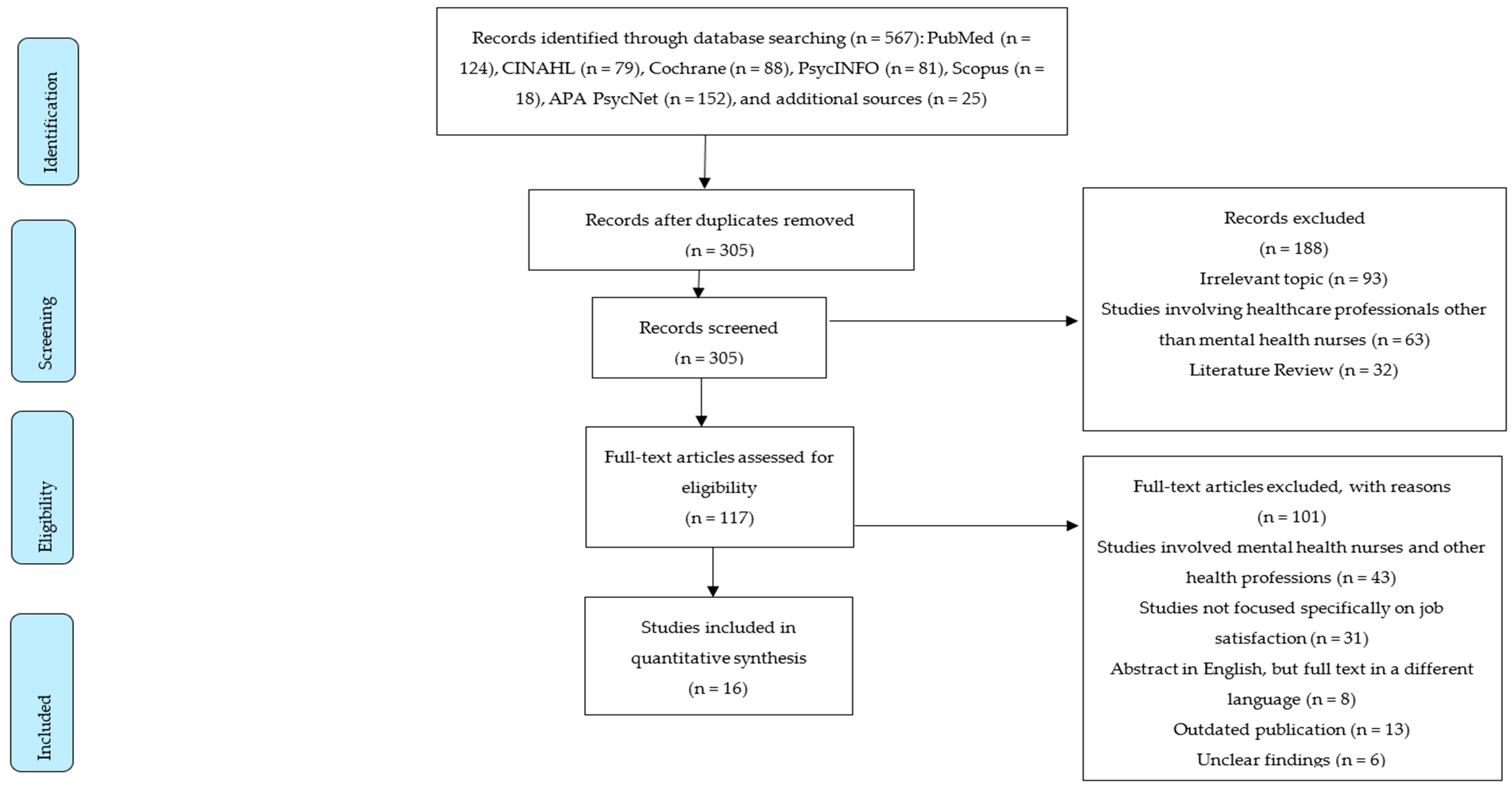
2.3. Search Outcomes
2.4. Data Abstraction
2.5. Data Synthesis
2.6. Quality Appraisal
3. Results
3.1. Characteristics of the Included Studies
3.2. Synthesize the Outcomes
3.2.1. Comparison between Studies Conducted in Psychiatric Hospitals and Other Psychiatric Settings
3.2.2. Extrinsic Factors Affecting Job Satisfaction
3.2.3. Intrinsic Factors Affecting Job Satisfaction
3.2.4. Personal and Emotional Factors Affecting Job Satisfaction
3.2.5. Psychosocial Factors Affecting Job Satisfaction
4. Discussion
4.1. Comparison between Studies Conducted in Psychiatric Hospitals and Other Psychiatric Settings
4.2. Extrinsic and Intrinsic Factors Affecting Job Satisfaction
4.3. Personal and Emotional Factors Affecting Job Satisfaction
4.4. Psychosocial Factors Affecting Job Satisfaction
4.5. Strengths and Limitations
4.6. Burnout, Stress, and Negative Emotions in Nurses: Implications for Healthcare
5. Conclusions
Author Contributions
Funding
Institutional Review Board Statement
Informed Consent Statement
Data Availability Statement
Acknowledgments
Conflicts of Interest
References
- Robbins, S.P.; Judge, T.A.; Millett, B. OB: The Essentials; Pearson: Melboourne, Australia, 2015; ISBN 978-1-4860-1959-5. [Google Scholar]
- Al-Surimi, K.; Almuhayshir, A.; Ghailan, K.Y.; Shaheen, N.A. Impact of Patient Safety Culture on Job Satisfaction and Intention to Leave Among Healthcare Workers: Evidence from Middle East Context. Risk Manag. Healthc. Policy 2022, 15, 2435–2451. [Google Scholar] [CrossRef] [PubMed]
- Shin, J.I.; Lee, E. The Effect of Social Capital on Job Satisfaction and Quality of Care among Hospital Nurses in South Korea. J. Nurs. Manag. 2016, 24, 934–942. [Google Scholar] [CrossRef] [PubMed]
- Pressley, C.; Garside, J. Safeguarding the Retention of Nurses: A Systematic Review on Determinants of Nurse’s Intentions to Stay. Nurs. Open 2023, 10, 2842–2858. [Google Scholar] [CrossRef] [PubMed]
- Liu, Y.; Duan, Y.; Guo, M. Turnover Intention and Its Associated Factors among Nurses: A Multi-Center Cross-Sectional Study. Front. Public. Health 2023, 11, 1141441. [Google Scholar] [CrossRef]
- Dall’Ora, C.; Ball, J.; Reinius, M.; Griffiths, P. Burnout in Nursing: A Theoretical Review. Hum. Resour. Health 2020, 18, 41. [Google Scholar] [CrossRef]
- Lu, H.; Zhao, Y.; While, A. Job Satisfaction among Hospital Nurses: A Literature Review. Int. J. Nurs. Stud. 2019, 94, 21–31. [Google Scholar] [CrossRef]
- Seo, J.-W.; Ran, K.M.; Joo, J.N. A Study on the Factors Influencing Burnout of Psychiatric Ward Nurses—Violence Experience, Violence Coping, Social Support. J. Korea Acad. Ind. Coop. Soc. 2019, 20, 393–405. [Google Scholar]
- Alameddine, M.; Mourad, Y.; Dimassi, H. A National Study on Nurses’ Exposure to Occupational Violence in Lebanon: Prevalence, Consequences and Associated Factors. PLoS ONE 2015, 10, e0137105. [Google Scholar] [CrossRef]
- Staempfli, S.; Lamarche, K. Top Ten: A Model of Dominating Factors Influencing Job Satisfaction of Emergency Nurses. Int. Emerg. Nurs. 2020, 49, 100814. [Google Scholar] [CrossRef]
- Jester, R. Editorial—Global Shortage of Nurses—Rebecca Jester for May 2023 Issue. Int. J. Orthop. Trauma Nurs. 2023, 49, 101018. [Google Scholar] [CrossRef]
- International Council of Nurses (ICN). International Council of Nurses Policy Brief: The Global Nursing Shortage and Nurse Retention; International Council of Nurses: Geneva, Switzerland, 2021. [Google Scholar]
- International Council of Nurses. The Global Mental Health Nursing Workforce: Time to Prioritize and Invest in Mental Health and Wellbeing; International Council of Nurses: Geneva, Switzerland, 2022. [Google Scholar]
- WHO Mental Health Atlas Mental Health ATLAS 2020. Available online: https://www.who.int/publications-detail-redirect/9789240036703 (accessed on 26 May 2024).
- Delaney, K.R. Inclusion of Psychiatric–Mental Health Advanced Practice Nurses in Federal Behavioral Workforce Planning. Psychiatr. Serv. 2023, 75, 594–596. [Google Scholar] [CrossRef] [PubMed]
- Hackman, J.R.; Oldham, G.R. Motivation through the Design of Work: Test of a Theory. Organ. Behav. Hum. Perform. 1976, 16, 250–279. [Google Scholar] [CrossRef]
- Herzberg, F.; Mausner, B.; Snyderman, B. The Motivation to Work, 2nd ed.; John Wiley: Oxford, UK, 1959; p. xv, 157. [Google Scholar]
- Maslow, A.H. Motivation and Personality; Harpers: Oxford, UK, 1954; p. xiv, 411. [Google Scholar]
- Vroom, V.H. Work and Motivation; Wiley: Oxford, UK, 1964. [Google Scholar]
- Alshmemri, M. Job Satisfaction of Saudi Nurses Working in Saudi Arabian Public Hospitals. Ph.D. Thesis, RMIT University, Melbourne, Australia, 2014. [Google Scholar]
- Garza, J.A.; Taliaferro, D. Job Satisfaction Among Home Healthcare Nurses. Home Healthc. Now 2021, 39, 20–24. [Google Scholar] [CrossRef] [PubMed]
- Holmberg, C.; Sobis, I.; Carlström, E. Job Satisfaction Among Swedish Mental Health Nursing Staff: A Cross-Sectional Survey. Int. J. Public Adm. 2016, 39, 429–436. [Google Scholar] [CrossRef]
- Holmberg, C.; Caro, J.; Sobis, I. Job Satisfaction among Swedish Mental Health Nursing Personnel: Revisiting the Two-Factor Theory. Int. J. Ment. Health Nurs. 2018, 27, 581–592. [Google Scholar] [CrossRef] [PubMed]
- Rai, R.; Thekkekara, J.V.; Kanhare, R. Herzberg’s Two Factor Theory: A Study on Nurses’s Motivation. RGUHS J. Allied Health Sci. 2021, 1, 13–17. [Google Scholar] [CrossRef] [PubMed]
- Dion, M.J. The Impact of Workplace Incivility and Occupational Stress on the Job Satisfaction and Turnover Intention of Acute Care Nurses. Ph.D. Thesis, University of Connecticut, Mansfield, CT, USA, 2006. [Google Scholar]
- Herzberg, F.I. Work and the Nature of Man; World: Oxford, UK, 1966. [Google Scholar]
- Bohm, J. Two-Factor Theory—At the Intersection of Health Care Management and Patient Satisfaction. Clin. Outcomes Res. 2012, 4, 277–285. [Google Scholar] [CrossRef][Green Version]
- Alrawahi, S.; Sellgren, S.F.; Altouby, S.; Alwahaibi, N.; Brommels, M. The Application of Herzberg’s Two-Factor Theory of Motivation to Job Satisfaction in Clinical Laboratories in Omani Hospitals. Heliyon 2020, 6, e04829. [Google Scholar] [CrossRef]
- Goetz, K.; Campbell, S.M.; Broge, B.; Dörfer, C.E.; Brodowski, M.; Szecsenyi, J. The Impact of Intrinsic and Extrinsic Factors on the Job Satisfaction of Dentists. Comm. Dent. Oral. Epid 2012, 40, 474–480. [Google Scholar] [CrossRef]
- Jones, T.L. Effects of Motivating and Hygiene Factors on Job Satisfaction Among School Nurses. Ph.D. Thesis, Walden University, Minneapolis, MN, USA, 2011. [Google Scholar]
- Aloisio, L.D.; Coughlin, M.; Squires, J.E. Individual and Organizational Factors of Nurses’ Job Satisfaction in Long-Term Care: A Systematic Review. Int. J. Nurs. Stud. 2021, 123, 104073. [Google Scholar] [CrossRef]
- Alwawi, A.; Koç, A.; İnkaya, B. Factors affecting nurses’ job satisfaction in medical surgical nursing care in Turkey: A systematic review. Int. J. Health Serv. Res. Policy 2020, 5, 178–188. [Google Scholar] [CrossRef]
- Dilig-Ruiz, A.; MacDonald, I.; Demery Varin, M.; Vandyk, A.; Graham, I.D.; Squires, J.E. Job Satisfaction among Critical Care Nurses: A Systematic Review. Int. J. Nurs. Stud. 2018, 88, 123–134. [Google Scholar] [CrossRef] [PubMed]
- Geese, F.; Zwakhalen, S.; Lucien, B.; Hahn, S. Job Satisfaction of Advanced Practice Nurses in Cancer Care: A Systematic Review. Eur. J. Oncol. Nurs. 2022, 56, 102089. [Google Scholar] [CrossRef] [PubMed]
- Halcomb, E.; Smyth, E.; McInnes, S. Job Satisfaction and Career Intentions of Registered Nurses in Primary Health Care: An Integrative Review. BMC Fam. Pract. 2018, 19, 136. [Google Scholar] [CrossRef] [PubMed]
- Han, R.M.; Carter, P.; Champion, J.D. Relationships among Factors Affecting Advanced Practice Registered Nurses’ Job Satisfaction and Intent to Leave: A Systematic Review. J. Am. Assoc. Nurse Pract. 2018, 30, 101–113. [Google Scholar] [CrossRef]
- Hudays, A.; Gary, F.; Voss, J.G.; Zhang, A.Y.; Alghamdi, A. Utilizing the Social Determinants of Health Model to Explore Factors Affecting Nurses’ Job Satisfaction in Saudi Arabian Hospitals: A Systematic Review. Healthcare 2023, 11, 2394. [Google Scholar] [CrossRef]
- Lin, P.S.; Viscardi, M.K.; McHugh, M.D. Factors Influencing Job Satisfaction of New Graduate Nurses Participating in Nurse Residency Programs: A Systematic Review. J. Contin. Educ. Nurs. 2014, 45, 439–450. [Google Scholar] [CrossRef]
- Yanriatuti, I.; Fibriola, T.N.; Nama Beni, K.; Patarru, F. Work Environment, Spiritual, and Motivational Factors Affecting Job Satisfaction among Hospital Nurses: A Systematic Review. J. NERS 2019, 14, 227–230. [Google Scholar] [CrossRef][Green Version]
- Yasin, Y.M.; Kerr, M.S.; Wong, C.A.; Bélanger, C.H. Factors Affecting Job Satisfaction among Acute Care Nurses Working in Rural and Urban Settings. J. Adv. Nurs. 2020, 76, 2359–2368. [Google Scholar] [CrossRef]
- Yasin, Y.M.; Alomari, A.; Al-Hamad, A.; Kehyayan, V. The Impact of COVID-19 on Nurses’ Job Satisfaction: A Systematic Review and Meta-Analysis. Front. Public Health 2024, 11, 1285101. [Google Scholar] [CrossRef]
- Moher, D.; Liberati, A.; Tetzlaff, J.; Altman, D.G.; PRISMA Group. Reprint—Preferred Reporting Items for Systematic Reviews and Meta-Analyses: The PRISMA Statement. Phys. Ther. 2009, 89, 873–880. [Google Scholar] [CrossRef] [PubMed]
- Alsaraireh, F.; Quinn Griffin, M.T.; Ziehm, S.R.; Fitzpatrick, J.J. Job Satisfaction and Turnover Intention among Jordanian Nurses in Psychiatric Units. Int. J. Ment. Health Nurs. 2014, 23, 460–467. [Google Scholar] [CrossRef] [PubMed]
- Emmanuel Olatunde, B.; Odusanya, O. Job Satisfaction and Psychological Well-Being among Mental Health Nurses. Int. J. Transl. Community Med. 2015, 3, 64–70. [Google Scholar] [CrossRef]
- Baum, A.; Kagan, I. Job Satisfaction and Intent to Leave among Psychiatric Nurses: Closed versus Open Wards. Arch. Psychiatr. Nurs. 2015, 29, 213–216. [Google Scholar] [CrossRef] [PubMed]
- Toren, O.; Kerzman, H.; Kagan, I. The Difference Between Professional Image and Job Satisfaction of Nurses Who Studied in a Post-Basic Education Program and Nurses With Generic Education: A Questionnaire Survey. J. Prof. Nurs. 2011, 27, 28–34. [Google Scholar] [CrossRef]
- Behilak, S.; Abdelraof, A.S. The Relationship between Burnout and Job Satisfaction among Psychiatric Nurses. J. Nurs. Educ. Pract. 2019, 10, 8. [Google Scholar] [CrossRef]
- Jin, R. Job Satisfaction and Burnout of Psychiatric Nurses during the COVID-19 Pandemic in China—The Moderation of Family Support. Front. Psychol. 2022, 13, 1006518. [Google Scholar] [CrossRef]
- Kabeel, A.R.A.; Mosa Eisa, S.A.E.-M. Relationship between Job Satisfaction and Professional Identity among Psychiatric Nurses. Egypt. Nurs. J. 2017, 14, 9–16. [Google Scholar] [CrossRef]
- Kagwe, J.; Jones, S.; Johnson, S.L. Factors Related to Intention to Leave and Job Satisfaction among Registered Nurses at a Large Psychiatric Hospital. Issues Ment. Health Nurs. 2019, 40, 754–759. [Google Scholar] [CrossRef]
- Lin, C.-F.; Lai, F.-C.; Huang, W.-R.; Huang, C.-I.; Hsieh, C.-J. Satisfaction with the Quality Nursing Work Environment Among Psychiatric Nurses Working in Acute Care General Hospitals. J. Nurs. Res. 2020, 28, e76. [Google Scholar] [CrossRef]
- Yoder, L.H. Staff Nurses’ Career Development Relationships and Self-Reports of Professionalism, Job Satisfaction, and Intent to Stay. Nurs. Res. 1995, 44, 290–297. [Google Scholar] [CrossRef] [PubMed]
- Matsumoto, Y.; Yoshioka, S.-I. Factors Influencing Psychiatric Nurses’ Job Satisfaction Levels: Focusing on Their Frequency of Experiencing Negative Emotions Toward Patients and Support at Their Workplaces. Yonago Acta Med. 2019, 62, 293–304. [Google Scholar] [CrossRef] [PubMed]
- Payne, A.; Koen, L.; Niehaus, D.J.H.; Smit, I.-M. Burnout and Job Satisfaction of Nursing Staff in a South African Acute Mental Health Setting. S. Afr. J. Psychiatr. 2020, 26, 1454. [Google Scholar] [CrossRef] [PubMed]
- Perkins, R.T.; Bamgbade, S.; Bourdeanu, L. Nursing Leadership Roles and Its Influence on the Millennial Psychiatric Nurses’ Job Satisfaction and Intent to Leave. J. Am. Psychiatr. Nurses Assoc. 2023, 29, 15–24. [Google Scholar] [CrossRef] [PubMed]
- Quinn, R.E. Beyond Rational Management: Mastering the Paradoxes and Competing Demands of High Performance; Jossey-Bass: San Francisco, CA, USA, 1988; p. xxii, 199. ISBN 1-55542-075-3. [Google Scholar]
- Mobley, W.H. Intermediate Linkages in the Relationship between Job Satisfaction and Employee Turnover. J. Appl. Psychol. 1977, 62, 237–240. [Google Scholar] [CrossRef]
- Zheng, Z.; Gangaram, P.; Xie, H.; Chua, S.; Ong, S.B.C.; Koh, S.E. Job Satisfaction and Resilience in Psychiatric Nurses: A Study at the Institute of Mental Health, Singapore. Int. J. Ment. Health Nurs. 2017, 26, 612–619. [Google Scholar] [CrossRef]
- Zhou, H.; Jiang, F.; Rakofsky, J.; Hu, L.; Liu, T.; Wu, S.; Liu, H.; Liu, Y.; Tang, Y.-L. Job Satisfaction and Associated Factors among Psychiatric Nurses in Tertiary Psychiatric Hospitals: Results from a Nationwide Cross-Sectional Study. J. Adv. Nurs. 2019, 75, 3619–3630. [Google Scholar] [CrossRef]
- AbdElhamid, M.; Saeed AbdElmohsen, N.; Abd.ElHalim, O.Z. Reletionship between Workplace Violence and Job Satisfaction among Nurses Working In Psychitric Setting. Egypt. J. Health Care 2017, 8, 256–269. [Google Scholar] [CrossRef]
- Mohamed Ali, N.; Sayed Mohamed, H. Correlation between Workplace Violence, Work Stress, and Job Satisfaction among Psychiatric Nursing Staff. Egypt. J. Health Care 2021, 12, 1713–1730. [Google Scholar] [CrossRef]
- Moola, S.; Munn, Z.; Tufanaru, C.; Aromataris, E.; Sears, K.; Sfetc, R.; Currie, M.; Lisy, K.; Qureshi, R.; Mattis, P.; et al. Chapter 7: Systematic Reviews of Etiology and Risk. JBI Man. Evid. Synth. 2020. [Google Scholar] [CrossRef]
- Armstrong-Stassen, M.; Stassen, K. Professional Development, Target-Specific Satisfaction, and Older Nurse Retention. Career Dev. Int. 2013, 18, 673–693. [Google Scholar] [CrossRef]
- Schaufeli, W.B. Applying the Job Demands-Resources Model: A ‘How to’ Guide to Measuring and Tackling Work Engagement and Burnout. Organ. Dyn. 2017, 46, 120–132. [Google Scholar] [CrossRef]
- King, G.A. Resilience and Leadership: The Self-Management of Failure. In Self-Management and Leadership Development; Rothstein, M.G., Ed.; New Horizons in Management; Edward Elgar Publishing: Northampton, MA, USA, 2010; pp. 361–394. ISBN 978-1-84844-323-5. [Google Scholar]
- Ayalew, F.; Kibwana, S.; Shawula, S.; Misganaw, E.; Abosse, Z.; van Roosmalen, J.; Stekelenburg, J.; Kim, Y.M.; Teshome, M.; Mariam, D.W. Understanding Job Satisfaction and Motivation among Nurses in Public Health Facilities of Ethiopia: A Cross-Sectional Study. BMC Nurs. 2019, 18, 46. [Google Scholar] [CrossRef] [PubMed]
- Zhang, L.; Hu, W.; Cai, Z.; Liu, J.; Wu, J.; Deng, Y.; Yu, K.; Chen, X.; Zhu, L.; Ma, J.; et al. Early Mobilization of Critically Ill Patients in the Intensive Care Unit: A Systematic Review and Meta-Analysis. PLoS ONE 2019, 14, e0223185. [Google Scholar] [CrossRef]
- Hellín Gil, M.F.; Ruiz Hernández, J.A.; Ibáñez-López, F.J.; Seva Llor, A.M.; Roldán Valcárcel, M.D.; Mikla, M.; López Montesinos, M.J. Relationship between Job Satisfaction and Workload of Nurses in Adult Inpatient Units. Int. J. Environ. Res. Public Health 2022, 19, 11701. [Google Scholar] [CrossRef]
- Maqbali, M.A.A. Factors That Influence Nurses’ Job Satisfaction: A Literature Review. Nurs. Manag. 2015, 22, 30. [Google Scholar] [CrossRef]
- Chien, W.-T.; Yick, S.-Y. An Investigation of Nurses’ Job Satisfaction in a Private Hospital and Its Correlates. Open Nurs. J. 2016, 10, 99–112. [Google Scholar] [CrossRef]
- Shahrbabaki, P.M.; Abolghaseminejad, P.; Lari, L.A.; Zeidabadinejad, S.; Dehghan, M. The Relationship between Nurses’ Psychological Resilience and Job Satisfaction during the COVID-19 Pandemic: A Descriptive-Analytical Cross-Sectional Study in Iran. BMC Nurs. 2023, 22, 137. [Google Scholar] [CrossRef]
- Heidari, S.; Parizad, N.; Goli, R.; Mam-Qaderi, M.; Hassanpour, A. Job Satisfaction and Its Relationship with Burnout among Nurses Working in COVID-19 Wards: A Descriptive Correlational Study. Ann. Med. Surg. 2022, 82, 104591. [Google Scholar] [CrossRef]
- Hart, P.L.; Brannan, J.D.; De Chesnay, M. Resilience in Nurses: An Integrative Review. J. Nurs. Manag. 2014, 22, 720–734. [Google Scholar] [CrossRef]
- Zander, M.; Hutton, A.; King, L. Coping and Resilience Factors in Pediatric Oncology Nurses. J. Pediatr. Oncol. Nurs. 2010, 27, 94–108. [Google Scholar] [CrossRef] [PubMed]
- Chang, H.E.; Cho, S.-H. Workplace Violence and Job Outcomes of Newly Licensed Nurses. Asian Nurs. Res. 2016, 10, 271–276. [Google Scholar] [CrossRef] [PubMed]
- Cheung, T.; Yip, P.S.F. Workplace Violence towards Nurses in Hong Kong: Prevalence and Correlates. BMC Public Health 2017, 17, 196. [Google Scholar] [CrossRef] [PubMed]
- Pappa, D.; Koutelekos, I.; Evangelou, E.; Dousis, E.; Mangoulia, P.; Gerogianni, G.; Zartaloudi, A.; Toulia, G.; Kelesi, M.; Margari, N.; et al. Investigation of Nurses’ Wellbeing towards Errors in Clinical Practice—The Role of Resilience. Medicina 2023, 59, 1850. [Google Scholar] [CrossRef] [PubMed]
- Kousar, R.; Afzal, M.; Sarwar, H.; Waqas, A.; Gillani, D.S.A. The Impact of Job Satisfaction on Nurses’ Burnout among Registered Nurses at Jinnah Hospital Lahore, Pakistan. Saudi J. Med. Pharm. Sci. 2017, 3, 528–533. [Google Scholar]
- Kelly, L.A.; Gee, P.M.; Butler, R.J. Impact of Nurse Burnout on Organizational and Position Turnover. Nurs. Outlook 2021, 69, 96–102. [Google Scholar] [CrossRef]
- Bishop, G.D. Emotions and Health. In International Encyclopedia of the Social & Behavioral Sciences; Smelser, N.J., Baltes, P.B., Eds.; Pergamon: Oxford, UK, 2001; pp. 4454–4459. ISBN 978-0-08-043076-8. [Google Scholar]

| Inclusion Criteria | Exclusion Criteria | Key Words | Databases Searched | Number of Studies | |
|---|---|---|---|---|---|
| Studies that are of a quantitative type. | Studies that are of a qualitative type, systematic reviews, books, and opinion articles. | (Mental Health Nurses OR Psychiatric Nurses OR Nurses in Psychiatric Settings OR Nurses in Mental Health Care) AND (Herzberg’s Two-Factor Theory OR Job Satisfaction OR Motivation–Hygiene Theory OR Two-Factor Theory) AND (Psychiatric Care Settings OR Mental Health Facilities OR Inpatient OR Outpatient OR Community Mental Health OR Acute Care OR Long-term Care) AND (Job Satisfaction OR Work Satisfaction OR Workplace Satisfaction OR Employee Satisfaction OR Nurse Satisfaction OR JS). | PubMed | 124 | |
| Studies exclusively focusing on mental health nurses as the population of interest in relation to job satisfaction. | Studies involving healthcare professionals other than mental health nurses (e.g., physicians, therapists, etc.). Additionally, studies involving both healthcare professionals and nurses (mixed populations) are excluded. | CINAHL | 79 | ||
| Studies settings should be at psychiatric settings. | Studies that do not specifically investigate mental health care or psychiatric settings. | Cochrane Library | 88 | ||
| Studies written in English. | Studies written in languages other than English. | PsycINFO | 81 | ||
| Studies published in the last 10 years. | Studies published before 2014. | ||||
| Google Scholar | 25 | ||||
| Scopus | 18 | ||||
| APA PsycNet | 152 | ||||
| Total: 567 |
| Authors/Year/Data Collection Period/Country | Design | Framework | Sample Strategy/Size/Setting | Measures/Internal and External Validity | Type of Statistical Test | Findings Related to Job Satisfaction among Nurses | Factor Category |
|---|---|---|---|---|---|---|---|
| [43] N/S Jordan | Descriptive cross-sectional design | _ | Strategy: non-probability sampling “convenience sampling”. Size: Of 200 nurses, a total of 154 nurses completed the questionnaires (inclusion and exclusion criteria were provided). Setting: Governmental hospital for mental health in Jordan. | The Minnesota Job Satisfaction Questionnaire (MSQ). Cronbach’s alpha = 0.91. Internal Validity Concern: Instrumentation: Not a problem. External Validity Concern: Response Rate: Not a problem; the study reported a response rate of 86%. | Independent-sample t-tests | Females reported much higher job satisfaction scores (mean = 64.07, SD = 8.88) than males (mean = 55.40, SD = 11.08), t (152) = −5.39, p = 0.000). | Personal |
| Married people reported higher satisfaction scores (mean = 63.10, SD = 10.41) compared to single people (mean = 55.95, SD = 10.03), with t (152) = −4.263, p = 0.000). | Personal | ||||||
| Participants with an associate degree reported higher satisfaction scores (mean = 61.45, SD = 10.60) compared to those with a bachelor’s degree (mean = 54.18, SD = 9.85), with t (152) = 3.324, p = 0.001). | Personal | ||||||
| No significant difference between day shift and evening shift t (152) = 1.551, p = 0.123). | Work conditions (Hygiene) | ||||||
| Pearson correlations | Strong and significant positive correlation between age and job satisfaction (r = 0.508, p = 0.01). | Personal | |||||
| Strong and significant positive correlation between experience and job satisfaction (r = 0.566, p = 0.01). | Personal | ||||||
| Strong and significant positive correlation between salary and job satisfaction (r = 0.780, p = 0.01). | Salary (Hygiene) | ||||||
| [44] June 2013 Nigeria | Descriptive cross-sectional study | _ | Strategy: Random sampling Size: Sample size was 110 mental health nurses (inclusion criteria provided, exclusion criteria unclear). Setting: Neuropsychiatric Hospital, Aro, Abeokuta, Nigeria | The Minnesota Satisfaction Questionnaire (MSQ). Internal Validity Concern: Instrumentation: Reliability & validity unreported, threatening internal validity. External Validity Concern: Response Rate: Not a problem; the study reported a response rate of 96.5%. | Chi-Squared test | Older respondents (aged 40–59 years), of whom 44.4% reported high job satisfaction levels, showed significantly higher levels of job satisfaction compared to younger respondents (aged 20–39 years), of whom 27.7% reported high job satisfaction (χ2 = 9.59, p = 0.024). | Personal |
| No significant difference for marital status, number of children, work cadre, religion, and length of years in service. | Personal | ||||||
| [45] N/S Israel | Cross-sectional quantitative design study | _ | Strategy: non-probability sampling “convenience sampling”. Size: 52 nurses (inclusion & exclusion criteria were not explicitly provided). Setting: A large psychiatric hospital in central Israel. Specifically, nurses working on: Closed wards Open wards. | Toren, Kerzman, and Kagan [46] instrument. Cronbach’s alpha = 0.81. Internal Validity Concern: Instrumentation: Not a problem. External Validity Concern: Response Rate: Not a problem; the study reported a response rate of 95%. | Independent-sample t-tests | Level of job satisfaction was notably greater among full-time nurses compared to those who worked part-time (t = 2.05, p < 0.05). | Personal |
| [47] N/S Egypt | Descriptive correlation design | _ | Strategy: Not stated. Size: The sample for the study comprised 50 staff nurses (inclusion criteria provided, exclusion criteria unclear). Setting: Psychiatric Department in Tanta University Hospital and Tanta Mental Health Hospital, Egypt. | Kuopio University Hospital Job Satisfaction Scale (KUHJSS). Cronbach’s α = 0.76 Maslach Burnout Inventory Scale (MBI). Cronbach’s α = 0.76 Internal Validity Concern: Instrumentation: Not a problem External Validity Concern: Based on the characteristics table and findings, it appears that all 50 nurses returned the questionnaire. However, the authors did not explicitly state the response rate. | Pearson’s correlation coefficient | Significant negative correlation (r = −0.555, p = 0.0001) between total burnout score and job satisfaction score, specifically in terms of emotional exhaustion, depersonalization, and accomplishment. | Personal/Emotional factors |
| [22] N/S Sweden | Cross-sectional survey | Herzberg’s motivation–hygiene theory | Strategy: non-probability sampling “convenience sampling”. Size: Out of 130 nurses employed at the clinic, 118 completed the survey (inclusion criteria provided, exclusion criteria unclear). Setting: A psychiatric university hospital clinic located in western Sweden. | The researchers designed a custom-made survey comprising 69 questions. Cronbach’s alpha (0.71–0.89). Internal Validity Concern: Instrumentation: Not a problem. External Validity Concern: Response Rate: Not a problem; the study reported a response rate of 90.7%. | Multiple regression | Relationships with peers exhibited a significant correlation with job satisfaction (B = 0.263, SE = 0.071, Beta = 0.284, t = 3.704, p = 0.001). | Interpersonal relationship (Hygiene) |
| Salary demonstrated a significant correlation with job satisfaction (B = 0.157, SE = 0.06, Beta = 0.120, t = 2.574, p = 0. 019). | Salary (Hygiene) | ||||||
| Recognition displayed a positive correlation with job satisfaction (B = 0.298, SE = 0.108, Beta = 0.359, t = 2.759, p = 0.012). | Recognition (Motivation) | ||||||
| Responsibility showed a positive correlation with job satisfaction (B = 0.109, SE = 0.058, Beta = 0.149, t = 1.879, p = 0.023). | Responsibility (Motivation) | ||||||
| [48] November to December 2021 China | Cross-sectional descriptive study | _ | Strategy: Simple random sampling Size: Of the 229 questionnaires distributed, 212 were completed and returned (inclusion and exclusion criteria were provided). Setting: The study was conducted among psychiatric nurses working in psychiatric units in four Grade-A tertiary hospitals in Jiangsu Province, China. | Job satisfaction scale. Cronbach’s alpha ranged from 0.916, to 0.969 (two dimensions). The MBI-GS job burnout scale. Cronbach’s alpha values of 0.911 for the overall scale, and 0.956, 0.965, and 0.953 for the emotional exhaustion, depersonalization, and low personal accomplishment subscales, respectively. Internal Validity Concern: Instrumentation: Not a problem External Validity Concern: Response Rate: Not a problem; the study reported a response rate of 92.58%. | Pearson correlation | Significant negative correlation between satisfaction with “Status at Work” and job burnout (r = −0.415, p < 0.000). | Status (Motivation) |
| Significant negative correlation between satisfaction with “Interpersonal Relationships at Work” and job burnout (r = −0.220, p = 0.019). | Interpersonal relationship (Hygiene) | ||||||
| [49] February 2016 to March 2016 Egypt | Descriptive correlation research design. | _ | Strategy: non-probability sampling “convenience sampling”. Size: 50 nurses (inclusion and exclusion criteria were provided). Setting: Abbassya Mental Health Hospital in Egypt. | Mueller and McCloskey Satisfaction Scale. Cronbach’s alpha = 0.85. Nurses’ professional identity tool. Cronbach’s alpha = 0.96. Internal Validity Concern: Instrumentation: Not a problem. External Validity Concern: Response Rate: Based on the characteristics table and findings, it appears that all 50 nurses returned the questionnaire. However, the authors did not explicitly state the response rate. | Pearson correlation | Statistically significant positive correlations between total nurses’ professional identity scores and nurses’ satisfaction, with a correlation coefficient of r = 0.589. Additionally, the relationship between nurses’ professional identity and nurses’ satisfaction was statistically significant, with a p-value of 0.000. | Personal |
| [50] N/S Western US | Descriptive, cross-sectional study. | _ | Strategy: non-probability sampling “convenience sampling”. Size: From a total of 260 nurses, only 94 RNs completed the online survey (inclusion criteria provided, exclusion criteria unclear). Setting: A large inpatient state-run psychiatric hospital in the western US. | Custom-made questionnaire Internal Validity Concern: Instrumentation: Reliability & validity unreported, threatening internal validity. External Validity Concern: Response Rate: The study reported a low response rate of 36%. | Pearson correlations | Employees who receive feedback before disciplinary action is taken tend to have higher job satisfaction (p < 0.05). | Recognition (Motivation) |
| Recognizing and acknowledging employees’ additional credentials is linked to higher job satisfaction with (p < 0.05). | Recognition (Motivation) | ||||||
| Providing employees with opportunities for growth and development is significantly related to higher job satisfaction with (p < 0.05). | Growth (Motivation) | ||||||
| [51] 2013 Taiwan | Correlational cross-sectional design. | _ | Strategy: Stratified random sampling. Size: 185 nurses (inclusion and exclusion criteria were provided). Settings: Diverse range of acute care institutions across Taiwan, including academic medical centers (n = 4), metropolitan hospitals (n = 9), and district hospitals (n = 12), with a specific focus on acute psychiatric wards and psychiatric nurses providing care to patients with mental health conditions. | Job satisfaction was evaluated using a single item adapted from Yoder [52]. Internal Validity Concern: Instrumentation: Reliability & validity unreported, threatening internal validity. Indicators of a quality nursing work environment. Internal Validity Concern: Cronbach’s α = 0.93 Instrumentation: Not a problem External Validity Concern: Response Rate: Not a problem; the study reported a response rate of 99%. | Hierarchical regression models after adjusting for variables | Professional specialization and teamwork were positively related to job satisfaction (t = 2.496, β = 0.203, B = 0.170, p < 0.05). Support and caring in the work environment were positively related to job satisfaction (t = 5.531, β = 0.592, B = 0.514, p < 0.001). | Interpersonal relationship (Hygiene) Responsibility (Motivation) |
| [53] June to August 2017 Japan | Correlational cross-sectional design. | Conceptual framework | Strategy: Random sampling. Size: From a total of 1097 nurses, 663 psychiatric nurses responded (inclusion and exclusion criteria were provided). Setting: 13 psychiatric hospitals in the Chugoku area. | Negative Feeling Toward Patient Frequency scale. Cronbach’s α = 0.953. Support in workplace scale. Cronbach’s α: SW (supervisors) = 0.976; SW (co-workers) = 0.971. The new Brief Job Stress Questionnaire (job stress and satisfaction). Cronbach’s α: (job satisfaction) = 0.722; (job stress) = 0684). Internal Validity Concern: Instrumentation: Not a problem External Validity Concern: Response Rate: Not a problem; the study reported a response rate of 60.4% (663 out of 1097), and of those respondents, 87.0% (577 out of 663) provided valid responses without missing data. | Logistic regression | Nurses’ job satisfaction levels were positively correlated with support from supervisors (B = 0.067, SE = 0.009, p = 0.000, OR: 1.069). | Supervision (Hygiene) |
| Nurses’ job satisfaction levels were negatively correlated with job stress levels (B = −0.287, SE = 0.038, p = 0.000, OR: 0.751). | Working conditions (Hygiene) | ||||||
| Nurses’ job satisfaction levels were negatively correlated with the frequency of experiencing negative emotions (B = −0.020, SE = 0.005, p = 0.000, OR: 0.980). | Personal/Emotional factor | ||||||
| [54] Between November and December 2017 South Africa | Cross-sectional study | _ | Strategy: Not stated Size: From a total of 221 psychiatric nurses, 132 psychiatric nurses participated (inclusion and exclusion criteria were provided). Setting: Stikland Psychiatric Hospital in Belville. | Job Satisfaction Survey (JSS). Copenhagen Burnout Inventory (CBI). Internal Validity Concern: Instrumentation: Reliability & validity unreported, threatening internal validity. External Validity Concern: Response Rate: Not a problem; the study reported a response rate of 60%. | Linear regression | Higher levels of burnout were significantly associated (r = −0.077, p < 0.01) with lower levels of job satisfaction (Negative correlation). | Working conditions (Hygiene) |
| No significant associations between job satisfaction and gender. | Personal | ||||||
| No significant associations between job satisfaction and rank. | Personal | ||||||
| No significant associations between job satisfaction and years of experience. | Personal | ||||||
| [55] N/S USA | Correlational, exploratory design | Quinn’s [56] Model of Managerial Leadership Roles and the conceptual framework of Mobley’s [57] Model of Employee Turnover. | Strategy: Snowball sampling Size: Out of the 4520 nurses initially eligible, a final sample of 83 participants was used for analysis (inclusion and exclusion criteria were provided). Setting: A variety of mental health settings (regular hospitals, psychiatric hospitals, prisons, jails, outpatient mental health organizations). | Job Satisfaction Survey (JSS). Cronbach’s alpha ranged from 0.60 to 0.82 (nine aspects: pay, promotion, supervision, benefits, contingent rewards, operating procedures, coworkers, nature of work, and communication). Competing Values Managerial Skills Instrument. Cronbach’s alpha ranged from 0.76 to 0.88 (leadership behavior roles: broker role, coordinator role, director role, facilitator role, mentor role, producer role, and innovator role). Internal Validity Concern: Instrumentation: Not a problem External Validity Concern: No report on response rate. | Canonical correlation analysis | Millennial psychiatric nurses who perceived their managers to display the roles in being a facilitator (rs = 0.618), mentor (rs = 0.965), innovator (rs = 0.691), broker (rs = 0.588), producer (rs = 0.692), director (rs = 0.746), and monitor (rs = 0.749)) more frequently, tended to have higher job satisfaction in terms of: | |
| Pay, contingent rewards | Benefit (Hygiene) | ||||||
| Promotion | Advancement (Motivation) | ||||||
| Supervision | Supervision (Hygiene) | ||||||
| Coworkers | Interpersonal relationship (Hygiene) | ||||||
| Nature of work | Work itself (Motivation) | ||||||
| Communication | Interpersonal relationship (Hygiene) | ||||||
| [58] From 16–24 December 2014 Singapore | Cross-sectional study | _ | Strategy: non-probability sampling “convenience sampling”. Size: 726 nurses (inclusion and exclusion criteria were provided). Setting: A tertiary psychiatric institution in Singapore. | McCloskey and Mueller Satisfaction Scale (MMSS). Cronbach alpha = 0.89. Resilience Scale. Cronbach alpha ranged from 0.72 to 0.94. Internal Validity Concern: Instrumentation: Not a problem. External Validity Concern: Response Rate: Not a problem; the study reported a response rate of 83.1%. | Linear regression | Positive association between resilience and job satisfaction (β = 0.109, t = 2.953, p = 0.003). | Personal/Emotional factor |
| [59] From 18–31 December 2017 China | Cross-sectional survey. | _ | Strategy: Although not explicitly stated, the study appears to use stratified sampling, targeting specific hospitals in specific locations to ensure regional representation. Size: Among the total of 9907 nurses, a response was received from 8493 nurses (inclusion and exclusion criteria were provided). Setting: 32 tertiary psychiatric hospitals in 29 provincial capitals in China. | Short-form Minnesota Satisfaction Questionnaire (MSQ). Cronbach’s alpha was >0.7. Internal Validity Concern: Instrumentation: Not a problem. External Validity Concern: Response Rate: Not a problem; the study reported a response rate of 85.7%. | Multiple linear regression | Age was negatively associated with job satisfaction, such that the age groups of 28–32 years (B = −0.975, p < 0.05), 33–40 years (B = −1.973, p < 0.05), and 41 years and above (B = −3.191, p < 0.05) all had significantly lower job satisfaction scores compared to the youngest reference group (27 and below). | Personal |
| Monthly income demonstrated a positive association with job satisfaction (p < 0.05). | Salary (Hygiene) | ||||||
| Negative association between working more than 40 h per week and job satisfaction scores for nurses (B = −2.702, p < 0.05). | Work conditions (Hygiene) | ||||||
| Social recognition showed a positive association with job satisfaction (p < 0.05). | Recognition (Motivation) | ||||||
| Nurse–physician collaboration exhibited a positive association with job satisfaction (p < 0.05). | Interpersonal relationship (Hygiene) | ||||||
| Experiencing violence initiated by patients, whether in the form of verbal abuse or physical assault, had a negative correlation with job satisfaction (p < 0.05). | Experienced violence (Psychosocial factor) | ||||||
| [60] N/S Egypt | Descriptive correlational design | _ | Strategy: non-probability sampling “convenience sampling”. Size: A total of 600 individuals from all departments (inclusion criteria provided, exclusion criteria unclear). Setting: Al-Abbassia Mental Health Hospital (AMHH), Egypt. | -Work place Violence Scale Cronbach’s alpha coefficient = 0.90 -Job Satisfaction Scale Cronbach’s alpha coefficient = 0.87 -Work Productivity Scale Cronbach’s alpha coefficient = 0.60 Internal Validity Concern: Instrumentation: Not a problem. External Validity Concern: Response Rate: Based on the frequency distribution table, all 600 nurses returned the questionnaire. However, the authors did not explicitly state the response rate. | Correlation coefficient | There is a strong statistically significant relationship between violence and job satisfaction, with correlation coefficients of R = 0.059 and R = 0.234 at p = 0.000, respectively. | Workplace violence (Psychosocial factor) |
| Correlation between types of aggression subscales, job satisfaction, and recurrence of violence: | Workplace violence (Psychosocial factor) | ||||||
| Verbal Aggression and Job Satisfaction: R = 0.105, p = 0.005 (weak positive correlation, statistically significant) Verbal Aggression and Recurrence of Violence: R = 0.081, p = 0.005 (weak positive correlation, statistically significant) Physical Aggression Toward Things and Job Satisfaction: R = 0.145, p = 0.005 (weak positive correlation, statistically significant) Physical Aggression Toward Things and Recurrence of Violence: R = 0.167, p = 0.005 (moderate positive correlation, statistically significant) Physical Aggression Toward Self and Job Satisfaction: R = 0.168, p = 0.005 (moderate positive correlation, statistically significant) Physical Aggression Toward Self and Recurrence of Violence: R = 0.199, p = 0.005 (moderate positive correlation, statistically significant) Physical Aggression Toward Others and Job Satisfaction: R = 0.166, p = 0.005 (moderate positive correlation, statistically significant) Physical Aggression Toward Others and Recurrence of Violence: R = 0.206, p = 0.005 (stronger moderate positive correlation, statistically significant) | |||||||
| [61] September to November 2021 Egypt | Descriptive correlational design | _ | Strategy: Although not explicitly stated, the study seems to employ non-probability sampling, specifically convenience sampling. Size: A total of 106 out of 140 psychiatric nurses who fulfilled the study’s inclusion criteria took part in the research (inclusion criteria provided, exclusion criteria unclear). Setting: Al Abbassia mental health hospital in Cairo. | Workplace Violence in Healthcare Questionnaire (WPVHC) Cronbach’s alpha coefficient = 0.85 Perceived Stress Scale (PSS) Cronbach’s alpha coefficient = 0.94 Satisfaction of Employee in Healthcare Scale (SEHC) Cronbach’s alpha coefficient = 0.85 Internal Validity Concern: Instrumentation: Not a problem. External Validity Concern: Response Rate: Based on the frequency distribution table, it appears that all 106 nurses returned the questionnaire. However, the authors did not explicitly state the response rate. | Multiple linear regression | Statistically significant positive correlations were identified among the overall scores of workplace violence, perceived stress, and job satisfaction among the psychiatric nurses in the study (p < 0.001). This indicates that as exposure to workplace violence increases, both perceived stress and job satisfaction are likely to rise within this group. | Workplace violence (Psychosocial factor) |
| Study | Were the Criteria for Inclusion in the Sample Clearly Defined? | Were the Study Subjects and the Setting Described in Detail? | Was the Exposure Measured in a Valid and Reliable Way? | Were Objective, Standard Criteria Used for Measurement of the Condition? | Were Confounding Factors Identified? | Were Strategies to Deal with Confounding Factors Stated? | Were the Outcomes Measured in a Valid and Reliable Way? | Was Appropriate Statistical Analysis Used? |
|---|---|---|---|---|---|---|---|---|
| [43] | + | + | + | + | – | – | + | + |
| [44] | Exclusion (?) | + | + | + | – | – | + | + |
| [45] | – | – | + | + | – | – | + | + |
| [47] | Exclusion (?) | + | + | + | – | – | + | + |
| [22] | Exclusion (?) | + | + | + | – | – | + | + |
| [48] | + | + | + | + | + | + | + | + |
| [49] | + | + | + | + | – | – | + | + |
| [50] | Exclusion (?) | + | ? | + | – | – | ? | + |
| [51] | + | + | + | + | + | + | ? | + |
| [53] | + | + | + | + | – | – | + | + |
| [54] | + | + | ? | + | – | – | ? | + |
| [55] | + | + | + | + | – | – | + | + |
| [58] | + | + | + | + | – | – | + | + |
| [59] | + | + | + | + | ? | ? | + | + |
| [60] | Exclusion (?) | + | + | + | – | – | + | – |
| [61] | Exclusion (?) | + | + | + | – | – | + | – |
Disclaimer/Publisher’s Note: The statements, opinions and data contained in all publications are solely those of the individual author(s) and contributor(s) and not of MDPI and/or the editor(s). MDPI and/or the editor(s) disclaim responsibility for any injury to people or property resulting from any ideas, methods, instructions or products referred to in the content. |
© 2024 by the authors. Licensee MDPI, Basel, Switzerland. This article is an open access article distributed under the terms and conditions of the Creative Commons Attribution (CC BY) license (https://creativecommons.org/licenses/by/4.0/).
Share and Cite
Hudays, A.; Gary, F.; Voss, J.G.; Arishi, A.; Alfar, Z.A.; Algodimi, A.M.; Fitzpatrick, J.J. Factors Influencing Job Satisfaction among Mental Health Nurses: A Systematic Review. Healthcare 2024, 12, 2040. https://doi.org/10.3390/healthcare12202040
Hudays A, Gary F, Voss JG, Arishi A, Alfar ZA, Algodimi AM, Fitzpatrick JJ. Factors Influencing Job Satisfaction among Mental Health Nurses: A Systematic Review. Healthcare. 2024; 12(20):2040. https://doi.org/10.3390/healthcare12202040
Chicago/Turabian StyleHudays, Ali, Faye Gary, Joachim G. Voss, Amal Arishi, Zainab A. Alfar, Ali M. Algodimi, and Joyce J. Fitzpatrick. 2024. "Factors Influencing Job Satisfaction among Mental Health Nurses: A Systematic Review" Healthcare 12, no. 20: 2040. https://doi.org/10.3390/healthcare12202040
APA StyleHudays, A., Gary, F., Voss, J. G., Arishi, A., Alfar, Z. A., Algodimi, A. M., & Fitzpatrick, J. J. (2024). Factors Influencing Job Satisfaction among Mental Health Nurses: A Systematic Review. Healthcare, 12(20), 2040. https://doi.org/10.3390/healthcare12202040

