1. Introduction
We address a stochastic flow [
1] covered by the following Ito stochastic differential equations
where phase variables
and
are interpreted as the position and velocity of fluid particles moving in a turbulent flow. Here the random forcing
is assumed to be a Gaussian white noise in time and a statistically homogeneous random field in space, i.e.,
where
is its space covariance matrix. A constant non-random parameter
is called the Lagrangian correlation time.
In particular, the motion of a single particle in the framework (
1) is covered by a Langevin equation for the velocity
where
is a standard Brownian motion in 2D, thereby the Lagrangian velocity of the particle is simply a well known (two-dimensional) Ornstein–Uhlenback process and its position is an integrated Ornstein–Uhlenback process.
In general the motion of any number
n of the particles is described by a diffusion process in
for the vector of positions/velocities
with a drift and diffusivity matrix expressed in terms of
and
[
2].
To introduce the problem we focus on, let us supply (
1) with initial conditions
where
is a given deterministic function (the initial Eulerian velocity field), i.e., each particle starts from a certain position with a certain velocity completely determined by its position, and introduce the Jacobian
where
is the solution of (
1) satisfying the above initial conditions or, in simple words, the position of the particle at moment
t starting
at position
.
An important physical meaning of the Jacobian can be seen from the following. Let the initial position
be a random variable independent of the flow with probability density
, then for the conditional density
conditioned on the flow is given by
It is well known [
3] that for incompressible flows
, hence the density of the particles does not change at any point in the fluid. A remarkable and one of the most important feature of model (
1) is that it yields a compressible flow for any value of
and any function
, e.g., [
4]. Moreover,
may take zero values leading to an infinite density at certain points of the fluid called caustics.
Let
be the mean frequency (intensity) of caustic occurrence and
the top Lyapunov exponent (LE) for (
1).
Despite numerous studies of this important quantity in physical literature (see recent comprehensive reviews in [
4,
5]) almost all remarkable analytical results were obtained in the one dimensional case, among them explicit expressions [
6,
7] should be mentioned first
where
,
s is Stokes number (the ratio of Lagrangian and Eulerian time scales, e.g., [
2]),
M is the modulus of the Airy function. Furthermore, to our best knowledge no rigorous proofs of formulas (
3) were presented so far. Furthermore, worth noting expressions for
and
in a quite different setup when the noise is a telegraph process rather then the Gaussian white noise [
6]. Even though that results were proven rigorously it still was a one dimensional case that hard to consider as a turbulence model.
As for two dimensions, we found no analytical results whatsoever concerning with the dependence of
on
s, while some asymptotics for LE were obtained in [
2,
6,
7]. Moreover, exact expressions for LE were derived as well in very special degenerate cases [
7].
Advances in this work could be summarized as follows.
(i) Rigorous proofs of (
3) were given.
(ii) In the framework of general 2D model (
1) a system of stochastic differential equations was derived in four unknowns, involving the Jacobian.
(iii) The system was efficiently investigated for two cases of a special forcing in (
1) yielding an exact asymptotic of
as
and reasonable numerical boundaries for
in a wide range of
s. That results may be used for estimating the mean time when the corresponding SPDE for the Eulerian velocity field loses its uniqueness.
(iv) In one of that cases it was found that LE has exactly same expression as given in (
3).
(v) For an isotropic turbulence the system was elaborated via introducing longitudinal and normal Stokes numbers.
In physical literature the model (
1) most often was used to describe so called inertial particles such as water drops in atmospheric clouds, particulate matter or living organisms in the turbulent upper layer of oceans, and many other phenomena. Undoubtedly, real turbulent flows in the ocean and atmosphere are essentially 3D phenomena. However, the introduction of three dimensional perturbations does not destroy the main features of the cascade picture according to [
8], implying that 2D turbulence phenomenology establishes a realistic picture of turbulent fluid flows.
In Eulerian terms Equation (
1) cover Lagrangian motion in the Eulerian velocity field
satisfying the following equation
By the method of characteristics one can find that for some (maybe short) interval
the solution of this equation exists and unique since at the initial moment
. However, after some time the uniqueness is lost (the Jacobian vanishes) due to a very weak dissipation modeled by the last term on the left hand side (LHS). Thus, estimates of the mean of the first moment when
hits zero would provide us with an idea when (
4) loses uniqueness. In terms of the non-linear wave theory, one can treat that as the first moment of wave breaking.
Worth noting that if the dissipation term is replaced by a classical friction , then we arrive at the well known stochastic Burger’s equation which has a unique solution for all t thereby no caustics may occur.
Some of our results can be predicted by simply proceeding to dimensionless variables in (
4). Let
U and
L be some typical velocity and length scales, respectively. Changing
to
one gets from (
4)
where the dimensionless parameter
is called Stokes number.
Thus, if then the underlying Eulerian velocity field satisfies a linear equation and hence the intensity of caustics should tend to zero. In the opposite case the non-linear term dominates and one may expect that the number of caustics per time grows indefinitely.
The paper is organized as follows. A similar one-dimensional problem is exactly solved in
Section 1. The solution is essentially used in investigating 2D phenomena. A deterministic case (
) is briefly discussed in
Section 2. In
Section 3, we derive a system of equations containing
J in the general case of an arbitrary homogeneous forcing. For particular forms of the forcing rigorous estimates for the mean number of caustics
are found in
Section 4. Furthermore,
is computed by solving a simple
parabolic equation. The case of an isotropic forcing (unsolved yet) is mentioned in
Section 5. Conclusions are gathered in
Section 6 and some details are brought to
Appendix A.
2. One-Dimensional Case
A part of results from this section is well known from physical literature [
4,
7,
9], presented sometimes in a quite vague fashion. We formulate and prove them rigorously and give more details.
Consider
with
and
For
one can get by direct differentiation (
6) in
a
where
Introduce the following dimensionless quantity
and apply the Ito formula to the last system. As a result we have
Then we proceed to a dimensionless time
and obtain
where
w is a standard Wiener process and
Worth noting that if the velocity and length scales of the flow are chosen as
and
, respectively, then (
8) coincides with the earlier introduced Stokes number (
5).
Assume that zeros of are prime that is typical for stationary processes, then they can be identified with moments of explosion of .
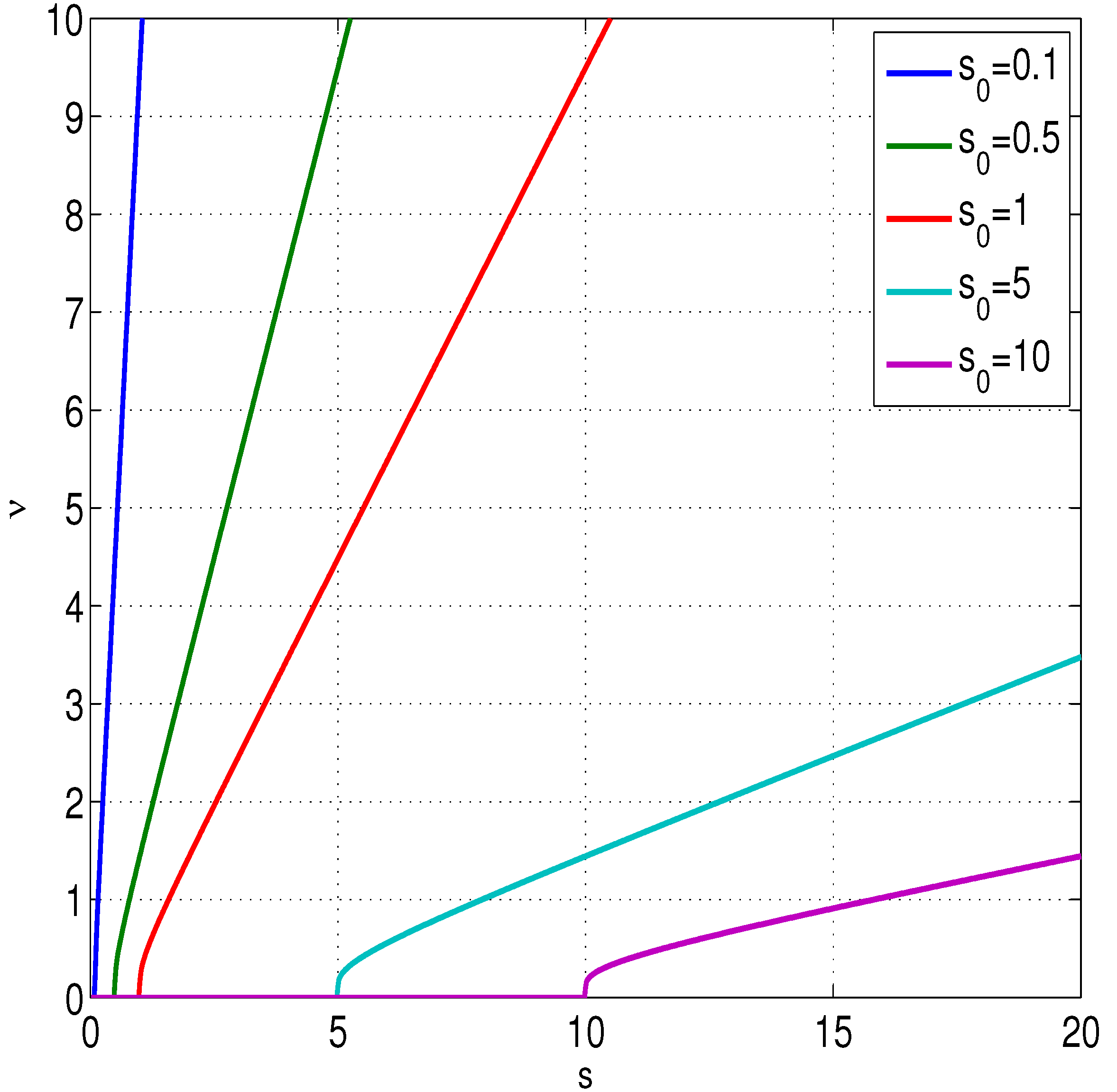
Proposition 1. Process p is explosive(e.g., [10]), more exactlywhere the explosion time S is finiteand its expectation can be explicitly computedwhere are the Airy functions and their modulus. Notice that (
9) implies the expression (
2) for the intensity of caustics since
.
Explosiveness of
follows from the Feller’s criteria [
10].
To prove (
9) we introduce
as the mean time to explosion under condition
, then solve
where
is the generator of (
7).
Then we set
and arrive at (
9). Details of computations are the same as in [
11].
For the purpose of studying
models the knowledge of the mean explosion time is not enough. Introduce
and let
be the same probability under condition
, then
In [
12], it was shown that
satisfies the initial value problem
To ensure uniqueness of solution of (
10) we add the natural boundary conditions assuming that the limit
exists similarly to
.
A simplest Euler scheme was used for solving (
10) numerically. Some details and validation of the choice of the scheme parameters are given in
Appendix A. Notice that our goal is not to evaluate and minimize the error of the numerical computations, but rather to illustrate that (
10) can be solved quite accurately and efficiently with very simple tools.
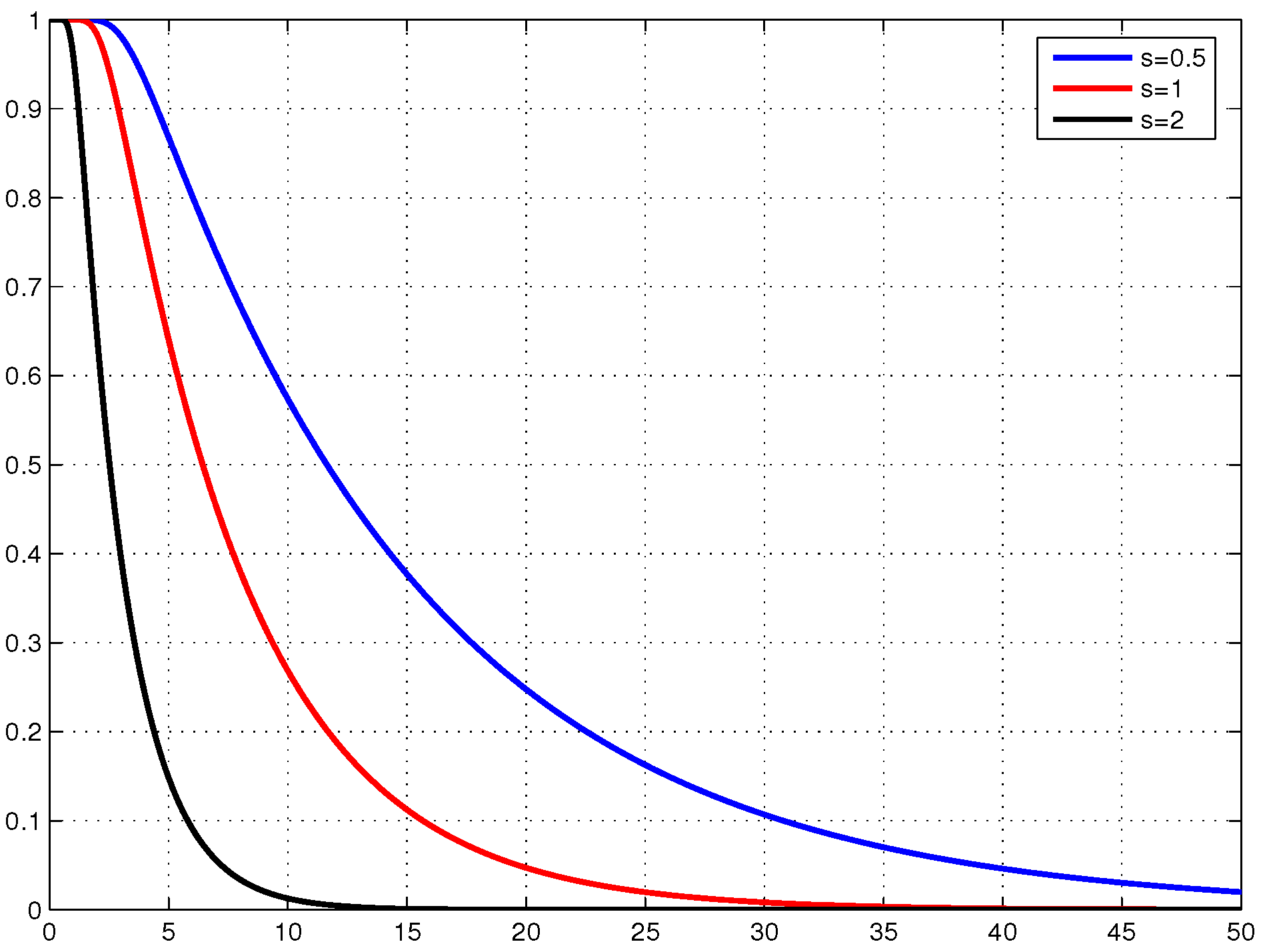
Graphs of
for a few values of
s are shown in
Figure 1To proceed to investigating LE we notice that after explosion process
can be continued by starting over, i.e., by solving same Equation (
7) with the initial condition
The positive sign follows from relation and the fact that zeros of are prime. Thus, takes different signs on different sides of a zero of .
LE for flow (
7) is expressible in terms of the ergodic mean of
p
as follows from (
2) and definition of
, see [
2] for details. It also can be exactly found
Proposition 2. The ergodic mean of p is given by The statement is proven in
Appendix A and here we just make some comments. Notice that the density of the stationary distribution
of
does exist and is given by
where
C is a normalized constant.
One can find the following asymptotic
Thus, the integral for the invariant mean
is formally divergent, however if the integral is meant as a Cauchy principal value then it coincides with the RHS of (
11).
4. System of Equations for Jacobian in General 2D Case
Now we return to the stochastic model (
1). In a few works it was pointed out that there is a closed equation for the matrix
An analysis of that equation led to some general important conclusions, but it is of little help for our purposes because in general it cannot be reduced to efficiently handled scalar equations.
Let us first rewrite (
1) in the coordinate-wise form with
where
and
are entries of
. The goal is to investigate time behavior of the Jacobian
It is not possible to obtain a closed equation for
, but it can be included in a system of four equation as it is shown in
Appendix A. Namely, for dimensionless time
denoted by the same letter, Jacobian can be represented as
where dimensionless random function
is included into the following system
s is Stokes number defined similarly to (
8) and an exact expression for it is given in
Appendix A.
To define processes
we nondimensionalize
and set
where the subs mean derivatives. Thus,
’s are dependent Wiener (non-standard) processes with a covariance matrix
given by -4.6cm0cm
where
is a dimensionless version of
and partial derivatives are taken at
.
5. Two Special Cases
Under certain conditions imposed on the forcing in (
14) the first moment
S of
to hit zero turns out to be the minimum from the first explosion moments for two independent 1D processes described by (
7).
In this section, we assume a zero initial velocity field
that implies zero initial conditions
in (
15)
Model 1. Assume
where
are independent and
From (
16,
18) it follows that
Then from (
16,
17,
19)
and hence
are independent identically distributed Wiener processes.
Next due to the zero initial conditions
. Introduce
By adding and subtracting first two equations in (
15) we get two separated equations
for independent identically distributed processes
and
Model 2. In this model we assume
with independent
U and
V such that
where the prime means the derivative in the space coordinate. From (
16,
17,
21,
22) it follows that
and
are independent identically distributed Wiener processes since
and
.
Thus,
and introducing
arrive at the same equations (
20).
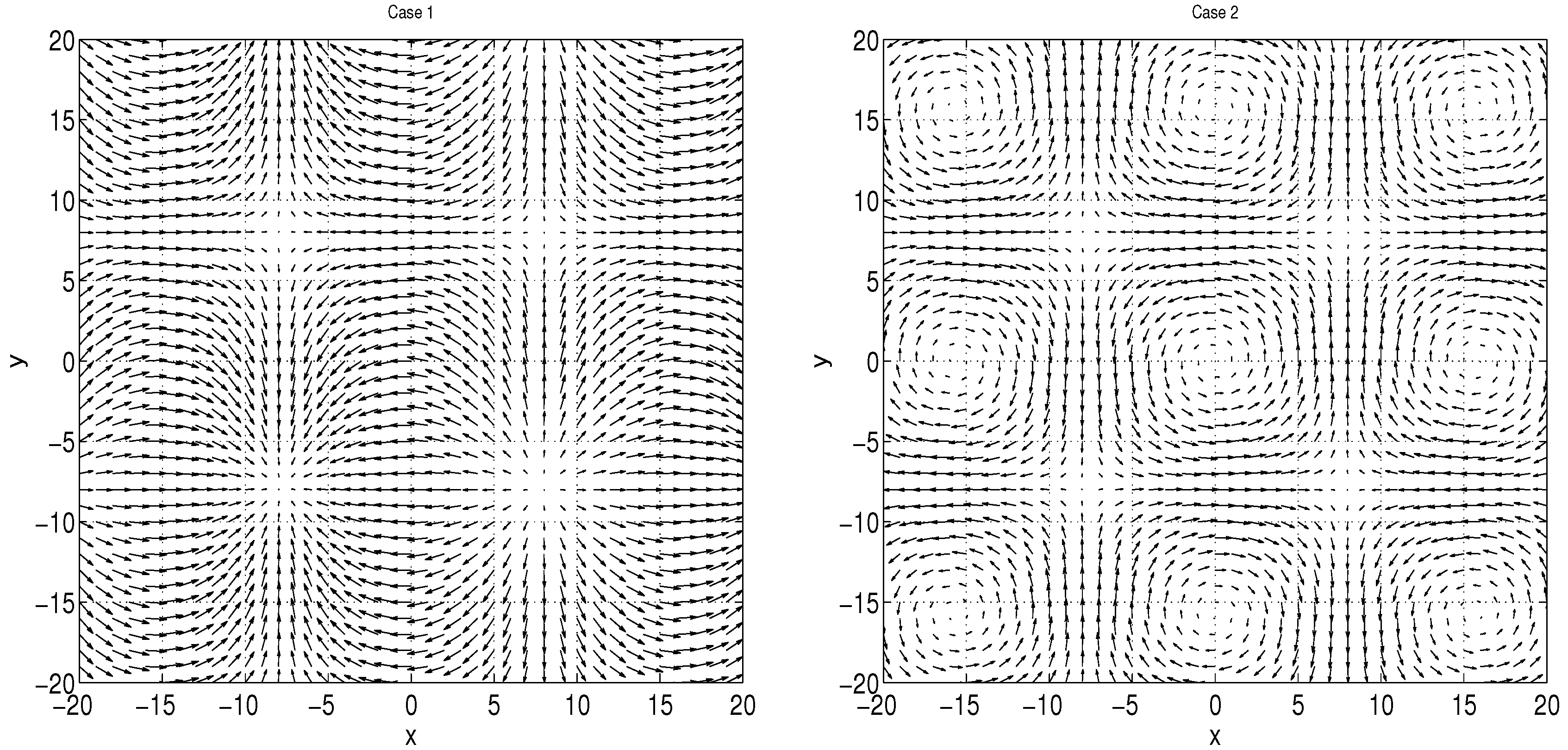
Below we show simulated velocity fields at a particular time moment for both models (
Figure 3) where periodic in space forcings were used.
Let
and
be the first explosion moments for
and
, respectively, then
Certainly the knowledge of
is not enough to find
, but the latter can be expressed in terms of
as
Manipulating with this formula it is not difficult to present an example where the expected value of the minimum of two independent identically distributed random variables
is finite while the expectation of each variable is infinite due to heavy tails of
distribution. So, theoretically speaking
and
may differ by an order of magnitude. Fortunately it is not the case here since the tail of distribution of
is exponential and can be evaluated [
13].
Namely from Theorem 1.1 in [
13] it follows that the exponential moment
is finite for all
satisfying
and
Hence, it is reasonable to assume that
with
satisfying (
24). In view of this assumption
On the other side obviously that
Thus, for the mean number of caustics
one gets from (
9)
For small
s asymptotics of the lower bound and upper bound coincide and we get
while for large
s the corresponding asymptotics differ just by a constant
Approximation (
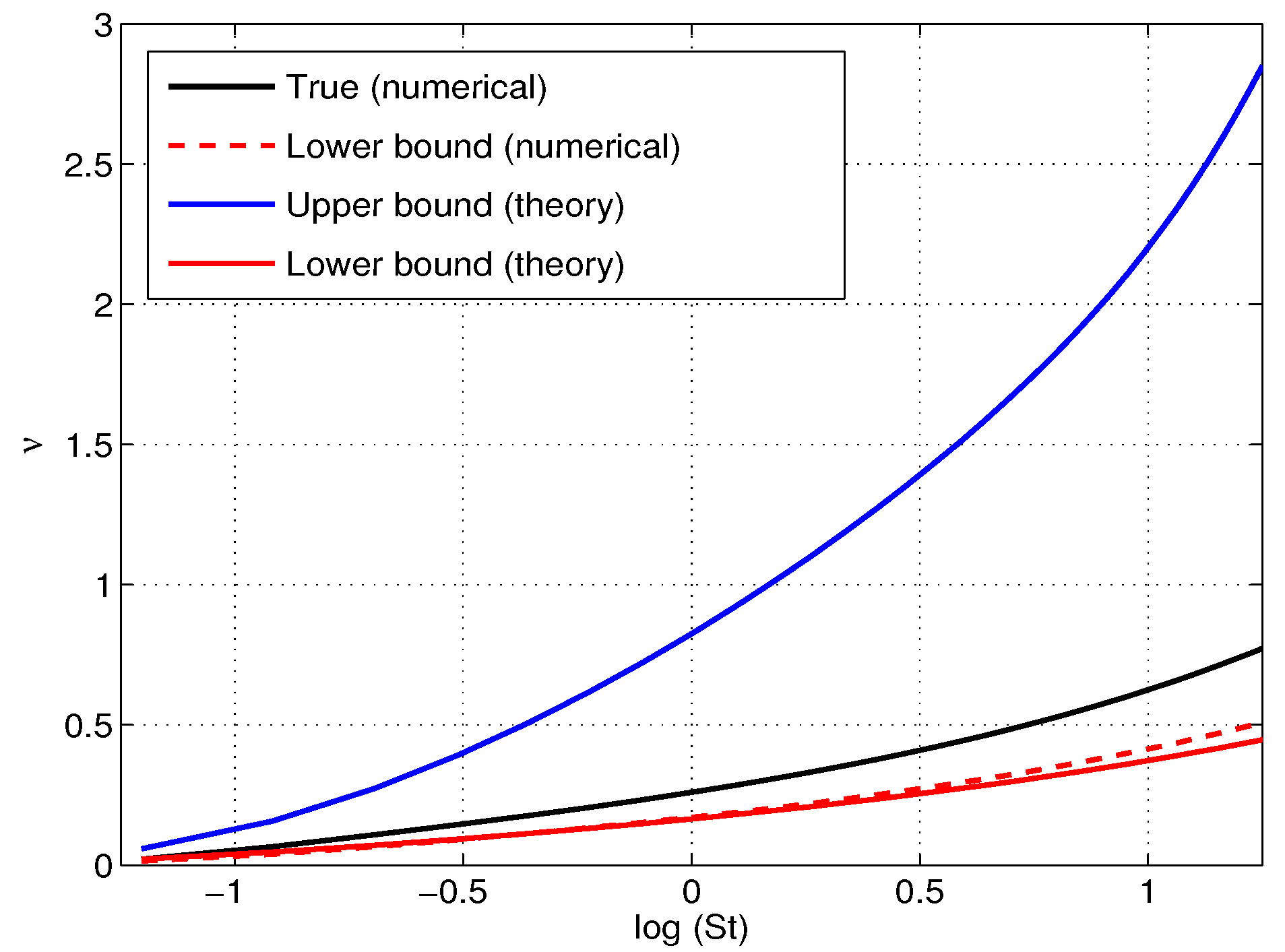
25) is quite speculative and indeed it greatly overestimates
. It can be seen by comparing the bounds with exact curve
obtained from solving the corresponding PDE for
(
Section 1). The upper and lower bounds for
are shown in
Figure 4 as well as its numerical version.
In Model 2 LE cannot be found by such simple tools because the equations for x and y components do not split.
Finally, notice that LE in Model 1 is given by the same expression (
11) as in
case. Indeed, in this case each component of the separation process
is the separation process for one dimensional flow (
6). Hence
for small
and large
t, where
is LE for (
6). Then our claim follows from Definition (
2).
7. Conclusions and Discussion
While one dimensional stochastic models for inertial particles have been comprehensively addressed, refs. [
4,
6,
7,
9] no essential progress in analytical studies for
turbulence have been reported yet. In this work for the first time the intensity of the caustics was rigorously treated in the framework of two dimensional stochastic flows modeling
turbulence in compressible media.
Namely, we revealed two cases, where the mean time to explosion in the particle density, , can be analytically estimated for the full range of Stokes number s and can be accurately evaluated by solving an initial/boundary problem for a one dimensional parabolic equation. Worth noting that both boundaries provide an exact asymptotic as . For both models the reciprocal , interpreted as the intensity of caustics, increases monotonically from zero to infinity that is in full agreement with physics of phenomena in question.
The reported advance in the proposed models is due to reduction in the number of unknowns in the system (
15) from four to two. Alas, for the most interesting isotropic case such a reduction is not possible, but a hope for finding asymptotics of
still remain. This is the main direction of our future studies.
Another interesting area of further consideration is the Equation (
4) describing the Eulerian velocity field generating Lagrangian motion covered by model (
1). It should be recognized that the interpretation of
and
in terms of solutions of (
4) is not clear enough except the deterministic case with the initial velocity field
for which
and
do not depend on
at all. A natural and important question is how the mean time until the uniqueness loss depends on the initial velocity field.