


Abstract
We study the concept of i-ideal of an ordered n-ary semigroup and give a construction of the i-ideal of an ordered n-ary semigroup generated by its nonempty subset. Moreover, we study the notions of prime, weakly prime, semiprime and weakly semiprime ideals of an ordered n-ary semigroup.
1. Introduction
A semigroup, which is a well-known generalization of groups, is an algebraic structure appearing in a natural manner in some applications concerning the theory of automata formal languages and other branches of applied mathematics (for example, see [1,2,3,4,5]). A notable particular kind of semigroup is a semigroup together with a partially ordered relation, namely an ordered semigroup. Obviously, we are always able to see a semigroup S as an ordered semigroup together with the equality relation . Some classical and notable researches on ordered semigroups are [6,7,8,9]. Additionally, Kehayopulu and Tsingelis defined several types of regularities on ordered semigroups in [10,11].
A ternary algebraic system was first introduced as a certain ternary algebraic system called a triplex, which turns out to be a ternary group by Lehmer [12] in 1932. As a generalization of a ternary group, the notion of a ternary semigroup was known to S. Banach. He showed that it is always possible to construct a ternary semigroup from a (binary) semigroup and gave an example in which a ternary semigroup does not necessarily reduce to a semigroup. Later, Santiago [13] mainly investigated the notions of an ideal and a bi-ideal of a ternary semigroup and used them to characterize a regular ternary semigroup. In 2012, Daddi and Pawar [14] defined the notions of ordered quasi-ideals and ordered bi-ideals of ordered ternary semigroups, which are special kinds of ternary semigroups and also presented regular ordered ternary semigroups in terms of several ideal-theoretical characterizations. Another type of regularity on ordered ternary semigroups, namely an intra-regular ordered ternary semigroup, was introduced and characterized by S. Lekkoksung and N. Lekkoksung in [15]. Several kinds of regularities of ordered ternary semigroups were also investigated and characterized in terms of many kinds of ordered ideals by Daddi in [16] and Pornsurat and Pibaljommee in [17].
A generalization of classical algebraic structures to n-ary structures was first introduced by Kasner [18] in 1904. In 1928, Dörnte [19] introduced and studied the notion of n-ary groups, which is a generalization of that one of groups. Later, Sioson [20] introduced a regular n-ary semigroup, which is an important generalization of a (binary) semigroup and verified its properties. In [21], Dudek and Groździńska investigated the nature of regular n-ary semigroups. Moreover, Dudek proved several results and gave many examples of n-ary groups in [22,23]. Furthermore, in [24], Dudek also studied potent elements of n-ary semigroups () and investigated properties of ideals in which all elements are potent.
Prime, semiprime, weakly prime and weakly semiprime properties are interesting properties of ideals of semigroups and ordered semigroups. In 1970, Szász [25] showed that a semigroup is intra-regular and the set of all ideals forms a chain if and only if every ideal is prime. Later, Kehayopulu [26] gave the same result in ordered semigroups. Furthermore, Kehayopulu also generalized her work on ordered semigroups [26] to ordered hypersemigroups in [27]. The concepts of prime and semiprime ideals were also studied on ternary semigroups by Shabir and Bashir [28] in 2009. In cases of quasi-ideals and bi-ideals of ternary semigroups, Shabir and Bano [29] introduced the notions of prime, semiprime and strongly prime properties of quasi-ideals and bi-ideals and also characterized ternary semigroups for which each bi-ideal is strongly prime.
In this work, we investigate some algebraic properties of an ordered n-ary semigroup, which is an n-ary semigroup together with a partially ordered relation and also a generalization of ordered semigroups. We also study the concept of an i-ideal of an ordered n-ary semigroup and give the construction of an i-ideal of an ordered n-ary semigroup generated by its nonempty subset. Then we generalize the concept of an i-ideal of an ordered n-ary semigroup to the concept of a -ideal in order that an i-ideal is a special case of a -ideal where . Finally, we study the notions of prime, weakly prime, semiprime and weakly semiprime properties of a -ideal where and use them to generalize some results in [26] to an ordered n-ary semigroup.
2. Preliminaries
Let be the set of all natural numbers and . A nonempty set S together with an n-ary operation given by , where , is called an n-ary groupoid [24]. For , the sequence of elements of S is denoted by and if , we write instead of . For , we denote as empty symbol and so is . So, the term
is able to be simply represented by
The associative law [23] for the n-ary operation f on S is defined by
for all and . An n-ary groupoid is called n-ary semigroup if the n-ary operation f satisfies the associative law.
By the associativity of an n-ary semigroup , we define the map where by
for any . Hence, we note that for any . Many notations above can also be found in [21,22,23,24].
For , the sequence of nonempty sets of S is denoted by the symbol . For nonempty subsets of S, we denote
If , we write instead of . If , then we write instead of , and similarly in other cases. For , we set the notations and to be the empty symbols as a similar way of the notations and .
An ordered semigroup is an algebraic structure such that is a semigroup and is a poset satisfying the compatibility property, i.e., if , then and for all . To generalize the notion of n-ary semigroups and ordered (binary) semigroups, the notion of an ordered n-ary semigroup is defined as follows.
Definition 1.
An ordered n-ary semigroup is a system such that is an n-ary semigroup and is a partially ordered set satisfying the following property. For any , if , then
for all
Throughout this paper, we write S for an ordered n-ary semigroup, unless specified otherwise.
For any , we denote
Now, we give some basic properties of the operator on an ordered n-ary semigroup as follows.
Lemma 1.
Let be nonempty subsets of S. Then the following statements hold:
- (i)
- ;
- (ii)
- ;
- (iii)
- implies ;
- (iv)
- ;
- (v)
- ;
- (vi)
The following remark is directly obtained by the notion of where and .
Remark 1.
Let A be a nonempty subset of S, and . If , then .
Lemma 2.
Let A be a nonempty subset of S. Then for all positive integers
Proof.
Let .
Then for some , .
Hence, for all positive integers . □
3. Ideals of Ordered n-ary Semigroups
In this section, we study the concept of i-ideals of an ordered n-ary semigroup and give a construction of i-ideal of an ordered n-ary semigroup generated by its nonempty subset.
Definition 2.
Let . A nonempty subset I of S is called an i-ideal of S if and . A nonempty subset I of S is called an ideal of S if I is an i-ideal for every .
Next, we define the notion of a -ideal of S whenever as follows.
Definition 3.
Let . A nonempty subset I of S is called a Λ-ideal of S if for all and .
Lemma 3.
Let be nonempty subsets of S. If are -ideals of S, then is a -ideal of S.
Proof.
Let be -ideals of S. Then and . So, is a 1-ideal of S.
Similarly, we can show that is an n-ideal of S. Hence, is a -ideal of S. □
Lemma 4.
The following statements are equivalent.
- (i)
- for every ideal A of S.
- (ii)
- for all ideals of S.
Proof.
(i)⇒(ii). Let be ideals of S.
We consider and , i.e., So, is an i-ideal of S for all . That is is an ideal of S. Let . By assumption, . It is clear that .
(ii)⇐(i). Let A be an ideal of S. Then . □
Corollary 1.
The following statements are equivalent.
- (i)
- for every -ideal A of S.
- (ii)
- for all -ideals of S.
Let A be a nonempty subset of S. We call the intersection of all -ideals of S containing A to be the -ideal of S generated by A. Then, we denote the notation to mean the -ideal of S generated by A. In a particular case , we write instead of .
Next, we give the constructions of the -ideals of S generated by a nonempty subset whenever and as follows.
Theorem 1.
Let A be a nonempty subset of S. Then
Proof.
Let A be a nonempty subset of S and . First, we show that is an i-ideal of S. Let . Then we consider the following two cases.
- Case 1: . Then .
- Case 2: . Using Remark 1 and Lemma 2, we have
So, is an i-ideal of S. Next, we show that is the smallest i-ideal of S containing A. Let I be any i-ideal of S containing A. We consider . Hence, is the smallest i-ideal of S containing A. □
Corollary 2.
Let A be a nonempty subset of S. Then the following statements hold:
- (i)
- and .
- (ii)
- If and , then
Proposition 1.
Let A be a nonempty subset of S. Then
Proof.
Let A be a nonempty subset of S.
First, we show that is a -ideal of S. We consider . So, is a 1-ideal of S. Similarly, we can show that is an n-ideal of S. Hence, is a -ideal of S. Next, we show that is the smallest -ideal of S containing A. Let I be a -ideal of S containing A. We consider . Hence, is the smallest -ideal of S containing A. □
4. Prime, Semiprime, Weakly Prime and Weakly Semiprime of Ordered n-ary Semigroups
In this section, we define the notions of prime, weakly prime, semiprime and weakly semiprime of an ordered n-ary semigroup and study prime properties by using the sets that are 1-ideals and n-ideals of an ordered n-ary semigroup.
Definition 4.
Let P be a nonempty subset of S. For any nonempty subset of S for , P is called prime if implies for some .
Remark 2.
A nonempty subset P of S is prime if and only if for all , implies for some .
Definition 5.
Let P be a Λ-ideal of S. Then P is called weakly prime if for all Λ-ideals of S such that implies for some .
Definition 6.
Let P be a nonempty subset of S. Then P is called semiprime if for all nonempty subsets A of S, implies .
Remark 3.
A nonempty subset P of S is semiprime if and only if for all , implies .
Definition 7.
Let P be a Λ-ideal of S. Then P is called weakly semiprime if for all Λ-ideals A of S such that , we have that .
Remark 4.
Let S be an ordered n-ary semigroup.
- (i)
- If P is prime, then P is weakly prime.
- (ii)
- If P is prime, then P is semiprime.
- (iii)
- If P is weakly prime, then P is weakly semiprime.
- (iv)
- If P is semiprime, then P is weakly semiprime.
It is clear that every prime ideal of an ordered n-ary semigroup is weakly prime. The converse is not true as shown by the following example.
Example 1.
Let Define a binary operation · on S by the following table:
| · | a | b | c | d | e |
| a | a | a | a | a | a |
| b | a | b | a | d | a |
| c | a | e | c | c | e |
| d | a | b | d | d | b |
| e | a | e | a | c | a |
Define a binary relation ≤ on S by
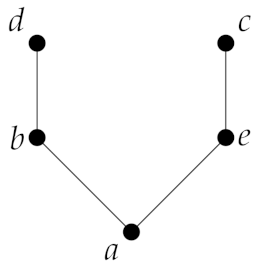
Then is an ordered semigroup. All ideals of S are as follows: and S. We have that is a weakly prime ideal. However, it is not a prime ideal and not a semiprime ideal since but . Moreover, is a weakly semiprime ideal.
Example 2.
Let be the set of all natural numbers. Define an n-ary operation by
for all where · is the usual multiplication on . It is easy to see that is an ordered n-ary semigroup with partially relation =. We have that is a semiprime ideal of . However, but and . This shows that is not a prime ideal and not a weakly prime ideal. Moreover, is a weakly semiprime ideal.
Now, we use prime, weakly prime, semiprime and weakly semiprime properties of -ideals to generalize results of [26] to an ordered n-ary semigroup.
Theorem 2.
The following statements are equivalent.
- (i)
- Every -ideal of S is weakly semiprime.
- (ii)
- for every -ideal I of S.
Proof.
Assume that every -ideal of S is weakly semiprime. Let I be a -ideal of S. By Lemma 3, is a -ideal of S. So, is weakly semiprime. Since , . It is clear that . Conversely, assume that for every -ideal I of S. Let P be a -ideal of S and I be -ideal of S such that . Then . So, P is weakly semiprime. □
Corollary 3.
The following statements are equivalent.
- (i)
- Every -ideal of S is weakly semiprime.
- (ii)
- for every -ideal I of S.
Theorem 3.
The following statements are equivalent.
- (i)
- Every -ideal of S is weakly prime.
- (ii)
- The set of all -ideals of S forms a chain and for every -ideal of S.
Proof.
Assume that every -ideal of S is weakly prime. Let A and B be -ideals of S. By Lemma 3, is a -ideal of S. So, or . If , then . If , then . Since every weakly prime is weakly semiprime and by Theorem 2, for every -ideal of S.
Conversely, assume that the set of all -ideals of S forms a chain and for every -ideal of S. Let P be a -ideal of S and be -ideals of S such that . By assumption, there exists such that for all . Using Corollary 1, we have . So, P is weakly prime. □
Remark 5.
For any , we observe that is a -ideal of S.
Proof.
Let . Then
and . So, is an n-ideal of S. Similarly, we can show that is a 1-ideal of S. □
Definition 8.
An element is called intra-regular, if there exist such that . An ordered n-ary semigroup S is called intra-regular, if each one of its elements is intra-regular.
The following lemma is directly obtained by Definition 8.
Lemma 5.
The following statements are equivalent.
- (i)
- S is intra-regular.
- (ii)
- for any .
- (iii)
- for any .
Now, we give an example of an intra-regular ordered n-ary semigroup as the following example.
Example 3.
Let and . Define an n-ary operation f on S by
for all It is easy to see that is an ordered n-ary semigroup with partially relation =. Let . Case 1: . Since , a is intra-regular. Case 2: . We have that . So, S is intra-regular.
Moreover, it is not difficult to verify that all ideals of S are subsets of S containing 0 and they are semiprime. Indeed, let B be an ideal of S and such that . If , then it is clear that . If , then . However, is a semiprime ideal, which is not prime because for and for some , but for all .
Proposition 2.
Let S be an ordered n-ary semigroup. If S is intra-regular, then
Proof.
Assume that S is intra-regular. Let A be a nonempty subset of S. Then It is clear that is a -ideal of S. By Proposition 1,
So, □
Theorem 4.
The following statements are equivalent.
- (i)
- Every -ideal of S is semiprime.
- (ii)
- S is intra-regular.
Proof.
Assume that every -ideal of S is semiprime. Let . We have
By Remark 5 and assumption, and so, . By Lemma 5, S is intra-regular. Conversely, assume that S is intra-regular. Let P be a -ideal of S and such that . By assumption, we have . So, P is semiprime. □
Theorem 5.
The following statements are equivalent.
- (i)
- Every i-ideal of S is semiprime.
- (ii)
- for all .
Proof.
Assume that every i-ideal of S is semiprime. Let . We have
Since is an i-ideal of S and by assumption,
and so . Conversely, assume that for all .
Let I be an i-ideal of S and such that . By assumption,
Hence, I is semiprime. □
Corollary 4.
The following statements are equivalent.
- (i)
- Every 1-ideal of S is semiprime if and only if for all .
- (ii)
- Every n-ideal of S is semiprime if and only if for all .
5. Conclusions and Discussion
In this paper, we study i-ideals of ordered n-ary semigroups. Moreover, we study prime properties of -ideals of ordered n-ary semigroups, which are generalizations of n-ary semigroups. So, our results hold in n-ary semigroups as well. We introduce the notions of -ideals of ordered n-ary semigroups as a generalization of the notions of i-ideals and investigate prime properties of a -ideal of ordered n-ary semigroups whenever . In ordered semigroups S, ordered n-ary semigroups with , Kehayopulu showed that every ideal of S is prime if and only if S is intra-regular and the set of all ideals of S forms a chain. However, this result still opens for -ideals of (ordered) n-ary semigroups where . Moreover, algebraic properties of -ideals in (ordered) n-ary semigroups can be further investigated.
Author Contributions
Conceptualization, P.P., P.P.n.A., and B.P.; investigation, P.P., P.P.n.A., and B.P.; writing—original draft preparation, P.P., P.P.n.A., and B.P.; writing—review and editing, P.P., P.P.n.A., and B.P.; supervision, B.P. All authors have read and agreed to the published version of the manuscript.
Funding
This research received no external funding.
Institutional Review Board Statement
Not applicable.
Informed Consent Statement
Not applicable.
Data Availability Statement
Data sharing not applicable.
Acknowledgments
We would like to express our thanks to Science Achievement Scholarship of Thailand (SAST) and our heartfelt thanks to the referee(s) for their interest, extremely valuable remarks and suggestions to our paper.
Conflicts of Interest
The authors declare no conflict of interest.
References
- Almeida, J.; Margolis, S.; Steinberg, B.; Volkov, M. Representation theory of finite semigroups, semigroup radicals and formal language theory. Trans. Am. Math. Soc. 2009, 361, 1429–1461. [Google Scholar] [CrossRef]
- Lallement, G. Semigroups and Combinatorial Applications; John Wiley & Sons Inc.: Hoboken, NJ, USA, 1979. [Google Scholar]
- Močkoř, J. Semigroup homomorphisms and fuzzy automata. Soft Comput. 2002, 6, 422–427. [Google Scholar] [CrossRef]
- Pin, J.E. Logic, semigroups and automata on words. Ann. Math. Artif. Intell. 1996, 16, 343–384. [Google Scholar] [CrossRef]
- Straubing, H. Semigroups and languages of dot-depth two. Theoret. Comput. Sci. 1988, 58, 361–378. [Google Scholar] [CrossRef][Green Version]
- Alimov, N.G. On ordered semigroups. Izv. Akad. Nauk SSSR Ser. Mat. 1950, 14, 569–576. [Google Scholar]
- Birkhoff, G. Lattice Theory; American Mathematical Society Colloquium Publication: Providence, RI, USA, 1967. [Google Scholar]
- Chehata, C.G. On ordered semigroups. J. Lond. Math. Soc. 1953, 28, 353–356. [Google Scholar] [CrossRef]
- Conrad, P. On ordered semigroups. Nagoya Math. J. 1960, 16, 51–64. [Google Scholar] [CrossRef]
- Kehayopulu, N. On completely regular ordered semigroups. Sci. Math. 1998, 1, 27–32. [Google Scholar]
- Kehayopulu, N.; Tsingelis, M. On left regular ordered semigroups. Southeast Asian Bull. Math. 2002, 25, 609–615. [Google Scholar] [CrossRef]
- Lehmer, D.H. A ternary analogue of abelian groups. Am. J. Math. 1932, 59, 329–338. [Google Scholar] [CrossRef]
- Santiago, M.L. Regular ternary semigroups. Bull. Cal. Math. Soc. 1980, 82, 67–71. [Google Scholar]
- Daddi, V.R.; Pawar, Y.S. On ordered ternary semigroup. Kyungpook Math. J. 2012, 52, 375–381. [Google Scholar] [CrossRef]
- Lekkoksung, S.; Lekkoksung, N. On intra-regular ordered ternary semigroups. Int. J. Math. Anal. 2012, 6, 69–73. [Google Scholar]
- Daddi, V.R. Characterizations of regular ordered ternary semigroups by bi-ideals. Int. J. Open Problems Compt. Math. 2018, 11, 33–43. [Google Scholar]
- Porsurat, P.; Pibaljommee, B. Regularities in ordered ternary semigroups. Quasigroups Relat. Syst. 2018, 27, 107–118. [Google Scholar]
- Kasner, R. An extension of the group concepts. Bull. Amer. Math. Soc. 1904, 10, 290–291. [Google Scholar]
- Dörnte, W. Untersuchungen über einen verallgemeinerten Gruppenbegriff. Math. Z. 1929, 29, 1–19. [Google Scholar] [CrossRef]
- Sioson, F.M. On regular algebraic systems. Proc. Japan Acad. 1963, 39, 283–286. [Google Scholar] [CrossRef]
- Dudek, W.A.; Groździńska, I. On ideals in regular n-ary semigroups. Mat. Bilten 1980, 4, 25–44. [Google Scholar]
- Dudek, W.A. Remarks on n-groups. Demonstr. Math. 1980, 13, 165–181. [Google Scholar]
- Dudek, W.A. On (i,j)-associative n-groupoids with the non-empty center. Ric. Mat. 1986, 35, 105–111. [Google Scholar]
- Dudek, W.A. Idempotents in n-ary semigroups. Southeast Asian Bull. Math. 2001, 25, 97–104. [Google Scholar] [CrossRef]
- Szász, G. Eine Charakteristik der Primidealhalbgruppen. Publ. Math. Debr. 1970, 17, 209–213. [Google Scholar]
- Kehayopulu, N. On prime, weakly prime ideals in ordered semigroups. Semigroup Forum 1992, 44, 341–346. [Google Scholar] [CrossRef]
- Kehayopulu, N. On ordered hyoersemigroups with idempotent ideals, prime or weakly prime ideals. Eur. J. Pure. Appl. Math. 2018, 11, 10–22. [Google Scholar] [CrossRef]
- Shabir, M.; Bashir, S. Prime ideals in ternary semigroups. Asian-Eur. J. Math. 2009, 2, 141–154. [Google Scholar] [CrossRef]
- Shabir, M.; Bano, M. Prime bi-ideals in ternary semigroups. Quasigroups Relat. Syst. 2008, 16, 239–256. [Google Scholar]
Publisher’s Note: MDPI stays neutral with regard to jurisdictional claims in published maps and institutional affiliations. |
© 2021 by the authors. Licensee MDPI, Basel, Switzerland. This article is an open access article distributed under the terms and conditions of the Creative Commons Attribution (CC BY) license (http://creativecommons.org/licenses/by/4.0/).