


Abstract
According to the Frenet equations of the null curves in semi-Euclidean 4-space, the existence conditions and the geometrical characterizations of the Bertrand curves of the null curves are given in this paper. The examples and the graphs of the Bertrand pairs with two different conditions are also given in order to supplement the conclusion of this paper more intuitively.
1. Introduction
The study on the local and global geometric properties of curves has attracted the attention of many researchers. In case of semi-Euclidean space, there are three categories of curves: spacelike curves, timelike curves, and null (lightlike) curves. The spacelike curves and timelike curves are called non-degenerated curves, which have many similar properties with the curves in Euclidean space [1,2]. However, for the null curves (degenerate curves), with the reason of no length, compared with non-degenerate curves, there are many different geometrical properties. Seeing that, from the differential geometry point of view, the null curves have their own research value. Many researchers had focused their attention on the null curves [3,4,5,6,7,8,9,10]. The first author and Pei, D.H., obtained the singularities and other characterizations of null curves on the 3-null cone in [4,6]. The authors focused their attention on the characterizations of the pseudo-spherical null curves and Bertrand null curves in [8].
On the other hand, Bertrand stated the fact that the principal normal vector of a curve can also be the principal normal vector of another curve in Euclidean 3-space [11], and he gave a necessary and sufficient condition for the existence of the Bertrand mate. From then on, many researchers began to study the Bertrand curves and got many interesting properties [12,13,14]. The authors gave the relationship between the curvatures and the torsions of the Bertrand curve pairs in [12]. However, due to the increase of dimension, the authors gave the new definitions of the Bertrand curves in 4-space [15,16,17]. The definitions of the new Bertrand curves ((1,3)-type) and some characterizations were obtained in [15]. The characterizations of the general surfaces and generalized Bertrand curves in Galilean space were studied in [17,18].
Synthesizing the above views, in this paper, we study the existence conditions of the Bertrand curves of the null curves in semi-Euclidean 4-space. Firstly, we provide some fundamental concepts on the null curves and the semi-Euclidean 4-space. Then, we present some geometrical properties of the Bertrand curves of the null curves in Section 3, and we provide the existence conditions of the Bertrand curves for two different cases. In the last section, two examples are given to demonstrate the correctness of the conclusions in view of the geometric intuition.
2. Preliminaries
Let be a 4-dimensional vector space. For any vectors and in the pseudo scalar product of and is defined by . is called semi-Euclidean 4-space and denoted by
A vector in is called a spacelike vector, a lightlike vector or a timelike vector if is positive, zero or negative, respectively. The norm of a vector is defined by For any two vectors and in we say that is pseudo-perpendicular to if The pseudo vector product of vectors , , and is defined by
where is the canonical basis of . One can easily show that . For a real number we define the hyperplane with pseudo normal vector by We call a spacelike hyperplane, a timelike hyperplane or a lightlike hyperplane if is a spacelike, timelike or null (lightlike) vector, respectively.
Definition 1.
Let be a curve in . Then is called a null (lightlike) curve, a spacelike curve or a timelike curve if its tangent vector is null vector, spacelike vector or timelike vector for , respectively.
In this paper, we consider the null curve with pseudo parameter s satisfying and
For a non-null curve in , we have a non-null bundle subspace of satisfying
However, for a null curve , the tangent bundle can be split into three non-intersecting complementary vector bundles. For this purpose, we consider a complementary vector bundle (screen vector bundle) to in , which means
We know is non-degenerate. Since is para compact, there exists a screen bundle, such that
Notice that since is of rank 2 and contains , there exists a unique null vector bundle of rank 1, which plays a similar roll like the unique normal vector bundle of the non-null curve. Hence, the unique transversal vector is obtained by the following lemma [3]:
Lemma 1.
Let be a null curve in , be a sub bundle of a screen vector bundle , such that , where stands for the null transverse of vector . Let be a locally defined nowhere zero section.
- 1.
- Then everywhere in
- 2.
- If we consider given bythen is a unique vector bundle over of rank 1, and, there is a unique vector field satisfying
- 3.
- The tangent bundle splits into the following three bundle spaces:
For a null curve in , and the unique null transversal vector field to , the screen vector bundle is Lorentz. Hence, the two null vectors and are two Frenet frames of . Then, and we construct a non null frame , and
A null curve with the Frenet frame , satisfies
where is the tangent vector, is the normal vector, is the first binormal vector, and is the second binormal vector. The Frenet Equations of are given as follows [3],
where , and are called the first curvature function, the second curvature function and the third curvature function of , respectively.
As in [15,17], we give the definition of the Bertrand curve as following,
Definition 2.
Let and be two curves in semi-Euclidean 4-space and a regular -map, such that each point of corresponds to the point of for all If the Frenet–Serret normal plane spanned by at each point of coincides with the Frenet–Serret normal plane spanned by at each corresponding point of , then is called the Bertrand curve (mate) of .
3. The Bertrand Curves of Null Curves
In this section, we present some geometrical characterizations and provide the existence conditions of the Bertrand curves of the null curves in semi-Euclidean 4-space. We also give the existence of the Bertrand curves for two cases () respectively.
For be a null curve in semi-Euclidean 4-space, the Bertrand curve of can be written as following,
where and are functions on I, , and is the pseudo parameter of .
Differentiating the Equation (4) with respect to we can obtain
Since the plane spanned by and is parallel with the plane spanned by and , we have
where are two functions. By the fact
we get
Since
we obtain
Together with the Equations (9) and (10), when , we obtain
From
together with the Equations (3) and (7), we can obtain
and
Hence,
Theorem 1.
Let be a null curve in semi-Euclidean 4-space with the frames , and the Bertrand curve of with the frames , where . When , there exist three functions as in the formulas (4), (6) and (7) such that:
Case 1: when , the following conclusions are established:
- 1.
- and , where are constants;
- 2.
- 3.
- , where
Case 2: when , the following conclusions are established:
- 1.
- , where K is a constant;
- 2.
- 3.
Proof.
When , by the Equations (10) and (15), we can obtain
Case 1: when , where is a constant, from the third equation of (15), we have
By differentiating the Equation (16), we obtain
and we get and . Substituting to the first equation of (15) gives us
where are two constants.
By the Equations (5)–(7), (11) and (16), we can obtain
By differentiating the vector , we get
Meanwhile,
hence,
By , we find
Similarily,
and we get
From, , we have
and we obtain
By substituting (21) in (19) and (20), we have
, Hence,
where
Case 2: When , and , we can obtain and where K is a constant.
By substituting the above to Equation (9),
we find
By differentiating , we get
hence, we obtain
By the fact , , and , we can obtain
- (1).
- When from (23), we know , which contradicts with . Hence, we omit this case.
- (2).
- When we know and , where is a constant. By substituting this in the Equation (23), we have
By the fact that we can obtain
□
Theorem 2.
Let be a null curve in semi-Euclidean 4-space with the frames , and the Bertrand curve of with the frames , where . When , there exist three functions as in the formulas (4), (6) and (7) such that:
- 1.
- is a constant, and ;
- 2.
- 3.
Proof.
By the Equation (15), we can obtain
By differentiating , we get
Hence,
and,
Since
we obtain
Meanwhile,
where
By the fact , , and , we can obtain
Since we have
By substituting Equations (30), (31) and (33) into Equation (11), we obtain that there exist two functions and satisfying
By substituting the Equations (29), (31) and (33) into Equation (34), we can obtain
When we choose , then . □
4. Some Examples
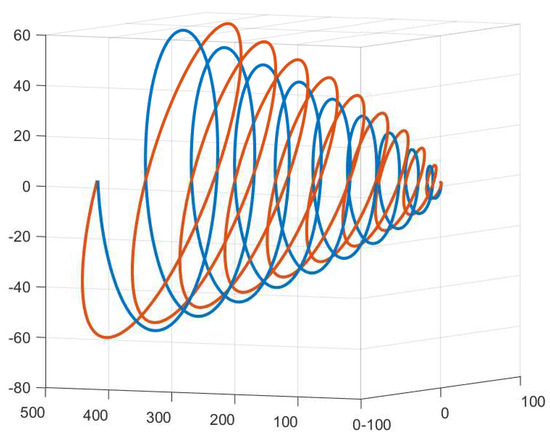
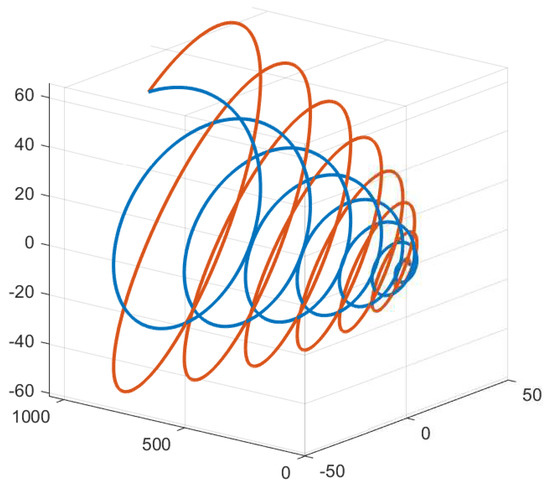
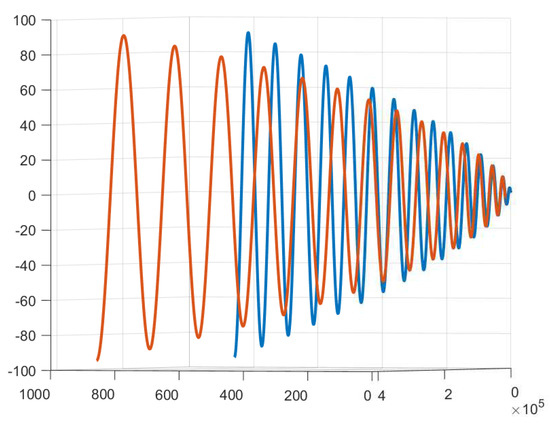
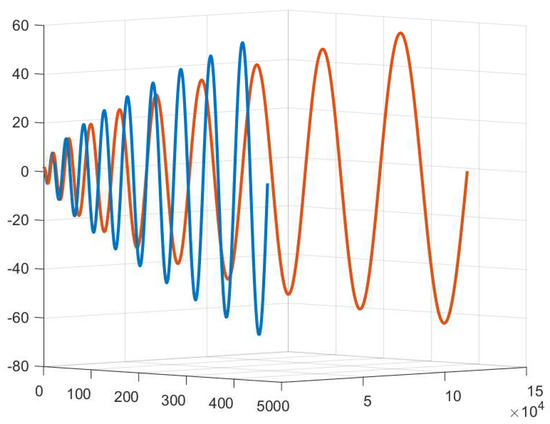
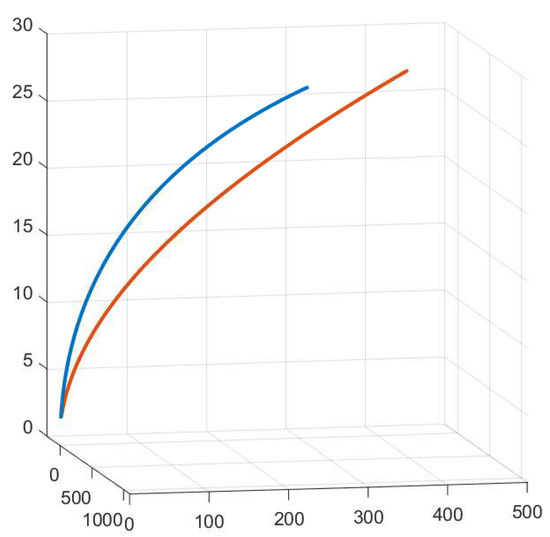
In this section, we give two examples of the Bertrand curves of the null curves in semi-Euclidean 4-space to certificate our main conclusions. The graphics of the null curves and the Bertrand curves are described in the followings. Moreover, for the reason that it cannot draw the high dimension graph, and here, we give the projection graph of the null curve and the Bertrand curves for two cases (), respectively.
Example 1.
Let be a null curve in semi-Euclidean 4-space with , and be the Bertrand curve of . The equation is as following [3],
and we can choose the frame of the null curve :
The curvatures are the following
By the analysis in Section 3, we can obtain . We might as well choose . We can get
Hence, we have
We draw four graphics from four different projection angles in the following (Figure 1, Figure 2, Figure 3 and Figure 4).
Figure 1.
The blue curve is and the red curve is the in the projection space spanned by .
Figure 2.
The blue curve is and the red curve is the in the projection space spanned by .
Figure 3.
The blue curve is and the red curve is the in the projection space spanned by .
Figure 4.
The blue curve is and the red curve is the in the projection space spanned by .
Example 2.

Let be a null curve in the semi-Euclidean 4-space with , and be the Bertrand curve of . The equation is as follows
and we can choose the frame of the null curve :
The curvatures are By the analysis in Section 3, when choosing , we draw two graphics from two different projection angles in the following (Figure 5 and Figure 6).
Figure 5.
The blue curve is and the red curve is the in the projection space spanned by when we choose .
Figure 6.
The blue curve is and the red curve is the in the projection space spanned by when we choose .
Author Contributions
Writing—original draft preparation, J.S.; writing—review and editing, J.S., Y.Z.; funding acquisition, J.S. All authors have read and agreed to the published version of the manuscript.
Funding
The authors were supported by the Shandong Provincial Natural Science Foundation (no. ZR2021MA052) and the National Natural Science Foundation of China (no. 11601520).
Institutional Review Board Statement
No applications.
Informed Consent Statement
No applications.
Data Availability Statement
No applications.
Acknowledgments
The authors thank the reviewers for their suggestions in improving our paper. The first author is supported by the Shandong Provincial Natural Science Foundation (no. ZR2021MA052).
Conflicts of Interest
The authors declare no conflict of interest.
References
- O’neill, B. Semi-Riemannian Geometry with Application to Relativity; Academic Press: New York, NY, USA, 1983. [Google Scholar]
- Jie, H.; Pei, D.H. Singular Special Curves in 3-Space Forms. Mathematics 2020, 8, 846. [Google Scholar] [CrossRef]
- Duggal, K.; Jin, D.H. Null Curves and Hypersurfaces of Semi-Riemannian Manifolds; World Scientific: London, UK, 2007. [Google Scholar]
- Sun, J.G.; Pei, D.H. Null surfaces of null curves on 3-null cone. Phys. Lett. A 2014, 378, 1010–1016. [Google Scholar] [CrossRef]
- Sun, J.G.; Pei, D.H. Null Cartan Bertrand curves of AW(k)-type in Minkowski 4-space. Phys. Lett. A 2012, 376, 2230–2233. [Google Scholar] [CrossRef]
- Sun, J.G.; Jiang, X.Y.; Ji, F.H. Geometrical Properties of the Pseudo null Hypersurfaces in Semi-Euclidean 4-Space. Mathematics 2021, 9, 1274. [Google Scholar] [CrossRef]
- Külahc, M.; Bektaş, M.; Ergüt, M. On Harmonic Curvatures of Null Curves of the AW(k)-Type in Lorentzian Space. Z. Naturforsch. A 2008, 63, 23–32. [Google Scholar]
- Cöken, A.C.; ÜCiftci, A.C. On the Cartan curvatures of a null curve in Minkowski spacetime. Geom. Dedicata 2005, 114, 71–78. [Google Scholar] [CrossRef]
- Sakaki, M. Notes on null curves in Minkowski spaces. Turk. J. Math 2010, 34, 417–424. [Google Scholar]
- Li, Y.L.; Zhu, Y.S.; Sun, Q.Y. Singularities and dualities of pedal curves in pseudo-hyperbolic and de Sitter space. Int. J. Geom. Meth. Mod. Phys. 2021, 18, 1–31. [Google Scholar] [CrossRef]
- Bertrand, J.M. Mémoire sur la theéorie des courbes á double courbure. C. R. 1850, 15, 332–350. [Google Scholar]
- Choi, J.H.; Kim, J.H. Associated curves of a Frenet curve and their applications. Appl. Math. Comput 2012, 218, 9116–9124. [Google Scholar] [CrossRef]
- Izumiya, S.; Takeuchi, N. New special curves and developable surfaces. Turk. J. Math. 2004, 28, 153–163. [Google Scholar]
- Camci, C.; Uçum, A.; Ilarslan, K. A new approach to Bertrand curves in Euclidean 3-space. J. Geom. 2020, 111, 49. [Google Scholar] [CrossRef]
- Keçilioǧlu, O.; İlarslan, K. Quaternionic Bertrand curves in Euclidean 4-space. Bull. Math. Anal. Appl. 2013, 5, 27–38. [Google Scholar]
- Tanriáver, N. Some properties of Bertrand curves in Lorentzian n-space. Int. J. Geom. Methods Mod. Phys. 2016, 13, 1650064. [Google Scholar] [CrossRef]
- Oztekin, H. Special Bertrand Curves in 4D Galilean Space. Math. Probl. Eng. 2014, 2014, 318458. [Google Scholar] [CrossRef]
- Artikbaev, A.; Safarov, T.N.; Sobirov, J.A. Features of the Galilean Space Geometry. J. Adv. Res. Dyn. Control. Syst. 2020, 12, 33–39. [Google Scholar] [CrossRef]
Publisher’s Note: MDPI stays neutral with regard to jurisdictional claims in published maps and institutional affiliations. |
© 2021 by the authors. Licensee MDPI, Basel, Switzerland. This article is an open access article distributed under the terms and conditions of the Creative Commons Attribution (CC BY) license (https://creativecommons.org/licenses/by/4.0/).