1. Introduction
For the specification of ongoing behaviours of reactive systems, the use of temporal logics has become one of the significant developments in formal reasoning [
1,
2,
3]. However, interpreted over Kripke structures, traditional temporal logics can only quantify the computations of the closed systems in a universal/existential manner. In order to reason in multi-agent systems, we need to specify the ongoing strategic behaviours [
4].
Since Alur and Henzinger [
5] proposed alternating-time temporal logic (ATL/ATL
) in 2002, strategy specification and verification has been an active research area in multi-agent systems, artificial intelligence, and game theory. In recent years, there have been many extensions or variants of strategic logics proposed to reason about coalitional strategic abilities. For instance, in [
6], Chatterjee et al. proposed strategy logic, which treats strategies as explicit first-order objects in turn-based games with only two agents; Mogavero et al. extended this logic with explicit strategy quantifications and agent bindings in multi-agent concurrent systems [
7]; in order to reason about uniqueness of Nash Equilibria, Aminof et al. introduced a graded strategic logic [
8]; in [
9], Bozzelli et al. considered strategic reasoning with linear past in alternating-time temporal logic; and in [
10], Belardinelli et al. studied strategic reasoning with knowledge. These logics are interpreted over concurrent game structures, in which agents act concurrently and instantaneously. Each agent acts independently and interacts with other agents. Formulas of these logics are used to specify an individual’s or a group’s strategic abilities.
In ATL/ATL
, strategic abilities for coalition
A (i.e., a set of agents) are expressed as
, representing that coalition
A has a group strategy to make sure that goal
holds, no matter which strategies are chosen by other agents outside of
A, here
can be any temporal formula. A much more expressive strategic logic is Strategy Logic (SL) [
6,
7], which is a multi-agent extension of linear-time temporal logic (LTL) [
11] with the concepts of agent bindings and strategy quantification. In SL, we can explicitly reason about the agent’s strategy itself, allow different agents to share the same strategy, and also represent the existence of deterministic multi-player Nash equilibria.
However, on one hand, existing strategic logics are mainly based on the classical temporal logics. For instance, the underlying logics of ATL, ATL
, alternating-time mu-calculus (AMC) [
5], and SL are temporal logic computational tree logic CTL [
12], CTL
[
3],
-calculus [
13], and LTL, respectively. However, they cannot express general
-regular properties, such as “property
p holds in any even steps in an infinite sequence, and holds in odd steps or not” [
14].
On the other hand, the need of a declarative and convenient temporal logic, which can express any general
-regular expression, is considered compelling from a practical viewpoint in industry [
15]. In some papers, e.g., [
16], the authors introduce regular expressions or automaton directly into LTL to express
-regular properties. However, regular expressions or automaton are all too low level as a formalism for expressing temporal specifications. In 2011, Moshe Y. Vardi proposes a novel logic, named linear dynamic logic (LDL) [
17], which merges LTL with regular expression in a very natural way and adopts exactly the syntax of propositional dynamic logic (PDL) [
18]. LDL has three advantages:
- (1)
It has the same expressive power as
-regular expression, which is also equivalent with monadic second-order logic over infinite traces [
19];
- (2)
It retains the declarative nature and intuitive appeal of LTL [
20];
- (3)
The model checking complexity of LDL is PSPACE-complete [
17,
21], which is the same as that of LTL.
In order to express any
-regular properties in strategic logic, in [
22], Liu et al. propose a logic JAADL to specify joint abilities of coalitions, which combines alternating-time temporal logic with LDL. However, in JAADL, the authors consider a very complex semantics and study the model checking complexity with imperfect recall for JAADL.
Similarly, to remedy the inability to express any general
-regular temporal goal in strategic abilities in SL, we propose a novel strategic logic, called LDL-based Strategy Logic, abbreviated as LDL-SL. It can explicitly represent and reason about strategies and specify expressive strategic abilities for coalitions about more representative temporal goals, which can be general
-regular properties. By combining LDL and SL, LDL-SL becomes a natural and intuitive strategic logic to specify more expressive properties. (In [
23], the authors propose a strategy logic based on LDL interpreted over interpreted systems with bounded private actions.)
In this paper, we show that LDL-SL is much more expressive than SL and LDL and prove that the model checking complexity of LDL-SL is nonelementary-hard [
24]. Moreover, we study fragments of LDL-SL and their model-checking complexities, and we define three types of strategic logics: ATL-like, one-goal, and star-free. The former two, which are fragments for LDL-SL, have the same expressivity as those based on LTL or CTL
, and the model-checking problems are also the same. As for the last, firstly, we formally define the star-free LDL logic and prove it is equivalent with LTL. By this, we know that the corresponding star-free strategic logics are equivalent with those based on LTL/CTL
. Furthermore, the model-checking problems of these new logics, based on LDL, are the same as those based on LTL/CTL
. Furthermore, we show that the model-checking problem complexities of these logics are either 2EXPTIME-complete or nonelementary-hard.
Therefore, in any case, LDL can be viewed as a good and natural underlying temporal logic of strategic logics.
The paper is organized as follows.
Section 2 introduces LDL, and its classical temporal logic fragments and then introduces the syntax and semantics of strategic logics.
Section 3 indicates that LTL is equivalent with star-free fragment of LDL. In the next section, we propose the LDL-based strategy logic (LDL-SL) and give fragments of LDL-SL. Furthermore, we present the relations for expressivity among strategic logics. Moreover, the model checking problems for these new proposed strategic logics are considered. Finally, we present conclusions and future work.
2. Preliminaries
In this section, firstly, we introduce temporal logics including such as CDL and its fragments LDL, LTL, and CTL. Then we introduce strategic logics whose underlying logics are LTL and CTL.
In this paper, we fix two non-empty finite sets, which are atomic proposition set , agent set , and one nonempty countable set of strategy variable . By , we denote the set of propositional formulas over . In this paper, we use (resp. ) to refer to valid (resp. contradiction) formula.
2.1. Temporal Logics
Computational-tree dynamic logic (CDL
) [
25] is a branching-time extension of LDL, which adopts the syntax from propositional dynamic logic (PDL).
Definition 1 (Syntax of CDL
)
. The syntax of is defined inductively by:where, , and . Intuitively, the path formula means that from the current instant, there exists an execution satisfying the path expression s.t. Its last instant satisfies , and the state formula means that there exists a reachable path that makes the path formula hold.
Let define the dual of , i.e., , and let define the dual of , i.e., .
LDL is a linear-time fragment of CDL
, just as LTL is a fragment of CTL
The syntax of LDL is
Furthermore, CTL(resp. LTL) is a fragment of CDL(resp. LDL), where is replaced by next-time ◯, eventuality ◊, and until , three temporal operators.
Any LTL formula can be linearly expressed in LDL, for instance, , , and , when .
Definition 2 (Kripke Model)
. A Kripke model M is a tuple , where W is a finite non-empty set of possible worlds; , which is a left-total relation over W, i.e., for any , there exists a s.t., ; and is a valuation function.
In a Kripke model , by we denote the set of infinite reachable sequences (i.e., path) from w, where and for all . Let denote the i-th element in , and denote the suffix of , i.e., , and let denote the prefix of , i.e., .
The semantics of CDL is defined inductively as follows.
Given a CDL state formula , a Kripke model M and a state w in M, the relation is defined as follows.
iff , here ;
iff ;
iff and ;
iff there exists s.t. .
Given a CDL path formula , a path in M, and , the relation is defined as follows.
iff , here is a CDL state formula;
iff ;
iff and ;
iff there exists j such that and .
Given a path expression and a path in M, for , the relation is defined as follows:
iff , and , here ;
iff , and ;
iff or ;
iff there exists , , satisfying that and ;
iff , or .
2.2. Strategic Logics Based on Classical Temporal Logics
SL [
24] is an expressive logic, which can explicitly reason about agents’ strategies in multi-agent concurrent systems. In [
26], Knight and Maubert propose a branching-time version BSL of SL, which is equivalent to SL. Here we introduce BSL with some minor changes, still equivalent with SL.
Definition 3 (BSL Formula)
. BSL formulas are defined inductively by:here , , and . Syntactically, BSL extends linear-time temporal logic LTL with two operators. Intuitively, (resp. ) means “there exists a strategy x" (resp. “bind agent a to the strategy associated with variable x"). Here, let , which means “for all strategies x”.
For a BSL formula
, let
denote the set of
free strategy variables and agents of
. Informally,
contains all strategy variables (resp. agents) for which there exists an agent binding but no quantifications (resp. no agent binding after the occurrence of a temporal operator). Here the formal definition refers to [
24].
Since CTL
(resp. ATL
) is a fragment of ATL
[
5] (resp. SL [
24]), and BSL is equivalent with SL [
26], then both CTL
and ATL
are fragments of BSL.
Now we introduce the semantics model of BSL based on the notion of
concurrent game structure [
5].
Definition 4 (Concurrent Game Structure)
. A concurrent game structure (CGS) has five components :
(resp. W) is a non-empty finite sets of actions (resp. states);
is an initial state in W;
is a valuation function;
transition function maps a state and a decision to next state.
A decision is a function from to , by we denote .
In fact, a concurrent game structure can be viewed as a multi-player game, in which all agents strategically perform joint actions. Before defining the semantics of BSL, first we present relevant notations and definitions, namely track, strategy, strategy assignment, and outcome.
Definition 5 (Track)
. In a CGS , a finite state sequence is called a track in if, for each i with , there exists s.t. .
Given a track , let denote the length of h, and denote the last state of h.
Definition 6 (Strategy)
. In a CGS , a strategy in is a function mapping a track in into an action.
Intuitively, a strategy of one agent can be viewed as a plan for this agent, which contains the unique choice of action for each track in .
For brevity, let (resp. ) denote the set of all tracks (strategies) in a CGS , and let denote the set of all tracks starting with w.
Like the definition of variable assignment in first-order logic, a partial function is called a strategy assignment or just assignment in , which maps a variable or an agent to a strategy. Let denote the set of all strategy assignments in CGS . If , is called complete, here is the domain of . For each agent a, is called w-total, if . Let denote the set of all w-total assignments in . Let denote a new strategy assignment almost like , where the only difference is that it maps x into g.
Let denote the set of outcomes (or paths) from w, which is determined by . If is explicit, we omit the in .
Definition 7 (Outcome)
. For any , iff , for any , there exists a joint action d, such that , satisfying for each .
Given a collective strategy
of
A, i.e.,
, by
we denote the set of legal executions from
w where agents in
A perform actions according to
. Formally,
When is complete and w-total, there exists just one path in , which we call -play.
Given a CGS , a BSL state formula , an assignment , and a state w, the relation is inductively defined as follows.
if and only if ;
if and only if ;
if and only if and ;
if and only if ;
if and only if there exists , s.t., ;
if and only if there exists , s.t., .
Given a path formula in BSL, , and a path , the relation is defined by:
if and only if ;
if and only if with , satisfying that ;
if and only if with , such that for each k, satisfying that , and .
BSL state formula is called a sentence if . Clearly, does not depend on ; hence, we can omit without confusion.
In order to define the syntax of BSL[1G], we introduce the notions of
quantification prefix and
binding prefix [
24]. A sequence
is called quantification prefix, if
is either an existential or universal quantification. Given a fixed set of agents
, a sequence
is called a binding prefix if every agent in
occurs exactly once. A combination
is
closed if every variable occurring in ♭ occurs in some quantifier of
℘.
Now the syntax of one-goal fragment BSL[1G] of BSL is defined as follows.
where
is a closed combination of a quantification/binding prefix [
24].
ATL
, whose underlying logic is CTL
, is a fragment of BSL[1G] [
24]. Its syntax is defined by (
)
For details about the semantics of ATL
and BSL[1G], see [
5,
24].
Here, consider the semantics of the case
: given a CGS
and a state
w,
3. Star-Free Logic of LDL
In this section, we first define star-free logic LDL (resp. CDL) of LDL (resp. CDL), and then show that their expressive abilities are equivalent with LTL (resp. CTL).
We conjecture that if regular expressions are replaced by star-free regular expressions in LDL, then the expressivity of this new temporal logic is equivalent with that of LTL. In fact, in this section, we show that it is indeed true by Theorem 1.
Definition 8 (Star-free Logic LDL
)
. The star-free logic LDL is defined inductively by:where and . Here
is the complement of
. In the star-free logic CDL
of CDL
, the path expressions in CDL
are just replaced by star-free path expressions as follows:
In a Kripke model
M, given a path
and path expression
, for any
, define
Easily, the following simple property holds.
Lemma 1. For any path π in a Kripke model, the following holds, Proof. Firstly, iff iff ; secondly, iff . □
Hence, the following two equivalent results are correct.
Corollary 1. Given an LDL formula ψ, the following are valid Since first-order logic (FO) over naturals has the expressive power of star-free regular expressions [
27], and LTL over the naturals has precisely the expressive power of FO [
28], then LTL over naturals has the same expressivity as star-free regular expression. Now we consider the relation between LTL and LDL
.
In fact, for each LTL formula , we can translate it into a star-free LDL formula by function as follows:
Obviously, the function is well-defined; i.e., for any in LTL, . Then the following result holds.
Lemma 2. In a Kripke model M, for any LTL formula ψ, a path π, and , Proof. We show this lemma inductively as follows. Here we just consider the following cases; the others are routine.
For case : iff iff iff (by induction) iff .
For case : iff iff , s.t., iff and (by Lemma 1) iff and (by induction) iff .
Therefore, we have that iff or there exists j, and iff there exists j, such that for all s.t. and (by induction) iff . □
By this lemma, LTL can be linearly embeded into LDL
. Conversely, in order to express an LDL
formula
by an LTL formula, we first express
by a first-order logic FO(AP) formula under linear order over natural numbers
[
16]. In FO(AP), the language is formed by the binary predicate <, a unary predicate for each symbol in
.
The first order logic FO(AP) interpretation is the form , where the interpretation of the following binary predicates and the constant are fixed,
;
;
;
.
In fact, the following properties hold.
0 can be defined as one x, which satisfies that or .
Intuitively, means that y is an immediate successor of x.
Given a path
in a Kripke model
, we define a corresponding first order logic interpretation
with that for each
,
and interpretations of the other predicates or constant are fixed.
Now we define two functions and G, which translate an LDL formula into a first-order logic FO(AP) formula by induction.
, ;
;
;
;
, here ;
;
;
;
.
The function and auxiliary function are well-defined. Intuitively, here the function G is used to specify the relation by formulas in FO(AP).
It is shown that the following lemma holds by induction of structures about LDL formula.
Lemma 3. For any path π in a Kripke model M and , given an LDL formula ψ, we havewhere is the corresponding first order interpretation of path π. Proof. By induction of the formula LDL formula , we can show this lemma.
For case : iff (by semantics) iff iff iff iff ;
for case : iff does not hold iff does not hold (by induction) iff iff ;
for case : iff and iff and (by induction) iff ;
In order to show the case
, we should show the following mutually with the above (
11) by induction.
For case : iff iff and iff .
For case : iff and iff and by induction iff .
For case : iff iff or . The last is because by induction, we have iff , and iff .
For case : iff iff there exists k, with , satisfying that and by induction iff .
For case : iff iff and iff and iff .
Now we show the case : iff there exists j, satisfying that iff there exists j, and by induction iff by definition. □
In [
28], Gabbay et al. have shown that first-order logic FO for linear order over natural numbers is equivalent with LTL over infinite traces. In addition, one of the most familiar LDL formulas is
, which cannot be expressed in LTL [
14]. Therefore, with the addition of Lemma 2 and 3, the following result holds.
Theorem 1. LTL has exactly the same expressive power as the star-free logic LDL, and strictly less expressive than LDL.
Moreover, LTL formulas can be linearly translated into LDL formulas, but the converse procedure is not. Some star-free LDL formulas are hard to encode by LTL formulas, even by LDL formulas.
4. Strategic Logics Based on LDL/LDL
In this section, we introduce two new classes of expressive strategic logics, whose underlying logic is LDL and LDL, respectively. The former can express -regular properties, and the latter has the same expressivity as star-free regular properties. Firstly, LDL-based Strategy Logic (abbr. LDL-SL) is introduced.
4.1. LDL/LDL-Based Strategic Logics
Definition 9 (LDL-SL Formula)
. LDL-SL formulas are defined inductively as follows.where , , , and . In fact, LDL-SL is a logic that combines BSL with LDL. LDL-SL formula is defined recursively by three components: state formula, path formula, and path expression. Now we present the complete definition about the semantics of LDL-SL formula.
Given a CGS , a state formula , a strategy assignment , and a state w, the relation is defined as follows.
if and only if ;
if and only if ;
if and only if and ;
if and only if ;
if and only if s.t., ;
if and only if s.t., .
Given a CGS , a path formula , a strategy assignment , a path and some , the relation is defined as follows.
if and only if , here ;
if and only if ;
if and only if and ;
if and only if and .
The relation is defined as follows:
if and only if and ;
if and only if and ;
if and only if or ;
if and only if there exists k, , satisfying and ;
if and only if , or .
In the above, we omit in when there is no confusion. Intuitively, means that the sequence is a legal execution of under assignment in CGS .
For two special path expressions, and its nondeterministic iteration , the following properties hold, where is an LDL-SL path formula.
Lemma 4. Given a CGS , a path formula ψ, a path π, a strategy assignment χ, and , Proof. iff there exists k with such that and iff there exists k with such that and and iff and . □
Corollary 2. Given a CGS , a path formula ψ, a path π, a strategy assignment χ, and , Proof. iff or there exists k () s.t. and iff or ( and ) by Lemma 4 iff or (, and ) iff or (, ,..., and ) iff or (, ,..., and ) repeatedly iff . □
Secondly, LDL-based Strategy Logic (abbr. LDL-SL is introduced).
Definition 10 (LDL-SL
Formula)
. The LDL-SL formulas are defined as follows:where , , , and . For the semantics of star-free fragment, given a CGS
, a star-free path expression
, and a strategy assignment
, for any
,
4.2. Fragments of LDL-SL and LDL-SL
In this subsection, we consider fragments for both LDL-SL and LDL-SL, including SL-like, one-goal fragments, and ATL-like fragments.
Firstly, we consider the SL-like fragment BSL of LDL-SL.
Since LTL is a sublogic of LDL, then by Corollary 2 it is easily shown that BSL is a fragment of LDL-SL by induction and semantics definition. In the following, suppose a logic , let (resp, ) denote all the set of state (resp. path) formulas in .
Theorem 2. LDL-SL is strictly more expressive than BSL.
Proof. Firstly, we define two functions and by induction of structures of state formulas and path formulas.
; ; ;
; ; .
; ; ;
; ;
.
By induction, both and are well-defined; i.e., for any and , and .
Moreover, for any CGS
, a BSL state formula
, a strategy assignment
, and a state
w, the following holds:
For any CGS
, a BSL path formula
, a strategy assignment
, a path
, and some
, the following holds:
We can show the above two mutually by induction.
It is easy to see that for the Boolean cases, the above two are obvious.
For case : iff by definition of iff by semantics definition iff by induction iff by semantics definition.
For case : iff by definition of iff , iff , iff .
For case : iff by definition of iff s.t. iff s.t. iff .
For case : iff by definition of iff iff iff .
For case : iff by definition of iff iff iff .
For case : iff by definition of iff there exists , iff there exists , iff .
For case : ) iff by definition of iff there exists j with , such that iff there exists j with or (, , satisfying that ), such that by semantics definition and Corollary 2 iff there exists j with or (, , satisfying that ), such that by induction iff .
Secondly, according to a well-known property
“a proposition
q has to be true in each even state of one sequence” cannot be expressed in LTL [
14], which can be expressed in LDL by
. Considering those CGSs with only one agent, LDL-SL formula
cannot be expressed by any BSL formula.
Hence we have shown that LDL-SL is more expressively than BSL. □
Secondly, we consider a one-goal fragment LDL-SL[1G] and an ATL-like fragment ADL of LDL-SL.
The syntax of LDL-SL[1G] is the same as that of LDL-SL, except for state formulas:
where
, and
is a closed combination of a quantification/binding prefix.
The following is ATL-like fragment ADL of LDL-SL, of which the path formulas are different from those of ATL.
Definition 11 (ADL
Syntax)
. The syntax of ADL is defined as follows:where , , and . By the following lemma, any ATL formula can be expressed in ADL.
Lemma 5. Any ATL formula can be linearly encoded by one ADL formula.
Proof. Define two translation functions , :
; ; ;
.
; ; ;
; ;
.
Here to show this lemma, similarly with those in Theorem 2, the only different case is . Given a CGS , a state w, a state formula ,
for the case : iff by definition of iff there exist collective strategies s.t. for each , by semantics iff there exist collective strategies s.t. for each , by induction iff by semantics.
Obviously, for any , the size of is . □
Thirdly, we consider one-goal fragment LDL-SL[1G]
and ATL-like fragment ADL
of LDL-SL
. The syntax of LDL-SL[1G]
is the same as that of LDL-SL[1G] except for regular expressions:
where
, and
is a path formula in LDL-SL[1G]
.
The syntax of ADL
is the same that of ADL
except for regular expressions,
where
and
is a path formula in ADL
.
Here we consider three kinds of fragments of LDL-SL: one-goal fragment, star-free, and ATL-like. The semantics of these logics are the same as those of LDL-SL and LDL-SL, respectively.
5. Expressivity Relations among Fragments of LDL-SL and LDL-SL
In this section, we study the expressivity relations among mentioned fragments of LDL-SL and LDL-SL. Firstly, we give the following definitions about the expressive power between two logics.
Logic is at least as expressive as logic , denoted as , if given a model M, for any formula in , there exists a formula in , satisfying that iff . is strictly more expressive than, denoted as , if , but does not hold. has the same expressive power as, denoted as , if and . and are incomparable if neither nor .
According to Theorem 1, star-free type strategic logics have the same expressive power as their corresponding strategic logics based on LTL or CTL.
Theorem 3. Star-free strategic logics have the same expressive power as their corresponding strategic logics whose underlying logic is LTL or ATL.
Proof. By applying Lemma 2 that LDL is equivalent with LTL, these results can be shown by induction of the structures of formulas similarly. Here, we just sketch the ideas of proofs as follows.
In order to show that , by induction hypothesis, we just consider the case , which is an formula. Suppose for each maximal state subformulas in , by induction, there is an ATL formula equivalent with . If we use a new atom to replace it, then make be equivalent with a pure LDL formula. By Lemma 2, replace with one LTL formula; and further replace those new atoms with original ATL state formulas. Hence the resulting formula is an ATL state formula, equivalent with .
Similarly, we can show that LDL-SL and LDL-SL[1G].
For item 1: In order to show
, define two functions
and
similarly with those in Lemma 5 except the following two cases in
.
Here, the proof for case or about iff is the same as that of Lemma 2.
Similarly to Item 1, and by Theorem 2, and can be shown. □
Theorem 4. The following fragments are incomparable.
Proof. Here, we just sketch the ideas of proofs.
For item (1), we consider the following formulas:
where is a BSL formula, but it cannot be expressed in LDL-SL[1G]; = conversely, is a LDL-SL[1G] formula, but it cannot be expressed in BSL.
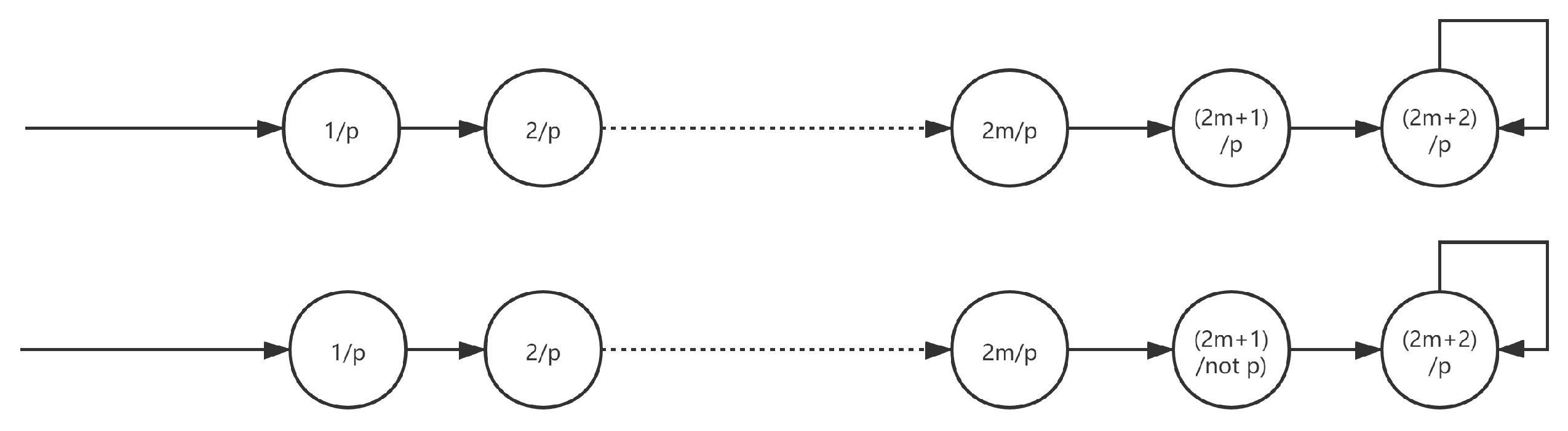
In order to show that
cannot be expressed in BSL, we consider all the CGSs with just one agent and an action. So in these CGSs, each BSL sentence is equivalent with one CTL
state formula. Suppose
is a CTL
state formula with
m◯ temporal operators; then, consider the following two CGSs with just one agent and an action—see
Figure 1. In
,
p holds in all states, and in
,
p does not hold only in state
. Due to unique path starting from the initial state, we can see that
is equivalent with an LTL formula
under each
,
. Then by the following theorem given by Wolper,
Theorem 4.1 ([14]) Given an atomic proposition q, any LTL formula containing m◯ temporal operators has the same truth value on all sequences such as , here and is a LTL formula containing only atomic q. It holds that iff . However, , but . Therefore, cannot be expressed in BSL.
For item (2), we consider the following two formulas:
Here, is a BSL[1G] formula, but it cannot be expressed in ADL; conversely, is a ADL formula, but cannot be expressed in BSL[1G].
Like in [
24], consider two concurrent game structures CGSs with
and
,
, and
, where
,
,
,
, and
,
.
,
.
,
;
;
,
, here
and
. We can show that
, but
. Inspired by the approach in [
24], it can be shown that any ADL
formula cannot distinguish between
and
.
In order to show that cannot be expressed in LDL-SL[1G], we can adopt the same two CGSs like for here. The proof that cannot be expressed in BSL[1G] is similar with that for . □
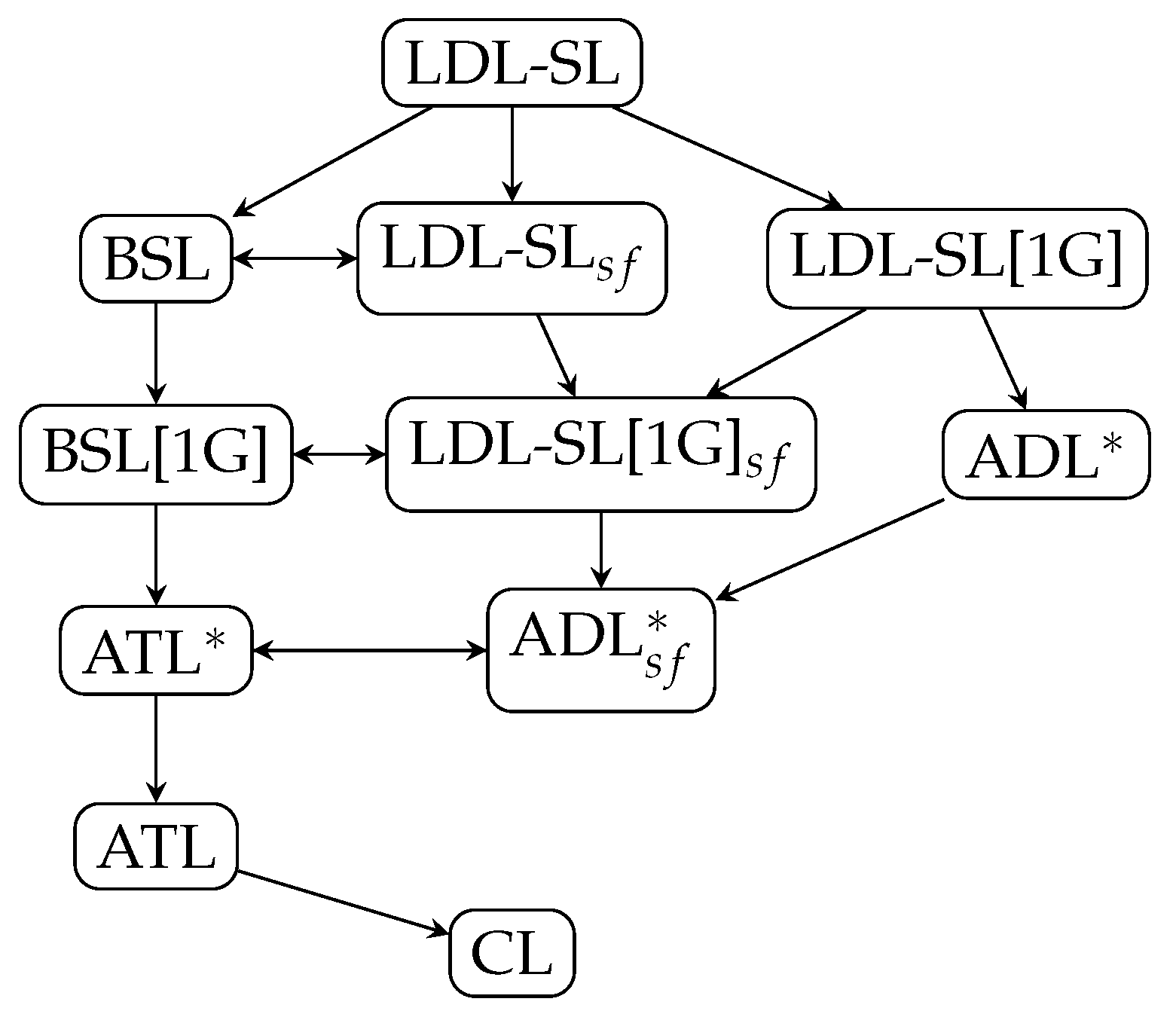
Theorem 5. Inclusion relations among existing strategic logics:
Proof. By Lemma 1, the star-free logic ADL (resp. LDL-SL[1G]) is less expressive than ADL. (resp. LDL-SL[1G]). One-goal fragment LDL-SL[1G] is obviously less expressive than LDL-SL, due to the restriction about the alternations about strategy variables and agent bindings. Furthermore, the ATL-like fragment ADL of LDL-SL is less than one-goal fragment LDL-SL[1G] of LDL-SL, since the coalition operators can be specified by the prefix. □
According to Theorems 3–5, as well as CL ⊊ ATL ⊊ ATL
⊊ BSL[1G] ⊊ SL, we can obtain an expressivity graph; see
Figure 2.
Here, coalition logic (CL) [
29] is a logic, which just has coalition operators without temporal operators.
6. Positive and Negative Properties for LDL-SL
In this section, similar with those results about BSL in [
30], we state negative/positive results about LDL-SL.
Firstly, as in [
30], for LDL-SL, we introduce four basic definitions, including bisimilarity between two CGSs, local isomorphism between two CGSs, state-unwinding, and decision-unwinding.
Definition 12 ([
30])
. CGSs and are called bisimilar, denoted as , if and only if (1) there exists one relation , named as bisimulation relation, and (2) there exists a function , named as bisimulation function, satisfying that:- 1.
;
- 2.
for each state pair , if then
- (a)
;
- (b)
for each , there exists satisfying ;
- (c)
for each , there exists satisfying ;
- (d)
for each decision pair , it holds that .
Here, is the lifting of function f from actions to decisions, satisfying
Obviously, according to the definition of bisimulation relation, the bisimulation of two CGSs can imply the existence of a bismulation between two decisions in them.
Proposition 1. Suppose that two concurrent game structures and are bisimilar with a bisimulation relation ∼ and a bisimulation relation f, for each state pair with , it holds that:
for each , there exists satisfying that ;
for each , there exists satisfying that .
Next, we define the notion of local isomorphism relation between two CGSs.
Definition 13 ([
30])
. Two CGSs and are locally isomorphic, denoted as , if and only if there exists a bisimulation relation between these two CGSs, satisfying that, for each state pair with is bijective between the successors of and those of .
Now we extend the definition of locally isomorphic to tracks, paths, strategies, and assignments as follows.
Definition 14. Let ∼ (resp. f) be a bisimulation relation (resp. function) between two CGSs and .
Two tracks and are locally isomophic, denoted as , if (1) ; (2) , holds.
Two paths and are locally isomophic, denoted as , if , holds.
Two strategies and are locally isomophic, denoted as , if and , there exists with satisfying .
Two assignments and ) are locally isomorphic, denoted as , if (1) and (2) , .
In Definition 14, obviously, if and , then . Further, if , is a complete -total assignment, and , then it holds that and , , where is the -play.
To show whether LDL-SL has tree model properties, consider two unwinding forms of concurrent game structures; one is about state-unwinding, and another is about decision-unwinding.
Definition 15 ([
30])
. Given a CGS , the state-unwinding of is the new CGS , where;
, here ;
there exists a surjective function , satisfying that for each and , (1) ; (2) .
From Definition 15, the state-unwinding of a CGS is a tree, whose direction set is just the set W of states in .
Definition 16 ([
30])
. Given a CGS , the decision-unwinding of is the new CGS , where and ;
there exists a surjective function , satisfying that for each and , (1) ; (2) ; (3) .
From Definition 16, the decision-unwinding of a CGS is a tree, whose direction set is just the set (i.e., ) in .
Theorem 6 ([
30])
. Given a CGS , the following properties hold: and its state-unwinding are locally isomorphic;
and decision-unwinding are bisimilar;
there exists a CGS , satisfying that and are not locally isomorphic.
We note that any CGS just has a unique associated state-unwinding and a unique associated decision-unwinding .
For BSL logic, the following negative properties hold.
Theorem 7 ([
30])
. Four negative properties for BSL:it holds that BSL is not decision-unwinding invariant;
it holds that BSL does not have the bounded tree model property;
it holds that BSL does not have the finite model property;
it holds that BSL is not bisimulation invariant.
These negative results can be extended into LDL-SL.
Theorem 8. Four negative properties for LDL-SL:
it holds that LDL-SL is not decision-unwinding invariant;
it holds that LDL-SL does not have the bounded tree model property;
it holds that LDL-SL does not have the finite model property;
it holds that LDL-SL is not bisimulation invariant.
Proof. By Theorems 2 and 7, these results are the same as those for BSL. □
Similar with those positive properties for BSL [
30], the following properties also hold for LDL-SL.
Theorem 9. Three positive properties for LDL-SL:
it holds that LDL-SL is local isomorphism invariant;
it holds that LDL-SL is state-unwinding invariant;
it holds that LDL-SL has the unbounded tree model property.
Proof. For item 1:
For any LDL-SL formula
, given any two CGSs
and
with
, two states
and
with
, two assignments
, and
with
, here
, we inductively show that
From the bisimulation definition and the inductive hypothesis, the cases of atoms and Boolean connectives are easy. As for the cases of existential quantification
and agent binding
, the proofs are the same as those in [
30]. Here we just show the case of
, here
is a path formula.
iff there exists a
such that
.
That means we should mutually show with state formulas by induction, i.e.,
For the case : iff iff by induction iff .
For the cases of Boolean connectives, these are easy from the definitions and the inductive hypothesis.
For the case
: we need to show the following by induction,
For case : iff and by definition iff and .
For case : iff and by definition iff and by induction.
For case : iff or iff or by induction iff .
For case : iff there exists k, , satisfying that and iff there exists k, , satisfying that and by induction iff .
For case : iff or iff or by induction iff .
Therefore, it implies that LDL-SL is indeed invariant under local isomorphism.
For item 2: by item 1 in Theorem 6, for any CGS , it holds that . So by item 1, each LDL-SL sentence is an invariant for CGS and its state-unwinding .
For item 3: let the LDL-SL sentence be satisfiable. Therefore, there exists one CGS , and by item 2, it holds that . Since is a tree model, this means that LDL-SL has the (unbounded) tree model property. □
8. Conclusions and Future Work
In this paper, we propose logic LDL-SL, an expressive new strategic logic based on linear dynamic logic, which can naturally express -regular properties. This logic is a branching-time extension of SL based on linear-time temporal logic. We show that LDL-SL is more expressive than SL, whose model-checking complexity is non-elementary-complete. Moreover, based on LDL, we define similar fragments of LDL-SL, which are more expressive than corresponding strategic logics based on LTL. However, all these fragments have the same model checking complexity, i.e., are 2EXPTIME-complete. At the same time, we define star-free-like strategic logics, based on star-free regular expressions. We show that these logics have the same expressivity as those corresponding strategic logics based on LTL or CTL.
In short, based on LDL, we propose a new class of strategic logics. These logics have the same model-checking complexities as, but more expressivity than, current mainstream strategic logics. Furthermore, these logics can extend the application areas in multi-agent systems.
However, until now, the upper bounds of LDL-SL and its star-free fragments (ADL
, LDL-SL[1G]
, and LDL-SL
) are not known. In future, we will study the compact bounds of these logics. As in [
43,
44], we will consider concrete implementations about these model checking problems. In addition, here we just consider perfect recall strategies in multi-agent concurrent games with complete information. Next, we will further study these new proposed strategic logics under incomplete information [
45,
46,
47], where the strategies of agents maybe memoryless or perfect recall [
48]. In this paper, we present formal frameworks and show technical results; in the future, we will also present case studies or practical applications to illustrate these theories, such as information security [
49], solving winning strategies [
50], and voting protocol [
51].