You are currently viewing a new version of our website. To view the old version click .
Mathematics
  • Article
  • Open Access

26 November 2021

{0,1}-Brauer Configuration Algebras and Their Applications in Graph Energy Theory
,
,
and
Departamento de Matemáticas, Universidad Nacional de Colombia, Edificio Yu Takeuchi 404, Kra 30 No 45-03, Bogotá 11001000, Colombia
*
Author to whom correspondence should be addressed.
Authors contributed equally to this work.
This article belongs to the Special Issue Algebraic Structures and Graph Theory

Abstract

The energy E ( G ) of a graph G is the sum of the absolute values of its adjacency matrix. In contrast, the trace norm of a digraph Q, which is the sum of the singular values of the corresponding adjacency matrix, is the oriented version of the energy of a graph. It is worth pointing out that one of the main problems in this theory consists of determining appropriated bounds of these types of energies for significant classes of graphs, digraphs and matrices, provided that, in general, finding out their exact values is a problem of great difficulty. In this paper, the trace norm of a { 0 , 1 } -Brauer configuration is introduced. It is estimated and computed by associating suitable families of graphs and posets to Brauer configuration algebras.

1. Introduction

Brauer configuration algebras (BCAs) were introduced recently by Green and Schroll [1]. These algebras are multiserial symmetric algebras whose theory of representation is based on combinatorial data.
Since its introduction, BCAs have been a tool in the research of different fields of mathematics. Its role in algebra, combinatorics, and cryptography is remarkable. For instance, Malić and Schroll [2] associated a Brauer configuration algebra to some dessins d’enfants used to study Riemann surfaces, Cañadas et al. investigated the structure of the keys related to the Advanced Encryption Standard (AES) by using some so-called polygon-mutations in BCAs. On the other hand, BCAs were a helpful tool for Espinosa et al. to describe the number of perfect matchings in some snake graphs. We point out that Schiffler et al. used perfect matchings of snake graphs to provide a formula for the cluster variables associated with appropriated cluster algebras of surface type. In their doctoral dissertation, Espinosa used the notion of the message of a Brauer configuration to obtain the results [3,4]. According to him, each polygon in a Brauer configuration has associated a word. The concatenation of such words constitutes a message after applying a suitable specialization.
Perhaps, the message associated with a Brauer configuration is one of the most helpful tools to obtain applications of BCAs. In this work, we use Brauer configuration messages, some results of the theory of posets (partially ordered sets) and integer partitions to obtain the trace norm of some { 0 , 1 } -Brauer configurations, which are Brauer configurations whose sets of vertices consist only of 0’s and 1’s.
It is worth pointing out that the research on trace norm has its roots in chemistry within the Hückel molecular orbital theory (HMO) [5]. Afterwards, Gutman [6] founded an independent line of investigation in spectral graph theory based on graph energy, which is the sum E ( G ) = λ s p e c t ( M G ) | λ | , where s p e c t ( M G ) is the set of eigenvalues of the adjacency matrix M G of a graph G. The trace norm associated with the adjacency matrix of a digraph or quiver Q denoted | | Q | | * is a generalization of the graph energy. It is also called the Schatten 1-norm, Ky Fan n-norm or nuclear norm. If σ 1 , σ 2 , , σ n are the singular values of the m × n - adjacency matrix M Q , with σ 1 σ 2 σ n then | | Q | | * = i = 1 min { m , n } σ i . Relationships between energy graph and trace norm were investigated first by Nikiforov [7].
One of the main problems in graph energy theory is giving the extremal values of the energy of significant classes of graphs. For instance, Gutman [6] proved that if T n is a tree with n vertices then the following identity holds:
E ( S n ) E ( T n ) E ( A n )
where, S n ( A n ) denotes the star (the Dynkin diagram of type A ) with n vertices.
Graph energy associated with digraphs was investigated first by Kharaghani–Tayfeh–Rezaie [8], afterwards by Agudelo–Nikiforov [9], who found bounds of extremal values of the trace norm for ( 0 , 1 ) -matrices. It is worth noticing that if the adjacency matrix of a graph G is normal, then the graph energy equals the trace norm. In particular, if the adjacency matrix M G of a graph G is symmetric, then E ( G ) = | | M G | | * .

Contributions

In this paper, we introduce the notion of trace norm of a { 0 , 1 } -Brauer configuration. Bounds and explicit values of these trace norms are given for significant classes of graphs induced by this kind of configuration. In particular, the dimension of the associated algebras and their centers are obtained. These results give a relationship between Brauer configuration algebras and graph energy theories with an open problem in the field of integer partitions proposed by Andrews in 1986. Such a problem asks for sets of integer numbers S , T for which P ( S , n ) = P ( T , n + a ) , where P ( X , n ) denote the number of integer partitions of n into parts within the set X with a being a fixed positive integer [10].
As a consequence of their investigations regarding Andrews’s problem, Cañadas et al. [11,12] introduced and enumerated a particular class of integer compositions (i.e., partitions for which the order of the parts matter) of type D n , for which the Andrews’s problem holds if a = 1 . For each n, compositions of type D n constitute a partially ordered set whose number of two-point antichains is given by the integer sequence encoded in the OEIS (On-Line Encyclopedia of Integer Sequences) A344791 [13]. The following identity (2) gives the nth term ( A 344791 ) n of this sequence:
( A 344791 ) n = n i = 1 i 2 j = 0 h i j ( t i 2 t j ) .
where t k denotes the kth triangular number, and
h i j = n + 1 i , if i = 2 j and 1 j n 2 , 0 , if i = n and j = 0 , 1 , otherwise .
This paper uses this sequence to estimate eigenvalues sums of matrices associated with polygons of some { 0 , 1 } -Brauer configurations.
It is worth noting that the relationships introduced in this paper between the theory of Brauer configuration algebras and the graph energy theory do not appear in the current literature devoted to these topics.
This paper is distributed as follows; in Section 2, we recall definitions and notation used throughout the document. In particular, we introduce the notion of trace norm of a { 0 , 1 } -Brauer configuration. In Section 3, we give our main results, we compute and estimate the trace norm and graph energy of some families of graphs defined by Brauer configuration algebras. Concluding remarks are given in Section 4. Examples of trace norm values associated with some Brauer configurations are given in Appendix A.
The following diagram (3) shows how the notions of Brauer configuration and trace norm are related to some of the main results presented in this paper.
Mathematics 09 03042 i001

3. Applications

In this section, we give applications of { 0 , 1 } -Brauer configuration algebras in graph energy. We start by defining some suitable { 0 , 1 } - Brauer configuration algebras, dimensions of these algebras and corresponding centers are given as well. We also compute and estimate eigenvalues and trace norm of their reduced messages M R ( Γ ) .
  • For n 2 fixed, let us consider the {0,1}-Brauer configuration Δ n = ( Δ 0 n , Δ 1 n , μ , O ) , such that:
    Δ 0 n = { 0 , 1 } . Δ 1 n = { D 1 , D 2 , , D n } , for 1 i n , | D i | = ( t i + 2 1 ) 2 . μ ( 0 ) = μ ( 1 ) = 1 .
    The orientation O is defined in such a way that in successor sequences associated with vertices 0 and 1, it holds that D i < D i + 1 , for 1 i n .
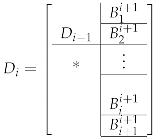
    Polygons D i can be seen as ( t i + 2 1 ) × ( t i + 2 1 ) -matrices over Z 2 or as ( t i + 2 1 ) × 1 -matrices over the vector space P t i + 2 2 of polynomials of degree t i + 2 2 . Its construction goes as follows:
    (a)
    For any i, 1 i n , D i is a symmetric matrix,
    (b)
    D 1 = 1 1 0 1 1 1 1 1 0 1 0 1 1 1 1 1 0 1 1 1 1 1 1 1 1 = t 4 + t 3 + t + 1 t 4 + t 3 + t 2 + 1 t 3 + t 2 + t + 1 t 4 + t 2 + t + 1 t 4 + t 3 + t 2 + t + 1 ,
    (c)
    Mathematics 09 03042 i002
    (d)
    Blocks B j i + k , with k > 1 are defined as follows:
    • Over Z 2 , B j j M ( j + 1 ) × ( j + 1 ) , B j j + s M ( j + 1 ) × ( j + s + 1 ) , 0 s j + 1 ,
    • Over P j + s + 2 , B j i + k = p 1 i + k ( t ) p 2 i + k ( t ) p j + 1 i + k ( t ) ,
      p h i + k ( t ) = l = 0 j h + 1 x l , if 1 h k , l = 0 j h + 1 x l + j = 0 h k 1 x j + k h + 1 , if h > k and 2 k i + 2 , p h m ( t ) , if m > i + 2 .
    Corollary 2.
    If D n = F Q Δ n n / I Δ n n is the Brauer configuration algebra induced by the {0,1}-Brauer configuration Δ n then the following statements hold:
    dim F D n = ( e n d n ) 2 + ( e n 1 ) 2 + ( d n 1 ) , dim F Z ( D n ) = ( t n + 2 ) 2 + n + 3 .
    where
    a n = 1 ( 1 ) n 8 n 4 n 2 + 8 n 3 + 2 n 4 32 = ( A 344791 ) n , b n + 2 = n + 2 i = 1 t i 2 10 , c n + 2 = ( n + 2 ) ( n + 3 ) ( n + 4 ) 3 + 8 , d n = b n + 2 + c n + 2 + n , n 1 , e n = 2 n i = 1 a i + 1 .
    Proof. 
    For n > 1 fixed, consider the following set:
    P n = { x 1 , 1 , x 1 , 2 , x 2 , 1 , x 2 , 2 , x 2 , 3 , , x i , 1 , , x i , i + 1 , , x n , 1 , , x n , n + 1 }
    P n is endowed with a partial order ⊴, which defines the following coverings:
    x j , k x j , k + 1 , 1 j n , 1 k j , x j , k x j + 1 , k + 1 , 1 j < n , 1 k j + 1 , x r , k x r 1 , k + 1 , 1 < r n , 1 k r .
    ( P n , ) defines a matrix M n whose entries m i , j are given by the following identities:
    m i , j = 1 , if x i , r x j , s or x j , s x i , r 0 , otherwise .
    Clearly M n is a ( t n + 1 1 ) × ( t n + 1 1 ) symmetric matrix with M n = D n 1 Δ 1 n , that is, M n is the matrix associated with the polygon D n 1 Δ 1 n . Thus, 1 2 occ ( 0 , D n ) equals the number of two-point antichains in ( P n , ) . Therefore, occ ( 0 , D n ) is twice the nth term of the sequence A344791 (see (2), (9)), and occ ( 1 , D n ) = ( t n + 1 1 ) 2 occ ( 0 , D n ) . Since dim F D n = 2 n + v a l ( 0 ) ( v a l ( 0 ) 1 ) + v a l ( 1 ) ( v a l ( 1 ) 1 ) . The result holds. Since rad 2 D n 0 , then dim F Z ( D n ) = 1 + n + # ( L o o p s Q Δ n ) with # ( L o o p s Q Δ n ) = ( t n + 2 ) 2 + 2 . We are done. □
    Now we are interested in estimating the eigenvalues of M n . Since the polygons D n Δ 1 n can be seen as ( t n + 1 1 ) square symmetric matrices described in the previous proof as D n 1 = M n . We will assume that for each n, the real eigenvalues of a matrix M n are indexed in the following decreasing order:
    μ m a x ( M n ) = μ 1 ( M n ) μ 2 ( M n ) μ t n + 1 1 ( M n ) = μ min ( M n ) .
    The next result, which derives two inequalities for the eigenvalues of Hermitian matrices, was proved by Bollobás and Nikiforov [35].
    Theorem 4
    ([35], Theorem 2). Suppose that 2 k n and let A = ( a i j ) be a Hermitian matrix of size n. For every partition { 1 , 2 , , n } = N 1 N k we have
    μ 1 ( A ) + + μ k ( A ) r = 1 k 1 | N r | i , j N r a i j
    and
    μ k + 1 ( A ) + + μ n ( A ) r = 1 k 1 | N r | i , j N r a i j 1 n i , j 1 , 2 , , n a i j .
    The following result on the eigenvalues of M n can be obtained by applying Theorem 4 to the matrix M n associated with the polygon D n 1 Δ 1 n .
    Corollary 3.
    For n > 1 and k = n . Let M n = ( m i j ) be the matrix associated with the polygon D n 1 Δ 1 n . For partition { 1 , 2 , , t n + 1 1 } = N 1 N n where N i = i ( i + 1 ) 2 , , i ( i + 3 ) 2 . We have
    i = 1 n μ i ( M n ) t n + 1 1
    and
    i = n + 1 t n + 1 1 μ i ( M n ) 2 ( A 344791 ) n t n + 1 1 . ( see ( 2 ) ) .
    Proof. 
    Since N i = i ( i + 1 ) 2 , , i ( i + 3 ) 2 , for each i = { 1 , 2 , , n } then | N i | = i + 1 , besides each set N i can be seen as a subset of the set P n defined in (10) as follows:
    N i = { x i , 1 , , x i , i + 1 } .
    On the other hand, to compute i , j N i a i j , we will use the coverings defined in (11) and the fact that P n is a partial order, so we obtain:
    i , j N i m i j = 2 j = 1 i ( x i , j x i , j + 1 ) + j = 1 i + 1 ( x i , j x i , j ) + 2 j = 1 i 1 ( x i , j x i , j + 2 ) = 2 i + ( i + 1 ) + 2 t i 1 = ( i + 1 ) 2
    Therefore:
    i = 1 n 1 | N i | i , j N i m i j = i + 1 a n d 1 t n + 1 1 i , j { 1 , 2 , , t n + 1 1 } m i , j = 1 t n + 1 1 M n F 2 = 1 t n + 1 1 ( t n + 1 1 ) 2 2 ( A 344791 ) n
    Hence, applying Theorem 4 we obtain (12) and (13). □
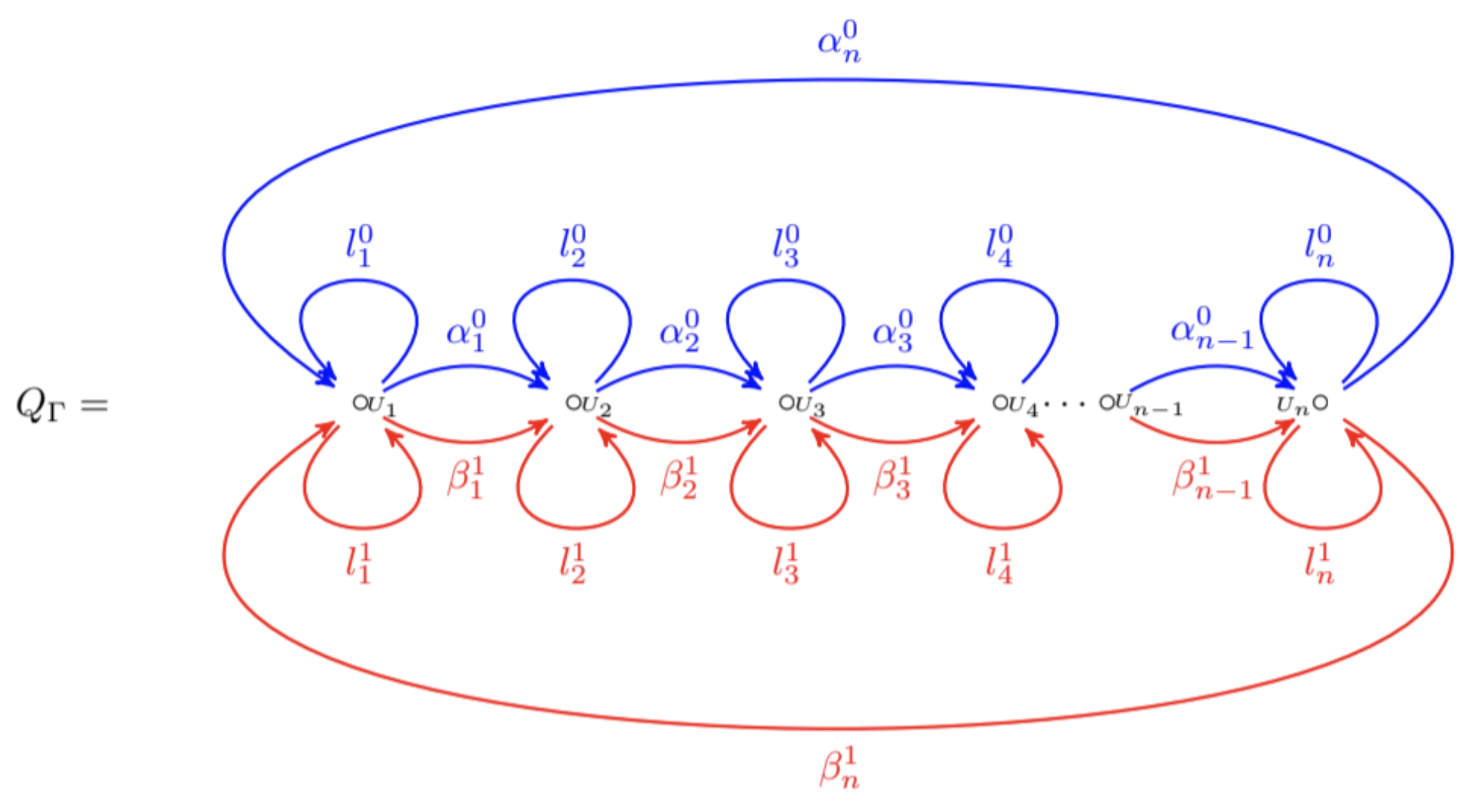
  • For n 1 fixed, let Γ n = { Γ 0 n , Γ 1 n , μ , O } be a {0,1}-Brauer configuration such that:
    Γ 0 n = { 0 , 1 } . Γ 1 n = { U 1 , U 2 , , U n } , for 1 i n , | U i | = 2 2 n . μ ( 0 ) = μ ( 1 ) = 1 .
    The orientation O is defined in such a way that in successor sequences associated with vertices 0 and 1, it holds that U i < U i + 1 .
    Polygons U i can be seen as 2 n × 2 n -matrices over Z 2 using the Kronecker product, denoted by ⊗, as follows:
    U 1 = 1 0 1 1 U 2 = U 1 U 1 U i = U 1 U i 1 .
    Corollary 4.
    For n 1 , if G n = F Q Γ n n / I Γ n n is the Brauer configuration algebra induced by the {0,1}-Brauer configuration Γ n then the following statements hold:
    dim F G n = 2 n + 2 r n ( r n 1 ) + 2 s n ( s n 1 ) dim F Z ( G n ) = 6 , i f n = 1 1 n + r n + s n , i f n 2 .
    where r n and s n are the nth term of the OEIS sequences A 016208 and A 029858 , respectively.
    Proof. 
    Given n N , let P n = { A : A { 1 , 2 , , n } } . For x , y P n , define x < y if x y . In this case the poset ( P n , ) consists of all subsets of { 1 , 2 , , n } ordered by inclusion.
    We associate to each finite poset P n of size n the following 2 n × 2 n -matrix:
    [ M P n ] i j = 1 , i f i , j   are   comparable 0 , i f i , j   are   incomparable
    Under appropriate labeling of poset points P n , the matrix M P n can be viewed using the Kronecker product as follows:
    M P 1 = 1 0 1 1 M P 2 = M P 1 0 M P 1 M P 1 = M P 1 M P 1 M P 3 = M P 2 0 M P 2 M P 2 = M P 1 M P 2 M P n = M P n 1 0 M P n 1 M P n 1 = M P 1 M P n 1
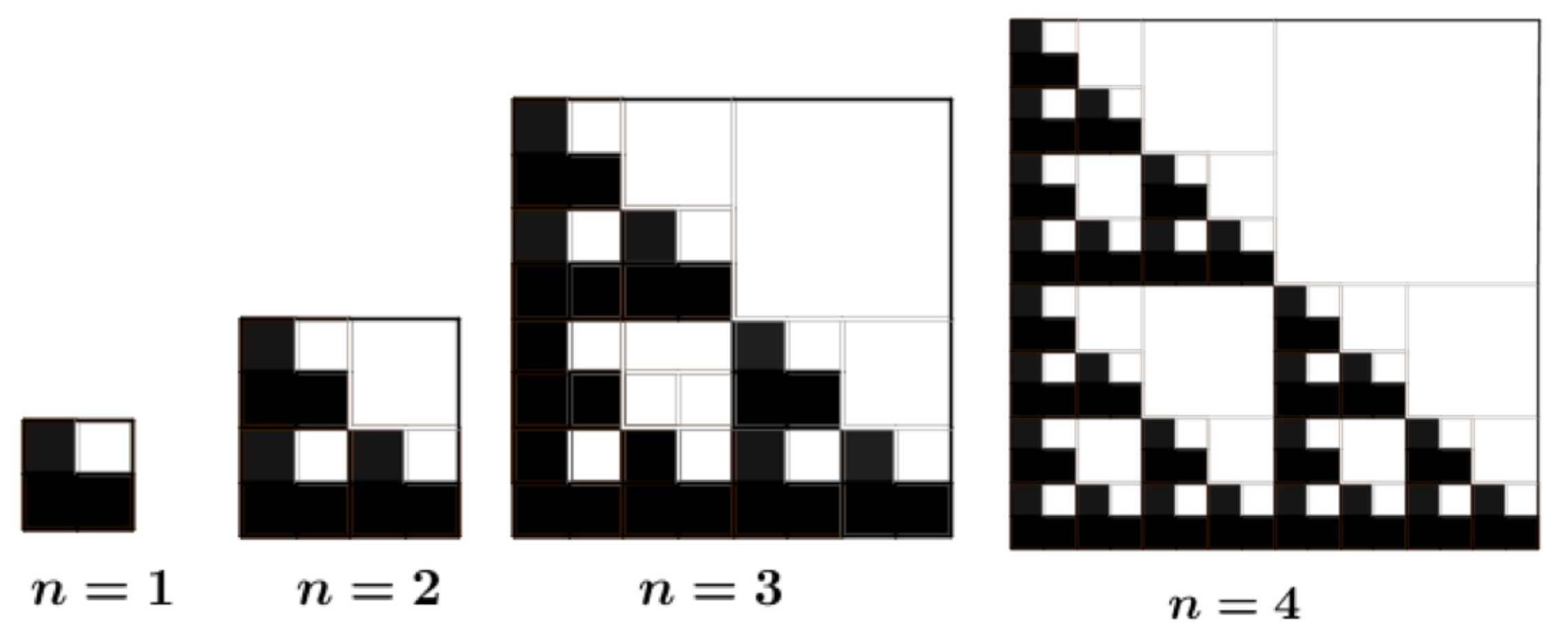
    matrices M P n can be seen as pavements, cells with 1’s are colored black and those with 0’s are colored white. Figure 2 shows examples of these types of matrices.
    Figure 2. Matrices M P n for n = 1 , 2 , 3 and 4.
    M P n is the matrix associated with the polygon U n Γ 1 n , thus occ ( 0 , U n ) can be computed in the following fashion:
    occ ( 0 , U 1 ) = 1 occ ( 0 , U n ) = 3 ( occ ( 0 , U n 1 ) ) + 2 2 n 2
    Therefore occ ( 0 , U n ) = k = 1 n 3 n k 2 2 ( k 1 ) and occ ( 1 , U n ) = 3 n thus the result holds. □
    Now we are interested in computing the trace norm of the {0,1}-Brauer configuration Γ n . For this, we recall the following theorem about the singular values of the Kronecker product:
    Theorem 5
    ([36], Theorem 4.2.15). Let A M m , n and B M p , q have singular value decompositions A = V 1 Σ 1 W 1 * and B = V 2 Σ 2 W 2 * and let r a n k A = r 1 and r a n k B = r 2 . Then A B = ( V 1 V 2 ) ( Σ 1 Σ 2 ) ( W 1 W 2 ) * . The nonzero singular values of A B are the r 1 r 2 positive numbers { σ i ( A ) σ j ( B ) : 1 i r 1 , 1 j r 2 } (including multiplicities).
    The following Lemma 1 is helpful to prove Theorem 6.
    Lemma 1.
    Let A M n ( C ) be a given matrix. If B = A 0 A A M 2 n ( C ) then the singular values of B are ϕ σ i ( A ) and ϕ 1 σ i ( A ) for i = 1 , , n , where ϕ = 1 + 5 2 is the golden ratio.
    Proof. 
    Note that B = A 0 A A = 1 0 1 1 A . The singular values for 1 0 1 1 are ϕ and ϕ 1 , then by Theorem 5 the result holds. □
    Theorem 6.
    For each n 1 , if M R ( Γ n ) = M P n is the matrix associated with the polygon U n Γ 1 n then
    M P n * = 5 n / 2
    Proof. 
    By induction on n. For n = 1 , M P 1 * = ϕ + ϕ 1 = 5 . Let us suppose that M P n * = ( 2 ϕ 1 ) n = 5 n / 2 and let us see that the result is fulfilled for n + 1 , i.e.,
    M P n * = ( 2 ϕ 1 ) n + 1 = 5 n + 1 2
    Since M P n + 1 = M P 1 M P n , then for the Lemma 1 the singular values of M P n + 1 are
    ϕ σ i ( M P n )   a n d ϕ 1 σ i ( M P n )
    for i = 1 , , 2 n . Thus,
    M P n + 1 * = i = 1 2 n + 1 σ i ( M P n + 1 ) = i = 1 2 n ϕ σ i ( M P n ) + i = 1 2 n ϕ 1 σ i ( M P n ) = ϕ M P n * + ϕ 1 M P n * = M P n * ϕ + ϕ 1 = M P n * ( 2 ϕ 1 ) = 2 ϕ 1 n + 1 = 5 n + 1 2
    Corollary 5.
    n = 2 1 M P n * = 1 2 ( 3 ϕ )
    Proof. 
    By Theorem 6, we have:
    n = 2 1 M P n * = n = 2 1 ( 2 ϕ 1 ) n
    which is a convergent geometric series with r = 1 ( 2 ϕ 1 ) < 1 and a = 1 ( 2 ϕ 1 ) 2 , therefore:
    n = 2 1 M P n * = 1 ( 2 ϕ 1 ) 2 1 1 2 ϕ 1 = 1 2 ( 3 ϕ )
  • For n 1 fixed, let Φ n = { Φ 0 n , Φ 1 n , μ , O } be a {0,1}-Brauer configuration such that:
    Φ 0 n = { 0 , 1 } . Φ 1 n = { U 1 , U 2 , , U n } , for 1 i n , | U i | = ( i + 5 ) 2 . μ ( 0 ) = μ ( 1 ) = 1 .
    For i 1 , the word w i associated with the polygon U i has the form w i = w i , 1 w i , 2 w i , δ i , w i , j { 0 , 1 } , o c c ( 0 , U i ) = ( i + 5 ) ( i + 3 ) , o c c ( 1 , U i ) = 2 ( i + 5 ) .
    The orientation O is defined in such a way that for successor sequences associated with vertices 0 and 1, it holds that U i < U i + 1 .
    Polygons U i can be seen as ( i + 5 ) × ( i + 5 ) -matrices over Z 2 . Each row R j is defined by coefficients of a polynomial P j i ( t ) with the form P j i ( t ) = u j , 1 i + u j , 2 i t + + u j , i + 4 i t i + 4 , u j , k i { 0 , 1 } .
    U 1 = 0 1 1 0 0 0 1 0 0 1 0 0 1 0 0 1 0 0 0 1 1 0 1 0 0 0 0 1 0 1 0 0 0 0 1 0 u j , k i = u j , k i 1 , 1 j , k i + 4 , u j , i + 5 i = 0 , 1 j i + 3 , u i + 4 , i + 5 i = 1 , u i + 5 , i + 4 i = 1 , u i + 5 , i + 5 i = 0 .
Theorem 7.
For n 1 , if F n = F Q Φ n n / I Φ n n is the Brauer configuration algebra induced by the {0,1}-Brauer configuration Φ n , α n = 2 ( t n + 5 6 ) , and β n = ε n + 5 ε 5 , with ε i = i ( i + 1 ) ( 2 i + 6 ) 6 for i 1 then the following statements hold:
1.
dim F F n = 2 n + 2 t α n 1 + 2 t β n 1 ,
2.
dim F Z ( F n ) = 1 + n + ε n + 4 2 n ,
3.
Lim n ρ ( M R ( Φ n ) ) = 2 + 2 2 .
Proof. 
The Formulas (1) and (2). for the dimension of the algebra F n and its center Z ( F n ) are consequences of the definition of a Brauer configuration Φ n and Corollary 1.
Let us prove identity 3. Firstly, we note that the characteristic polynomials P n ( λ ) associated with matrices U n can be obtained recursively. They obey the following general rules according to the size of the corresponding matrices.
P 3 ( λ ) = λ 3 2 λ , P 4 ( λ ) = λ 4 4 λ 2 , P n ( λ ) = n j = 1 a j n λ j , if n 5 , a n n = 1 , a n 1 n = 0 , a 1 n = ( 1 ) n + 1 2 , a s n = a s 1 n 1 a s n 2 , for the remaining vertices .
P 3 ( λ ) , P 4 ( λ ) and P 5 ( λ ) are characteristic polynomials of the following matrices T 3 , T 4 , and T 5 , respectively:
T 3 = 0 1 1 1 0 0 1 0 0 , T 4 = 0 1 1 0 1 0 0 1 1 0 0 1 0 0 1 0 , T 5 = 0 1 1 0 0 1 0 0 1 0 1 0 0 1 0 0 1 1 0 1 0 0 0 1 0 .
For any k 6 , P k ( λ ) is the characteristic polynomial of U k 5 Φ n .
We note that for k 5 , | 2 + 2 2 ρ ( M R ( Φ ( 2 k 1 ) ) ) | 1 10 δ k , where
δ k = s k 2 L n ( 2 k 1 ) , if k is odd , s k 2 L n ( 2 k 1 ) , if k is even .
s k = k 4 , if 5 k 7 , 62 k 8 , if k 8 .
Then Lim k | 2 + 2 2 ρ ( M R ( Φ ( 2 k 1 ) ) ) | = 0 . Thus, ρ ( M R ( Φ ( 2 k 1 ) ) ) is a Cauchy subsequence of the sequence ρ ( M R ( Φ n ) , n 5 converging to 2 + 2 2 . □
Corollary 6.
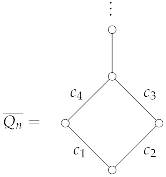
For any n 5 , an n-vertex quiver Q n with underlying graph Q n ¯ of the form:
Mathematics 09 03042 i003
is of wild type.
Proof. 
Since ρ ( Q 5 ¯ ) = 17 + 5 2 , then the result holds as a consequence of Theorem 2, Remark 1, and Theorem 7. □
The following results [37] regarding some relationship between graph operations and energy graph allow finding upper and lower bounds for M R ( Φ n ) * .
Theorem 8
(Theorema 4.18 [37]). Let G, H, and G H be graphs as specified above. Then
G H * G * + H *
Equality is attained if and only if either u is an isolated vertex of G or v is an isolated vertex of H or both.
Corollary 7
(Corollary 4.6 [37]). If { e } is a cut edge of a simple graph G, then G { e } * < G * .
As a consequence of these results, we obtain the following Corollary 8.
Corollary 8.
For n 6 .
2 n 1 < M R ( Φ n 5 ) * < 2 + 2 csc ( π 2 ( n 2 ) ) , i f n 3 0 ( m o d 2 ) , 2 cot ( π 2 ( n 2 ) ) , i f n 3 1 ( m o d 2 ) .
Proof. 
The inequality at right hand holds as a consequence of Theorem 8 taking into account that Q n ¯ is the coalescence [37] between the cycle C 4 and A n 3 , and that:
C 4 * = 4 and || A n 3 || * = 2 csc ( π 2 ( n 2 ) ) 2 , i f n 3 0 ( m o d 2 ) , 2 cot ( π 2 ( n 2 ) ) 2 , i f n 3 1 ( m o d 2 ) .
To prove the left hand inequality, we remove edges c 1 and c 2 in Q n ¯ , obtaining in this fashion a connected tree. Since among all trees of order n, S n attains the minimal energy. The result holds as a consequence of Corollary 7. □

4. Concluding Remarks

{ 0 , 1 } -Brauer configuration algebras give rise to the so-called trace norm of a Brauer configuration. Such Brauer configurations are a source of a great variety of graphs and posets via its reduced message. The structure of the adjacency matrices associated with these graphs allows estimating the corresponding trace norm or graph energy values. In line with the main problem in the graph energy theory, we give explicit formulas for the trace norm of some ( 0 , 1 ) -matrices associated with these families of graphs and posets. On the other hand, bounds for the energy of some families of graphs can be obtained via graph coalescence. It is worth pointing out that some of these graphs underlying quivers of wild type.
An interesting task for the future will be to find the trace norms of a wide variety of Brauer configuration algebras.

Author Contributions

Investigation, N.A.M., A.M.C., P.F.F.E. and I.D.M.G.; writing—review and editing, N.A.M., A.M.C., P.F.F.E. and I.D.M.G. All authors have read and agreed to the published version of the manuscript.

Funding

MinCiencias-Colombia and Seminar Alexander Zavadskij on Representation of Algebras and their Applications, Universidad Nacional de Colombia.

Institutional Review Board Statement

Not applicable.

Data Availability Statement

Not applicable.

Acknowledgments

N. Agudelo and A.M. Cañadas thanks to MinCiencias and Universidad Nacional de Colombia, sede Bogotá (Convocatoria 848- Programa de estancias Postdoctorales 2019) for their support.

Conflicts of Interest

The authors declare no conflict of interest.

Abbreviations

The following abbreviations are used in this manuscript:
dim F Λ Γ (Dimension of a Brauer configuration algebra)
dim F Z ( Λ Γ ) (Dimension of the center of a Brauer configuration algebra)
Γ 0 (Vertices in a Brauer configuration Γ )
M ( Γ ) (Message of a Brauer configuration Γ )
M R ( Γ ) (Reduced message of a Brauer configuration Γ )
occ ( α , V ) (Number of occurrences of a vertex α in a polygon V)
V i ( α ) (Ordered sequence of polygons)
v a l ( α ) (Valency of a vertex α )
w ( U ) (Word associated with a polygon of a Brauer configuration)
M F (Frobenius norm of matrix M)
M * (Trace norm of matrix M)
(Kronecker product)
ϕ (Golden ratio)
μ i ( M ) (Eigenvalues of matrix M)
ρ ( G ) (Spectral radius of a graph G)
σ i ( M ) (Singular values of matrix M)
t j (The jth triangular number)
M P n (Matrix associated with the polygon U n )

Appendix A

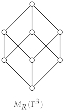
Table A1. This table shows the graphical representation of reduced messages of the Brauer configurations Γ 3 (14), Δ 2 (7) and Φ 1 (19). The dimension of the corresponding Brauer configuration algebras and their centers together with trace norm values.
M R ( Γ ) n dim F Λ dim F Z ( Λ ) M R ( Λ ) *
Mathematics 09 03042 i004396,630
230 5 3 11.1803
Mathematics 09 03042 i00527358105 i = 1 2 μ i ( M 3 ) 5
i = 3 9 μ i ( M 3 ) 4 5
Mathematics 09 03042 i0061294280 4.4721 M R ( Φ 1 ) * 6.8284

References

  1. Green, E.L.; Schroll, S. Brauer configuration algebras: A generalization of Brauer graph algebras. Bull. Sci. Math. 2017, 121, 539–572. [Google Scholar] [CrossRef]
  2. Malić, G.; Schroll, S. Dessins d’enfants and Brauer configuration algebras. In Galois Covers, Grothendieck-Teichmüller Theory and Dessins d’Enfants, Proceedings of the LMS Midlands Regional Meeting & International Workshop, Leicester, UK, 4–7 June 2018; Springer: Cham, Switzerland, 2020; pp. 205–225. [Google Scholar]
  3. Cañadas, A.M.; Gaviria, I.D.M.; Vega, J.D.C. Relationships between the Chicken McNugget Problem, Mutations of Brauer Configuration Algebras and the Advanced Encryption Standard. Mathematics 2021, 9, 1937. [Google Scholar] [CrossRef]
  4. Espinosa, P.F.F. Categorification of Some Integer Sequences and Its Applications. Ph.D. Thesis, Universidad Nacional de Colombia, Bogotá, Colombia, 2021. [Google Scholar]
  5. Coulson, C.A.; O’Leary, B.; Mallion, R.B. Hückel Theory for Organic Chemists; Academic Press: London, UK, 1978. [Google Scholar]
  6. Gutman, I. The energy of a graph. Ber. Math. Statist. Sekt. Forschungszentrum Graz. 1978, 103, 1–22. [Google Scholar]
  7. Nikiforov, V. The energy of graphs and matrices. J. Math. Anal. Appl. 2007, 326, 1472–1475. [Google Scholar] [CrossRef]
  8. Kharaghany, H.; Tayfeh-Rezaie, B. On the energy of (0,1)-matrices. Linear Algebra Appl. 2008, 429, 2046–2051. [Google Scholar] [CrossRef]
  9. Nikiforov, V.; Agudelo, N. On the minimum trace norm/energy of (0,1)-matrices. Linear Algebra Appl. 2017, 526, 42–59. [Google Scholar] [CrossRef]
  10. Andrews, G.E. Unsolved problems; further problems on partitions. Am. Math. Mon. 1987, 94, 437–439. [Google Scholar] [CrossRef]
  11. Cañadas, A.M.; Gaviria, I.D.M.; Giraldo, H. Representation of equipped posets to generate Delannoy numbers. Far East J. Math. Sci. 2017, 8, 1677–1695. [Google Scholar]
  12. Gaviria, I.D.M. The Auslander-Reiten Quiver of Equipped Posets of Finite Growth Representation Type, Some Functorial Descriptions and Its Applications. Ph.D. Thesis, Universidad Nacional de Colombia, Bogotá, Colombia, 2020. [Google Scholar]
  13. Sloane, N.J.A. OEIS. Available online: https://oeis.org/search?q=A344791 (accessed on 30 June 2021).
  14. Gutman, I.; Furtula, B. Graph energies and their applications. Bulletin 2019, 44, 29–45. [Google Scholar]
  15. Dhanalakshmi, A.; Rao, K.S.; Sivakumar, K. Characterization of α-cyclodextrin using adjacency and distance matrix. Indian J. Sci. 2015, 12, 78–83. [Google Scholar]
  16. Giuliani, A.; Filippi, S.; Bertolaso, M. Why network approach can promote a new way of thinking in biology. Front. Genet. 2014, 5, 83. [Google Scholar] [CrossRef]
  17. Yuge, K. Graph representation for configuration properties of crystalline solids. J. Phys. Soc. Jpn. 2017, 86, 024802. [Google Scholar] [CrossRef]
  18. Van Mieghem, P.; Van de Bovenkamp, R. Accuracy criterion for the mean-field approximation in susceptible-infected-susceptible epidemics on networks. Phys. Rev. E 2015, 91, 032812. [Google Scholar]
  19. Angadi, S.A.; Hatture, S.M. Face recognition through symbolic modelling of face graphs and texture. Int. J. Pattern Rec. Artif. Intell. 2019, 33, 1956008. [Google Scholar] [CrossRef]
  20. Bai, Y.; Dong, L.; Hunag, X.; Yang, W.; Liao, M. Hierarchical segmentation of polarimetric SAR image via non-parametric graph entropy. In Proceedings of the 2014 IEEE Geoscience and Remote Sensing Symposium, Quebec City, QC, Canada, 13–18 July 2014. [Google Scholar]
  21. Akram, M.; Naz, S. Energy of pythagorean fuzzy graphs with applications. Mathematics 2018, 6, 136. [Google Scholar] [CrossRef]
  22. Pugliese, A.; Nilchiani, R. Complexity analysis of fractionated spacecraft architectures. Am. Inst. Aeronaut. Astronaut. Space Forum 2017, 33, 2721275. [Google Scholar]
  23. Bolaños, M.E.; Aviyente, S. Quantifying the functional importance of neural assemblies in the brain using Laplacian Hückel graph energy. In Proceedings of the 2011 IEEE International Conference on Acoustics, Speech and Signal Processing, Prague, Czech Republic, 22–27 May 2011; pp. 753–756. [Google Scholar]
  24. Belov-Kanel, A.; Rowen, L.H.; Vishne, U. Full quivers of representations of algebras. Trans. Am. Math. Soc. 2021, 364, 5525–5569. [Google Scholar] [CrossRef]
  25. Assem, I.; Skowronski, A.; Simson, D. Elements of the Representation Theory of Associative Algebras; Cambridge University Press: Cambridge, UK, 2006. [Google Scholar]
  26. Auslander, M.; Reiten, I.; Smalo, S.O. Representation Theory of Artin Algebras; Cambridge University Press: Cambridge, UK, 1995. [Google Scholar]
  27. Simson, D. Linear Representations of Partially Ordered Sets and Vector Space Categories; Gordon and Breach: London, UK, 1992. [Google Scholar]
  28. Gabriel, P. Unzerlegbare Darstellungen I. Manuscripta Math. 1972, 6, 71–103. [Google Scholar] [CrossRef]
  29. Crabbe, A.; Leuschke, G. Wild hypersurfaces. J. Pure Appl. Algebra 2011, 215, 2884–2891. [Google Scholar] [CrossRef][Green Version]
  30. Drozd, J. On tame and wild matrix problems. In Matrix Problems, Kiev.; Istitute of Mathematics of SA of Ukr. SSR: Kyiv, Ukraine, 1977; pp. 104–114. (In Russian) [Google Scholar]
  31. Crawley-Boevey, W. On tame algebras and bocses. Proc. Lond. Math. Soc. 1988, 56, 451–483. [Google Scholar] [CrossRef]
  32. Smith, J.H. Some properties of the spectrum of a graph. In Combinatorial Structures and Their Applications; Guy, R., Hanani, H., Sauer, N., Schönheim, J., Eds.; Gordon and Breach: New York, NY, USA, 1970; pp. 403–406. [Google Scholar]
  33. Sierra, A. The dimension of the center of a Brauer configuration algebra. J. Algebra 2018, 510, 289–318. [Google Scholar] [CrossRef]
  34. Davey, B.A.; Priestley, H.A. Introduction to Lattices and Order, 2nd ed.; Cambridge University Press: Cambridge, UK, 2002. [Google Scholar]
  35. Bollobás, B.; Nikiforov, V. Graphs and Hermitian matrices: Eigenvalue interlacing. Discret. Math. 2004, 289, 119–127. [Google Scholar] [CrossRef][Green Version]
  36. Horn, R.; Johnson, C. Topics in Matrix Analysis; Cambridge University Press: Cambridge, UK, 1991. [Google Scholar]
  37. Li, X.; Shi, Y.; Gutman, I. Graph Energy; Springer: New York, NY, USA, 2012. [Google Scholar]
Publisher’s Note: MDPI stays neutral with regard to jurisdictional claims in published maps and institutional affiliations.

Article Metrics

Citations

Article Access Statistics

Multiple requests from the same IP address are counted as one view.