


Abstract
In this paper, we consider the pedal curves of the mixed-type curves in the Lorentz–Minkowski plane . The pedal curve is always given by the pseudo-orthogonal projection of a fixed point on the tangent lines of the base curve. For a mixed-type curve, the pedal curve at lightlike points cannot always be defined. Herein, we investigate when the pedal curves of a mixed-type curve can be defined and define the pedal curves of the mixed-type curve using the lightcone frame. Then, we consider when the pedal curves of the mixed-type curve have singular points. We also investigate the relationship of the type of the points on the pedal curves and the type of the points on the base curve.
1. Introduction
As an important kind of submanifolds, curves in different spaces have attracted wide attention from mathematicians. Studies have focused on investigating not only regular curves, but also singular curves, and have made great achievements (see [1,2,3,4,5,6,7,8,9,10,11]). Because Lorentz space is strongly connected to the theory of general relativity, the investigation of submanifolds in Lorentz space and its subspaces has great significance. Scholars have shown interest in curves in Lorentz space and its subspace and have studied evolutes, involutes, parallels and some other associated curves in these spaces. There have been several relevant investigations in this area (see [3,4,5,6,7,12,13,14,15]). Having the appearance of a negative index, there are three types of vectors in Lorentz space. For a curve, the type of tangent vector at each point determines the type of point. As for non-lightlike curves in Lorentz space, we always select their arc-length parameters and adopt the Frenet–Serret frame to investigate them (see [8,16]).
In fact, curves in Lorentz space do not always consist of a single type of points, but rather can involve all three types of points. This is what we mean by mixed-type curves. As a more familiar condition, the investigation of mixed-type curves has important significance. Because the curvature at lightlike points cannot be defined, the classical Frenet–Serret frame does not work. Due to the lack of necessary tools for its research, almost no research has been conducted on this subject. In 2018, S. Izumiya, M. C. Romero Fuster, and M. Takahashi presented the lightcone frame and established the fundamental theory of mixed-type curves in in [17]. As an application of the theory, they studied the evolutes of regular mixed-type curves. In [18], T. Liu and the second author of this paper gave the lightcone frame in Lorentz 3-space and considered mixed-type curves in this space. Currently, the investigation of mixed-type curves in has not been completed. As the depth of their work, the -cusp mixed-type curves in were investigated, as well as the evolutes of the -cusp mixed-type curves, as presented by us in [19]. Later, we also considered the evolutoids of mixed-type curves in .
The pedal curves is a kind of significant curves due to their geometric properties. In the Euclidean space , the pedal curve is always defined by the locus of the foot of the perpendicular from the given point to the tangent to the base curve. M. Boek and G. Foltn considered the relationship of singular points of regular curves’ pedal curves and the inflections of the base curves in in [20]. Later, in [21], Y. Li and the second author of this paper studied the pedal curve of the given curves with singular points in . O. Oulcan Tuncer et al. described the relationship of the pedal curves and contrapedal curves in in [22]. However, on the topic of pedal curves of mixed-type curves in , which is an interesting and worthy subject, there have not been relevant investigations.
Our purpose in this paper was to solve the problems related to the pedal curves of mixed-type curves in . In Section 2, we review some essential knowledge about and introduce the lightcone frame. Then, we define the pedal curves of mixed-type curves and investigate their properties in Section 3. We consider when the pedal curves of mixed-type curves have singular points and investigate the relationship of the types of points of the pedal curves and the base curves. Finally, in Section 4, for the purpose of showing the characteristics of the pedal curves of mixed-type curves, we present two examples.
If not specifically mentioned, all maps and manifolds in this paper are infinitely differentiable.
2. Preliminaries
Here, we introduce some essential knowledge about the Lorentz–Minkowski plane for the sake of convenience.
Let be a vector space of dimension 2. If is endowed with the metric which is induced by the pseudo-scalar product
where , , and , then we call the Lorentz–Minkowski plane and denote it by .
For a non-zero vector , there are three types of vectors in . When is positive, negative and vanishing, it is called spacelike, timelike or lightlike, respectively. A non-lightlike vector refers to a vector that is spacelike or timelike.
For a vector , if there exists a vector , which satisfies , we say is pseudo-perpendicular to .
We define the norm of by
and the pseudo-orthogonal complement of is given by . By definition, and are pseudo-orthogonal to each other, and
It is obvious that if and only if is lightlike, and is timelike (resp. spacelike) if and only if is spacelike (resp. timelike).
Let be a regular curve. Denote . Then we say is a spacelike (resp. timelike, lightlike) curve if is positive (resp. negative, vanishing) for any . Furthermore, the type of a point (or, t) is determined by the type of . For more details, see [17].
Moreover, we say a curve is non-lightlike if it is a spacelike or timelike curve and a point is non-lightlike if it is a spacelike or timelike point. If contains three types of points simultaneously, then it is exactly a mixed-type curve, which is the main research object in this paper.
Set and . These are linearly independent lightlike vectors. The pair {, } is called a lightcone frame along in , which was introduced by S. Izumiya, M. C. Romero Fuster, and M. Takahashi in [17].
Let be a regular mixed-type curve. There exists a corresponding smooth map , which satisfies
If Equation (1) is established, is called the lightlike tangential data of . The pseudo-orthogonal complement of can be expressed by
Since
the type of can be determined by . For more details about the lightcone frame and the lightlike tangential data, see [17].
Definition 1.
Let be a regular mixed-type curve. We call a point an inflection if .
Remark 1.
When is a non-lightlike curve, the curvature at is . If , then is called an inflection of . This satisfies Definition 1.
Let be a regular mixed-type curve with the lightlike tangential date . Then, is an inflection of if and only if
Remark 2.
Let be a regular mixed-type curve with the lightlike tangential date . When , but , i.e., , but , is called an ordinary inflection. In this paper, we only consider ordinary inflections of the mixed-type curves, and we call them inflections for short.
3. Pedal Curves of the Mixed-Type Curves in
The pedal curves of the regular curves in are widely studied. As for the regular curves in , the pedal curves of them are defined similarly. They are always given by the pseudo-orthogonal projection of a fixed point on the tangent lines of the base curves. Therefore, the definitions of pedal curves of the regular non-lightlike curves are given as follows.
Definition 2.
Let be a regular non-lightlike curve and be a point in . Then, the pedal curve of the base curve is given by
It is obvious that the pedal curve of a non-lightlike curve with the lightcone frame and the lightlike tangential data is
Let be a regular mixed-type curve. Since when is a lightlike point, it is probably not always possible to define a pedal curve of a mixed type curve. In fact, if coincides with the lightlike point or is on the tangent line of the lightlike point, we can define the pedal curve of with the lightcone frame and the lightlike tangential data by Formula (3).
When is a non-lightlike point, satisfies Formula (3), obviously.
When is a lightlike point, , and we suppose that coincides with the lightlike point or is on the tangent line of the lightlike point. In these cases, Formula (3) also holds, and in the following, we discuss the specific forms of .
If is non-lightlike, by direct calculation,
If is a lightlike point. Firstly, suppose that and , then coincides with the lightlike point or is on the tangent line of the lightlike point is exactly . In this case, we define as . Then, we can find that
If is not an inflection, , then
If is an inflection, we have
and
Since , we can find that . Continue to calculate and we can get
Therefore, when , is always equal to 0.
By the above calculation, we can define as . To sum up, if coincides with , then , is given by
If is on the tangent line of , then , is given by
As for the condition of and , in this case coincides with the lightlike point or is on the tangent line of the lightlike point refers to , similarly we can find that:
If coincides with , then is given by
If is on the tangent line of , then is given by
Remark 3.
Let be a regular mixed-type curve and be a point in . is the pedal curve of . Suppose that is a lightlike point, if is neither coincident with nor on the tangent line of , then when t approaches to , goes to infinity. Since one of and is equal to 0, asymptotic with lightlike line of or . Specifically, when , since asymptotic with lightlike line along the positive or negative direction of Similarly, when , asymptotic with lightlike line along the positive or negative direction of We can see the relevant examples in Section 4.
Considering when the pedal curves of the regular mixed-type curves have singular points, we have following conclusions.
Theorem 1.
Let be a regular mixed-type curve and be a point in . is the pedal curve of ρ. Then
- (1)
- if is a non-lightlike point, then is a singular point if and only if one of the following conditions occur:
- (i)
- is an inflection but is not coincides with ;
- (ii)
- is not an inflection, but coincides with ;
- (iii)
- is an inflection and coincides with .
- (2)
- if is a lightlike point, and coincides with or is on the tangent line of , then is regular.
Proof.
As the pedal curve of the mixed-type curve is given by the Formula (3), by direct calculation, we can get -4.6cm0cm
When is a non-lightlike point, if and only if
and
Specifically,
but if and only if is an inflection, but is not coincides with ;
but if and only if is not an inflection, but coincides with ;
and if and only if is an inflection and coincides with .
Following that, we consider the condition when is a lightlike point. First, we suppose that , . Since , we cannot calculate . When , we have known that is asymptotic with lightlike line along the positive or negative direction of So we consider the condition that .
First we suppose that is not an inflection of , then .
Since , we can find that
As , and , we can obtain . Therefore, is a regular point.
Afterwards, we suppose that is an inflection of , then , but .
Since , we can obtain
As , and , we can get . Therefore,
is a regular point.
When , and , we can get is a regular point similarly. □
Let be a regular mixed-type curve and be a point in . is the pedal curve of . If we denote , , ⋯, . Then, we have the following proposition about types of the singular points of .
Proposition 1.
Let be a regular mixed-type curve and be a point in . is the pedal curve of ρ. Suppose that exists. Then, is an -cusp if and only if
- (1)
- ,
- (2)
- .
We have given the definition of -cusp in [19]. According to the conclusion in [19], we can obtain Proposition 1 directly.
Proposition 2.
Let be a regular mixed-type curve and be a point in . is the pedal curve of ρ. Suppose that is on the tangent line of .
- (1)
- If is a non-lightlike point, then coincides with ;
- (2)
- If is a lightlike point, then is not coincident with .
Proof.
Since the pedal curve of the mixed-type curve is given by Formula (3).
Suppose that is on the tangent line of , then we have and are linearly dependent.
If is a non-lightlike point, then there exists , such that
We can obtain
Therefore, coincides with .
If is a lightlike point, we have know that when and ,
when and ,
Thus, is not coincident with . □
Then, we investigate the type of points of the pedal curve of the mixed-type curve in and the following proposition can be obtained.
Proposition 3.
Let be a regular mixed-type curve and be a point in . is the pedal curve of ρ. If is regular, then
- (1)
- When is non-lightlike, is a spacelike point if and only if .
- (2)
- When is non-lightlike, is a timelike point if and only if .
- (3)
- When is non-lightlike, is a lightlike point if and only if .
- (4)
- When is lightlike, , and ,
- (i)
- suppose that is not the inflection of ρ,
- (a)
- is a lightlike point if and only if coincides with ;
- (b)
- is a non-lightlike point if and only if is on the tangent line of . Moreover, is spacelike (or, timelike) if and only if (or, ).
- (ii)
- suppose that is an inflection of ρ, is always lightlike.
- (5)
- When is lightlike, , and ,
- (i)
- suppose that is not the inflection of ρ,
- (a)
- is a lightlike point if and only if coincides with ;
- (b)
- is a non-lightlike point if and only if is on the tangent line of . Moreover, is spacelike (or, timelike) if and only if (or, ).
- (ii)
- suppose that is an inflection of ρ, is always lightlike.
Proof.
Since is given by Formula (4), we can calculate that
When is a non-lighlike point, the type of can be easily obtained.
When is a lighlike point, by the proof of Theorem 1, we can get the conclusion. □
4. Examples
We would like to present the characteristics of the pedal curve of the regular mixed-type curve, especially at the lightlike point of the base curve, by the following three examples.
Example 1.
Let
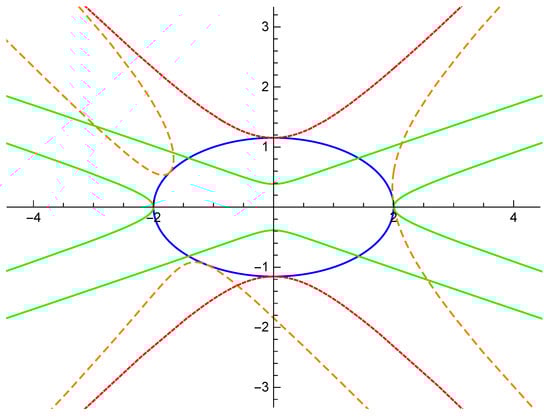
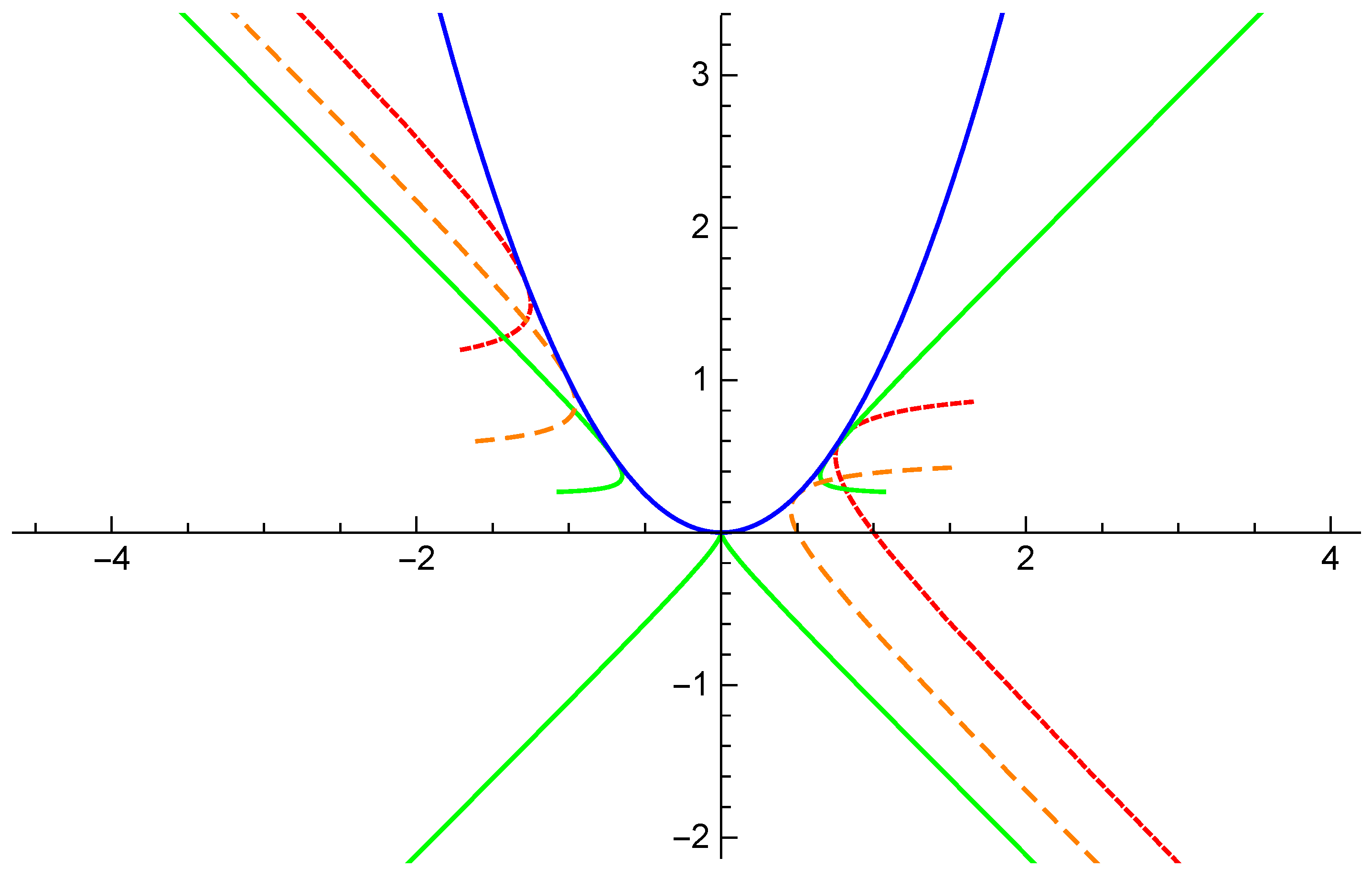
When , is a lightlike point. See the blue curve in Figure 1.
Figure 1.
The mixed-type curve (blue) and the pedal curves of it.
If , then , the pedal curve of is
In this case, is asymptotic with lightlike line along the positive and negative direction of . See the green curve in Figure 1.
If , then coincides with , the pedal curve of is
In this case, is a lightlike point. See the orange dashed curve in Figure 1.
If , then is on the tangent line of , the pedal curve of is
In this case, is a timelike point. See the red dashed curve in Figure 1.
Example 2.
Let
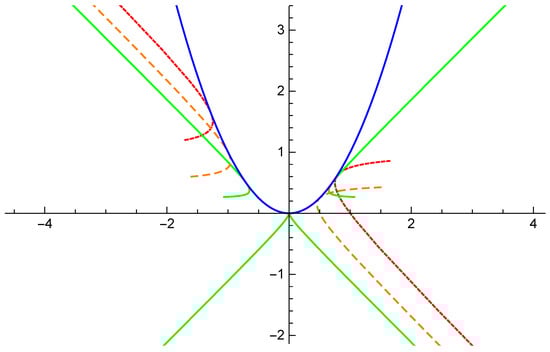
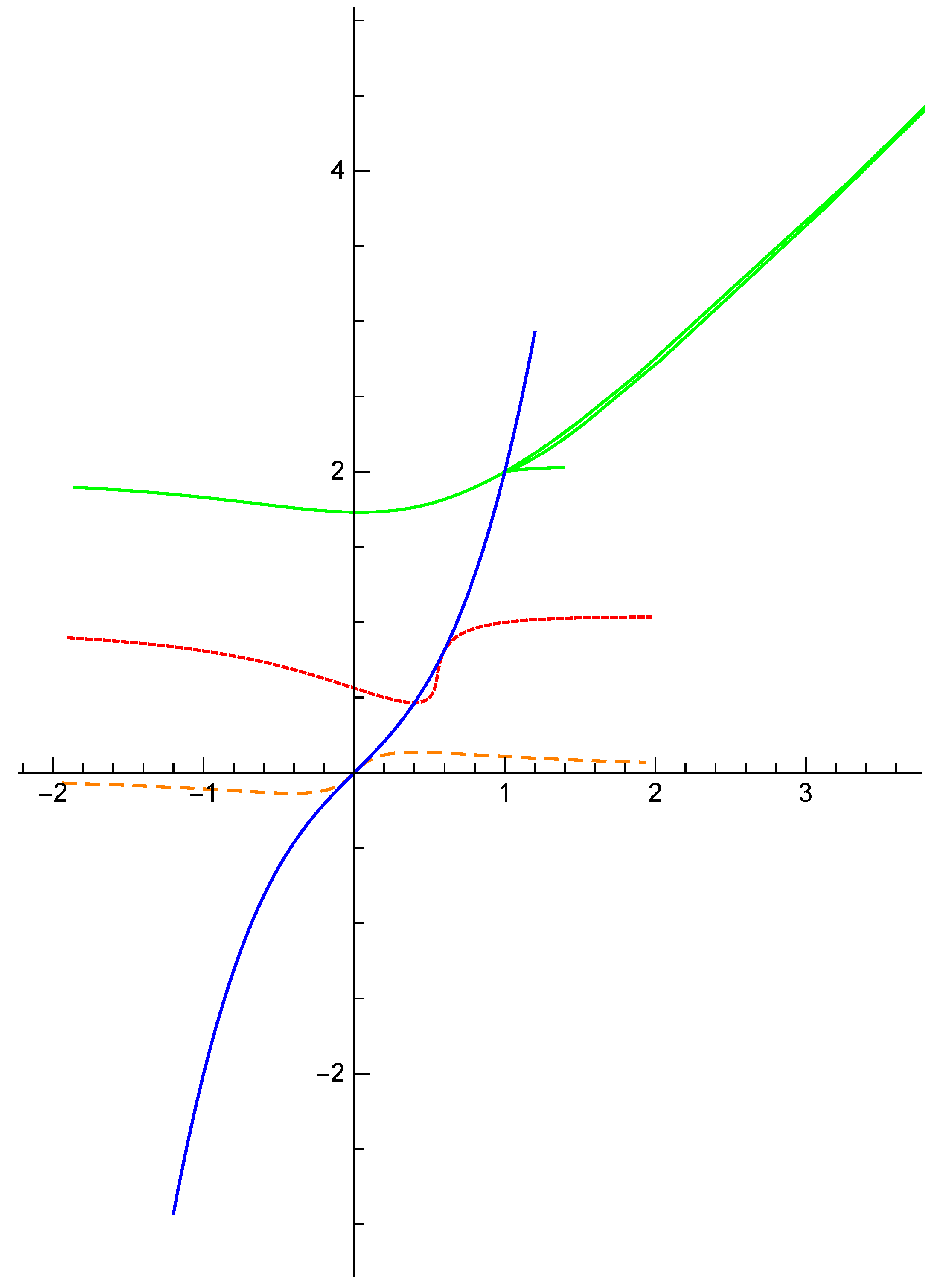
When , is a lightlike point. See the blue curve in Figure 2.
Figure 2.
The mixed-type curve (blue) and the pedal curves of it.
If , then , the pedal curve of is
In this case, is asymptotic with lightlike line along the positive and negative direction of . See the green curve in Figure 2.
If , then coincides with , the pedal curve of is
In this case, is a lightlike point. See the orange dashed curve in Figure 2.
If , then is on the tangent line of , the pedal curve of is
In this case, is a spacelike point. See the red dashed curve in Figure 2.
Example 3.
Let
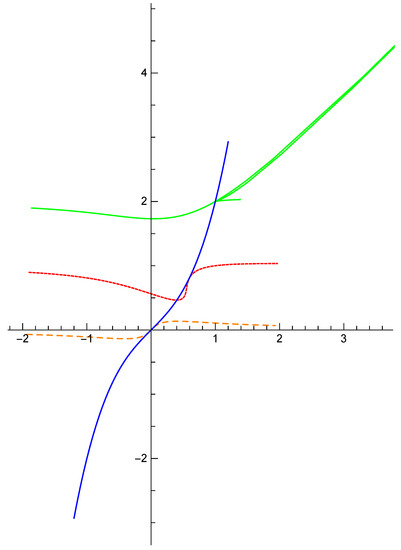
When , is a lightlike point and it is also an inflection. See the blue curve in Figure 3.
Figure 3.
The mixed-type curve (blue) and the pedal curves of it.
If , then , the pedal curve of is
In this case is asymptotic with lightlike line along the positive and negative direction of . See the green curve in Figure 3.
If , then coincides with , the pedal curve of is
In this case, is a lightlike point. See the orange dashed curve in Figure 3.
If , then is on the tangent line of , the pedal curve of is
In this case is a lightlike point. See the red dashed curve in Figure 3.
Author Contributions
Writing—original draft preparation, X.Z.; writing—review and editing, D.P.; funding acquisition, D.P. All authors have read and agreed to the published version of the manuscript.
Funding
This research was funded by the National Natural Science Foundation of China grant number 11671070.
Institutional Review Board Statement
Not applicable.
Informed Consent Statement
Not applicable.
Data Availability Statement
Not applicable.
Acknowledgments
The authors would like to thank the referees for helpful comments to improve the original paper.
Conflicts of Interest
The authors declare no conflict of interest.
References
- Bruce, J.W.; Giblin, P.J. Curves and Singularities: A Geometrical Introduction to Singularity Theory; Cambridge University Press: Cambridge, UK, 1992. [Google Scholar]
- Huang, J.; Pei, D. Singular Special Curves in 3-Space Forms. Mathematics 2020, 8, 846. [Google Scholar] [CrossRef]
- Duggal, K.L.; Jin, D.H. Null Curves and Hypersurfaces of Semi-Riemannian Manifolds; World Scientific: Singapore, 2007. [Google Scholar]
- Sun, J. Singularity properties of null killing magnetic curves in Minkowski 3-space. Int. J. Geom. Methods Mod. Phys. 2020, 17, 2050141. [Google Scholar] [CrossRef]
- Li, Y.; Wang, Z. Lightlike tangent developables in de Sitter 3-space. J. Geom. Phys. 2021, 164, 104188. [Google Scholar] [CrossRef]
- Ersoy, S.; Tosun, M. Timelike Bertrand curves in semi-Euclidean space. Int. J. Math. Stat. 2013, 14, 78–89. [Google Scholar]
- Wang, Z.; He, M.; Jiang, Y. Dual surfaces along spacelike curves in light cone and their singularity. Houst. J. Math. 2019, 45, 1119–1151. [Google Scholar]
- Saloom, A.; Tari, F. Curves in the Minkowski plane and their contact with pseudo-circles. Geom. Dedicata 2012, 159, 109–124. [Google Scholar] [CrossRef]
- Boyacıoǧlu Kalkan, Ö. On normal curves and their characterizations in Lorentzian n-space. AIMS Math. 2018, 162, 42–53. [Google Scholar] [CrossRef]
- Yıldız, Ö.G.; Tosun, M.; Karakuş, S.Ö. A note on inextensible flows of curves in En. Int. Electron. J. Geom. 2020, 5, 3510–3524. [Google Scholar]
- Wang, Y.; Chang, Y. Mannheim curves and spherical curves. Int. J. Geom. Methods Mod. Phys. 2020, 17, 2050101. [Google Scholar] [CrossRef]
- Sun, J.; Jiang, X.; Ji, F. Geometrical Properties of the Pseudonull Hypersurfaces in Semi-Euclidean 4-Space. Mathematics 2021, 9, 1274. [Google Scholar] [CrossRef]
- Qian, J.; Yin, P.; Fu, X.; Wang, H. Representations of Rectifying Isotropic Curves and Their Centrodes in Complex 3-Space. Mathematics 2021, 9, 1451. [Google Scholar] [CrossRef]
- Yıldız, Ö.G.; Tosun, M. A note on evolution of curves in the Minkowski spaces. Adv. Appl. Clifford Algebr. 2017, 27, 2873–2884. [Google Scholar] [CrossRef]
- Li, Y.; Wang, Z.; Zhao, T. Slant helix of order n and sequence of Darboux developables of principal-directional curves. Math. Methods Appl. Sci. 2020, 43, 9888–9903. [Google Scholar] [CrossRef]
- Izumiya, S.; Takeuchi, N. Evolutoids and pedaloids of plane curves. Note Mat. 2019, 39, 13–23. [Google Scholar]
- Izumiya, S.; Romero Fuster, M.C.; Takahashi, M. Evolutes of curves in the Lorentz-Minkowski plane. Adv. Stud. Pure Math. 2018, 78, 313–330. [Google Scholar]
- Liu, T.; Pei, D. Mixed-type curves and the lightcone frame in Minkowski 3-space. Int. J. Geom. Methods Mod. Phys. 2020, 17, 2050088. [Google Scholar] [CrossRef]
- Zhao, X.; Liu, T.; Pei, D.; Zhang, C. Evolutes of the (n,m)-cusp mixed-type curves in the Lorentz-Minkowshi plane. Int. J. Geom. Methods Mod. Phys. 2021, 18, 2150001. [Google Scholar] [CrossRef]
- Božek, M.; Foltán, G. On singularities of arbitrary order of pedal curves. Proc. Symp. Comput. Geom. SCG 2012, 21, 22–27. [Google Scholar]
- Li, Y.; Pei, D. Pedal curves of frontals in the Euclidean plane. Math. Methods Appl. Sci. 2018, 41, 1988–1997. [Google Scholar] [CrossRef]
- Oğulcan Tuncer, O.; Ceyhan, H.; Gök, İ.; Nejat Ekmekci, F. Notes on pedal and contrapedal curves of fronts in the Euclidean plane. Math. Methods Appl. Sci. 2018, 41, 5096–5111. [Google Scholar] [CrossRef]
Publisher’s Note: MDPI stays neutral with regard to jurisdictional claims in published maps and institutional affiliations. |
© 2021 by the authors. Licensee MDPI, Basel, Switzerland. This article is an open access article distributed under the terms and conditions of the Creative Commons Attribution (CC BY) license (https://creativecommons.org/licenses/by/4.0/).