Abstract
E. Yi recently introduced the fractional edge dimension of graphs. It has many applications in different areas of computer science such as in sensor networking, intelligent systems, optimization, and robot navigation. In this paper, the fractional edge dimension of vertex and edge transitive graphs is calculated. The class of hypercube graph with an odd number of vertices n is discussed. We propose the combinatorial criterion for the calculation of the fractional edge dimension of a graph, and hence applied it to calculate the fractional edge dimension of the friendship graph and the class of circulant graph .
1. Introduction and Preliminary Results
Let be a finite simple connected graph and . The denotes the length of shortest path between u and v. If , then . For , the resolving neighborhood of u and v, denoted by , is given by the collection of all , which are not equidistant from u and v. The set is a resolving set of G if for all distinct pairs of vertices in . The minimum cardinality of a resolving set is called a metric dimension, , of G. The metric dimension of a graph, mostly referred to as the conventional metric dimension of a graph, was introduced by Slater [1,2] and Harary [3] independently. This concept has been comprehensively studied by many scholars since its appearance due to its wide range of applications in science, social science, and technology. For more details on metric dimension and its applications, we refer readers to [4,5,6].
For and , is the distance between the edge e and vertex u. Let denote the collection of all pairs of distinct edges in G. A vertex is said to resolve a pair of distinct edges in G if . An edge resolving neighborhood of a pair of edges is defined as . A non-empty set S of vertices in a connected non-trivial simple graph G is an edge generator/edge resolving set for G, if for any pair of edges . The edge metric dimension of G is the least cardinality of the edge metric generator for G. This concept was introduced by Kelenc et al. [7] two years ago. The conventional resolving set is the set of vertices that uniquely identifies all the vertices, whereas the edge resolving set is the set of vertices that uniquely identifies all the edges of a graph. This topic is an active field of research for graph theorists, and many research articles have been published on this subject. For details, see [8,9].
In recent years, the fractionalization of various parameters of graphs has been developing rapidly. It is studied under the name of fractional graph theory. For details on fractional graph theory, see [10]. The problem of finding the metric dimension of a graph has been suggested as an integer programming problem by Chartrand and Lesniak [11]. The integer programming construction for the metric dimension of a graph is described as: Minimize subject to , where and is the column vector, all of whose entries are 1. Afterward, Currie and Oellermann [5] fractionalized this concept. The fractional metric dimension of G is the optimal solution for the integer programming relaxation of the integer programming problem after replacing with . Fehr et al. [12] asserted the equivalent formulation of the fractional metric dimension of a graph G, supposing and , where denotes distinct pairs of vertices in G. Let be a matrix with
where , . The resolving graph of G is a bipartite graph with a bipartition , where is connected to if resolves it. Arumugam and Matthew [13,14] formulated the fractional metric dimension of a graph in terms of resolving functions. A function is called the minimal resolving function of G if for any distinct pair of vertices in . , where , is called a fractional metric dimension of G, denoted by . The following proposition follows from the definition of the fractional metric dimension of a graph.
Proposition 1.
For any connected non-trivial graph, .
In his recent article [15], E. Yi introduced the notion of “Fractional edge dimension of graphs” as being analogous to the fractional metric dimension of graphs. A function is called an edge resolving function (ERF) of G if for any two distinct edges , where . An edge resolving function g of G is the minimal edge resolving function (MERF) if any function , such that and for at least one is not an edge resolving function of G. The fractional edge dimension of G is defined as . In the same article [15], E. Yi characterized all graphs G for which . He also calculated the fractional edge dimensions of trees, cycle, Petersen, wheel, complete k-partite, and grid graphs. Some of these results are given below.
Theorem 1
([15]). For any connected graph G of order n, if and only if , a path graph of order n.
Theorem 2
([15]).
- If is a cycle graph of order n, then
- For petersen graph ;
- For . The denotes the cartesian product of two Path graphs of order s and t, respectively.
Yi also gave bounds for the fractional edge dimension of a graph.
Observation 1
([15]).
.
Proposition 2
([15]). If G is a connected graph of order , then .
This paper aims to further explore the fractional edge dimension of graphs. The framework of this article is as follows: Section 1 is reserved for introduction and preliminaries. In Section 2, the upper bound of the fractional edge dimension is given, which is better than the upper bound stated in Proposition 2. The fractional edge dimension of vertex and edge transitive graphs is calculated. It is proved that the fractional edge dimension of vertex and edge transitive graphs is , where is the minimum cardinality of some edge resolving neighborhood in G. The method used here is the conventional method (using definition). In Section 3, a combinatorial criterion for the calculation of the fractional edge dimension of a graph is proposed. This criterion can be applied to any simple connected graph. Using this criterion, it is proved that the fractional edge dimension of the friendship graph is k. The fractional edge dimension of is calculated and is equal to if , and if otherwise. In Section 4, a summary of the work performed is given. We also cite some future research perspectives in this section.
2. Fractional Edge Dimension of Vertex and Edge Transitive Graphs
In this section, we give an improved upper bound of the fractional edge dimension of a graph. The fractional edge dimensions of class of vertex and edge transitive graphs have been computed. As an application of this result, the fractional edge dimension of a complete graph is calculated. Lastly, we calculate the fractional edge dimension of hypercubes with an odd number of vertices n.
Lemma 1.
If G is a connected graph, then for all pairs of distinct edges .
Proof.
Let be a distinct pair of edges such that . Clearly, either shares a vertex or not.
- Case 1
- : If shares a vertex (say) , then .
- Case 2
- : If does not share a vertex, then and , . This shows that resolves the pair of edges as . Moreover, . Similarly, resolves the pair of edges as well. Thus, , which completes the proof.
□
Lemma 2.
If G is a graph with , then .
Proof.
Define by . Then for any pair of distinct edges ,
. It shows that g is an edge resolving function of G. Thus, . □
Remark 1.
Clearly the upper bound of the fractional edge dimension of a graph given in Lemma 2 is better than the upper bound given by E.Yi in Proposition 2.
Let G be a graph with vertex set . The automorphism group is the set of all permutations of that preserve the adjacency and non-adjacency of vertices in a graph. A graph G is called vertex transitive if for any two distinct vertices there exists an automorphism such that . Similarly, G is edge transitive if for every pair of edges , there exists an automorphism such that .The following theorem is the main result of this section, followed by the fractional edge dimension of the complete graph.
Theorem 3.
Let G be a simple connected graph. If G is a vertex and edge transitive graph, then the fractional edge metric dimension of G is .
Proof.
Since (say) is the minimum cardinality of some edge resolving neighborhood, there must therefore exist a distinct pair of edges in such that . Supposing , for any automorphism of G, . Let be an edge resolving function with . Then , which shows that . Since G is vertex and edge transitive, then , which implies . Hence, by using Lemma 2. □
E. Yi in [15] calculated the fractional edge dimension of a complete graph. Since a complete graph is vertex and edge transitive, the fractional edge dimension of a complete graph can be calculated using Theorem 3 as well. Therefore, we give its alternative proof in the next corollary.
Corollary 1
([15]). If G is a complete graph with n vertices, then is .
Proof.
Using Lemma 1, if is adjacent. Let such that w is not the end vertex of e or . Since every vertex w is at distance 1 from every other vertex of G, . That implies . Since G is a vertex and edge transitive graph, using Theorem 3, we obtain . □
In [8], the metric dimension and edge dimension of the hypercube graph with an odd number of vertices n has been calculated and given in the following proposition.
Proposition 3
([8]). If n is odd, then .
The following theorem gives the fractional edge dimension of hypercube graph with an odd number of vertices n.
Theorem 4.
If G is a hypercube graph with an odd number of vertices n, then the fractional edge dimension, , of G is 2.
Proof.
Let . The and . Moreover, define a partition of . Let f be any edge resolving function of G, then and . Adding these, we have . Thus, . Using Propositions 3 and 1, the result follows for odd n. □
3. Combinatorial Criterion for Fractional Edge Dimension of Graphs
In this section, a combinatorial criterion for the calculation of the fractional edge dimension of any graph is proposed. As an application, the fractional edge dimension of the friendship graph and the circulant graph is computed.
The following main result of this section gives the combinatorial criterion for calculating the fractional edge dimension of any graph.
Theorem 5.
Let be the collection of all pairwise edge resolving neighborhoods of G such that represent the edge resolving neighborhoods of cardinality α and are the remaining edge resolving neighborhoods. If and with α from Lemma 2, then with .
Proof.
Define a minimum edge resolving function by
for G. Since and , therefore assigning zero to all is essential to attain the least possible weight of . Consequently, zero is assigned to all . Computing the summation of over all gives . □
3.1. Fractional Edge Dimension of Friendship Graph
The fractional edge dimension of the friendship graph has been calculated in the following proposition as an application of Theorem 5.
Proposition 4.
If is the friendship graph of order , then for all k.
Proof.
Let and (see Figure 1). Then,
- for ,
- , where is the complete list of all possible edge resolving neighborhoods in G. If are denoted by , then . Clearly, , where are the edge resolving neighborhoods other than . Using the criterion given in Theorem 5, assign zero to u and to all other vertices in G. This implies . □
Figure 1.
Friendship Graph Fk.
3.2. Fractional Edge Dimension of Circulant Graph
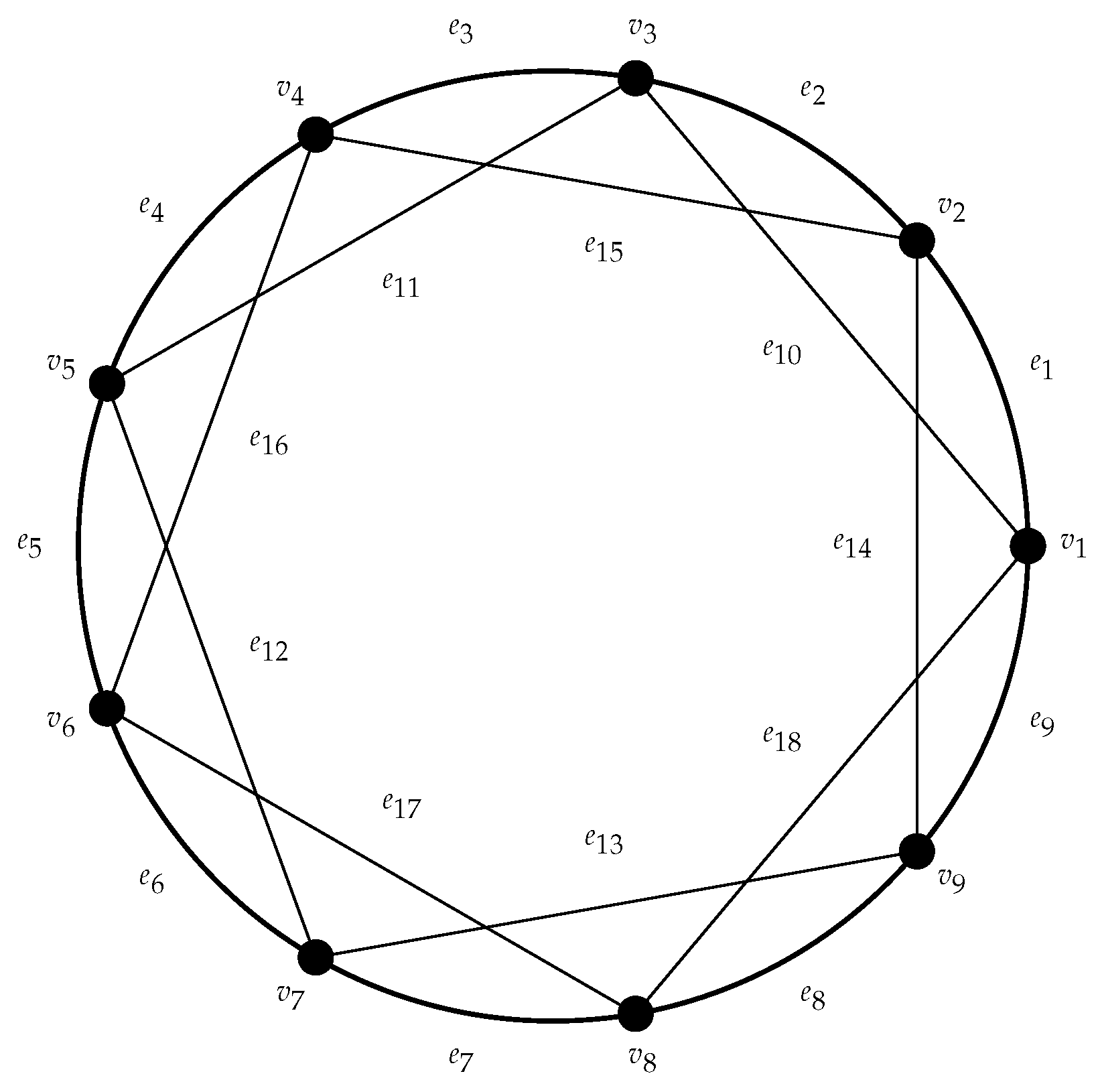
From now on, let be a circulant graph with and , where . Since the class of circulant graphs is vertex transitive, then label the arbitrary vertex as and other vertices accordingly. The set of edges of G can be partitioned as based on labels. If n is even, , , , and (see Figure 2). If n is odd, , , , and (see Figure 3). Note that the subscript of vertices is taken only over modulo n. Let denote . In the following lemmas, the cardinalities of the edge resolving neighborhoods of different pairs of distinct edges in G are computed, followed by the computation of the fractional edge dimension, , of G.
Figure 2.
Circulant Graph C8(1,2).
Figure 3.
Circulant Graph C9(1,2).
The following lemma gives the fractional edge dimension of .
Lemma 3.
If , then .
Proof.
Let and be the vertex and edge set of G, respectively (see Figure 3). Due to symmetry, the edge resolving neighborhoods of some specific pairs of edges are described as:
. Clearly, the set of cardinalities of these edge resolving neighborhoods is . Furthermore, , where i is odd and . The index of vertices are taken over modulo 7. Thus, . Additionally, , where . Using the criterion given in Theorem 5, define by , with as the minimum edge resolving function of G. Hence, . □
The edge resolving neighborhoods of minimum cardinalities in G are given in the following result.
Lemma 4.
If G is a circulant graph of order , then
Furthermore , where i is even and .
Proof.
Since therefore,
If i is even such that , then
The subscripts of vertices are taken over modulo n.
Similarly, if i is even such that , then
The subscripts of vertices are taken over modulo n. This shows . □
In the following lemma, the cardinality of the edge resolving neighborhood of a pair of edges is calculated.
Lemma 5.
If G is a circulant graph of order , then and
, where .
Proof.
Since that shows and using Lemma 4. □
Next, edges , where if , or if otherwise, are considered. The cardinalities of their edge resolving neighborhoods are computed.
Lemma 6.
Let G be a circulant graph of order .
- 1.
- If and , then ;
- 2.
- If and , then .
Furthermore, , where .
Proof.
- 1.
- If and , then which implies .
- 2.
- If and , thenThis shows .
follows from Lemma 4. □
In the following lemma, the edges are considered.
Lemma 7.
If G is a circulant graph of order , then .
Furthermore, , where .
Proof.
Since
This implies . Clearly, using Lemma 4. □
In the following lemma, the cardinalities of edge resolving neighborhoods of pairs of edges are computed.
Lemma 8.
Let G be a circulant graph of order . If n is odd and , or if n is even and , then . Furthermore, , where .
Proof.
If is odd and , then
If is even and , then
Combining the cardinalities of the expressions above, . Moreover, is straight forward using Lemma 4. □
Now, The pairs of edges , where accordingly if are considered. The cardinalities of their edge resolving neighborhoods are computed.
Lemma 9.
Let G be a circulant graph of order . If n is odd, then with or . Additionally, , where .
Proof.
For ,
If or , then . This implies . Using Lemma 4, follows directly. □
Now, consider edges , with an even n.
Lemma 10.
Let G be a circulant graph of order . If n is even, then , where .
Proof.
If is even, then
Clearly,
Furthermore, using Lemma 4. □
In the following lemma, the cardinalities of the edge resolving neighborhoods of pairs of edges with are computed.
Lemma 11.
Let G be a circulant graph of order . If n is even and , then , where .
Proof.
If is even and , then
This implies using Lemma 4. □
In the following lemma, the edge resolving neighborhoods of pairs of edges with are considered.
Lemma 12.
Let G be a circulant graph of order . If n is even and , then , where .
Proof.
If is even and , then
This implies .
Similarly, for , .
For ,
This implies .
For , which shows .
For ,
This implies ,with . Combining the cardinalities of all these edge resolving neighborhoods, with . Thus, , where using Lemma 4. □
In the following lemma, the edge resolving neighborhoods of pairs of edges with are considered for odd n.
Lemma 13.
Let G be a circulant graph of order . If n is odd and , then , where .
Proof.
For ,
For ,
For , ; for ,
Combining the cardinalities of all these edge resolving neighborhoods implies
with . Using Lemma 4, , where . □
In the following theorem, the fractional edge dimension of is calculated.
Theorem 6.
If and , then
Proof.
From Lemmas 4 to 13, with , with for an even n and for an odd n. Additionally, , . Thus, using Theorem 5, a minimum edge resolving function is defined by
for all of G. Hence,
□

4. Summary and Further Directions
In this article, we explored the concept of the fractional edge dimension of a graph. We improvised the upper bound proposed by E. Yi. It was also found that the class of hypercube graphs with an odd number of vertices has the fractional edge dimension equal to 2. The fractional edge dimension of the class of vertex and edge transitive graphs is , where is the minimum cardinality of the edge resolving neighborhoods of 1a graph G. We put forward the idea of combinatorics to calculate the fractional edge dimension of a graph. Using this criterion, and were calculated. The fractional edge dimension of a graph is a novel idea that has many lines yet to be expedited. Some of them are listed below.
- 1.
- Prove or disprove the converse of Theorem 3;
- 2.
- Calculate the fractional edge dimension of different classes of graphs such as the generalized Petersen graph, Tree graph, etc.;
- 3.
- Study the fractional edge dimension of different graph operations such as the cartesian product, etc.
Author Contributions
Methodology, N.G.; Conceptualization, N.G.; source of problem, N.G.; collection of material, N.G.; analyze and compute results, N.G.; writing original draft, N.G.; review and editing, N.G.; supervision, S.Z. and T.R.; validate and reviewed the entire work, S.Z. and T.R.; contributing the discussion on problem, J.L.G.G.; validation of results, J.L.G.G.; funding, J.L.G.G.; final reading, J.L.G.G. All authors approved the final version of article. All authors have read and agreed to the published version of the manuscript.
Funding
Research work for this paper was partially supported by the Ministerio de Ciencia, Innovación y Universidades through grant number PGC2018-097198-B-I00, and Fundación Séneca de la Región de Murcia through grant number 20783/PI/18.
Institutional Review Board Statement
Not applicable.
Informed Consent Statement
Not applicable.
Data Availability Statement
Not applicable.
Acknowledgments
The authors are grateful to the reviewers for their careful reading and suggestions to help to improve the manuscript.
Conflicts of Interest
The authors declare no conflict of interests regarding the publication of this paper.
References
- Slater, P.S. Leaves of Trees. Congr. Numer. 1975, 14, 549–559. [Google Scholar]
- Slater, P.S. Domination and location in acyclic graphs. Networks 1987, 17, 55–64. [Google Scholar] [CrossRef]
- Harary, F.; Melter, R.A. On the metric dimension of a graph. Ars Combin. 1976, 2, 191–195. [Google Scholar]
- Chartrand, G.; Eroh, L.; Johnson, M.; Oellermann, O.R. Resolvability in graphs and the metric dimension of a graph. Discret. Appl. Math. 2000, 105, 99–113. [Google Scholar] [CrossRef] [Green Version]
- Currie, J.; Oellermann, O.R. The metric dimension and metric independence of graphs. J. Combin. Math. Combin. Comput. 2001, 39, 157–167. [Google Scholar]
- Khuller, S.; Raghavachari, B.; Rosenfield, A. Landmarks in graphs. Discret. Appl. Math. 1996, 70, 217–229. [Google Scholar] [CrossRef] [Green Version]
- Kelenc, A.; Tratnik, N.; Yero, I.G. Uniquel identifying the edges of a graph: The edge metric dimension. Discret. Appl. Math. 2018, 251, 204–220. [Google Scholar] [CrossRef] [Green Version]
- Kelenc, A.; Toshi, A.T.; Skrekovski, R.; Yero, I.G. On metric dimension of hypercubes. arXiv 2021, arXiv:2102.10916v1. [Google Scholar]
- Peterin, I.; Yero, I.G. Edge metric dimension of some graph operations. Bull. Malays. Math. Sci. Soc. 2020, 43, 2465–2477. [Google Scholar] [CrossRef] [Green Version]
- Scheinerman, E.R.; Ulleman, D.H. Fractional Graph Theory: A Rational Approach to the Theory of Graphs; John Wiley & Sons: New York, NY, USA, 1997. [Google Scholar]
- Chartrand, G.; Lesniak, L. Graphs & Digraphs, 4th ed.; Chapman & Hall, CRC: London, UK, 2005. [Google Scholar]
- Fehr, M.; Gosselin, S.; Oellermann, O.R. The metric dimension of Cayley digraphs. Discret. Math. 2006, 306, 31–41. [Google Scholar] [CrossRef] [Green Version]
- Arumugam, S.; Mathew, V. The fractional metric dimension of graphs. Discret. Math. 2012, 312, 1584–1590. [Google Scholar] [CrossRef] [Green Version]
- Arumugam, S.; Mathew, V.; Shen, J. On the fractional metric dimension of graphs. Disc. Math. Algorithms Appl. 2013, 5, 135–137. [Google Scholar] [CrossRef]
- Yi, E. On the edge dimension and fractional edge dimension of graphs. arXiv 2021, arXiv:2103.07375v1. [Google Scholar]
Publisher’s Note: MDPI stays neutral with regard to jurisdictional claims in published maps and institutional affiliations. |
© 2021 by the authors. Licensee MDPI, Basel, Switzerland. This article is an open access article distributed under the terms and conditions of the Creative Commons Attribution (CC BY) license (https://creativecommons.org/licenses/by/4.0/).