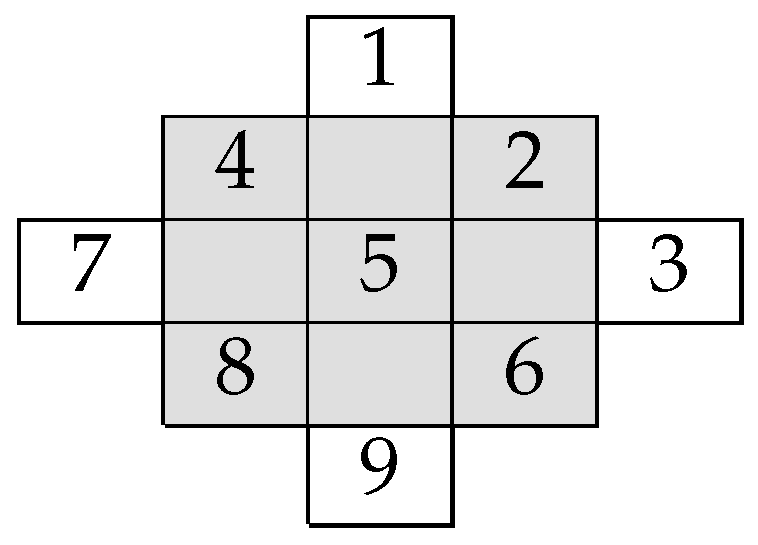
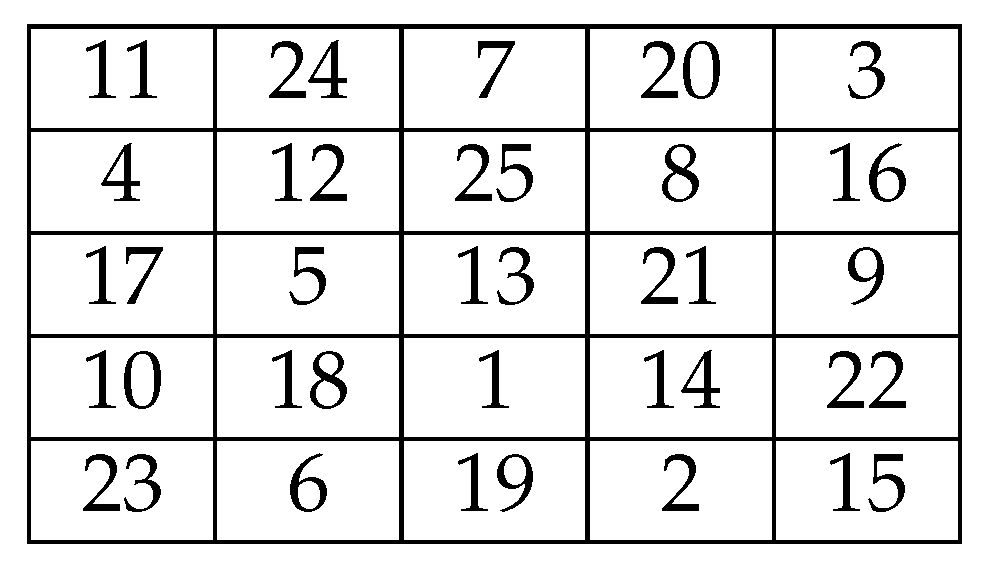
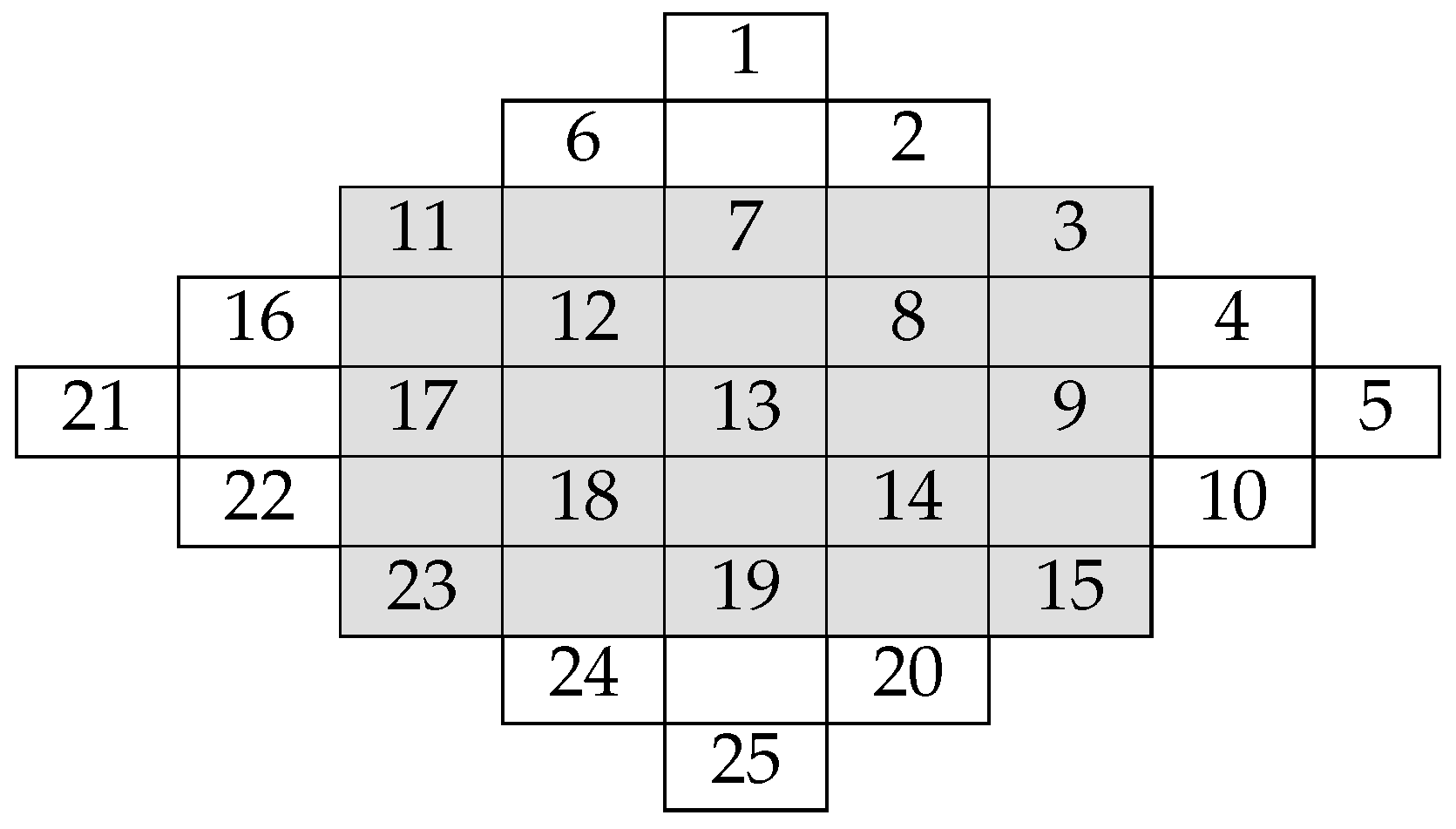
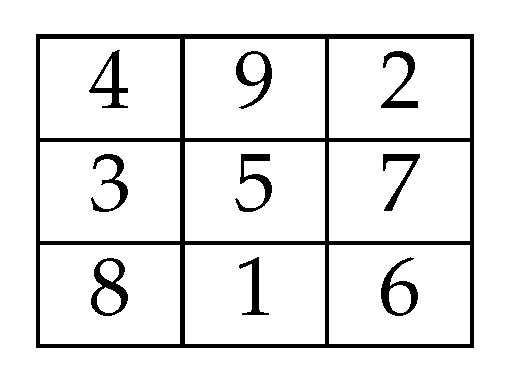
2.2. Arrangement That Avoids K-Term Arithmetic Progressions
In this section, we form a sequence
P, which is an arrangement of the rows of the
magic square from
Section 2.1 that avoids
k-term arithmetic progressions.
Theorem 2. Suppose . Let be the sequence of integers in the i-th row from left to right in the magic square formed by using the method in Section 2.1 where . Then, the sequence avoids k-term arithmetic progressions, but it has a -term arithmetic progression, . Remark 1. Note that Theorem 2 is not true for . In fact, the row has a three-term arithmetic progression.
Proof. Note that for
,
does not contain a 4-term arithmetic progression, but has a 3-term arithmetic progression
. Therefore, we may assume that
.
By Equations (
1), (
5) and (
6), for
, every integer in the row
is either congruent with
or
. By Equations (
2), (
7) and (
8), for
, every integer in the row
is either congruent with
or
. Lastly, by Equations (
3) and (
4), every integer in the row
is congruent with
. Note that the only integer congruent with
in row
is
, whereas the only integer congruent with
in row
is one. Thus, all the integers congruent with
in
appear in rows
, and
. For
, all the integers congruent with
in
appear in exactly two different rows.
Since
is in
for
and
, the progression
is a
-term arithmetic progression in
P. Now, we proceed to show that
P does not have any
k-term arithmetic progressions. We prove it by contradiction. Assume that there exists a
k-term monotone arithmetic progression
in
P. Then, there exists a nonzero integer
d such that:
for all
. Note that
.
Since:
should appear before
if we read the elements from left to right in
P. Thus, if
is in
for some
, then
will be in
where
or
, and if
is in
, then
will be in
. Furthermore, if
and
are both in
for some
, then
will appear after
in the sequence
P when we read from left to right.
Suppose or for some . If the former holds, then and , a contradiction. If the latter holds, then and , a contradiction. Hence, we may assume that or for all .
If two consecutive terms of T are in for some , then or . Suppose no two consecutive terms of T are in . This means that if is in , then will be in where or and . Since , either there exists such that and are in and , respectively, for some or and are in and , respectively, or and are in and , respectively. If such a exists, then or , otherwise, or .
Case 1: Suppose . This means no two consecutive terms of T are in and and are in and , respectively. Furthermore, and . Note that . Therefore, is in or . If is in , then will be in , a contradiction. If is in , then , a contradiction. If is in , then , a contradiction.
Case 2: Suppose . This means no two consecutive terms of T are in and and are in and , respectively. Furthermore, and . Note that and . If , then is in or , whereas is in or . This is not possible as should appear before in the sequence P. Suppose . Now, is in or , whereas is in or , again not possible.
Case 3: Suppose . This means no two consecutive terms of T are in and there exists such that and are in and , respectively, for some or and are in and , respectively. Now, cannot be in ; otherwise, will be in . Note that . Suppose is in for some . Then, or . If , then . Since , it must be in . Therefore, is in , a contradiction. Suppose . Since must appear after in P, we have and is in for some and is in . This implies that either is in the same row as or is in the same row as , a contradiction. Similarly, we also cannot have in for some .
Case 4: Suppose . Now, cannot be in ; otherwise, will be in and . Suppose is in for some . Then, is either congruent with or . Suppose . Then, . Since and , it must be in . Thus, is also in and , a contradiction. Suppose . Then, . If , then must be in . Therefore, is also in and , a contradiction. Suppose . Then, and it is in . Therefore, . Now, . Since , is in or , which is not possible as is in .
Suppose is in for some . Then, is either congruent with or . Suppose . Then, . If , then is in or , which is not possible. If , then and . Therefore, is in or , again not possible. Suppose . Then, . If , then is in or , which is not possible. If , then and . Therefore, is in or , again not possible.
Case 5: Suppose .
If two consecutive terms of
T, say
and
are in
, then
, a contradiction. Suppose
and
are in
. Then,
and
. By Equation (
1),
for some
and
for some
. Now,
Therefore,
, a contradiction.
Suppose
and
are in
. Then,
and
. By Equation (
2),
for some
and
for some
. Furthermore,
. Now,
Therefore,
, a contradiction. Hence, we may assume that no consecutive terms of
T are in
or
.
Suppose is in . Then, is either congruent with or . Suppose . Then, . Note that is not in , for no two consecutive terms of T are in . Therefore, is in . This means is in , for no two consecutive terms of T are in . Therefore, must be in , a contradiction as no two consecutive terms of T are in .
Suppose . Then, . Therefore, is in , or . Note that cannot be in , otherwise will be in . If is in , then , a contradiction. If is in , then , a contradiction.
Suppose is in for some . Then, is either congruent with or . Suppose . Then, and . Since is not in , it must be in . If , then must be in , for it cannot be in . Since , we must have in or . Both cases also cannot happen. If , then is in or , which is not possible. Suppose . Then, . If , then must be in . Since is not in , it must be in . However, then is also in , a contradiction. If , then is in or , which is not possible.
Suppose is in for some . Then, is either congruent with or . Suppose . Then, . Therefore, is in , or . Note that cannot be in ; otherwise, will be in . If is in , then , a contradiction. If is in , then , a contradiction.
Case 6: Suppose .
Then, for all j and or . If , then . Therefore, we must have and . Therefore, is in row , whereas is in , which is not possible. If , then . Therefore, we must have and . Now, for imply that for all . This is also not possible as should appear after , but before in P. Hence, we may assume that .
Case 6.1: Suppose . Then, is either in or for all j. Note that and for all . Therefore, we may assume that is in for all .
Case 6.1.1: Suppose
k is odd. Let
Note that
, and
are disjoint. By Equation (
3),
. Therefore, one of the
where
must contain at least two elements. Thus,
.
Suppose
. If
, then
for some
. Now,
and
. Therefore,
is in
. This is not possible. Thus, if
, then
.
Suppose . If , then for some . Since is the last term in , is not in , a contradiction. Thus, if , then .
Suppose
. If
, then
for some
. Now,
is the last term in
. Therefore,
and:
a contradiction. Thus, if
, then
.
Hence, for exactly one . Now, , , and . Thus, , a contradiction.
Case 6.1.2: Suppose
k is even. Let:
Note that
, and
are disjoint. By Equation (
4),
. Therefore, one of the
where
must contain at least two elements. Thus,
.
Suppose . If , then for some . Since is the last term in , is not in , a contradiction. Thus, if , then .
Suppose
. If
, then
for some
. Now,
and
. Therefore,
is in
. This is not possible. Thus, if
, then
.
Suppose
. If
,
for some
. Now,
is the last term in
. Therefore,
and:
a contradiction. Thus, if
, then
.
Hence,
for exactly one
. Now,
,
, and
. Thus,
and
. This means
can only be in
or
. Since
,
must be in
, that is
. Now,
a contradiction.
Case 6.2: Suppose
. Then
is either in
or
for all
j. Since there are at most
integers in
that are congruent with
, we must have
in
. Suppose both
and
are in
. By Equation (
1), we must have
and
and
for some
. Since there are at most
integers in
that are congruent with
, we must have
in
. The largest integer congruent with
in
is
, and the smallest integer congruent with
in
is
. Note that
. Let
s be the smallest integer such that
is in
and
is in
. Since both
and
are in
,
. Therefore,
a contradiction. Suppose
is in
, but
is in
. Then, we must have
for all
. By Equation (
2),
. On the other hand,
a contradiction.
Case 6.3: Suppose where . Then, for all j, is either in or .
Case 6.3.1: Suppose
is odd. Let:
Note that
, and
are disjoint. By Equations (
5) and (
6) (or Equations (
1) and (
6) when
),
. Therefore, one of the
where
must contain at least two elements. Thus,
.
Suppose
. If
, then
for some
. Now,
is the last term in
. Therefore,
and:
a contradiction. Thus, if
, then
. Now, if
, then
for some
. By Equation (
6),
. This is not possible as
should appear before
in
P. Thus, if
, then one and
k must be in
. This implies that
for all
. This is not possible as
. Hence,
and
.
Suppose
. If
, then
for some
. Now,
and
, a contradiction. Thus, if
, then
.
Suppose . If , then for some . Since is the last term in , is not in , a contradiction. Thus, if , then .
Hence,
for at most one
. If
, then:
a contradiction. Similarly, if
, then
, again a contradiction.
Case 6.3.2: Suppose
is even. Let:
Note that
, and
are disjoint. By Equations (
5) and (
6),
. Therefore, one of the
where
must contain at least two elements. Thus,
.
Suppose
. If
, then
for some
. Since
is the last term in
,
is not in
, a contradiction. Thus, if
, then
. Now, if
is not in
, then
for some
. By Equation (
5)
. This is not possible as
should appear before
in
P. Thus, if
, then one and
k must be in
. This implies that
for all
. This is not possible as
. Hence,
and
.
Suppose
. If
, then
for some
. Now,
and
, a contradiction. Thus, if
, then
.
Suppose
. If
, then
for some
. By Equation (
5),
, which is not possible. Thus, if
, then
.
Hence,
for at most one
. If
, then:
a contradiction. Similarly, if
, then
, again a contradiction.
Case 6.4: Suppose where . Then, is either in or for all j.
Case 6.4.1: Suppose
is odd. Let:
Note that
, and
are disjoint. By Equations (
7) and (
8),
. Therefore, one of the
where
must contain at least two elements. Thus,
.
Suppose . If , then for some . Therefore, , and this is not possible. Thus, if , then . Now, if , then for some . Therefore, , again not possible. Thus, if , then one and k must be in . This implies that for all . Therefore, , a contradiction. Hence, and .
Suppose . If , then for some . Therefore, , and this is not possible. Thus, if , then .
Suppose
. If
, then
for some
. Therefore,
and
, a contradiction. Thus, if
, then
. Hence,
for at most one
. If
, then:
a contradiction. Similarly, if
, then
, again a contradiction.
Case 6.4.2: Suppose
is even. Let:
Note that
, and
are disjoint. By Equations (
7) and (
8) (or Equations (
2) and (
6) when
),
. Therefore, one of the
where
must contain at least two elements. Thus,
.
Suppose . If , then for some . Therefore, , and this is not possible. Thus, if , then . Now, if , then for some . Therefore, , again not possible. Thus, if , then one and k must be in . This implies that for all . Therefore, , a contradiction. Hence, and .
Suppose . If , then for some . Therefore, , and this is not possible. Thus, if , then .
Suppose
. If
, then
for some
. Therefore,
and
, a contradiction. Thus, if
, then
. Hence,
for at most one
. On the other hand, if
, then:
a contradiction. Similarly, if
, then
, again a contradiction.
Hence, P does not contain any k-term monotone arithmetic progressions. This completes the proof of the theorem. □
Corollary 1. Let . For each integer n with , there is an arrangement of that avoids k-term arithmetic progressions, but contains a -term arithmetic progression.
Proof. For , the sequence avoids three-term arithmetic progressions. Now, for , remove from P, and denote the resulting sequence as . For instance, if , then , and if , then . Note that avoids three-term arithmetic progressions. Therefore, we may assume that .
Suppose . First, we show that if , then there is an arrangement of that avoids k-term arithmetic progressions, but contains a -term arithmetic progression. By Theorem 2, such an arrangement exists. Let us denote the arrangement by P. Now, remove from P, and denote the resulting sequence as . Note that avoids k-term arithmetic progressions, but contains a -term arithmetic progression, that is .
Suppose . Let . Then, it avoids k-term arithmetic progressions, but contains a -term arithmetic progression, that is . Now, remove from Q, and denote the resulting sequence as . Thus, avoids k-term arithmetic progressions, but contains a -term arithmetic progression, that is . □
Lemma 1. Let for some real numbers . Then, the sequence contains a k-term monotone arithmetic progression if and only if contains a k-term monotone arithmetic progression.
Proof. It is sufficient to show that if
contains a
k-term monotone arithmetic progression, then
contains a
k-term monotone arithmetic progression. Let
be such that
is a
k-term monotone arithmetic progression. Therefore,
for some real number
d. This implies that:
Hence,
is a
k-term monotone arithmetic progression. □
Let be the smallest integer such that and be the largest integer such that .
Theorem 3. Let . For each integer n with , there is an arrangement of that avoids k-term arithmetic progressions, but contains a -term arithmetic progression.
Proof. By Corollary 1, this theorem is true for
. Now, we may assume
. We also assume that the theorem is true for all
such that
. Let
where
and
are odd and even integers, respectively. Note that
and
. Note that:
Since
, by assumption, the theorem is true for
. Let
be an arrangement of
that avoids
k-term arithmetic progressions, but contains a
-term arithmetic progression. Furthermore, let
be an arrangement of
that avoids
k-term arithmetic progressions, but contains a
-term arithmetic progression. We claim that:
is an arrangement that avoids
k-term arithmetic progressions, but contains a
-term arithmetic progression. In fact, if
is a
k-term monotone arithmetic progression in
P, then
. Let:
Since
, one of the
where
must contain at least two elements. Thus,
d is even. If both
and
are nonempty, then there is a
such that
and
. Now,
is odd, a contradiction. Hence,
for at most one
. If
, then by Lemma 1,
contains a
k-term arithmetic progression, a contradiction. Similarly, if
, then
contains a
k-term arithmetic progression. Hence,
P avoids
k-term arithmetic progressions, but contains a
-term arithmetic progression. □