You are currently viewing a new version of our website. To view the old version click .
Mathematics
  • Article
  • Open Access

12 September 2021

Mathematical Modelling and Study of Stochastic Parameters of Computer Data Processing

Department of Informatics, Faculty of Applied Mathematics and Informatics, Technical University of Sofia, 1000 Sofia, Bulgaria
This article belongs to the Section E1: Mathematics and Computer Science

Abstract

The main goal of dispatching strategies is to minimize the total time for processing tasks at maximum performance of the computer system, which requires strict regulation of the workload of the processing units. To achieve this, it is necessary to conduct a preliminary study of the applied model for planning. The purpose of this article is to present an approach for automating the investigation and optimization of processes in a computer environment for task planning and processing. A stochastic input flow of incoming tasks for processing is considered and mathematical formalization of some probabilistic characteristics related to the complexity of its servicing has been made. On this basis, a software module by using program language APL2 has been developed to conduct experiments for analytical study and obtaining estimates of stochastic parameters of computer processing and dispatching. The proposed model is part of a generalized environment for program investigation of the computer processing organization and expands its field of application with additional research possibilities.

1. Introduction

In the general case, computer processing is a set of procedures performed on data streams. The procedures are implemented on the basis of separate algorithms, the unification of which is considered a complete algorithm of computer processing, realized at the macro level [1]. This processing forms the workload of the system, which is assessed by determining the probabilistic characteristics for the employment of the individual components.
Significant performance requirements are placed on real-time systems as well as distributed systems. When planning parallel and pseudo-parallel processes in them, the times for realization of the separate tasks must be taken into account and to be coordinated with the cyclic mode of the incoming information flow. An important criterion is the energy efficiency of the calculations in ensuring the timely delivery of services. This is the approach proposed in [2] for efficient loading in a distributed computing environment, combining the advantages of horizontal scaling and energy planning, while modelling with Matlab is applied to prove the efficiency.
When designing various computer systems, it is essential to pre-plan the calculations and the allocation of resources and to forecast the workload, which will lead to improved overall performance. For example, ref. [3] emphasizes that the development of computer and information technology, as well as Internet communications, places higher demands on the tools for process management and increasing the level of intelligence in their planning. To solve this problem, the article proposes a controller that maintains a knowledge base in the cloud and allows autonomous planning of the process. Another aspect of process-based workload planning and forecasting in distributed computing systems is presented in [4], highlighting the importance of improving service quality (QoS) and reducing energy consumption. The article provides an extensive overview of workload forecasting approaches, looking mainly at cloud services, and presents a taxonomy of workload forecasting schemes, summarizing their advantages and limitations. To achieve the required level of efficiency, a preliminary analytical study of the possibilities for defining a correct plan when performing multiple tasks is useful. Similar problems related to the energy efficiency of the actual load of the system relative to the capacity of the computing resources are discussed in [5], and a QoS-oriented mechanism for providing capacity using the queueing theory is proposed. The set goal of the developed mechanism is to predict the real demand for resource capacity without disturbing the level of service, as the experiments have shown a significant reduction in energy consumption. No less important is the determination of the optimal route in a communication environment, which reflects on the overall load of the system. This issue is discussed in [6], noting that the mechanisms for maintaining balanced, multi-band traffic and optimizing information flow are not sufficiently developed in the applied routing protocols.
Model investigation as a stage in the design of systems and processes is constantly proving its importance and usefulness. This is especially important both in the development of technologies for physical processes and in the design of complex computer processing systems. Confirmation of this is the discussion presented in [7] of the contribution of computer simulations to the design of a specific system (reactor) as a critical analysis of the possibility of integrating several tools into a common computational package. A procedure for model investigation in the development of computer systems and processes is presented in [1], emphasizing the need to choose an appropriate modelling method consistent with the goal.
The purpose of this article is to present an approach for automating the investigation of the processes of processing information units, arriving as a stochastic flow of service requests to processor devices. For this reason, a program module developed using the TryAPL2 system on the basis of preliminary formalization and mathematical modelling is presented. The choice of programming language (APL2) is made due to the supported parallelism and its good adequacy at describing processes. It is a high-level language, convenient for working with vectors and matrices and is suitable for analytical descriptions. Characteristic features are the specific alphabet, the maintenance of various data structures, the ability to work in dialog and program mode, a wide range of operations, incl. mathematical and possibility for laconic expression of complex transformations through composite operators. The order of operations in the expressions is from right to left. It is suitable for expressing the subordination between the different parts of the algorithm and allowing parallel execution of several operations. The TryAPL2 operating environment allows the creation of additional user workspaces from models designed as a separate function or as sequentially called functions. The organization of the work is done by system commands for management of the work session, storage and editing of copies of work spaces and transfer of data from one work space to another (manage APL file sharing). The environment also supports several system workspaces that can be used to create and run applications.
The present work should be considered a continuation of the research done in [1], and aims to present an addition to the developed set of modules for mathematical modelling of computer processing. For this reason, the organization of the model investigation is made on the basis of the procedure presented in [1], performing consistently the phases provided in it: goal defining; preliminary formalization of the object of study; mathematical modelling; program realization; conducting experiments; results analysis. The main contributions of the article can be summarized as follows. In the first part, a definition of the initial assumptions is made, which is used for the realization of the proposed mathematical formalization of the stochastic characteristics of the computational processes, and probabilistic characteristics are formulated that are related to the complexity of the tasks. The second part is a proposed program module for the organization of estimations, as well as the conducted experiments with summarization and analysis of their results.
The article is structured as follows. Section 2 discusses related work in the field. Section 3 presents the initial assumptions and formulates the mathematical formalization used for the realization of the program module for the estimation presented in Section 4, which discusses the obtained experimental results and assessments.

3. Initial Assumptions and Mathematical Formalization

3.1. Initial Assumptions

The subject of discussion is a set of procedures (algorithms, tasks) that must be planned for execution in a computer environment. It was pointed out that the discrete graph theory could be applied as an initial description by drawing up a generalized graph scheme of algorithm (GSA), designed to load the processor as the main service node. This problem is discussed in [1], where the possibility of partial ordering over the set of tasks (which are characterized by absolute and relative priority) is considered. This allows us to define the so-called “complete algorithm”, which can be described logically by the individual algorithms Ai and the conditions for their activation at a specific input information flow. Such a functional description allows us to construct the graph scheme based on the matrix of connections {cij: AiAj} between all pairs of individual algorithms. The formalization allows us to conduct a preliminary study through a chosen approach—stochastic (in probably differentiated connections) or determined (the matrix of connections is Boolean). Typically, in centralized systems, the queuing of tasks (numbering) and its maintenance is performed by the supervisor for global management of the usability of the system resource. The directing of the tasks to the free processor devices is performed by the dispatcher on the basis of the set rules (planning strategy) in the computer system and the defined priorities when arranging the tasks. In decentralized systems, the functions of a dispatcher are taken over by a supervisor, who may be part of the queue itself as an object with the highest priority.
In the case of discrete analytical formalization, the basic set of individual tasks (algorithms) for processing in a computer environment could be described by the system of equations:
A j = { i = 1 n a i j · A i } ;     j = 1 , 2 , , n .
In such a graph structure of discrete nodes (components), the transition from node Ai to the next node Aj in the graph depends on the coefficients aij: AiAj, which in the general case have a probabilistic character. In this sense, each planned implementation is a realization of a predefined path {AiAj} in GSA. The task of the system dispatcher is to optimize the possible paths in the set of tasks from the first task started to the last scheduled for execution so as to ensure minimum load of the processor unit at maximum performance. Two basic initial assumptions have been made for the realization of the task.
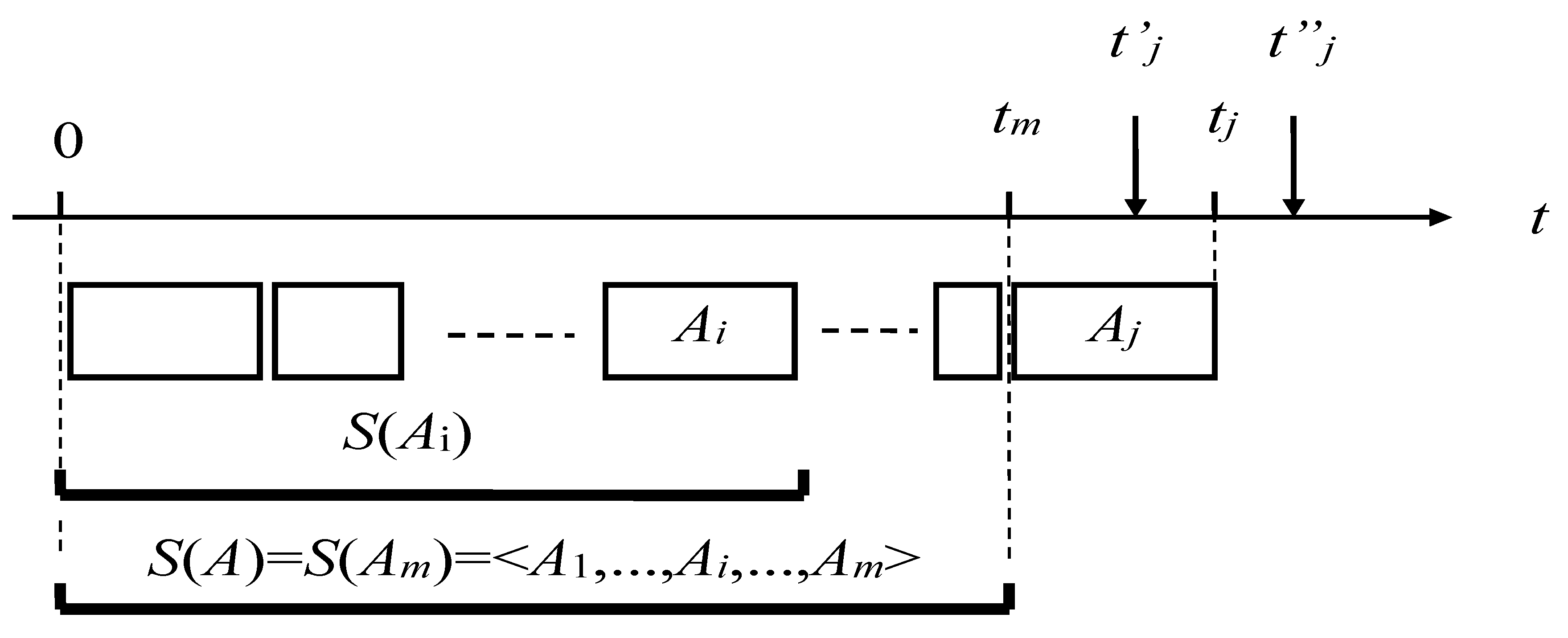
  • If a fixed sequence S(A) = <A1, …, Ai, …, Am> is formed, consisting of m tasks with random execution time T(Ai) for each of them, it can be allowed that the total time T(S) for the realization of this sequence of tasks has a normal distribution with average time E[T(S)] = ΣE[T(Ai)] and variance D[T(S)] = ΣD[T(Ai)].
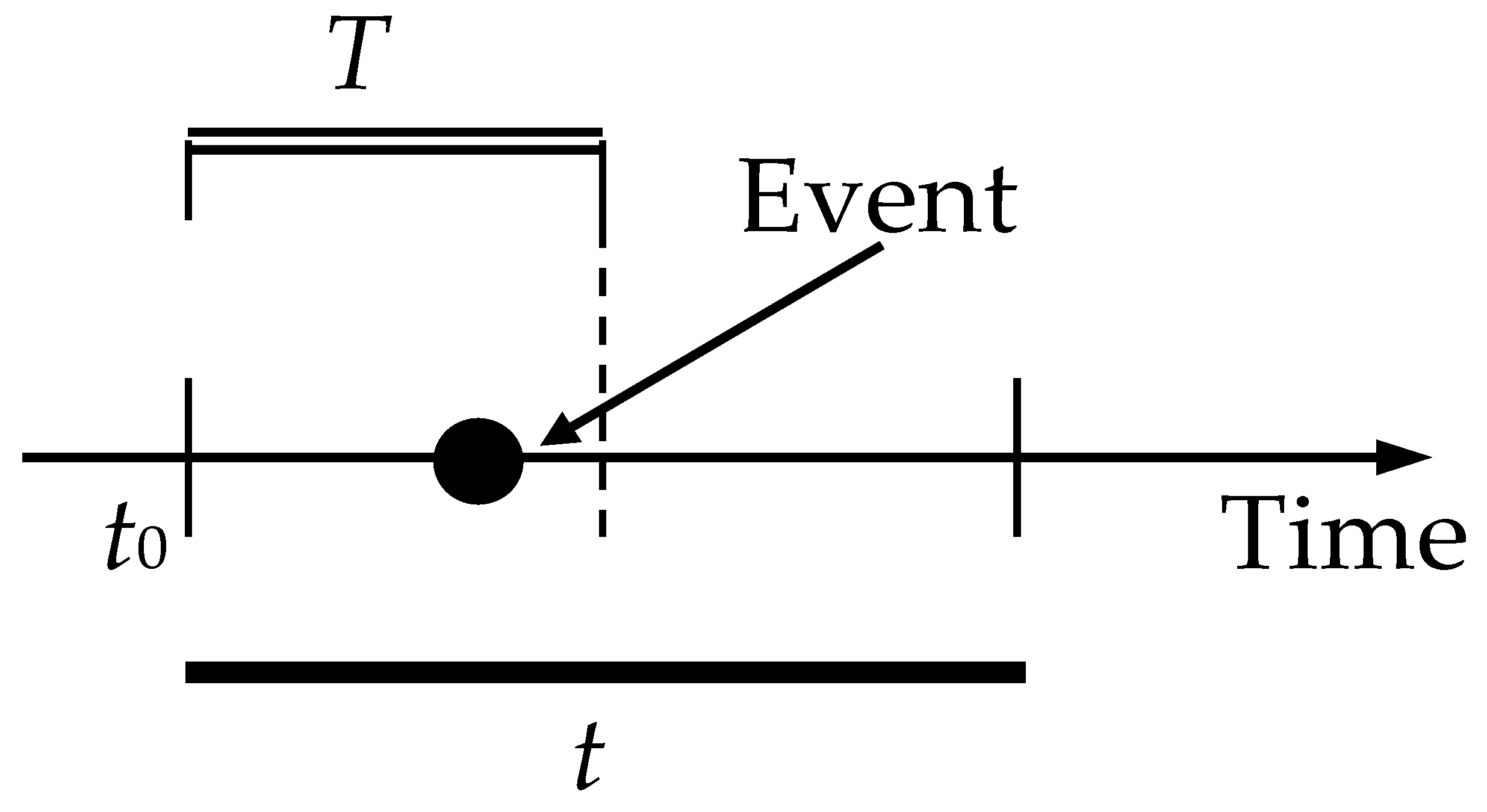
  • The distribution of the earliest time to start a task Aj, which is next after the realization of the sequence S(A), is equated to the moment tm = t(Am) of the completion of the task Am, which is last in S(A).
An example situation describing the statement above is shown in Figure 2. The execution of task Aj starts at time tm. The total execution time T(Aj) is a random variable and depends on the specific conditions for the implementation of the current calculation (data, processes, management, etc.). In this sense, the mathematical expectation for the moment time t(Aj) = tj for the completion of the task Aj (formation of the final result) is also a random variable for which the limit values can be calculated—the earliest admissible moment ( t j ) and the latest allowable moment ( t j ) . Since the start of task Aj is related to the random moment to complete the previous task, the above reasoning also applies to the initial moment of execution of Aj (assessment limits can also be set).
Figure 2. Example sequence of execution tasks.

3.2. Mathematical Formalization

When defining the mathematical model, a formal presentation of the following stochastic characteristics of the computational processes was performed:
  • The mathematical expectation of the time-moment tj for completing task Aj is defined as the sum of the mathematical expectations E[T(Ai)] of the times for solving (performing) the tasks in the previous sequence S(A) = < A1, …, Am > estimated by the longest path A1AmAj in the sequence if there are several equivalent ones.
  • The variance D[T(Aj)] is determined analogously to the sum D[T(A1)] + … + D[T(Am)].
  • Planning the deadlines for completion of task Aj:
    (a) the earliest allowable completion time ( t j ) is estimated by the variance and the standard deviation:
    D [ t j ] = D [ t m ] + D [ t j ] ; σ [ t j ] = { D [ t j ] } ;
    (b) the latest allowable completion time ( t j ) is estimated by the mathematical expectation:
    E [ t j ] = E [ t ( A F ) ] E [ t ( S j F ) ] ,
    where: AF—final task for the specific calculation; SjF—the longest path in the sequence <Aj, …, AF>. The variance of ( t j ) is estimated analogously by:
    D [ t j ] = D [ t ( A F ) ] D [ t ( S j F ) ] .
  • The probability of completing task Aj in a given time. The probability P(tj) for completion of the calculation of task Aj is considered no later than the moment ( t j * ) :
    P ( t j ) t j * = t * φ j ( x ) · d x ,
    where φj(x) is the density of the probability distribution of the random variable tj. If φj(x) is a normal distribution law with parameter μ = E[tj] and variance σ2 = D[tj], then:
    φ j ( x ) = 1 σ 2 π · e [ ( x μ ) 2 2 σ 2 ] .
For the analytical study of the stochastic processes in the structure, it is necessary to know some estimates of the probabilistic characteristics of the individual tasks. For example, if the labor intensity τ(Aj) of the task AjS(A) is known, then the time t(Aj) will depend on the speed B of the computer system, i.e., E[t(Aj)] = E[τ(Aj)/B], where E[x] is the mathematical expectation of the random variable x. A similar relationship exists for the variance D[x].
Therefore, if the complexity of the tasks is known, it is possible to determine the probabilistic estimates of both the random time-moments t(Aj) and the paths formed in the graph structure representing the computer processing. The definition of these estimates is as follows:
(a) an estimate of the total labor intensity of the implementation of a given Si path in the information structure S(A):
E [ t ( S i ) ] = A j S i E [ τ ( A j ) ]   ; D [ t ( S i ) ] = A j S i D [ τ ( A j ) ] = σ 2 [ τ ( S i ) ]   ;
(b) an assessment of the realization of a certain task included in a given path SiS(A) of the structure:
E [ t ( S i ) ] = E [ τ ( S i ) ] B   ; D [ t ( S i ) ] = D [ τ ( S i ) ] B = σ 2 [ τ ( S i ) ] B   ;
(c) an estimation of the correlation relationship for the pairs <Si, Sj>:
r i j = { k = 1 n D [ t ( A k i j ) ] } { σ [ t ( S i ) · σ [ t ( S j ) ] ] } ,
where D [ t ( A k i j ) ] is the time variance for solving the problem Ak belonging to both paths Si and Sj simultaneously.

4. Program Realization and Experimental Results

4.1. Program Realization

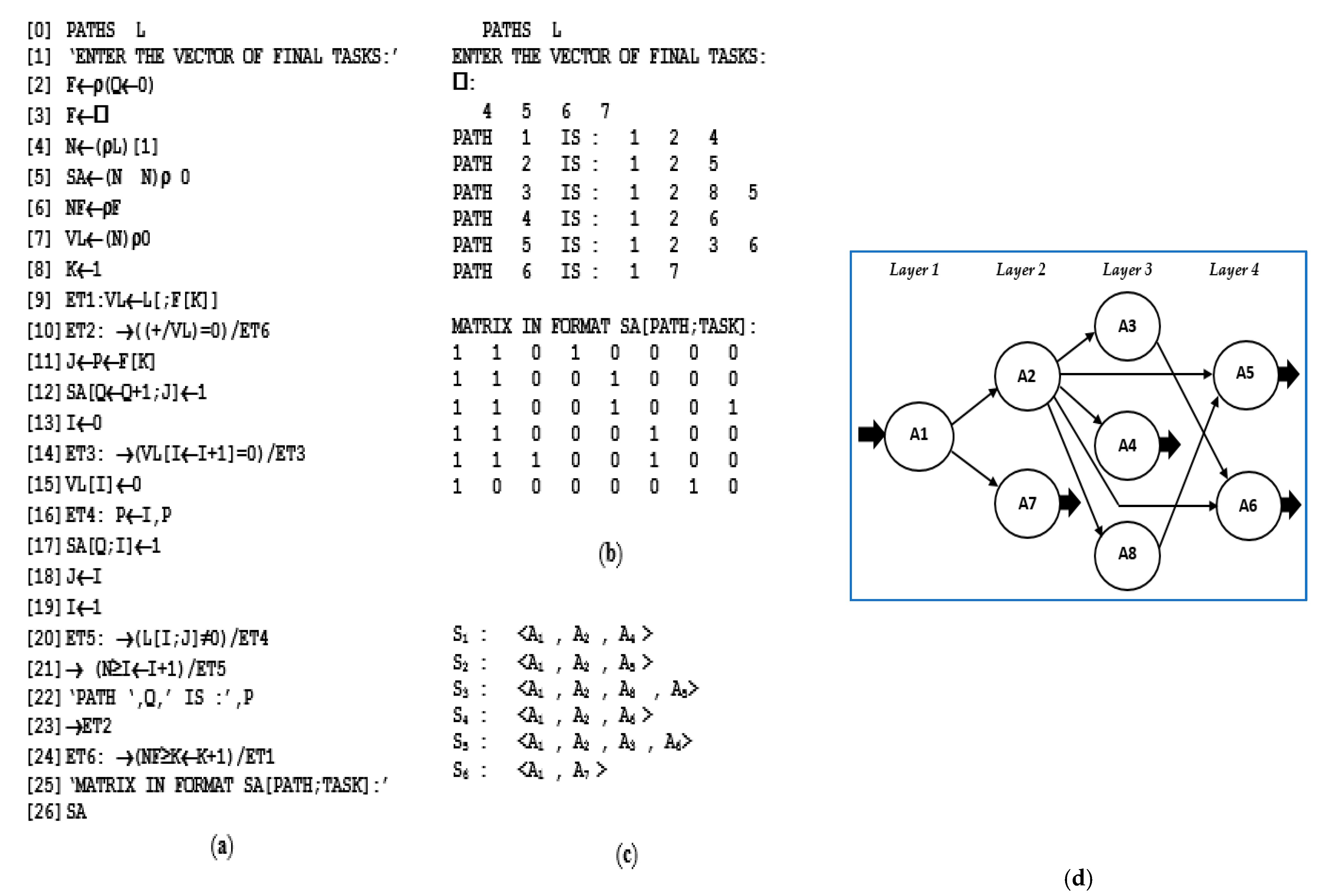
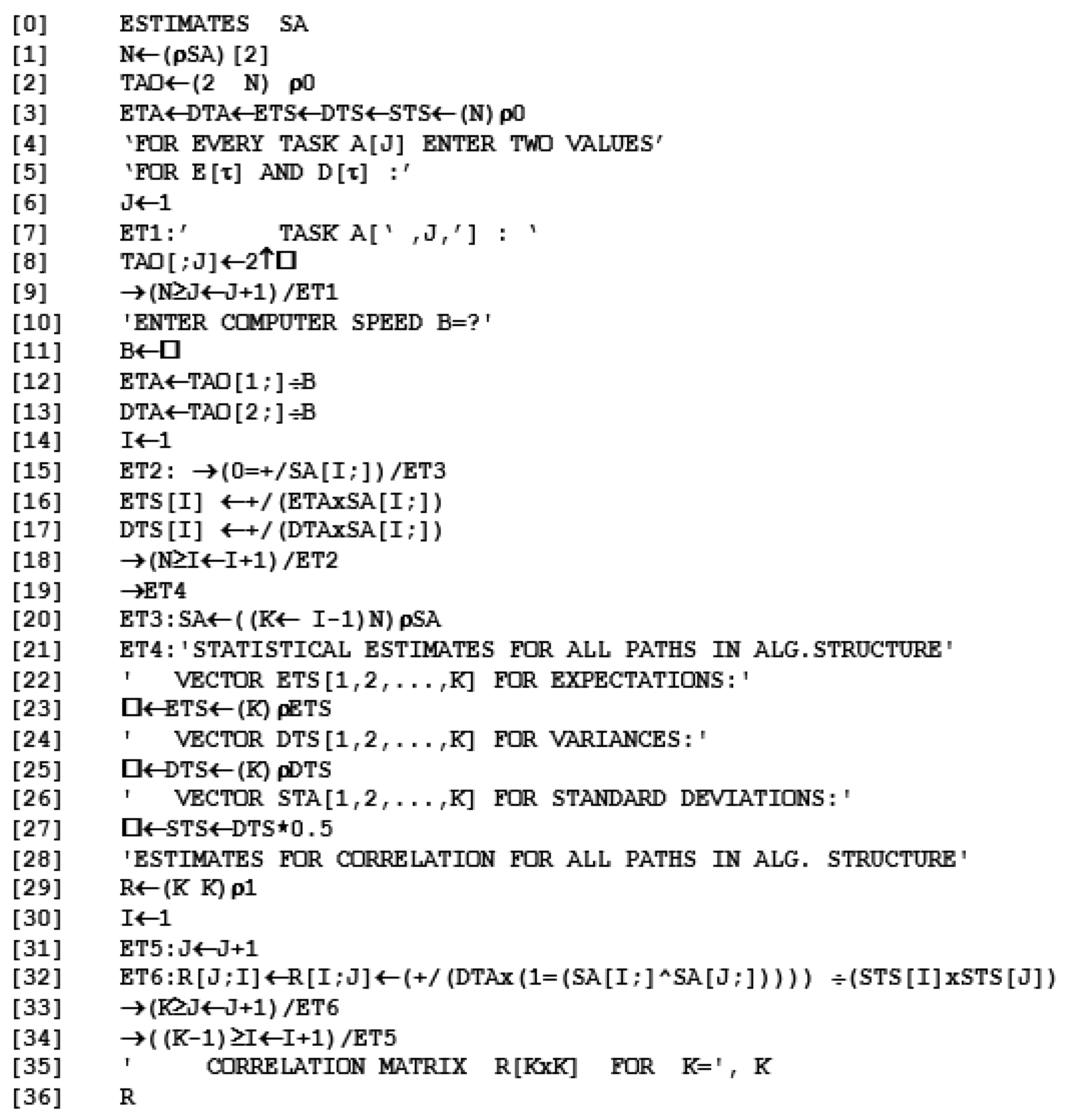
To conduct experiments in the analytical study of the stochastic time parameters of computer processing, a program module (function ESTIMATES) was created in the language environment APL2. As an input argument, it uses the matrix of determined paths SA, which is obtained after the execution of another APL2-funcion named PATHS, presented in [1] (see Figure 3 for program code and a sample experiment). As stated in [1], this function is “for reachability evaluation and determining all paths in the investigated algorithmic structure with argument matrix L”.
Figure 3. Program function PATHS—(a) program code; (b) execution; (c) defined paths; (d) investigated ordered graph scheme of algorithm [1].
The program code of the module ESTIMATE is shown in Figure 4. To implement an experiment with a program module, a preliminary definition (formation) of the matrix SA is required, which is a basic argument. Interactive determination of the additional operating parameters is provided—numerical estimates for the parameters E[τ(Aj)], D[τ(Aj)] and B.
Figure 4. Program function ‘ESTIMATES’.
The following assumptions and relative estimates were accepted in the organization of the experiments for processing parameters investigation with the module ‘ESTIMATES’:
(a) Numerical estimations for the stochastic characteristics of the task’s complexity (×10k):
Task→A1A2A3A4A5A6A7A8
E[τ(Aj)]0.51.00.40.20.40.32.00.4
D[τ(Aj)]0.050.10.040.020.040.030.20.04
(b) Value for the speed of computer system (processing) B = 4.10k [operations per second].

4.2. Experimental Result and Assessments

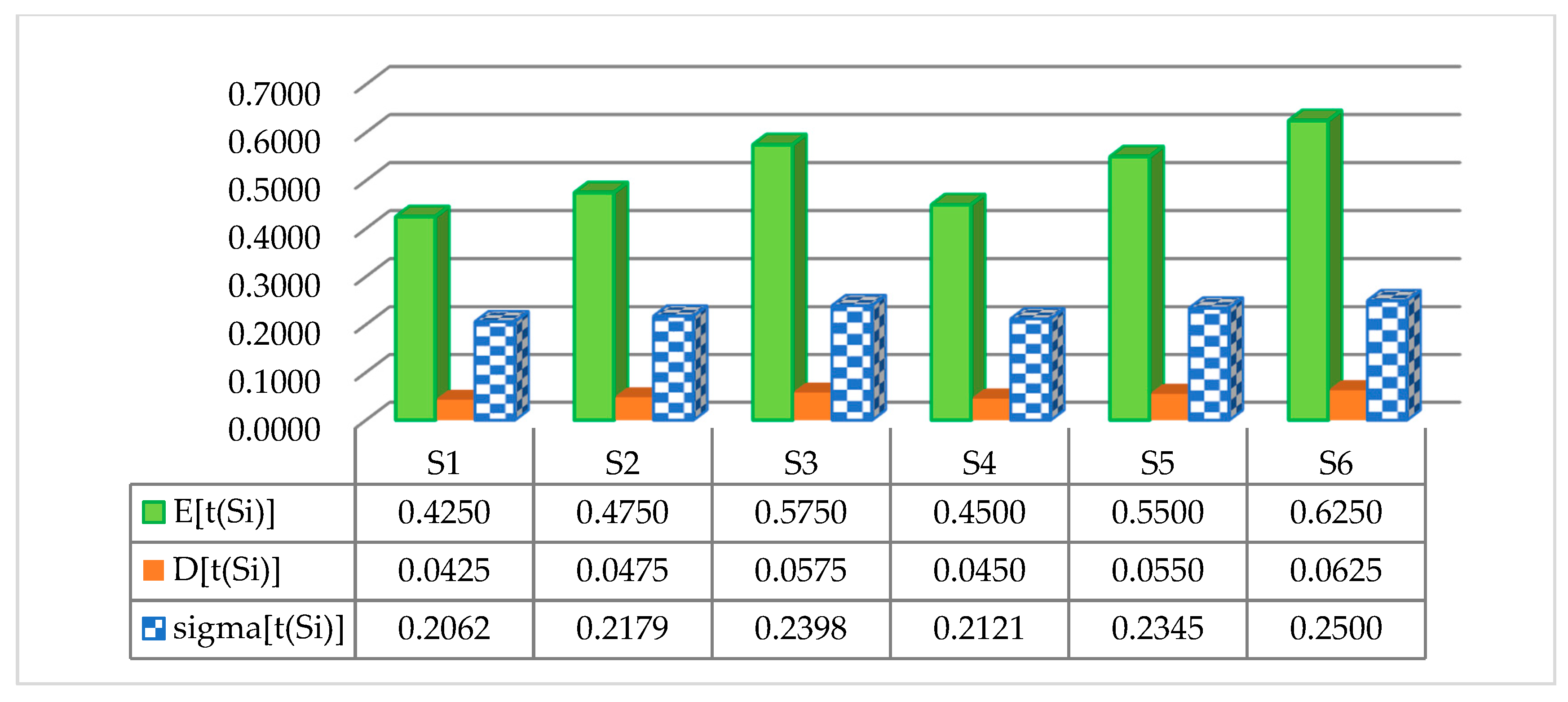
A summary of some experimental results obtained by execution of the program module ‘ESTIMATES’ for investigation of the graph structure from Figure 3d are presented below. For example, a graphical representation of the experimental estimates for mathematical expectation (E), variance (D) and standard deviation (sigma) is shown in Figure 5 and other estimates for correlation between determined paths in the structure are presented in Table 1.
Figure 5. Results for the stochastic parameters’ mathematical expectation (E), variance (D) and standard deviation (sigma).
Table 1. Experimental estimates of the correlation between defined pathways.
The obtained program results confirm the estimates obtained by analytical calculation (accuracy depends on rounding). For example, the correlation coefficient for the pair S1:<A1 A2 A4> and S2:<A1 A2 A5> is calculated analytically as follows:
r 12 = D [ t ( A 1 ) ] + D [ t ( A 2 ) ] σ [ t ( S 1 ) ] × σ [ t ( S 2 ) ] = ( 0.05 / 4 ) + ( 0.1 / 4 ) 0.206 × 0.218 = 0.0375 0.0449 0.835 .
On the other hand, calculated experimental execution results (Table 1) show that the maximum correlation exists for the equivalent pathways (for example r23 and r45).

4.3. Application in Parallel Processes Dispatching

Ensuring optimal performance in parallel processing of processes is associated with solving two mutually opposite tasks: (a) for the processing of a specific set of program units to determine the minimum composition of a parallel computing environment; (b) for a fixed composition of the computing environment to define an optimal plan for processing a given set of tasks in minimum time. The first task is oriented towards homogeneous architectural structures, while the second allows variable composition and the possibility of both static and dynamic parallelization. The application of the program module ‘ESTIMATES’ is aimed mainly at solving the second task, allowing us to conduct a preliminary study of the processes and to determine their characteristics, affecting the dispatch plan.
The dispatch plan is a segment function D(t) = {d1(t), …, dm(t)}, defined in the interval (0, τ) and accepting values from the set A = {A1, …, An}, which is a basic GSA component, defined as a directed graph G = G(A, L) of the information–logical connections lijL for pairs of nodes (planning processes) <Ai, Aj> (i, j = 1 ÷ n)—it is possible to represent the set A as a set of indices {1, 2, …, n}. Thus, the notation di(t) = j (1 ≤ im; 1 ≤ jn) reflects the occupancy of the resource Si at the moment t with the execution of the process Aj (S = {S1, …, Sm} e set of the system resource). Strictly connected sections in G, forming a road of type AiAj, are not allowed. The relation of information dependence is transitive, i.e., if Aj depends on Ai and Aq depends on Aj, then process Aq will depend on Ai. The latter obliges the process Ai to be executed before Aq. The transitive dependence in G will be represented by the presence of the pass(AiAj). The possibility of interrupting the execution of a process requires further clarification. If we assume that an interruption is not allowed, then the occupancy of the resource Si on the execution of Aj is tijT*. If T = {t1, …, tn} is a vector of the execution times of the processes Ai (i = 1 ÷ n), then in the case of heterogeneous system resources a given process Ai can occupy several devices in succession for different times {ti1, ti2, …, tik}. Then, ti = Σtik, and the vector T can be modified in the matrix T* = {tij} with n = |A| rows and m = |S| columns.
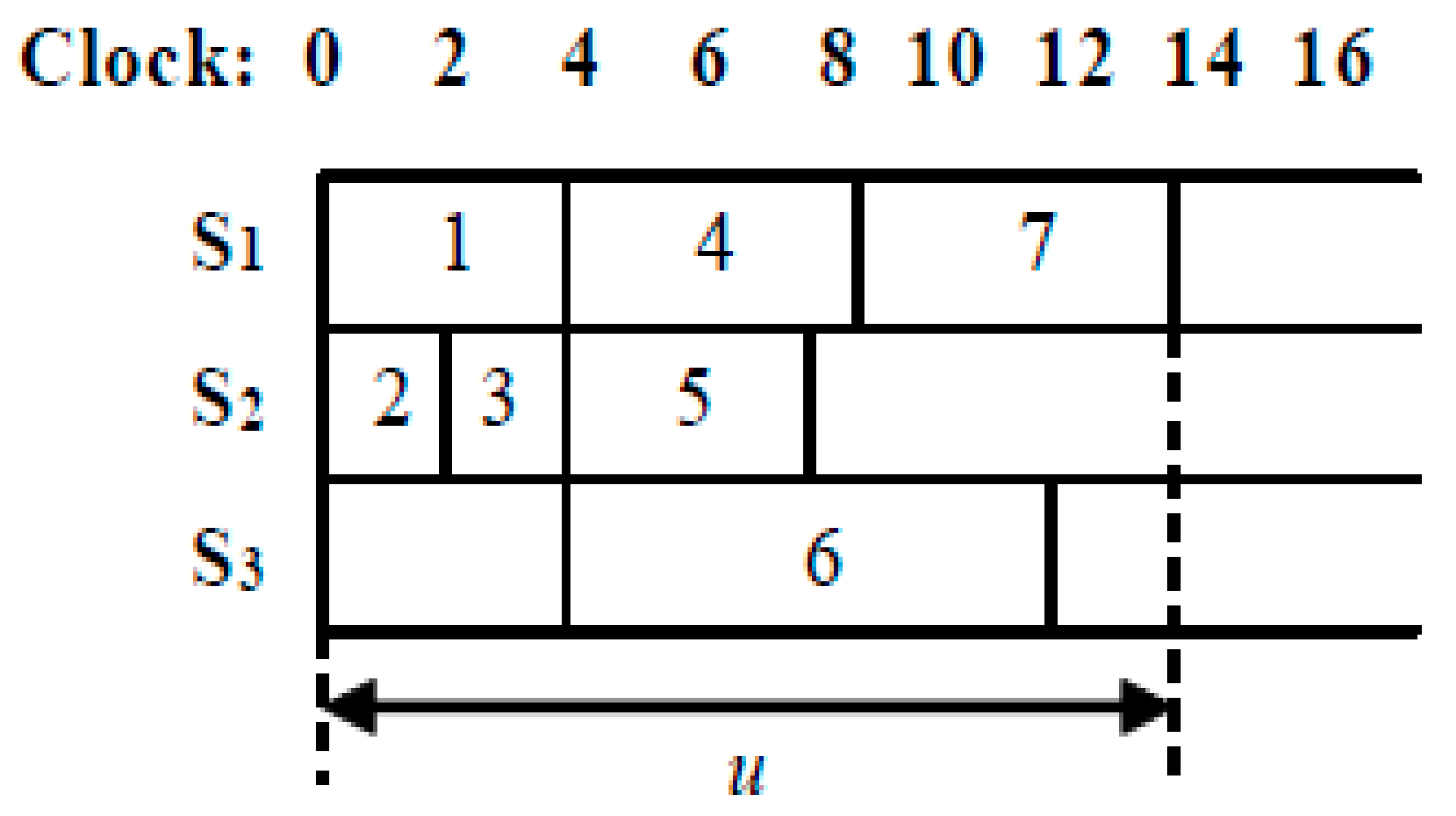
Based on the formalization made in the previous section, the process planning procedure can be presented as P = <S, A, G, T, F>, where in addition to the elements presented above, criterion F is included to define the type of planning strategy (for example, minimization of the total time for implementation of the global algorithm—FT, minimization of the average time for execution of a single process, minimization of resource usage, maximum workload of processors, minimization of CPU downtime, etc.). In this formulation, a plan for the realization of the processes from Figure 3d can be defined in the following way P = <{1,2,3}, {1,2,3,4,5,6,7}, G, {4,2,2,5,4,8,5}, FT>, where |S| = 3, |A| = 7, and FT is the chosen planning strategy. It is formed on the basis of determining all directed paths presented in Figure 3c in the ordered GSA after the applied module of Figure 3a. Four layers are defined, forming information-independent subsets of nodes with corresponding weights ti (i = 1 ÷ 7): {1(4); 2(2)}, {3(2)}, {4(5); 5(4), 6(8)}, {7(5)}, as the realization of the plan in environment S = {S1, S2, S3} is shown in Figure 6 [1]. Estimates of the processes obtained after the implementation of the module ‘ESTIMATE’ were used in the formation of the dispatching plan. The maximum environment for the implementation of the plan is determined by the maximum power (number of tasks) of a layer in the ordered GSA. In this case, three processors are used, but with criterion F = “maximum workload of processors” it would be more appropriate to implement the plan at |S| = 2.
Figure 6. Plan for implementation of the processes from Figure 3d in a system with three processors.

5. Discussion and Conclusions

The organization of the planning of parallel processes is directly related to the abstract description of the processes themselves and formalization of the hierarchical structure of the algorithms generating them, as well as to the correct description and definition of the optimal parallel form for realization. From the existing possibilities for deterministic research (logical and matrix schemes of algorithms, Post’s algorithmic system, normal Markov’s algorithms, d-maps, Petri nets, generalized networks, etc.) for solving the task set in the article, the formalization of the processes by ordered graph structure is selected.
The article discusses a partial problem related to investigation of time parameters and stochastic characteristics of processing in a generalized graph-structure of algorithm (GSA), which has been used as an input element (input data) for the implementation of the module ‘PATH’ and the obtained result SA is used as an input data for the module ‘ESTIMATES’. It is accepted that the currently active program (information) units can be represented as components (elements) of this directed common graph structure GSA. In this sense, the study presented here should be seen as a continuation of the investigation published in [1]. The general task is to form a unified program space of modules, which will allow the study of various problems in the processing of computer environments at the macro and micro level. Reference [20] can be considered an extension of the discussed problem, which discusses issues with the model investigation of basic structural components of the computer environment. In particular, this article discusses some problems with the evaluation of parameters of process realization aimed at forming an adequate and optimal plan for their implementation.
The proposed approach allows automation of the evaluation of certain characteristics of computer processing (mathematical expectation E[T(Ai)] and variance D[T(Aj)] of time for task realization, deadlines for task completion, probability characteristics, etc.), presented as a sequence of relatively independent processes, but performed jointly in a common environment, which requires competition between them in borrowing resources and proper advance planning of the task implementation. The main feature is that regardless of the discrete structure of the computer environment, the processes in it, as well as the incoming flow of service tasks, are probabilistic. This requires investigation and analysis of the stochastic parameters of these processes, and such an attempt is made in this article.
The object of this analysis are the parameters of the complexity of the tasks (which affects overall performance) and the probabilities for the realization of individual activations of sequences of program units—estimates E (mathematical expectation) and D (variance) of the total intensity of the implementation of a given Si path in the information structure S(A); the assessment E and D of the realization of a certain task included in a given path SiS(A); and the standard deviation σ and estimation of the correlation relationship rij for the pairs <Si, Sj>. Obtained experimental results are summarized in Figure 5 and Table 1. Assessments in this research are obtained by using proposed module ‘ESTIMATES’, which is developed in program spice TryAPL2 and language APL2. The choice of this environment is determined by the high possibilities for parallel calculations and work with matrices.
An application of a developed environment of program modules, including ‘ESTIMATES’, in the formation of a plan for the implementation of homogeneous processes {Ai} in the realization of the strategy “minimization of the total time for the implementation of the global algorithm G(A, L)” in a homogeneous system of computational resources {Sj}. The study was conducted on the basis of some assumptions that allow for the unification of the process. It is stated that the implementation of another planning strategy may lead to another outcome of a specific implementation.
The object of future work is the study of planning in inhomogeneous processes with different execution times t(Ai), which will allow us to expand the scope of applicability of the developed software space. For this purpose, it is necessary to set the scalar weights of the nodes when describing the initial GSA, which will not change the work of the developed modules from the program space—‘GSA’ (for determining the ordered scheme), ‘PATH’ (for forming the complete set of paths) and ‘ESTIMATES’ (for calculating assessments). The only difference will be obtained by defining the length of the roads (the sum of the weights) and calculating the critical time. On the other hand, when generating an optimal plan, it is necessary to estimate the weights of the processes in each individual layer.

Funding

This research received no external funding.

Institutional Review Board Statement

Not applicable.

Data Availability Statement

Not applicable.

Conflicts of Interest

The author declares no conflict of interest.

References

  1. Romansky, R. An Approach for Mathematical Modeling and Investigation of Computer Processes at a Macro Level. Mathematics 2020, 8, 1838. [Google Scholar] [CrossRef]
  2. Globa, L.; Gvozdetska, N. Comprehensive Energy Efficient Approach to Workload Processing in Distributed Computing Environment. In Proceedings of the 2020 IEEE International Black Sea Conference on Communications and Networking (BlackSeaCom), Odessa, Ukraine, 26–29 May 2020; pp. 1–6. [Google Scholar] [CrossRef]
  3. Ye, Y.; Hu, T.; Yang, Y.; Zhu, W.; Zhang, C. A knowledge based intelligent process planning method for controller of computer numerical control machine tools. J. Intell. Manuf. 2020, 31, 1751–1767. [Google Scholar] [CrossRef]
  4. Masdari, M.; Khoshnevis, A. A survey and classification of the workload forecasting methods in cloud computing. Clust. Comput. 2020, 23, 2399–2424. [Google Scholar] [CrossRef]
  5. Hu, C.; Deng, Y. QoS-Oriented Capacity Provisioning in Storage Clusters by Modeling Workload Patterns. In Proceedings of the 2017 IEEE International Symposium on Parallel and Distributed Processing with Applications and 2017 IEEE International Conference on Ubiquitous Computing and Communications (ISPA/IUCC), Guangzhou, China, 12–15 December 2017; pp. 108–115. [Google Scholar] [CrossRef]
  6. Kravets, O.J.; Atlasov, I.V.; Aksenov, I.A.; Molchan, A.S.; Frantsisko, O.Y.; Rahman, P.A. Increasing efficiency of routing in transient modes of computer network operation. Int. J. Inf. Technol. Secur. 2021, 13, 3–14. [Google Scholar]
  7. Smolentsev, S.; Spagnuolo, G.A.; Serikov, A.; Rasmussen, J.J.; Nielsen, A.H.; Naulin, V.; Marian, J.; Coleman, M.; Malerba, L. On the role of integrated computer modelling in fusion technology. Fusion Eng. Des. 2020, 157, 111671. [Google Scholar] [CrossRef] [Green Version]
  8. Li, C.; Zhang, Y.; Hao, Z.; Luo, Y. An effective scheduling strategy based on hypergraph partition in geographically distributed datacenters. Comput. Netw. 2020, 170, 107096. [Google Scholar] [CrossRef]
  9. Chang, S.; Zhao, X.; Liu, Z.; Deng, Q. Real-Time scheduling and analysis of parallel tasks on heterogeneous multi-cores. J. Syst. Arch. 2020, 105, 101704. [Google Scholar] [CrossRef]
  10. Harki, N.; Ahmed, A.; Haji, L. CPU Scheduling Techniques: A Review on Novel Approaches Strategy and Performance Assessment. J. Appl. Sci. Technol. Trends 2020, 1, 48–55. [Google Scholar] [CrossRef]
  11. Oleinikova, S.A.; Selishchev, I.A.; Kravets, O.J.; Rahman, P.A.; Aksenov, I.A. Simulation model for calculating the probabilistic and temporal characteristics of the project and the risks of its untimely completion. Int. J. Inf. Technol. Secur. 2021, 13, 55–62. [Google Scholar]
  12. Canon, L.-C.; Chang, A.K.W.; Robert, Y.; Vivien, F. Scheduling independent stochastic tasks under deadline and budget constraints. Int. J. High Perform. Comput. Appl. 2019, 34, 246–264. [Google Scholar] [CrossRef]
  13. Atlasov, I.V.; Bolnokin, V.E.; Kravets, O.J.; Mutin, D.I.; Nurutdinov, G.N. Statistical models for minimizing the number of search queries. Int. J. Inf. Technol. Secur. 2020, 12, 3–12. [Google Scholar]
  14. Ilyuskin, A. Scheduling Workloads of Workflows in Clusters and Clouds. Ph.D. Thesis, Delft University of Technology, Delft, The Netherlands, 19 December 2019. [Google Scholar] [CrossRef]
  15. Martyshkin, A.; Pashchenko, D.; Trokoz, D.; Cинeв, М.; Svistunov, B.L. Using queuing theory to describe adaptive mathematical models of computing systems with resource virtualization and its verification using a virtual server with a configuration similar to the configuration of a given model. Bull. Electr. Eng. Inform. 2020, 9, 1106–1120. [Google Scholar] [CrossRef]
  16. Siddiqui, S.; Darbari, M.; Yagyasen, D. An QPSL Queuing Model for Load Balancing in Cloud Computing. Int. J. e-Collab. 2020, 16, 33–48. [Google Scholar] [CrossRef]
  17. Leochico, K.; John, E. Evaluating Cloud Auto-Scaler Resource Allocation Planning Under High-Performance Computing Workloads. In Proceedings of the 2020 IEEE Intl Conf on Parallel & Distributed Processing with Applications, Big Data & Cloud Computing, Sustainable Computing & Communications, Social Computing & Networking (ISPA/BDCloud/SocialCom/SustainCom), Exeter, UK, 17–19 December 2020; pp. 966–975. [Google Scholar] [CrossRef]
  18. Cai, W.; Zhu, J.; Bai, W.; Lin, W.; Zhou, N.; Li, K. A cost saving and load balancing task scheduling model for computational biology in heterogeneous cloud datacenters. J. Supercomput. 2020, 76, 6113–6139. [Google Scholar] [CrossRef]
  19. Zhou, Z.; Liu, P.; Chang, Z.; Xu, C.; Zhang, Y. Energy-efficient workload offloading and power control in vehicular edge computing. In Proceedings of the 2018 IEEE Wireless Communications and Networking Conference Workshops (WCNCW), Las Vegas, NV, USA, 15–18 April 2018; pp. 191–196. [Google Scholar]
  20. Romansky, R. Program Environment for investigation of micro-level computer processing. Int. J. Int. Technol. Secur. 2021, 13, 83–92. [Google Scholar]
Publisher’s Note: MDPI stays neutral with regard to jurisdictional claims in published maps and institutional affiliations.

Article Metrics

Citations

Article Access Statistics

Multiple requests from the same IP address are counted as one view.