


Abstract
The goal of this paper is to introduce a novel soft hyperstructure called multi-fuzzy soft hyperstructure. We investigate the notion of multi-fuzzy soft hypermodules and some of their structural properties are discussed. We discuss the behavior image and inverse image of a multi-fuzzy soft set under the multi-fuzzy soft function. According to Zadeh’s extension principle, we prove that the image and inverse image of a multi-fuzzy soft hypermodules are further multi-fuzzy soft hypermodule.
MSC:
20N20; 20N25; 08A72
1. Introduction
Algebraic hyperstructures based on hyperoperations were introduced by Marty [1] and studied by many scientists. There are several books on hyperstructure theory, see in [2,3,4,5]. In [2], many applications are mentioned [2]. For example, fuzzy and rough set theory, cryptography, codes, automata, probability, geometry, lattices, binary relations, graphs, and hypergraphs. Studying fuzzy hyperalgebraic structures is one of the important topics of fuzzy set theory. Fuzzy sets, defined by Zadeh [6], and hyperstructures, defined by Marty [1], have found wide application area both theoretically and practically. The relationship between fuzzy sets and algebraic hyperstructures has been considered by some researchers. We recommend to readers to see the works in [7,8,9,10,11,12]. In [8,9], Davvaz applied the notion of fuzzy sets to the theory of algebraic hyperstructures and defined fuzzy subhypergroup (resp. -subgroup) of a hypergroup (resp. -group), which is a generalization of the notion of Rosenfeld’s fuzzy subgroup of a group [10] and also defined fuzzy -submodules. Different hypermodules, fuzzy hypermodules, and rough hypermodules have been studied [13,14,15,16,17,18,19].
Soft set theory introduced by Molodtsov [20] is an powerful mathematical tool for modeling vagueness. After Molodsov’s work, some different applications of soft sets were studied in [21,22]. Maji et al. [22] offered the definition of fuzzy soft set. They presented the first practical application of soft sets in decision making problems. The more generalized concept of the fuzzy soft set, which is a combination of fuzzy sets and soft sets, introduced and studied by these authors. Both soft set and fuzzy soft set theories have been applied to algebraic structures and hyperstructures by some authors, see in [23,24,25,26,27] for the relation between the generalization of crisp sets.
Recently, the theory of multi-fuzzy set has been introduced by Sebastian and Ramakrishnan [28]. Multi-fuzzy set theory uses ordered sequences of membership function and provides a new method to represent problems unexplained in other extensions of fuzzy set theory. In [29], Onasanya and Hoskova-Mayerova introduced fuzzy multi-groups excited by multisets. Then, fuzzy multi-polygroups and fuzzy multi--ideals, which are a generalization of fuzzy -ideals, were studied in [30,31]. Yang et al. [32] proposed the concept of the multi-fuzzy soft set for its application to decision making, which is a more general fuzzy soft set.
The notion of multi-fuzzy soft sets provides a new method to represent some problems, which are difficult to explain in other extensions of fuzzy set theory. For example, in a two-dimensional image, the color of pixels cannot be characterized by a membership function of an ordinary fuzzy set, but it can be characterized by a three-dimensional multi-fuzzy soft sets. Figure 1 shows the relation between generalization of crisp sets. Lately, Akın [33] proposed the multi-fuzzy soft sets to the theory of groups and defined the multi-fuzzy soft group.
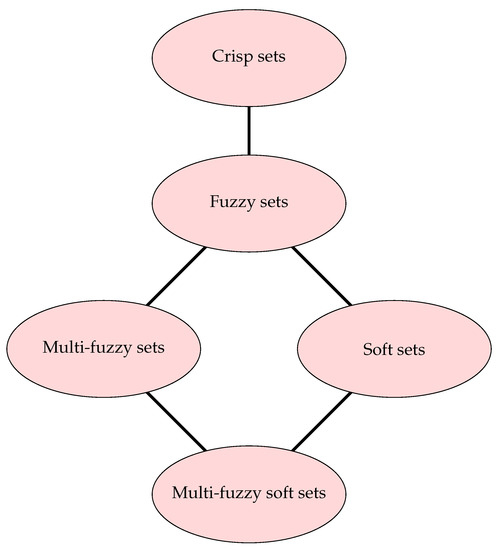
Figure 1.
The relation between generalization of crisp sets.
The goal of this paper is to assemble fuzzy soft hypermodules and soft hypermodules, from which we obtain a new sort of soft hypermodule named multi-fuzzy soft hypermodule. We first recall some basic definitions and results which are used to present the article in Section 2. In Section 3, the notion of multi-fuzzy soft hypermodule with its properties and structural characterization are discussed. In Section 4, we give the image and inverse image of a multi-fuzzy soft set under the multi-fuzzy soft function, and then define soft homomorphism between multi-fuzzy soft hypermodules. In Section 5, some conclusions are presented.
2. Preliminaries
Let H be a basic non-empty set. A hyperoperation on H is a mapping , where is the set of all the non-empty subsets of H. If and , then we denote , , and as follows: , and . is called a canonical hypergroup [5] if the following axioms hold:
- (1)
- , for all ;
- (2)
- , for all ;
- (3)
- There exists such that , for all ;
- (4)
- for every there exists a unique element such that , ( is called the adverse of x).
Definition 1
(Refs. [34,35,36]). The algebraic structure is called a hyperring (Krasner hyperring) if the following axioms hold: (1) is a canonical hypergroup; (we shall write 0 and for e and , respectively); (2) is a semigroup having zero as a bilaterally absorbing element; (3) The multiplication is distributive with respect to the hyperoperation +.
It is easy to see that he following elementary facts follow from the axioms: and . Let A be a non-empty subset of a hyperring R. Then A is called a sub-hyperring of R if is itself a hyperring. A sub-hyperring A of R is called a normal if for all .
Definition 2
(Ref. [16]). Let M be a non-empty set. Then, M is called a hypermodule over a hyperring R (R-hypermodule) if is a canonical hypergroup and there exists a map by such that for all and , we have , , and .
Let A be a non-empty subset of hypermodule M. Then, A is called a sub-hypermodule of M if A is itself a hypermodule. A sub-hypermodule A of M is called a normal if for all . From the definition, the following propositions are obtained. Let A be a normal sub-hypermodule of M. Then, for all and for all . If A and B are sub-hypermodules of an R-hypermodule M with B normal in M, then is a normal sub-hypermodule of A and B is a normal sub-hypermodule of . A mapping is called a homomorphism if for all and , and . Clearly, a homomorphism f is an isomorphism if f is both injective and surjective.
Definition 3
(Ref. [11]). Let μ be a fuzzy subset of a hypermodule M over a R. μ is called a fuzzy sub-hypermodule of M if
- (1)
- for all ;
- (2)
- for all ;
- (3)
- for all and .
A fuzzy sub-hypermodule of M is called a normal if for all . Let be a fuzzy sub-hypermodule of M. It is clear that , , for all .
We first recall some basic definitions and results which are used to present the article [20,23,24,25,26,28,32]. Let U be an initial universe set and E be a set of parameters. denotes the power set of U and .
Definition 4
(Ref. [20]). is said to be a soft set over U, where F is a set-valued function can be defined as for all and R will refer to an arbitrary binary relation between an element of A and an element of U, that is, R is a subset of . Actually, a soft set over U is a parameterized family of subsets of the universe U.
Definition 5
(Refs. [22,24]). Let be all fuzzy subsets of U. Then, is said to be a fuzzy soft set over U, where f is a mapping given by . That is, for each , is a fuzzy set on U.
Definition 6
(Ref. [28]). A multi-fuzzy set in U is a set of ordered sequences
, where and k is a positive integer.
The function is called the multi membership function of multi-fuzzy set denoted by , k is called a dimension of . Denoted by , the set of all multi-fuzzy sets of dimension k in U.
Note: Zadeh’s fuzzy set is one-dimensional multi-fuzzy set and Atanassov’s intuotionistic fuzzy set is two-dimensional multi-fuzzy set with
Example 1
(Ref. [28]). Assume a color image is approximated by an matrix of pixels. Let U be the set of all pixels of the color image. For any pixel , the membership values , , are the normalized red value, green value and blue value of the pixel u, respectively. Therefore, the color image can be estimated by the collection of pixels with the multi-membership function and can be represented as a multi-fuzzy set . In a two-dimensional image, pixel color cannot be characterized by a membership function of an ordinary fuzzy set. However, pixel color can be qualified by a three-dimensional membership function . Actually, a multi-fuzzy set can be known as a more general fuzzy set using ordinary fuzzy sets as its building blocks.
Definition 7
(Ref. [28]). Let . If , then is said to be the null multi-fuzzy set of dimension k, denoted by . If , then is said to be the absolute multi-fuzzy set of dimension k, denoted by .
Definition 8
(Ref. [28]). Let and be two multi-fuzzy sets of dimension k in U. We give the following relations and operations.
- (1)
- if and only if , i.e., , and .
- (2)
- if and only if , i.e., , and .
- (3)
- . That is, .
- (4)
- . That is, .
- (5)
Definition 9
(Ref. [32]). A pair is called a multi-fuzzy soft set of dimension k over U, where is a function defined by . That is, for each , . For , may be considered a set of a-approximate elements of the multi-fuzzy soft set .
Definition 10
(Ref. [32]). Let and be two multi-fuzzy soft sets of dimension k over U where . Then, is said to be a multi-fuzzy soft subset of if, and for each . In this situation, we write .
Definition 11
(Ref. [32]). Let be a multi-fuzzy soft set of dimension k over U. Then, is called a null multi-fuzzy soft set, denoted by if for all .
is called a absolute multi-fuzzy soft set, denoted by if for all .
Definition 12
(Ref. [32]). Let and be two multi-fuzzy soft sets of dimension k over U.
- (1)
- Their ∧-intersection denoted by , is defined as , where , for all .
- (2)
- Their ∨-union denoted by , is defined as , where , for all .
Definition 13
(Ref. [32]). Let and be two multi-fuzzy soft sets of dimension k over U. Then, their union is the multi-fuzzy soft set , where and for all , if , if and if . We write .
Definition 14
(Ref. [32]). Let and be two multi-fuzzy soft sets of dimension k over U.
- (1)
- Their restricted intersection is the multi-fuzzy soft set , where , and for all , . Its denoted by .
- (2)
- Their extended intersection is the multi-fuzzy soft set , where and for all , if , if and if . We write .
3. Multi-Fuzzy Soft Hypermodules
In [30], the notion of fuzzy-multi polygroup which extends the notion of multi-fuzzy group studied by Al Tahan et all. In this paper, we used the definition algebraic structure of multi-fuzzy set and multi-fuzzy soft set which was given by Sebastian et.al in [28] and Yang et al. [32], respectively, we introduce the definition of multi-fuzzy soft hypermodules and give some fundamental properties of multi-fuzzy soft hypermodules.
Definition 15.
Let M be a hypermodule over a hyperring R and be a multi-fuzzy soft set of dimension k over M. Then is called a multi-fuzzy soft hypermodule of dimension k over M if and only if for all , and ,
- (1)
- ;
- (2)
- ;
- (3)
- .
That is, for each , is a multi-fuzzy subhypermodule of M.
The first condition requires that the hypermodule is closed under multi-fuzzy soft hyperoperation +. The second condition is a generalization of inverse element under +. Furthermore, the third condition extend the external product.
Proposition 1.
Let be a multi-fuzzy soft set of dimension k over M. If is a multi-fuzzy soft hypermodule, then for all and , we have
- (i)
- ,
- (ii)
- ,
- (iii)
- .
Proof.
The proof follows from Definition 15. □
Indeed, the condition (i) is equivalent to the conditions (1) and (2). The condition (ii) means that the degree of membership of is equal to x, and the condition (iii) says that the degree of 0 is greater than of all elements of M.
To explain, we give a few examples to see what the definition means.
Example 2.
Consider and with the following hyperoperations:
| 0 | 1 | 2 | 3 | 0 | 1 | 2 | 3 | |||
| 0 | 0 | 1 | 2 | 3 | 0 | 0 | 0 | 0 | 0 | |
| 1 | 1 | 0 | {1,2} | {1,3} | 1 | 0 | 1 | 2 | 3 | |
| 2 | 2 | {1,2} | 0 | {2,3} | 2 | 0 | 2 | 0 | 2 | |
| 3 | 3 | {1,3} | {2,3} | 0 |
| 0 | 1 | 2 | 0 | 1 | 2 | |||
| 0 | 0 | 1 | 2 | 0 | 0 | 0 | 0 | |
| 1 | 1 | 0 | {1,2} | 1 | 0 | 1 | 2 | |
| 2 | 2 | {1,2} | 0 | 2 | 0 | 2 | 1 |
Then, is a hypermodule over hyperring [26]. Let be the set of parameters.
(1) We define the multi-fuzzy soft set as follows.
Then, for all , is a multi-fuzzy subhypermodule on M. By Definition 15, is a multi-fuzzy soft hypermodule of dimension 3 over M.
(2) We define the multi-fuzzy soft set as follows.
Then, it is easy to see that and are multi-fuzzy subhypermodules on M. However, is not a multi-fuzzy subhypermodule on M as . By Definition 15, is not a multi-fuzzy soft hypermodule of dimension 3 over M.
Example 3.
Let and be a soft set over M. For all , the multi-fuzzy soft set defined by
for all . Then, is a multi-fuzzy soft set of dimension k over M. According to this way a soft set over M can be consider as a multi-fuzzy soft set of dimension k over M.
Example 4.
According to Example 2, each one soft set can be seen as a multi-fuzzy soft set and each one characteristic function of a subhypermodule of a hypermodule is a multi-fuzzy subhypermodule, we can take into account a soft hypermodule as a multi-fuzzy soft hypermodule.
Example 5.
Take into account the hypermodule defined in Example 2. Let be a set of parameters. We define the multi-fuzzy soft set as follows. For all for all , and . Then, is a multi-fuzzy sub-hypermodule of M for all . By Definition 15, is a multi-fuzzy soft hypermodule of dimension k over M.
The following theorem shows that Definition 15 is a generalization of soft hypermodule. The theorem is expressed in terms of a necessary and sufficient condition.
Theorem 1.
Let be a soft set over M. Then, is a soft hypermodule over M if and only if is a multi-fuzzy soft hypermodule of dimension k over M.
Proof.
The proof is follows by Example 3. □
In Theorem 2, we show that the restricted intersection and the extended intersection of two multi-fuzzy soft hypermodules are also multi-fuzzy soft hypermodules.
Theorem 2.
Let and be two multi-fuzzy soft hypermodules of dimension k over M.
- (1)
- is a multi-fuzzy soft hypermodule.
- (2)
- is a multi-fuzzy soft hypermodule.
Proof.
(1) Using Definition 14 (i), let , where and for all , . As and be two multi-fuzzy soft hypermodule of dimension k over M, we have for arbitrary , for all and
For arbitrary , for all and
Moreover,
Therefore, is a multi-fuzzy soft hypermodule of dimension k over M.
(2) According to Definition 14 (2), we can write , . If , then is a multi fuzzy sub-hypermodule of M, as is a multi-fuzzy soft hypermodule over M; if , then is a multi fuzzy sub-hypermodule of M, as is a multi-fuzzy soft hypermodule over M; if , then is a multi-fuzzy sub-hypermodule of M by (1). Therefore, is a multi-fuzzy soft hypermodule of dimension k over M. □
From Theorem 2, we have the following corollary.
Corollary 1.
Let be a family of multi-fuzzy soft hypermodules of dimension k over M. If . Then,
- (1)
- is a multi-fuzzy soft hypermodule over M.
- (2)
- is a multi-fuzzy soft hypermodule over M.
The union of two multi-fuzzy soft hypermodules is not a multi-fuzzy soft hypermodule. In Theorem 3, we provide a condition for the union to be a multi-fuzzy soft hypermodule too.
Theorem 3.
Let and be two multi-fuzzy soft hypermodules of dimension k over M. If , then is a multi-fuzzy soft hypermodule of dimension k over M.
Proof.
According to Definition 13, we can write , where . As , it follows that either or for all . If , then is a multi fuzzy subhypermodule of M and if , then are multi fuzzy subhypermodule of M. Therefore, is a multi-fuzzy soft hypermodule of dimension k over M. □
Theorem 4.
Let and be two multi-fuzzy soft hypermodule of dimension k over M. Then is a multi-fuzzy soft hypermodule of dimension k over M.
Proof.
According to Definition 12 (1), let . We know that , for all , and , for all , is a multi-fuzzy subhypermodule of M and so is for all , because intersection of two multi-fuzzy subhypermodule is also a multi-fuzzy subhypermodule. Therefore, is a multi-fuzzy soft hypermodule of dimension k over M. □
From Theorems 3 and 4, we obtain the following corollary.
Corollary 2.
Let be a family of multi-fuzzy soft hypermodule of dimension k over M.
- (1)
- If for all and , then is a multi-fuzzy soft hypermodule of dimension k over M.
- (2)
- is a multi-fuzzy soft hypermodule of dimension k over M.
Theorem 5.
Let and be two multi-fuzzy soft hypermodules of dimension k over M. If or , then is a multi-fuzzy soft hypermodule of dimension k over M.
Proof.
Suppose that and be two multi-fuzzy soft hypermodules of dimension k over M. By the Definition 12 (2), we can write , where , and for all . As and are multi-fuzzy soft hypermodule of dimension k over M, we deduce that , for all , and , for all , are multi-fuzzy subhypermodule of M. By assumption, is a multi-fuzzy soft hypermodule of dimension k over M for all . Therefore, the ∨-union a multi-fuzzy soft hypermodule of dimension k over M. □
Definition 16.
Let and be two multi-fuzzy soft sets of dimension k over M. Then, their sum is a multi-fuzzy soft sets , where , denoted by and for all ,
and for every ,
Theorem 6.
Let and be two multi-fuzzy soft hypermodules of dimension k over M. Then, is a multi-fuzzy soft hypermodule of dimension k over M.
Proof.
It is straightforward. □
Definition 17.
Let be a multi-fuzzy soft set of dimension k over M. The soft set , where
for all , , is said to be a t-level soft set of the multi-fuzzy soft set , where is a t-level subset of the multi-fuzzy set .
Level set also known as t-cut is a soft set for a multi-fuzzy soft set consisting of all members of universe of discourse have membership value greater than or equal to t. The t-level cuts are a very useful tool to study the theory of multi-fuzzy soft sets and their applications. It convert the whole multi-fuzzy soft system to soft system (i.e., classical soft set theory system).
This following theorem explores the relation between multi-fuzzy soft hypermodule and t-level soft sets.
Theorem 7.
Let be a multi-fuzzy soft set of dimension k over M. Then, is a multi-fuzzy soft hypermodule of dimension k over M if and only if for all and for all with the t-level soft set is a soft hypermodule over M.
Proof.
Suppose be a multi-fuzzy soft hypermodule of dimension k over M. Then, for each , is a multi-fuzzy subhypermodule of M. Suppose that with and . Then, , . Thus,
which implies that for all . Therefore, . Moreover, for , we have and for all . It follows that for all , We obtain that is a sub-hypermodule of M for all . Consequently, is a soft hypermodule over M. Conversely, let be a soft hypermodule over M for all . Let for some . Then, obviously consequently, . Thus,
Now, for some . As, by the assumption, every non-empty t-level soft set is a soft hypermodule over M, for all . Then, and . As a result, we get that is a multi-fuzzy subhypermodule of M for all . Consequently, is a multi-fuzzy soft hypermodule of dimension k over M. □
Definition 18.
Let be a multi-fuzzy soft set of dimension k over M. We define the soft set , where
Theorem 8.
Let be a multi-fuzzy soft hypermodule of dimension k over M. Then, the soft set is a soft hypermodule over M.
Proof.
Let be a multi-fuzzy soft hypermodule of dimension k over M. Then for each , is a multi-fuzzy sub-hypermodule of M. Suppose that . Then, . Thus,
and which implies that for all . Therefore, . Moreover, for , we have by Proposition 1, . and similarly for all . It follows for all , We obtain that is a sub-hypermodule of M for all . Consequently, is a soft hypermodule over M. □
4. Image and Pre-Image of Multi-Fuzzy Soft Hypermodules
In this section, We define the images and pre-images of multi-fuzzy soft hypermodules using Zadeh image and primage operators. Then, we study and investigate their properties. First we begin with the following definition. Suppose that
Then, is called a multi-fuzzy soft set class over M.
Definition 19.
Let , and and be two functions. Then, the pair is said to be a multi-fuzzy soft function from to .
Definition 20.
Let , and be a multi-fuzzy soft function from to .
- (1)
- The image of under the multi-fuzzy soft function , denoted by , is the multi-fuzzy soft set such that the multi-fuzzy set for any is expressed as follows:for all .
- (2)
- The pre-image of under the multi-fuzzy soft function , denoted by , is the multi-fuzzy soft set such that the multi-fuzzy set is expressed as follows:
for all and .
If φ and ψ are injective (surjective), then is said to be injective (surjective).
Furthermore, we define a multi-fuzzy soft homomorphism and show that the homomorphic image and pre-image of a multi fuzzy soft hypermodule are also multi-fuzzy soft hypermodules.
Definition 21.
Let be two hypermodules and be a multi-fuzzy soft function from to . If φ is a strong homomorphism of hypermodules, then the pair is called multi-fuzzy soft homomorphism. If φ is a isomorphism and ψ is a one-to-one mapping, then is said to be multi-fuzzy soft isomorphism.
Theorem 9.
Let be two hypermodules and be a multi-fuzzy soft homomorphism from to . If is a multi-fuzzy soft hypermodule, then is a multi-fuzzy soft hypermodule.
Proof.
Let , . If or , the proof is straightforward. Assume that there exist , such that and . Since is a multi-fuzzy soft hypermodule, it follows that for each
for all . Let . We obtain . Then, we have
Therefore,
for all . Then, we have
Moreover, for all , where and , we have
Similarly, Consequently, is a multi-fuzzy soft hypermodule. □
Theorem 10.
Let be two hypermodules and be a multi-fuzzy soft homomorphism from to . If is a multi-fuzzy soft hypermodule, then is a multi-fuzzy soft hypermodule.
Proof.
Let , . For all , we have
Similarly for all , we have and Therefore, multi-fuzzy soft hypermodule. □
5. Conclusions
In this paper, we investigated the formal relationships among notions arising from the theories of algebraic hyperstructures, soft sets, and fuzzy sets. We introduced the concept of multi-fuzzy soft hypermodules over a hypermodule and studied some of their related properties. In our analysis, we include extended theories that introduce fuzziness and softness. In our study, if , then the multi-fuzzy soft hypermodule becomes a fuzzy soft hypermodule. Furthermore, we discussed image and pre-image of a multi-fuzzy soft set under the multi fuzzy soft function, and investigated soft homomorphism between multi-fuzzy soft hypermodules.
As algebraic hyperstructures can be used in the modeling of biological phenomena [37], this work can be extended to study the applications of multi-fuzzy soft sets in inheritance phenomena with the base of other algebraic hyperstructures like hypergroups, polygroups, and hyperrings.
Author Contributions
Conceptualization, O.K. and B.D.; methodology, O.K., S.H.-M. and B.D.; formal analysis, O.K.; investigation, O.K.; resources, O.K., S.H.-M. and B.D.; writing—original draft preparation, O.K.; writing—review and editing, O.K., S.H.-M. and B.D.; supervision, B.D.; project administration, S.H.-M.; funding acquisition, S.H.-M. All authors have read and agreed to the published version of the manuscript.
Funding
The research was supported by VAROPS, granted by the Ministry of Defence of the Czech Republic.
Institutional Review Board Statement
Not applicable.
Informed Consent Statement
Not applicable.
Data Availability Statement
Not applicable.
Acknowledgments
The authors are highly grateful to the referees for their constructive suggestions for improving the paper.
Conflicts of Interest
The authors declare no conflict of interest.
References
- Marty, F. Sur une generalization de la notion de group. In Proceedings of the 8th Congress Math, Scandenaves, Stockholm, 1934; H. Ohlssons Boktryckeri: Lund, Sweden, 1935; pp. 45–49. [Google Scholar]
- Corsini, P.; Leoreanu-Fotea, V. Applications of Hyperstructures Theory; Advanced in Mathematics; Kluwer: Dordrecht, The Netherlands; Springer: Berlin/Heidelberg, Germany, 2003. [Google Scholar] [CrossRef]
- Vougiouklis, T. Hyperstructures and Their Representations; Hadronic Press: Palm Harbor, FL, USA, 1999. [Google Scholar]
- Davvaz, B.; Leoreanu-Fotea, V. Hyperring Theory and Applications; Hadronic Press, Inc.: Palm Harber, FL, USA, 2007; Volume 115. [Google Scholar]
- Davvaz, B.; Cristea, I. Fuzzy Algebraic Hyperstructures; Studies in Fuzziness and Soft Computing; Springer International Publishing: Cham, Switzerland, 2015; Volume 321. [Google Scholar]
- Zadeh, L.A. Fuzzy sets. Inf. Control 1965, 8, 338–353. [Google Scholar] [CrossRef]
- Zahedi, M.M.; Bolurian, M.; Hasankhani, A. On polygroups and fuzzy subpolygroups. J. Fuzzy Math. 1995, 3, 1–15. [Google Scholar]
- Davvaz, B. Fuzzy Hv-groups. Fuzzy Sets Syst. 1999, 101, 191–195. [Google Scholar] [CrossRef]
- Davvaz, B. Fuzzy Hv-submodules. Fuzzy Sets Syst. 2001, 117, 477–484. [Google Scholar] [CrossRef]
- Rosenfeld, A. Fuzzy groups. J. Math. Anal. Appl. 1971, 35, 512–517. [Google Scholar] [CrossRef]
- Zhan, J.M.; Davvaz, B.; Shum, K.P. A new view on fuzzy hypermodules. Acta Math. Sin. 2007, 23, 1345–1356. [Google Scholar]
- Leoreanu-Fotea, V. Fuzzy hypermodules. Comput. Math. Appl. 2009, 57, 466–475. [Google Scholar] [CrossRef]
- Massouros, C.G. Free and cyclic hypermodules. Ann. Mat. Pura Appl. IV Ser. 1998, 150, 153–166. [Google Scholar] [CrossRef]
- Ameri, R. On categories of hypergroups and hypermodules. J. Discrete Math. Sci. Cryptogr. 2003, 6, 121–132. [Google Scholar] [CrossRef]
- Anvariyeh, S.M.; Davvaz, B. Strongly transitive geometric spaces associated to hypermodules. J. Algebra 2009, 322, 1340–1359. [Google Scholar] [CrossRef]
- Anvariyeh, S.M.; Davvaz, B. On the heart of Hypermodules. Math. Scand. 2010, 106, 39–49. [Google Scholar] [CrossRef][Green Version]
- Norouzi, M.; Leoreanu-Fotea, V. Isomorphism theorems of fuzzy hypermodules. An. St. Univ. Ovidius Constanta 2017, 25, 145–161. [Google Scholar] [CrossRef]
- Norouzi, M.; Leoreanu-Fotea, V. Constructions of Quotient of Fuzzy Hypermodules. J. Mult. Valued Log. Soft Comput. 2018, 30, 449–464. [Google Scholar]
- Kazancı, O.; Yamak, S.; Davvaz, B. The lower and upper approximations in a quotient hypermodule with respect to fuzzy sets. Inf. Sci. 2008, 178, 2349–2359. [Google Scholar] [CrossRef]
- Molodtsov, D. Soft set theory first results. Comput. Math. Appl. 1999, 37, 19–31. [Google Scholar] [CrossRef]
- Maji, P.K.; Biswas, R.; Roy, A.R. Soft set theory. Comput. Math. Appl. 2003, 45, 555–562. [Google Scholar] [CrossRef]
- Maji, P.K.; Biswas, R.; Roy, A.R. Fuzzy soft sets. J. Fuzzy Math. 2001, 9, 589–602. [Google Scholar]
- Aktaş, H.; Çağman, N. Soft sets and soft groups. Inf. Sci. 2007, 177, 2726–2735. [Google Scholar] [CrossRef]
- Aygunoğlu, A.; Aygun, H. Introduction to fuzzy soft groups. Comput. Math. Appl. 2009, 58, 1279–1286. [Google Scholar] [CrossRef]
- Leoreanu-Fotea, V.; Feng, F.; Zhan, J. Fuzzy soft hypergroup. Int. J. Comput. Math. 2012, 89, 963–974. [Google Scholar] [CrossRef]
- Ameri, R.; Norouzi, M.; Hedayati, H. Application of fuzzy sets and fuzzy soft sets in hypermodules. Rev. Real Acad. Cienc. Exactas Fis. Nat. Ser. Mat. 2013, 107, 327–338. [Google Scholar] [CrossRef]
- Zhan, J.M.; Cristea, I. Characterizations of fuzzy soft Gamma-hemirings. J. Intell Fuzzy Syst. 2014, 26, 901–911. [Google Scholar] [CrossRef]
- Sebastian, S.; Ramakrishnan, T.V. Multi-fuzzy sets: An extension of fuzzy sets. Fuzzy Inf. Eng. 2011, 3, 35–43. [Google Scholar] [CrossRef]
- Onasanya, B.O.; Hoskova-Mayerova, S. Multi-fuzzy group induced by multisets. Ital. J. Pure Appl. Math. 2019, 41, 597–604. [Google Scholar]
- Al-Tahan, M.; Hoskova-Mayerova, S.; Davvaz, B. Fuzzy multi-polygroups. J. Intell Fuzzy Syst. 2019, 38, 2337–2345. [Google Scholar] [CrossRef]
- Al Tahan, M.; Hoskova-Mayerova, S.; Davvaz, B. Some Results on (Generalized) Fuzzy Multi-Hv-ideals of Hv-Rings. Symmetry 2019, 11, 1376. [Google Scholar] [CrossRef]
- Yang, Y.; Tan, X.; Meng, C. The multi-fuzzy soft set and its application in decision making. Appl. Math. Modell. 2013, 37, 4915–4923. [Google Scholar] [CrossRef]
- Akın, C. Multi-fuzzy soft groups. Soft Comput. 2021, 25, 137–145. [Google Scholar] [CrossRef]
- Krasner, M. A class of hyperring and hyperfields. Int. J. Math. Math. Sci. 1983, 6, 307–312. [Google Scholar] [CrossRef]
- Bordbar, H.; Cristea, I.; Novak, M. Height of Hyperideals in Noetherian Krasner Hyperrings. Univ. Politeh. Buchar. Sci. Bull.-Ser. A-Appl. Math. Phys. 2017, 79, 31–42. [Google Scholar]
- Bordbar, H.; Cristea, I. Height of prime hyperideals in Krasner hyperrings. Filomat 2017, 31, 6153–6163. [Google Scholar] [CrossRef]
- Davvaz, B.; Vougiouklis, T. A Walk through Weak Hyperstructures. Hv-Structures; World Scientific Publishing Co. Pte. Ltd.: Hackensack, NJ, USA, 2019. [Google Scholar]
Publisher’s Note: MDPI stays neutral with regard to jurisdictional claims in published maps and institutional affiliations. |
© 2021 by the authors. Licensee MDPI, Basel, Switzerland. This article is an open access article distributed under the terms and conditions of the Creative Commons Attribution (CC BY) license (https://creativecommons.org/licenses/by/4.0/).