


Abstract
Let be a simple graph. A vertex labeling is defined to be a local inclusive (respectively, non-inclusive) d-distance vertex irregular labeling of a graph G if for any two adjacent vertices their weights are distinct, where the weight of a vertex is the sum of all labels of vertices whose distance from x is at most d (respectively, at most d but at least 1). The minimum k for which there exists a local inclusive (respectively, non-inclusive) d-distance vertex irregular labeling of G is called the local inclusive (respectively, non-inclusive) d-distance vertex irregularity strength of G. In this paper, we present several basic results on the local inclusive d-distance vertex irregularity strength for and determine the precise values of the corresponding graph invariant for certain families of graphs.
Keywords:
(inclusive) distance vertex irregular labeling; local (inclusive) distance vertex irregular labeling MSC:
05C15; 05C78
1. Introduction
All graphs considered in this paper are simple finite. We use for the vertex set and for the edge set of a graph G. The neighborhood of a vertex is the set of all vertices adjacent to x, which is a set of vertices whose distance from x is 1. Otherwise, denotes the set of all neighbors of a vertex including x, which is the set of vertices whose distance from x is at most 1. We are following the standard notation and the terminology presented in [1].
The notion of the irregularity strength was introduced by Chartrand et al. in [2]. For a given edge k-labeling , where k is a positive integer, the associated weight of a vertex is . Such a labeling is called irregular if for every pair of vertices of G. The smallest integer k for which an irregular labeling of G exists is known as the irregularity strength of G. This parameter has attracted much attention, see [3,4,5].
Inspired by irregularity strength and distance magic labeling defined in [6] and investigated in [7], Slamin [8] introduced the concept of a distance vertex irregular labeling of graphs. A distance vertex irregular labeling of a graph is a mapping such that the set of vertex weights consists of distinct numbers, where the weight of a vertex under the labeling is defined as The minimum k for which a graph G has a distance vertex irregular labeling is called the distance vertex irregularity strength of G and is denoted by .
In [8], Slamin determined the exact value of the distance vertex irregularity strength for complete graphs, paths, cycles and wheels, namely , for , , for , , for and , for . Completed results for cycles and wheels are proved in [9].
Bong et al. [10] generalized the concept of a distance vertex irregular labeling to inclusive and non-inclusive d-distance vertex irregular labelings. The difference between inclusive and non-inclusive labeling depends on the way whether the vertex label is included in the vertex weight or not. The symbol d represents how far the neighborhood is considered. Thus, an inclusive (respectively, non-inclusive) d-distance vertex irregular labeling of a graph G is a mapping such that the set of vertex weights consists of distinct numbers, where the weight of a vertex is the sum of all labels of vertices whose distance from x is at most d (respectively, at most d but at least 1). The minimum k for which there exists an inclusive (respectively, non-inclusive) d-distance vertex irregular labeling of a graph G is called the inclusive (respectively, non-inclusive) d-distance vertex irregularity strength of G. The non-inclusive 1-distance vertex irregularity strength of a graph G is using Slamin’s [8] terminology known as the distance vertex irregularity strength of G, denoted by . For the inclusive 1-distance vertex irregularity strength, we will use notation .
In [10] is determined the inclusive 1-distance vertex irregularity strength for paths , , stars, double stars with , a lower bound for caterpillars, cycles, and wheels. In [11] is established a lower bound of the inclusive 1-distance vertex irregularity strength for any graph and determined the exact value of this parameter for several families of graphs, namely for complete and complete bipartite graphs, paths, cycles, fans, and wheels. More results on triangular ladder and path for has been proved in [12,13].
Motivated by a distance vertex labeling [8], an irregular labeling [2] and a recent paper on a local antimagic labeling [14], we introduce in this paper the concept of local inclusive and local non-inclusive d-distance vertex irregular labelings.
A vertex labeling is defined to be a local inclusive (respectively, non-inclusive) d-distance vertex irregular labeling of a graph G if for any two adjacent vertices their weights are distinct, where the weight of a vertex is the sum of all labels of vertices whose distance from x is at most d (respectively, at most d but at least 1). The minimum k for which there exists a local inclusive (respectively, non-inclusive) d-distance vertex irregular labeling of G is called the local inclusive (respectively, non-inclusive) d-distance vertex irregularity strength of G and denoted by (respectively, ). If there is no such labeling for the graph G then the value of is defined as ∞. In the case when the index d can be omitted, thus (respectively, ). In this paper, we only discuss the case for inclusive labeling with . Note that the concept of a local non-inclusive distance vertex irregular labeling has been introduced earlier in [15] with a different name. For more information about labeled graphs see [16].
In this paper, we present several basic results and some estimations on the local inclusive 1-distance vertex irregularity strength and determine the precise values of the corresponding graph invariant for several families of graphs.
2. Basic Properties
In the following observations, we give several basic properties of . The first observation gives a relation between the local inclusive distance vertex irregularity strength, , and the inclusive distance vertex irregularity strength, . The second and third observations give the requirement for giving the label of two vertices which have a common neighbor.
Observation 1.
For a graph G, it holds that .
Observation 2.
If there exists an edge in a graph G such that , then for any local non-inclusive distance vertex irregular labeling f of a graph G holds .
Observation 3.
If there exists an edge in a graph G such that , then .
The next theorem gives a sufficient and necessary condition for . Note that the graph G is not necessarily connected.
Theorem 1.
For a graph G, it holds that if and only if there exists an edge such that .
Proof.
If there exists an edge such that , then immediately follows Observation 3 and we obtain . On the other hand, if then there exist at least two vertices u and v in G that have the same weight under any vertex labeling. It is only happened if . □
Immediately from the previous theorem we obtain the following result.
Corollary 1.
If there exist two distinct vertices in G such that , then .
Thus, for complete graphs we obtain
Corollary 2.
Let n be a positive integer. Then
Now, we present a sufficient and necessary condition for .
Theorem 2.
Let G be a graph. Then if and only if for every edge , .
Proof.
Consider a labeling that assigns number 1 to every vertex of a graph G. Under this labeling, the weight of any vertex v in G is . Thus, adjacent vertices can have distinct weights if and only if they have distinct degrees. □
The chromatic number of a graph G, denoted by , is the smallest number of colors needed to color the vertices of G so that no two adjacent vertices share the same color, see [1]. The following result gives a trivial lower bound for the number of distinct induced vertex weights under any local inclusive distance vertex irregular labeling of a graph G.
Theorem 3.
For a graph G, the number of distinct induced vertex weights under any local inclusive distance vertex irregular labeling is at least .
3. Local Inclusive Distance Vertex Irregularity Strength for Several Families of Graphs
In this section, we provide the exact values of local inclusive distance vertex irregularity strengths of some standard graphs such as paths, cycles, complete bipartite graphs, complete multipartite graphs, and caterpillars. We also give results on several products of graphs, such as corona graphs, union graphs, and join product graphs.
Theorem 4.
Let be a cycle on n vertices . Then
Proof.
Let be the vertex set and let be the edge set of a cycle . The lower bound for the local inclusive distance vertex irregularity strength of follows from Theorem 3 as
As is isomorphic to we use Corollary 2 in this case.
For n even, we label the vertices of as follows
Then, for the vertex weights we obtain
Thus, for n even we obtain .
For , we label the vertices such that , and . Then, , , and . Thus, .
For n odd, , the vertices are labeled in the following way
The weights of vertices are
As adjacent vertices have distinct weights we obtain for n odd. The above explanation concludes the proof. □
Corollary 3.
Let be a path on n vertices . Then
Proof.
Let be the vertex set and let be the edge set of a path . The result for follows from Corollary 2.
For , according to Theorem 3, the should be more than one. Using the vertex labels for n even as in Theorem 4 and the corresponding vertex weights are
Thus, □
The following result deals with complete multipartite graphs.
Theorem 5.
Let be a complete multipartite graph, , , . Then,
Proof.
Let us denote the vertices in the independent set , of a complete multipartite graph by symbols .
If , then the vertices and have the same degrees
and thus, by Corollary 1 we obtain .
If , then all adjacent vertices have distinct degrees. More precisely, the degree of a vertex , , is . Thus, by Theorem 2, we obtain .
If consider a vertex labeling f of defined such that
for , and the corresponding vertex weights are
Thus, all adjacent vertices have distinct weights. Thus, . Using mathematical induction, it is not complicated to show that . This concludes the proof. □
The following corollary gives the exact value of the studied parameter for complete bipartite graphs.
Corollary 4.
Let , , be a complete bipartite graph. Then
The corona product of G and H is the graph obtained by taking one copy of G, called the center graph along with copies of H, called the outer graph, and making the ith vertex of G adjacent to every vertex of the ith copy of H, where . For arbitrary graphs G, we can prove the following result.
Theorem 6.
Let r be a positive integer. Then, for holds
Moreover, if G is a graph with no component of order 1 then also .
Proof.
If then by Theorem 1 there exists at least one edge such that . However, as for or for if G has no component of order 1, in all vertices have distinct closed neighborhood and thus .
Now, consider that and let f be a local inclusive distance vertex irregular labeling of G. We define a labeling g of such that
For the vertex weights, we obtain
Evidently, for or for if G has no component of order 1, i.e., for every , we obtain that under the labeling g the vertex weights of adjacent vertices are different. □
Moreover, we can prove that the parameter is finite except the case when contains a component isomorphic to .
Theorem 7.
Let r be a positive integer. Then,
except the case when and the graph G contains a component of order 1.
Proof.
Let us denote the vertices of a graph G by symbols such that for every holds
and let , be the vertices of degree 1 adjacent to , , in . Now, we define a labeling f that assigns 1 to every vertex of G. Thus, for every
We extend the labeling f of the graph G to the labeling g of the graph in the following way
The induced vertex weights are
For and for if the graph G has no component of order 1, i.e., for every , we obtain that all adjacent vertices have distinct weights. □
Note that the upper bound in the previous theorem is tight, since . Immediately, from Theorem 2, we have the following result
Theorem 8.
For it holds if and only if .
Moreover, when G has no component of order 1 then if and only if .
Now, we present results for corona product of paths, cycles, and complete graphs with totally disconnected graph , . Combining Theorems 3 and 6, we obtain
Theorem 9.
Let be a path on n vertices and let r be a positive integer. Then
Theorem 10.
Let be a cycle on n vertices and let r be a positive integer. Then
Proof.
Let
be the vertex set and let
be the edge set of .
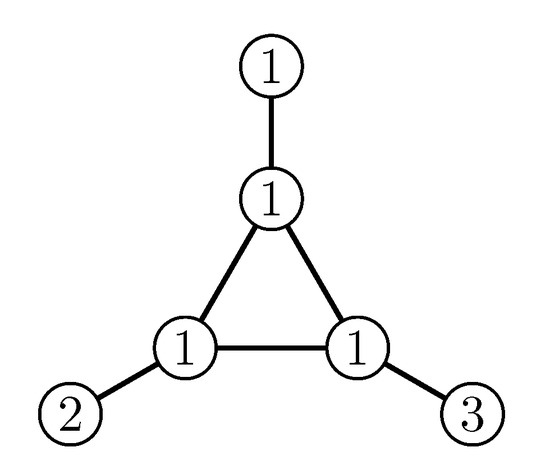
For even n the result follows from Theorems 4 and 6. For and consider the labeling illustrated on Figure 1.
Figure 1.
A local inclusive distance vertex irregular labeling of .
For odd n and , we define a vertex labeling f of such that
The weights of vertices of degree are
As the weights of vertices of degree one are either 2 or 3, we obtain that adjacent vertices have distinct weights. □
Theorem 11.
Let be positive integers. Then
Proof.
As the graph is isomorphic to the complete graph we use Corollary 2 in this case.
Let . Let the vertex set and the edge set of be the following
We define a vertex labeling f of such that
where for every the parameter , , is defined such that
For the vertex weights, we obtain
Evidently adjacent vertices have distinct weights. Thus, as the maximal vertex label is , the proof is completed. □
A caterpillar is a graph derived from a path by hanging any number of leaves from the vertices of the path. We denote the caterpillar as , where the vertex set is = , and the edge set is .
Theorem 12.
For every caterpillar with at least 3 vertices holds .
Proof.
For a regular caterpillar, thus the case , using Theorem 9, we obtain that .
For the other cases, label the vertices of a caterpillar using the following algorithm.
- Step 1:
- Label all vertices with 1.Then the weights of vertices , are and all vertices of degree 1 have weight 2.
- Step 2:
- Find the smallest index s, , such that .
- Step 3:
- If such number does not exist, it means that adjacent vertices have distinct degrees and thus . We are done.
- Step 4:
- If such number exists either relabel a leaf of adjacent to (if a leaf exists) from 1 to 2 or relabel the vertex from 1 to 2. Then .Note that this relabeling will not have an effect on weights of vertices for every .
- Step 5:
- Find the smallest index t, , such that .
- Step 6:
- If such number does not exist, it means that adjacent vertices have distinct degrees and thus . We are finished.
- Step 7:
- If such number exists either relabel a leaf of adjacent to (if a leaf exists) from 1 to 2 or relabel the vertex from 1 to 2. Then .
- Step 8:
- Return to Step 5.
After a finite number of steps, the algorithm stops and the weights of the vertices are always different from the weights of their neighbors. □
A similar algorithm can be used to obtain a result for closed caterpillars, which are graphs where the removal of all pendant vertices gives a cycle. We denote the closed caterpillar as , where the vertex set is = , and the edge set is .
Theorem 13.
For closed caterpillar holds
The proof of the next result for the disjoint union of graphs, follows from the fact that there are no edges between the distinct components.
Theorem 14.
Let , be arbitrary graphs. Then
Immediately from the previous theorem, we obtain the following result.
Corollary 5.
Let n be a non-negative integer and let G be a graph. Then, .
The join of the disjoint graphs G and H is the graph together with all the edges joining vertices of and vertices of . Let denote the maximal degree of the graph G.
Theorem 15.
For any graph G holds
Proof.
Let w be the vertex of . In a graph the vertex w is adjacent to all vertices in G we immediately get that .
If then in there are at least two vertices of degree and thus by Corollary 1 we have .
Let . If then by Theorem 1 there exists at least two vertices, say u and v in G such that . However, these vertices have the same closed neighborhood also in the graph as
However, this implies that
Now, consider that and let f be a corresponding local inclusive distance vertex irregular graph of G. We define a labeling g of in the following way
The induced vertex weights are
As we get that for any vertex is
Thus, all adjacent vertices have distinct weights. This means that g is a local inclusive distance vertex irregular labeling of . As vertex w is adjacent to every vertex in G we get in this case. This concludes the proof. □
The graph in the previous theorem is not necessarily connected.
Theorem 16.
Let , , be arbitrary graphs. Then
Proof.
The proof follows from Theorems 14 and 15. □
A wheel with n spokes is isomorphic to the graph . A fan graph is isomorphic to the graph , while a generalized fan graph is isomorphic to the graph . The following results are immediate corollaries of the previous theorems.
Corollary 6.
Let be a wheel on vertices . Then
Corollary 7.
Let be a fan on vertices . Then
Corollary 8.
Let be a generalized fan graph, . Then
If then by Theorem 1 there exist at least two vertices, say u and v in G such that they have the same closed neighborhood . Thus, we immediately get
where , , are the vertices of . Thus, for every positive integer r. Now we will deal with the case when and .
Theorem 17.
Let be a positive integer and let G be not isomorphic to a totally disconnected graph. If and then .
Proof.
Let us denote the vertices by the symbols , and let . Thus, . In a graph all the vertices , are adjacent to all vertices in G thus we immediately get that .
Let and let f be a corresponding local inclusive distance vertex irregular labeling of G. We define a labeling g of in the following way
Then, the vertex weights are
Evidently, under the labeling g, all adjacent vertices in have distinct weights. We need also to prove that no vertex in has the same weight as in . Consider that
As G is not isomorphic to a totally disconnected graph then for the weight of any vertex v in we have
for every . Thus, g is a local inclusive distance vertex irregular graph of and hence . □
Note that for small r the previous theorem is not necessarily true. Consider the graph G illustrated on Figure 2, evidently . However, .
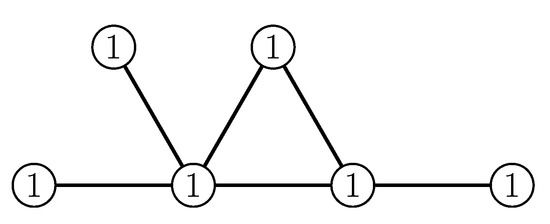
Figure 2.
A local inclusive distance vertex irregular labeling of a graph G.
4. Conclusions
In this paper, we introduced the local inclusive distance vertex irregularity strength of graphs and gave some basic results and also some constructions of the feasible labelings for several families of graphs. We still have some open problems and conjecture as follows:
Problem 1.
Find for general case, which is for the case , where .
Problem 2.
Characterize graphs for which .
Conjecture 1.
For arbitrary tree T with , or 2.
Author Contributions
Conceptualization, K.A.S., D.R.S., M.B. and A.S.-F.; methodology, K.A.S., D.R.S., M.B. and A.S.-F.; validation, K.A.S., D.R.S., M.B. and A.S.-F.; investigation, K.A.S., D.R.S., M.B. and A.S.-F.; resources, K.A.S., D.R.S., M.B. and A.S.-F.; writing—original draft preparation, K.A.S., and A.S.-F.; writing—review and editing, K.A.S., D.R.S., M.B. and A.S.-F.; supervision, K.A.S. and A.S.-F.; project administration, K.A.S., M.B. and A.S.-F.; funding acquisition, K.A.S., D.R.S., M.B. and A.S.-F. All authors have read and agreed to the published version of the manuscript.
Funding
This research has supported by PUTI KI-Universitas Indonesia 2020 Research Grant No. NKB-779/UN2.RST/HKP.05.00/2020. This work was also supported by the Slovak Research and Development Agency under the contract No. APVV-19-0153 and by VEGA 1/0233/18.
Institutional Review Board Statement
Not applicable.
Informed Consent Statement
Not applicable.
Data Availability Statement
Not applicable.
Conflicts of Interest
The authors declare no conflict of interest.
References
- West, D.B. Introduction to Graph Theory, 2nd ed.; Prentice-Hall: Hoboken, NJ, USA, 2000. [Google Scholar]
- Chartrand, G.; Jacobson, M.S.; Lehel, J.; Oellermann, O.R.; Ruiz, S.; Saba, F. Irregular networks. Congr. Numer. 1988, 64, 187–192. [Google Scholar]
- Frieze, A.; Gould, R.J.; Karonski, M.; Pfender, F. On graph irregularity strength. J. Graph Theory 2002, 41, 120–137. [Google Scholar] [CrossRef]
- Kalkowski, M.; Karonski, M.; Pfender, F. A new upper bound for the irregularity strength of graphs. SIAM J. Discrete Math. 2011, 25, 1319–1321. [Google Scholar] [CrossRef]
- Majerski, P.; Przybyło, J. On the irregularity strength of dense graphs. SIAM J. Discrete Math. 2014, 28, 197–205. [Google Scholar] [CrossRef]
- Miller, M.; Rodger, C.; Simanjuntak, R. Distance magic labelings of graphs. Australas. J. Combin. 2003, 28, 305–315. [Google Scholar]
- Arumugam, S.; Fronček, D.; Kamatchi, N. Distance magic graphs—A survey. J. Indones. Math. Soc. 2011, 11–26. [Google Scholar] [CrossRef] [Green Version]
- Slamin, S. On distance irregular labelings of graphs. Far East J. Math. Sci. 2017, 102, 919–932. [Google Scholar]
- Bong, N.H.; Lin, Y.; Slamin, S. On distance-irregular labelings of cycles and wheels. Australas. J. Combin. 2017, 69, 315–322. [Google Scholar]
- Bong, N.H.; Lin, Y.; Slamin, S. On inclusive and non-inclusive vertex irregular d-distance vertex labelings. submitted.
- Bača, M.; Semaničová-Feňovčíková, A.; Slamin, S.; Sugeng, K.A. On inclusive distance vertex irregular labelings. Electron. J. Graph Theory Appl. 2018, 6, 61–83. [Google Scholar] [CrossRef] [Green Version]
- Utami, B.; Sugeng, K.A.; Utama, S. On inclusive d-distance irregularity strength on triangular ladder graph and path. AKCE Int. J. Graphs Comb. 2020, 17, 810–819. [Google Scholar] [CrossRef]
- Utami, B.; Sugeng, K.A.; Utama, S. Inclusive vertex irregular 1-distance labelings on triangular ladder graphs. AIP Conf. Proc. 2021, 2018, 060006. [Google Scholar] [CrossRef]
- Arumugam, S.; Premalatha, K.; Bača, M.; Semaničová-Feňovčíková, A. Local antimagic vertex coloring of a graph. Graphs Combin. 2017, 33, 275–285. [Google Scholar] [CrossRef]
- Czerwiński, S.; Grytczuk, J.; Żelazny, W. Lucky labelings of graphs. Inform. Process. Lett. 2009, 109, 1078–1081. [Google Scholar] [CrossRef]
- Gallian, J.A. A dynamic survey of graph labeling. Electron. J. Combin. 2019. #DS6. Available online: https://www.combinatorics.org/ojs/index.php/eljc/article/view/DS6/pdf (accessed on 13 July 2021).
Publisher’s Note: MDPI stays neutral with regard to jurisdictional claims in published maps and institutional affiliations. |
© 2021 by the authors. Licensee MDPI, Basel, Switzerland. This article is an open access article distributed under the terms and conditions of the Creative Commons Attribution (CC BY) license (https://creativecommons.org/licenses/by/4.0/).