1. Introduction
In a recent paper, L.L. Karasheva [
1] introduced the entire function
where
,
and
and, throughout,
x is a real variable. This function is of interest as it is involved in the fundamental solution of the differential equation
for positive integer
n, where the derivative with respect to
t is the fractional derivative of the order
. In the simplest case
, we have
,
, where
is the Wright function
which finds application as a fundamental solution of the diffusion-wave equation [
2]. Under the above assumptions on
n and
it follows that the parameter
associated with (
1) satisfies
.
In this study, however, we shall allow the parameter
to satisfy
and consider the function
which coincides with
when
. From the well-known expansion
where
it follows that (
3) can be expressed as a finite sum of Wright functions defined in (
2) with rotated arguments (compare [
1], Equation (
4))
We note that the extreme values of satisfy , whence for .
We use the representation in (
5), with the values of
in (
4), to determine the asymptotic expansion of
for
by application of the asymptotic theory of the Wright function. A summary of the expansion of
for large
is given in
Section 3. The expansions of
for
are given in
Section 4 and
Section 5, where they are shown to depend critically on the parameter
(and to a lesser extent on the integer
n). A concluding section presents our numerical results confirming the accuracy of the different expansions obtained.
2. An Alternative Representation of
The Wright function appearing in (
2) can be written alternatively as
upon use of the reflection formula for the gamma function, where
. The associated Wright function
is defined by
which is valid for
. Hence, we obtain the representation
where
If we now exploit the symmetry of the
in (
4) (and the fact that
x is a real variable), we observe that the values of
for
, where
, satisfy
Then, we can write
where
The form (
8) involves half the number of Wright functions
and will be used to determine the asymptotic expansion of
as
in
Section 4 and
Section 5.
3. The Asymptotic Expansion of for
We first present the large-
asymptotics of the function
in (
6) based on the presentation described in ([
3],
Section 4); see also ([
4],
Section 4.2), ([
5], §2.3). We introduce the following parameters:
together with the associated (formal) exponential and algebraic expansions
where (The dependence of the coefficients
on the parameter
is not indicated.)
Then, since
, we obtain from ([
5], p. 57) the large-
z expansion
where the upper or lower signs are chosen according as
or
, respectively.
The expansion
is exponentially large as
in the sector
, and oscillatory (multiplied by the algebraic factor
) on the anti-Stokes lines
. In the adjacent sectors
, the expansion
continues to be present, but is exponentially small reaching maximal subdominance relative to the algebraic expansion on the Stokes lines (On these rays,
undergoes a Stokes phenomenon where it switches off in a smooth manner (see [
6], p. 67).)
. In our treatment of
, we will not be concerned with exponentially small contributions, except in one special case when
where the expansion of
is exponentially small.
The first few normalised coefficients
are [
3,
4]:
In addition to the Stokes lines
, where
is maximally subdominant relative to the algebraic expansion, the positive real axis is also a Stokes line. Here, the algebraic expansion is maximally subdominant relative to
. As the positive real axis is crossed from the upper to the lower half plane the factor
appearing in
changes to
, and vice versa. The details of this transition will not be considered here; see ([
5], p. 248) for the case of the confluent hypergeometric function
.
5. The Expansion of for
To examine the case of negative
x, we replace
x by
, with
, and use the fact that
to find, from (
8), that
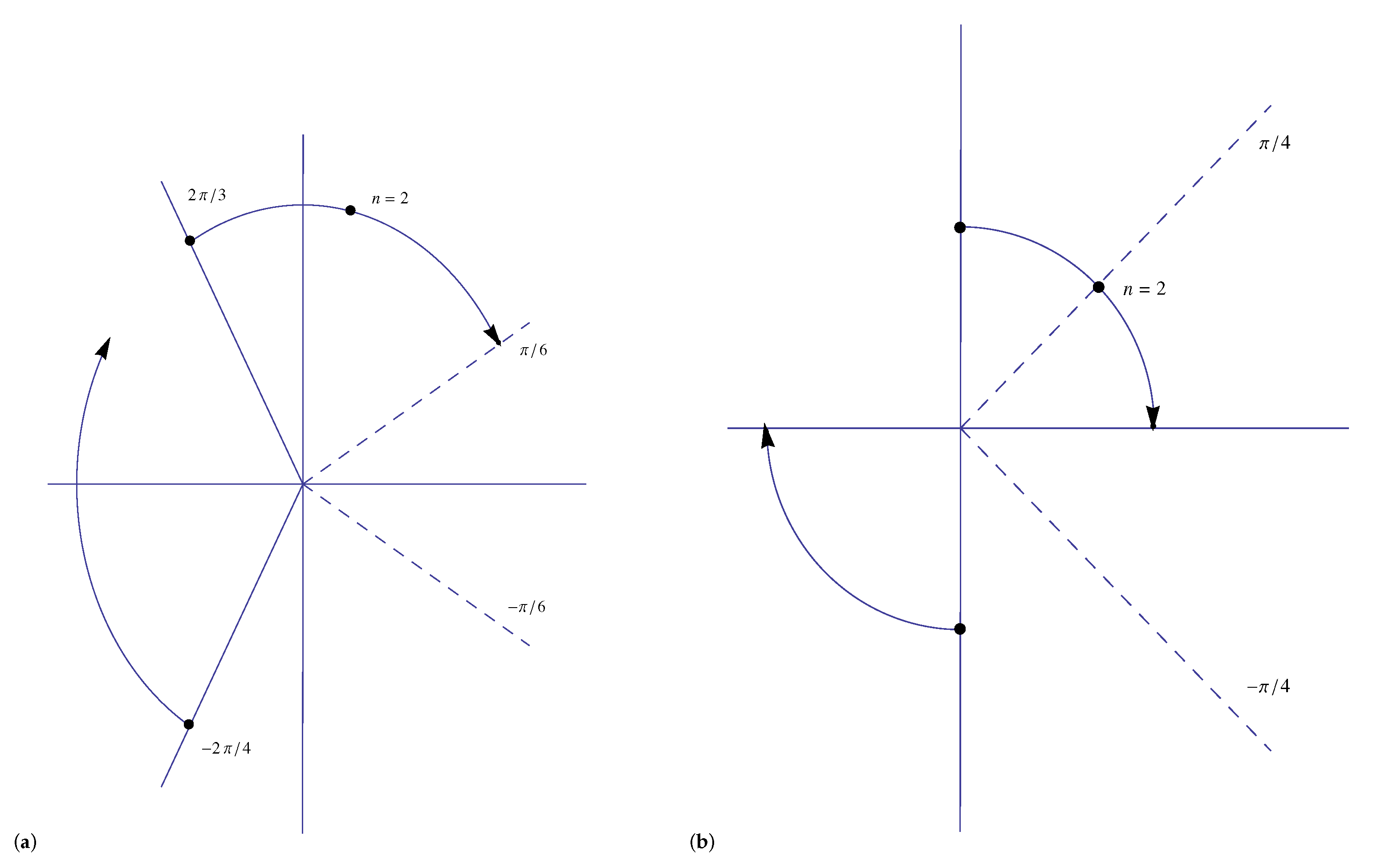
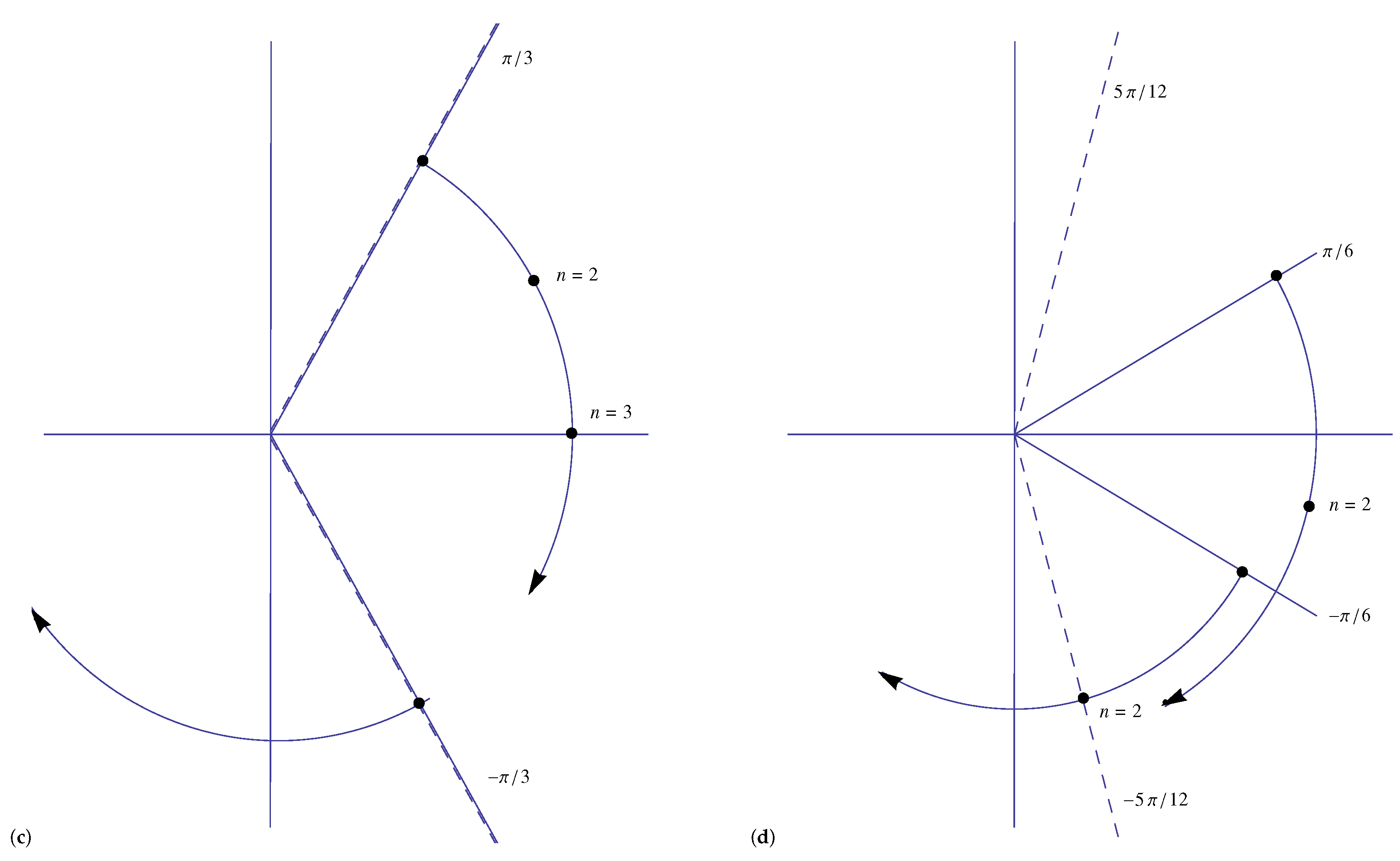
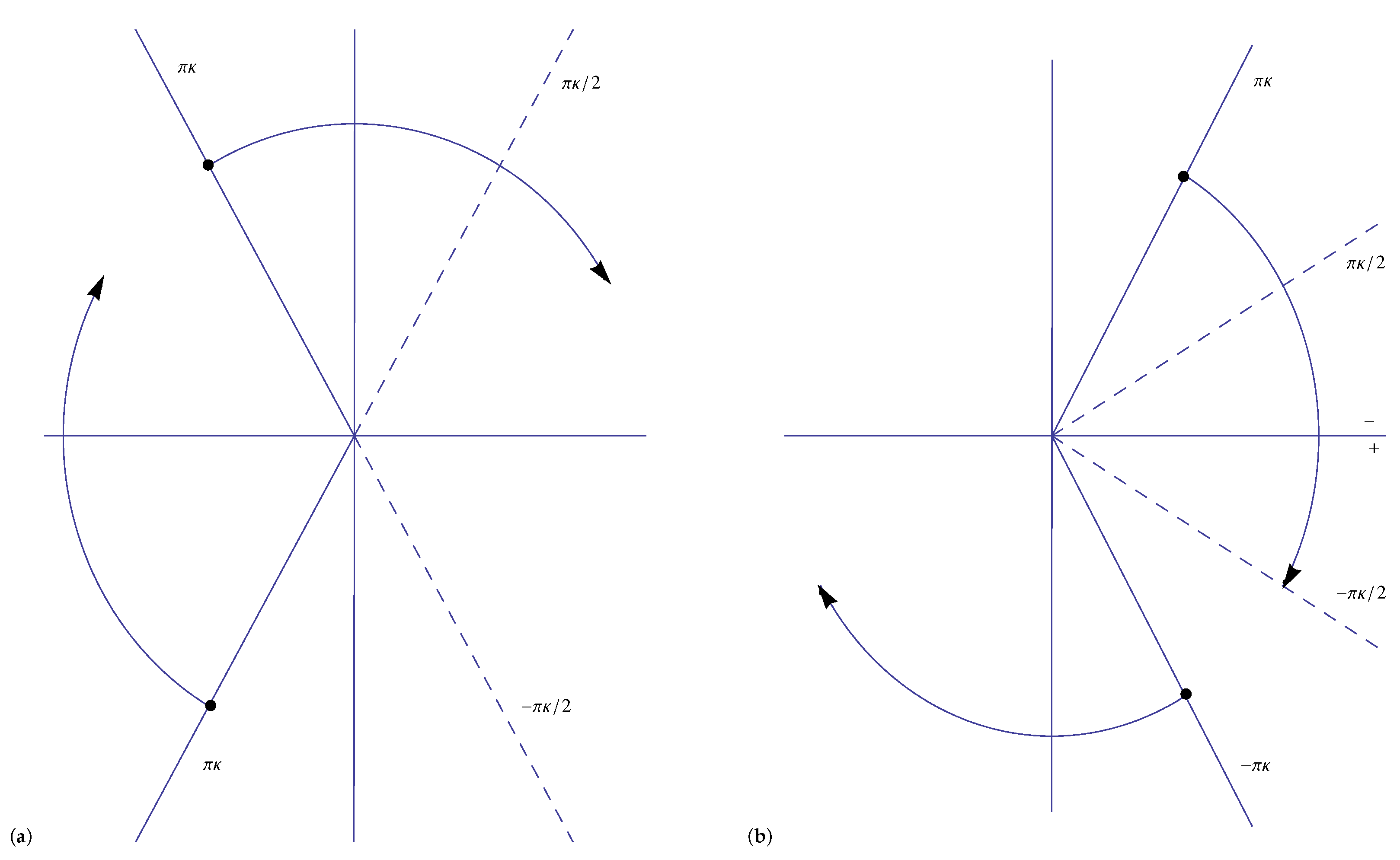
The rays
in
Figure 1 are now replaced by the Stokes lines
. The Stokes and anti-Stokes lines
are illustrated in
Figure 2 when
and
. In the sectors
, we recall that the exponential expansion
is still present but is exponentially small as
.
For the algebraic component of the expansion two cases arise when the argument
of the second
function in
is either (i) positive or (ii) negative. In case (i), the algebraic expansion
does not encounter a Stokes phenomenon as its argument does not cross
, whereas in case (ii), a Stokes phenomenon arises for those values of
r that make
. In case (i), the algebraic component contains the factor inside the sum over
r in (
21)
upon recalling the definition of
K in (
15) and noting that
. Similarly, the final term involves the factor
. Thus, the algebraic contribution to
vanishes in case (i).
For case (ii) to apply, we require that
; that is,
. Suppose that
for
. Then, the algebraic component resulting from the terms with
becomes
where, in the second term in round braces, we have taken account of the Stokes phenomenon (the first term and that multiplied by
are unaffected). Some routine algebra then produces the algebraic contribution
when
and
when
. (We avoid here consideration of the algebraic contribution when
, that is, on the Stokes line
.)
Reference to
Figure 2 shows that there is no exponential contribution to
from the terms
and
. From (
10) and (
21), we find the exponential expansion results from the terms
, which is given by
where
X and the asymptotic sum
S are defined in (
17) and (
18) with
. For
(when the algebraic expansion vanishes), the expansion of
will be exponentially small provided
; that is, when
. If
, there is an exponentially oscillatory contribution, and when
, the expansion is exponentially large.
To summarise, we have the theorem:
Theorem 2. The following expansion holds for :where the exponential expansion is defined in (23). This last expansion is exponentially small as when and . The algebraic expansion is given bywhere and K, are specified in (15) and (22). 6. Numerical Results
In this section, we describe numerical calculations that support the expansions given in Theorems 1 and 2. The function
was evaluated using the expression in terms of Wright functions (valid for real
x)
which follows from (
5) and the symmetry of
.
In
Table 1, we present the results of numerical calculations for
compared with the expansions given in Theorem 1. We choose four representative values of
that focus on the different cases of Theorem 1 and
and 4. The numerical value of
was obtained by high-precision evaluation of (
25). The exponential expansion
was computed with the truncation index
and the algebraic expansion
was optimally truncated (that is, at or near its smallest term).
The first case has an exponentially large expansion with a subdominant algebraic contribution for all three values of n. The second case corresponds to ; when , is oscillatory and makes a similar contribution as , whereas when and 4, is exponentially large. The third case corresponds to ; when , there is no exponential contribution, whereas when , is oscillatory and thus makes a similar contribution as ; when , is exponentially large. Finally, when , the expansion of is purely algebraic in character.
In
Table 2, we present illustrative examples of Theorem 2 when
. The first case,
(
), has an expansion that is exponential in character; for
,
is exponentially small, whereas for
, the argument
lies on the upper boundary of the exponentially large sector
, and thus
is oscillatory. For
,
becomes exponentially large as
. In the second case,
(
),
is exponentially small for
and exponentially large for
.
In the third case, , is oscillatory for and exponentially large for . Finally, when (), the function is exponentially large for and . However, for , the two values and yield arguments () situated on both boundaries of the exponentially large sector . In this case is oscillatory and, since , there is, in addition, an algebraic contribution .