1. Introduction
Since Einstein put forward the theory of relativity in 1915, semi-Euclidean space has attracted the attention of many geometry and physics scholars. Compared with Euclidean space, the characteristic of semi-Euclidean space is the existence of a lightlike vector. There are three types of curves (surfaces) in semi-Euclidean space: spacelike curves (surfaces), timelike curves (surfaces), and lightlike curves (surfaces) [
1,
2,
3,
4]. In physics, Hiscock WA [
5] obtained that the horizon of the black hole was a null hypersurface. In this paper, we construct a special kind of null hypersurface along a partially null slant helix and obtain its singularity types, which can help scientists to further study the shape of the black hole horizon.
There are many examples and phenomena of helical structures in nature, such as carbon nanotubes and the DNA double helical structure, among others. Amand AL and Lambin P [
6] stated that the DNA double helical structure was believed to be one of the most important subjects in biology. Izumiya S and Takeuchi N [
7] gave the definition of the slant helix in Euclidean space. Abazari N [
8] obtained the stationary acceleration in Minkowski space. Yaliniz AF, Hacisalihoglu HH [
9] obtained some geometry properties of the null generalized helices in
. The third author and Hou [
10] gave a new kind of helicoidal surface in Minkowski 3-space. Mosa S, Elzawy M [
11] considered the differential geometrical properties of the helicoidal surfaces in Galilean 3-space.
Petrović-Torgašev M, Ilarslan K, and Nešović E [
12] gave definitions and some geometrical properties of partially null curves and pseudonull curves in
; Ali A, López R, and Turgut M [
13] defined the
k-type partially null and pseudonull slant helices in
. Harslan K and Nešović E [
14] obtained the geometrical properties of the null helices and gave some characterizations for the timelike and null helices. We find that many papers about the helical curves only considered the smooth properties, but few considered the singular properties. Therefore, starting from the singularity, in this paper, we study the singularity properties of the pseudonull hypersurfaces of the partially null slant helices in semi-Euclidean 4-space with index two using singularity theory.
In the research of geometric properties of submanifolds, singularity is an inevitable research object. Singularity is widely used in many disciplines, such as biology and physics, among others. The singularities of surfaces and curves in Euclidean space or semi-Euclidean space were studied in [
4,
15,
16,
17,
18,
19]. The first author [
1,
20] studied the singularity properties of some null curves in different spaces. In this paper, we investigate the differential geometry and the singularity properties of the pseudonull hypersurfaces of the partially null slant helices in semi-Euclidean 4-space.
We organize the present manuscript as follows. In the second section, we introduce the definition of the pseudonull hypersurface and obtains some geometrical properties of the partially null slant helices. Meanwhile, the main singularity result (the Theorem 3) is also given in this section. The height functions of partially null slant helices are constructed to describe the contract relation in
Section 3. For the remainder of this paper, we consider the versal unfolding and the generic properties of the partially null slant helices to prove Theorem 3 in
Section 4. In the last section, we give one example to insist on our results.
2. Preliminaries and the Main Results
Let
be an arc-length parameterized differentiable curve with Frenet frames
and
, where
is called the tangent vector,
is called the principal normal vector,
is called the first binormal vector, and
is called the second binormal vector [
13].
For a fixed constant vector field , we call a 0-type, 1-type, 2-type, or 3-type slant helix if and only if or respectively, where c is a constant.
First, the definition of a partially null curve is given by the following [
12,
13].
Definition 1. Let be an arc-length parameterized differentiable curve with Frenet frames , satisfying the following conditions:We call the curve a partially null curve. The Frenet formulas of the partially null curve are given by the following equations [
13]:
where
,
and
are called the curvature functions of the partially null curve
We call a curve a 0-type partially null slant helix if the curve is a partially null curve with
When
we have the following remark.
Remark 1. When , from Equations (1), we can ascertain that is a constant vector and the rectifying space at every points of are parallel. So or . The two spaces are equal. In the following text, we only consider . Theorem 1. Let be a 0-type partially null slant helix in if and only if is constant for any .
Proof. Let
be a 0-type partially null slant helix, we choose a constant vector
satisfying
where
c is constant. By taking the derivative of the Equation (
2) with respect to
s, we assume there exist two coefficients
and
, the constant vector
can be written easily:
Differentiating the both sides of the Equation (
3), we can find the following equations:
Hence, we obtain that is a constant with . The contrary is clearly established. We completed the proof. □
Theorem 2. In is a 0-type partially null slant helix; then, is also a 1-type, 2-type, or 3-type partially null slant helix.
Proof. Let
be a 0-type partially null slant helix. From the Theorem 1, we can obtain the following conclusion:
Hence
is a 1-type partially null slant helix. Taking the derivative from both sides of the Equation (
5) with respect to
s and using Frenet Equation (
1), we obtain the following statements:
and
Hence,
is also a 2-type partially null slant helix. Similarly,
We know is constant, and is a 3-type partially null slant helix. □
As the same method of the Theorem 2, we have the following conclusion:
Corollary 1. In is a 1-type partially null slant helix if and only if is a 3-type partially null slant helix.
Let
be a 0-type partially null slant helix in
. We define a surface with the base curve
as following:
we call
the pseudonull hypersurface of
, which is a ruled hypersurface. We call
the hyperplane.
We can obtain the main result of the singularity types of the pseudonull hypersurface by the following theorem.
Theorem 3. Let be a 0-type partially null slant helix; for , we have the following:
- (1)
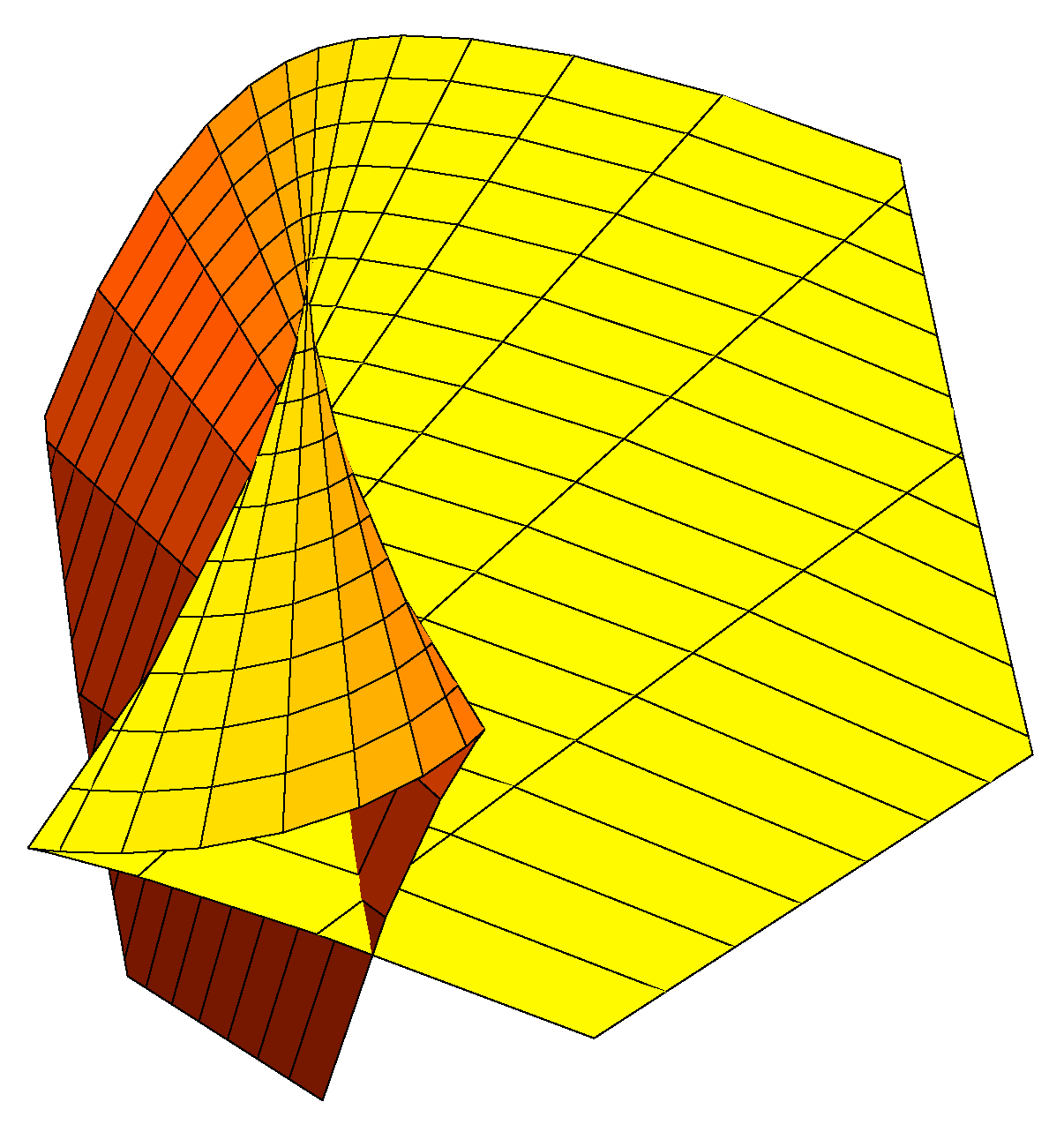
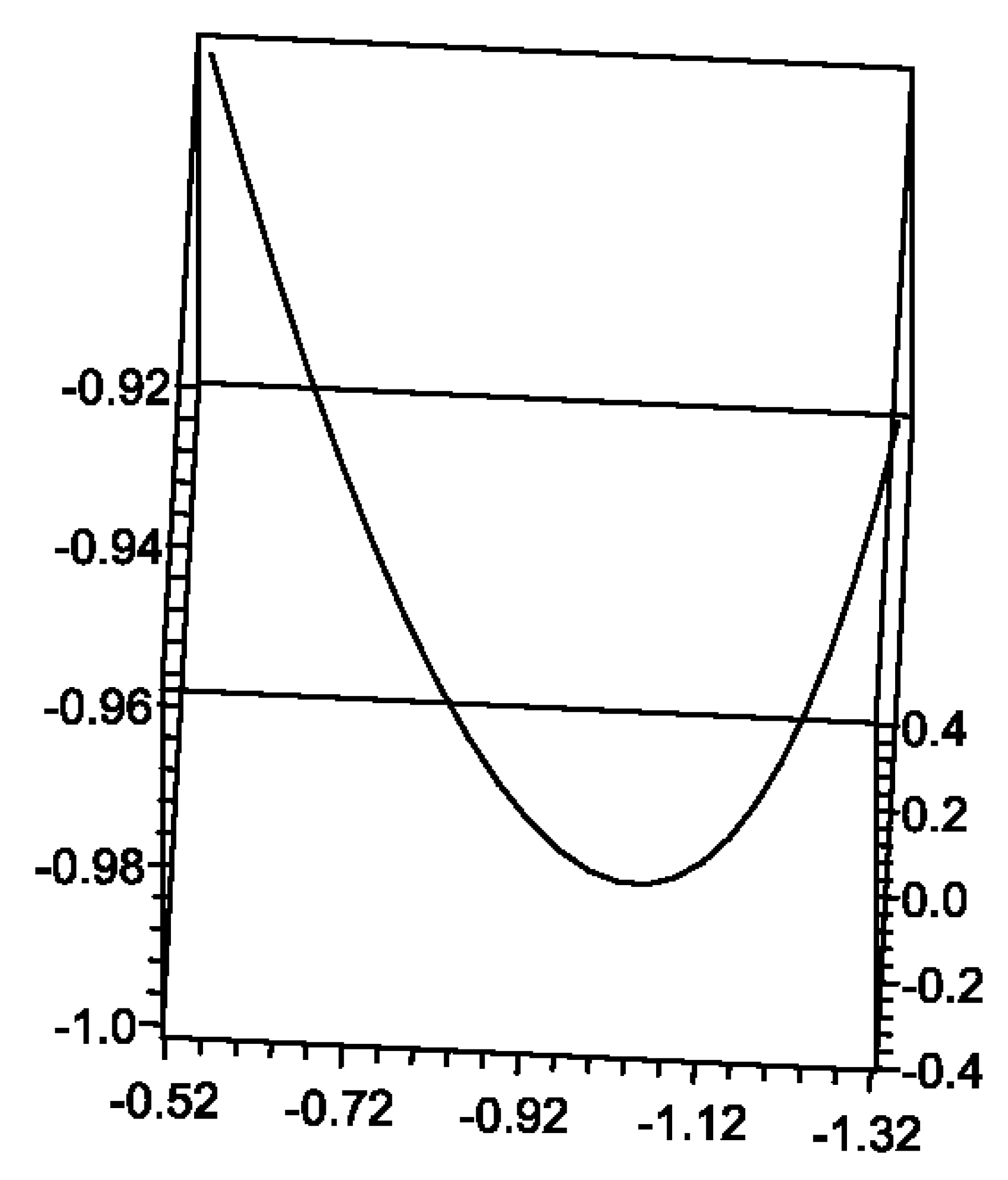
and have at least 2-point contact at (Figure 1). - (2)
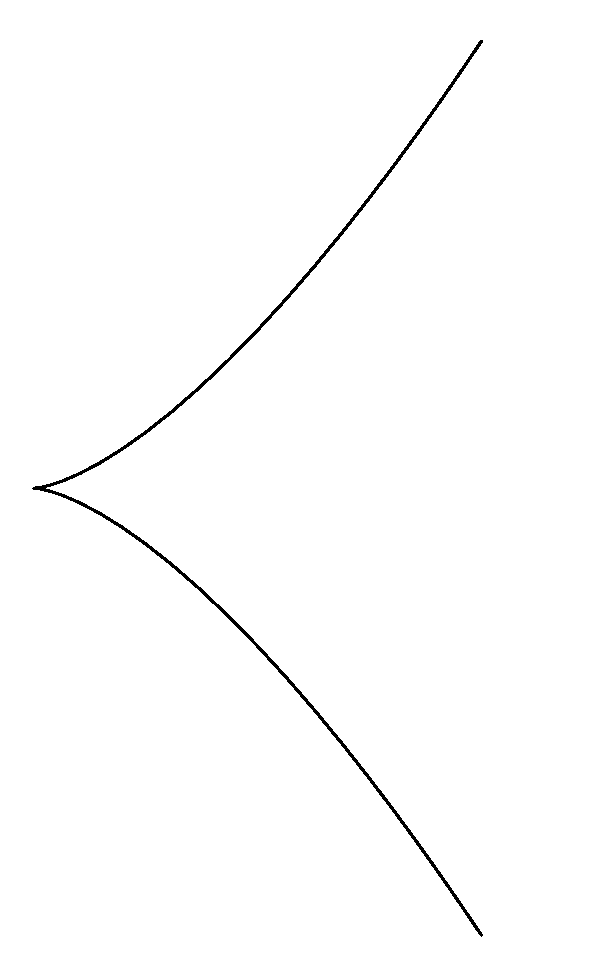
and have 3-point contact at if and only if , under this condition, the germ of is diffeomorphism to the cuspidal edge (Figure 2). - (3)
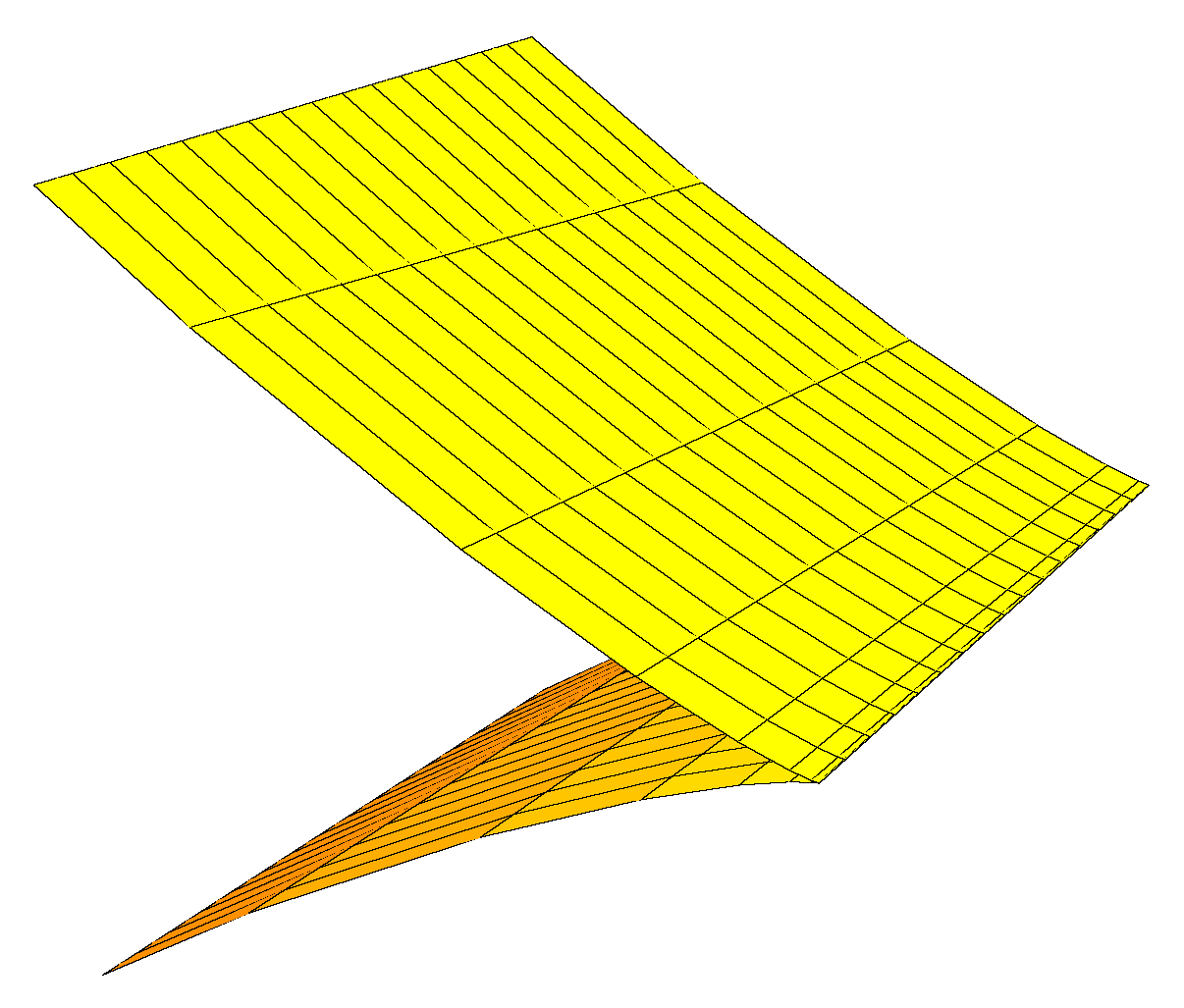
and have 3-point contact at if and only if , under this condition, the germ of is diffeomorphism to the swallowtail (Figure 3).
Here is the cuspidal edge and is the swallowtail.
3. The Height Function
In this section, we mainly give the definition of the height function on to describe the contact relationship.
Let
be a 0-type partially null slant helix in
. The height function
is given as
We write for any fixed vector . Then, we have the following proposition:
Proposition 1. Let be a 0-type partially null slant helix in , for a fixed vector Then, we have
- (1)
if and only if there exist three real numbers , such that .
- (2)
if and only if .
- (3)
if and only if .
- (4)
if and only if .
Proof. (1). Let us assume that where . Thus, it can be seen that if and only if we obtain the statement (1).
(2). Differentiating both sides of the Equation
with respect to
s and using Frenet Equation (
1), we get
and in the view of
, it can be seen that
. The statement (2) is supported.
(3). Similarly, differentiating both sides of the Equation (
9) with respect to
s and using Frenet Equation (
1),
It can be seen that
. We obtain the statement (3).
(4). Taking the derivative of the Equation (
10) with respect to
s and using Frenet Equation (
1), we can obtain
Thus,
when
. □
4. The Proof of the Theorem 3
In this section, we use some general results on the singularity theory [
15] to prove the main result (Theorem 3).
Firstly, we introduce two important sets. The singular set of
F is the set
The discriminant set of
F is the set
Then, applying the main result of Theorem 4.1 in [
16] and the versal unfolding in [
18], for the height function
H of the 0-type partially null slant helix, we obtain the following theorem:
Theorem 4. Let be a 0-type partially null slant helix and , H is a versal unfolding of if has -singularity at .
Proof. Suppose and
We have
and
Let
be the 2-jet of
at
, we can show that
where
and
When
h has
-singularity at
, by the Proposition 1, there exist two nonzero numbers
satisfying
We can see that the rank of
is 1 since
From the Proposition 1,
h has
-singularity at
if and only if
,
. When
h has
-singularity at
we require the rank of
is 2.
This completes the proof. □
Then, we have the following proposition as a corollary of Lemma 6 [
16].
Proposition 2. Let be a submanifold of Then the set is transversal to is a residual subset of If is a closed subset, then is open.
There is another characterization of the versal unfolding as follows [
15],
Proposition 3. Let be an r-parameter unfolding of which has -singularity at 0. Then, F is a versal unfolding if and only if is transversal to the orbit for Here, is the l-jet extension of F given by
Proposition 4. There exists an open and dense subset such that for any , the pseudonull hypersurface is locally diffeomorphic to the cuspidal edge at a singular point.
Proof. For
we consider the decomposition of the jet space
into
orbits. We define a semialgebraic set by
The codimension of
is 3; therefore, the codimension of
is 4 and the orbit decomposition of
is
where
is the orbit through an
-singularity. Thus, the codimension of
is
. We consider the
l-
extension
of the indicatrix height function
H. By Proposition 2, there exists an open and dense subset
such that
is transversal to
and the orbit decomposition of
This means that
and
H is a versal unfolding of
h at any point
. By Theorem 4.1 in [
15], the discriminant set of
H is locally differmorphic to cuspidal edge at a singular point. □
Proof of the Theorem 3. Let
be a 0-type partially null slant helix in
. For a vector
,
has
-singularity at
if and only if
and
have
k-point contact at
. By Bruce’s singularity classification method [
16], the Propositions 1 and 4, we can obtain the main conclusion in Theorem 3. □