1. Introduction
The pairwise comparison and classification of objects is one of the main steps in any field dealing with data analysis. This task is generally handled by equivalence relations for crisp data and
T-equivalences in fuzzy environments, where
T is a triangular norm called briefly a
t-norm [
1,
2]. Traditionally, the equivalence relations (known also as indistinguishability relations) and (pseudo-)metrics (or distinguishability relations) have a close link, where one can be defined as the dual of the other. However, in fuzzy environments, the
T-equivalences usually produce pseudo-ultrametrics, rather than standard metric spaces, in which the triangular inequality of a metric has been generalized by the maximum operator [
3,
4,
5,
6].
Recently, the notion of multi-polarity, arising from multi-source data, has been introduced in the fuzzy context to achieve higher accuracy in data analysis. However, this concept has two sides. From the first perspective, it describes fuzzy rule-based classification systems, designed based on different categories, where the final rule (which consists of a set of fuzzy rules) contains the consequent class of the final rule from the
m predefined classes/categories/patterns [
7,
8,
9,
10]. From another direction, multi-polarity provides a flexible framework for input and output data in information systems, applied in computer science, multi-criteria decision making, and graph theory, where instead of one absolute value
the
m-tuple
is employed to describe data based on different parameters/criteria [
11,
12,
13]. Note that this paper follows the second case, which is known as
m-polar fuzzy set theory.
The widespread use of
m-polar fuzzy sets in decision making (see [
14,
15,
16,
17]) led us to consider fuzzy similarity relations for information systems dealing with
m-polar fuzzy data. Since finitely multivalued logic is the background idea to construct
m-polar fuzzy sets, in which the truth values are modeled by the Cartesian product of the unit interval
m-times, an extension of the classical fuzzy logic into
m-polar fuzzy logic is required. In such a new multivalued logic, we need to study the concepts of conjunction (usually interpreted by
t-norms), disjunction (defined by
t-conorms), implication, and negation for the
m-polar case. Our interest in solving the problem of classification and ranking in decision making situations motivated us to consider the application of
m-polar
t-norm operators for defining the
m-polar fuzzy similarity relations. As
t-norms are used to develop
T-equivalences (see [
18]), by extending the concept of the
t-norm
T into the
m-polar
t-norm
, we suggest the new concept of
m-polar
-equivalences to interpret fuzzy indistinguishability relations between
m-polar fuzzy data. Note that, in this study, the bold letters refer to the
m-polar case.
On the other hand, in fuzzy logic, the use of the concept of duality leads to a one-to-one correspondence between
T-equivalences and pseudo-(ultra)metrics (see [
3,
4,
19]), where a pseudo-(ultra)metric on a set
X is a mapping
equipped with the inequality
for all
rather than the well-known triangular inequality
in the standard definition of metric spaces. Because the maximum operator is a
t-conorm, it seems natural to consider a stronger version of pseudo-ultrametric for the
m-polar case as a
-pseudo-ultrametric where
is any
m-polar
t-conorm. Moreover, it can be determined whether or not the result is always an
m-polar pseudo-(ultra)metric if the traditional concept of fuzzy duality, which is used to define the induced metrics by
T-equivalences, is replaced by an
m-polar negation
.
Therefore, in this contribution we give an introduction of
m-polar
t-norms,
m-polar
t-conorms,
m-polar implications, and
m-polar negations in
Section 2 and
Section 3. We also aim to explore in greater depth the one-to-one correspondence between
m-polar
-equivalences and
m-polar
-pseudo-(ultra)metrics in
Section 4 by using
m-polar negations. Finally, in
Section 5, we present a link between fuzzy graphs and
m-polar
-pseudo-ultrametrics, built by
m-polar
-equivalences. An algorithm is then designed to compute a fuzzy graph based on the
m-polar
-pseudo-ultrametric, where
is the
m-polar Lukasiewicz
t-conorm, and we illustrate it with an example.
2. Fuzzy T-Orderings
In this section, we first recall some theoretical background needed to develop the main results of this paper. Then, we introduce some new concepts including m-polar t-norms , m-polar t-conorms , and m-polar -orderings as natural extensions of the corresponding definitions in traditional fuzzy set theory.
The binary operation
and its dual (i.e.,
) are respectively called triangular norm and conorm, or
t-norm and
t-conorm in brief, if they are associative and commutative with the neutral elements
and
(c.f. [
5]). The
t-norms
T and the
t-conorms
S are in fact different membership functions to model conjunction (i.e., the logical AND) and disjunction (i.e., the logical OR) in fuzzy logic. To interpret the concept of logical implication in fuzzy logic, a binary operation
is used to define the fuzzy implication which admits the following conditions:
If , then ;
If , then ;
and ;
,
where
. Moreover, the concept of negation is developed in fuzzy logic by using a decreasing operator
with boundary conditions
and
. For more details, we recommend [
20].
By using the t-norms and t-conorms, particular classes of implication and negation operators are formulated as follows.
Definition 1 ([
20]).
Let T be a left-continuous t-norm. The implication operation (which is also called residuum) with respect to the t-norm T is defined asfor any . Definition 2 ([
20]).
Let T be a left-continuous t-norm and S be a right-continuous t-conorm.The induced negation operation by T is defined as The induced negation operation by S is defined as
for any .
Note that in the above Equations (
1)–(
3) the operators “sup” and “inf” can be respectively replaced by “max” and “min” since
T is a left-continuous
t-norm and
S is a right-continuous
t-conorm [
20].
2.1. m-Polar Fuzzy -Orderings
By expanding the range of membership functions from the unit interval into the mth power of , that is, where and are respectively the least and greatest elements, we can extend the traditional fuzzy set (dealing with uni-polar data) into the new concept called m-polar fuzzy set, which deals with multi-polar information.
The set is considered as a poset (preordered set) with order “≤” such that for any where and , we have the point-wise ordering over them, that is, iff for each where is the ith projection mapping and .
Definition 3 ([
11]).
An m-polar fuzzy set μ on the universe X is a mapping such that for any where is the ith projection mapping. In fact, the map is a fuzzy set on X, called the ith degree of membership function μ. The concept of
m-polar fuzzy relation
is also discussed in [
10,
13] as a mapping
such that
for any
where for each
, the value
shows the relationship between
x and
y in direction
i.
To define the concept of m-polar -ordering, we first need to introduce the concept of t-norm for the m-polar case.
Definition 4. Let . The operator is called an m-polar t-norm if for any it admits the following conditions:
- 1.
;
- 2.
;
- 3.
,
where we define such that for any ; shows the ith degree of .
Note that the concept of the m-polar t-conorm is defined as the dual of , that is, , by the following definition.
Definition 5. The operator is called an m-polar t-conorm if for any it admits the following conditions:
- 1.
;
- 2.
;
- 3.
.
The introduced
m-polar
t-norm
and
m-polar
t-conorm
in Definitions 4 and 5 come from the original definitions of
t-norms and
t-conorms discussed earlier in
Section 2, where each component
of
(
of
) for
may be defined by a
t-norm
(
t-conorm
). This issue is discussed in the following proposition.
Proposition 1. Consider the operators for . If is defined by such that for any ; . Then is an m-polar t-norm iff for each i the operator is a t-norm.
We use the concept of
m-polar
t-norms to develop
-properties of the
m-polar fuzzy relation
in Definition 6. However, first we recall from [
1,
21] that a fuzzy relation
is called
Reflexive if ;
Symmetric if ;
T-antisymmetric if such that : ;
T-asymmetric if : ;
T-transitive if ;
T-preorder if reflexive and T-transitive;
T-equivalence if reflexive, T-transitive and symmetric,
where is a t-norm.
Definition 6. Let be an m-polar t-norm. The m-polar fuzzy relation is called
Reflexive if , i.e, for each ;
Symmetric if , i.e, for each ;
-antisymmetric if such that : , i.e, for each ;
-asymmetric if : ;
-transitive if , i.e, for each .
Accordingly, m-polar fuzzy -orderings can be defined as below.
Definition 7. Let be an m-polar fuzzy relation on X. If is reflexive and -transitive, then it is called m-polar -preordering. If it is an m-polar -preorder relation which is also symmetric, then it is called an m-polar -equivalence relation.
Proposition 2. Let be an m-polar t-norm characterized by t-norms for . Then, the m-polar -property of is equivalent to the -property of each component of .
3. m-Polar Implications and Negations Induced by m-Polar t-Norms
In this section, we first introduce the m-polar implications and the m-polar negations as generalizations of the corresponding concepts in traditional fuzzy logic. We also discuss how to generate the m-polar implications and negations by using m-polar t-norms.
Definition 8. Let such that , and . A function is called an m-polar fuzzy implication if it satisfies the following conditions:
- 1.
If , then ;
- 2.
If , then ;
- 3.
and ;
- 4.
,
such that for any where shows the ith degree of .
If , then the following boundary conditions are obtained directly from Definition 8:
;
;
.
Theorem 1. Suppose the operation , defined by , is characterized as where for any , is a binary operator. Then is an m-polar fuzzy implication iff for each i the is a fuzzy implication.
Theorem 2. Let the operators , for , be left-continuous t-norms. Suppose the m-polar t-norm is given as . Operator defined byis an m-polar fuzzy implication induced by . Analogously to Equation (
1), Theorem 2 allows us to apply any
m-polar left-continuous
t-norm
to generate the
m-polar fuzzy implications without any violations of the axioms.
Example 1. Let where (the minimum operator) and (the Lukasiewicz operator). Then, is a 2-polar fuzzy implication induced by t-norms and such thatand for any . In order to develop an m-polar -pseudo-ultrametric based on the -equivalences (see the related Theorem 7), we first need to define the concept of m-polar negation.
Definition 9. A function is called an m-polar fuzzy negation if it satisfies the following conditions:
- 1.
and ;
- 2.
if ,
for any . Note that we define , where shows the ith degree of .
Theorem 3. Let is characterized by where for any , is an operator such that . Then, is an m-polar fuzzy negation iff functions , for all i, are fuzzy negations.
For instance, a natural
m-polar negation
can be defined as
for any
, where
c stands for complement, such that for each
;
where
is the natural fuzzy negation operator, that is,
for each
i. We call
the standard
m-polar fuzzy negation.
According to Theorem 3, the given Equations (
2) and (
3) in Definition 2 can be adapted with the
m-polar fuzzy case to explain some procedures for producing the special classes of
m-polar fuzzy negation based on the
m-polar
t-norm
.
Corollary 1. Consider the m-polar fuzzy implication . The operator defined by such that where is an m-polar fuzzy negation which is called the m-polar negation induced by .
Corollary 2. Consider the m-polar t-norm such that for any the operator is a left-continuous t-norm. The operator defined by such that is an m-polar fuzzy negation which is called the m-polar negation induced by .
In Corollary 2, if , then where and for all the operators are left-continuous t-norms.
Corollary 3. Consider the m-polar t-conorm such that for any the operator is a right-continuous t-conorm. The operator defined by such that is an m-polar fuzzy negation which is called the m-polar negation induced by .
Remark 1. From Corollaries 1, 2, and 3, it is easy to check that if and are two m-polar implications such that , then . If and are two m-polar t-norms such that , then . Moreover, if and are two m-polar t-conorms such that , then .
Proposition 3. Let and be an m-polar t-norm and an m-polar t-conorm, respectively. Then, and for any .
Definition 10. Let be an m-polar fuzzy negation. Then, it is called
Strict if it is strictly decreasing and continuous at any component .
Strong if for any .
Weak if for any .
Theorem 4. Suppose is an m-polar fuzzy negation defined by where for all , the operators are fuzzy negations. Then, is strong iff for all i, the operators are strong.
Analogously, the following theorems can be proved.
Suppose is an m-polar fuzzy negation defined by where for any , the operator is a fuzzy negation.
Theorem 5. The m-polar fuzzy negation is weak iff for all , the operators are weak.
Proof. This proof is similar to Theorem 4. □
Theorem 6. The m-polar fuzzy negation is strict iff for all , the operators are strict.
Proof. It is similar to Theorem 4. □
4. m-Polar -Pseudo-Ultrametric
A pseudo-metric on a (nonempty) set X is a function such that for all we have
- 1.
;
- 2.
;
- 3.
.
If the first axiom is replaced by the following stronger version for all , then the pseudo-metric d is indeed a metric on X. Moreover, if the last axiom of the pseudo-metric d is replaced by the condition , then d is called a pseudo-ultrametric on X. However, because the maximum operator is a t-conorm, it seems natural to generalize the third axiom of pseudo-ultrametrics by using any t-conorm S. By expanding this idea for m-polar fuzzy sets, a new concept, namely, the m-polar -pseudo-ultrametric, can be defined as below.
Definition 11. An m-polar -pseudo-ultrametric on a (nonempty) set X is a function such that for all we have
- 1.
;
- 2.
;
- 3.
,
where is an m-polar t-conorm and .
The following theorem discusses how to build an m-polar -pseudo-ultrametric from an m-polar -equivalence .
Theorem 7. Suppose is an m-polar negation where for all the operators are strong fuzzy negations (i.e., ). Let be an m-polar t-norm characterized by left-continuous t-norms and be an m-polar t-conorm such that for each the t-conorm is a -dual of t-norm —that is, . Then, the function defined byis an m-polar -pseudo-ultrametric on X generated by an m-polar -equivalence relation on X. Analogously, we have the following result.
Theorem 8. Suppose is an m-polar negation where for all the operators are strong fuzzy negations. Let be an m-polar t-norm characterized by left-continuous t-norms and be an m-polar t-conorm such that for each the t-conorm is a -dual of t-norm . Then, function defined byis an m-polar -equivalence relation on X generated by an m-polar -pseudo-ultrametric on X. Corollary 4. Let be an m-polar fuzzy relation on a set X. The following conditions are equivalent:
- 1.
is an m-polar -equivalence on X;
- 2.
The function is an m-polar pseudo-ultrametric on X,
where the m-polar t-norm is defined as for any .
Corollary 5. Let be an m-polar fuzzy relation on a set X. The following conditions are equivalent:
- 1.
is an m-polar -equivalence on X;
- 2.
The function is an m-polar pseudo-metric on X,
where the Lukasiewicz m-polar t-norm is defined by for any .
Proposition 4. Let be an m-polar t-conorm characterized by right-continuous t-conorms for . Suppose is an m-polar t-norm induced by such that for any : for . Then, function defined byis an m-polar -pseudo-ultrametric on X generated by an m-polar -equivalence relation on X. Corollary 6. Let and be two m-polar t-conorms such that and be an m-polar -equivalence on X. Then, where and .
5. Generating Fuzzy Graphs from m-Polar -Pseudo-Ultrametrics
Graphs, representing objects and their relationships, are widely used to model real-world problems from biology and chemistry to decision making and computer sciences, especially in social networks, traffic networks, influence networks, and so on [
22,
23,
24,
25]. In general, a graph
includes a set of nodes
V and a set of edges
between the nodes. The concepts of a fuzzy graph [
26,
27,
28] and recently an
m-polar fuzzy graph [
11,
12,
29,
30,
31] were developed by combining graph theory and fuzzy set theory to visualize the problems in which different aspects of objects (nodes) as well as pairwise relations between the nodes are uncertain and vague.
Roughly speaking, in a fuzzy graph, nodes and edges are described by membership degrees, where the degree of each vertex presents its satisfaction level regarding the given parameter or criteria and the weight of each edge between a pair of nodes shows how much these nodes are related to each other. Mathematically, a triplet where and are fuzzy sets on V and , respectively, such that for all is called a fuzzy graph where are called fuzzy nodes and are called fuzzy edges. Note that if in the fuzzy graph G we put then G is defined on the crisp node set V and known as a weighted graph on V.
The pair is called the underlying crisp graph of the fuzzy graph G where and . The fuzzy graph G is called strong if for all and it is called complete if for all . A path p of length n between u and v is a sequence of different nodes where for . The strength of p is defined as the minimum of the membership degrees which is referred to the weakest arc. The , where , shows the strength of connectedness between any two nodes u and v and is denoted by . If for all the , then G is called connected. The fuzzy graph G is called regular if the neighborhood degrees of all vertices u in G, defined by where , is the same value.
By extending the mappings and from the uni-polar case into the m-polar case as functions and , the triplet can be defined as an m-polar fuzzy graph which serves as a mathematical model for situations where positive and negative sides (where ) or different aspects/directions/categories (where ) of given information affect the resultant outputs.
Since the weights of edges in an undirected graph, where edges link two vertices symmetrically, can be obtained based on a distance function over the set of alternatives [
32], a special type of
m-polar fuzzy undirected graph based on the
m-polar
-pseudo-ultrametric
, discussed in the previous section, can be defined over the set of crisp nodes. However, drawing an
m-polar fuzzy graph is a complicated and complex task when we deal with a large number of
m. One way to overcome this difficulty is to use aggregation functions in order to combine different edges in different directions between each pair of nodes into a unique one.
In this section, we propose a procedure to draw a fuzzy or weighted graph over the set of alternatives by using a distance function between them, built from m-polar -equivalences. We first obtain an m-polar -pseudo-ultrametric over the alternatives (see Theorem 7 and Proposition 4) and then derive a new S-pseudo-ultrametric on X, where S is a t-conorm, with the help of aggregation function F as below.
Theorem 9. Let be a t-conorm and be an m-polar -pseudo-ultrametric on X where is characterized by S. Suppose that is an aggregation operator. Function defined byis an S-pseudo-ultrametric on X if . Corollary 7. Let X be a nonempty set and be an m-polar fuzzy relation on X.
- 1.
If is an m-polar -equivalence on X, then ρ is a pseudo-ultrametric on X for , the maximum operator.
- 2.
If is an m-polar -equivalence on X, then ρ is a pseudo-metric on X for , the weighted arithmetic mean operator.
Definition 12. Let X be a nonempty set of objects and be the pseudo-ultrametric given by Equation (9). The triplet is a fuzzy (or weighted) graph on X induced by ρ, where χ is the characteristic function on X, which is called a fuzzy dissimilarity graph. The weight of each edge between a pair of nodes shows the degree of distinguishability between these two points. Clearly, the order of G (i.e., ) equals to the cardinality of X (i.e., ), while the size of G is . Moreover, G does not have any loop since for all .
Remark 2. Because ρ is a pseudo-(ultra)metric, that is, does not necessarily imply that , we cannot talk about the connectedness, regularity, and completeness of the fuzzy graph in general. However, these properties can be considered in some special cases.
If is an m-polar -equivalence relation on X where for some ; , then G is a fuzzy connected graph iff the aggregation function F defined in Equation (9) does not have a zero element 0. If for some j, , then the fuzzy graph G is completed iff the aggregation function F has a zero element 1. Proposition 5. Let X be a nonempty set and be an m-polar fuzzy relation on X. Suppose is the fuzzy graph defined by Equation (9). - 1.
Let be an m-polar -equivalence on X. Suppose for . Then, the fuzzy graph G is connected iff for some j,. Moreover, the fuzzy graph G is completed iff there exists j such that .
- 2.
Let be an m-polar -equivalence on X. Suppose for . Then, the fuzzy graph G is connected iff for some j,.
5.1. Application in Group Decision Making
In a group decision making problem with m-polar fuzzy information, let and be the finite sets of alternatives and parameters, respectively, where is the weighting vector for the parameter set P such that : and . Suppose that is the set of decision makers and is their weighting vector where for all k: and . Assume that each decision maker k applies an m-polar fuzzy set to present their evaluation of alternatives such that where for any j, shows the satisfaction degree/level of alternative regarding the attribute in the view of decision maker k.
After each expert prepares a numerical judgment of alternatives based on the given parameters, the first stage is to get an
m-polar fuzzy
-equivalence relation on the set
X, where
is a given
m-polar
t-norm. This issue has been discussed in our previous paper [
33]. We recall from [
33] that if
is an
m-polar
t-norm characterized by left-continuous
t-norms
and
is the
m-polar implication generated by
. Then, the
m-polar fuzzy relation
defined by
such that for any
:
is an
m-polar
-preorder on
X if for each
i,
where
is an aggregation function. Moreover, the
m-polar fuzzy relation
defined by
is an
m-polar
-equivalence on
X if for any
,
where
is a symmetric aggregation function.
Consequently, an m-polar -pseudo-ultrametric can be obtained (see Theorem 7). The next stage is to reach a new S-pseudo-ultrametric over X which is handled through an aggregation operator F, where S is a t-conorm. The final stage of the proposed approach aims to find a fuzzy graph which shows the distance between alternatives with respect to the parameter set P.
Since the Lukasiewicz t-norm is an appropriate choice for practical situations, we apply the approach proposed above for the Lukasiewicz m-polar t-norm and the aggregation function (the weighted arithmetic mean) to design the following algorithm.
Remark 3. According to Proposition 5, if there exits j such that for any the value of the positive -preordering used in Algorithm 1 is not equal to 1, then the resultant fuzzy graph G is connected since does not have zero elements 0 and 1 and does not have zero element 1.
| Algorithm 1: Fuzzy dissimilarity graph generated by an m-polar pseudo-metric. |
 |
Numerical Example
To illustrate the proposed approach, let
be a set of alternatives which are evaluated by three experts with weights
based on two parameters
and
with different importance degrees
and
. The experts’ judgments about these four alternatives can be modeled by three 2-polar fuzzy sets given by the following matrices:
Based on each evaluation matrix
, for
, the 2-polar fuzzy implication matrix
, induced by 2-polar Lukasiewicz
t-norm
, is computed as below (Step 1):
To draw a fuzzy graph based on these data, we need first to derive the 2-polar
-equivalence matrix
with respect to 2-polar
-preorder matrix
(Steps 2 and 3).
Now, the 2-polar pseudo-metric
is obtained as below (Step 4):
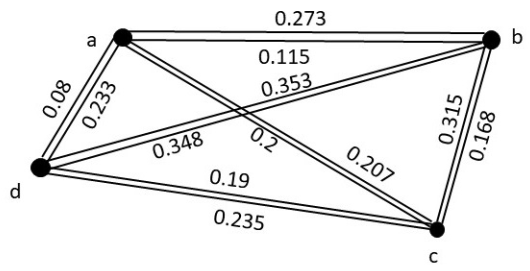
Figure 1 shows the 2-polar fuzzy graph generated by the 2-polar pseudo-metric
.
The pseudo-metric
is then computed based on
(Step 5):
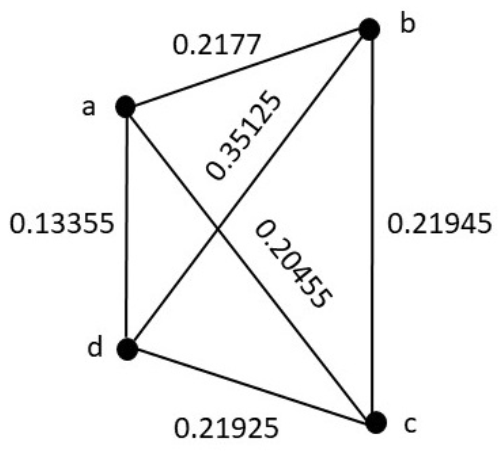
Thus, the following fuzzy dissimilarity graph
G, see
Figure 2, is obtained (Step 6).
6. Conclusions
Fuzzy similarity, formulated as T-equivalence relations, is a well-known method to measure the similarity degree among fuzzy concepts. There is a close link in theory between similarity and dissimilarity (distance) measures, such that one is the dual of another. Despite different proposed formulas in the literature to define the distance functions in an m-dimensional space in order to calculate the dissimilarity degree between each component of two points with m aspects, and consequently to measure the degree of similarity among them, such methods usually have a main drawback: defining based on a predefined metric that leads to a fix formula for all cases .
Introducing the new concept of similarity for
m-polar fuzzy data, called
m-polar
-equivalences, allowed us to measure the similarity degree among
m-polar fuzzy sets independently from any metric (Equations (
10) and (
11)). Moreover, using membership functions to model the
m-polar
-equivalences helped us to define the similarity degree in each direction
(Theorem 2 and Example 1). Therefore, to measure the similarity between each component of two
m-polar fuzzy items, different formulas can be applied for each case
i.
In this paper, we extended the standard definitions of t-norm, t-conorm, fuzzy implication, and fuzzy negation to the m-polar case by operators acting on the Cartesian product , m-times, rather than the unit interval . The main contribution of this study is the use of the concept of m-polar negation to define a stronger version of pseudo-ultrametrics, namely, m-polar -pseudo-ultrametric, based on the m-polar t-conorm and -equivalence where is an m-polar t-norm (Theorem 7). By replacing the third axiom of pseudo-ultrametrics with the new condition , where S is a t-conorm, for each case ,this new metric space enables us to offer a more general version of the transitivity property in pseudo-ultrametric spaces with respect to all three sides, not just the maximum one. Algorithm 1 was then designed to derive an m-polar -pseudo-ultrametric, which can be visualized by an m-polar fuzzy graph. The complexity problem of the m-polar fuzzy graphs was overcome by using the aggregation functions (Theorem 9) and the output was presented in the form of fuzzy graphs, namely, fuzzy dissimilarity graphs. Finally, the computational steps of the proposed approach were demonstrated by a numerical example.
The proposed method can be also considered for m-polar fuzzy data with membership degrees in the form of interval values rather than exact values (known as interval-valued m-polar fuzzy sets). This may help experts to provide more realistic solutions during a decision making process. So, further work is needed to convert the steps of Algorithm 1 to the new format. Moreover, the theoretical results of the paper can be applied to develop fuzzy digraphs, which are widely used in behavioral sciences such as psychology and management, based on the m-polar -preorder relations. In our future work, we may mainly focus on using the proposed similarity measurement for data clustering based on the fuzzy multigraph models.