1. Introduction
In applications of graph theory to sciences and engineering, it is very common to study the evolution of the heat equation on graphs [
1,
2,
3,
4,
5]:
where
is a complex state vector which varies with time
, and
L is the
combinatorial graph Laplacian. The solution of this model, known in engineering as the consensus protocol [
4,
5], always converges in a connected graph to the average of the values of
. That is,
, where
in which
and
are the
jth column of the matrix of eigenvectors of
L and its inverse, respectively, and
are the corresponding eigenvalues of
L. Here, as usual,
means the transpose of the column vector
v. Then, for very long times,
where
. Then, by taking
, where
is the all-ones column vector of appropriate dimension, we have
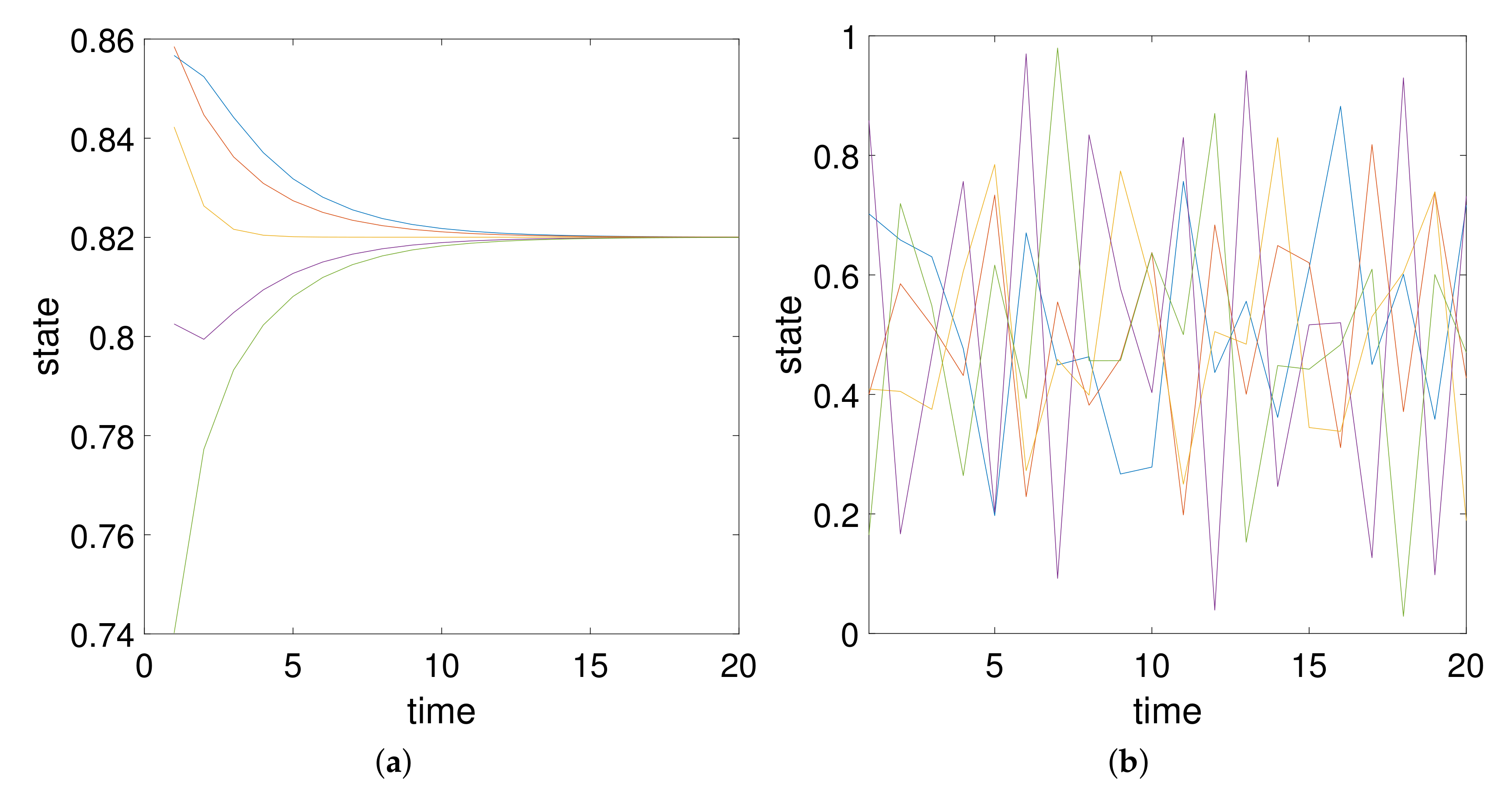
This behavior, which is illustrated in
Figure 1a, contrasts with that of the Schrödinger equation on graphs, which has been defined by [
6,
7,
8,
9]
with initial state
, which shows the characteristic wave behavior illustrated in
Figure 1b. The wave nature of the solution comes from the fact that it is given by
, where
Notice that a different field is the consideration of the Schrödinger equation on metric graphs, which are known as quantum graphs [
10], and which is not the topic of the current work.
The influence of the graph topology on the dynamics is captured in both models by the combinatorial Laplacian [
11,
12,
13,
14], which accounts for the hops of diffusive (classical or quantum) particles from one node to any of its nearest neighbors. An important characteristics of a few real-world systems, which is not accounted for by the combinatorial Laplacian, is the non-locality of certain processes taken place on discrete structures. For instance, it is nowadays well documented that, in the self-diffusion processes of metallic atoms weakly bounded to metallic surfaces, there are not only nearest-neighbor hops but also long-range ones [
15,
16,
17,
18], which are not captured by the combinatorial Laplacian. Similar processes are also found in light-harvesting complexes [
19,
20], Rydberg atoms [
21,
22], and other systems [
23,
24].
In December 2011, Estrada proposed an extension of the combinatorial Laplacian to account for the long-range hops of diffusive particles on graphs [
25]. In this work, the concept of graph Laplacian is generalized by introducing the
d-path Laplacians, which were then plugged into a generalized diffusion equation to study the influence of long-range jumps on diffusive processes on graphs (see Preliminaries for definitions). A year later, in November 2012, Riascos and Mateos proposed the use of fractional powers of the combinatorial Laplacian to capture nonlocalities in random walks on graphs [
26]. Recently, Estrada et al. [
27,
28] have proved analytically that the generalized diffusion equation with
d-path Laplacians produces superdiffusive behavior in 1- and 2-dimensions, in agreement with recent experiments in physics, and have shown some other applications to real-world systems [
29]. On the other hand, in 2015, Riascos and Mateos extended their fractional approach to quantum systems by studying quantum transport on simple graphs [
30].
The topic of the current work resonates with an important area of research in physics, which is the so-called many-body localization (MBL) under long-range hopping. MBL is a phenomenon occurring in sufficiently disordered quantum systems and represents an interesting and unusual phase of matter [
31,
32,
33]. The existence of MBL under long-range hopping has been widely debated in the physics literature. For instance, many numerical experiments have shown that MBL cannot survive in systems with strong power–law interactions [
34,
35]. However, other theoretical frameworks used for disordered spin chain has shown the existence of MBL for strong LRI [
36]. More recently, Nag and Garg [
37] demonstrated that MBL persists in the presence strong long-range hopping. They studied a one-dimensional system of spinless fermions with a deterministic aperiodic potential in the presence of long-range interactions and long-range hopping.
Here, we will consider the use of the d-path Laplacians on a generalized Schrödinger equation on graphs that account for both short and long-range hops of a quantum diffusive particle. We will consider analytically the solution of the generalized Schrödinger equation for certain classes of graphs and will provide some evidence of the differences between this approach and the one using fractional powers of the Laplacian. In particular, we show an example where the fractional Laplacian behaves similarly to the Schrödinger equation without long-range interactions, while the generalized d-path Schrödinger equation displays a qualitatively different phenomena. We finish by mentioning some open problems for the mathematical analysis of the d-path Laplacians in general, and its use in quantum systems in particular.
2. Preliminaries
In this work, we always consider
to be an undirected finite or infinite graph with vertices
V and edges
E. We assume that
is connected and locally finite (i.e., each vertex has only finitely many edges emanating from it). Let
d be the shortest path distance metric on
, i.e.,
is the length of the shortest path from
v to
w, and let
be the
d-path degree of the vertex
v [
25,
27], i.e.,
Let
be the Hilbert space of square-summable functions on
V with inner product
where
represents the complex conjugate of
In
, there is a standard orthonormal basis consisting of the vectors
,
, where
For
, the following operator defined in
is the
d-path Laplacian of the graph
which act on the vectors
it acts as follows:
For each , the d-path Laplacian is a self-adjoined operator in . Furthermore, the operator is bounded if and only if the function is bounded.
In order to account for a gradual influence of first, second, and thus nearest neighbors, we consider a transformation of the
d-path Laplacian operators of the form [
25,
27,
28]
with
and ▵ being the diameter of the graph. In particular, we will consider here the
Mellin-transformed d-Laplacian
where
For infinite graphs if
for some
and
, then
is a bounded operator for
with
. If the graph is finite, then there is no restriction on the parameter
s.
For a connected graph, the matrix is positive semidefinite with real eigenvalues and the corresponding orthonormalized eigenvectors , , such that it can be written as , where is the diagonal matrix of eigenvalues and the columns of U are the corresponding eigenvectors.
3. Quantum Transport Controlled by d-Path Laplacians
In order to study the quantum transport with long-range hops on graphs, we plug the transformed
d-path Laplacian operators into the Schrödinger equation as considered by Hancock et al. [
6,
7,
8,
9] on graphs to obtain
where
is the Mellin transformed
d-path Laplacians as defined in the previous section. The solution of the Schrödinger equation with the transformed
d-path Laplacian operators is
, where
For the analysis of quantum transport on a graph, it is common to consider the
transition probability between two nodes
p and
q,
, at a given time
t and for a given values of the parameter
s,
In particular, is the return probability to the node p–the probability that the particle return to its origin p after a given time t–and is the average probability of return. We are going to analyze the evolution of the quantum transport in some simple graphs.
3.1. Quantum Transport on a Ring
We will start the analysis of quantum transport on graphs by considering a ring (cycle graph) without LRI using (
4). The cycle graph consists of
n nodes all of degree 2. In particular, we will consider the solution
, where
due to the equivalence of all nodes in the ring. The following is a result obtained by Riascos and Mateos.
Lemma 1. (Riascos and Mateos) Let G be a ring (cycle graph) with n nodes. Then, if n is sufficiently large , where d is the shortest path separation between the two nodes and is the corresponding Bessel function of the first kind.
For the sake of simplicity and without any loss of generality hereafter, we will consider a ring graph with an odd number of nodes.
Lemma 2. Let G be a ring (cycle graph) with an odd number n of nodes and let be the Mellin transformed d-path Laplacian of G with parameter s. Then,where are the generalized harmonic numbers and . Proof. For a cycle graph,
is a circulant matrix with structure
where
. The eigenvalues of
are then
where
, which can be rearranged as
from which the result finally arises. □
The trigonometric series of the form
were studied by Stanković et al. [
38] who for the case in which
,
obtained
where
is the Riemann zeta function. As an example, we are going to study
in order to compare with
.
Theorem 1. Let G be a ring (cycle graph) with an odd number n of nodes and letbe the Mellin transformed d-path Laplacian of G with parameter . Then, the transition probability between a node labeled as and a node q at a shortest path distance d from is, for sufficiently large n,where . Proof. Because
is circulant, we have that
is given by
where
. Every nontrivial eigenvalue of
has multiplicity two for
n odd (when
n is even, there is one nontrivial eigenvalue with multiplicity one). Then, we should notice that the eigenvectors
and
are associated with the same eigenvalue
. For instance, in a ring with seven nodes, the eigenvectors
and
are both associated with
;
and
with
;
and
with
. Therefore, by selecting the node
(first row of
U), we have for any node at a shortest path distance
d from
p:
where
. We now consider the case
for which the trigonometric series converges to
Then, for a sufficiently large ring graph, i.e.,
we have
After integration, we finally obtain the result. □
Corollary 1. Let G be a ring (cycle graph) with odd number n of nodes and letbe the Mellin transformed d-path Laplacian of G with parameter . Then, the return probability is, which for a sufficiently large ring is We checked here that the values obtained for
from Theorem (1) and those from using the function
implemented in Matlab for the eigenvalues of a matrix are exactly the same for rings of size
. Therefore, we now study the evolution of the probability of return in a ring of size
for the Schrödinger equation using the combinatorial Laplacian as well as the Mellin transformed
d-path Laplacian. The results illustrated in
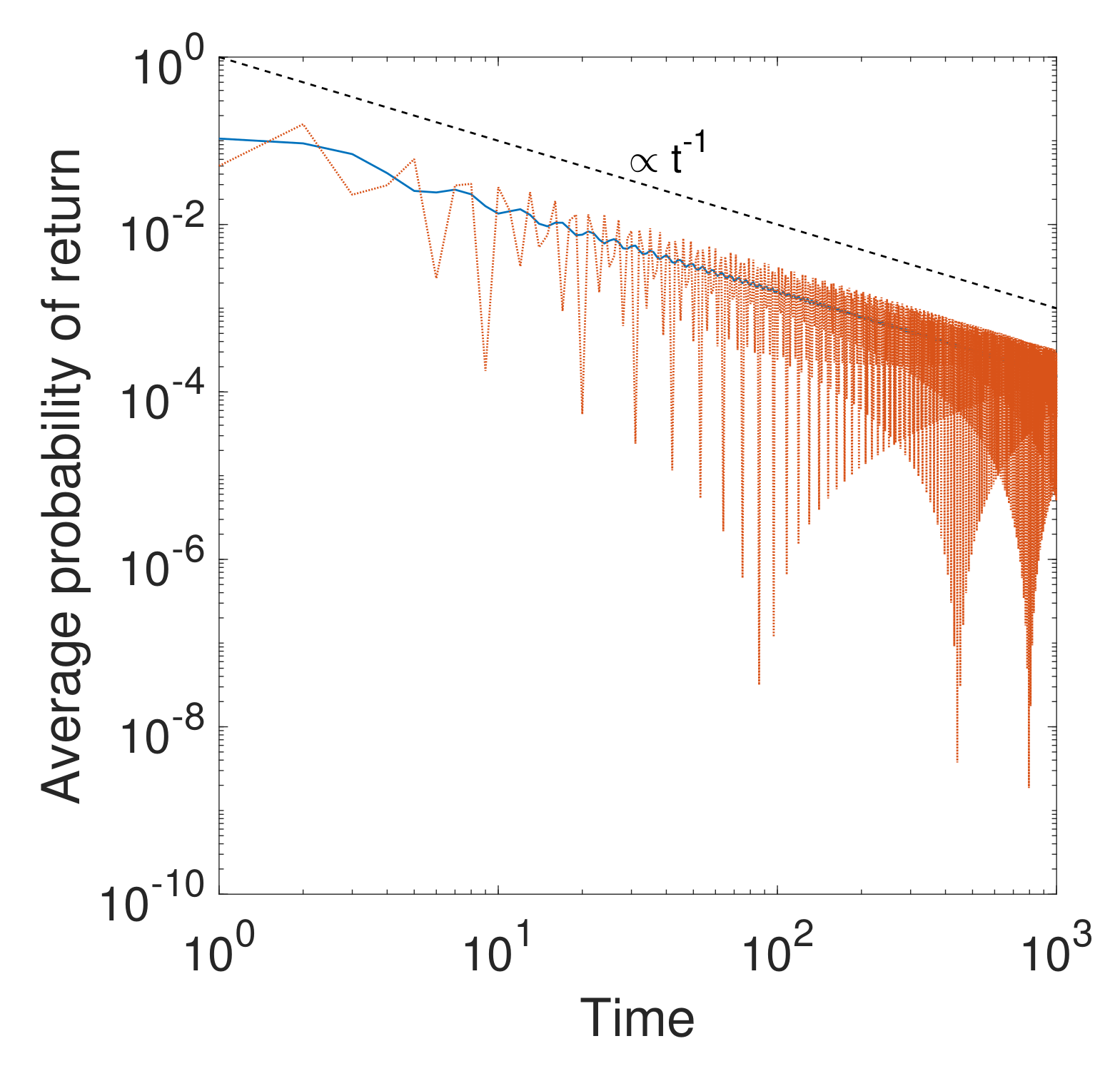
Figure 2 illustrate the main difference between the use of the SE without (red dotted line) and with (continuous blue line) long-range hops. Similar results were reported for ring graphs by Riascos and Mateos [
30].
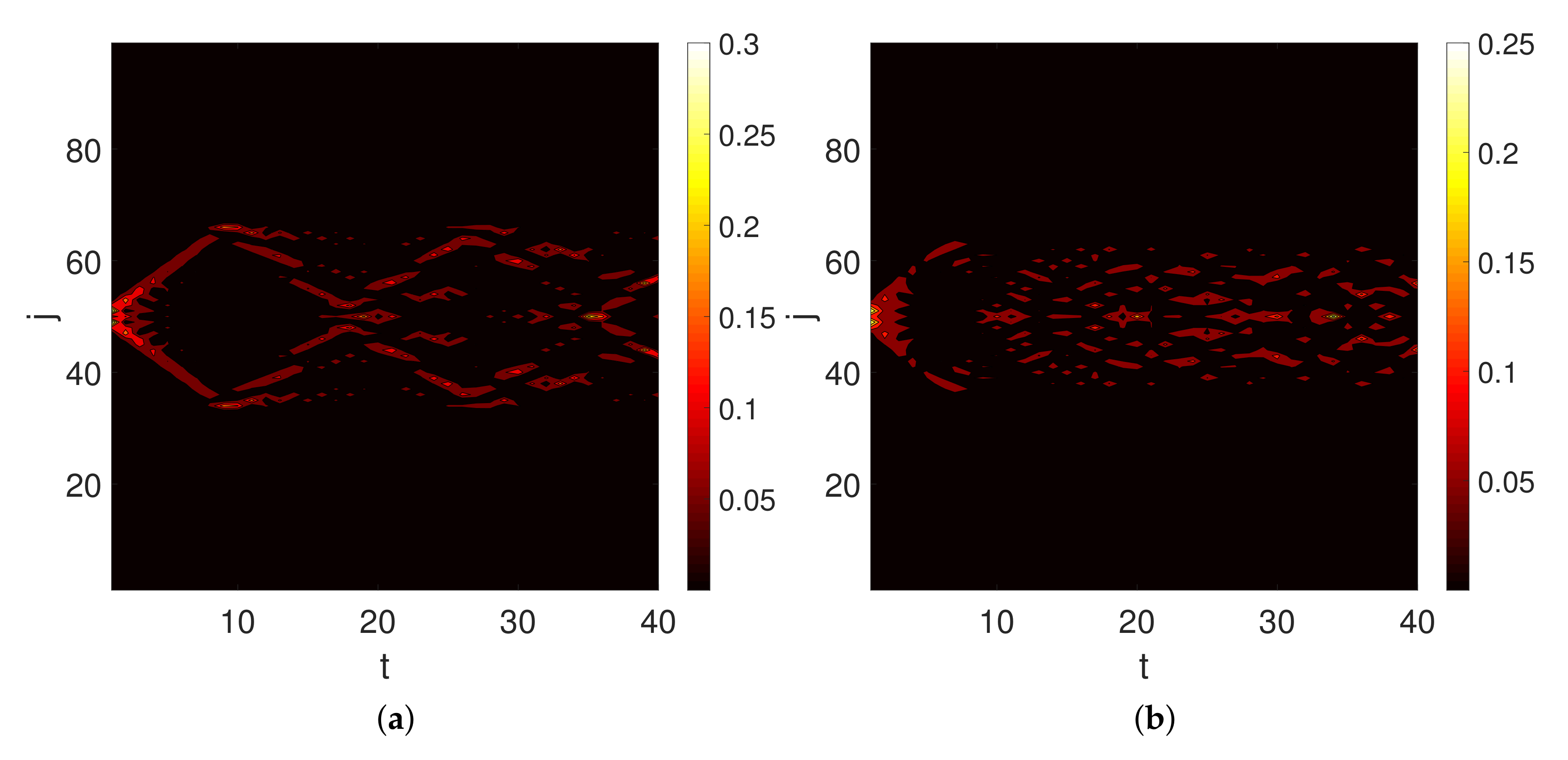
In
Figure 3, we illustrate the evolution of
in a ring graph having 101 nodes for
(a) and for
(b). The effects of LRI are very clear, in particular the fact that, at very short times, the probability of transition from
to the most distant nodes, e.g., nodes labeled as 1 and 101, is much higher when
than when there are no LRI effects.
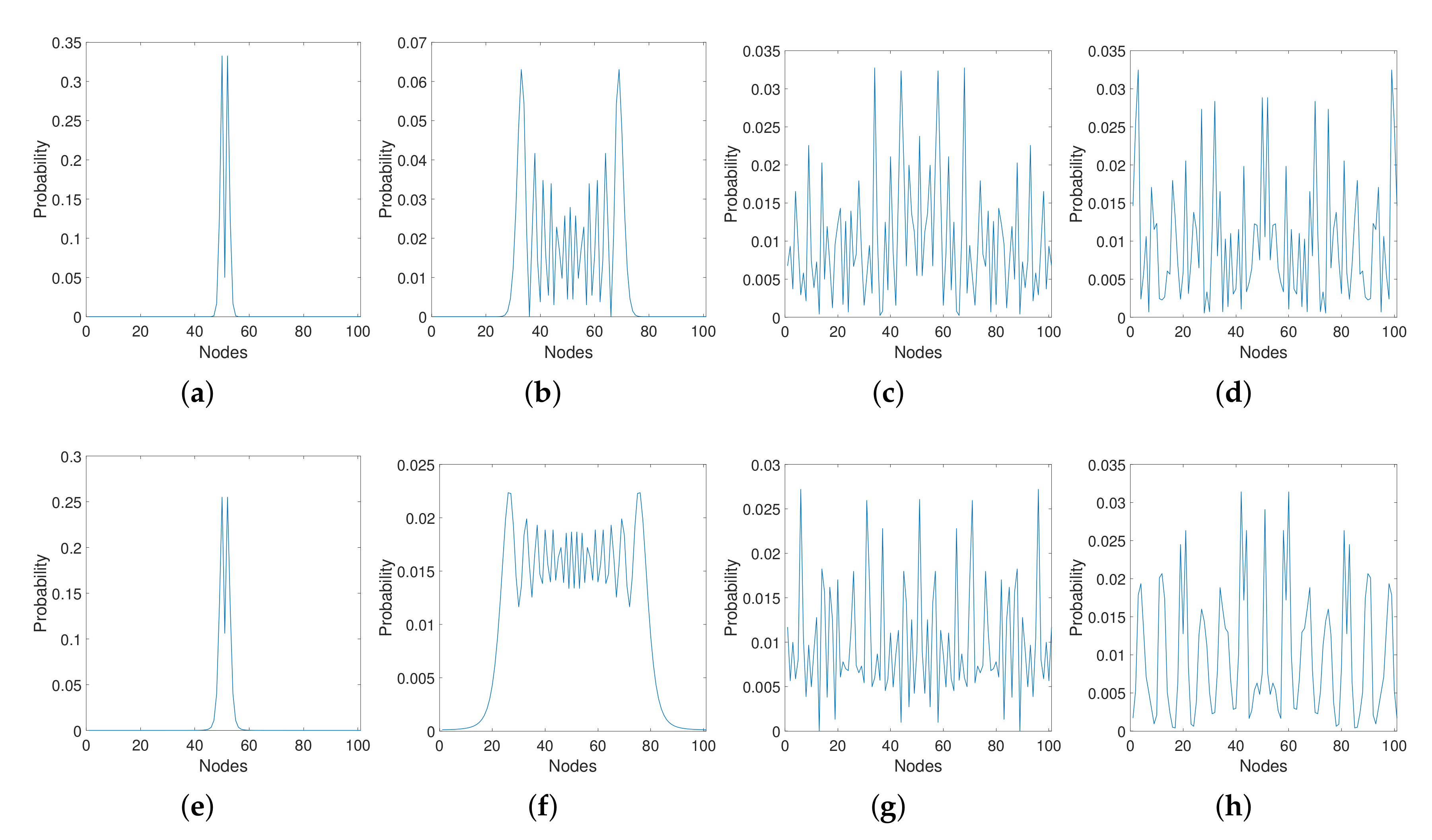
In
Figure 4, we illustrate the evolution of the transition probability for Schrödinger equation without LRI (top panels) and with Mellin transform using
(bottom panels).
Although both
Figure 3 and
Figure 4 are only partial snapshots of the dynamics taking place for the quantum particle in a ring, they allow us to observe some important differences between the consideration of LRI in relation to the dynamics without LRI. In
Figure 3, it can be seen that at short times the probability of locating the particle at its origin is significantly higher when there are LRI than when there are not. Even at longer times, e.g.,
, the probability of finding the particle in the dynamics without LRI is almost the same at every node of the ring, while, for the case when there are LRI, this probability is higher around the origin. In
Figure 4, there are more snapshots of the dynamics and we can observe part of the oscillations that the probability displays at different times. For instance, at
, the particle oscillates between nodes 30 and 70 in both dynamics, i.e., with and without LRI. However, when there are no LRI, the probability of finding the particle at certain nodes with label between 30 and 70 is almost zero, and the probabilities of finding the particle at either node 30 or 70 is significantly higher than at any of the rest of the nodes. In the case of the dynamics with LRI, this probability is never close to zero for any node in this interval and almost all the nodes in it have probabilities between 0.01 and 0.025. That is, the particle is trapped in the region between nodes 30 and 70 with almost the same probability of being found at any of these nodes. When the time is bigger, it is more difficult to extract some general observations, but in any case the behavior of both dynamics show significant differences as previously seen in
Figure 3.
3.2. Quantum Transport in Complete and Star Graphs
We study here analytically two other classes of graphs, namely the complete and star graphs. The complete graph of n nodes is the graph in which every pair of nodes is connected by an edge. The star graph has one node of degree and nodes of degree one.
Lemma 3. Let be a complete graph with n vertices. Then, the transition probability isand the average probability of return is Proof. The eigenvalues of
for the complete graph are
with multiplicity one and
with multiplicity
Then, because in
all vertices are equivalent, we have that
. That is,
The eigenvector associated with
is
. Then, the term
is given by
Then, because
, we have
and
The final result comes from the fact that . □
Theorem 2. Let be a star graph with n vertices labeled in such a way that the vertex with degree is labeled as the number 1. Let Then, the average probability of return is , where In addition, the transition probabilities are Proof. The eigenvalues of
for
are:
with multiplicity one,
with multiplicity
and
with multiplicity one. It is easy to check that
and that
The communicability function for any pair of vertices can be written as
Now, because
, we have that
. Therefore, if
, we have
which means that
If
such that
We also have that
, such that
. Thus, for the case
,
, we obtain
. Therefore,
Finally, if
such that
The final result comes from the fact that . □
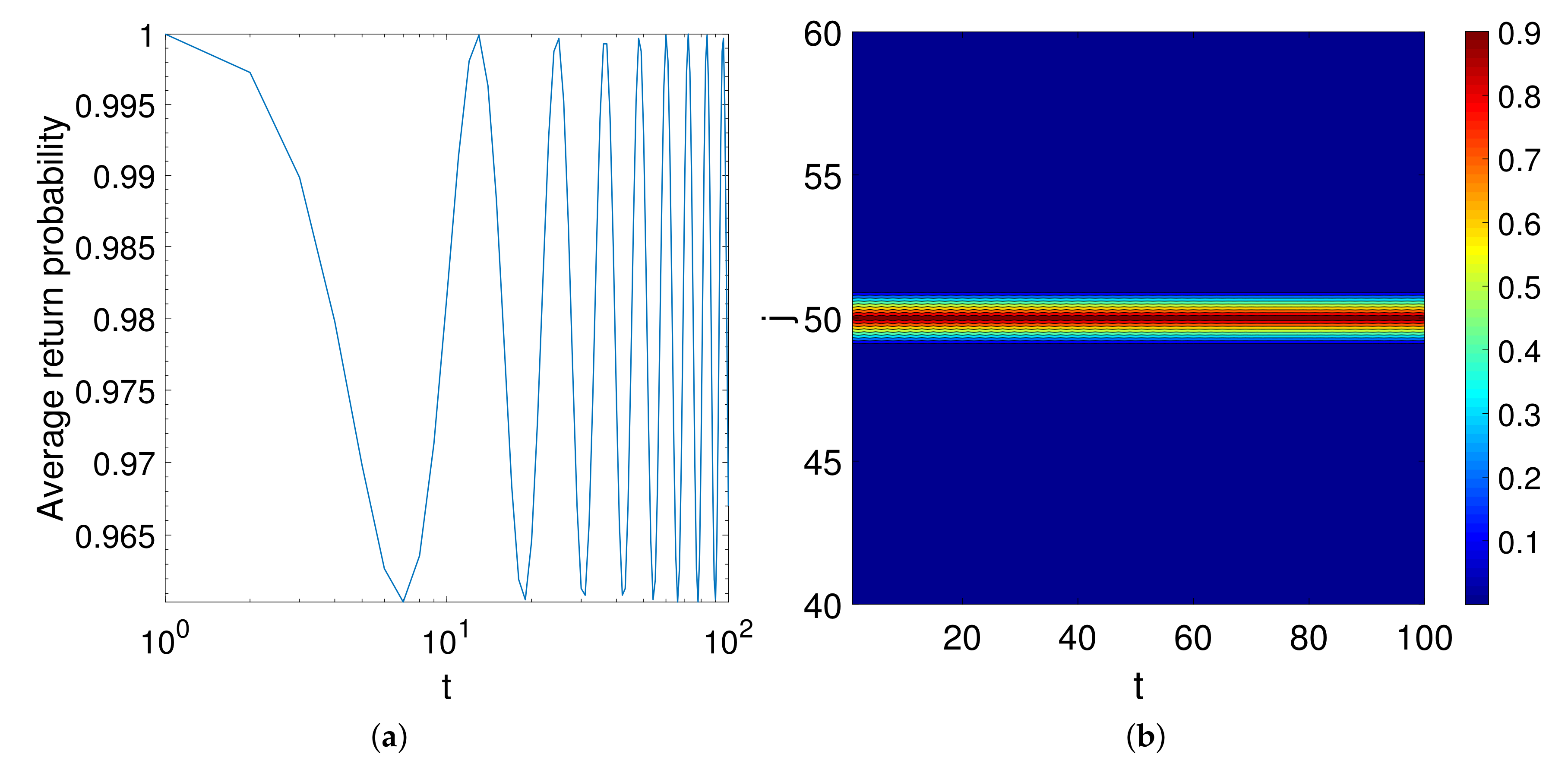
These results indicate that, for the case of the complete and the star graphs, the wave packet remains constant and does not decay with time as in the case of the ring graph. Indeed, in these graphs, the quantum particle remains located at the initial position at any time. For instance, in
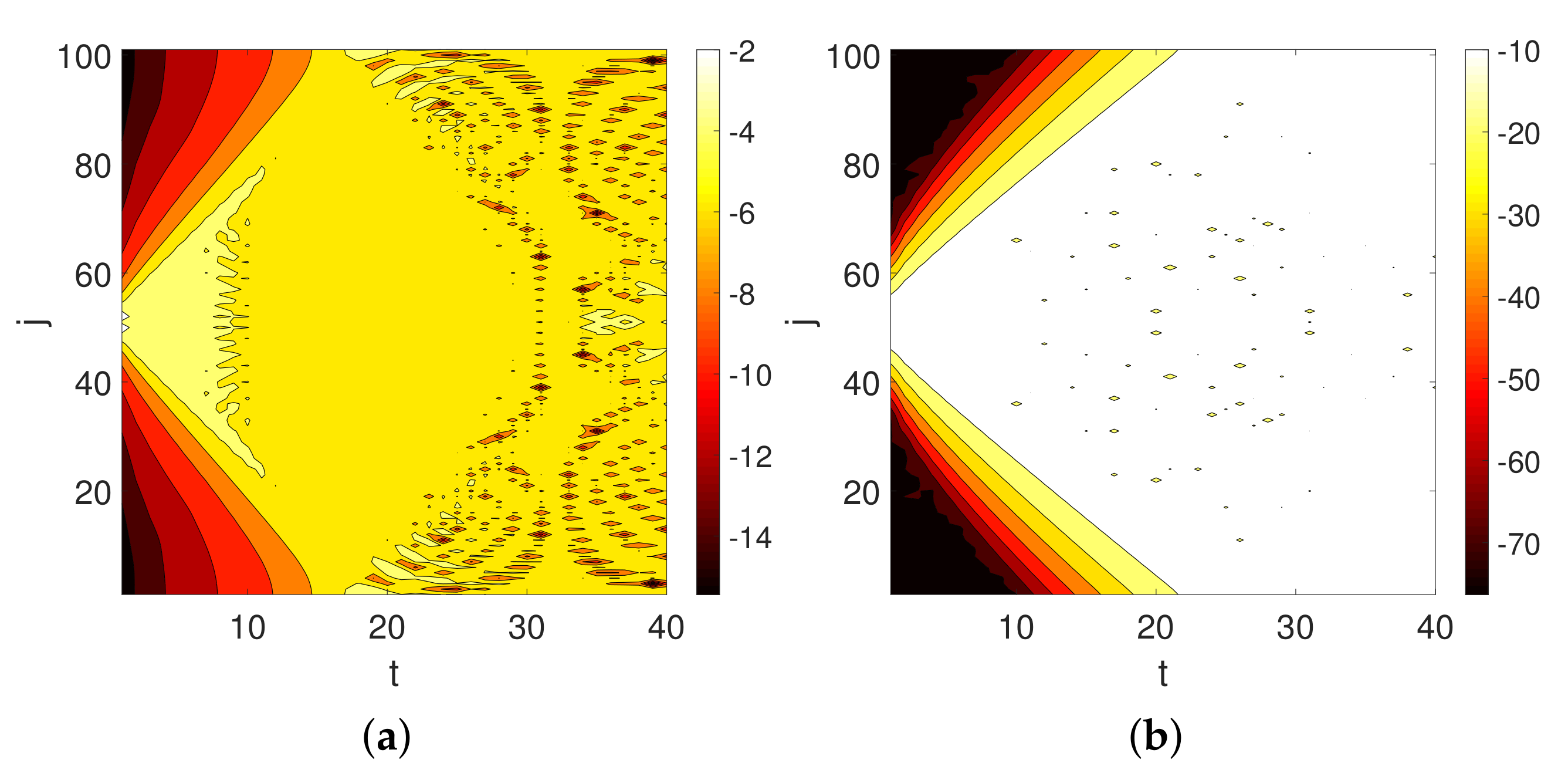
Figure 5a, we illustrate the evolution of the return probability of a quantum particle in a complete graph with 100 nodes,
It can be seen that the probability always oscillates between 0.96 and 1.0 not showing a decay as the one observed for the case of the ring in
Figure 2 in which the probability decays as a power-law. Here, the mean probability is just a horizontal line at probability 0.98. In
Figure 5b, we show for the same graph that the probability of finding the particle at the origin is always close to unity (white color in
Figure 5), indicating that the particle is always localized at the origin at any time (notice the logarithmic scale in
Figure 5).
In agreement with these results, a quantum particle located in a region between two cliques oscillates among the nodes in that region without visiting the nodes of the cliques. For instance, in a barbell graph (see [
29] for results using the classical diffusion equation), i.e., a graph consisting of two cliques separated by a path, if the particle is located at node of the path, it gets trapped in the nodes of the path without visiting the two cliques (see
Figure 6).
4. d-Path Laplacians versus Fractional Graph Laplacian
We are not interested here in a deep comparison between the use of the
d-path Laplacians and that of the fractional graph Laplacian in the Schrödinger equation. However, we would like to make some remarks about some important differences which may guide the reader to select between one or the other for the studies they conduct. First, we should remark that the “fractional” graph Laplacian corresponds to the fractional powers of the combinatorial Laplacian, which can be defined by the following integral (see [
39]):
Then, because the combinatorial graph Laplacian is positive semidefinite, we have the following result about the existence of
[
39].
Theorem 3. Let be a simple graph. Then, because L has no eigenvalues in , there is a unique pth root of In addition, because L is real, then is real.
Obviously, always exists for any connected graph. Another similarity between both approaches is that and are both the same, i.e., they are equal to L. However, there is an important difference between these two concepts when we consider the limits of the coefficients and s to zero: and , where E is the all-ones matrix of order n and I the identity matrix of order n. That is, while does not represent a Laplacian matrix, corresponds to the Laplacian matrix of the complete graph . Conceptually, this is also important because is telling us that, in this limit, there are no dynamics between the nodes of the graph, while is telling us that there is a dynamics between every pair of nodes, which is the real limit of the strongest possible LRI. This is well described by the following result.
Lemma 4. Let be a simple graph and let L and be the combinatorial Laplacian and the Mellin transformed d-path Laplacian with parameter s. Then,andwhere n is the number of nodes, E is the all-ones matrix of order n and I the identity matrix of order n. These differences are not only clear at this limit but also when we use both approaches for studying quantum transport in certain simple graphs. For instance, in
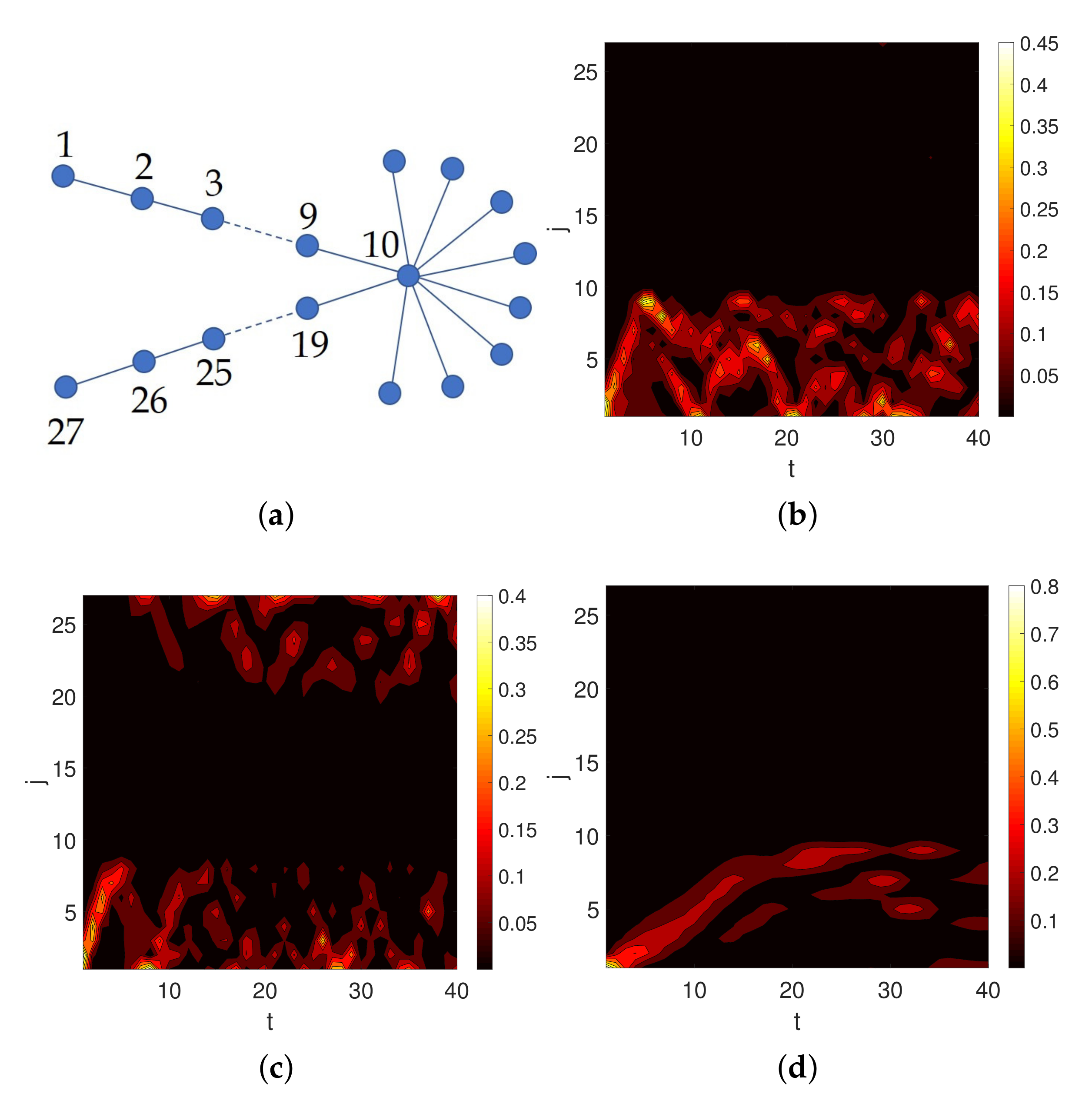
Figure 7a, we illustrate a simple graph consisting of a long path with a “barrier” in the middle, consisting of a star subgraph. If we locate a quantum particle at the position labeled as one, which is one of the endpoints of the long path, it gets trapped in the branch of the tree consisting of nodes 1–8 when there is no LRI in the Schrödinger equation (see
Figure 7b). However, the use of the
d-path Laplacian in the Schrödinger equation makes the particle hop over the barrier and visiting the nodes in the other branch of the tree (
Figure 7c). It is remarkable that this effect is not observed when the fractional Laplacian
is used, which then behaves like the Schrödinger equation without LRI. We explored different values of
and in no case did we observe trans-barrier hopping (see
Figure 7d for the case
). This is a clear evidence of the qualitatively, even conceptually, new phenomena that can emerge from the consideration of LRI effects accounted for by the
d-path Laplacian on graphs.
Finally, we should remark the fact that the use of fractional powers of a matrix/operator is limited to the case in which it has no eigenvalues in
This situation limits its use to other important graph matrices/operators such as the adjacency and the incidence matrix/operator. The use of
d-path matrices/operators are easily extended to those cases as it has been shown in the recent literature [
40,
41]. Then, quantum mechanical models such as the tight-binding model [
42], which is based on the adjacency operators on graphs, can be extended to consider LRI through the use of transformed
d-path adjacency matrices/operators. In a similar way, quantum synchronization systems, such as the quantum Kuramoto models [
43,
44], can also be extended in similar ways by using transformed
d-path incidence matrices/operators.
5. Conclusions and Future Outlook
We have defined a Schrödinger equation with long-range interactions via the use of the transformed d-path Laplacian matrix. In a similar way as we have previously studied for the diffusion equation, the d-path Schrödinger equation can be considered for locally finite infinite graphs. We reported here analytical expressions for the transition and return probabilities of a quantum particle at the nodes of a ring graph. We show that the average return probability in ring graphs decays as a power law with time when LRI is present. In contrast, we prove analytically that the transition and return probabilities on a complete and start graphs oscillate around a constant value. Therefore, we inferred that in a barbell graph the quantum particle get trapped and oscillates across the nodes of the path without visiting the nodes of the cliques. When compared with the fractional powers of the Laplacian previously used in the literature, the d-path Laplacian operators produce the emergence of new phenomena related to the location of the wave packet in graphs with barriers, which are not observed neither for the Schrödinger equation without LRI nor for the one using fractional powers of the Laplacian.
The study of the
d-path Laplacian formalism in both classical and quantum mechanics is still in its infancy. Therefore, there are still many open questions. They are important for a better understanding of the mathematical properties of the transformed
d-path Laplacian matrices/operators and their applications. In no particular order and in a non-exhaustive manner we mention here: (i) the analysis of the spectral properties of the transformed
d-path Laplacian matrices/operators for certain families of simple and random graphs; (ii) the detailed analysis of the similarities and differences between the (classical and quantum) diffusion equations using transformed
d-path Laplacians versus those using fractional powers of the combinatorial Laplacian; (iii) the analysis of quantum transport on graphs with the
d-path Schrödinger equation based on moments of the wave packet and on the temporal autocorrelation function [
45,
46], among others. In addition, due to the easy computational implementation of the current formalism, it would be desirable to see a wider range of applications in different real-world scenarios to gain more insights about its scope of applications.