2. An Algorithm for a Signed Bipartite Graph
In this section, we introduce a signed constrained matching for the signed bipartite graph in order to study the minimum rank problem for a sign pattern.
A signed digraph is a digraph
, which consists of a digraph
together with a sign function
, denoted
, that is, the edges (arcs) of
have been signed positive or negative by sign. For a
sign pattern
P, the graph of
P is a signed digraph
. It is converted into a signed bipartite graph
with vertices
based on rows of
P and
based on columns of
P. If
-entry of
P is nonzero, then the sign of an edge
of
is the same as the sign of the entry of
P. The bipartite graph is important for the study of the regularity for graphs (see [
13,
14]).
In [
2], the constrained matching in a bipartite graph has proven useful in the study of the zero forcing number of a loop directed graph, and the equivalence between a constrained matching in a bipartite graph and a zero forcing set in a directed graph was proved. We will give the definition of a signed constrained matching in a signed bipartite graph
in the following way:
A set of k signed edges with the same sign is said to be a signed k-matching between and if vertices are distinct as well as vertices .
A signed k-matching is called constrained if it is the only signed k-matching between U and V.
A signed constrained k-matching in is said to be maximum if there is no (constrained) s-matching with .
For a signed bipartite graph
, if two edges with the same direction can meet at the same column, then they are called a
c-pair. A cycle with an even (respectively, odd) number of c-pairs is called an
e-cycle (respectively,
o-cycle). If the entries of
P are resigned to make sure all diagonal entries of
P are non-zero, then these diagonal entries can correspond to a perfect matching
M in
. A cycle in
containing each edge
in
, corresponding to any column
c it passes through, is called an
relative to
M, or an
M-interlacing for short. The cycles relative to
M with no common vertices are called disjoint
M-interlacing cycles (see [
15]).
Lemma 1 ([
15])
. If are m cycles in M-interlacing cycles and , thenwhere sign() denotes the sign of the permutation . Lemma 2 ([
15])
. Let P be an sign pattern with each diagonal element nonzero, its associated signed bipartite graph and M the perfect matching in the bipartite graph of P corresponding to its diagonal.(1) For the determinant expansion of P, the number of termsis equal to the number of disjoint M-interlacing cycles in.
(2) Let ε denote the sign of the product of the diagonal elements of P. Then, the number of terms ofin the determinant expansion of P is equal to the cardinality of the set of all sets of disjoint M-interlacing cycles that contain an odd number of M-interlacing e-cycles.
We will change the condition in Lemma 2 to obtain the following theorem.
Theorem 1. Let P be ansign pattern with each diagonal element nonzero,its associated signed bipartite graph and A a real matrix in the sign pattern class of. Let M denote the perfect matching inof P corresponding to its diagonal. Then, the number of terms of sign ε in the determinant expansion of P is equal to the cardinality of the set of all sets of disjoint M-interlacing cycles that contain an even number of M-interlacing e-cycles.
Proof. According to Equation (
1), every term
x in the determinant expansion of
P is sign
and the sign of
x is determined by sign
sign(disjoint
M-interlacing cycles), where the disjoint
M-interlacing cycles are
and
.
The cycle
corresponding to
is defined to be the subgraph
of
.
By permutation, we suppose that all diagonal entries of
P are negative. Then,
and we consider other terms with sign
. By Equation (
1) of Lemma 1,
where
.
Because of all negative diagonal entries, the sign of
x equals
In order for the term x to have sign , must be equal . We will discuss the following two cases:
- Case 1:
Let
l be odd, then
where
-cycles among
) is the number of
o-cycles among
, a similar statement holds for
e-cycles as well.
- Case 2:
The proof of this theorem is similar to the proof of Theorem 2.9 in [
15]. □
For an sign pattern P, let be subsets of . We denote by () the submatrix of P lying in (deleting) the rows indicated by and the columns indicated by . If , the submatrix () is abbreviated to ().
If P is a square full sign pattern associated with its signed bipartite graph , with one set of vertices based on rows of P and the other set of vertices based on columns of P. For an square sub-sign pattern of P, there is an associate sub-signed bipartite graph of .
We will provide the following Algorithm 1 to construct a sub-signed bipartite graph with the maximum perfect matching
corresponding to every set of disjoint
-interlacing cycles, which contain an even number of
-interlacing
e-cycles.
| Algorithm 1: The construction for a sub-signed bipartite graph with the maximum perfect |
| Let be a signed bipartite graph associated with its sign pattern and be the signed perfect matching in corresponding to ’s diagonal. This algorithm produces a sub-signed bipartite graph with the maximum perfect matching corresponding to every set of disjoint -interlacing cycles, which contain an even number of -interlacing e-cycles. |
| Set with one set of vertices based on rows of P and the other set of vertices based on columns of P, and . |
| While : |
| (1) Search for every set of the disjoint -interlacing cycles and count the number of every set of the disjoint -interlacing e-cycles. |
| (2) If each is even, then . |
| Else delete a vertex r from and a vertex from in a disjoint -interlacing e-cycles and all edges adjacent to r and , and obtain a sub-signed bipartite of . |
| (3) Set . |
| (4) . |
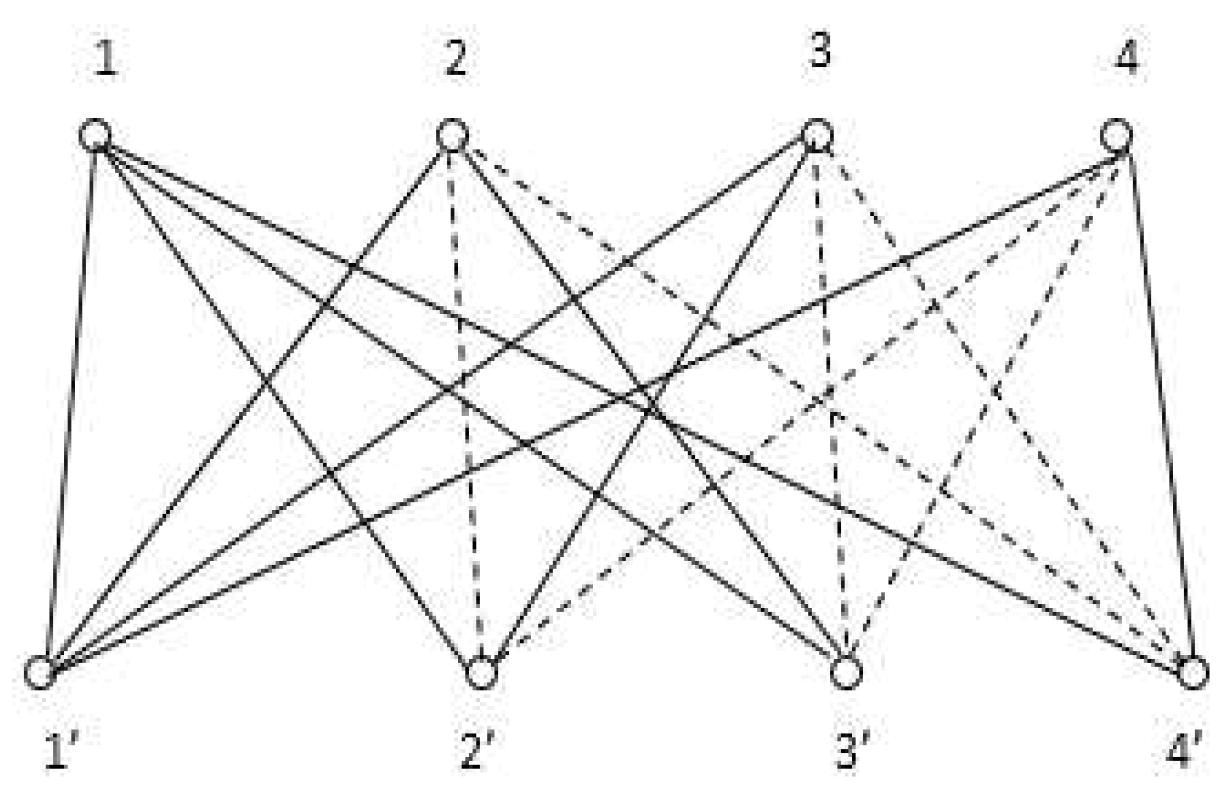
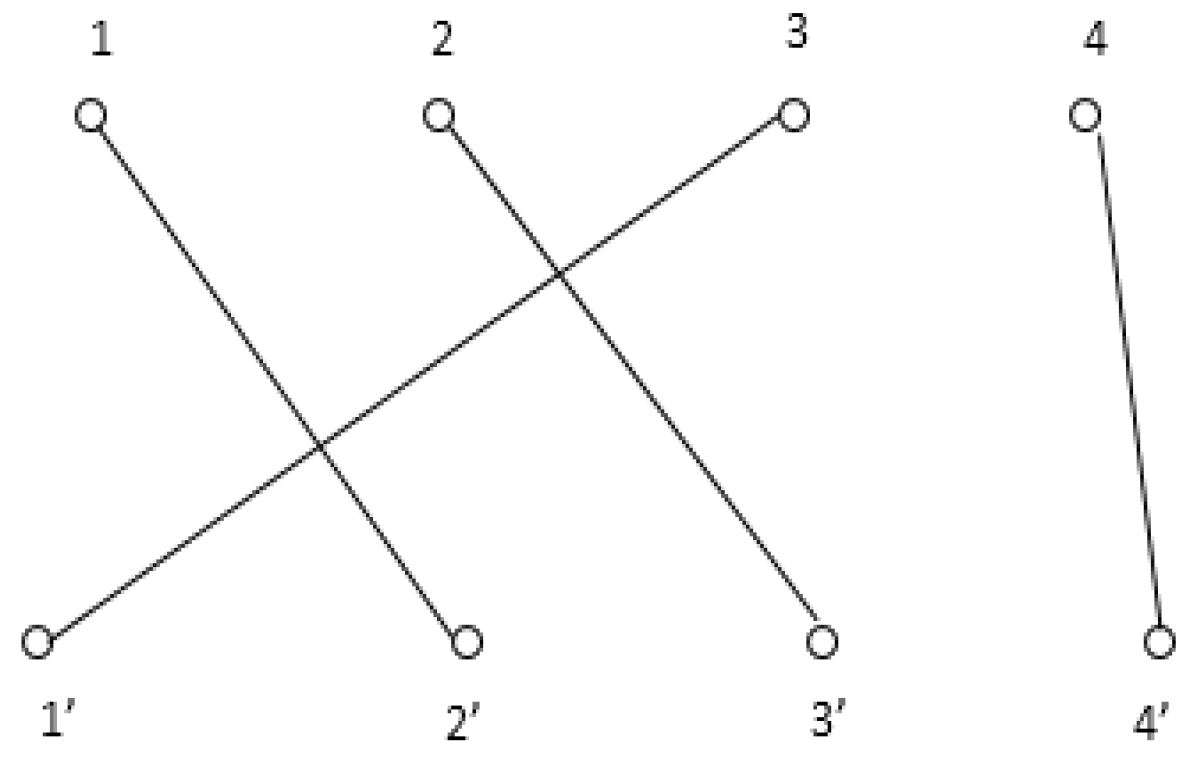
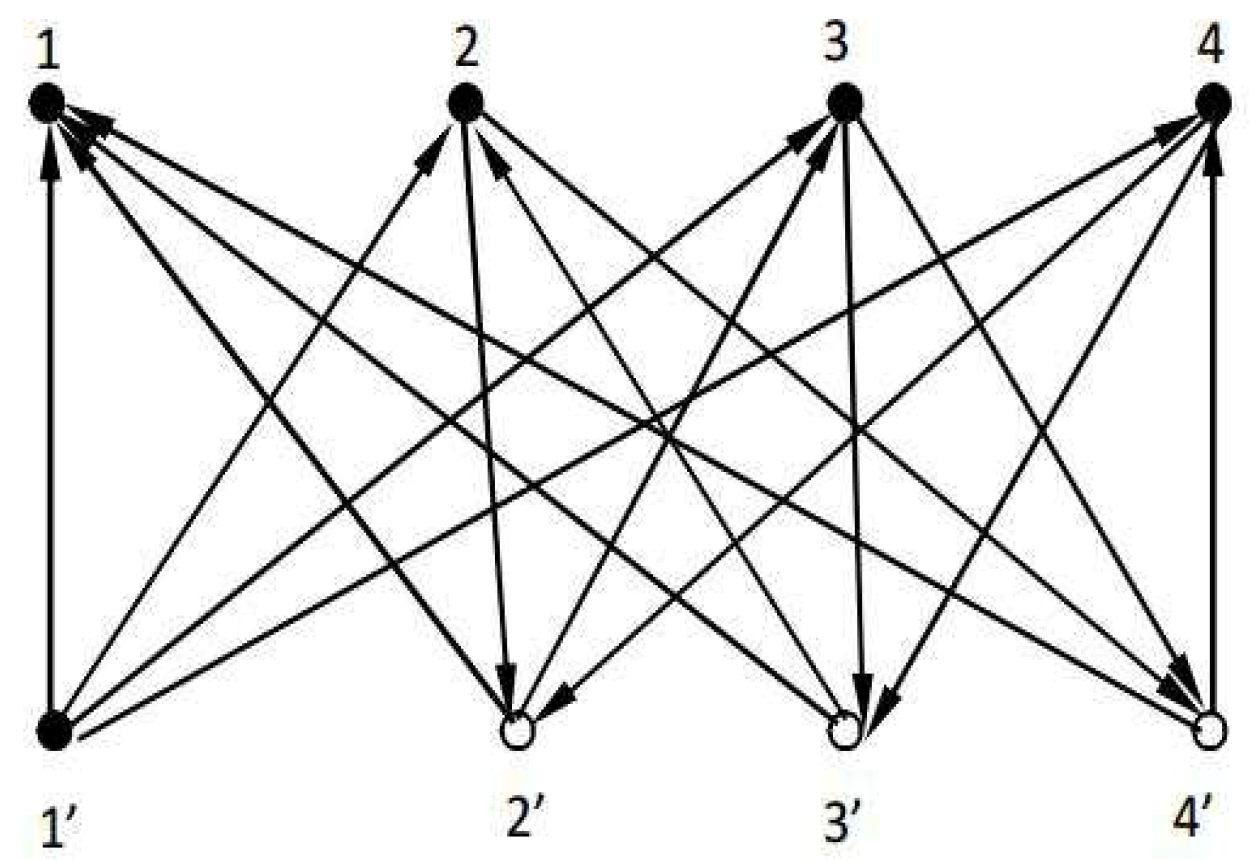
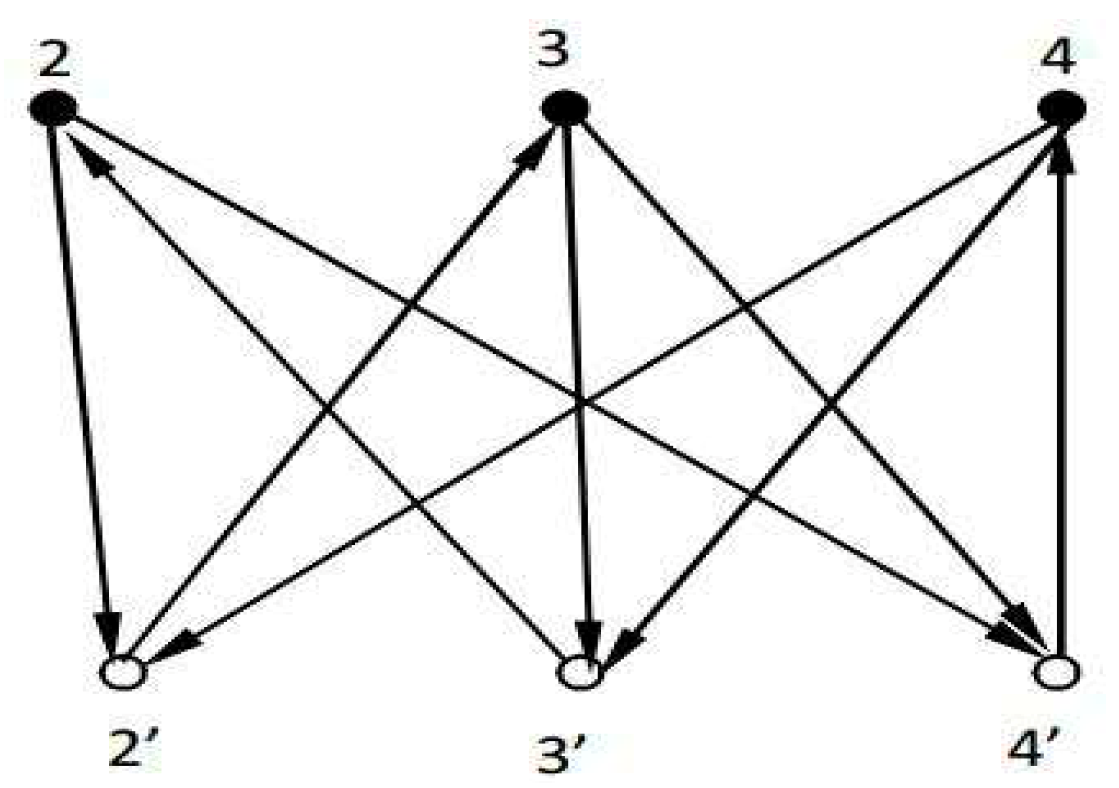
Example 1. Letbe a sign pattern of order 4 whose signed bipartite graph iswith one set of verticesbased on rows of P and the other set of verticesbased on columns of P (see Figure 1). The perfect matching
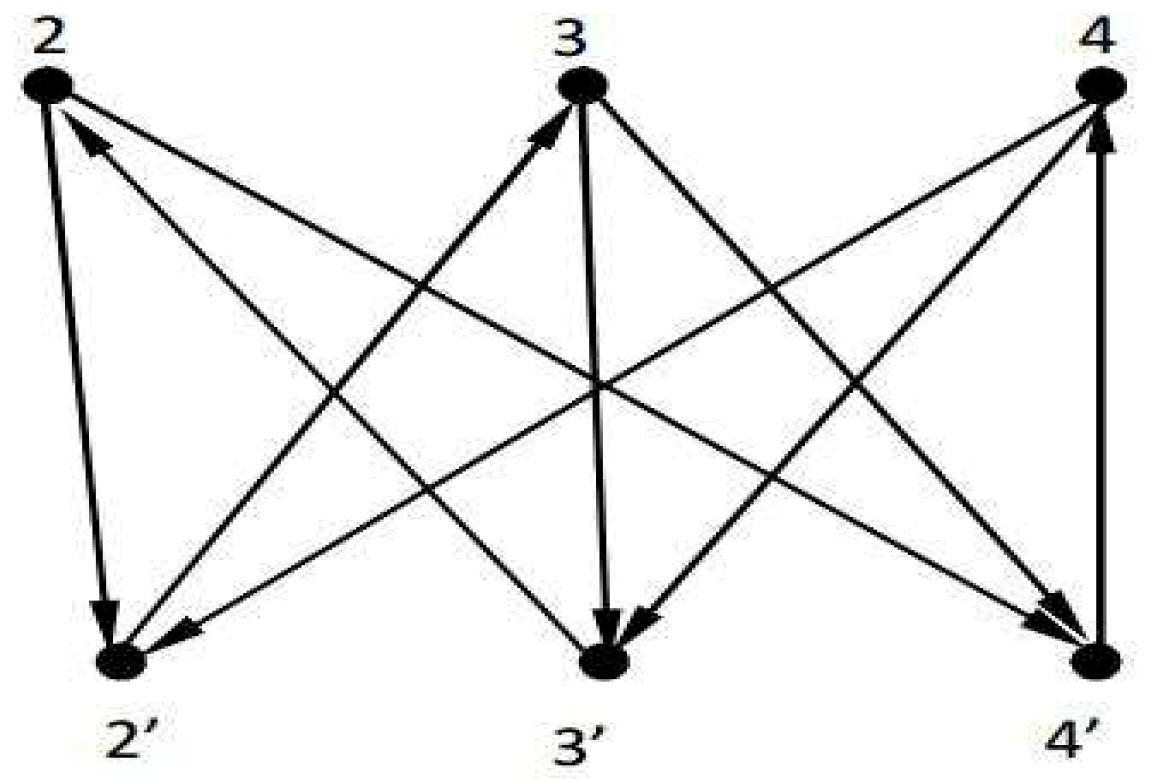
is a signed 4-matching, but it is not constrained (see
Figure 2). If we delete the vertex 1 from
U and the vertex
from
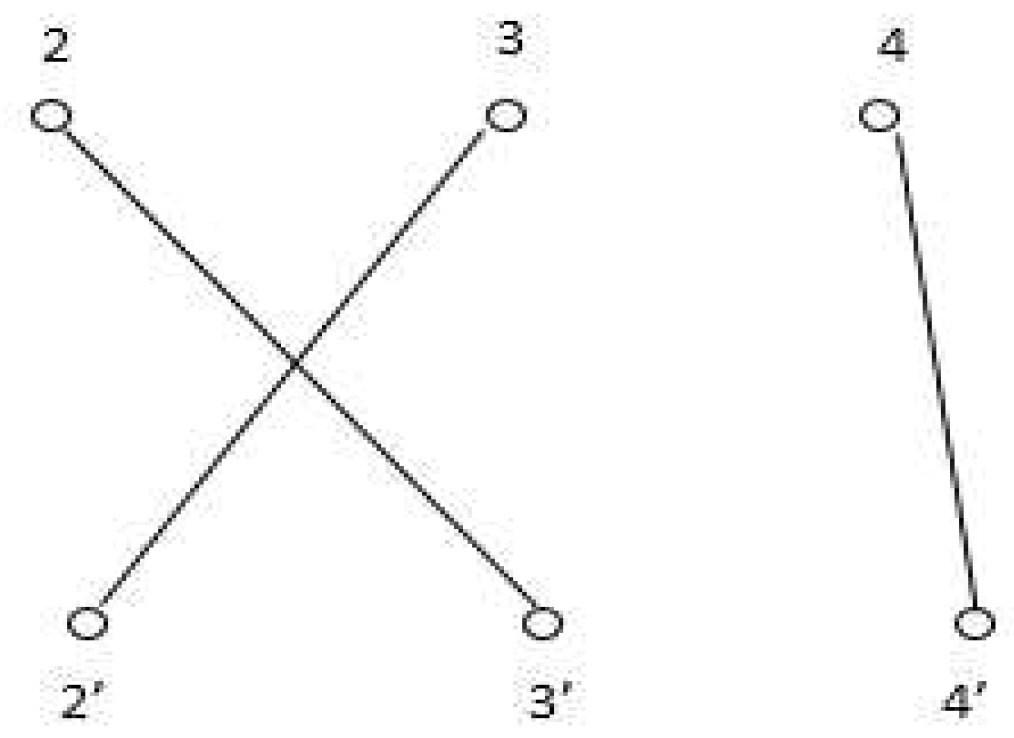
V, then the perfect matching
is a signed constrained 3-matching (see
Figure 3).
The cycle has one c-pair and thus is an o-cycle. On the other hand, the cycle has two c-pairs and so is an e-cycle.
Let be the perfect signed matching corresponding to its diagonal. Search for every set of the disjoint -interlacing cycles and the disjoint -interlacing or has one e-cycle. We delete the vertices 2 and from -interlacing and all edges adjacent 2 and from , and obtain a sub-signed bipartite graph of according to Algorithm 1. However, each set of disjoint -interlacing cycles does not contain an even number of -interlacing e-cycles in , and we will continue (1) of Algorithm 1.
Remark 1. The dashed lines denote negative edges, and full lines denote positive edges in all of the above figures.
3. Bipartite Zero Forcing Set for a Full Sign Pattern
Zero forcing is a combinatorial game played on the vertices of a graph, during which the vertices are colored black or white. The coloring change rule is to change the color of a white vertex
w to black; in this case, we say
u forces
w and write
. Then, a color-change rule is applied until no more changes are possible. This rule is different in a simple undirected graph or a directed graph or a signed digraph. However, the following definition is identical for graphs of any type (see [
7]).
Definition 1. Letbe a graph.
A subset defines an initial set of black vertices, called a coloring.
Given a coloring of G, the derived set is the set of black vertices obtained by applying the color change rule until no more changes are possible.
A zero forcing set for G is a subset of vertices Z such that, if, initially, the vertices in Z are colored black and the remaining vertices are colored white, the derived coloring of G is all black. The zero forcing number is the minimum number over all zero forcing sets.
For a given zero forcing set, construct the derived set and list the forces in order in which they were performed to color the vertices of in black. This list is called a chronological list of forces.
For example, a zero forcing set for a path is an endpoint and a zero forcing set for a cycle is any set of two adjacent vertices.
In order to give the definition of the bipartite zero forcing set, we will convert a signed bipartite graph into a directed bipartite graph in the following way:
if sign (or sign) in , vertex is an out-neighbor (or in-neighbor) of i in ; that is to say, (or ) is a directed edge of .
the out-degree of i, denoted by deg, is the number of out-neighbors of i in , and similarly for in-degree, denoted by deg. The smallest out-degree among the vertex set U (or V) is denoted by (or ) and analogously for the smallest in-degree among the vertex set U (or V), denoted by ().
We will give the definition of directed constrained matching in a directed bipartite graph in the following way:
A set of k directed edges with the same direction is said to be a directed k -matching between and if vertices are distinct as well as vertices .
A directed k-matching is called constrained if it is the only directed k-matching between U and V.
A directed constrained k-matching in is a said to be maximum if there is no (constrained) s-matching with .
Observation 1. Let be a directed bipartite graph. If is a vertex with deg in V, then is in every zero forcing set of V.
Rule A ([
7]). (The color-change rule for a digraph
). If
is a simple digraph with each vertex colored either white or black,
u is a black vertex, and exactly one out-neighbor
v of
u is white; then, change the color of
v to black.
Let
A be a matrix associated with a sign pattern
P. The sign inversion function
l is defined by
and
; the letters
s and
t will be used as indices taking values in
and
will be defined as + if
and as − if
. The signed zero forcing rule was introduced in [
10]: if
w is a white vertex, we will denote by
its marker if it is marked; otherwise, we will write
.
Rule B ([
10]). (Signed zero forcing rule for sign pattern
P). Let
u be a vertex of
P such that either
u is black or
u is white and
. Let
- (a)
If , color w black.
- (b)
If or , color all vertices w black.
- (c)
If , , and , mark w with .
- (d)
If no white vertices in the whole graph are marked and u is white, then mark u with +.
The signed zero forcing number of P, , is the size of the minimum forcing set in signed zero forcing rule. It provided an upper bound for the maximum nullity of a matrix with a given sign pattern, that is, . In order to do better at the signed zero forcing game, a new variant-branched signed zero forcing was defined, denoted by , and , while the signed zero forcing method is unsuitable for providing an upper bound for the maximum nullity of a non-square sign pattern. We define a new variant-bipartite zero forcing for a directed bipartite graph in order to study the minimum rank problems for a square full sign pattern and a non-square sign pattern.
Let be a directed bipartite graph, where all vertices of U are colored black and each vertex of V is colored either white or black. A new zero forcing rule will be applied.
Rule C. Given an full sign pattern P. Let denote its directed bipartite graph with based on rows and based on columns, and M be the perfect matching corresponding to its nonzero diagonal.
- (a)
If there exists a vertex with deg in V, then mark as a black vertex and delete the vertex (corresponding to the j’th column of P) and all edges adjacent to . Otherwise, we will return (b).
- (b)
If there exists a set of disjoint M-interlacing cycles with an odd number of M-interlacing e-cycle in , then delete some vertex i (corresponding to the i’th row of P ) from the M-interlacing e-cycle and all edges adjacent to i from according to Algorithm 1 (2), and we will return (a). Let denote a sub-directed bipartite graph with based on rows of and based on columns of .
- (c)
If there exists a maximum directed constrained matching in , then change the signs of all the edges to zero. Otherwise, we will return (b). Let be a sign pattern with these entries zero. Let denote a directed sub-bipartite graph with based on rows of , and based on columns of .
- (d)
If is non-singular according to Theorem 1, then change these vertices to black, is a chronological list of forces. Otherwise, we will repeatedly apply and .
Let S be a deleted row set of P and T be a set of the black vertices from V in Rule C. Let be a sign pattern with entries zero for and its associated directed bipartite graph with and .
Definition 2. A bipartite zero forcing set for a sign pattern P is a subset T such that if, initially, the vertices in V are colored black and the remaining vertices are colored white in, the derived coloring ofis all black. The bipartite zero forcing number of a square sign pattern P, denoted by, is the size of the minimum forcing set in V.
In order to obtain the following theorem, we recall the zero forcing set for a graph (see [
7]).
Let A be an real matrix and x be a vector in the kernel of A:
A black vertex is associated with a coordinate in x that is required to be zero,
A white vertex indicates a coordinate that can be either zero or nonzero,
Changing a vertex from white to black, it is essentially noted that the corresponding coordinate is forced to be zero if x is in the kernel of A and all black vertices indicate coordinates assumed to be or previously forced to be 0.
The set of black vertices is called the zero forcing set.
Theorem 2. Ifis a directed constrained k-matching forin Rule C, then the signs of all the edgesare changed to zero.
Proof. Vertex has only vertex as a white out-neighbor. Thus, the vertex will color vertex black by applying Rule A. Since has been colored in black, vertex has only vertex as white out-neighbor and is colored in black, and so on for all vertices .
Now, let
A be a real matrix associated with a full sign pattern
P whose graph is a directed bipartite graph
. The kernel of matrix
A will be denoted by ker(
A) and let a real vector
ker
. We have for any vertex
of
U:
where
T is a bipartite zero forcing set for
,
. Because
is a chronological list of forces
,
. Then, (2) reduces to
The coefficients of in (2) may be equivalent to zeros. That is to say, if is a directed constrained k-matching for , then the signs of all the edges may be zeros. □
The bipartite zero forcing number is of interest in the study of an upper bound on the maximum nullity of a matrix with a given sign pattern.
Theorem 3. Let P be a square full sign pattern. Then, according to Rule C.
Proof. Let A be an real matrix with a full sign pattern P and be a directed bipartite graph with vertices based on rows of P and based on columns of P. The sub-vector of real vector x is formed on the entries indexed by a set T, denoted by , where T is the minimum zero forcing set for .
We will argue that, for , if , then .
Indeed, by applying Rule C(
a), Rule C(
b), and Rule C(
c), we have Equation (
3) for every vertex
and obtain a linear system with
equations in
variables, and the sign pattern of the coefficient matrix
of (3) is
and it is non-singular according to Theorem 1. Thus, all
and
. □
A permutation sign pattern is an square sign pattern each of whose rows and columns contain exactly one + entry and n-1 zero entries. A signature pattern is a diagonal sign pattern that does not have any zero entries on the main diagonal.
Pre-or post-multiplication of a sign pattern P by a signature pattern or permutation pattern does not change the minimum rank of P. A sign pattern that is obtained from P by performing one or more of these operations is called equivalent to P; if only one type of operation is used, is referred to as signature equivalent or permutation equivalent to P.
Example 2. Letbe the Hadamard sign pattern of order 4. By pre-multiplying a negative diagonal sign pattern, we obtain
Let
denote its directed bipartite graph. The vertex
with deg
is marked as a black vertex (see
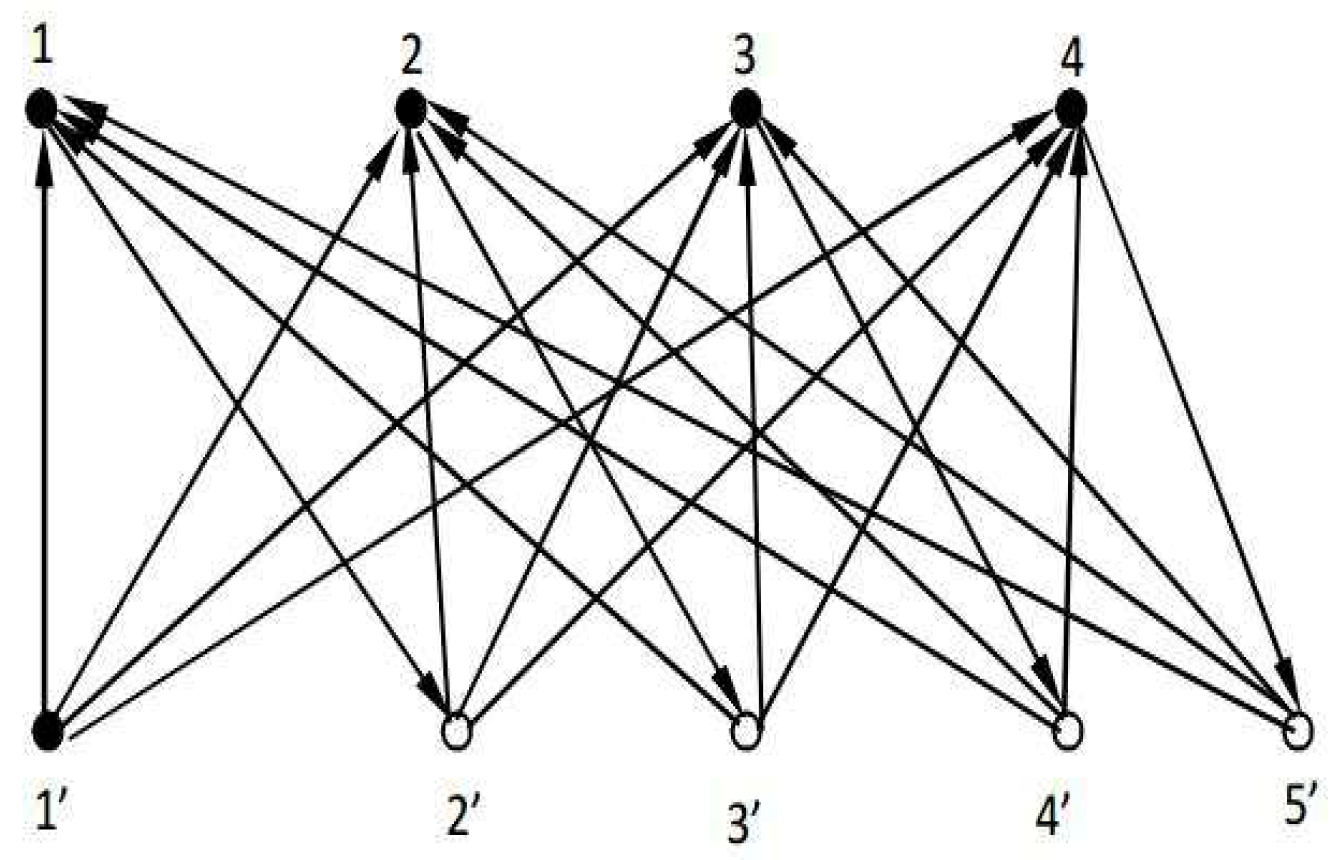
Figure 4) and delete the vertex
(corresponding to the first column of
) and all edges adjacent to
by applying Rule C(
a). We apply Rule C(
b) to delete the vertex 1 (corresponding to the first row of
) from the disjoint interlacing
.
is a directed sub-bipartite graph with
based on rows of
and
based on columns of
(see
Figure 5).
There exists a directed constrained 3-matching
in
, then change the signs of edges
and
to zero according to Rule C(
c) (see
Figure 6). We obtain that
is non-singular. Then, change the vertices 2′, 3′ and 4′ to black according to Rule C(
d). Therefore, the bipartite zero forcing set of
P is {1′},
Zb(
P) = 1 and
M(
P) ≤ 1.
Example 3. Letbe a full sign pattern of order 4. By applying Rule B, color the vertex 1 black, mark vertex 2 with +, and consider three options for vertex 3: marked with +, marked with −, or black.
- Case 1:
m. Let , then we have and . Therefore, we can mark 4 with . Now, let u = 3 and we obtain . This means we can blacken all three white vertices.
- Case 2:
m(3) = −. Let u = 2, then we have and . Therefore, we can mark 4 with . Now, let u = 3 (or 1, 4) and we can not obtain (or .
- Case 3:
3 is black. Let u = 1; then, we have and . Therefore, we can mark 4 with . Now, let u = 3 and we obtain . All white vertices can be blackened once again.
We have obtained and .
We are going to show that for P by applying Rule C.
Let denote its directed bipartite graph with based on rows of P and based on columns of P. Now, we apply Rule C(b) to delete the vertex 4 (corresponding to the fourth row of P) from the disjoint interlacing . The vertex with deg is marked as a black vertex and delete the vertex (corresponding to the first column of P) and all edges adjacent to by applying Rule C(a).
Let
denote the directed sub-bipartite graph with
based on rows of
and
based on columns of
. There exists a directed constrained 3-matching
in
, then change the signs of edges
and
to zero according to Rule C(
c). We obtain that
is not non-singular.
By pre-multiplying a negative diagonal sign pattern, we obtain
In , we again apply Rule C(b) to delete the vertex 1 (corresponding to the first row of P) from the disjoint interlacing . The vertex with deg is marked as a black vertex and delete the vertex (corresponding to the fourth column of P) and all edges adjacent to by applying Rule C(a).
Let
denote the directed sub-bipartite graph with
based on rows of
and
based on columns of
. There exists a directed constrained 2-matching
in
, then change the signs of edges
and
to zero according to Rule C(
c). We obtain that
is non-singular. Then, change these vertices
and
to black according to Rule C(
d). Therefore, the bipartite zero forcing set of
P is
,
and
.
In fact, the
integer Toeplitz matrix
whose sign pattern is
P has rank 2.
One advantage of the bipartite zero forcing is that it can be not only applied to a square sign pattern but also applied to a non-square sign pattern. A non-square minimum rank problem will be converted to a square minimum rank problem.
Definition 3. Suppose anfull sign pattern P associated with directed bipartite graph iswithbased on rows andbased on columns.isbalanced if. If, ansquare sub-sign pattern ofcan be picked out from a non-square full sign pattern P and hence induces a sub-bipartite graphof. Such a sub-sign pattern and the sub-bipartite graph are both said to bebalanced.
Rule D (Bipartite zero forcing rule for a non-square full sign pattern P) Given an full sign pattern P, let denote its directed bipartite graph with based on rows and based on columns.
(a) Search for a maximum directed constrained k-matching for by applying Algorithm 1.
Let R be a set consisting of all deleted vertices from U and L be a set consisting of all deleted vertices from V. Let be a balanced directed bipartite graph with and .
Suppose is an sign pattern associated with .
(b) Compute the bipartite zero forcing number of by applying Rule C.
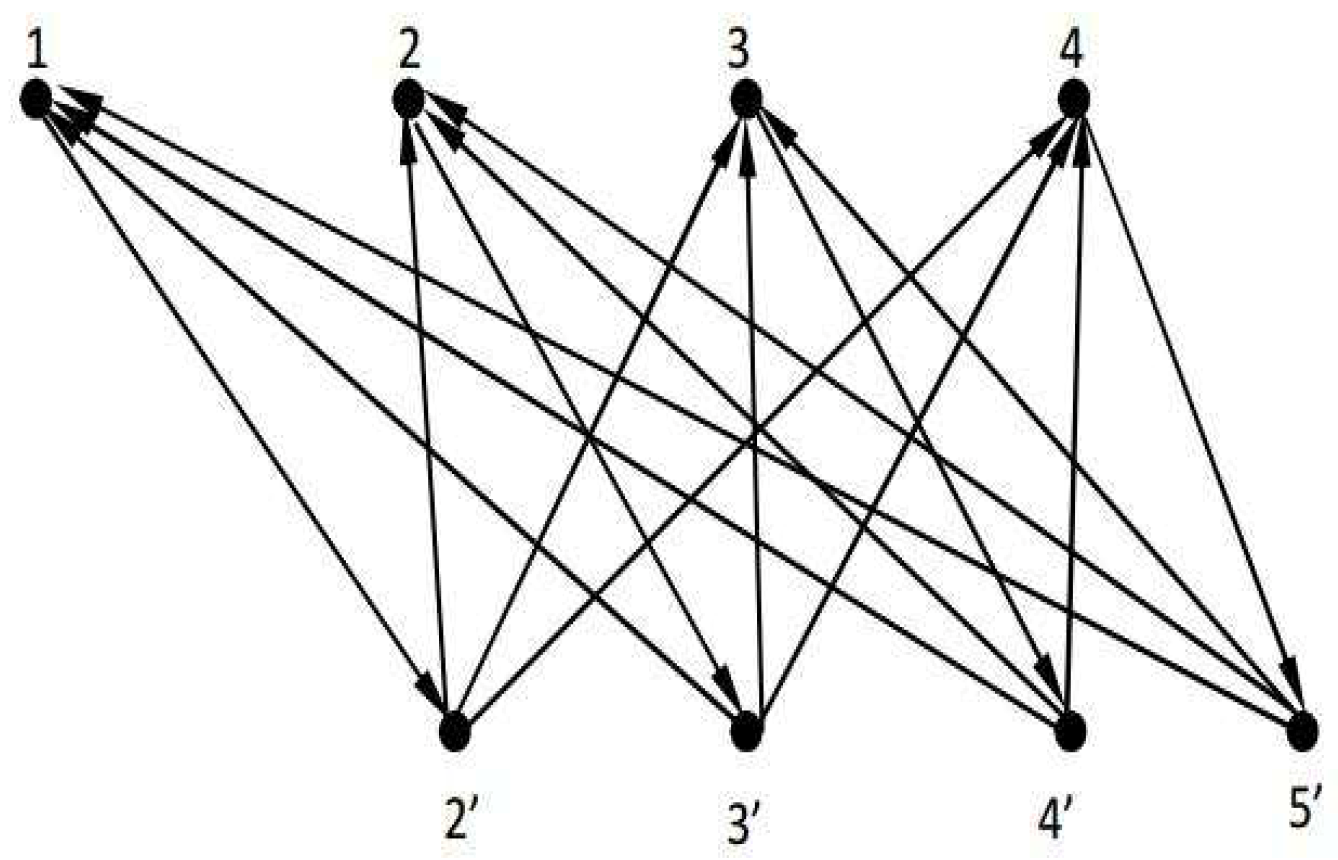
Example 4. Letbe asign pattern. Let
denote its directed bipartite graph with
based on rows of
P and
based on columns of
P (see
Figure 7). Now, we apply Rule
to obtain the directed constrained
and delete
from
V and all edges adjacent to
. We obtain a
sub-sign pattern
. Let
denote the balanced directed sub-bipartite graph with
and
(see
Figure 8). Then, change the signs of edges
and
to zero according to Rule C(
c).
In this case, we obtain that
is not non-singular.
For , we apply Rule C(b) to delete the vertex 1 (corresponding to the first row of P) from the disjoint interlacing . The vertex with deg is marked as a black vertex and delete the vertex (corresponding to the second column of P) and all edges adjacent to by applying Rule C(a).
Let
denote the directed sub-bipartite graph with
based on rows of
and
based on columns of
. There exists a directed constrained 3-matching
in
, then change the signs of edges
and
to zero by applying Rule C(
c). We obtain that
is non-singular. Then, change the vertices 3′, 4′ and 5′ to black according to Rule C(
d). Therefore, the bipartite zero forcing set of
P is {2′},
Zb(
P) = 1 and
M(
P) ≤ 1.