


Abstract
We study optimal shape of an inverted elastic column with concentrated force at the end and in the gravitational field. We generalize earlier results on this problem in two directions. First we prove a theorem on the bifurcation of nonlinear equilibrium equations for arbitrary cross-section column. Secondly we determine the cross-sectional area for the compressed column in the optimal way. Variational principle is constructed for the equations determining the optimal shape and two new first integrals are constructed that are used to check numerical integration. Next, we apply the Noether’s theorem and determine transformation groups that leave variational principle Gauge invariant. The classical Lagrange problem follows as a special case. Several numerical examples are presented.
1. Introduction
The first problem of optimization of elastic rods was formulated by Lagrange, [1]. The problem consists of finding the shape of an elastic rod of given volume that has largest value of the buckling force. The solution of the problem, with the simply supported boundary conditions, was obtained by Clausen in [2]. Various versions of the optimal shape of a column problem were treated in a number of publications, see [3,4,5,6,7,8,9,10].
In this work we propose to solve the problem of the strongest column in a constant gravity field for the case when the upper end is fixed, as in [10], and, additionally, loaded by a constant concentrated force at the top. Thus, we shall be able to reproduce both classical Clausen problem [2] as well as the problem of heavy inverted column, treated in [10]. Also we shall examine the bifurcation points of nonlinear equilibrium equations. Namely, we shall show that the lowest bifurcation point of linear and nonlinear problem coincide. This is important, since optimization will be performed at eigenvalues of the linearized problem. Also for differential equations describing the optimal shape of the column, a variational principle is formulated and two new first integrals are obtained. We also studied the invariance of the variational principle, by using the Noether’s theorem, see [11,12,13], where integer and fractional order systems are treated. We showed that one of two first integrals follow from the Absolute invariance of the Hamilton’s action integral and the other from so called Gauge invariance. Pontryagin’s principle and variational methods, including Noether’s theory, represent powerful methods for the study of mechanical and physical systems. Our results demonstrate this on an example where new results are obtained by using these methods. For recent contribution to a nontrivial extension of the Noether’s theory see [14]. In this work we will follow the notation of [11,15].
2. Formulation
In Figure 1 we show the column with inextensible axis of length At upper end B the column is fixed with the possibility of sliding along the axis A concentrated force of intensity F is applied at the end B. Equations describing behaviour of the column [15] are
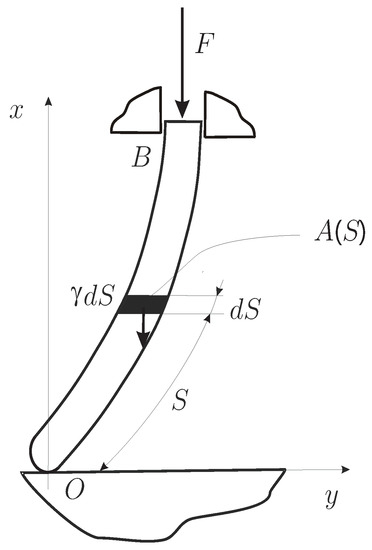
Figure 1.
Coordinate system for the rod under self-weight and concentrated force.
Here H and V are components of cross-sectional force along x and y axes, M denotes the bending moment, denotes the angle between the tangent to the column axis and the x axis of a coordinate system Also S denotes the arc-length of the column axis. We use the specific distributed force given as with being the mass density, g is the gravitational constant and is area of the rod at an specific point of the rod axis. In order to apply the Bernoulli–Euler bending theory we assume that Also
express inextensibility of the axis. Constitutive equation of the classical Bernoulli–Euler theory reads
In (2) and (3) x and y denote coordinates of an arbitrary point in system . We use E to denote modulus of elasticity and I the second moment of the cross-section area. From Figure 1 we conclude that
so that
The column has volume given by
If the column cross-sections are similar and similarly oriented, then
with being a constant, equal for circular cross-section. We introduce
so that (1)–(8) become
with
The volume of the column now becomes
For (9) and (10) we find a trivial solution
valid for all values of and and for any We examine the values of that lead to a nontrivial solution of (9) and (10). First we write (9) in operator form as
with
The solution is trivial solution valid for all The Fréchet derivative of calculated at is
We consider the linearized boundary value problem , i.e.,
It is known that the necessary condition for the existence of nontrivial solution of (9), (10) is that there is nontrivial solution of the linearized equation
subject to
Suppose that with fixed (gravitational force is not subject to changes) and and is a solution to (12) and (13). Then with as a bifurcation parameter, we have:
Proposition 1.
Giventhe boundary value problem (12) and (13) has only real eigenvalues, there are an infinite but countable number of them,,, and they can be ordered to satisfy
The number of zeros of the eigenfunctionin the interval (0,1) isAlso,
Proof of Proposition 1.
Note that with the conditions of the Theorem 4.3.1 of [16] are satisfied. The result follows from the application of this Theorem. ☐
The condition that guarantees that (9) and (10) have nontrivial solution is formulated next. Our interest is to show that at the lowest eigenvalue of (12) and (13), that is for , the system (9) and (10) with arbitrary , , has a bifurcation point. We note that in the next Section will be determined from the optimization procedure. We state this as:
Theorem 1.
Proof ofTheorem 1.
We use the Crandall–Rabinowitz theorem, see [17,18], p.15. Thus, let be eigenvector of (12) and (13) with given and lowest eigenvalue , i.e., We assume that is normalized, so that Note that
subject to
leads to unique eigenvector . To prove that is unique, observe that If from (3) we conclude that Then, the equilibrium equations for the rod lead to the conclusion that there is only trivial solution Since , the Theorem 5, p.73 of [19], implies that is unique. Next we determine as
Remark 1.
In principle the same results may be obtained if we treat bothandas bifurcation parameters. In that case a generalization of the Crandall–Rabinowitz theorem given in [18], p.161, must be used. However, for our purposes the result presented here suffices since it shows that for any,, the bifurcation point of (12) and (13) leads to the bifurcation of (11).
3. Minimization of w for Given Load Parameters and
The optimization problem now becomes: determine the control so that
with differential constraints (17) and (18).
We take U as a set of continuous nonnegative functions, defined on the interval , i.e.,
To solve the optimization problem we use the Pontryagin’s principle. For recent example of application of Pontryagin’s principle, see an example from biology [20]. Here the Pontryagin’s function becomes (see [12])
where variables , are determined from
and
From the condition we obtain
or
We note that state variables , and co-state variables , have an important symmetry. Namely, by comparing
we conclude that for any the solution determines the co-state variables by
This type of identification was used in [9] and is applicable to both single and bi modal optimization of elastic rods. Since , we conclude from (23) that We set so that
Thus, (23) becomes
Note that (26) is a necessary condition for . We comment now on the sufficient conditions for the minimality of (19). There are two main sufficiency theorems in optimal control theory. First one is the Mangasarian’s sufficiency theorem, see [21], which requires that the objective function and constraints are convex jointly in state and control variables for the minimization problems. The second condition, known as the Arrow’s theorem, is applied as follows, see [22]. The control variable (23) is substituted in Pontryagin’s function to obtain
Now, the condition is guaranteed if in expression (27) the function is convex function with respect to , when , are fixed and positive. This is not the case here.
There are many other approaches to the problem of specifying the sufficient conditions for minimum of For example, in [23] the sufficient conditions involve Legendre–Clebsch condition and solution of an additional Riccati equation. Such a study is beyond the scope of our paper. Therefore, in the analysis that follow we will use only the necessary conditions for given by (22).
Now, differentiating (29) it follows
Thus, the optimal compressed inverted column is determined from
subject to
4. Variational Principle and First Integrals for (31), (32)
We state now our central result as:
Theorem 2.
Proof of Theorem 2.
Let
Let be a functional defined as
and consider the problem of minimizing I when . The necessary condition for optimality are the Euler–Lagrange equations
which are equal to (36). Therefore
which is 1 in Theorem 1. Next by multiplying (36) by and integrating, we get
that proves (39). Since given by (41) does not have explicit dependance on t, we conclude that Hamiltonian is a constant (i.e., ). Thus, for (36) and (37) we have [12]
or
To determine in terms of we multiply by and by , add the result, integrate and use the boundary conditions to obtain
Also from (29) we have
By solving (45) for and by using the result in (42) we obtain (40). Next we multiply (36) by and (36) by z and substitute in the resulting equations the term from (42) to obtain
Integrating the previous relation and using the boundary conditions it follows
Remark 2.
In the special casewe have, so that first integrals take the form
obtained in [10]. Also, by evaluating (40) atit follows.
5. Invariance Properties of the Integral (38)
Consider transformation of independent and dependent variables in (38) given by
where and f are generators of the infinitesimal transformation group and The case of multi-time transformation and corresponding version for Noether-type first integrals is presented in [14]. Here, it is assumed that and f are continuously differentiable with respect to all variables. If action integral (38) is invariant under the transformation (47), then Noether’s theorem guarantees the existence of a first integral to the Euler–Lagrange’s system of equations (34), see [12], p. 137. Using Noether’s theorem for the present case, we state:
Theorem 3.
If the generators of the infinitesimal transformation group,, f satisfy
whereandis an arbitrary function continuously differentiable with respect to all variables (gauge function), then the system (34) has a first integral of the form
We apply now the Theorem 3 to the Lagrangian (41). Thus, we calculate and substitute the result into (48). The invariance condition then becomes
Consider two special cases generators of the infinitesimal transformation group and gauge function P:
- By using (46) to eliminate we obtain
6. Results of Numerical Solution to (36), (37)
Using variables (16), and the system (17), (18), (25) and (28) transforms to
with boundary conditions
Thus, we have to choose in order to satisfy Conservation laws (40) with , become
In solving (52), (53) we used (54) to monitor the accuracy of the integration. We solved (52) and (53) with as a given parameter. The eigenvalue is determined so that , that is the volume of the column is given as . In Table 1 the results of computation are presented.

Table 1.
Critical values of the load parameter.
For values of shown in Table 1 the first integrals (54) are constants up to the order of . In numerical solution of (52), (53) and evaluation of the first integrals we used the computer package Mathcad 14.
In Figure 2 the optimal cross-sectional area is shown that corresponds to the following values of parameter The corresponding values of are taken from Table 1. We note that to we have This is a special case of optimally shaped light column, see [15] p.216, and the exact value is . Our numerical result given in the Table 1 agrees with the exact value up to the order . Also for the light optimal rod, the analytical result is , while our numerical value is Another special case presented in Figure 2 corresponds to the case and the compressive force is . This shape is shown by curve in Figure 2.
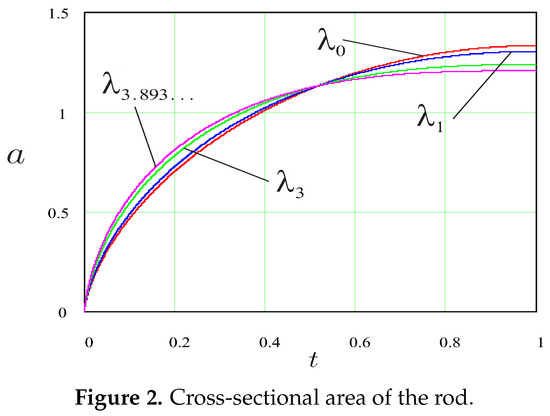
Figure 2.
Cross-sectional area of the rod.
7. Conclusions
We analysed the problem of finding the shape of the strongest compressed inverted column in a constant gravity field. The problem treated here, for the case when the column has constant cross-section, is analyzed in [27,28,29]. Our main results may be summarized as:
- We proved that the eigenvalues of the linearized problem are bifurcation points of the nonlinear equilibrium equations for arbitrary cross-sectional area, Theorem 1.
- We determined transformation group that generates first integrals via Noether’s theorem. Those transformation groups leave the functional (38), absolutely in Case 1, and gauge invariant in Case 2.
- The shape of the column, as a function of arc-length, is determined for several values of parameters given in Table 1. The special case corresponds to the known analytical solution of Lagrange problem.
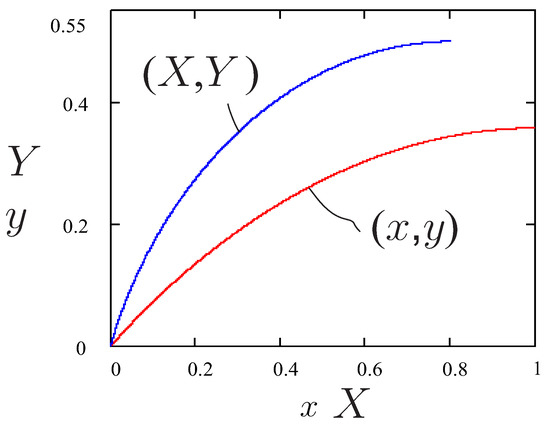
- The post critical behaviour of the optimally shaped column is presented for one specific value of parameters.
The increase of the buckling force for optimally shaped column and the column with constant cross-section is between 12% for , see [10], and 33%, for , see [3].
Author Contributions
Investigation, E.K.; Supervision, T.M.A. and C.D. All authors have read and agreed to the published version of the manuscript.
Funding
This research was funded by Serbian Academy of Arts and Sciences, grant number F-64.
Conflicts of Interest
The authors declare no conflict of interest.
References
- Lagrange, J.L. Sur la figure des colonnes. In Oeuvres de Lagrange V. 2; Serret, M.J.A., Ed.; Gauthier-Villars: Paris, France, 1868; pp. 125–170. [Google Scholar]
- Clausen, T. Über die form architektonischer säulen, Bull. cl, physico math. Acad. St. Pétersbourg 1851, 9, 369–380. [Google Scholar]
- Tadjbakhsh, I.; Keller, J.B. Strongest columns and isoperimetric inequalities for eigenvalues. J. Appl. Mech. (Trans. ASME) 1962, 29, 159–164. [Google Scholar] [CrossRef]
- Olhoff, N.; Rasmussen, S.H. On the single and bimodal optimum buckling loads of clamped columns. Int. J. Solids Struct. 1977, 13, 605–614. [Google Scholar] [CrossRef]
- Seyranian, A.P. Lagrange problem for optimal shape of a column. Dev. Mech. (Uspehi Mehaniki) 2003, 2, 45–96. [Google Scholar]
- Olhoff, N.; Seyranian, A.P. Bifurcation and post-buckling analysis of bimodal optimum columns. Int. J. Solids Struct. 2008, 45, 3967–3995. [Google Scholar] [CrossRef]
- Atanackovic, T.M.; Seyranian, A.P. Application of Pontryagin’s principle to bimodal optimization problems. Struct. Multidisc. Optim. 2008, 25, 393–410. [Google Scholar] [CrossRef]
- Atanackovic, T.M. Optimal shape of a column with own weight: Bi and single modal optimization. Meccanica 2006, 41, 173–196. [Google Scholar] [CrossRef]
- Atanackovic, T.M. On the optimal shape of a compressed rotating rod. Meccanica 2004, 39, 147–157. [Google Scholar] [CrossRef]
- Atanackovic, T.M. Optimal shape of a strongest inverted column. J. Comput. Appl. Math. 2007, 203, 209–218. [Google Scholar] [CrossRef][Green Version]
- Vujanovic, B.D.; Jones, S.E. Variational Methods in Nonconservative Phenomena; Academic Press: Boston, MA, USA, 1989. [Google Scholar]
- Vujanovic, B.D.; Atanackovic, T.M. An Introduction to Modern Variational Techniques in Mechanics and Engineering; Birkhäuser: Boston, MA, USA, 2004. [Google Scholar]
- Atanackovic, T.M.; Konjik, S.; Pilipović, S.; Simic, S.S. Variational problems with fractional derivatives: Invariance conditions and Nöther’s theorem. Nonlinear Anal. 2009, 71, 1504–1517. [Google Scholar] [CrossRef]
- Treanţă, S. Noether-Type First Integrals Associated with Autonomous Second-Order Lagrangians. Symmetry 2019, 11, 1088. [Google Scholar] [CrossRef]
- Atanackovic, T.M. Stability Theory of Elastic Rods; World Scientific: Singapore, 1997. [Google Scholar]
- Zettl, A. Sturm—Liouville Theory; American Mathematical Society, Mathematical Surveys and Monographs: Providence, RI, USA, 2005; Volume 121. [Google Scholar]
- Crandall, M.G.; Rabinowitz, P.H. Bifurcation from simple eigenvalues. J. Funct. Anal. 1971, 8, 321–340. [Google Scholar] [CrossRef]
- Kielhöfer, H. Bifurcation Theory: An Introduction with Applications to PDEs; Springer: New York, NY, USA, 2004. [Google Scholar]
- Churchill, R. Fourier Series and Boundary Value Problems; McGraw-Hill: New York, NY, USA, 1969. [Google Scholar]
- Yusof, F.M.; Abdullah, F.A.; Ismail, A.I.M. Modeling and optimal control on the spread of hantavirus infection. Mathematics 2019, 7, 1192. [Google Scholar] [CrossRef]
- Mangasarian, O.L. Sufficient conditions for the optimal control of nonlinear systems. SIAM J. Control 1966, 4, 139–152. [Google Scholar] [CrossRef]
- Chiang, A.C. Elements of Dynamic Optimization; McGraw-Hill: New York, NY, USA, 1992. [Google Scholar]
- Malanowski, K.; Maurer, H.; Pickenhain, S. Second-order sufficient conditions for state-constrained optimal control Problems. J. Optim. Theory Appl. 2004, 123, 595–617. [Google Scholar] [CrossRef]
- Keller, J.B.; Niordson, F.I. The tallest column. J. Math. Mech. 1966, 16, 433–446. [Google Scholar] [CrossRef]
- McCarthy, C.M. An Investigation of the Optimal Design of the Tallest Unloaded Column. Ph.D. Thesis, Rice University, Houston, TX, USA, 1997. [Google Scholar]
- McCarthy, C.M. The tallest column—Optimality revisited. J. Comput. Appl. Math. 1999, 101, 27–37. [Google Scholar] [CrossRef][Green Version]
- Willers, A. Das knicken schwerer geatänge. Z. Angew. Math. Mech. (ZAMM) 1941, 21, 43–51. [Google Scholar] [CrossRef]
- Wang, C.Y.; Drachman, B. Stability of a heavy column with an end load. J. Appl. Mech. (Trans. ASME) 1981, 48, 668–669. [Google Scholar] [CrossRef]
- Wang, C.M.; Wang, C.Y.; Reddy, J.N. Exact Solutions for Buckling of Structural Members; CRC Press: Boca Raton, FL, USA, 2005. [Google Scholar]
© 2020 by the authors. Licensee MDPI, Basel, Switzerland. This article is an open access article distributed under the terms and conditions of the Creative Commons Attribution (CC BY) license (http://creativecommons.org/licenses/by/4.0/).