Abstract
We study Riemann-Lebesgue integrability for interval-valued multifunctions relative to an interval-valued set multifunction. Some classic properties of the integral, such as monotonicity, order continuity, bounded variation, convergence are obtained. An application of interval-valued multifunctions to image processing is given for the purpose of illustration; an example is given in case of fractal image coding for image compression, and for edge detection algorithm. In these contexts, the image modelization as an interval valued multifunction is crucial since allows to take into account the presence of quantization errors (such as the so-called round-off error) in the discretization process of a real world analogue visual signal into a digital discrete one.
Keywords:
Riemann-Lebesgue integral; interval valued (set) multifunction; non-additive set function; image processing MSC:
28B20; 28C15; 49J53
1. Introduction
The theory of multifunctions is an important field of research. Since interval arithmetic, introduced by Moore in [1], it appears a natural option for handling the uncertainty in data and in sensor measurements, particular attention was addressed to the study of interval-valued multifunctions and multimeasures because of their applications in statistics, biology, theory of games, economics, social sciences and software, to keep track of rounding errors in calculations and of uncertainties in the knowledge of the exact values of physical and technical parameters (see for example [2,3,4,5]). In fact, since the uncertainty of information could affect an expert’s opinion, the ability to consider the uncertainty information during the process could be very important, see for example [2,3,4,6,7,8,9,10,11] and the references therein.
However, in some recent papers, interval-valued multifunctions have been applied also to some new directions, involving signal and image processing. Digital images are in fact the result of a discretization of the reality; namely sampled version of a continuous signal. Hence, there are different sources of uncertainty and ambiguity to be considered when performing image processing tasks, see for example [12,13]. For instance, the applications of fractal image coding for image compression [14,15] is one of the topic in which interval-valued multifunctions have been applied. Clearly, image compression techniques [16] are very useful in order to speed up the processes of digital image transmission and to improve the efficiency of image storage for high dimensional databases [17]. Further, applications of interval-valued multifunctions to the implementation of edge detection algorithms can also be found (see e.g., [13,18]).
In the literature several methods of integration for functions and multifunctions have been studied extending the Riemann and Lebesgue integrals. In this framework a generalization of Riemann sums was given in [19,20,21,22,23,24,25,26,27,28,29,30,31,32,33,34,35,36,37] while another generalization is due to Kadets and Tseytlin [38], who introduced the absolute Riemann-Lebesgue and unconditional Riemann-Lebesgue integrability, for Banach valued functions with respect to countably additive measures. They proved that in finite measure space, the Bochner integrability implies integrability which is stronger than integrability that implies Pettis integrability. Regarding this last extension contributions are given also in [21,23,34,39].
In the last decade the study of non-additive set functions and multifunctions has recently received a wide recognition, (see also [3,9,10,40,41,42,43,44,45,46]). In this paper, motivated by the large number of fields in which the interval-valued multifunction can be applied, we introduce a new type of integral of an interval-valued multifunction G with respect to an interval-valued submeasure M with respect to the weak interval order relation introduced in [4] by Guo and Zhang. Although the construction procedure of the integral is similar to the one given in [34,38,39], the integral proposed is a generalization of it since we are concerned with the study of a Riemann-Lebesgue set-valued integrand with respect to an arbitrary interval-valued set function, not necessarily countably additive. So the novelty of this construction concerns not only the codomain of the integrands but also the non-additivity of the measure with respect to which they are integrated. The main results on this subject are Theorem 1, in which the additivity of the integral is proved even if the pair does not satisfy this property; the monotonicity and the order continuity are established in Theorems 2 and 4 and a convergent result given in Theorem 5.
The paper is organized as follows: in Section 2 the basic concepts and terminology are introduced together with some remarks. In Section 3 we introduce the RL-integral of an interval-valued multifunction with respect to an interval valued subadditive multifunction and we provide a comprehensive treatment of the integration theory together with a comparison with other integrals defined in the same setting (Remark 8). An example of an application in image processing is given in Section 3.1. The applications concerning image processing discussed in the present paper is given for the purpose of illustration and is new. The main reason for which we discuss the above application is to provide examples and justifications of the uses of interval-valued multifunctions to concrete applications in Image Processing. The advantage of using the notion of interval-valued multifunction in signal analysis is that this formalism allows to include in a unique framework possible uncertainty or the noise on the evaluation of an image at any given pixel.
2. Preliminaries
Let S be a nonempty at least countable set, the family of all subsets of S and a -algebra of subsets of The symbol denotes, as usual, the set of non negative real numbers.
Definition 1
([34], Definition 2.1).
- (i)
- A finite (countable) partition of S is a finite (countable) family of nonempty sets () such that and ( ).
- (ii)
- If P and are two partitions of S, then is said to be finer than P, denoted by (or , if every set of is included in some set of P.
- (iii)
- The common refinement of two finite or countable partitions and is the partition .
- (iv)
- A countable tagged partition of S if a family such that is a partition of S and for every .
We denote by the class of all the countable partitions of S and if is fixed, by we denote the class of all the countable partitions of the set
Definition 2
([34], Definition 2.2). Let be a non-negative function, with A set is said to be an atom of m if and for every , with , it is or .
m is said to be:
- (i)
- monotone if , , with ;
- (ii)
- subadditive if for every , with
- (iii)
- a submeasure (in the sense of Drewnowski [47]) if m is monotone and subadditive;
- (iv)
- σ-subadditive if for every sequence of (pairwise disjoint) sets , with .
- (v)
- order-continuous (shortly, o-continuous) if for every decreasing sequence of sets , with ;
- (vi)
- exhaustive if for every sequence of pairwise disjoint sets
- (vii)
- null-additive if , for every , with ;
Moreover m satisfies property if the ideal of m-zero sets is stable under countable unions (see for example [34], Definition 2.3).
We denote by the symbol the family of all non-empty convex compact subsets of , by convention, . We consider on the Minkowski addition () and the standard multiplication by scalars. . is the Hausdorff distance in , while and .
is a complete metric space ([48,49]), but is not a linear space since the subtraction is not well defined.
If then . Moreover
In the family the following operations are also considered, for every :
- (i)
- ;
- (ii)
- if and only if ;
- (iii)
- if and only if and ; (weak interval order)
- (iv)
- ;
- (v)
- .
In general there is no relation between (iii) and (ii); they only coincide on the subfamily . Let .
In this paper we consider , namely the space is endowed with the Hausdorff distance and the weak interval order. As a particular case of [20] (Definition 2.1) we have:
Definition 3.
Let be two sequences of real numbers so that .
The series is called convergent if the sequence of partial sums is -convergent to it.
Remark 1.
It is easy to see that , with , if and only if and
We recall the following definition for the integrable Banach-valued functions with respect to non-negative measures given in [38,39]:
Definition 4.
A function f is called unconditional Riemann-Lebesgue ( ) m-integrable (on S) if there exists such that for every , there exists a countable partition of S, so that for every countable partition of S with , f is bounded on every , with and for every , , the series is unconditional convergent and
The vector b (necessarily unique) is called the Riemann-Lebesgue m-integral of f on S and it is denoted by . The definition of the integrability on a subset is given in the classical manner.
Remark 2.
We remember that, in the countably additive case, unconditional -integrability is stronger than Birkhoff integrability (in the sense of Fremlin), see Ref. [23] and the references therein; while the notion of unconditional Riemann-Lebesgue integrability coincides with Birkhoff’s one given in [21] (Definition 1, Proposition 2.6 and note at p. 8).
For the properties of this integral with respect to a submeasure we refer to the results given in [34]. Moreover we have that
Proposition 1.
Let be an increasing sequence of bounded integrable function with respect to a submeasure of bounded variation. If there exists a such that
- (a)
- uniformly,
- (b)
then g is integrable with respect to μ and
Proof.
Since , by the monotonicity we have that so . Thanks to uniform convergence g is bounded; let an upper bound for g.
Let be fixed and consider be such that
For every countable partition finer than (the one that verifies Definition 4 for ) and for every we have that converges, since is of bounded variation.
In fact for every and, for every , it is Moreover
□
Remark 3.
We can extend Proposition 1 to the bounded sequences that converge μ-almost uniformly on S (namely to the sequences such that for every there exists with and converges uniformly to g on ), if we assume that even g is bounded.
We can proceed in fact in the same way, as in the previous proof, taking and, for every countable partition finer than , dividing in two parts: the one relative to , where the uniform convergence is assumed, and the remining part.
Convergence results in Gould integrability of functions with respect to a submeasure of finite variation are established for instance in [50].
Given two submeasures with for every let defined by
M is called an interval submeasure. For results in this subject see for example [3,43].
Let . We say that M is an interval valued multisubmeasure if
- for every with (monotonicity);
- for every disjoint sets (subadditivity).
In literature the multimeasures that satisfy the first two statements are also called set valued fuzzy measures (see for example [4] (Definition 1), [3,11,42,43,44] and the references therein).
A very interesting case of interval-valued multisubmeasure was given, for the first time, in [6,8] where Dempster and Shefer proposed a mathematical theory of evidence using non additive measures: Belief and Plausibility in such a way for every set A the Belief interval of the set is . This theory is capable of deriving probabilities for a collection of hypotheses and it allows the system inferencing with the imprecision and uncertainty. If the target space is it is used for example in decision theory.
We say that M is an additive multimeasure if for every disjoint sets .
If a multimeasure M is countably additive in the Hausdorff metric , then it is called a -multimeasure. In this case we have that , for every sequence of pairwice disjoint sets such that .
Remark 4.
By Ref. [43] (Remark 3.6) is a multisubmeasure with respect to ⪯ if and only if are submeasures in the sense of Definition 2 (iii). Moreover M is monotone, finitely additive, order-continuous, exhaustive respectively if and only if the set functions and are the same (see [40] (Proposition 2.5, Remark 3.3)).
Definition 5.
Let . The variation of M is the set function defined by
M is said to be of finite variation if .
Remark 5.
We can observe that if , then in the definition of one may consider the supremum over all finite partitions . If M is finitely additive, then for every
If M is subadditive (countably subadditive, respectively) of finite variation, then is finitely additive (countably additive, respectively). Finally, if , for every , then .
3. Interval Valued Integral and Its Properties
In this section, we introduce and study Riemnn-Lebesgue integrability of interval-valued multifunctions with respect to interval-valued set multifunctions, pointing out various properties of this integral. For this, unless stated otherwise, in what follows suppose S is a nonempty set, with card (card is the cardinality of S), is a -algebra of subsets of S.
The multisubmeasure M here considered is an interval-valued one and satisfies (1).
Given with for all , let be the interval-valued multifunction defined by for every . For every countable tagged partition of S we denote by
By [20] (Lemma 2.2) the set is closed and convex in , so it is an interval .
Definition 6.
A multifunction is called Riemann-Lebesgue integrable with respect to M (on S) if there exists such that for every , there exists a countable partition of S, so that for every tagged partition of S with , the series is convergent and
is called the Riemann-Lebesgue integral of G with respect to M and it is denoted
Obviously, if it exists, is unique.
Example 1.
Suppose is countable, , for every , and let be such that the series are convergent. Then G is integrable with respect to M and
Observe moreover that, in this case, the -integrability of such G with respect to M implies that the product , as defined ini), is integrable in the same sense. In particular, if such G is a discrete or countable interval-valued signal, the represents the energy of the signal.
If M is of bounded variation and is bounded and such that M-a.e., then, by [34] (Theorem 3.4), G is M-integrable and
From now on we suppose that G is bounded and is of finite variation.
Proposition 2.
An interval multifunction is integrable with respect to M on S if and only if are integrable with respect to , and
Proof.
Suppose that is integrable with respect to , that means there exists such that for every , there exists a countable partition of S, so that for every tagged partition of S with , the series is convergent and
By this inequality it follows that
for every tagged partition of S with and then are integrable with respect to , . Formula (3) follows from the convexity of the integral.
For the converse, for every , let two countable partitions that verify the definition of integrability for . Let be a countable partition of S with . Then, for every and for every it is
Since are selections of G this means that
and then the assertion follows. □
Remark 6.
By Definition 6 and Proposition 2 we obtain the following definitions for the following cases:
- If is an arbitrary set function and with for every then
- If as in (1) and then
Proposition 3.
Let G be an interval valued multifuncion. The integrability with respect to M is hereditary on subsets . Moreover G is integrable with respect to M on A if and only if (where is the characteristic function of the set A) is integrable with respect to M on S. In this case, for every ,
Proof.
Assume that G is integrable in S with respect to M. Let and denote by the integral of G; then, for every , there exists a countable partition of S, such that, for every finer countable partition and for every it is
Let be a partition such that , and we denote by the corresponding partition of the set A. Let be a partition of A finer than , and extend it with a common partition of in such a way the new partition is finer than .
It is possible to prove that satisfy a Cauchy principle in , and so the first claim follows by the completeness of the space. The equality follows from [34] (Theorem 3.2) and Proposition 2. □
Remark 7.
It is easy to see that, if G is integrable with respect to M, for every it is:
- (a)
- is integrable with respect to M and
- (b)
- G is integrable with respect to and
Theorem 1.
If G is an interval valued integrable with respect to M multifunction, then defined by
is a finitely additive multimeasure.
Proof.
By Proposition 3 we have that for every . In order to prove the additivity we can observe that, for every with
If we prove that for every pair of interval valued integrable with respect to M multifunctions we have that
the assertion follows. In order to prove formula (5) let be fixed. Since are integrable with respect to M, for every there exists a countable partition such that for every and every , the series , are convergent and
Then is convergent and, by [48] (Proposition 1.17),
So is integrable with respect to M and formula (5) is satisfied.
The set-valued integral is monotone relative to the order relation "⪯" and the inclusion one, with respect to the interval-valued integrands.
Proposition 4.
If are two integrable with respect to M interval valued multifunctions with then, for every , .
Proof.
We will prove for . Let . By the integrability of F and G we have, by Proposition 2
Since for all and by [34] (Theorem 3.10) we have that
and so by the weak interval order, iii), we have that □
Corollary 1.
If are integrable with respect to an interval valued multisubmeasure M then, for every ,
- (a)
- ;
- (b)
- .
Proof.
Let . By [34] (Theorem 3.10) and an analogous result holds for . So the result given in 1.a) follows from the definition of ⪯ and ∧.
The second statement follows analogously. □
Proposition 5.
Let be bounded so that are integrable with respect to M. If then for all .
Proof.
As before we will prove for S. Let be arbitrary. Since F, G are integrable with respect to M, there exists a countable partition of S so that for every other countable partition with and every choise of points , the series
are convergent and
Then, by the triangular property of the eccess e,
Since the series and are convergent in , and, by hypothesis, , then
Consequently, from the arbitrariety of , , which implies □
We can observe moreover that
Proposition 6.
If G is bounded and integrable with respect to M, with M of bounded variation, then
- (a)
- (b)
Proof.
It is a consequence of the properties of and [34] (Proposition 3.3, Theorem 3.5). □
Proposition 7.
Let be a bounded multifunction such that G is integrable with respect to M on every set .
- (a)
- If M is of bounded variation, then (in the ε-δ sense) and is of finite variation.
- (b)
- If moreover M is o-continuous (exhaustive respectively), then is also o-continuous (exhaustive respectively).
Proof.
The statements easily follow by Proposition 6. □
Moreover
Theorem 2.
Let be a multifunction such that G is integrable with respect to M on every set . The following statements hold:
- (a)
- If M is monotone, then is monotone too.
- (b)
- If M is a -multimeasure of bounded variation then is countably additive.
Proof.
Let with . By monotonicity for . We divide B in and we apply [34] (Theorem 3.2, Corollary 3.6). The conclusion follows by (iii).
Since M is a -multimeasure, then is countably additive too and o-continuous. Applying Proposition 7 is o-continuous too. Let be an arbitrary sequence of pairwise disjoint sets, with . We denote by the set . Since , then . Since is finitely additive, we have
which ensures that is a -multimeasure. □
Proceeding as in to the proof of the formula (5) and applying [34] (Theorem 3.8) we obtain the following result:
Proposition 8.
Let be , with and suppose is integrable with respect to both and . If is the interval-valued multisubmeasure defined by , for every , then G is integrable with respect to M and
Theorem 3.
Let M be of bounded variation and be bounded interval-valued multifunctions. If are integrable with respect to M, then
Proof.
Since are M-integrable then are -integrable and are -integrable functions. According to [34] (Theorem 3.9), we have for ,
Therefore, by (6) and Remark 5, it follows
□
Theorem 4.
Let and be integrable with respect to both and . Then
- (a)
- If , then .
- (b)
- If , then .
Proof.
Let and . Both the results are consequences of Theorem 2 and [34] (Theorem 3.11). It is enough to observe that if then and , while if then . □
As a particular case of Theorem 4 and Corollary 1 we have that for every G which is integrable with respect to both positive submeasures and then
Moreover a convergence result can be obtained using Proposition 1.
Theorem 5.
Let be a sequence of bounded -integrable interval valued multifunction with respect to such that for every . If M is of bounded variation and there exists a function such that:
- (a)
- uniformly;
- (b)
then G is -integrable with respect to M and
Proof.
Since we have that for , this is a consequence of Proposition 4 and Definition 6. By uniformly we have that converges uniformly to zero. We can use now Proposition 1 and we obtain
For every let be such that
So,
Let be the countable partition of S given by (the ones that verify Definition 4 for respectively). Then, for every countable partition of S with and for every the series is convergent and
From previous inequalities and by the arbitrariety of the -integrability of G follows. □
Remark 8.
Since this research starts from the papers [34,43], this part ends with a comparison between the two types of integral considered: the integral with the Gould one given in [43] (Definition 4.7).
If the interval-valued multifunction F is bounded and is of finite variation then, analogously to Proposition 2 it is, by [43] (Proposition 4.9),
So, the two kinds of integral coincide on bounded interval-valued multifunctions with values in when are complete countably additive measures by [34] (Proposition 4.5) or are monotone, countably -subadditive by [34] (Theorem 4.7).
Without countable additivity the equivalence does not hold; an example can be constructed using [34] (Example 4.6). In the general case only partial results can be obtained on atoms when are monotone, null additive and satisfy property : the proof follows from [34] (Theorem 4.8).
Accordingly with the comparison between Gould and Birkoff integrals given in [28] we have that Birkhoff, Gould, integrals of the bounded single valued functions agree in the countably additive case, see [28] (Theorem 3.10), while in [43] (Remark 5.5) an analogous comparison is given with the Choquet integral.
A comparison between simple Birkhoff and integrabilities, introduced in [23,28], in this non additive setting can be obtained using [34] (Theorem 4.2).
Finally we would like to observe that the Rådström’s embedding tell us that , when X finite dimensional, is a near vector space with 0 element and order unit . In this case, using [51] (Theorem 5.1), it is a near vector space (see [51] (Definition 2.1) for its definition) that could be embedded, for example, in or in with compact and Hausdorff in such a way the embedding is an isometric isomorphism which takes into account the ordering on the hyperspace.
If we consider instead , since in general there is no relation between “⪯” and “⊆” the Rådström embedding provide only the integrability of the interval-valued functions and does not take the weak interval order into account. For this reason we preferred to give the the construction of the integral and the proofs, both related to ⪯, independently of the Rådström’s embedding.
3.1. Applications of Interval Valued Multifunctions
Now, in order to explain what could be the benefits of this approach we give an example of an application of interval valued multifunctions on interval valued multisubmeasure in image processing. In fact a signal can be modeled as an interval-valued multifunction as in [12]. In fact, when the value of the points can not be assigned with precision, it might be preferable to use a measure-based approach.
The advantage of using the notion of interval-valued multifunction in signal analysis is that this formalism allows to include in a unique framework possible uncertainty or the noise on the value of a point.
This situation usually occurs in signal and image processing when images are derived by a measure process, as happens for instance for biomedical images (in CT images, MR images, etc), and in several other applied sciences. In particular, we can apply this representation to a digital image in such a way:
Example 2.
To each pixel (or to a set of pixels) of the image is associated an interval which measures the round-off error which is that committed on the detection on the signal due by the tolerances and by the limits on computational accuracy of the measurements tools ([52]).
When we consider subsets of pixels we are taking into account the so-called time-jitter error, i.e., the error that occur in the measure of a given signal when the sampling values can not be matched exactly at the theoretical node but just in a neighborhood of it (see, e.g., [53]).
In this sense, if is the matrix associated to a static, gray-scale image, we can consider the space , and hence the interval-valued multifunction corresponding to I, will be given by:
The model of a digital image by an interval-valued multifunction as , and obtained by a certain discretization (algorithm) of an analogue image, allows to control the round-off error in the sense that, the true value assumed by original signal at the pixel x belongs to the interval , in fact providing a lower and an upper bound on the possible oscillations of the sampled image.
For example, in fractal image coding, the functions and represent respectively the lower and upper contraction maps of an image, which take into account of the round-off error in the contraction procedure, and can be chosen as follows:
where , , are suitable integer scaling parameters, , , are suitable functions, and is the continuous model associated to the starting image I. The functions and provide for each pixel the interval containing the true value of the compressed image.
In particular, in the algorithm considered in [15], the functions and are piecewise constant, and for a starting image of pixel size, they have been defined as follows:
where:
and
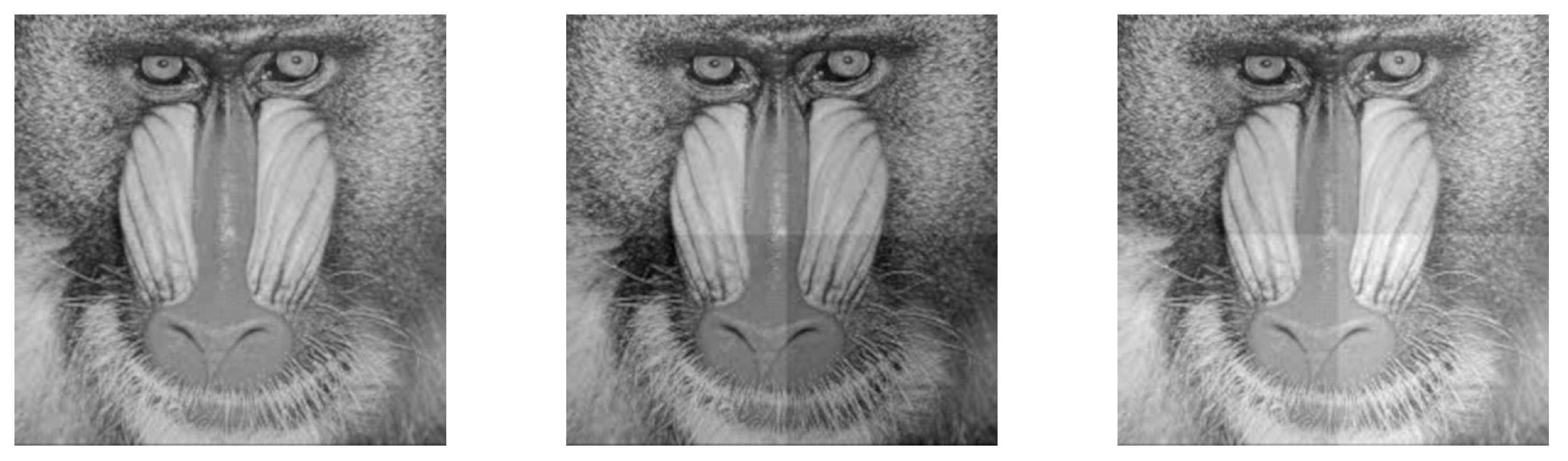
As an example we use the interval-valued multifunction (7) to operate with the well-known image of "Baboon" given in Figure 1 (left); the images generated by and using the function β defined in (8) are given in Figure 1 (center and right).
Here, also numerical truncation have been taken into account, in order to maintain the values of the pixels in the (integer) gray scale .
For other examples of functions and , see, e.g., [13,54]. For instance, in [13] the image representation by multifunctions is used for the implementation of edge detection algorithms, and in this case the corresponding functions and are:
where represents the value of a pixel at a position , while denotes any set of pixels centered at x. For more details, or other applications, see [13,18].
This example was built with the aim to highlight a useful link between the abstract theory of the interval-valued multifunction and the concrete application to image processing. One of the crucial tool in the above set-valued theory is provided by the Hausdorff distance between sets. This special metric plays an important role in the context of digital image processing, where it is used, for example, in order to measure the accuracy of certain class of algorithms, such as those of edge detection, already mentioned in the previous list of possible applications. More precisely, if A is the region of interest (ROI) of a given image and B is the corresponding approximation of the ROI A detected by a suitable edge detection algorithm, the Hausdorff distance measure the displacement between A and B, in fact evaluating the accuracy (i.e., the approximation error) of the method. For instance, in [55] the Hausdorff distance has been used in order to evaluate the degree of accuracy of an algorithm for the detection of the pervious area of the aorta artery from CT images without contrast medium. This procedure is useful, for example, in the diagnosis of aneurysms of the abdominal aorta artery, especially for patients with severe kidneys pathology for which CT images with contrast medium can not be performed. A similar use of the Hausdorff distance could be done for the edge detection algorithms considered in [13,18].
4. Conclusions
A Riemann Lebesgue integral is defined for interval-valued multifunction with respect to interval-valued multisubmeasures. Properties of the integral are established showing in particular that the multimeasure generated is finitely additive. Sufficient conditions for the monotonicity, the order continuity, bounded variation and convergence results are also obtained. A comparison with other integrals is sketchced; an example of an applications in image processing is given highlighting that the advantage of using the notion of interval-valued multifunction in signal analysis is that this formalism allows to include in a unique framework possible uncertainty or the noise on the evaluation of an image at any given pixel. In a future research we will generalize these results in the setting of Banach lattices and we will compare this method with other DIP (digital image processing) algorithms.
Author Contributions
Writing, review and editing, D.C., A.C., A.G., A.I. and A.R.S. All authors have read and agreed to the published version of the manuscript.
Funding
The first and the last authors are members of the working group “Teoria dell’Approssimazione e Applicazioni” of the Italian Mathematical Union (U.M.I.) and they were partially supported by: Grant “Analisi reale, teoria della misura ed approssimazione per la ricostruzione di immagini” (2020) of GNAMPA – INDAM (Italy) and University of Perugia—Fondo Ricerca di Base 2019.
Conflicts of Interest
The authors declare no conflict of interest.
Copyright of the Pictures
The Figure 1 (baboon) are adapted from the original image contained in the repository http://calvados.di.unipi.it/dokuwiki/lib/exe/detail.php?id=ffnamespace:apps&media=ffnamespace:baboon.jpg under the following license: CC Attribution-Share Alike 3.0 Unported.
References
- Moore, R.E. Interval Analysis; Prentice Hall: Englewood Cliffs, NJ, USA, 1966. [Google Scholar]
- Weichselberger, K. The theory of interval-probability as a unifying concept for uncertainty. Int. J. Approx. Reason. 2000, 24, 149–170. [Google Scholar] [CrossRef]
- Pap, E. Pseudo-additive measures and their applications. In Handbook of Measure Theory, II; Pap, E., Ed.; Elsevier: Amsterdam, The Netherlands, 2002; pp. 1403–1465. [Google Scholar]
- Guo, C.; Zhang, D. On set-valued fuzzy measures. Inform. Sci. 2004, 160, 13–25. [Google Scholar] [CrossRef]
- El-Owny, H.; Elaraby, A. Improved Generalized Interval Arithmetic. Int. J. Math. Comput. 2013, 19, 84–93. [Google Scholar]
- Dempster, A.P. Upper and lower probabilities induced by a multivalued mapping. Ann. Math.Statist. 1967, 38, 325–339. [Google Scholar] [CrossRef]
- Zadeh, L.A. Probability measures of fuzzy events. J. Math. Anal. Appl. 1968, 23, 421–427. [Google Scholar] [CrossRef]
- Shafer, G. A Mathematical Theory of Evidence; Princeton University Press: Princeton, NY, USA, 1976. [Google Scholar]
- Torra, V. Use and Applications of Non-Additive Measures and Integrals. In Non-Additive Measures, Theory and Applications; Torra, V., Narukawa, Y., Sugeno, M., Eds.; Studies in Fuzziness and Soft Computing; Springer: Berlin/Heidelberg, Germany, 2014; Volume 310, pp. 1–33. [Google Scholar] [CrossRef]
- Torra, V.; Narukawa, Y.; Sugeno, M. (Eds.) Non-Additive Measures: Theory and Applications; Studies in Fuzziness and Soft Computing; Springer: Berlin/Heidelberg, Germany, 2014; Volume 310. [Google Scholar] [CrossRef]
- Coletti, G.; Petturiti, D.; Vantaggi, B. Models for pessimistic or optimistic decisions under different uncertain scenarios. Int. J. Approx. Reason. 2019, 105, 305–326. [Google Scholar] [CrossRef]
- La Torre, D.; Mendivil, F. Minkowski-additive multimeasures, monotonicity and self-similarity. Image Anal. Stereol. 2011, 30, 135–142. [Google Scholar] [CrossRef]
- Lopez-Molina, C.; De Baets, B.; Barrenechea, E.; Bustince, H. Edge detection on interval-valued images. In Eurofuse 2011. Advances in Intelligent and Soft Computing; Melo-Pinto, P., Couto, P., Serôdio, C., Fodor, J., De Baets, B., Eds.; Springer: Berlin/Heidelberg, Germany, 2011; Volume 107. [Google Scholar] [CrossRef]
- Vrscay, E.R. A generalized class of fractal-wavelet transforms for image representation and compression. Can. J. Elect. Comp. Eng. 1998, 23, 69–84. [Google Scholar] [CrossRef][Green Version]
- La Torre, D.; Mendivil, F.; Vrscay, E.R. Iterated function systems on multifunctions. In Math. Everywhere; Springer: Berlin/Heidelberg, Germany, 2007; pp. 125–138. [Google Scholar]
- Wohlberg, B.; De Jager, G. A review of the fractal image coding literature. IEEE Trans. Image Process. 1999, 8, 1716–1729. [Google Scholar] [CrossRef]
- Zhou, Y.; Zhang, C.; Zhang, Z. An efficient fractal image coding algorithm using unified feature and DCT. Chaos Solitons Fractals 2009, 39, 1823–1830. [Google Scholar] [CrossRef]
- Jurio, A.; Paternain, D.; Lopez-Molina, C.; Bustince, H.; RMesiar, R.; Beliakov, G. A Construction Method of Interval-Valued Fuzzy Sets for Image Processing. In Proceedings of the 2011 IEEE Symposium on Advances in Type-2 Fuzzy Logic Systems (T2FUZZ), Paris, France, 11–15 April 2011. [Google Scholar]
- Birkhoff, G. Integration of functions with values in a Banach space. Trans. Amer. Math. Soc. 1935, 38, 357–378. [Google Scholar] [CrossRef][Green Version]
- Cascales, B.; Rodríguez, J. Birkhoff integral for multi-valued functions. J. Math. Anal. Appl. 2004, 297, 540–560. [Google Scholar] [CrossRef]
- Cascales, B.; Rodríguez, J. The Birkhoff integral and the property of Bourgain. Math. Ann. 2005, 331, 259–279. [Google Scholar] [CrossRef][Green Version]
- Marraffa, V. A Birkhoff Type Integral and the Bourgain Property in a Locally Convex Space. Real Anal. Exch. 2007, 32, 409–428. [Google Scholar] [CrossRef]
- Potyrala, M. Some remarks about Birkhoff and Riemann-Lebesgue integrability of vector valued functions. Tatra Mt. Math. Publ. 2007, 35, 97–106. [Google Scholar]
- Boccuto, A.; Candeloro, D. Integral and ideals in Riesz spaces. Inf. Sci. 2009, 179, 2891–2902. [Google Scholar] [CrossRef]
- Candeloro, D.; Sambucini, A.R. Order-type Henstock and McShane integrals in Banach lattices setting. In Proceedings of the 2014 IEEE 12th International Symposium on Intelligent Systems and Informatics (SISY), Subotica, Serbia, 11–13 September 2014; pp. 55–59. [Google Scholar] [CrossRef]
- Candeloro, D.; Sambucini, A.R. Comparison between some norm and order gauge integrals in banach lattices. Panam. Math. J. 2015, 25, 1–16. [Google Scholar]
- Croitoru, A.; Gavriluţ, A. Comparison between Birkhoff integral and Gould integral. Mediterr. J. Math. 2015, 12, 329–347. [Google Scholar] [CrossRef]
- Candeloro, D.; Croitoru, A.; Gavrilut, A.; Sambucini, A.R. An extension of the Birkhoff integrability for multifunctions. Mediterranean J. Math. 2016, 13, 2551–2575. [Google Scholar] [CrossRef]
- Candeloro, D.; Di Piazza, L.; Musiał, K.; Sambucini, A.R. Gauge integrals and selections of weakly compact valued multifunctions. J. Math. Anal. Appl. 2016, 441, 293–308. [Google Scholar] [CrossRef]
- Caponetti, D.; Marraffa, V.; Naralenkov, K. On the integration of Riemann-measurable vector-valued functions. Monatsh. Math. 2017, 182, 513–536. [Google Scholar] [CrossRef]
- Candeloro, D.; Di Piazza, L.; Musiał, K.; Sambucini, A.R. Some new results on integration for multifunction. Ric. Mat. 2018, 67, 361–372. [Google Scholar] [CrossRef]
- Candeloro, D.; Sambucini, A.R. A Girsanov result through Birkhoff integral. In International Conference on Computational Science and Its Applications; Springer International Publishing AG: Cham, Switzerland, 2018; Volume LNCS 10960, pp. 676–683. [Google Scholar] [CrossRef]
- Gal, S.G. On a Choquet-Stieltjes type integral on intervals. Math. Slov. 2019, 69, 801–814. [Google Scholar] [CrossRef]
- Candeloro, D.; Croitoru, A.; Gavrilut, A.; Iosif, A.; Sambucini, A.R. Properties of the Riemann-Lebesgue integrability in the non-additive case. Rend. Circ. Mat. Palermo Ser. 2 2020, 69, 577–589. [Google Scholar] [CrossRef]
- Candeloro, D.; Di Piazza, L.; Musiał, K.; Sambucini, A.R. Multi-integrals of finite variation. Boll. dell’Unione Mat. Ital. 2020, 13, 459–468. [Google Scholar] [CrossRef]
- Croitoru, A.; Gavriluţ, A. Convergence results in Birkhoff weak integrability. Boll. Dell’Unione Mat. Ital. 2020, 13, 477–485. [Google Scholar] [CrossRef]
- Di Piazza, L.; Musiał, K. Decompositions of Weakly Compact Valued Integrable Multifunctions. Mathematics 2020, 8, 863. [Google Scholar] [CrossRef]
- Kadets, V.M.; Tseytlin, L.M. On integration of non-integrable vector-valued functions. Mat. Fiz. Anal. Geom. 2000, 7, 49–65. [Google Scholar]
- Kadets, V.M.; Shumyatskiy, B.; Shvidkoy, R.; Tseytlin, L.M.; Zheltukhin, K. Some remarks on vector-valued integration. Mat. Fiz. Anal. Geom. 2002, 9, 48–65. [Google Scholar]
- Gavriluţ, A. Remarks of monotone interval valued set multifunctions. Inf. Sci. 2014, 259, 225–230. [Google Scholar] [CrossRef]
- Iosif, A.; Gavriluţ, A. Integrability in interval-valued (set) multifunctions setting. Bul. Inst. Politehnic din Iaşi 2017, 63, 65–79. [Google Scholar]
- Candeloro, D.; Mesiar, R.; Sambucini, A.R. A special class of fuzzy measures: Choquet integral and applications. Fuzzy Sets Syst. 2019, 355, 83–99. [Google Scholar] [CrossRef]
- Pap, E.; Iosif, A.; Gavriluţ, A. Integrability of an Interval-valued Multifunction with respect to an Interval-valued Set Multifunction. Iran. J. Fuzzy Syst. 2018, 15, 47–63. [Google Scholar]
- Sambucini, A.R. The Choquet integral with respect to fuzzy measures and applications. Math. Slov. 2017, 67, 1427–1450. [Google Scholar] [CrossRef]
- Stamate, C.; Croitoru, A. The general Pettis–Sugeno integral of vector multifunctions relative to a vector fuzzy multimeasure. Fuzzy Sets Syst. 2017, 327, 123–136. [Google Scholar] [CrossRef]
- Torra, V.; Narukawa, Y. On network analysis using non-additive integrals: Extending the game-theoretic network centrality. Soft Comput. 2019, 23, 2321–2329. [Google Scholar] [CrossRef]
- Drewnowski, L. Topological rings of sets, continuous set functions, integration, I, II, III. Bull. Acad. Polon. Sci. Ser. Math. Astron. Phys. 1972, 20, 277–286. [Google Scholar]
- Hu, S.; Papageorgiou, N.S. Handbook of Multivalued Analysis I and II. In Mathematics and Its Applications, 419; Kluwer Academic Publisher: Dordrecht, The Netherlands, 1997. [Google Scholar]
- Román-Flores, H.; Chalco-Cano, Y.; Lodwick, W.A. Some integral inequalities for interval-valued functions. Comp. Appl. Math. 2018, 37, 1306–1318. [Google Scholar]
- Gavriluţ, A.; Petcu, A. Some properties of the Gould type integral with respect to a submeasure. Bul. Inst. Polit. Iasi Sec. Mat. Mec. Teor. Fiz. 2007, 53, 121–130. [Google Scholar]
- Labuschagne, C.C.A.; Pinchuck, A.L.; van Alten, C.J. A vector lattice version of Rådström’s embedding theorem. Quaest. Math. 2007, 30, 285–308. [Google Scholar] [CrossRef]
- Butzer, P.L.; Stens, R.L. Linear Prediction by samples from the past. In Advanced Topics in Shannon Sampling and Interpolation Theory; Springer: New York, NY, USA, 1993; pp. 157–183. [Google Scholar]
- Balakrishnan, A. On the problem of time jitter in sampling. IRE Trans. Inf. Theory 1962, 8, 226–236. [Google Scholar] [CrossRef]
- Mendivil, F.; Vrscay, E.R. Correspondence between fractal-wavelet transforms and iterated function systems with grey-level maps. In Fractals in Engineering: From Theory to Industrial Applications; Levy-Vehel, J., Lutton, E., Tricot, C., Eds.; Springer: London, UK, 1997. [Google Scholar]
- Costarelli, D.; Seracini, M.; Vinti, G. A segmentation procedure of the pervious area of the aorta artery from CT images without contrast medium. Math. Methods Appl. Sci. 2020, 43, 114–133. [Google Scholar] [CrossRef]
Publisher’s Note: MDPI stays neutral with regard to jurisdictional claims in published maps and institutional affiliations. |
© 2020 by the authors. Licensee MDPI, Basel, Switzerland. This article is an open access article distributed under the terms and conditions of the Creative Commons Attribution (CC BY) license (http://creativecommons.org/licenses/by/4.0/).