Abstract
The fractional calculus is useful in describing the natural phenomena with memory effect. This paper addresses the fractional form of Ambartsumian equation with a delay parameter. It may be a challenge to obtain accurate approximate solution of such kinds of fractional delay equations. In the literature, several attempts have been conducted to analyze the fractional Ambartsumian equation. However, the previous approaches in the literature led to approximate power series solutions which converge in subdomains. Such difficulties are solved in this paper via the Homotopy Perturbation Method (HPM). The present approximations are expressed in terms of the Mittag-Leffler functions which converge in the whole domain of the studied model. The convergence issue is also addressed. Several comparisons with the previous published results are discussed. In particular, while the computed solution in the literature is physical in short domains, with our approach it is physical in the whole domain. The results reveal that the HPM is an effective tool to analyzing the fractional Ambartsumian equation.
1. Introduction
Historically, the mathematical model describing the absorption of light by the interstellar matter was derived more than two decades earlier by Ambartsumian []. In the present time, the model is well known as Ambartsumian delay equation. The fractional generalization of this equation is called the fractional Ambartsumian equation (FAE) which takes the form:
where q is a constant for the given model and is the non-integer order of the fractional derivative. The FAE is subjected to
where is also a constant. Equation (1) reduces to the classical model with ordinary derivative as . Although the classical Ambartsumian equation was physically derived by Ambartsumian [], the derivation of the fractional form of this equation needs to introduce some materials about the physics of interstellar matter. However, the present work is focused on deriving accurate approximations of the fractional model (1–2) when compared with other approaches in the relevant literature.
In the literature [,,,,], several analytical methods have been applied to solve/analyze the classical model. Patade and Bhalekar [] obtained the solution of the ordinary model (as ) as a power series. Additional results were also reported by Khaled et al. [] for the Ambartsumian equation using the conformable derivative. However, the FAE has been investigated via the homotopy transform analysis method (HTAM) in Ref. [] using the Caputo fractional derivative. Besides, Patade [] obtained a closed-form power series solution for the present FAE using an iterative method. Such closed-form solution was obtained as a power series in terms of (), and it was proved for convergence for all . The main observation of such closed-form solution [] is that it is applicable in certain domains, i.e., it is not valid in the whole domain . So, we will show in this paper that the solution of the system (1–2) can be obtained in terms of the Mittag-Leffler functions which converge in the whole domain of the current model. The homotopy perturbation method (HPM) was used in references [,] to solve ordinary differential equations (ODEs) and also used for partial differential equations (PDEs) [,,]. In this paper, the HPM is proposed to solve the current fractional model. Although several numerical approaches [,,] were used to solve various fractional models, it will be declared that the HPM is an effective analytical tool to deal with the current fractional model. Several numerical comparisons will be presented to validate our results. The advantages of the HPM over the closed-form solution [] will also be discussed.
2. Basic Concepts
The Caputo fractional derivative [,,,] of a function is defined by
The Laplace transform (LT) of the Caputo fractional derivative is given by
The following relations are usually implemented to solve fractional differential equations by means of LT,
where the Mittag-Leffler functions of one parameter and two parameters are defined by
Equations (9) and (10) lead to the following properties:
and the integral formula:
3. Application of the HPM
Before applying this method, we rewrite Equation (1) as
where p is an auxiliary parameter such that the homotopy series solution is
Inserting Equation (16) into Equation (15), yields
which leads to the following systems of initial value problems (IVPs):
The solution of the zeroth-order IVP (18) is well known in fractional calculus and given by
At , the first-order IVP becomes
Applying the LT on Equation (21) gives
The LT of the r.h.s. is obtained by inserting the values , , and into Equation (5), note that . Accordingly, we obtain
and hence
However, can be factorized as
where and are given by
Applying the inverse LT, we obtain
or
Inserting the value of into (29), we get in the explicit form:
At , we have the second-order IVP:
Applying the LT, it then follows
which can be simplified to obtain as
Implementing partial fractions, we have
where
Hence,
Applying the inverse LT again on , we obtain
where , , and are already obtained by Equation (35). The HPM gives the N-term approximate analytic solution when as
Accordingly, the 3-term approximate solution is given by
4. Unified Formula for
In this section we show that a unified formula for can be obtained. Hence, can be calculated sequentially . To do that, the LT is applied on the unified IVP (19) to give
Since , we have
where . Applying the inverse LT on the unified expression (41), yields
or
and the symbol describes the convolution operation. By this, we get
To check this formula, we have at that
Since is already obtained by Equation (20), it then follows
Evaluating this integral using the given Formula (14), we obtain
which is the same obtained result in (30). By repeating this procedure, the higher-order components can be directly calculated via the unified Formula (44) with the help of the integration Formula (14). The advantage of this approach over the previous one in Section 2 is that each higher-order component can be evaluated by substituting the preceding obtained components . In addition, the present unified integral formula may be better than solving several IVPs to derive the higher-order components in a separate manner. Furthermore, the unified Formula (44) is programmable by any software to reduce the time of calculations.
5. Results & Validation
5.1. As
At this point, the approximate solution (41) can be validated as . In this case, Equation (39) reduces to
where
5.2. Convergence
The convergence of the HPM has been investigated in detail by Ayati and Biazar [] for ordinary differential equations (ODEs) and by Touchent et al. [] and Sene and Fall [] for fractional partial differential equations (FPDEs). Moreover, it was proved in Ref. [] that the homotopy series is convergent in the limit if such that , with the norm defined in Banach space by (see Ref. []). For such purpose, the values , , , ⋯, are listed in Table 1 when and at three different values of including the fractional/ordinary derivative, i.e., , , and .
Table 1.
List of the values of when and at three different values of .
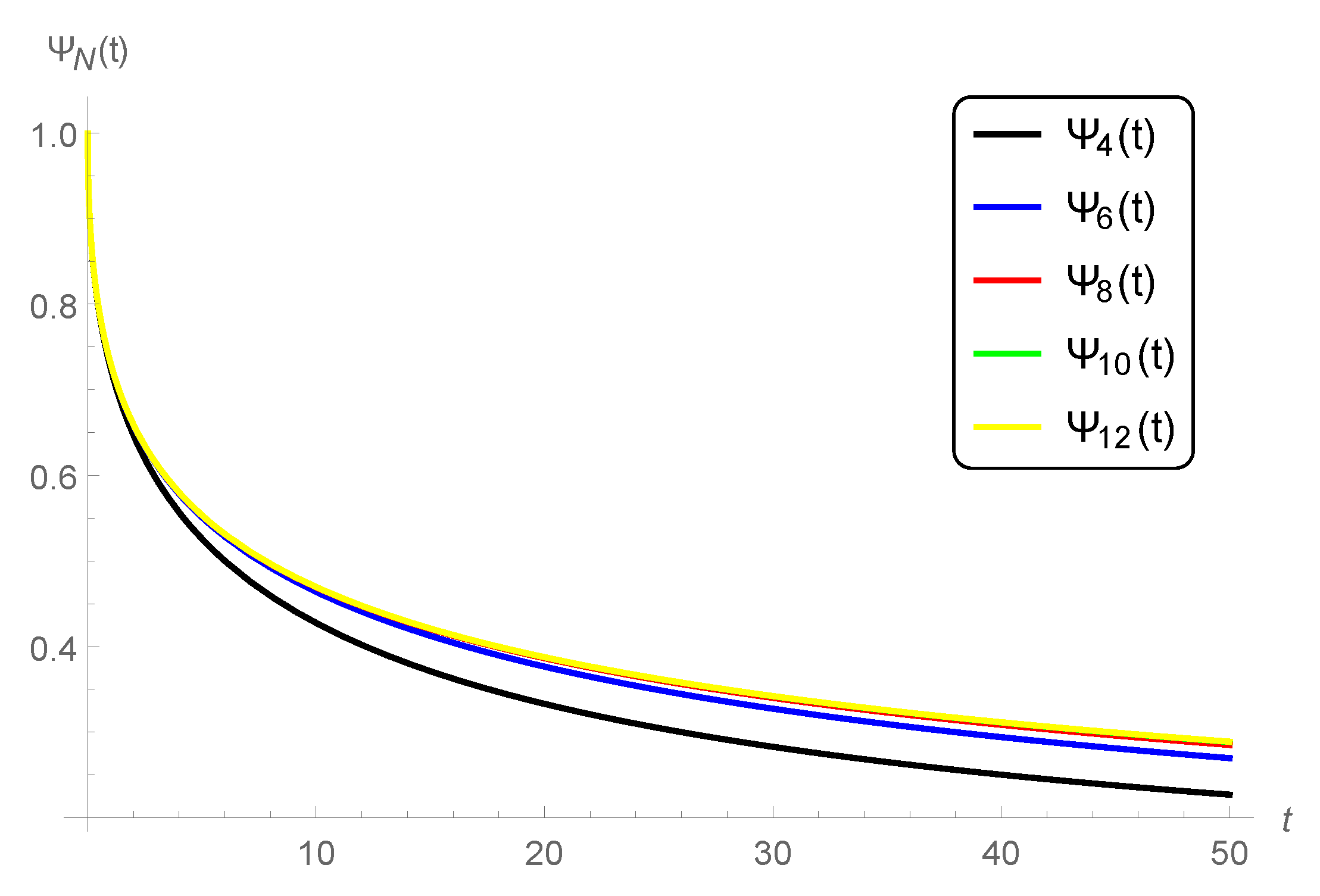
The calculations of the present results and graphs are deducted using the CAS Wolfram Mathematica. It can be seen from this table that the values of are all less than one which satisfy the requirement of convergence of the present approximate solutions. The convergence of the sequence is also shown in Figure 1, where , , , , and are depicted at , , and . Figure 1 shows that the sequence of the approximations curves converges to a certain function as the number of terms N increases. Hence, the convergence is achieved in the whole domain of t. Regarding the rate of convergence, it was shown in Ref. [] that if and are obtained by two homotopy and for each , then the rate of convergence of is higher than .
Figure 1.
Convergence of the sequence of approximate solutions at , , and .
5.3. Comparisons
In Ref. [], Patade obtained the following closed-form power series solution for Equations (1) and (2) by applying an iterative method:
The Solution (51) is convergent for all , see [] for detail. As a special case, , the Solution (51) can be recovered from the brilliant results obtained by Bhalekar and Patade [] for the Pantograph equation. However, it will be shown here that the solution (51) converges in subdomains, i.e., it is not so in the whole domain . Furthermore, the advantages of our solution over the solution in the literature [] is discussed here. For numerical purposes, the infinity in (51) is replaced by to give the M-term approximation as
From (38) and (52), we define the difference between our approximation (38) and the published one (52) (Ref. []) as when taking the same number of terms from both series, i.e., at . In Table 2, the numerical values of the present and (Ref. []) are listed along with the obtained . The results declare that is increased by increasing the domain of t. In addition, after a certain value of t the obtained values of become significant and considerable. Moreover, it is noted from Table 2 that the truncated series solution gives negative values for which is not acceptable from the physical point of view. Accordingly, such truncated series solution [] is physical in only subdomains while it is not so in the whole domain.
Table 2.
Comparison between the present results and Picard iterative method [] when , and .
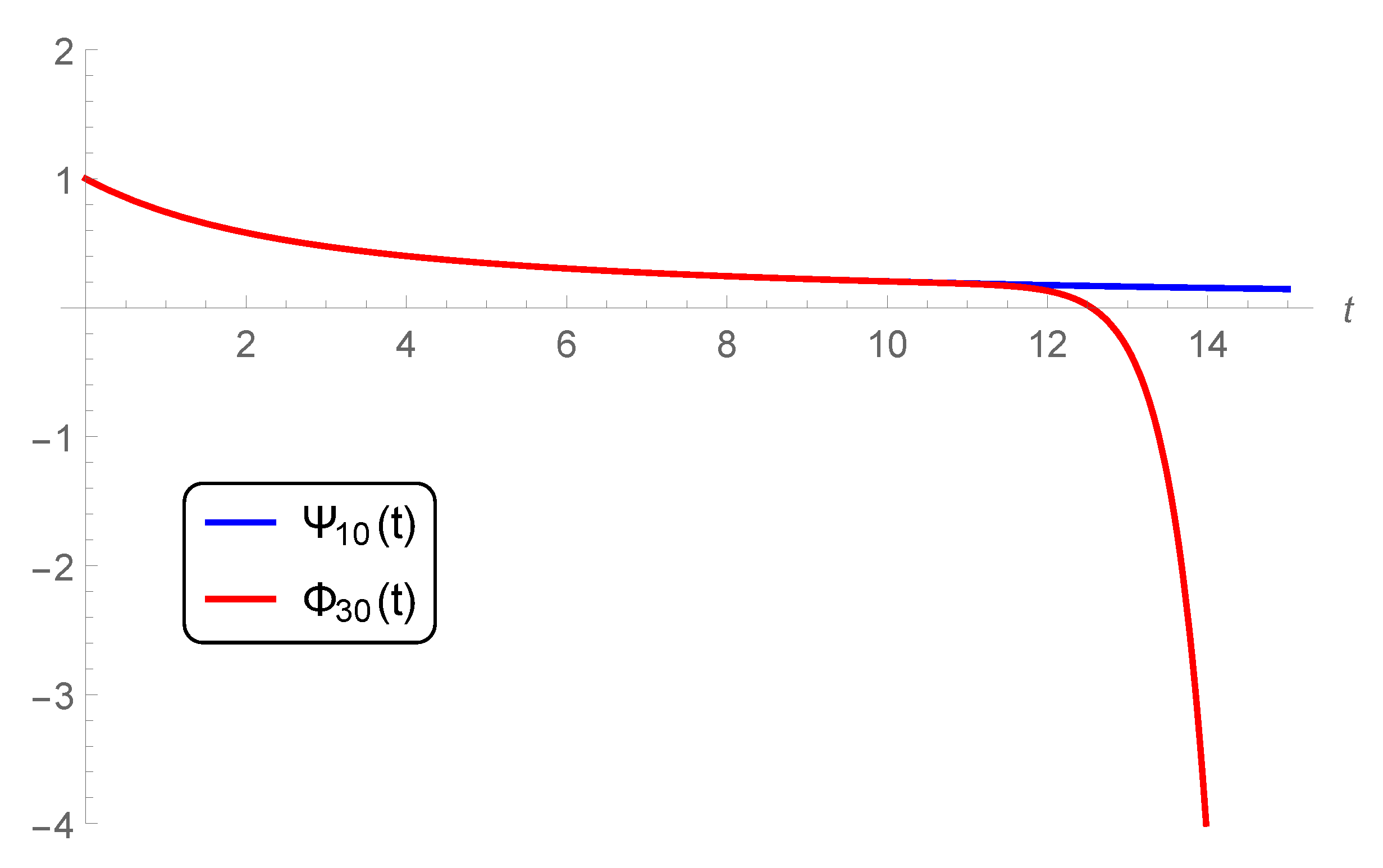
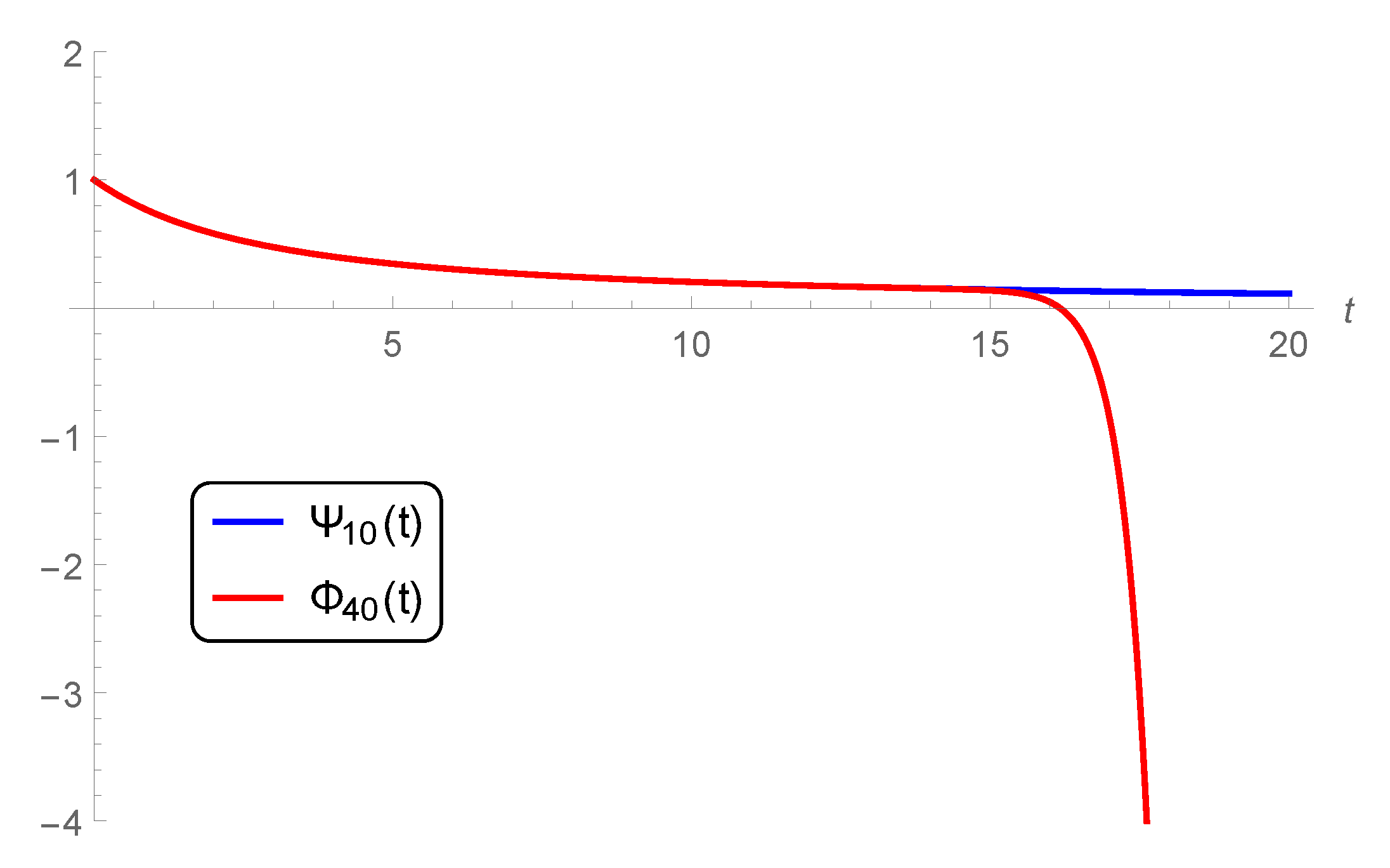
To confirm this point, a graphical comparison between the present 10-term approximate solution and the 30-term approximate solution (Ref. []) is displayed in Figure 2 at , , and (ordinary derivative). In addition, Figure 3 shows the comparison between the present and (Ref. []) at the same values of Figure 2, i.e., , , and (ordinary derivative).
Figure 2.
Comparison between (present) and (Ref. []) at , , and (ordinary derivative).
Figure 3.
Comparison between (present) and (Ref. []) at , , and (ordinary derivative).
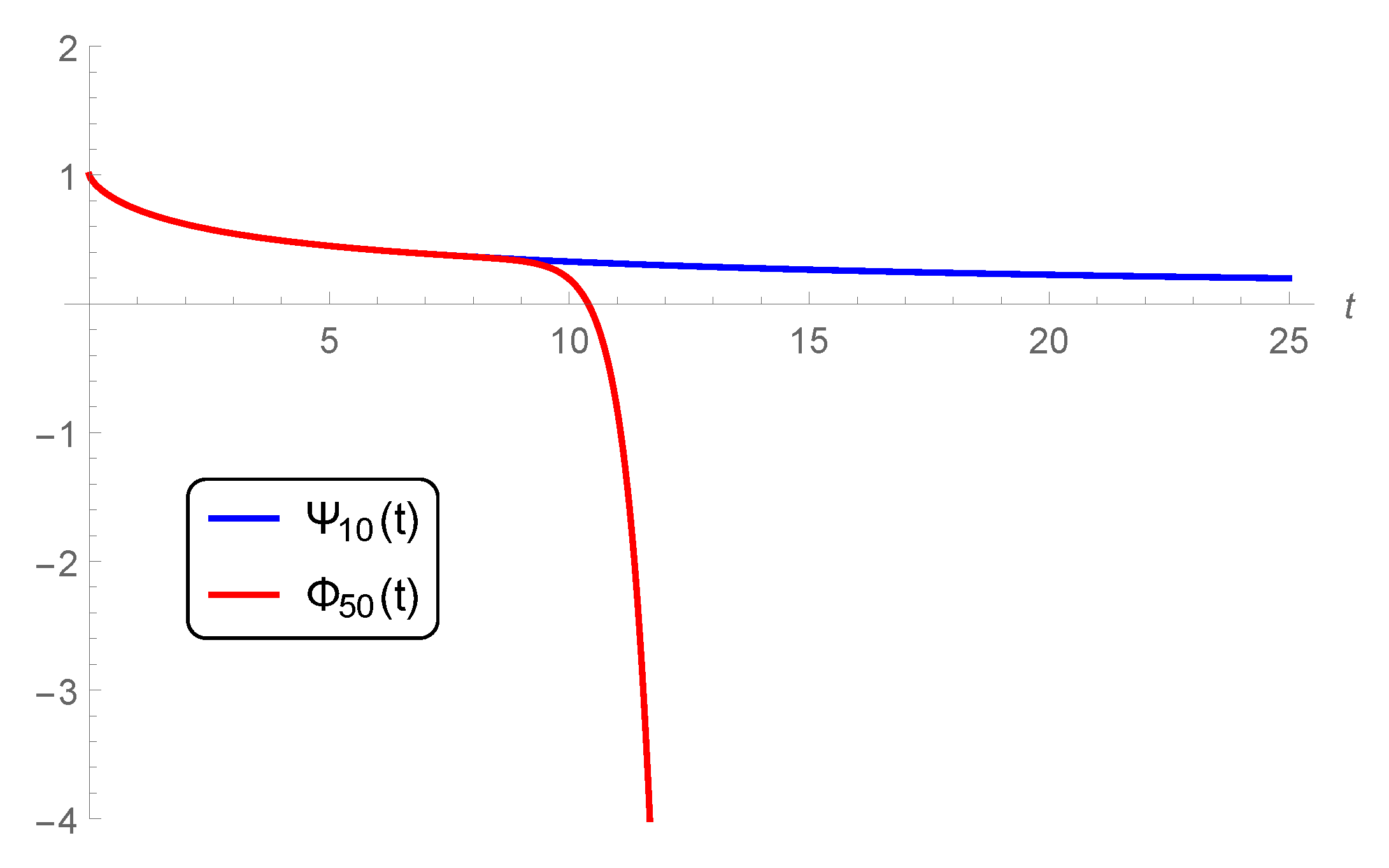
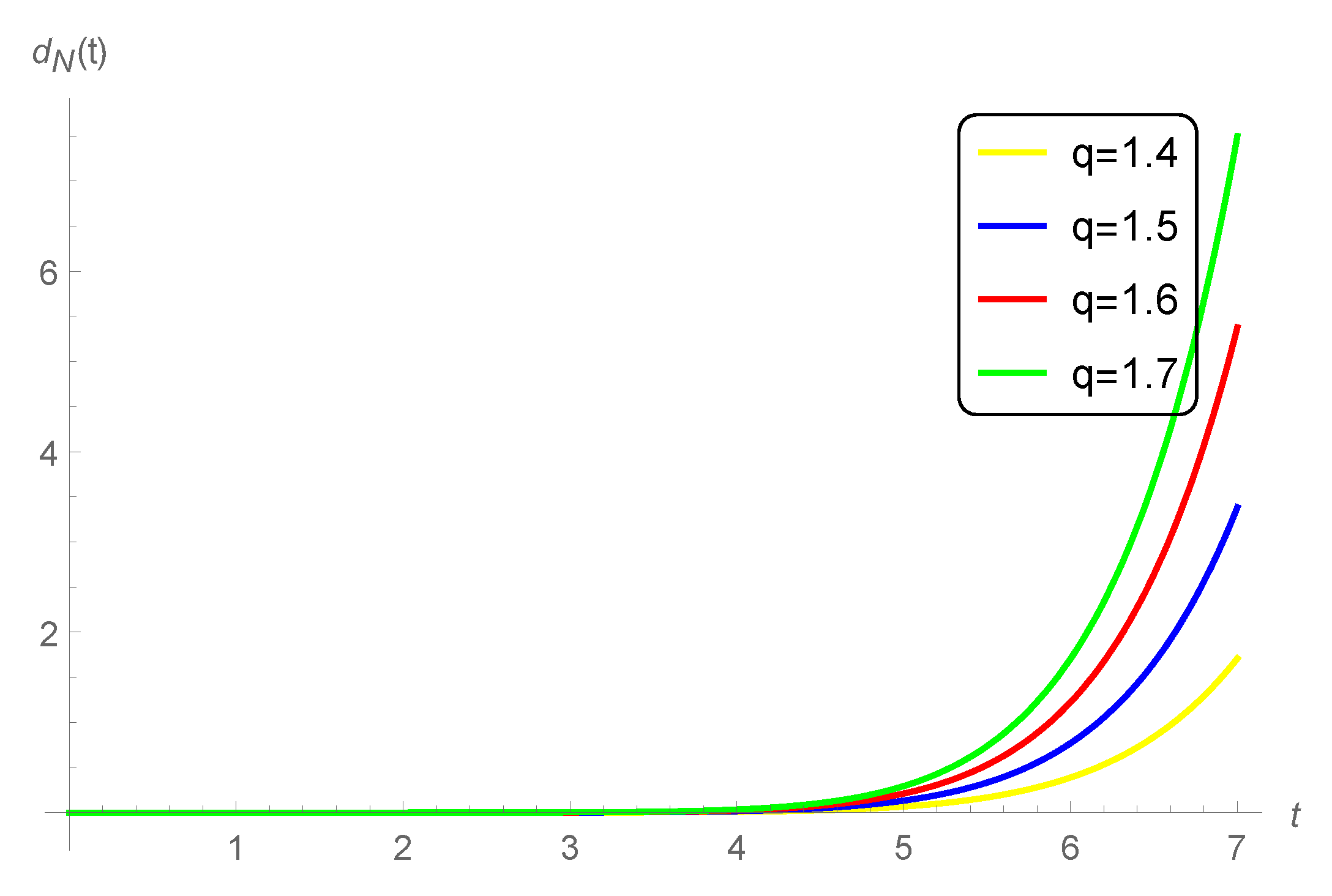
Besides, the comparison between (present) and at , , and (fractional derivative) is plotted in Figure 4. It is observed from these figures that the solution in the literature coincides with our approximate one in specified subdomains. After such subdomains, our solution goes smoothly unlike the corresponding one in []. In addition, the number of terms needed to be taken from (52) is multiples of the current number of terms. The effect of the delay parameter q on the difference , defined above, is depicted in Figure 5 for . The results reveal that is highly affected by increasing q. The preceding discussion shows the applicability and efficiency of the HPM in accurately solving the FAE.
Figure 4.
Comparison between (present) and (Ref. []) at , , and (fractional derivative).
Figure 5.
The effect of the delay parameter q on the difference at and .
6. Conclusions
The HPM was applied successfully in this paper to approximate the FAE in view of the Caputo fractional derivative. The current approach was mainly based on applying the LT combined with the HPM. It may be the first time to introduce the approximate solutions of the FAE in terms of the Mittag-Leffler functions. The present approximate solution reduces to the corresponding one in the literature in the case of ordinary derivative. The convergence of the current approximate solutions were verified. It was shown in this paper that the obtained approximations in the relevant literature (power series solutions) converge in specified subdomains while our approximate ones converge in the whole domain. The obtained results were validated/supported via performing several comparisons between the current approach and the corresponding one in the literature. Finally, the obtained results were based on considering the Caputo fractional operator with a full memory (cf. left terminal in Equation (3) is 0). However, the present work can also be extended to explore the influence of short memory by following the approach developed by Wojciech and Voyiadjis [], in this case the left-sided Caputo derivative is to be utilized.
Author Contributions
Conceptualization, W.A. and S.P.; methodology, W.A. and S.P.; software, W.A.; validation, W.A. and S.P.; formal analysis, W.A. and S.P.; investigation, W.A.; data curation, W.A. and S.P.; writing—original draft preparation, W.A.; writing—review and editing, W.A. and S.P.; visualization, S.P. Both authors have read and agreed to the published version of the manuscript.
Funding
This research received no external funding.
Conflicts of Interest
The authors declare no conflict of interest.
References
- Ambartsumian, V.A. On the fluctuation of the brightness of the milky way. Dokl. Akad Nauk USSR 1994, 44, 223–226. [Google Scholar]
- Patade, J.; Bhalekar, S. On analytical solution of Ambartsumian equation. Natl. Acad. Sci. Lett. 2017, 40, 291–293. [Google Scholar] [CrossRef]
- Bakodah, H.O.; Ebaid, A. Exact solution of Ambartsumian delay differential equation and comparison with Daftardar-Gejji and Jafari approximate method. Mathematics 2018, 6, 331. [Google Scholar] [CrossRef]
- Ebaid, A.; Al-Enazi, A.; Albalawi, B.Z.; Aljoufi, M.D. Accurate approximate solution of Ambartsumian delay differential equation via decomposition method. Math. Comput. Appl. 2019, 24, 7. [Google Scholar] [CrossRef]
- Algehyne, E.A.; El-Zahar, E.R.; Alharbi, F.M.; Ebaid, A. Development of analytical solution for a generalized Ambartsumian equation. AIMS Math. 2019, 5, 249–258. [Google Scholar] [CrossRef]
- Alatawi, A.A.; Aljoufi, M.; Alharbi, F.M.; Ebaid, A. Investigation of the surface brightness model in the milky way via homotopy perturbation method. J. Appl. Math. Phys. 2020, 8, 434–442. [Google Scholar] [CrossRef]
- Khaled, S.M.; El-Zahar, E.R.; Ebaid, A. Solution of Ambartsumian delay differential equation with conformable derivative. Mathematics 2019, 7, 425. [Google Scholar] [CrossRef]
- Kumar, D.; Singh, J.; Baleanu, D.; Rathore, S. Analysis of a fractional model of the Ambartsumian equation. Eur. Phys. J. Plus 2018, 133, 133–259. [Google Scholar] [CrossRef]
- Patade, J. Series solution of system of fractional order Ambartsumian equations: Application in astronomy. arXiv 2020, arXiv:2008.04904v1. [Google Scholar]
- Patra, A.; Saha Ray, S. Homotopy perturbation Sumudu transform method for solving convective radial fins with temperature-dependent thermal conductivity of fractional order energy balance equation. Int. J. Heat Mass Trans. 2014, 76, 162–170. [Google Scholar] [CrossRef]
- Ayati, Z.; Biazar, J. On the convergence of Homotopy perturbation method. J. Egypt. Math. Soc. 2015, 23, 424–428. [Google Scholar] [CrossRef]
- Golmankhaneh, A.K.; Ali, K.G.; Baleanu, D. Homotopy perturbation method for solving a system of Schrodinger-Korteweg-De Vries equations. Rom. Rep. Phys. 2011, 63, 609–623. [Google Scholar]
- Touchent, K.A.; Hammouch, Z.; Mekkaoui, T.; Belgacem, F.B.M. Implementation and convergence analysis of homotopy perturbation coupled with Smudu transform to construct solutions of local-fractional PDEs. Fractal Fract. 2018, 2, 22. [Google Scholar] [CrossRef]
- Sene, N.; Fall, A.N. Homotopy perturbation ρ-Laplace transform method and its application to the fractional diffusion equation and the fractional diffusion-reaction equation. Fractal Fract. 2019, 3, 14. [Google Scholar] [CrossRef]
- Parvizi, M.; Eslahchi, M.R.; Dehghan, M. Numerical solution of fractional advection-diffusion equation with a nonlinear source term. Numer. Algorithms 2015, 68, 601–629. [Google Scholar] [CrossRef]
- Donatelli, M.; Mazza, M.; Serra-Capizzano, S. Spectral analysis and structure preserving preconditioners for fractional diffusion equation. J. Comput. Phys. 2016, 307, 262–279. [Google Scholar] [CrossRef]
- Lin, X.-L.; Ng, M.K.; Sun, H.-W. A multigrid method for linear systems arising from time-dependent two-dimensional space-fractional diffusion equations. J. Comput. Phys. 2017, 336, 69–86. [Google Scholar] [CrossRef]
- Podlubny, I. Fractional Differential Equations; Academic Press: San Diego, CA, USA, 1999. [Google Scholar]
- Hilfer, R. Applications of Fractional Calculus in Physics; World Scientific Publishing Company: Singapore, 2000. [Google Scholar]
- Povstenko, Y. Fractional Diffusion-Wave Equation for Scientists and Engineers; Birkhäuser: New York, NY, USA, 2015. [Google Scholar]
- Gorenflo, R.; Kilbas, A.A.; Mainardi, F.; Rogosin, S.V. Mittag-Leffler Functions, Related Topics and Applications; Springer: Berlin, Germany, 2014. [Google Scholar]
- Bhalekar, S.; Patade, J. Series solution of the Pantograph equation and its properties. Fractal Fract. 2017, 1, 16. [Google Scholar] [CrossRef]
- Wojciech, S.; Voyiadjis, G.Z. A hyperelastic fractional damage material model with memory. Int. J. Solids Struc. 2017, 124, 151–160. [Google Scholar]
Publisher’s Note: MDPI stays neutral with regard to jurisdictional claims in published maps and institutional affiliations. |
© 2020 by the authors. Licensee MDPI, Basel, Switzerland. This article is an open access article distributed under the terms and conditions of the Creative Commons Attribution (CC BY) license (http://creativecommons.org/licenses/by/4.0/).