Abstract
A necessity in the design of a path planning algorithm is to account for the environment. If the movement of the mobile robot is through a dynamic environment, the algorithm needs to include the main constraint: real-time collision avoidance. This kind of problem has been studied by different researchers suggesting different techniques to solve the problem of how to design a trajectory of a mobile robot avoiding collisions with dynamic obstacles. One of these algorithms is the artificial potential field (APF), proposed by O. Khatib in 1986, where a set of an artificial potential field is generated to attract the mobile robot to the goal and to repel the obstacles. This is one of the best options to obtain the trajectory of a mobile robot in real-time (RT). However, the main disadvantage is the presence of deadlocks. The mobile robot can be trapped in one of the local minima. In 1988, J.F. Canny suggested an alternative solution using harmonic functions satisfying the Laplace partial differential equation. When this article appeared, it was nearly impossible to apply this algorithm to RT applications. Years later a novel technique called proper generalized decomposition (PGD) appeared to solve partial differential equations, including parameters, the main appeal being that the solution is obtained once in life, including all the possible parameters. Our previous work, published in 2018, was the first approach to study the possibility of applying the PGD to designing a path planning alternative to the algorithms that nowadays exist. The target of this work is to improve our first approach while including dynamic obstacles as extra parameters.
Keywords:
proper generalized decomposition; motion planning; artificial potential fields; harmonic functions; Laplace equation; dynamic environment MSC:
15A69; 15A23; 57R25; 65N30
1. Introduction
One of the most important tasks in the navigation problems of mobile robots is to plan a path free of collisions from an initial to a target position in a dynamic environment. The computational cost of this goal is high; consequently, it is unlikely to be applied in real-time (RT) applications [1].
There are many publications in robotics related to geometric path planning (or the piano mover’s problem). Researchers have divided the investigation of this topic into different problems. It is possible to distinguish sub-classes of the general problem: sampling-based planners, grid-based and interval-based planners, potential-field-based techniques, [2,3], etc.
The artificial potential field technique (APF) ([1,4,5]) is one of the most important algorithms for solving these problems. The APF generates an artificial potential field that guides the trajectory of the robot. The target position originates an attractive force which makes the mobile robot move towards it. The dynamic obstacles generate repulsive forces to avoid them. Consequently, it is possible to obtain a unique trajectory from the start to the goal. Its computation is fast, and for that reason, APF works perfectly in RT applications. However, repulsive fields generally create local minima and the robot may not reach the goal even if a solution exist.
To solve the local minima problem, harmonic functions (proposed in [6]) have been used to generate the potential field [7]. The properties of harmonic functions are very interesting for robot planning, see [8]. The main objective is to avoid the appearance of deadlocks, and as the harmonic functions verify the min-max principle, it is possible, [9]. After that, path planning can be considered achieved when harmonic functions are used including some assumptions. Moreover, the environment where the robot has to be guided has dynamic and static obstacles. For that reason, when the robot is close to the obstacles it is necessary to improve the behavior of the robot. This improvement can be obtained through the principle of superposition that satisfies the solutions to Laplace’s equation. Besides this, the velocity reference of the robot navigation is also needed, and this vector is acquired with the gradient of an harmonic function.
However, there are some disadvantages when path planning is computed through harmonic functions. These functions cannot be computed in closed form. Therefore, solutions can only be obtained using discrete approximations and the computational burden of these methods is really high. As a consequence, their use is not recommended [10]. For instance, the Laplace equation can be solved using standard numerical methods ([8,11]). This methodology is useful when the robot moves in an environment including the start and goal positions and the environment does not change. If the environment changes, it is compulsory to recompute the harmonic function, which is unfeasible for RT robot planning. The only profit of this methodology is when the environment remains static, which is not the standard situation. In spite of this, some techniques have sped up this computation ([12,13]), but the computational burden is still high for RT path planning, with 646s for an environment with 512 × 512 nodes using the EGSOR algorithm in [13].
Therefore, during the last few years researchers have almost discarded these types of functions for RT path planning and have focused on similar approaches. For instance, those developed for underwater robots that account for ocean currents and obstacles by means of the definition of drift fields and the use of grid-based planning strategies ([14,15]). Additionally, the optimal control theory is very popular for path planning in this context, particularly multi-population genetic algorithms or clustering-based algorithms to solve vehicle task assignments [16].
A short time ago, an original technique called proper generalized decomposition (PGD) was developed to give an approximation of the solutions of non-linear convex variational problems [17]. It is a new methodology for solving problems in high-dimensional spaces ([18,19]).
The main advantage of PGD is that the solution of the problem is solved once in life, including all the possible solutions and parameters. It is named computational vademecum. PGD opens the possibility of solving problems with a new strategy not possible in the past.
It is possible to see in [11] how important is to have the trajectory precomputed when the obstacles and the goal are fixed. PGD offers the option of obtaining the streamline maps for all the possible solutions combining start/goal positions. This was not possible in the 90s, as the algorithm to solve partial differential equations (PDE) parametrically did not yet exist and researchers had discarded this technique.
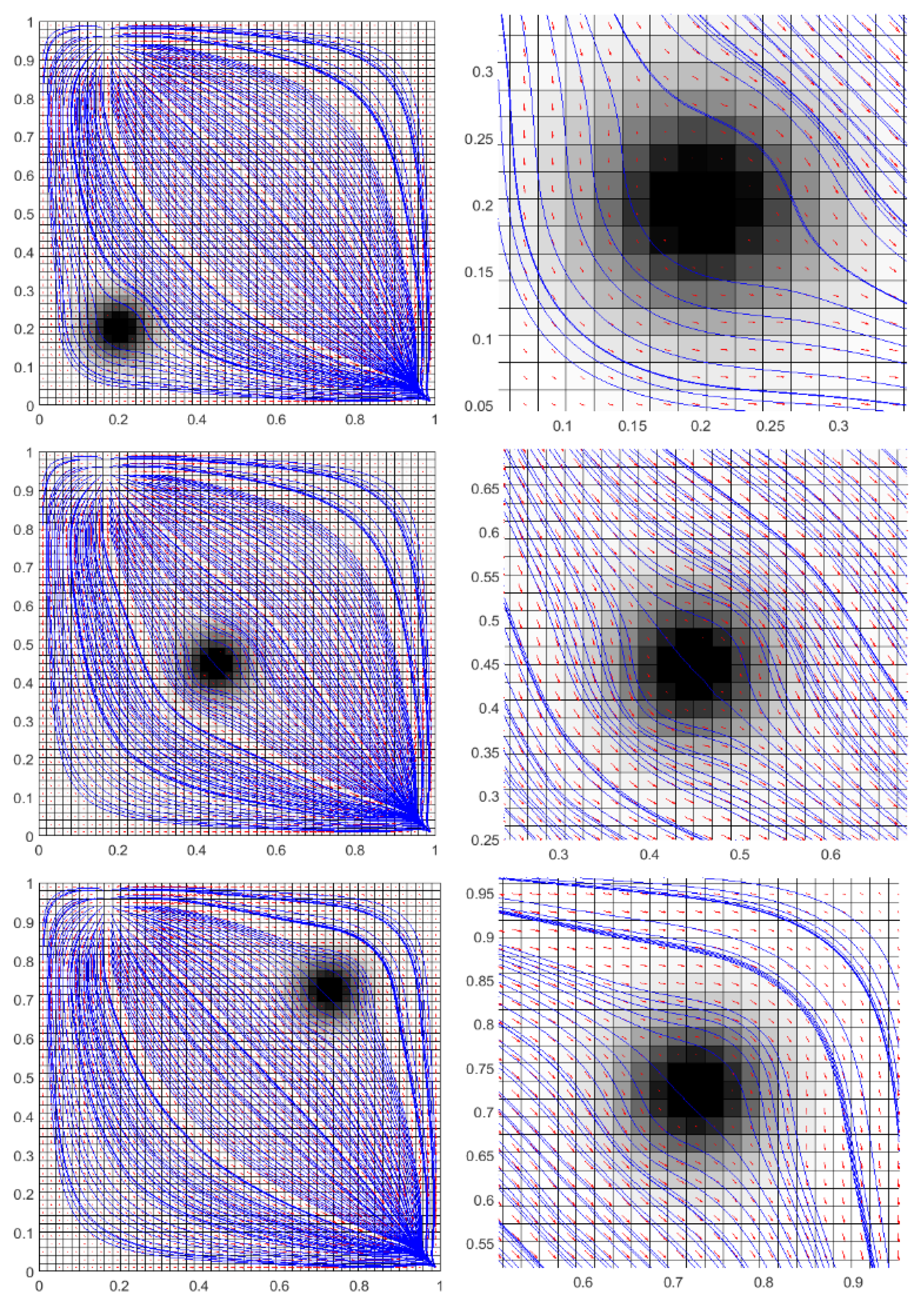
Our previous work, references [20,21] developed a PGD-based computational vademecum (PGD-vademecum) or abacus to solve the Laplace equation, allowing the use of the potential flow theory in RT applications when the robot is guided in a static environment [22]. In this paper, the formulation of the PGD-vademecum for dynamic environments with dynamic obstacles is derived, the progressive PGD-vademecum, where the obstacles are considered in the representation as extra parameters. This is modeled as a matrix modifying the properties of the initial domain, and in the context of the potential flow theory, the porosity of the medium.
This work has been organized in different sections: In Section 2, we introduce a PGD-based computational vademecum for robot path planning in a dynamic environment. Later, Section 3 explains the progressive construction of a variational vademecum. In Section 4 we provide a numerical example. Finally, Section 5 draws conclusions and future works.
2. A Variational Vademecum for a Dynamic Obstacle Robotic Problem
Now the variational vademecum is introduced using the potential flow theory in robotics to explain the definition along with a real-life application.
2.1. Potential Flow Theory for a Dynamic Obstacle Robotic Problem
Path planning for a dynamic robotic problem based on the potential flow theory has been applied in the literature during the last few years, see [11,17,23,24,25]. In these articles, the problem is based on the Laplace equation. To begin with, it is necessary to describe the algorithm that describes the flow of an inviscid incompressible fluid. Let us assume a uniform condition irrational flow in a Eulerian configuration, the velocity vector , satisfies
and hence the velocity can be characterized as the gradient of a scalar potential function, i.e., As a consequence, the function u appears as a solution of the equation:
By using a 2.5D mould filling model similar to [23], represented by a two dimensional domain denoted by a Dirac function (respectively, ) is introduced in the right side of the Equation (2). This means the fluid source (respectively, sink). We can also introduce a matrix term A modelling the porosity of the medium as follows. We assume a unit amount of fluid injected at point during a unit of time and the same unit withdrawn at the point The velocity of the fluid is now the solution of the D’Arcy like equation, which includes the source term and the porosity of the medium represented by matrix A as follows:
Equation (3) needs to be modified introducing boundary conditions. The condition ( being a vector normal to the boundary ) represents that the fluid will not be able to flow across the boundaries. In particular, the resolution of Equation (3), when A is the identity matrix and under the above conditions, is a field of vectors joining the Start point (source) to the Target point (sink) without deadlocks [25].
In practice, we can implemented (3) as follows. Consider that the source term f is non-uniform, that is, where the function when and zero otherwise. The functions and are two-dimensional Gaussian density distributions centered in and , respectively, and they both have equal variance that is given by a diagonal matrix for some We can write, more precisely, and hence , and and here. Then, the Equation (3) is now
where and the solution is in the form
2.2. Introducing the Variational Vademecum
The Hilbert space is the closure of (functions in with compact support in ) in with respect to the norm in . Thus, the space is characterized with this norm
which is equivalent to the classical norm on
From now on, we will assume that that the common variance r takes a fixed value and the parameter includes the starting point (source) and the target point (sink), and also other points of , denoted by for which the matrix satisfies that is close to zero for all in a small neighborhood of each for The classical variational formulation for (4) along with is: For each fixed parameters values and r find such that
holds for all Here denotes the gradient in the coordinates The variational vademecum is then the solution of (4) and the solution contains all the possible configurations of a dynamic obstacle robotic problem taking the variables In this case, u gives us the set of variational solutions of (4) for all the possible parameter values We remark that solving once (5) we solve variationally (4) for all the possible parameter values
To search the vademecum u we use a closed subspace of the tensor Hilbert space constructed as follows. Let the algebraic tensor product space be
endowed with the norm
The norm is indeed a cross-norm because
holds for all and By taking its completion over this norm, the Hilbert tensor space is obtained as follows:
The inner product is given by
In particular, we obtain for the so-called rank-one tensors
where denotes the gradient in the coordinates We can observe that for are satisfied for all and that for each fixed the set
is a closed subspace of linearly isomorphic to
It has been introduced in [26] (see also [17,23])using the mathematical analysis of a progressive PGD to solve (5) in the tensor Hilbert space for a fixed . In the next sections we will develop a constructive approach to obtain a progressive variational vademecum.
3. A Progressive Construction of a Variational Vademecum
Let us consider and where both are open and bounded domains and represents the number of parameters of our model. Let us introduce the variables The aim of the paper is: given , defined step by step using Greedy Rank-One Algorithm, a variational answer of the problem with parameters.
for together with the homogeneous boundary condition
We assume that is an uniformly coercive matrix, that is, for all there exists a constant such that it holds
Since for each fixed classical results give us, for each fixed the existence and uniqueness of a weak solution for the PDE:
for together with the homogeneous boundary condition
Thus, we have a map that solves (6) and (7) for all The idea of the abacus introduced in [18] is to propose iteratively a global solution of the parametrized PDE (6) and (7) following the ideas that we will explain below.
Now, our main goal is to construct iteratively the weak solution of (6) and (7) denoted by Next the set of tensors of bounded rank one is introduced:
The main properties of are given in the next lemma.
Lemma 1.
The set satisfies the following properties
- (a)
- is dense in
- (b)
- It is a cone, that is, if then for all
- (c)
- It is a weakly closed set in
Proof.
The proofs of (a) and (b) are straightforward. Additionally, (c) follows Proposition 4.3 in [27] because the norm is a cross-norm. □
Now, we consider the functional
given by
The following assumptions (A1)–(A3) on the functional are satisfied (see [28]).
- (A1)
- J is Fréchet differentiable, with Fréchet differential ;
- (A2)
- J is elliptic;
- (A3)
- is Lipschitz continuous on bounded sets.
Thanks to the Lemma 1 and that the functional J satisfies (A1)–(A2), the following definition can be obtained.
Definition 1
([20], Progressive Variational Vademecum). Since satisfies (A1)–(A2) let be such that
A progressive variational vademecum is defined using tensors of rank-one of as follows. Given and for from is set up in the following equations. As J verifies (A3) and from Lemma 1 we can find an element
such that
Next, before updating m to define update m to and go to
This definition and the next theorem were introduced in [20].
The important factor in the previous procedure is the minimization problem because for each m is considered a map
where
After each step in the definition of a progressive variational vademecum over the set of tensors of bounded rank-one of a rank-one function is achieved
Otherwise, if we write
and continue. From Theorem 5 in [17] the next result follows.
Theorem 1
([20]). Let satisfy (10). Consider a progressive variational vademecum over of Then converges in to that is,
The progressive variational vademecum is computed following this approach:
- Consider two finite dimensional subspaces and
- Assume that for each the approximation is known.
- Choose the function randomly and let be a linear subspace such that Find be such that
- Let be a linear subspace such that Find be such that
- Repeat steps 3 and 4 just until is stabilized. Take
- If then return Otherwise put and go to step 2.
5. Conclusions
A basic issue in mobile robots is to design the movement of the robot to avoid all the obstacles from an initial to a target position. This geometric problem is computationally hard because it is necessary to take into account the different positions of the dynamic obstacles and the possibilities of start and goals positions. There are different algorithms to solve this problem. However, some of them have disadvantages. For that reason, we introduce the technique of the progressive PGD in the mobile robotics task to improve the problems that appears with the use of other algorithms. In our previous work we consider a static environment and in this work we have obtained all the possible paths for a mobile robot introducing a dynamic obstacle in the environment. We called as PGD-vademecum because we can consider any position for start and goal points and any position for the dynamic obstacle. The big advantage is that this set of solutions are computed offline and later they will be used online; for that reason to apply a progressive PGD is very fast in real time applications.
Author Contributions
Investigation, writing and revision: A.F., L.H., N.M., M.C.M. and E.N. All authors have read and agreed to the published version of the manuscript.
Funding
This research was funded by the GVA/2019/124 grant from Generalitat Valenciana and by the RTI2018-093521-B-C32 grant from the Ministerio de Ciencia, Innovación y Universidades.
Conflicts of Interest
The authors declare no conflict of interest.The funders had no role in the design of the study; in the collection, analyses or interpretation of data; in the writing of the manuscript, or in the decision to publish the results.
References
- Reif, J.H. Complexity of the Mover’s Problem and Generalizations. In Proceedings of the IEEE ymposium on Foundations of Computer Science, San Juan, PR, USA, 29–31 October 1976; pp. 421–427. [Google Scholar]
- González, D.; Pérez, J.; Milanés, V.; Nashashibi, F. A Review of Motion Planning Techniques for Automated Vehicles. IEEE Trans. Ntelligent Transp. Syst. 2016, 17, 1135–1145. [Google Scholar] [CrossRef]
- Kavraki, L.E.; LaValle, S. Chapter 5. Motion Planning; Khatib, S., Ed.; Handbook of Robotics; Springer: Berlin/Heidelberg, Germany, 2008. [Google Scholar]
- Rimon, E.; Koditschek, D. Exact robot navigation using artificial potential functions. IEEE Trans. Robot. Autom. 1992, 8, 501–518. [Google Scholar] [CrossRef]
- Khatib, O. Real-time obstacle avoidance for manipulators and mobile robots. Int. J. Robot Res. 1986, 5, 90–98. [Google Scholar] [CrossRef]
- Zhachmanoglou, E.; Thoe, D.W. Introduction to Partial Differential Equations with Applications; Dover Publications, Inc.: New York, NY, USA, 1986. [Google Scholar]
- Kim, J.; Khosla, P. Real-time obstacle avoidance using harmonic potencial functions. IEEE Trans. Robot. Autom. 1992, 8, 338–349. [Google Scholar] [CrossRef]
- Connolly, C.I.; Grupen, R. The Application of Harmonic functions to Robotics. J. Robot. Syst. 1993, 10, 931–946. [Google Scholar] [CrossRef]
- Canny, J.F. The Complexity of Robot Motion Planning; MIT Press: Cambridge, UK, 1988. [Google Scholar]
- Garrido, S.; Moreno, L.; Blanco, D.; Martín, M.F. Robotic Motion Using Harmonic Functions and Finite Elements. J. Intell. Robot Syst. 2010, 59, 57–73. [Google Scholar] [CrossRef][Green Version]
- Connolly, C.I.; Burns, J.B.; Weiss, R. Path planning using Laplace’s equation. In Proceedings of the IEEE International Conference on Robotics and Automation, Cincinnati, OH, USA, 13–18 May 1990; pp. 2102–2106. [Google Scholar]
- Saudi, A.; Sulaiman, J. Path Planing for mobile robots using 4EGSOR via Nine-Point Laplacian (4EGSOR9L) Iterative method. Int. J. Comput. Appl. 2012, 53, 38–42. [Google Scholar]
- Saudi, A.; Sulaiman, J.; Ahmad, H.M.H. Robot Path Planing with EGSOR Iterative Method using Laplacian Behaviour-Based Control (LBBC). In Proceedings of the 5th International Conference on Intelligent Systems, Modelling and Simulation, Langkawi, Malaysia, 27–29 January 2014; pp. 87–91. [Google Scholar]
- Yan, W.; Bai, X.; Peng, X.; Zuo, L.; Dai, J. The routing problem of autonomous underwater vehicles in ocean currents. In Proceedings of the MTS/IEEE Conference OCEANS’14, Taipei, Taiwan, 7–10 April 2014; pp. 1–6. [Google Scholar]
- Bai, X.; Yan, W.; Cao, M.; Xue, D. Distributed multi-vehicle task assignment in a time-invariant drift field with obstacles. IET Control Theory Appl. 2019, 13, 2886–2893. [Google Scholar] [CrossRef]
- Bai, X.; Yan, W.; Ge, S.S.; Cao, M. An integrated multi-population genetic algorithm for multi-vehicle task assignment in a drift field. Inf. Sci. 2018, 453, 227–238. [Google Scholar] [CrossRef]
- Falcó, A.; Nouy, A. Proper Generalized Decomposition for Nonlinear Convex Problems in Tensor Banach Spaces. Numer. Math. 2012, 121, 503–530. [Google Scholar] [CrossRef]
- Chinesta, F.; Leygue, A.; Bordeu, F.; Aguado, J.V.; Cueto, E.; Gonzalez, D.; Alfaro, I.; Ammar, A.; Huerta, A. PGD-Based computational vademecum for efficient Design, Optimization and Control. Arch. Comput. Methods Eng. 2013, 20, 31–49. [Google Scholar] [CrossRef]
- Chinesta, F.; Keunings, R.; Leygue, A. The Proper Generalized Decomposition for Advanced Numerical Simulations. A Primer; Springer Briefs in Applied Science and Technology; Springer: Berlin/Heidelberg, Germany, 2013. [Google Scholar]
- Falcó, A.; Montés, N.; Chinesta, F.; Hilario, L.; Mora, M.C. On the Existence of a Progressive Variational Vademecum based on the Proper Generalized Decomposition for a Class of Elliptic Parameterized Problems. J. Comput. Appl. Math. 2018, 330, 1093–1107. [Google Scholar] [CrossRef]
- Montés, N.; Chinesta, F.; Falcó, A.; Mora, M.C.; Hilario, L.; Rosillo, N. PGD-based Method for mobile robot applications. In Proceedings of the Congress on Numerical Methods in Engineering CMN2017, Valencia, Spain, 3–5 July 2017. [Google Scholar]
- Montés, N.; Chinesta, F.; Falcó, A.; Mora, M.C.; Hilario, L.; Nadal, E.; Duval, J.L. A PGD- based Method for Robot Global Path Planning: A Primer. In Proceedings of the 16th International Conference on Informatics in Control, Automation and Robotics (ICINCO 2019), Prague, Czech Republic, 29–31 July 2019; pp. 31–39. [Google Scholar]
- Domenech, L.; Falcó, A.; García, V.; Sánchez, F. Towards a 2.5D geometric model in mold filling simulation. J. Comput. Appl. Math. 2016, 291, 183–196. [Google Scholar] [CrossRef]
- Falcó, A.; Nouy, A. A Proper Generalized Decomposition for the solution of elliptic problems in abstract form by using a functional Eckart-Young approach. J. Math. Anal. Appl. 2011, 376, 469–480. [Google Scholar] [CrossRef]
- Gingras, D.; Dupuis, E.; Payre, G.; Lafontaine, J. Path Planning Based on Fluid mechanics for mobile robots used Unstructured Terrain models. In Proceedings of the IEEE International Conference on Robotics and Automation, Anchorage, AK, USA, 3–8 May 2010. [Google Scholar]
- Cancès, E.; Ehrlacher, V.; Lelièvre, T. Convergence of a greedy algorithm for high-dimensional convex nonlinear problems, Mathematical Models and Methods. Appl. Sci. 2011, 21, 2433–2467. [Google Scholar]
- Falcó, A.; Hackbusch, W. On minimal subspaces in tensor representations. Found. Comput. Math. 2012, 12, 765–803. [Google Scholar] [CrossRef]
- Canuto, C.; Urban, K. Adaptive optimization of convex functionals in banach spaces. SIAM J. Numer. Anal. 2005, 42, 2043–2075. [Google Scholar] [CrossRef]
- Ammar, A.; Chinesta, F.; Falcó, A. On the convergence of a Greedy Rank-One Update Algorithm for a class of Linear Systems. Arch. Comput. Methods Eng. 2010, 17, 473–486. [Google Scholar] [CrossRef]
Publisher’s Note: MDPI stays neutral with regard to jurisdictional claims in published maps and institutional affiliations. |
© 2020 by the authors. Licensee MDPI, Basel, Switzerland. This article is an open access article distributed under the terms and conditions of the Creative Commons Attribution (CC BY) license (http://creativecommons.org/licenses/by/4.0/).