


Abstract
In his famous work, “Measurement of a Circle,” Archimedes described a procedure for measuring both the circumference of a circle and the area it bounds. Implicit in his work is the idea that his procedure defines these quantities. Modern approaches for defining eschew his method and instead use arguments that are easier to justify, but they involve ideas that are not elementary. This paper makes Archimedes’ measurement procedure rigorous from a modern perspective. In so doing, it brings a rigorous and geometric treatment of the differential properties of the trigonometric functions into the purview of an introductory calculus course.
1. Introduction
Archimedes’ estimate of the value of in “Measurement of a Circle” is one of his greatest achievements [1]. His approach anticipated foundational ideas of modern analysis as formulated in the 19th and early 20th centuries, making this work one of the first major analytical achievements. Archimedes implicitly defined the circumference of a unit circle axiomatically as a number always greater than the perimeters of approximating inscribed polygons and always less than the perimeters of approximating circumscribed polygons, where the approximating polygons are regular refinements of a regular hexagon. By calculating the perimeters of a regular inscribed and circumscribed polygon of 96 sides, he arrived at the famous estimate:
He also found upper and lower bounds for the area of a disk, respectively given by the areas of regular refinements of circumscribed and inscribed squares. He showed that the area of the disk should be the area of a right triangle with one leg having a length equal to the circumference of the unit circle and the other having the length of the radius.
The fact that the approximation procedure for the circumference appears to depend both on the method of refinement and on the type of polygon used in the first stage of the approximation presents a difficulty from a modern point of view. The circumference should be intrinsic to the circle and independent of any specified approximation procedure. It is important to modernize Archimedes’ construction in a way that is maximally accessible to a contemporary of Archimedes for both aesthetic and practical reasons. A practical consequence is that such a modernization cleanly and efficiently resolves the principle difficulty that arises in developing the infinitesimal theory of the trigonometric functions, the calculation
Gearhart and Schultz discuss in [2], the sinc function, its connection to a variety of topics, and some of its many applications that give important motivation for the independent study of (1). Unger notes in [3] some difficulties in the approaches to treating this limit that are common in differential calculus textbooks. Richman also points out in [4] some of these difficulties and directs the reader to the approach of Apostol [5], which avoids common logically circular arguments by using twice the area of a sector rather than arc length as the argument of the trigonometric functions. This is a natural point of view, especially when considering the direct analogy with the hyperbolic trigonometric functions. Although Apostol’s approach is compelling, it remains desirable to connect this nonstandard way of defining the trigonometric functions with the standard approach. Moreover, Apostol defines the area of a sector rather than deriving it from a limiting procedure using inscribed and circumscribed polygons, so there is still some work to be done to connect the viewpoints.
There are several approaches to computing (1) in the literature. Authors commonly use an analytical approach to solve the problem by defining the trigonometric functions as power series or as solutions to a system of differential equations. Some authors begin by defining the inverse of the tangent function as an integral. Unfortunately, these approaches lack geometric motivation. Cipra studied in [6] the derivatives of the sine and cosine functions by considering the properties of integrals of these functions. He then determined the circumference of the unit circle by using the formula for the length of an arc of a parameterized planar curve. However, the argument that he uses for the sine and cosine function is the arc length, so the length of an arc of a circle still requires a geometric definition independent of his approach.
In [7], Vietoris used the sum of angles formula for the trigonometric functions to prove (1) directly. The notion of an arbitrary fraction of a circle requires a group structure on the circle, and defining such a structure is certainly natural and unavoidable. The argument of the sine and cosine functions will be a multiple of the fraction of a circle that a particular arc represents. However, taking the multiple to be the length of an arc requires a definition of the length of an arc. Defining and computing the length of the arc is the primary difficulty. If one follows Vietoris, one must define in some way independent of it being the area of the unit circle, or half its circumference. If one uses the approach of Zeisel in [8] that follows Vietoris’—at least philosophically—then one can dispense with the alternate definition of . Taking as the limit of the area given by regular circumscribed n-gons and taking the multiple of the fraction in the argument to be will imply the limit (1). However, without some further work, even this elegant approach of Zeisel does not establish the meaning of the area and circumference of the unit circle or their relationship. In fact, one must still show that the limit of the areas he discusses actually exists.
The study of the properties of inscribed and circumscribed polygons and their generalizations are still of current interest, and Apostol and Mnatsakanian present in [9] some interesting results about circumgons, where the notion of a circumgon generalizes the notion of a circumscribed polygon. The novelty of the current study is our modernization of Archimedes’ approach to approximating the circle by inscribed and circumscribed polygons. Using only basic euclidean geometry, we prove our main technical result: for any arc that is less than half of a circle, if n is greater than m and if and are the lengths of chords that respectively subtend arcs that are an and an of , then
We prove an analogous but reverse inequality for lengths corresponding to edges of circumscribed polygons. These inequalities imply that the circle is a rectifiable curve. They, furthermore, give the classical relationship between the circumference of a circle and the area that it bounds in a way that is both rigorous and accessible to freshman calculus students. Using these inequalities, we show that is the limiting value of any sequence of perimeters of approximating inscribed or circumscribed polygons. This approach is a simple modernization of the approach of Archimedes and makes rigorous the usual geometric arguments in calculus textbooks that prove (1). It is also elementary enough to be accessible, at least in principle, to a freshman calculus student.
2. Approximation by Regular -Gons
Denote by the unit circle centered at O. Unless otherwise specified, n will be in , the set of natural numbers greater than or equal to three, and m will be in , the natural numbers with zero. All sequences henceforth indexed by m will be indexed over the set .
2.1. Regular Inscribed and Circumscribed Polygons
Definition 1.
An inscribed polygon of is a simple convex polygon all of whose vertices lie on . An inscribed polygon of is regular if all of its edges are of equal length.
Definition 2.
A circumscribed polygon of is a simple convex polygon all of whose edges intersect tangentially. A circumscribed polygon of is regular if each of its edges intersects tangentially at its midpoint and all of its edges are of equal length.
Remark 1.
The assumption of convexity in the above definitions is redundant, as is the assumption in the case of circumscribed polygons that all edges have the same length. We leave the verification of these assertions to the reader as an exercise.
Denote respectively by and the regular inscribed and circumscribed polygons with edges. Up to congruency, there is only one such inscribed and one such circumscribed polygon for each choice of m and n. Denote respectively by and the edge length of and . The respective perimeters of and are and , where
Let P and Q be adjacent vertices of and let A and B be adjacent vertices of . Denote respectively by and the areas of the triangles and . The respective areas of and are and , where
The triangle inequality and the additivity of area together imply the following proposition.
Proposition 1.
For fixed n, the sequences and are both increasing and the sequences and are both decreasing.
The parallel postulate implies the following useful lemma. Refer to Figure 1 to clarify the statement of the lemma.
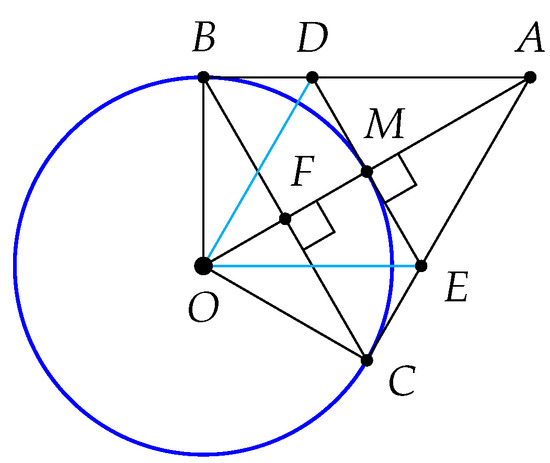
Figure 1.
The intersection of adjacent edges of a circumscribed polygon and its refinement.
Lemma 1.
Suppose that C and B are points on so that the counterclockwise oriented arc from C to B is less than half of . If and are lines tangent to respectively at B and C, then and intersect at a point A and the right triangles and are congruent. If F is the point of intersection of with , then is a right angle. Let M be the point at which intersects and be the line tangent to at M. Denote by D the point at which the line intersects and denote by E the point at which intersects . The angle is congruent to and both are right angles.
2.2. Area and Perimeter Bounds
While Proposition 1 guarantees for fixed n the strict monotonicity of , , and , it does not guarantee that the sequences are bounded. The following proposition provides the desired bounds.
Proposition 2.
For each n and each m,
Since and are increasing and bounded above by and , and since and are decreasing and bounded below by and , all four sequences are convergent, implying Proposition 3.
Proposition 3.
For each n, there are real numbers , , , and such that
2.3. Convergence of the Approximations
Proposition 3 gives for each fixed n respective limiting values for the areas and perimeters of regular refinements of regular inscribed and circumscribed polygons with n edges. It does not prove the equality of the respective limits.
Theorem 1
(Heron’s Theorem). If T is a triangle with side lengths and is the area of T, then
For any points A and B in the plane, denote by the length of the line segment . Denote by the distance from a vertex of to .
Proposition 4.
For each n,
Proof.
Since the sequences and are both convergent and are respectively equal to and , both and tend to zero as m tends to infinity. Heron’s theorem implies that
and so
Since is a unit circle, is equal to and so
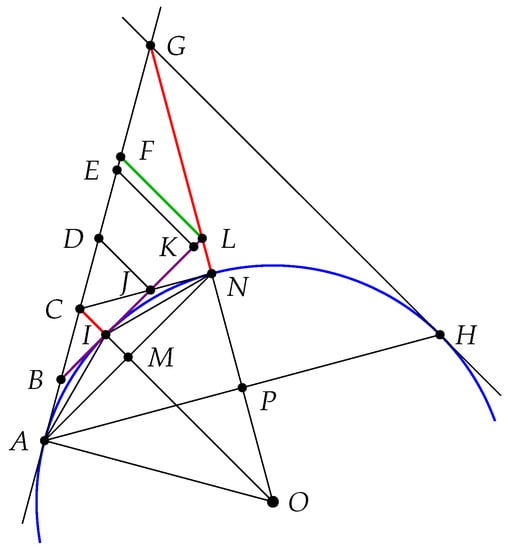
Suppose that G is a vertex of , that A and H are points on where the edges of with endpoint G are tangent to , and that is counterclockwise oriented (Figure 2). Line segments and are half edges of , so is equal to . Take N to be a point of so that and are edges of . The intersection, C, of lines tangent to at A and N is a vertex of . Take P to be the intersection of with and M to be the intersection of with . Let I be the point of that intersects . Lemma 1 implies that and are right angles. Denote by B intersection of line tangent to at A with line tangent to at I. Denote by J the intersection of the line tangent to at I with line tangent to at N. The points B and J are adjacent vertices of . Angle is obtuse because is right; hence
Figure 2.
The sequence of heights is a null sequence.
Extend to meet at a point L. Lemma 1 implies that and are both right angles and so and are parallel. The point L therefore lies between N and G. The line segment has length and is equal to .
Line segments , , and are congruent as half edges of . The hypotenuse of the right triangle is , so is greater than . Let K be a point on such that and are congruent. Furthermore, let E and F be points lying on such that , , and are parallel. The similarity of , , and and the equality of and together imply that is equal to . Since is right, is obtuse and so is as well, implying that is greater than . Since is greater than ,
The triangle inequality implies that is greater than ; hence
and so
The estimate (5) implies that
3. Edge Length Comparison Theorems
Comparing the edge lengths of inscribed and circumscribed segments corresponding to different regular subdivisions of an arc is the key to proving that the definition of is independent of any approximation scheme. This section will present such a comparison.
Definition 3.
A(counter)clockwise oriented partition P of an arc is a finite sequence of points of that is (counter)clockwise ordered, and the first and last points of P are the endpoints of . Such a finite sequence is regular if all adjacent points of P are equidistant.
Temporarily ignore the previous restrictions on the natural numbers m and n and refer to Figure 3 for the discussion that follows.
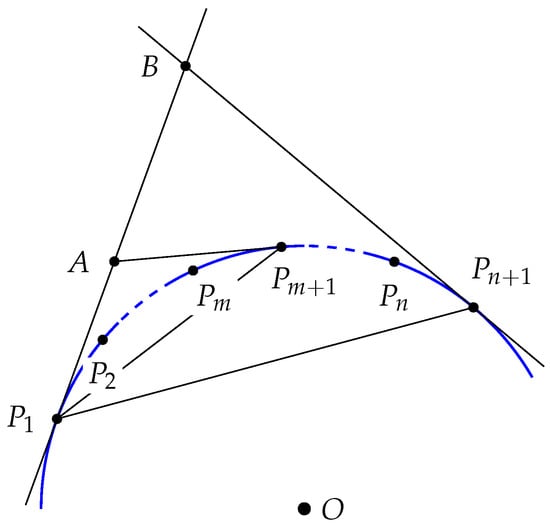
Figure 3.
Comparing edge lengths associated to different numbers of congruent segments.
Suppose that m and n are natural numbers with n greater than m. Let be an arc of that is less than half of and let be a regular clockwise oriented partition of . Let B be the point of intersection of the lines tangent to at and and let A be the point of intersection of the lines tangent to at and . Denote by , , , and the respective lengths of , , and . We will show that
3.1. General Symmetry Considerations for Polygonal Segments
Suppose that A, B, C, and D belong to a collection of points that form a regular partition of (Figure 4), that A and B are adjacent, that C and D are adjacent, and that B and C lie on the same side of the line and opposite the side where O lies. Suppose furthermore that the quadruple forms a clockwise oriented partition of . Standard arguments using the SSS theorem imply Proposition 5, whose proof is left as an exercise.
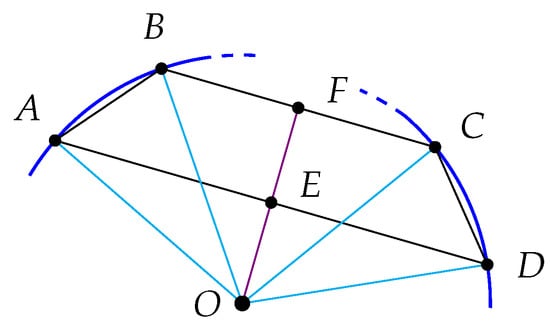
Figure 4.
An inscribed isosceles trapezoid.
Proposition 5.
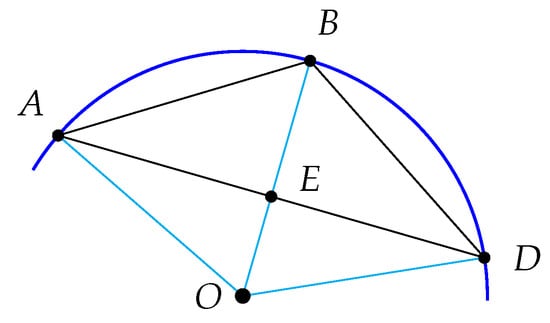
The quadrilateral (Figure 4) is an isosceles trapezoid and and are parallel. Furthermore, in the degenerate case (Figure 5) when B is equal to C, angles and are congruent and bisects .
Figure 5.
A degenerate inscribed isosceles trapezoid.
Refer to Figure 6. Suppose that is a clockwise ordered partition of an arc of and that has the same length as . Let , , and be lines tangent to that intersect A, B, C, and D respectively. Since is less than half of a circle, Lemma 1 implies that and intersect at a point , and intersect at a point , and intersect at a point , and and intersect at a point . The SAS and SSS theorems along with Proposition 5 and Lemma 1 imply Proposition 6, whose proof is left to the reader as a standard exercise.
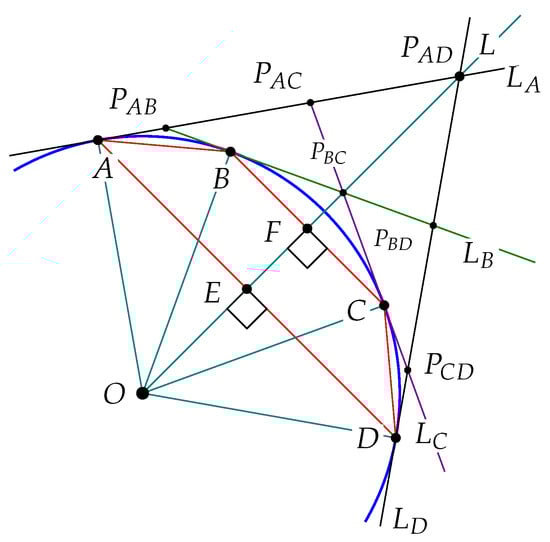
Figure 6.
An isosceles trapezoid that defines a segment of a circumscribed polygon.
Proposition 6.
The line segment can be extended to a ray, L, that meets O and bisects and is perpendicular to , , and . Furthermore, L bisects . Finally, triangles and are congruent, as are and .
Suppose that is an arc of that is less than half of and suppose that is a regular clockwise orientated partition with n greater than 3 (Figure 7). For each natural number i in , let be the line tangent to and intersecting . Since is less than half of a circle, Lemma 1 implies that the lines and intersect for each i not equal to j; call this point of intersection . Notice that is equal to . The key theorem of the next section is to prove that
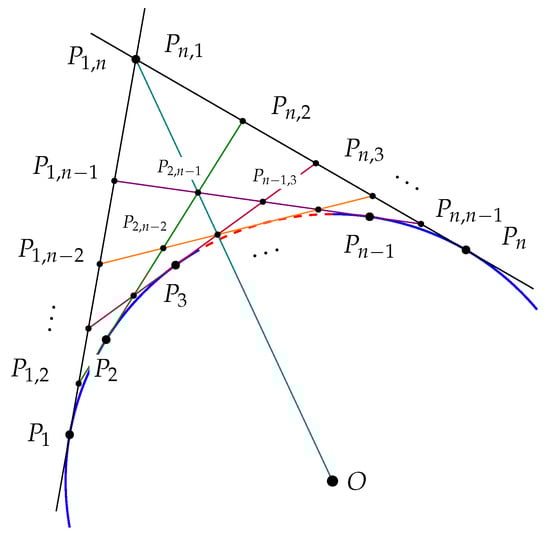
Figure 7.
Line segments defined by refinements of a circumscribed polygon.
Denote by the degree measure of . Refer to Figure 7 for Proposition 7.
Proposition 7.
Suppose that n is in and is a regular clockwise oriented partition of an arc that is less than half of . If is equal to , then
- (1)
- (2)
- ;
- (3)
- .
Proof.
Both and are right angles, implying that
Since is equal to , the fact that the sum of the interior angles of the quadrilateral formed by , , O and is implies (1). Since , and lie on the same line, and are supplementary. By (1),
and so
Of course, an analogous argument proves the same result for , implying (2), although another argument is not necessary in light of Proposition 6. Finally, since the sum of angles of a quadrilateral is , (3) follows from (1) and (2). □
3.2. Length Estimates for Inscribed Polygonal Segments
Let again be an arc of a unit circle that is less than half of the circle. Suppose that is a regular clockwise oriented partition of (Figure 8 and Figure 9). For each where i is a natural number in , there is a line perpendicular to that intersects at a point on .
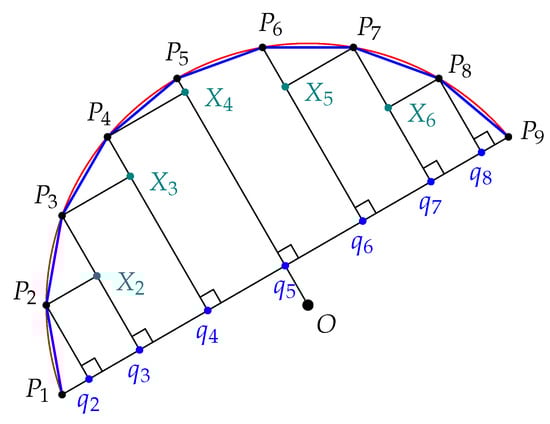
Figure 8.
Inscribed length estimates for an odd number of points on an arc.
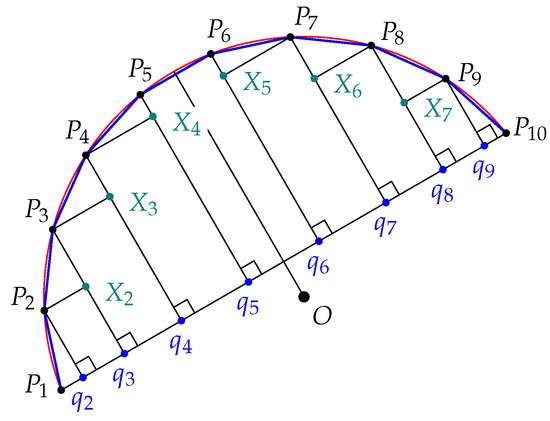
Figure 9.
Inscribed length estimates for an even number of points on an arc.
Figure 8 shows an example where n is even and Figure 9 shows the qualitative difference in an odd example. Set to be equal to and let be equal to . For each i between 1 and , let be the point on so that is perpendicular to .
Proposition 8.
If i and j are natural numbers in with i less than j, then
Proof.
Proposition 5 implies that each of the line segments is parallel to . Since and are perpendicular for i in ,
Let be equal to , and for each i in , let be the point of intersection of and . Let be equal to , and for each i in , let be the point of intersection of and . For each i in , Proposition 5 implies that is equal to , which is equal to and .
Let i and j be in with i less than j. To show that is less than , it suffices to show that if i and are in , then is less than . Extend the line segment to a ray, , originating at . Extend the line segment to a ray, , that meets at a point A. The ray passes through the point and is greater than , while angles and are congruent, implying that is greater than . Since and are both right triangles with hypotenuses that have the same length, is greater than , implying that is less than . Since i and j are integers, the statement of the proposition is different when n is odd and when n is even.
Note that if n is odd, then the above arguments show that is the longest of all of the segments . □
Since the lengths of the line segments are strictly increasing up to the midpoint of for even n and the middle segment for odd n, the following corollary is immediate.
Corollary 1.
Let k be the largest integer less than or equal to . If n is greater than 2 and s is a natural number in , then
Remark 2.
The above corollary implies that the average length of a segment of is less than the average length of a segment of if the arc between and is less than half of .
From this corollary follows the following key theorem.
Theorem 2.
Suppose that is an arc that is less than half of a circle and that is a regular clockwise oriented partition of . Denote by the length of the line segment , and by the length of . If m is less than n, then
Proof.
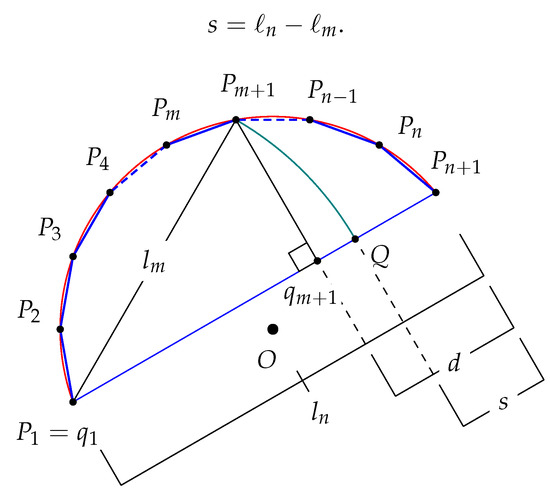
Assume first that is greater than n and refer to Figure 10. Let Q be the point of intersection of the circle of radius centered at with the line segment . The length of is equal to . If s the length of the line segment , then
Figure 10.
Lengths of chords subtending arcs with different numbers of congruent segments.
There are n edges with vertices on the arc between and . There are vertices of the regular subdivision between and on . Since is greater than n, lies clockwise from the intersection, M, of a line bisecting and the circle. For the same reason, the point lies counterclockwise from M.
Proposition 8 implies that the average lengths of the segments , , ..., is the same as the average lengths of the segments , . However, for any edge between the vertices and , the projection of the edge, on the line , is longer than the longest of the segments with j in . Denote by d the length of the line segment to obtain the inequality
Since is the length of the hypotenuse of a triangle with a leg of length and is equal to , the length s is less than d and so
Since, is equal to ,
Suppose that is equal to n. Since the sum of the lengths of two sides of a non-degenerate triangle are greater than the length of the third, is greater than , and so
In the case when is less than n, there is a natural number k with
which together with (6) implies that
The points and have segments between them as do the points and . Thus,
Therefore, is equal to the sum of the lengths of two sides of and so is greater than . Therefore,
The inequality
follows from applying the above argument more times. □
3.3. Length Estimates for Circumscribed Polygonal Segments
Use the notation of Proposition 7 and refer to Figure 11 for the statement and proof of the proposition below.
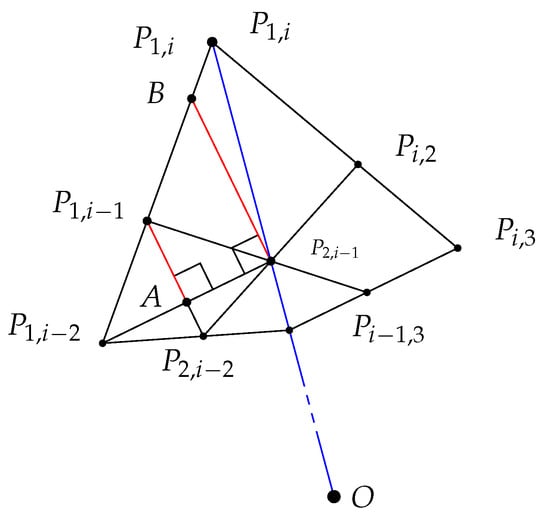
Figure 11.
The apex of the intersection of circumscribed edges and their refinements.
Proposition 9.
If k and l are natural numbers, then
Proof.
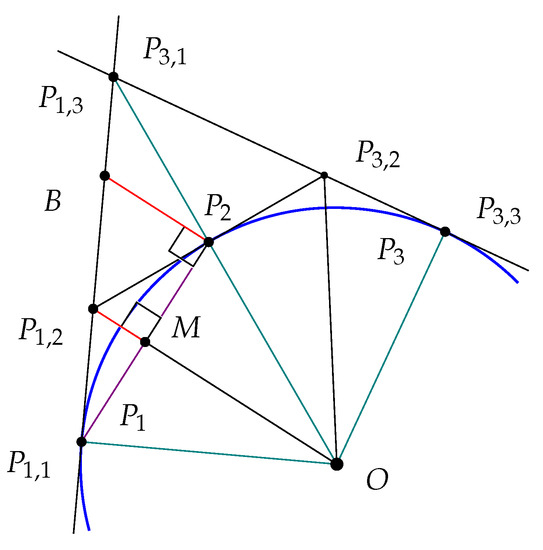
Suppose that i is a natural number in . Proposition 6 implies that the line is a perpendicular bisector of . Denote by A this intersection. To prove the proposition, it suffices to show that is greater than a right angle. In this case, there is a line that intersects and is perpendicular to that intersects at a point B. The triangles and are similar, but since is twice the length of , is twice the length of , and so
Proposition 6 implies the congruency of the angles and . Proposition 7 implies that
Proposition 6 implies that is perpendicular to and furthermore that bisects . Therefore, and are congruent. Proposition 7 implies that
Therefore, is equal to and so
Figure 12.
The intersection of circumscribed edges associated to an arc with two segments.
Proposition 6 implies that is tangent to , and hence perpendicular to . It suffices to show that does not equal 0. Since
has measure . Since the angles and are congruent, both have measure , which is greater than 0. □
Theorem 3.
Suppose that n is a natural number greater than two and is a regular clockwise orientated partition of an arc . If and respectively denote the length of the line segment and the length of the line segment , then
Proof.
The lengths of the segments are increasing in i, so the average length of a segment of is larger than the average length of a segment of . Therefore,
implying the desired result. □
4. Circumference and Area Are Intrinsic
Definition 4.
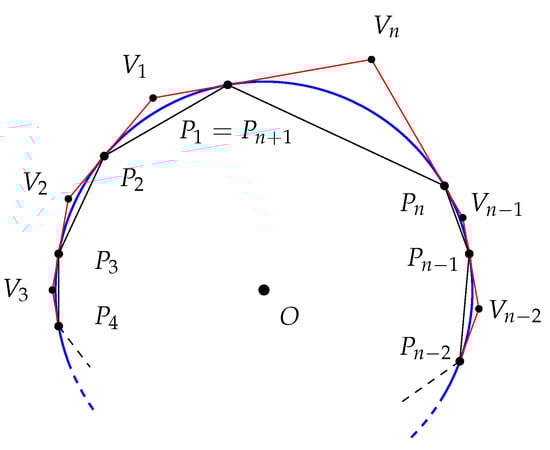
A circuit is a finite sequence of points on that is counterclockwise ordered and with the property that is equal to (see Figure 13).
Figure 13.
Inscribed and circumscribed polygons associated to a circuit.
Without loss in generality and in order to simplify the exposition, assume that the arc connecting adjacent points of a circuit is less than half of a circle.
Definition 5.
A refinement of a circuit is a circuit such that, as functions on finite sets, the range of is a subset of the range of .
Denote by the set of all circuits on . Suppose that is in . The inscribed polygon is the polygon whose vertices are the points in the circuit and the circumscribed polygon is the polygon whose vertices are the points given by the intersections of the lines tangent to at adjacent points of the circuit.
Definition 6.
For any polygon P, denote by the perimeter of P. Let denote the minimum edge length of and denote by the maximal edge length of .
4.1. Approximation by Rational Circuits
Let the length ℓ be less than 2. Construct recursively a sequence of points and a corresponding piecewise linear path in the following way. Take to be a point on . Let be the term in a sequence of points on so that if and are adjacent points in the sequence, then is equal to ℓ and the triangle is counterclockwise oriented. The circle of radius ℓ with center intersects in exactly two places. Let be the first of these points counterclockwise from . The line segment is of length ℓ. If the sequence has the property that for some k, is equal to , then ℓ is a rational length and there is a first such k that is the numerator of ℓ, denoted by . The closed piecewise linear path is the finite sequence of edges
Let be the line from the origin to the point . Denote by , the denominator of ℓ, the number of times the lines intersect the line segment , where i in . The denominator counts how many times wraps around the origin. A length ℓ is integral if is equal to 1, implying that ℓ is the edge length of a regular inscribed polygon. A circuit is said to be integral if all of its edge lengths are integral. A regular circuit is an integral circuit in which the distance between any two adjacent points in the circuit is the same. The counterclockwise ordered set of intersections of any circumscribed regular polygon with is a regular circuit. Furthermore, any regular circuit is the set of intersections of a regular circumscribed polygon with .
Proposition 10.
Let ℓ and m be rational lengths. Let L and M denote the edge lengths of circumscribed edges corresponding to the inscribed edges ℓ and m respectively. If m is less than ℓ, then
Remark 3.
If ℓ and m are integral lengths, then and are both equal to 1 and the proposition gives a comparison of the perimeters of the regular polygons of side lengths ℓ and m. In the rational but non-integral case, it is not reasonable to compare the lengths of the curves and because of the dissimilar wrapping of the curves and around the circle. Dividing the lengths of the above curves by their respective denominators gives a way to compare the average length of the curves on a single wrapping around the circle. It is this idea that will prove important in the next proposition.
Proof.
Since length is invariant under rotation, assume that both paths and start with the same initial point. All the points on the paths and are points on the regular polygon with sides containing the point . Since ℓ may be realized as the edge length of a straight line segment traversing segments of a regular -gon and m may be realized as the edge length of a straight line segment traversing segments of a regular -gon, ℓ may also be realized as the edge length of a straight line segment traversing segments of a regular -gon and m may also be realized as the edge length of a straight line segment traversing segments of a regular -gon. Since ℓ is larger than m,
By assumption, both lengths are less than a diameter. Theorem 2 therefore implies that
and this proves the proposition.
The case of circumscribed polygons is similar except that instead of comparing the lengths ℓ and m, compare the lengths L and M and appeal to Theorem 3 to obtain the reverse inequality. □
Proposition 11.
If and are two rational circuits, then
implies that
- (1)
- , and
- (2)
- .
Proof.
Denote by and the lengths
Abuse notation and denote again by and the respective segments of length and . There are k segments for and n segments for . Let be the shortest of the segments of and be the longest of the segments of . Take to be the product
and take copies of both polygons. Compute the respective perimeters of these polygons to obtain
The inequality follows from Theorem 2 since is the minimum length of the segments of . The ultimate equality follows from the fact that
To justify the last assertion, note that given copies of the polygon , the segments in all of these copies form a path that wraps around exactly times. However, this collection of polynomial contains copies of each segment ; hence, copies each path which wraps around exactly times. Summing each of these wrappings gives the total number of wrappings, , implying the above formula for the sum.
Similarly, use the reverse inequality and make use of Proposition 10 to obtain the inequality
Dividing both sides of the inequality by finishes the proof for inscribed polygons.
The proof of the result for circumscribed polygons is done in the same way but appeals to the appropriate inequality in Proposition 10, reversing the inequalities analogous to those given above. □
Definition 7.
Following Archimedes, define to be equal to (as defined in Proposition 3).
Denote by the set of all rational circuits on and suppose that is in . Denote the maximal edge length of , the mesh of , by .
Theorem 4.
For any positive real number ε there is a positive real number δ such that
Proof.
Let be a positive real number. Both and tend to as m tends to infinity, and so as long as is a large enough natural number,
Let be a rational circuit. Take to be a positive real number less than the side length of , so that the maximum possible side length of is less than the side length of and the maximum possible side length of is less than the edge length of . Since is less than , Proposition 11 implies that
Take to be a large enough natural number so that the edge length of is smaller than the smallest edge length of and the edge length of is smaller than the smallest edge length of . Such a choice of is possible because the side lengths of both and tend to zero as m tends to infinity. Proposition 11 implies that
Denote by the perimeter of a regular n-gon inscribed in and denote by the perimeter of a regular circumscribed n-gon.
Corollary 2
(Corollary to Proposition 11). If n is greater than m and m is greater than 2, then
Corollary 3
(Corollary to Theorem 4). For any natural numbers n and m larger than 2,
where the notation follows Proposition 3.
Remark 4.
The next section presents results somewhat more general than those of the above theorem. Until this point we have only used the convergence of bounded monotone sequences, the axioms of Euclidean geometry, and the properties of the natural numbers. In this next section, we use a cardinality argument to show that not all edge lengths are rational lengths, and so this section relies on a consideration that is highly unlikely to have been considered by a contemporary of Archimedes, but is necessary from a modern perspective.
4.2. Approximation by General Circuits
Each rational length corresponds to a pair of two integers, a numerator and a denominator, making the set of rational lengths a countably infinite set. However, there are uncountably many possible edge lengths and so this necessitates a study of circuits that are not necessarily rational.
Proposition 12.
Given any circuit and a positive real number ε, there is a rational circuit such that
Proof.
Suppose that a circuit has n distinct points and thus corresponds to a vertex set of an inscribed polygon with n sides. Let be a positive real number. There is a natural number m such that the edge length ℓ of is smaller than . Take to be a point of . To each point of , take to be if is a vertex of . Otherwise, take to be the first vertex of that is counterclockwise from . With such a choice of , the length is less than ℓ. The circuit that is equal to is a rational circuit. Furthermore, for each natural number i in ,
□
Corollary 4.
For any circuits and on ,
Proof.
Suppose that is the circuit and that is the circuit . Suppose further that is greater than . For any positive real number , there are rational circuits and such that
and furthermore such that
We leave the straightforward details of the proof to the reader. Proposition 12 implies that is greater than , and so
Since the above inequality holds for any positive , is greater than or equal to □
Given any two points on , there is an m large enough so that the arc between the two points contains two vertices of . The following lemma follows from this fact and the fact that rotations preserve the ordering of points on .
Lemma 2.
Given points P, Q, and R on in counterclockwise order, there is a point S between Q and R such that is a rational length.
Establish the following notation for the statements and proofs of Lemma 3 and Lemma 4. Suppose that A, B and C are points on in counterclockwise order and the arc from A to C is less than half of . For any points X and Y on , denote by the intersection of the lines tangent to at X and Y (Figure 14 ).
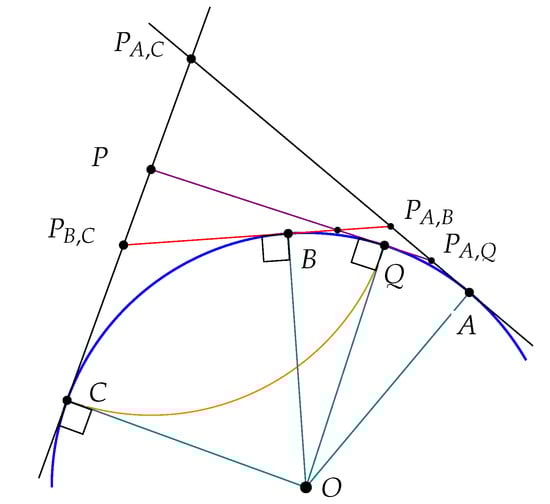
Figure 14.
An order preserving bijection.
Lemma 3.
There is an order preserving bijection from the points on the line segment and the points on the arc between B and C.
Proof.
Suppose P is a point on . Let be the circle of radius centered at P. The circle intersects at precisely two points, at the point C and at a point Q that lies on the arc from A to B. Define the circles and in the same way as . The circles , , and all intersect at C, and since they have different radii, they can meet at no more than two points. Since is tangent to all three circles, the three circles meet only at C. The radius of is greater than the radius of , which is greater than the radius of , therefore
Since all three points lie counterclockwise from A on an arc less that half of a circle, Q is clockwise from B and counterclockwise from A.
Suppose that Q is a point between A and B on the arc from A to B, that B is clockwise from C, and that the arc from A to C is less than half of a circle. Let L be the line tangent to at Q. Since is less than a straight line, L intersects the line tangent to at C at a point P and the intersection occurs on the same side of C as and . The point Q is between A and B, and so
The line segments , , and are all radii, implying the equality of , , and , and therefore, the inequalities
The point P therefore lies on the line segment . Note that Lemma 1 implies that and are congruent and so the map we initially constructed will map P to the point Q.
Let be the map taking points on to points on the arc from A to B and let be the map taking points on the arc from A and B to point on . These functions are inverses of each other, and so both are invertible, and hence bijective. □
Lemma 4.
Let ε be a positive real number. There is a Q on the arc from A to B such that Q is not equal to B and
Furthermore, any point on the arc from Q to B will also satisfy the above estimate where Q is replaced by .
Proof.
Pick a point z on such that is less than . Lemma 3 guarantees the existence of a point Z on the arc between A and B such that z is the point of intersection of the line tangent to at Z and the line segment . Pick a point q on such that is less than . Lemma 3 guarantees the existence of a point Q on the arc from Z to B such that q is the point of intersection of the line tangent to at Q and the line segment . Using the established notation, q is the point , and furthermore, Q will satisfy the estimate (10). Since the bijection given in Lemma 3 is order preserving, if is any point not equal to B in the arc from Q to B, then the point will also satisfy the estimate (10). □
Proposition 13.
Suppose that is a circuit with the property that the arc between any adjacent points is less than a fourth of a circle. Suppose ε is a positive real number. There is a rational circuit such that
Proof.
Set equal to . Suppose that is a sequence of points where each lies on the arc between and , each lies on the same regular polygon, each edge is less than a quarter of the circle, and
Lemma 4 implies that there is a not equal to but on the arc between and such that for any Q on the arc between and ,
Take Q to be a vertex of a regular polygon on which through lie by choosing the regular polygon to be a sufficiently fine refinement of the regular polygon on which through are vertices. Recursively construct in this way a polygon , with and both equal to , which approximates in the sense that
□
Corollary 5.
If and are two arbitrary sequences of points on C then
implies that
Proof.
The above corollary is proved exactly as the first corollary to Proposition 12 is proved above except that the inequalities are reversed because they are reversed in Proposition 11. □
Theorem 5.
Suppose that is a general partition of . For any positive real number ε there is a positive real number δ such that
Proof.
The theorem is proved in the same way as Theorem 4 but by appealing to Proposition 11 and the corollary to Proposition 13 rather than Proposition 11 and the corollary to Proposition 12. □
Let be a general partition of . Denote by the area of the inscribed polygon and the area of the circumscribed polygon .
Theorem 6.
For any positive real number ε there is a positive real number δ such that
Proof.
Let be a positive real number. Theorem 5 implies that there is a positive real number so that if is a circuit with mesh less than , then
Denote by the length of the segment . Heron’s Theorem implies that
For each i,
Since the sum of all of the ’s is the perimeter of an inscribed polygon and therefore less than , the bound on implies that
This proves the theorem. □
5. Application to the Circular Trigonometric Functions
5.1. Arclength of an Arc and Area of a Sector
Suppose that A and B are points on and that is the counterclockwise oriented arc from A to B. If the length is a rational length, then for some natural number m, there is a regular inscribed n-gon such that has on it exactly vertices of and both A and B are vertices of . Denote by the edge length of to obtain the equality
The inscribed polygon will have vertices on . Denote by the approximation of the arc length of given by
This approximation of the length of an arc of depends only on the fraction of that represents and so defines the length of an arc for any arc whose endpoints form a rational length. Define similarly the area of a sector of , the area bounded by the lines and and the counterclockwise oriented arc , so that
If the length is not a rational length, then there is a sequence of rational lengths that approximate it. In particular, take A to be a point on for some n where n is a large enough natural number so that at least one vertex of lies on between A and B. For each m, choose the vertex of that is closest to B. The counterclockwise oriented arc from A to will have rational length and will be a fraction of a circle, where is an increasing bounded above sequence with
where is an irrational number. m tends to infinity the limits
where the limits are independent of the sequence that approximates B.
Using the notation above and given any counterclockwise arc from a point X on to a point Y on , define the angle measure by
The length is the length of the arc . The area, , of the sector bounded by , , and the counterclockwise oriented arc is given by
5.2. Limit of the Sine Function
The argument frequently given by authors of calculus texts for calculating the limit (1) is perfectly valid, although it does require some explanation since we have not yet introduced a coordinate system nor defined the trigonometric functions. View the unit circle as the subset of the plane given by
Define the trigonometric functions, as is customary, as functions of the argument in , so that the point is the point on the unit circle so that the counterclockwise oriented arc from to has length . The area of the sector defined by is . Take to be less that . Bound the area of the sector above and below respectively by the areas of the triangles
to obtain the inequality
Take limits and use the sandwich theorem to obtain the limit (1) as a one-sided limit. If is a point in the first quadrant so that the signed length of the arc from to is , then define the signed length of the arc from to to be . Given this signed argument, the sine function is an odd function of and the cosine function is even. Extending the definitions of the trigonometric functions in this way to negative signed arc lengths permits the limit (1) to be viewed as a two sided limit and the oddness of the sine function implies this two sided limit. While this is a standard approach to calculating the limit in many calculus texts—[10], for example—the approach is non-rigorous because these texts omit a discussion of the equivalence of defined as half the circumference of a unit circle and as the area of a unit circle, and so as well the relationship between the length of an arc and the area of the sector that the arc defines. Our current discussion closely follows Archimedes and remedies this shortcoming.
Funding
This research received no external funding.
Acknowledgments
I thank V.S. Varadarajan for the insights and suggestions he gave me during our many discussions involving this paper. From him I learned to love, among many things, the history of our subject, and so I dedicate this paper to his memory. I thank Alexander Henderson for his helpful comments.
Conflicts of Interest
The author declares no conflict of interest.
References
- Heath, T.L. The Works of Archimedes; Dover: New York, NY, USA, 1953. [Google Scholar]
- Gearhart, W.B.; Shultz, H.S. The function . Coll. Math. J. 1990, 21, 90–99. [Google Scholar]
- Unger, P. Calculus and Analytic Geometry by Howard Anton. Rev. Am. Math. Mon. 1986, 93, 221–230. [Google Scholar] [CrossRef]
- Richman, F. A circular argument. Coll. Math. J. 1993, 24, 160–162. [Google Scholar] [CrossRef]
- Apostol, T.M. Calculus; Blaisdell: Waltham, MA, USA, 1967. [Google Scholar]
- Cipra, B.A. The derivatives of the sine and cosine functions. Coll. Math. J. 1987, 18, 139–141. [Google Scholar] [CrossRef]
- Vietoris, L. Vom Grenzwert lim sin x. Elem. Math. 1957, 12, 8–10. [Google Scholar]
- Zeisel, H. and the definition of π. arXiv 2013, arXiv:1302.1167Z. [Google Scholar]
- Apostol, T.M.; Mnatsakanian, M.A. Figures Circumscribing Circles. Am. Math. Mon. 2004, 111, 853–863. [Google Scholar] [CrossRef]
- Stewart, J. Calculus, 6th ed.; Brooks Cole: Pacific Grove, CA, USA, 2007. [Google Scholar]
Publisher’s Note: MDPI stays neutral with regard to jurisdictional claims in published maps and institutional affiliations. |
© 2020 by the author. Licensee MDPI, Basel, Switzerland. This article is an open access article distributed under the terms and conditions of the Creative Commons Attribution (CC BY) license (http://creativecommons.org/licenses/by/4.0/).