Abstract
In this article, we investigate the fundamental properties of coalgebras with coalgebra comultiplications, counits, and coalgebra homomorphisms of coalgebras over a commutative ring R with identity based on digital images with adjacency relations. We also investigate a contravariant functor from the category of digital images and digital continuous functions to the category of coalgebras and coalgebra homomorphisms based on digital images via the category of unitary R-modules and R-module homomorphisms.
Keywords:
digital image; digital (co)homology module; coalgebra; coalgebra comultiplication; coalgebra counit MSC:
Primary 55N20; Secondary 68U03; 16W60; 68U05
1. Introduction
1.1. Associative Algebra and Its Dual, Coalgebra
An associative algebra is an algebraic structure with compatible operations of additions, associative multiplications and scalar multiplications by elements in a module or a field. A counital coalgebra is one of the dual notions of the unital associative algebras; see [1] [page 197] and [2] [page 803]. Historically, coalgebras occur as the dual of algebras in [3,4] in the category theoretic approach to dynamical systems and automata. An automaton as a coalgebra was nicely presented and an early proof that the set of formal languages is a final coalgebra was described in [5]. A bisimulation as a notion of behavioural equivalence for concurrent processes and a notion of strong extensionality for the theory of non-well-founded sets were invented in [6,7,8]. The notion of bisimulation was generalized to the level of arbitrary coalgebras in [9]. As a consequence, coalgebra is one of the nice ingredients from mathematics and becomes an extensive field of research.
The axioms of unital associative algebras can be formulated in terms of commutative diagrams in the category-theoretic sense of reversing arrows. In general, it is well known that a coalgebra structure gives rise to an algebra structure. Classically, a coalgebra appears naturally in combinatorics, algebra, and algebraic topology as describing ways one can decompose objects into other objects of the same type. Moreover, a coalgebra occurs naturally in a number of contexts such as a universal enveloping algebra and a group scheme. There are also F-coalgebra structures with important applications in computer science; see [10,11].
One of the classical cohomology algebras is the singular (or simplicial) cohomology algebra whose multiplication is the usual cup product, and its unit is induced from the unique continuous function from a topological space to a one-point space. A graded singular homology module of a Hopf space becomes a graded algebra with a unit element. Moreover, it is well known that, if the homology modules of a Hopf space is free of a finite type, then it is a commutative and associative Hopf algebra over a principal ideal domain, and that the singular homology of a topological space with coefficients in a field has naturally the coalgebra structure whose coalgebra comultiplication and counit are induced by the diagonal map via the Künneth formula and by the unique continuous function from the topological space to a one-point space, respectively, as in the case of cohomology.
1.2. Homotopical Viewpoint for a Dual
In classical (or rational) homotopy theory, it is well known that the notion of a (pointed) Hopf space [12,13,14] is one of the Eckmann–Hilton dual concepts of a (pointed) co-Hopf space. Co-Hopf spaces were introduced in [15] and were used to determine whether a pointed CW-space has the same homotopy type of the suspension of another pointed CW-space or not [16] [Theorem A]; see also [17]. The second author has developed the structures of a wedge of (localized) spheres as the co-Hopf spaces with various homotopy comultiplications [18,19,20,21,22,23], and the suspension structure with the standard comultiplication in the sense of same homotopy n-types [24,25,26,27,28]; see also [29,30] for the topics which are related to the fundamental concepts of those CW-spaces, and [31] for the equivariant homotopy theoretic point of view with the behavior of the local cohomology spectral sequence.
1.3. Previous Results and Motivation
In the category of topological spaces and continuous maps, a pair consisting of a space Z and a function is said to be a co-H-space if
where are the first and second projections, respectively, and is the identity map on Z. In this case, is called a topological comultiplication on the space Z.
Let be the Quillen model of a rational co-Hopf space Z, i.e., a wedge of rational spheres up to homotopy, and let be the Quillen model of . Then, there exists a bijection of sets between the set of all homotopy classes of topological comultiplications and the set of all homomorphisms such that
where are the first and second projections; see [32] [Lemma 2.2].
Motivated from the above statements, we raise the following query: Are there any kinds of coalgebra structures based on a digital image to develop its fundamental properties in itself? To give an answer to this query, we try to investigate an R-module homomorphism
of digital cohomology modules based on a -connected digital image corresponding to the standard homomorphism and to the standard topological comultiplication via the bijection above. We can thus construct an R-coalgebra with an R-coalgebra comultiplication and an R-coalgebra counit. The coalgebra structure in this paper induces a familiar mathematical structure which is originated from a connected digital image, and offers a method for how to construct the standard coalgebra as the practical links between the algebraic approach and the analysis of digital images.
1.4. Digital Images and Our Goals
Digital topological spaces and digital images are highly related to combinatorial topology and computer science, and it mostly deals with the two-dimensional or three-dimensional digital images. Digital topology was first studied in the late 1960s by A. Rosenfeld, and digital surfaces (or digital manifolds) were also developed in the early 1980s and in 1990s by many authors. In particular, the formal and informal definitions of a lot of terms in homotopy and simplicial (co)homology theory based on a digital image on or with adjacency relations were nicely described in [33,34,35,36,37,38]; see also [22] for digital quasi co-Hopf space, and [39,40] for digital cohomology modules and cone metric spaces.
We need to develop another theory to study digital topological spaces (or digital images) out of classical cohomology theory and digital counterparts of those ideas in classical homology and cohomology theories. In the current paper, we study another consideration of the so-called algebraic approach from the classical cohomology groups. In fact, the current study deals with coalgebras, coalgebra comultiplications, counits, and coalgebra homomorphisms of coalgebras over a commutative ring R with identity based on digital images with adjacency relations. The functorial properties as one of the digital counterparts to classical cohomology theory originated from the algebraic invariants and their important properties of cohomology modules in classical cohomology theory will be discussed.
1.5. Organization
This paper is organized as follows: in Section 2, we briefly review the basic definitions of digital images with adjacency relations and digital continuous functions. We also examine the digital homology and cohomology modules over a commutative ring R with identity based on digital images with some adjacency relations. In Section 3, we consider coalgebras, coalgebra comultiplications, counits, and coalgebra homomorphisms of coalgebras over a commutative ring R with identity on digital images with adjacency relations, and find out the relationships between the category of digital images and digital continuous functions, the category of digital cohomology R-modules and R-module homomorphisms of digital cohomology R-modules, and the category of coalgebras and coalgebra homomorphisms based on digital images induced by the digital continuous functions between them.
2. Digital Images and Digital (Co)homology Modules
Let be the set of all integers, and let For a positive integer u with , we define an adjacency relation in as follows:
Definition 1
([41]). Two different points and in are said to be -adjacent if
- there are at most u distinct indices i with the property; and
- for each positive integer, if, then.
Example 1
([39]).
- (1)
- The set of-adjacent points of 0 inis the set consisting ofand 1.
- (2)
- The set of-adjacent points ofinis the set consisting of,,and.
- (3)
- The set of-adjacent points ofinis the set consisting of,,,,,,, and.
We mostly denote a -adjacency relation on a digital image X (see below) by the -adjacency relation for short unless we specifically state otherwise.
A digital image consists of a bounded and finite subset X of and an adjacency relation on X. A digital image in is said to be -connected ([42,43]) if, for each set consisting of two distinct points x and y, there exists a subset
consisting of distinct points such that
- ;
- ; and
- and are -adjacent for .
Definition 2
([44]). A function
of digital images and with -adjacency and -adjacency relations, respectively, is said to be a -continuous function if the image of any -connected subset of the digital image under the function f is a -connected subset of ; see also [43] [Definition 2.3].
Remark 1
([39]). We note that if , and are digital images and if
is a -continuous function and
is a -continuous function, then it can be shown that the composite
is also a -continuous function. Therefore, it is possible for us to consider the category of k-connected digital images and digital continuous functions; that is, the object classes of are k-connected digital images and the morphism classes are digital continuous functions.
Let , , …, and be elements of , and let
be the digital image in with the -adjacency relation. It can be seen that it is a -connected digital image.
Let R be a commutative ring with identity and let be a digital image with a -adjacency relation. For each , we denote as the non-negatively graded free R-module with a basis consisting of all -continuous functions
and define the so-called digital boundary operator
by
where is the i-th face function; see [45,46] for more details. It can be shown that
for all , and thus is automatically an R-submodule of for each . The n-th digital homology module over R of a digital image with a -adjacency relation is defined by
for each [45]; see also [36,47].
Definition 3
([39]). The n-th digital cohomology module over R of a digital image is defined to be the corresponding cohomology module over a commutative ring R with identity of the cochain complex obtained by the dual R-modules along with the dual R-module homomorphisms, i.e.,
for all , where
is the so-called digital coboundary operator which is the dual of the digital boundary operator for each .
It can be seen in [39] that, for each digital image , has the R-module structure whose scalar multiplication
is given by
where
- ;
- with ; and
- the second and third bullets ‘•’ in (16) are the scalar multiplications on as an R-submodule of .
Indeed, as a quotient R-module, has the unitary R-module structure because R is a commutative ring with identity; see [39] [Theorem 1] for further details.
Let A and B be R-modules. A function is said to be an R-module homomorphism if
- ; and
- ,
for all and , where
- is the binary operation on A;
- is the binary operation on B;
- the first bullet is the scalar multiplication on A; and
- the second bullet is the scalar multiplication on B.
Remark 2.
Letbe the category of digital images and digital continuous functions as mentioned earlier in Remark 1, and letbe the category of unitary R-modules and R-module homomorphisms. Then, it can be seen in [39] [Theorem 1] that the assignment
given by
is a contravariant functor for each.
3. Coalgebras, Counits, and Coalgebra Homomorphisms
In this section, two digital images and are always -connected and -connected digital images, respectively, so that the 0-th digital cohomology modules of the digital images are just the coefficient rings; that is,
Recall that a triple consisting of an R-module C and R-module homomorphisms
and
is said to be a coalgebra over a ring R (or an R-coalgebra) if the following diagrams
and
are strictly commutative. Here,
- is the identity automorphism;
- given by is an R-module isomorphism; and
- given by is an R-module isomorphism,
where the bullet multiplications above are coming from the right and left R-module structures on C with scalar multiplications
and
respectively. The above R-module homomorphism
is said to be an R-coalgebra comultiplication on C, and the R-module homomorphism
is said to be an R-coalgebra counit.
A pointed digital Hopf space consists of a pointed digital image with an adjacency relation and a -continuous function which is called a digital homotopy multiplication (or digital multiplication for short) such that the following diagrams
and
commutate up to pointed digital homotopy, where is the diagonal function; see [48,49] for more details.
Let and be pointed digital Hopf spaces with digital multiplications and , respectively. A base point preserving -continuous function is said to be a digital Hopf function (compare with [50,51]) if and are pointed digital -homotopic in .
It can be shown that, if is a pointed digital Hopf space with digital multiplication , then the digital multiplication provides the graded digital cohomology module with the structure of coalgebra over the commutative ring R with identity .
Remark 3.
For a path connected Hopf space Y with a multiplication , it can be seen that the diagonal map and the multiplication induce homomorphisms of classical homology and cohomology modules as follows:
- ;
- ;
- ; and
- ,
where
- ;
- ;
- × is the homology and cohomology cross products; and
- the homology and cohomology modules are free modules of finite ranks.
It is well known in algebraic topology that has the structure of an R-algebra with , and has the structure of an R-coalgebra with . Similarly, the algebraic structure arising from the diagonal map has the coalgebra structure on homology and the algebra structure on cohomology together with the Künneth formula; see [52,53].
Let be the set of all R-coalgebra comultiplications on an R-coalgebra C and let be its cardinality. In general, there exist (infinitely) many types of R-algebra comultiplications on an R-coalgebra C; that is, .
We now focus on the development of an R-coalgebra based on a -connected digital image . To do so, we define one of the R-coalgebra comultiplications on the direct sum of digital cohomology modules to construct the R-coalgebra structure on it as follows.
Definition 4.
Let be any -connected digital image. Then, we define an R-module homomorphism
by
for all , where is the identity element of the ground ring
corresponding to the unique element of ; that is,
Indeed, by Remark 3, we can show that ‘’ preserves the scalar multiplication and the addition as follows:
for all and and
for all and and this is similar for the 0-dimensional digital cohomology case. Moreover, we can show that the R-module homomorphism is indeed an R-coalgebra comultiplication; that is, ; see Theorem 1 below.
Remark 4.
We can also define another R-module homomorphism
by
for all. The R-module homomorphism ψ is sometimes called a diagonal or coproduct in the sense of Hatcher [53] [page 283].
Let be the diagonal map. In classical homology and cohomology theories, an element z of is said to be a primitive homology class if
in . Similarly, if Y is a connected Hopf space with multiplication , then an element y of is said to be a primitive cohomology class if
in . We note that the element in Definition 4 looks like a primitive cohomology class.
Moreover, it can be seen that the R-module homomorphisms in Definition 4 and in Remark 4 are completely different from any types of the above homomorphisms on homology and on cohomology induced by the diagonal map on a topological space Y (or even a digital image .
Definition 5.
We define an R-module homomorphism
by
for.
Similarly, we have
and
for all and , where ⋄ is the ring multiplication on R. By extending the linearity, we can see that ‘’ preserves the addition.
Convention. From now on, we make use of the notation to denote the direct sum of digital cohomology modules; that is, .
We now have the following.
Theorem 1.
Letbe a-connected digital image, and let
and
be the R-module homomorphisms in Definitions 4 and 5, respectively. Then, the triple
is an R-coalgebra.
Proof.
If , then we also obtain
for all , where
is the scalar multiplication on a left unitary R-module . The above Equation (49) shows that the triangle on the right-hand side of (23) is commutative. Similarly, we have
for all , where
is the scalar multiplication on a right unitary R-module which is equal to the scalar multiplication on as a left unitary R-module in (50) by defining
If , then we have
and
Indeed, it is possible for us to do so because the ground ring R is commutative. The above Equations (49), (51), (54), and (55) show that the two triangles in (23) are strictly commutative, as required. □
We now give an example of the digital cohomology modules of some digital images, and then present another example of an R-coalgebra based on the same digital images as follows.
Example 2.
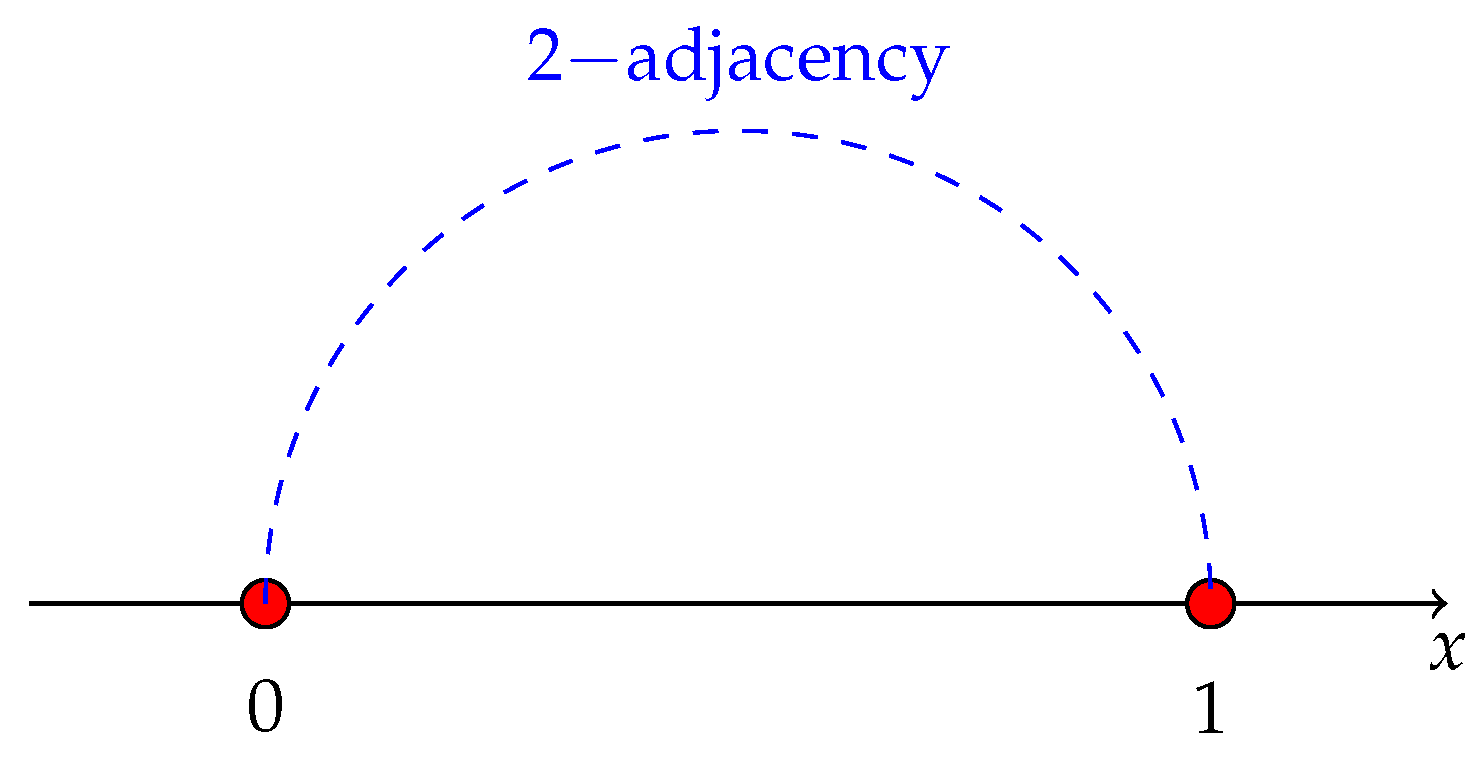
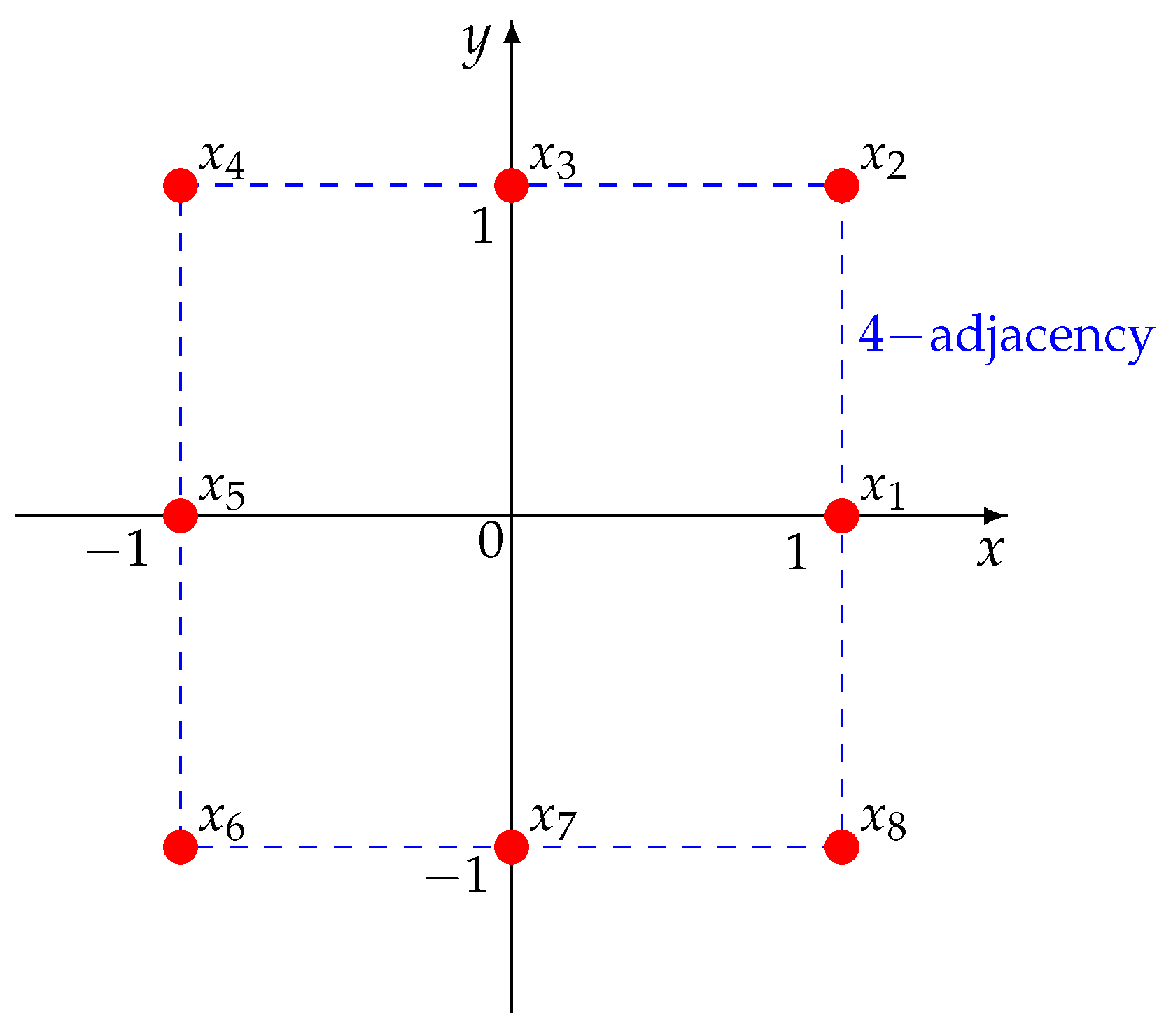
Letandbe digital images inandwith 2-adjacency and 4-adjacency relations, respectively, where,,; see Figure 1 and Figure 2. Then, it can be shown that X and Y are 2-connected and 4-connected digital images, respectively. Moreover, we have
and
We note that
because there are no digital coboundaries in dimension 0; that is, the module of digital 0-coboundaries inis trivial.
Figure 1.
A digital image X with the 2-adjacency relation along with the dotted curve.
Figure 2.
A digital image Y with the 4-adjacency relation along with the 8-dotted lines.
Example 3.
Letandbe digital images inwith 2-adjacency and 4-adjacency relations, respectively, in Example 2. We consider an R-coalgebra comultiplication
given by
for allin Definition 4. We also define an R-coalgebra counit
to be the Formula (43) in Definition 5. Therefore, it can be seen that the triple
has the R-coalgebra structure, and similarly for the digital image, where.
Definition 6.
Letandbe coalgebras over a commutative ring R with identity. An R-module homomorphism
is said to be an R-coalgebra homomorphism if the following diagrams
and
are strictly commutative.
For digital images and , we let
and
be R-coalgebra comultiplications on and , respectively. Let
and
be R-coalgebra counits on and , respectively.
We note that if
is a -continuous function and if
is a -continuous function, then it can be shown that
is a -continuous function. Therefore, by using the linear property, we have an R-module homomorphism of R-modules
defined by
where is an element of the commutative ring R with identity, and the bullets • are the scalar multiplications on the R-modules and with the same notation.
Let
be a -continuous function between digital images. Then, we define a map
by
for every ; that is, the following triangle
is strictly commutative, where is the ring of integers.
Lemma 1.
Let
be a-continuous function. Then, the map
given by
is an R-module homomorphism, where
and y is an element of the kernel of
Proof.
See [39] [Lemma 2] for further details. □
Theorem 2.
Let
be a-continuous function between digital images. Then, the homomorphism
induced by f is an R-coalgebra homomorphism.
Proof.
It can be shown in [39] [Lemma 2] that
is an R-module homomorphism; that is, preserves the scalar multiplication and the addition as follows:
and
all and .
If , then we have
for all .
If , then we obtain
where
is the identity automorphism on R.
For the R-coalgebra counits, if , then we have
for all . Similarly, if , then
where
is the identity automorphism on R, as required. □
Example 4.
Letandbe digital images inandwith 2-adjacency and 4-adjacency relations, respectively, in Example 2. Let
be any-continuous function between digital images. Then, it can seen that the map
is an R-coalgebra homomorphism.
Indeed, if , then, by Example 2, we obtain
for any element of . If , then
Similarly, we have
as required.
Let , and be coalgebras over a commutative ring R with identity . If
and
are R-coalgebra homomorphisms, then it can be shown that
is also an R-coalgebra homomorphism. Therefore, we can consider the category of R-coalgebras and R-coalgebra homomorphisms of R-coalgebras; that is, the class of objects of the category consists of R-coalgebras and the class of morphisms of consists of R-coalgebra homomorphisms of R-coalgebras.
Corollary 1.
For each object classin, the assignment
given by
is a contravariant functor.
Proof.
Let be any -continuous function. Then, by applying the contravariant functor
we have an R-module homomorphism [39] [Theorem 1]
Let
be the covariant functor assigning to each unitary R-module the R-coalgebra . Then, by using Theorems 1 and 2, we have an R-coalgebra homomorphism
by putting the R-coalgebra comultiplications and the R-coalgebra counits into the digital cohomology modules (with the same notation ), where
and
Therefore, it can be shown that, if
is the identity function on any digital image , and if
and
are morphism classes in ; that is, -continuous and -continuous functions, respectively, then we have
which is the identity morphism on as the unique morphism class of , and
as required. □
Remark 5.
Let
be the covariant functor assigning to each unitary R-modulethe R-coalgebraas described in the proof of Corollary 1, and let
be the forgetful functor, which assigns to each R-coalgebraits underlying unitary R-module(forgetting the R-coalgebra comultiplication and the R-coalgebra counit). Then, it can be shown that the following triangle
is commutative as natural transformations; that is,
- ;
- ; and
of (covariant or contravariant) functors.
4. Conclusions and Applications
In applied mathematics or computer science, digital topology deals with features and properties of digital images in , especially, the two-dimensional or three-dimensional digital images corresponding to the topological features and properties of object classes. In mathematics, coalgebras have the structures that are dual to unital associative algebras in the sense of category theory by reversing objects and arrows as objects classes and morphism classes, respectively.
In this paper, we have investigated some fundamental properties of the coalgebras, coalgebra comultiplications, counits, and coalgebra homomorphisms of coalgebras based on digital images with some adjacency relations. We have explored the functorial properties as one of the digital counterparts to classical cohomology theory originated from the algebraic invariants and their important properties of cohomology modules in classical cohomology theory. We have also developed the relationship between the category of digital images and digital continuous functions, the category of digital cohomology R-modules and R-module homomorphisms of digital cohomology R-modules, and the category of R-coalgebras and R-coalgebra homomorphisms induced by the digital continuous functions.
We have also constructed an R-module homomorphism of digital cohomology modules based on a -connected digital image as an R-coalgebra comultiplication to give the R-coalgebra structure on it. We do hope that our results will be applied to the world of Lie algebras and rational homotopy theory to develop the Lie algebra comultiplications based on graded vector spaces.
Author Contributions
The authors claim to have contributed equally in this article: Conceptualization, D.-W.L.; methodology, S.L.; validation, D.-W.L.; formal analysis, S.L.; investigation, D.-W.L.; writing—original draft preparation, D.-W.L. and S.L.; writing—review and editing, D.-W.L. and S.L.; supervision, D.-W.L.; funding acquisition, D.-W.L. All authors have read and agreed to the published version of the manuscript.
Funding
This work was supported by the National Research Foundation of Korea (NRF) grant funded by the Korean government (MSIT) (No. 2018R1A2B6004407).
Conflicts of Interest
The authors declare no conflict of interest.
References
- MacLane, S. Homology; Reprint of the first edition, Die Grundlehren der mathematischen Wissenschaften, Band 114; Springer: Berlin/Heidelberg, Germany; New York, NY, USA, 1967. [Google Scholar]
- Strom, J. Modern Classical Homotopy Theory; Graduate Studies in Mathematics, 127; American Mathematical Society: Providence, RI, USA, 2011. [Google Scholar]
- Arbib, M.A.; Manes, E.G. Adjoint machines, state-behavior machines, and duality. J. Pure Appl. Algebra 1975, 6, 313–344. [Google Scholar] [CrossRef]
- Arbib, M.A.; Manes, E.G. Parametrized data types do not need highly constrained parameters. Inform. Control 1982, 52, 139–158. [Google Scholar] [CrossRef][Green Version]
- Manes, E.G.; Arbib, M.A. Algebraic Approaches to Program Semantics; Texts and Monographs in Computer Science, AKM Series in Theoretical Computer Science; Springer: New York, NY, USA, 1986. [Google Scholar]
- Milner, R. A Calculus of Communicating Systems; Lecture Notes in Computer Science, 92; Springer: Berlin/Heidelberg, Germany; New York, NY, USA, 1980. [Google Scholar]
- Park, D.M.R. Concurrency and automata on infinite sequences. Theor. Comput. Sci. 1981, 104, 167–183. [Google Scholar]
- Aczel, P. Non-Well-Founded Sets; Number 14 in CSLI Lecture Notes; Center for the Study of Languages and Information: Stanford, CA, USA, 1988. [Google Scholar]
- Aczel, P.; Mendler, N. A final coalgebra theorem. Categ. Theory Comput. Sci. 1989, 389, 357–365. [Google Scholar]
- Rutten, J.J.M.M. Universal coalgebra: A theory of systems. Theoret. Comput. Sci. 2000, 249, 3–80. [Google Scholar] [CrossRef]
- Jacobs, B. Introduction to Coalgebra. Towards Mathematics of States and Observation; Cambridge Tracts in Theoretical Computer Science, 59; Cambridge University Press: Cambridge, UK, 2017. [Google Scholar]
- James, I.M. On H-spaces and their homotopy groups. Quart. J. Math. 1960, 11, 161–179. [Google Scholar] [CrossRef]
- Arkowitz, M.; Curjel, C.R. On maps of H-spaces. Topology 1967, 6, 137–148. [Google Scholar] [CrossRef][Green Version]
- Arkowitz, M.; Lupton, G. Loop-theoretic properties of H-spaces. Math. Proc. Camb. Philos. Soc. 1991, 110, 121–136. [Google Scholar] [CrossRef]
- Hilton, P. Homotopy Theory and Duality; Gordon and Breach Science Publishers: New York, NY, USA; London, UK; Paris, France, 1965. [Google Scholar]
- Berstein, I.; Hilton, P.J. On suspensions and comultiplications. Topology 1963, 2, 73–82. [Google Scholar] [CrossRef]
- Ganea, T. Cogroups and suspensions. Invent. Math. 1970, 9, 185–197. [Google Scholar] [CrossRef]
- Lee, D.-W. Phantom maps and the Gray index. Topol. Appl. 2004, 138, 265–275. [Google Scholar] [CrossRef]
- Arkowitz, M.; Lee, D.-W. Properties of comultiplications on a wedge of spheres. Topol. Appl. 2010, 157, 1607–1621. [Google Scholar] [CrossRef]
- Arkowitz, M.; Lee, D.-W. Comultiplications on a wedge of two spheres. Sci. China Math. 2011, 54, 9–22. [Google Scholar] [CrossRef]
- Lee, D.-W. Comultiplication structures for a wedge of spheres. Filomat 2016, 30, 3525–3546. [Google Scholar] [CrossRef]
- Lee, D.-W. On the digitally quasi comultiplications of digital images. Filomat 2017, 31, 1875–1892. [Google Scholar] [CrossRef]
- Lee, D.-W. Comultiplications on the localized spheres and Moore spaces. Mathematics 2020, 8, 86. [Google Scholar] [CrossRef]
- Lee, D.-W. On the same n-type conjecture for the suspension of the infinite complex projective space. Proc. Am. Math. Soc. 2009, 137, 1161–1168. [Google Scholar] [CrossRef]
- Lee, D.-W. On the same n-type structure for the suspension of the Eilenberg-MacLane spaces. J. Pure Appl. Algebra 2010, 214, 2027–2032. [Google Scholar] [CrossRef]
- Lee, D.-W. On the same n-type of the suspension of the infinite quaternionic projective space. J. Pure Appl. Algebra 2013, 217, 1325–1334. [Google Scholar] [CrossRef]
- Lee, D.-W. On the generalized same N-type conjecture. Math. Proc. Camb. Philos. Soc. 2014, 157, 329–344. [Google Scholar] [CrossRef]
- Lee, D.-W. On the same N-types for the wedges of the Eilenberg-MacLane spaces. Chin. Ann. Math. Ser. B 2016, 37, 951–962. [Google Scholar] [CrossRef]
- Lee, D.-W. Algebraic loop structures on algebra comultiplications. Open Math. 2019, 17, 742–757. [Google Scholar] [CrossRef]
- Lee, D.-W.; Lee, S. Homotopy comultiplications on the k-fold wedge of spheres. Topol. Appl. 2019, 254, 145–170. [Google Scholar] [CrossRef]
- Greenlees, J.P.C.; Lee, D.-W. The representation-ring-graded local cohomology spectral sequence for BPℝ⟨3⟩. Commun. Algebra 2019, 47, 2396–2411. [Google Scholar] [CrossRef]
- Arkowitz, M.; Lupton, G. Rational co-H -spaces. Comment. Math. Helv. 1991, 66, 79–108. [Google Scholar] [CrossRef]
- McAndrew, A.; Osborne, C. Algebraic methods for multidimensional digital topology. Proc. SPIE 1993, 2060, 14–25. [Google Scholar]
- McAndrew, A.; Osborne, C. A survey of algebraic methods in digital topology. J. Math. Imaging Vis. 1996, 6, 139–159. [Google Scholar] [CrossRef]
- Arslan, H.; Karaca, I.; Öztel, A. Homology groups of n-dimensinal images. In Proceedings of the XXI Turkish National Mathematics Symposium, Mersin, Turkey, 1 September 2008; pp. B1–B13. [Google Scholar]
- Boxer, L.; Karaca, I.; Öztel, A. Topological invariants in digital images. J. Math. Sci. Adv. Appl. 2011, 11, 109–140. [Google Scholar]
- Ege, O.; Karaca, I. Digital homotopy fixed point theory. C. R. Acad. Sci. Paris Ser. I 2015, 353, 1029–1033. [Google Scholar] [CrossRef]
- Ege, O.; Karaca, I. Cohomology theory for digital images. Rom. J. Inf. Sci. Technol. 2013, 16, 10–28. [Google Scholar]
- Lee, D.-W. On the digital cohomology modules. Mathematics 2020, 8, 1451. [Google Scholar] [CrossRef]
- Dukić, D.; Paunović, L.; Radenović, S. Convergence of iterates with errors of uniformly quasi-Lipschitzian mappings in cone metric spaces. Kragujev. J. Math. 2011, 35, 399–410. [Google Scholar]
- Boxer, L. Homotopy properties of sphere-like digital images. J. Math. Imaging Vis. 2006, 24, 167–175. [Google Scholar] [CrossRef]
- Boxer, L. Digitally continuous functions. Pattern Recognit. Lett. 1994, 15, 833–839. [Google Scholar] [CrossRef]
- Boxer, L. A classical construction for the digital fundamental group. J. Math. Imaging Vis. 1999, 10, 51–62. [Google Scholar] [CrossRef]
- Rosenfeld, A. Continuous functions on digital pictures. Pattern Recognit. Lett. 1986, 4, 177–184. [Google Scholar] [CrossRef]
- Lee, D.-W. Digital singular homology groups of digital images. Far East J. Math. Sci. 2014, 71, 39–63. [Google Scholar]
- Lee, S.; Kim, Y.; Lim, J.-E.; Lee, D.-W. On the Digital Pontryagin Algebras. Symmetry 2020, 12, 875. [Google Scholar] [CrossRef]
- Vergili, T.; Karaca, I. Some properties of homology groups of Khalimsky spaces. Math. Sci. Lett. 2015, 4, 131–140. [Google Scholar]
- Lee, D.-W. Near-rings on digital Hopf groups. Appl. Algebra Eng. Commun. Comput. 2018, 29, 261–282. [Google Scholar] [CrossRef]
- Lee, D.-W. Digital H-spaces and actions in the pointed digital homotopy category. Appl. Algebra Eng. Commun. Comput. 2020, 31, 149–169. [Google Scholar] [CrossRef]
- Ege, O.; Karaca, I. Digital H-spaces. In Proceedings of the 3rd International Symposium on Computing in Science and Engineering, ISCSE, Aydin, Turkey, 24–25 November 2013; pp. 133–138. [Google Scholar]
- Ege, O.; Karaca, I. Some properties of digital H-spaces. Turk. J. Electr. Eng. Comput. Sci. 2016, 24, 1930–1941. [Google Scholar] [CrossRef]
- Sweedler, M.E. Hopf Algebras. Mathematics Lecture Note Series; W. A. Benjamin, Inc.: New York, NY, USA, 1969. [Google Scholar]
- Hatcher, A. Algebraic Topology; Cambridge University Press: Cambridge, UK, 2002. [Google Scholar]
Publisher’s Note: MDPI stays neutral with regard to jurisdictional claims in published maps and institutional affiliations. |
© 2020 by the authors. Licensee MDPI, Basel, Switzerland. This article is an open access article distributed under the terms and conditions of the Creative Commons Attribution (CC BY) license (http://creativecommons.org/licenses/by/4.0/).