Abstract
In this work, we introduce a class of generalized multistep collocation methods for solving oscillatory Volterra integral equations, and study two kinds of convergence analysis. The error estimate with respect to the stepsize is given based on the interpolation remainder, and the nonclassical convergence analysis with respect to oscillation is developed by investigating the asymptotic property of highly oscillatory integrals. Besides, the linear stability is analyzed with the help of generalized Schur polynomials. Several numerical tests are given to show that the numerical results coincide with our theoretical estimates.
1. Introduction
In many practical problems, such as epidemic diffusion, population dynamics and reaction processes, one may usually come across a class of Volterra integral equations (VIEs) (see [1] and references therein). Noting that most VIEs cannot be solved in closed forms, many researchers have made contributions to the numerical approaches to VIEs.
Particularly, the study of numerical solutions to VIEs with highly oscillatory Fourier or Bessel kernels has attracted much attention during the past decade. In [2], Xiang and Brunner first investigated Filon collocation approximations to highly oscillatory VIEs by employing the asymptotic property of oscillatory integrals. They found that errors of Filon collocation solutions decayed fast as the frequency increased. The third author presented an optimal convergence order for the direct Filon collocation solution to the first kind of oscillatory VIE arising in acoustic scattering in [3]. The convergence behavior of such kinds of numerical approaches was able to be revealed with the help of the detailed study of the remainder for the error function. Besides, it is noted that numerical analysis with respect to the frequency, which is usually done by solving error equations and extending van der Corput lemma (see [4] p. 333), is able to detect the ability of the numerical method to solve highly oscillatory VIEs. With these techniques in mind, several authors made great contributions to numerical solutions to highly oscillatory VIEs. For example, Galerkin and collocation solutions for VIEs with highly oscillatory trigonometric kernels were investigated in [5,6], highly oscillatory VIEs with weakly singular kernels were studied in [7], the Hermite-type Filon collocation method was presented in [8], and Clenshaw–Curtis–Filon qudrature for Cauchy singular integral equations was investigated in [9].
In this work, we consider the numerical computation of the following second-kind oscillatory VIE:
where and are sufficiently smooth, is unknown, and denotes the oscillation parameter. When Equation (1) reduces to the classical VIEs. In the case of the kernel in Equation (1) is highly oscillatory, and special quadrature rules should be employed in practical computation.
In the remaining part, we are restricted to the following problems. In the forthcoming section, we first develop a class of generalized multistep collocation methods () for Equation (1) with non-oscillatory kernels, that is, Then, classical convergence analysis and linear stability analysis are implemented. In the third section, we study the numerical solution to VIE (1) when the kernel changes rapidly, that is, and present the frequency-explicit convergence analysis. Some concluding remarks are given in Section 4.
2. in the Case of
Frequently-used approaches for VIEs include collocation methods [10], the spectral collocation method [11,12], the spectral Galerkin method [13,14], the Nyström method [15,16], and so on. Among these numerical formulae, the collocation-based approach is one of the most important tools. In general, the collocation solution is obtained by making the polynomial or piecewise polynomial satisfy the collocation equation. For one-step collocation methods, one can find detailed analysis in [10]. To increase the convergence rate without adding collocation points, Conte and Paternoster studied multistep collocation solutions with the help of employing approximations to numerical solutions in computed steps in [17]. However, multistep methods usually tend to be unstable. Fazeli et al. further investigated the stability of multistep collocation methods in [18], and found some super implicit collocation solutions with wide stability regions. On the other hand, inspired by the study of boundary value methodology for solving ODE (see [19]), several authors made contributions to boundary value solutions to Volterra functional equations [20,21,22]. Based on interpolation outside the current subinterval and approximated end values, the third author and Xiang devised CBVM for second-kind VIEs in [22]. Furthermore, the third author extended said kind of methodology to VIEs with weakly singular kernels by employing the fractional polynomial interplant in [23], and the block CBVM for the first-kind VIE was investigated in [24]. In this section we first investigate the construction of with the help of local polynomial interpolation. Then, the convergence and linear stability analysis of are considered.
2.1. Discretization of VIE
Let the interval [] be divided uniformly, that is,
Then define local basic functions
For the first subintervals, that is, for any the collocation polynomial is represented by
For over the interval is rewritten as
In the last subinterval [], we rewrite as
Finally, the collocation equation follows:
A direct calculation leads to
Denoting
we have for
2.2. Convergence Analysis with Respect to Stepsize
Now we turn to studying the convergence behavior of the piecewise collocation polynomial computed by Equation (9). Firstly, we revisit some helpful results from approximation theory.
Lemma 1
([10] p. 43). Consider the following assumption.
- •
- Defining abscissa we obtain the error between and the Lagrange interpolation polynomial of degree with respect to the given pointswhere denotes Lagrange basis.
- •
- Letting we suppose belongs to the space
Then we can represent the error function as follows.
Here the kernel function can be obtained by
and
Lemma 2
([10] p. 81). Suppose that there a sequence with and another sequence with Moreover, and satisfy
with Then
Existing studies show that we cannot compute collocation boundary value solutions by recurrences. All numerical values should be computed simultaneously through solving linear systems. Note that the element of is bounded by
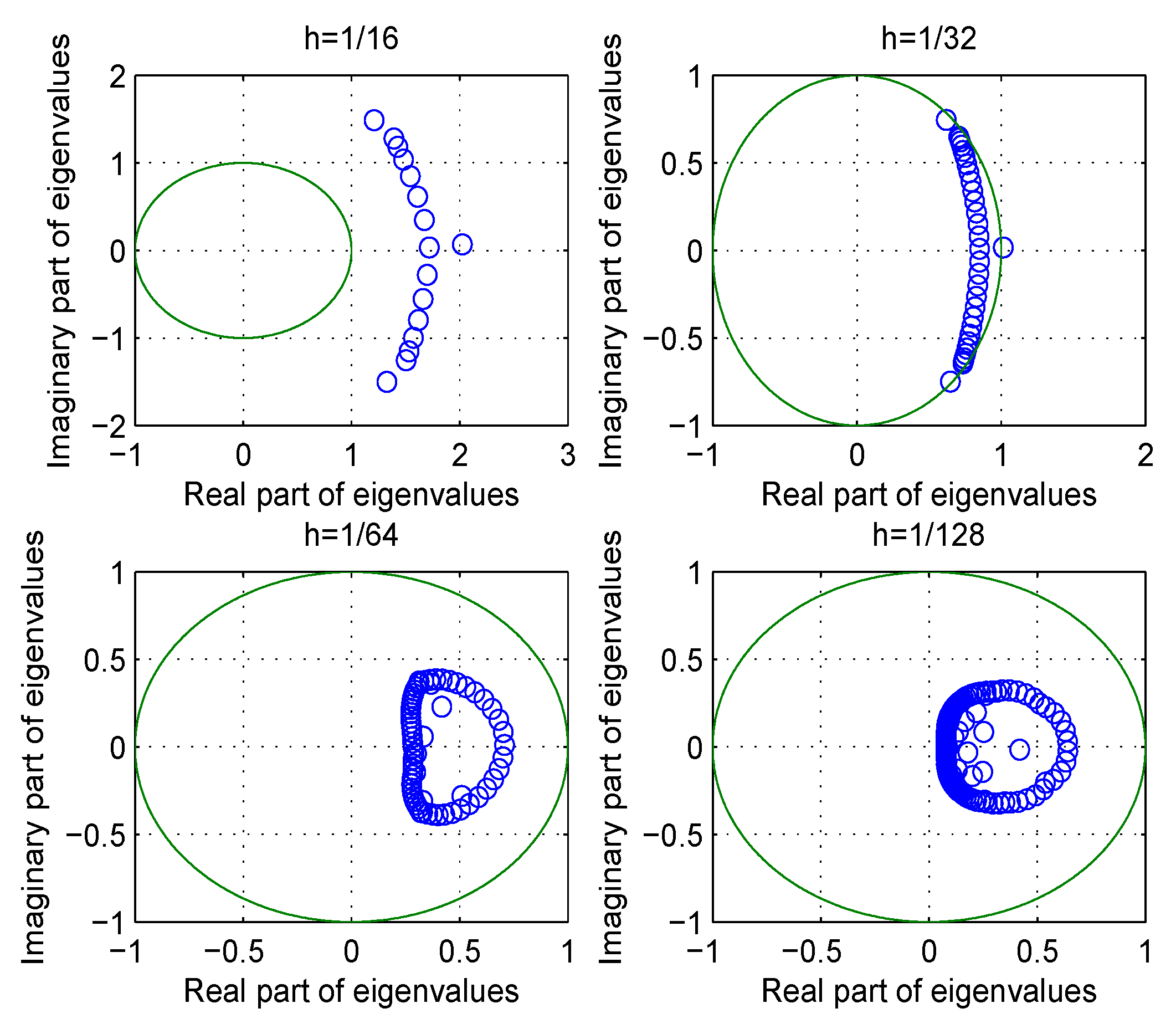
where denotes the maximum of the kernel function and the above inequality is derived from the Lesbegue constant of the polynomial interpolant (see [25]). We obtain whenever which enables us to compute by Gaussian elimination, as is done in [22]. Therefore, the well-posedess of the solution computed by is guaranteed. It is noted that when we encounter stiff problems, the maximum may be large, which implies we have to apply a particularly small stepsize h and restricts the application of the collocation method. However, due to the compactness of Volterra integral operator, the spectrum of will be found in the neighborhood of 0 with a tolerance stepsize, and the multistep collocation method is feasible in practical uses. In Figure 1, we show the discretized spectrum of by considering the kernel function with the maximum It can be seen that eigenvalues are bounded by the unit circle when the stepsize decreases to which guarantees the solvability of the linear system.
Figure 1.
The spectrum of for various stepsizes h.
Furthermore, we arrive at the following theorem by employing Lemmas 1 and 2.
Theorem 3.
Suppose that in VIE (1) are sufficiently smooth, that is, and Furthermore, let denote the collocation polynomial computed by with a stepsize Then the collocation error in the collocation grid is bounded by
where the constant C is independent of the stepsize h but depends on T.
Proof.
Note that by
and
we obtain the collocation error function satisfying
Let
where
For we have
where For we have
For we have
Furthermore, by letting
we obtain
Suppose that and are bounded by the constant It is easily noted from Equations (8) and (13) that B does not depend on the stepsize. A direct calculation leads to
Hence, we have
Since for sufficiently small stepsize we obtain
According to Lemma 2, we have
or equivalently,
for sufficiently small stepsize □
Example 1.
Let us solve VIE with
with the exact solution
In this example, we test the performance of . We mainly focus on two terms of data, the maximum of error functions (INAE), and the convergence order. Computed results are shown in Table 1, Table 2 and Table 3.
Table 1.
Collocation error and convergence order of for Example 1.
Table 2.
Collocation error and convergence order of for Example 1.
Table 3.
Collocation error and convergence order of for Example 1.
It can be seen from these tables that as the quantity of nodes increases, absolute errors decay fast, and as and get bigger, the convergence order enlarges. Besides, numerical results illustrate that achieves the expected order of the estimate given in Theorem 3.
Remark 1.
When numerical solutions of evolution equations are considered, Courant proposes that the combination of a consistent and stable numerical approach led to its convergence, which contributes to the foundation of classical numerical analysis theory of numerical studies on differential equations. On the other hand, the above convergence analysis is based on a fixed integration interval which differs from the convergence analysis for evolution problems where we usually consider the case of In addition, it should be noted that the convergence result in Theorem 3 does not guarantee a feasible approximation in practical computation for long-time integration, especially when we are met with stiff problems. Therefore, we give linear stability analysis of the presented collocation method in the forthcoming subsection.
2.3. Linear Stability Analysis
For a long-time integration problem, round-off errors may dramatically affect the numerical solution. In this subsection, we analyze the collocation solution’s linear stability originating from the study of numerical solutions of ordinary differential equations, where one usually considers the test equation
Particularly, Brugnano and Trigiante investigated multistep methods for solving differential problems with the above scalar equation in [19]. For the general linear multistep formula
we can introduce two polynomials
and define the associated characteristic polynomial with When is a Schur polynomial for fixed the method is absolutely stable at For the moment the definition of the region of absolute stability is
If the method is said to be stable.
Since both of discretization of ODE and VIE result in difference equations, we can investigate the generalized multistep collocation method with the help of stability studies of ODE. Consider the following test equation:
We turn to study the linear stability of the collocation solution by investigating Equation (15). By applying we have
Next, noting the difference between and in Equation (15) leads to
Then the characteristic polynomial is defined by
Before investigating the linear stability region, we introduce some helpful definitions and theorems in the version of .
Definition 4
([19]). For any complex number if the collocation solution to Equation (15) computed by goes to 0 as T goes ∞ for fixed stepsize, then is said to be absolutely stable at
Definition 5
([19]). For any if is absolutely stable at then the set is said to be the linear stability region of Particularly, if the left part of the complex plane is contained in then is said to be stable.
Theorem 6
then is stable at
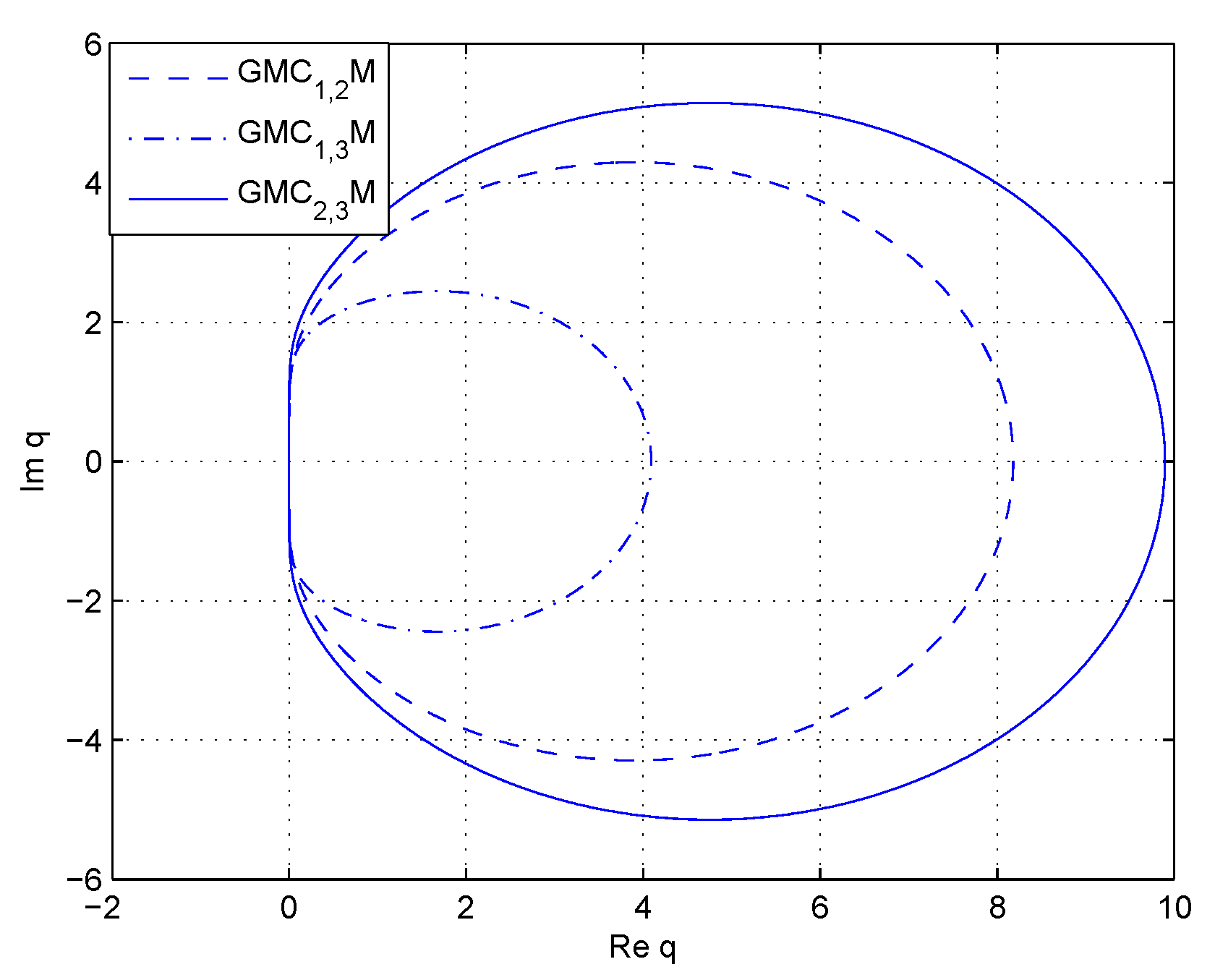
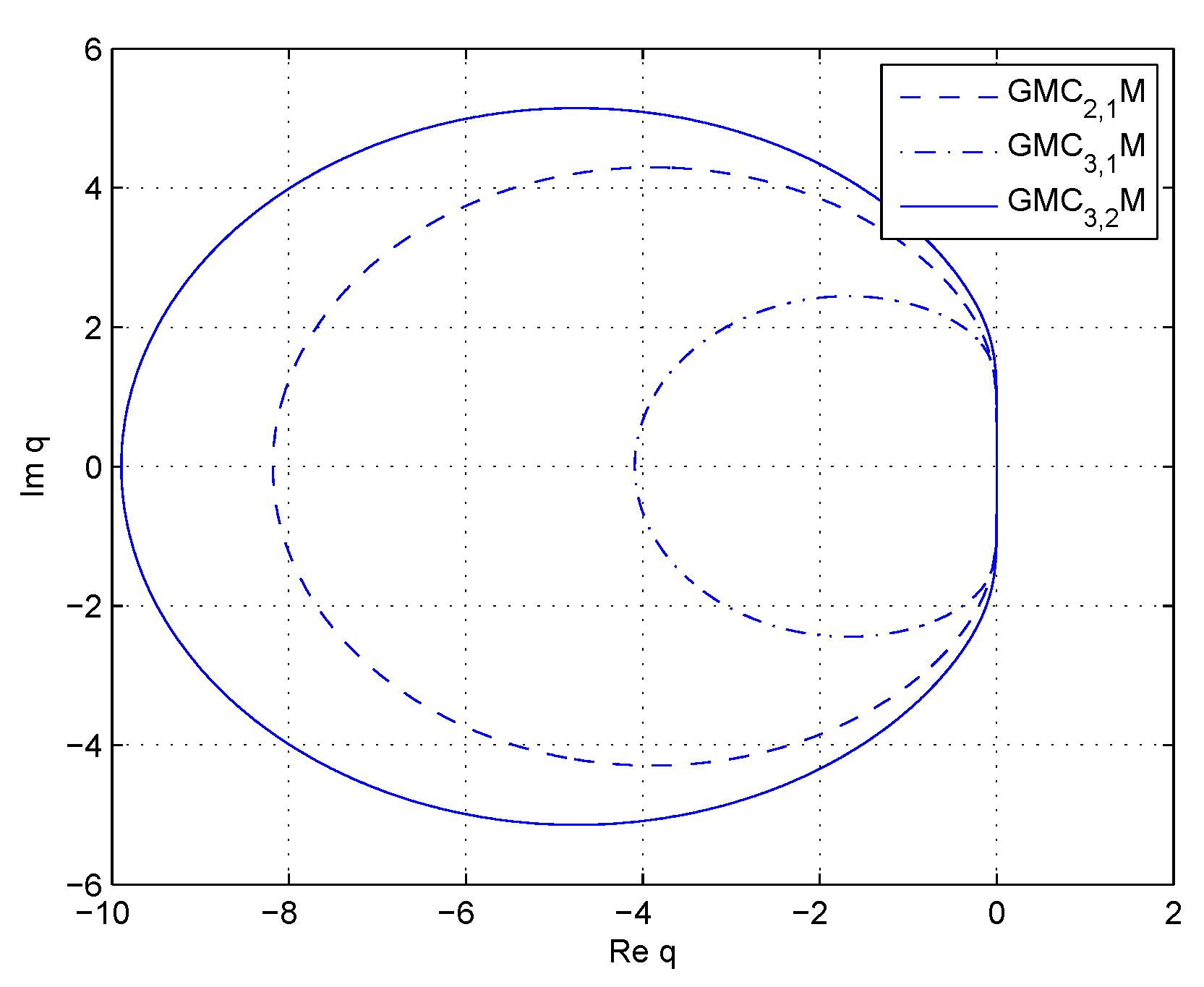
By a direct calculation, we find that roots of do not satisfy the condition given in Theorem 6 in the case of . Hence, the region of stability cannot be shown. In Figure 2 and Figure 3, we list the boundary locus corresponding to various multistep collocation methods with where the boundary is defined by
Figure 2.
Linear stability region for
Figure 3.
Linear stability region for
It can be seen that these trajectories are Jordan curves, which implies is the boundary of corresponding absolute stability region. The stability region in Figure 2 is the part outside the boundary curves, while that in Figure 3 is the inside part. Therefore, we can conclude that has wide stability region in the case of In addition, the boundary trajectories of and are symmetric with respect to virtual axis.
3. in the Case of
When the oscillation parameter in Equation (1), classical quadrature usually results in time-consuming algorithms. Hence, we first give an efficient numerical approach for moments in Equation (6) in this section. Then the frequency-explicit convergence analysis is presented.
3.1. Fast Calculation of Moments
Numerical studies of highly oscillatory integrals (HOIs) have been intensively focused on in the past few decades. High-order algorithms, such as Filon-type quadrature [26], Levin quadrature [27], and the numerical steepest decent method [28], have been proposed. In this subsection, we consider a composite quadrature rule based on Xiang’s modified Filon-type quadrature developed in [29].
Consider the computation of
When the phase has no stationary points, that is, for any let be the equispaced nodes on the interval that is, for In addition, let denote a set of positive integers associated with nodes which helps represent Hermite interplant later. Furthermore, define the function
Then we can find a polynomial with satisfying
With the coefficients by solving the above linear system, we can approximate by
where can be calculated by incomplete Gamma function.
In the case of for some suppose without loss of generality. Then we insert the grid points
where m is the maximum integer less than Integration with Xiang’s Filon quadrature in each subintervals results in the composite Filon quadrature. It is noted that the integral over the first interval is non-oscillatory and we can employ classical quadrature such as Gauss or Clenshaw–Curtis instead to avoid the stationary problem.
3.2. Convergence Analysis with Respect to the Frequency
Collocation methods with high-order quadrature usually lead to a class of fascinating algorithms, which are able to provide high-precision collocation solutions in the case of high frequency. In this subsection, we consider the general oscillator and investigate the convergence analysis for multistep collocation solutions, where the convergence order is represented by the frequency parameter
Firstly, let us restrict ourselves to considering the following set of functions.
Definition 7.
Given any bivariate functiondefined onsuppose thathas several stationary pointsoverfor any fixedand
LetandThenis said to be in
Secondly, we give a slight extension of the classical van der Corput Lemma (see [4] p. 333).
Lemma 8.
Suppose that Moreover, suppose and is integrable. We can conclude that
Here the constant C is independent of
Finally, we are able to develop the convergence behavior of collocation polynomials computed by in the highly oscillatory case.
Theorem 9.
Assume both of and f are sufficiently smooth. Then the numerical solutions derived from for VIE (1) satisfy
Proof.
To begin with, we explore the boundedness of the solution to Equation (1) and its derivative. By applying Picard iteration, we can rewrite as
Here denotes the integral operator
According to Lemma 8, we get that is bounded as On the other hand, the derivative can be rewritten by a direct calculation
where
By letting is bounded due to Lemma 8, and is bounded by noting that vanishes at
When noting that the collocation error function defined in the previous section satisfies
we obtain
where
Since both of and are bounded as employing Lemma 8 implies
Hence for fixed stepsize is invertible for sufficiently large and we can represent by
By noting that maximum of goes to 0 with a speed of as goes to we obtain the estimate (21). □
In the following example, we test the convergence rate of in the case of high frequency.
Example 2.
In this example, we solve the following VIE with
The exact solution is
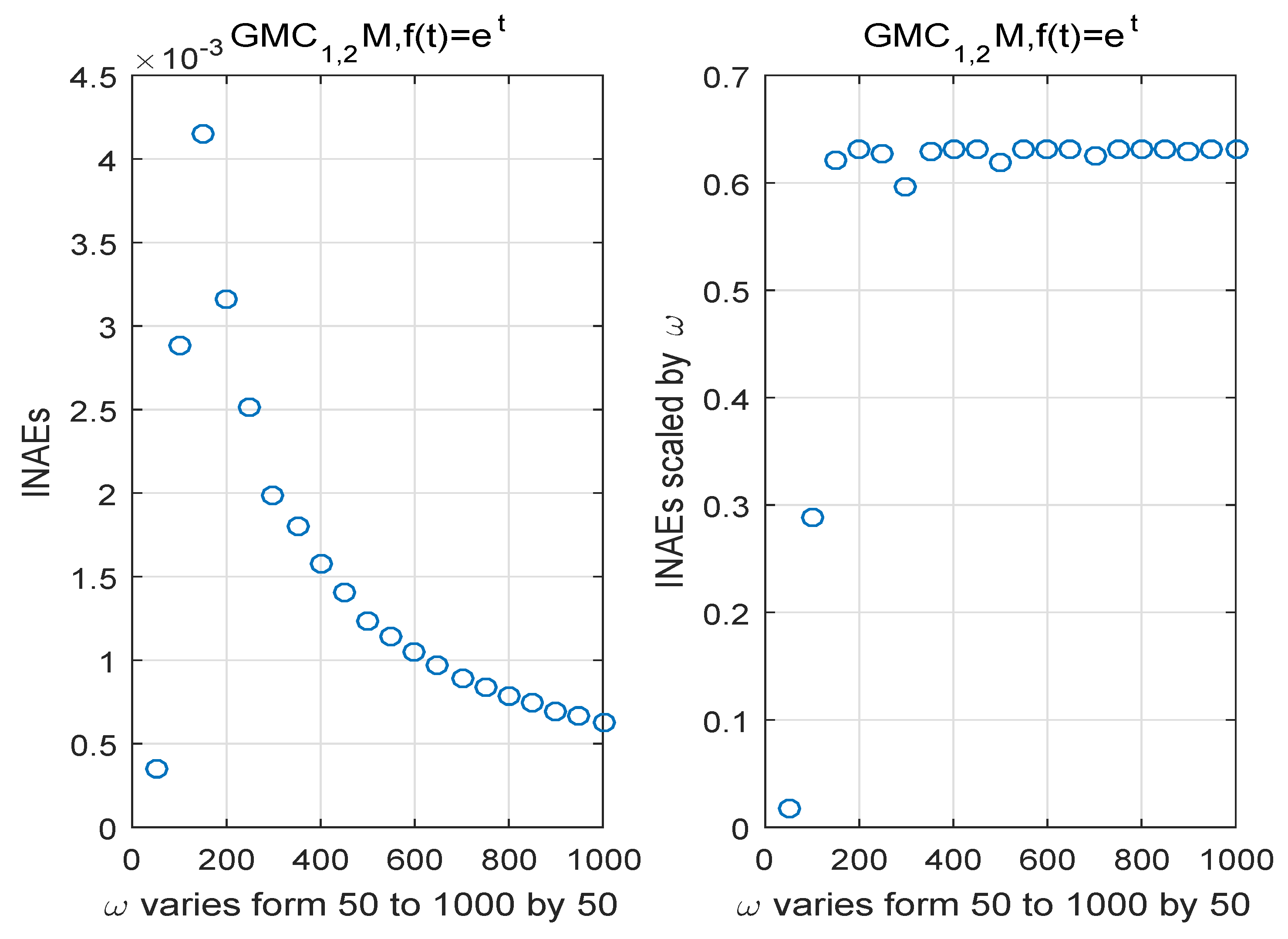
In Figure 4, we plot the scaled infinite norm of absolute error according to the corresponding order by letting , and varies from 50 to The left part shows the infinite norm of the error and the right part shows the absolute error scaled by corresponding rates. It can be seen that the increase of the frequency parameter makes the absolute error get smaller. This indicates as the kernel becomes more highly oscillatory, computed approximation becomes more accurate. Considering the right part of Figure 4, we find that when the frequency parameter reaches the curve turns to a horizontal straight line, which is in agreement with the estimate given in Theorem 9.
Figure 4.
for the highly oscillatory problem.
4. Final Remark
For VIEs with oscillatory and non-oscillatory kernels, we have investigated the generalized multistep collocation solution to VIE (1). Detailed convergence properties with respect to the stepsize and oscillation are presented. Noting that the new approach coupled with mild composite oscillatory quadrature rules is able to produce high-order approximation as the frequency goes to infinity, we could expect it is valuable to conduct further studies in related highly oscillatory problems, such as oscillatory Riemann–Hilbert problems, spectral calculation of oscillatory Fredholm operators, and so on.
Author Contributions
H.C. and J.M. conceived and designed the experiments; H.C. and L.L. performed the experiments; H.C. and J.M. analyzed the data; J.M.contributed reagents/materials/analysis tools; H.C. and J.M. wrote the paper. All authors have read and agreed to the published version of the manuscript.
Funding
This work was supported by National Natural Science Foundation of China (number 11901133) and the Science and Technology Foundation of Guizhou Province (number QKHJC[2020]1Y014).
Conflicts of Interest
The authors declare no conflict of interest.
Abbreviations
The following abbreviations are used in this manuscript:
| VIE | Volterra integral equation |
| generalized multistep collocation method | |
| ODE | ordinary differential equation |
| CBVM | collocation boundary value method |
| HOI | highly oscillatory integral |
References
- Brunner, H. Volterra Integral Equations: An Introduction to Theory and Applications; Cambridge University Press: Cambridge, UK, 2017. [Google Scholar]
- Xiang, S.; Brunner, H. Efficient methods for Volterra integral equations with highly oscillatory Bessel kernels. BIT Numer. Math. 2013, 53, 241–263. [Google Scholar] [CrossRef]
- Ma, J.; Xiang, S.; Kang, H. On the convergence rates of Filon methods for the solution of a Volterra integral equation with a highly oscillatory Bessel kernel. Appl. Math. 2013, 26, 699–705. [Google Scholar] [CrossRef]
- E Stein. Harmonic Analysis: Real-Variable Methods, Orthogonality, and Oscillatory Integrals; Princeton University Press: Princeton, NJ, USA, 1993. [Google Scholar]
- Xiang, S.; He, K. On the implementation of discontinuous Galerkin methods for Volterra integral equations with highly oscillatory Bessel kernels. Appl. Math. Comput. 2013, 219, 4884–4891. [Google Scholar] [CrossRef]
- Ma, J.; Fang, C.; Xiang, S. Modified asymptotic orders of the direct Filon method for a class of Volterra integral equations. J. Comput. Appl. Math. 2015, 281, 120–125. [Google Scholar] [CrossRef]
- Ma, J.; Kang, H. Frequency-explicit convergence analysis of collocation methods for highly oscillatory Volterra integral equations with weak singularities. Appl. Numer. Math. 2020, 151, 1–12. [Google Scholar] [CrossRef]
- Fang, C.; He, G.; Xiang, S. Hermite-Type collocation methods to solve Volterra integral equations with highly oscillatory Bessel kernels. Symmetry 2019, 11, 168. [Google Scholar] [CrossRef]
- Saira, S.X.; Liu, G. Numerical solution of the Cauchy-type singular integral equation with a highly oscillatory kernel function. Mathematics 2019, 7, 872. [Google Scholar] [CrossRef]
- H. Brunner. Collocation Methods for Volterra Integral and Related Functional Equations; Cambridge University Press: Cambridge, UK, 2004. [Google Scholar]
- Shen, J.; Tang, T.; Wang, L. Spectral Methods: Algorithms, Analysis and Applications; Springer: Berlin/Heidelberg, Germany, 2011. [Google Scholar]
- Li, X.; Tang, T. Convergence analysis of Jacobi spectral collocation methods for Abel-Volterra integral equations of second kind. Front. Math. China 2012, 7, 69–84. [Google Scholar] [CrossRef]
- Xie, Z.; Li, X.; Tang, T. Convergence analysis of spectral Galerkin methods for Volterra type integral equations. J. Sci. Comput. 2012, 53, 414–434. [Google Scholar] [CrossRef]
- Cai, H.; Qi, J. A Legendre-Galerkin method for solving general Volterra functional integral equations. Numer. Algorithms 2016, 73, 1159–1180. [Google Scholar] [CrossRef]
- Berrut, J.P.; Hosseini, S.A.; Klein, G. The linear barycentric rational quadrature method for Volterra integral equations. SIAM J. Sci. Comput. 2014, 36, A105–A123. [Google Scholar] [CrossRef]
- Li, M.; Huang, C. The linear barycentric rational quadrature method for auto-convolution Volterra integral equations. J. Sci. Comput. 2019, 78, 549–564. [Google Scholar] [CrossRef]
- Conte, D.; Paternoster, B. Multistep collocation methods for Volterra integral equations. Appl. Numer. Math. 2009, 59, 1721–1736. [Google Scholar] [CrossRef]
- Fazeli, S.; Hojjati, G. Numerical solution of Volterra integro-differential equations by superimplicit multistep collocation methods. Numer. Algorithms 2015, 68, 741–768. [Google Scholar] [CrossRef]
- Brugnano, L.; Trigiante, D. Solving Differential Problems by Multistep Initial and Boundary Value Methods; Cordon and Breach Science Publishers: Concord, ON, Canada, 1998. [Google Scholar]
- Chen, H.; Zhang, C. Boundary value methods for Volterra integral and integro-differential equations. Appl. Math. Comput. 2011, 218, 2619–2630. [Google Scholar] [CrossRef]
- Li, C.; Zhang, C. Block boundary value methods applied to functional differential equations with piecewise continuous arguments. Appl. Numer. Math. 2017, 115, 214–224. [Google Scholar] [CrossRef]
- Ma, J.; Xiang, S. A collocation boundary value method for linear Volterra integral equations. J. Sci. Comput. 2017, 71, 1–20. [Google Scholar] [CrossRef]
- Ma, J.; Liu, H. Fractional collocation boundary value methods for the second kind Volterra equations with weakly singular kernels. Numer. Algorithms 2020, 84, 743–760. [Google Scholar] [CrossRef]
- Liu, L.; Ma, J. Block collocation boundary value solutions of the first-kind Volterra integral equations. Numer. Algorithms 2020. [Google Scholar] [CrossRef]
- Trefethen, L.N.; Weideman, J.A.C. Two results on polynomial interpolation in equally spaced points. J. Approx. Theory 1991, 65, 247–260. [Google Scholar] [CrossRef]
- Iserles, A.; Nørsett, S.P. Efficient quadrature of highly oscillatory integrals using derivatives. Proc. R. Soc. Math. Phys. Eng. Sci. 2005, 461, 1383–1399. [Google Scholar] [CrossRef]
- Levin, D. Procedures for computing one- and two-dimensional integrals of functions with rapid irregular oscillations. Math. Comput. 1982, 38, 531–538. [Google Scholar] [CrossRef]
- Milovanovic, G.V. Numerical calculation of integrals involving oscillatory and singular kernels and some applications of quadratures. Comput. Math. Appl. 1998, 36, 19–39. [Google Scholar] [CrossRef]
- Xiang, S. Efficient Filon-type methods for . Numer. Math. 2007, 105, 633–658. [Google Scholar] [CrossRef]
Publisher’s Note: MDPI stays neutral with regard to jurisdictional claims in published maps and institutional affiliations. |
© 2020 by the authors. Licensee MDPI, Basel, Switzerland. This article is an open access article distributed under the terms and conditions of the Creative Commons Attribution (CC BY) license (http://creativecommons.org/licenses/by/4.0/).