


Abstract
In this paper, we introduce the notion of a -algebra, and we show that a -algebra is logically equivalent to several algebras, i.e., -algebras, -algebras, -algebras and 0-commutative B-algebras. Moreover, we show that a -algebra with is logically equivalent to several algebras, and we show some relationships between a -algebra with and several related algebras.
MSC:
06F35; 20N02
1. Introduction
The notion of -algebras was formulated by . The motivation of this notion is based on both set theory and propositional calculus (see [1]). As a generalization of this notion, -, -, -, -algebras have been developed by many researchers (see [2,3,4]). Jun et al. [5] introduced the notion of a -algebra, which is a generalization of -algebras. The concept of B-algebras was introduced by Neggers and Kim [6]. Kim and Kim [7] defined the notion of a -algebra. They showed that a -algebra is equivalent to a 0-commutative B-algebra. Kim and Kim [8] introduced the notion of a -algebra, and proved that every -algebra is 0-commutative, and obtained several algebras which are logically equivalent to the -algebra. Walendziak [9] introduced a -algebra, which is a generalization of a B-algebra, and investigated some properties of (normal) ideals in -algebras. Kim and Kim [10] defined the notion of a -algebra, and showed that an algebra A is a -algebra if and only if it is a 0-commutative -algebra. Kim et al. [11] introduced the notions of (pre-)Coxeter algebras in the Smarandache setting, and Kim and Kim [12] discussed some relations between (pre-)Coxeter algebras and its related topics.
In this paper, we introduce the notion of a -algebra consisting of 3 simple axioms, and we show it is logically equivalent to several known algebras. In particular, we investigate the role of the axiom for proving the logically (non-) equivalence to several algebras. Moreover, we show that a -algebra with is logically equivalent to several algebras, and we show some relationships between a -algebra with and several related algebras.
2. Preliminaries
A B-algebra [6] is a non-empty set A with a constant 0 and a binary operation ‘*’ satisfying the following axioms:
- (A1)
- ,
- (A2)
- ,
- (B)
for any
Proposition 1.
[6] If is a B-algebra, then for all .
An algebra is called a -algebra [5] if it satisfies and , where
- (BH)
- and imply .
Kim and Kim [7] defined a -algebra satisfying and , where
- (BM)
for any . Walendziak [9] introduced a -algebra as an algebra satisfying and , where
- (BF)
for any . An algebra is called a -algebra [8] if it satisfies and , where
- (BO)
for any . An algebra is said to be 0-commutative [13] if for any . Cho and Kim [13] discussed B-algebras and quasigroups using the notion of the 0-commutativity.
Proposition 2.
[8] An algebra is a -algebra if and only if it is a 0-commutative B-algebra.
An algebra is called a Coxeter algebra if it satisfies and , where
- (D)
for all . It is known that a Coxeter algebra is a special type of abelian groups, i.e., a Boolean group (see [11,12]). An algebra is called a pre-Coxeter algebra if it satisfies and
- (E1)
- if , then ,
- (E2)
for all . It was proved that every Coxeter algebra is a pre-Coxeter algebra, but the converse need not be true in general (see [11,12]).
3. -Algebras
In this section, we define a notion of a -algebra, and we investigate some relations between -algebras and other algebras, i.e., B-algebras, 0-commutative B-algebras, -algebras, -algebras, -algebras, -algebras, -algebras, -algebras and Coxeter-algebras.
Definition 1.
An algebra is said to be a -algebra if it satisfies and , where
- (BV)
for all .
Example 1.
Let be a set with the following table:
| * | 0 | 1 | 2 | 3 | 4 |
| 0 | 0 | 2 | 1 | 4 | 3 |
| 1 | 1 | 0 | 3 | 2 | 4 |
| 2 | 2 | 4 | 0 | 3 | 1 |
| 3 | 3 | 1 | 4 | 0 | 2 |
| 4 | 4 | 3 | 2 | 1 | 0 |
Then it is easy to see that is a -algebra.
Proposition 3.
If is a -algebra, then the followings hold:
- (i)
- ,
- (ii)
- ,
- (iii)
- ,
- (iv)
- ,
- (v)
- ,
- (vi)
- ,
- (vii)
- (viii)
- ,
- (ix)
- ,
- (x)
- ,
- (xi)
- ,
for any .
Proof.
(i). If we let in , then by . (ii). If we let in (i), then, by and , we obtain . (iii). If we let in , then , and hence . (iv). If we let in , then . (v). If we let in (i), then . By applying (ii), we obtain . (vi). If we let in , then, by applying (iii) and (i), we have . (vii). If in (iv), then , which implies . It follows that by (ii). (viii). If , then and hence by (ii). (ix). If we let in (iv), then . By applying (ii), we obtain . (x). Assume . Then, by applying (iv), we have
By applying (viii), we obtain . (xi). If we assume , then, by (iii), we obtain . By applying (viii), we have . By (x), we obtain . □
By applying (iii) and (vii) of Proposition 3, we obtain the following theorem:
Theorem 1.
Let be a -algebra. Then
- (i)
- it is a -algebra,
- (ii)
- it is a -algebra.
Remark 1.
The converse of Theorem 1(i) does not hold in general.
Example 2.
Let be a set. Define a binary operation “*” on A as follows:
| * | 0 | 1 | 2 | 3 | 4 |
| 0 | 0 | 1 | 2 | 4 | 3 |
| 1 | 1 | 0 | 4 | 1 | 4 |
| 2 | 2 | 3 | 0 | 3 | 4 |
| 3 | 3 | 1 | 4 | 0 | 0 |
| 4 | 4 | 3 | 3 | 0 | 0 |
Then is a -algebra, but not a -algebra, since .
Theorem 2.
If is a Coxeter algebra, then it is a -algebra.
Proof.
Let be a Coxeter algebra. Since A satisfies the conditions and , it is enough to show the condition . Given , we have
Hence A is a -algebra. □
Remark 2.
The converse of Theorem 2 does not hold in general.
Example 3.
Let be a -algebra as in Example 1. Then it is not a Coxeter algebra, since .
Lemma 1.
If is a -algebra, then it is a 0-commutative.
Proof.
It follows immediately from Proposition 3(v). □
Theorem 3.
If is a -algebra, then it is a B-algebra.
Proof.
Let A be a -algebra. Since A satisfies the conditions and , it is enough to show the condition . If and z be any elements of A, then
Hence A is a B-algebra. □
Remark 3.
The converse of this theorem does not hold.
Example 4.
Let A be the set of all real numbers except for a negative integer . Define a binary operation “*” on A as follows:
for any . Then is a B-algebra [6], but it is not a -algebra, since .
By using Lemma 1 and Theorem 3, we obtain the following:
Corollary 1.
If is a -algebra, then it is a 0-commutative B-algebra.
Theorem 4.
If is a 0-commutative B-algebra, then it is a -algebra.
Proof.
Let be a 0-commutative B-algebra. Then
for all . Hence is a -algebra. □
By Corollary 1 and Theorem 4, we obtain the following corollary:
Corollary 2.
An algebra is a -algebra if and only if it is a 0-commutative B-algebra.
An algebra is called a -algebra if the conditions and hold, where
- (BT)
for all
Theorem 5.
An algebra is a -algebra if and only if it is a -algebra.
Proof.
Assume that is a -algebra. We show the condition . Given , we have
for all . Hence A is a -algebra.
Conversely, assume that A is a -algebra. If we let in , then, by (A1) and (A2), we have for all . To show that A is a -algebra, we show that the condition holds. In fact, we have
for all . Hence A is a -algebra. □
Kim and Kim defined the notion of a -algebra. An algebra is said to be a -algebra [10] if it satisfies the conditions , and , where
- (BN)
for all . It was proved that -algebras are equivalent to 0-commutative -algebras [10].
Theorem 6.
If is a -algebra, then it is a -algebra.
Proof.
Let A be a -algebra. Then A satisfies the conditions and . We show that the condition holds.
for all . Hence A is a -algebra. □
Remark 4.
The converse of Theorem 6 does not hold in general.
Example 5.
Let be a set with the following table:
| * | 0 | 1 | 2 | 3 |
| 0 | 0 | 1 | 2 | 3 |
| 1 | 1 | 0 | 1 | 1 |
| 2 | 2 | 1 | 0 | 1 |
| 3 | 3 | 1 | 1 | 0 |
Then is a -algebra, but not a -algebra, since .
By Corollary 2, Theorem 5 and Proposition 2, we obtain the interesting result below:
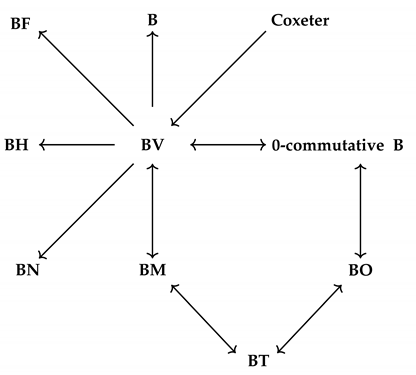
Theorem 7.
The following statements are logically equivalent:
- (1)
- A is a -algebra,
- (2)
- A is a 0-commutative B-algebra,
- (3)
- A is a -algebra,
- (4)
- A is a -algebra,
- (5)
- A is a -algebra.
We summarize the above discussion, and we give a diagram describing some relations between -algebras and its related algebras as follows:
4. -Algebras with Some Conditions
In this section, we investigate some relationships between several general algebraic structures and -algebras with special conditions as follows:
- (D)
- (F)
for all . Note that Boolean groups and the Klein four group are -algebras with .
Theorem 8.
If is a -algebra with , then it is a pre-Coxeter algebra.
Proof.
Let be a -algebra with . If , then by Proposition 3(vii). On the other hand, by Proposition 3(iii), we obtain . Hence A is a pre-Coxeter algebra. □
Remark 5.
The converse of Theorem 8 does not hold in general.
Example 6.
Let be a set with the following table:
| * | 0 | 1 | 2 | 3 | 4 | 5 | 6 | 7 | 8 | 9 |
| 0 | 0 | 1 | 2 | 3 | 4 | 5 | 6 | 7 | 8 | 9 |
| 1 | 1 | 0 | 3 | 2 | 5 | 4 | 7 | 6 | 9 | 8 |
| 2 | 2 | 3 | 0 | 1 | 6 | 8 | 4 | 9 | 5 | 7 |
| 3 | 3 | 2 | 1 | 0 | 9 | 7 | 8 | 5 | 6 | 4 |
| 4 | 4 | 5 | 6 | 9 | 0 | 1 | 2 | 8 | 7 | 3 |
| 5 | 5 | 4 | 8 | 7 | 1 | 0 | 9 | 3 | 2 | 6 |
| 6 | 6 | 7 | 4 | 8 | 2 | 9 | 0 | 1 | 3 | 5 |
| 7 | 7 | 6 | 9 | 5 | 8 | 3 | 1 | 0 | 4 | 2 |
| 8 | 8 | 9 | 5 | 6 | 7 | 2 | 3 | 4 | 0 | 1 |
| 9 | 9 | 8 | 7 | 4 | 3 | 6 | 5 | 2 | 1 | 0 |
Then is a pre-Coxeter algebra, but it is not a -algebra with , since .
Theorem 9.
An algebra is a -algebra with if and only if it is a Coxeter algebra.
Proof.
Assume that is a -algebra with . Then A satisfies the conditions and . Given , we obtain
This shows that A is a Coxeter algebra.
Conversely, assume that is a Coxeter algebra. Then A satisfies the conditions and . Given , we have
Hence is a -algebra with . □
Note that the -algebra in Example 1 does not satisfy the condition , and hence it is not a Coxeter algebra.
Lemma 2.
Let be a -algebra. Then the followings are equivalent: for any ,
- (i)
- ,
- (ii)
- .
Proof.
(i) ⇒ (ii). Suppose the condition (i) holds. Then, for any , we have
(ii) ⇒ (i). Suppose the condition (ii) holds. If we let in (ii), then, by (A2) and Proposition 3(ii), we obtain for any . □
Example 7.
In Example 1, we see that and hence the condition does not hold for some . In fact, .
Lemma 3.
If is a B-algebra with , then for any .
Proof.
Since A is a B-algebra with , if we let in , then for all . □
Example 8.
In Example 4, we see that and hence the condition does not hold for some . In fact, .
Theorem 10.
An algebra is a -algebra with if and only if it is a B-algebra with .
Proof.
Let be a -algebra with the condition . Then, for any , we have
Hence is a B-algebra with .
Conversely, let A be a B-algebra with . Then
for any . Hence A is a -algebra with . □
Lemma 4.
If is a -algebra with , then for any .
Proof.
Since is a -algebra with , by Proposition 3(iii) and , we have for any . □
Lemma 5.
If is a -algebra with , then
- (i)
- ,
- (ii)
- .
for any .
Proof.
(i). Let A be a -algebra with . If we let in , then and hence for all .
(ii). If we let in , then by (i) for any . □
Theorem 11.
An algebra is a -algebra with if and only if it is a -algebra with .
Proof.
Assume that A is a -algebra with . Then A satisfies the conditions (A1) and (A2). By Proposition 3(iii), A satisfies the condition . Let and z be any elements of A. Then
Hence A is a -algebra with .
Conversely, assume that A is a -algebra with . Then A satisfies the conditions (A1) and (A2). By Lemma 5(i), A satisfies the condition . Let and z be any elements of A. Then
Hence A is a -algebra with . □
Lemma 6.
Let be a -algebra with . Then
- (i)
- ,
- (ii)
- ,
- (iii)
- ,
- (iv)
- ,
for any .
Proof.
Let A be a -algebra with . (i). If we let in , then . By applying and , we obtain .
(ii). If we let in , then . By applying and , we obtain .
(iii). Let in . Then . By applying (ii) and , we obtain for all .
(iv). If we let in , then . By applying (iii) and , we obtain for all . □
Theorem 12.
An algebra is a -algebra with if and only if it is a -algebra with .
Proof.
Let be a -algebra with . Then A satisfies the conditions (A1) and (A2). By Lemma 2, A satisfies the condition . By applying Proposition 3(vi), we obtain for all , which shows that the condition holds. Hence is a -algebra with .
Conversely, let A be a -algebra with . Then A satisfies the condition (A1) and (A2). By Lemma 6(iii), A satisfies the condition . Given , we have
Hence A is a -algebra with . □
From Lemma 2, we have the following corollary:
Corollary 3.
An algebra is a -algebra with if and only if it is a -algebra with .
Theorem 13.
Let be a B-algebra. Then the followings are equivalent: for any ,
- (i)
- ,
- (ii)
- .
Proof.
(i) ⇒ (ii). Let A be a B-algebra. Assume A satisfies the condition (i). Then
for any .
(ii) ⇒ (i). Assume A satisfies the condition (ii). Then
for any . □
Lemma 7.
Let be a -algebra with . Then, for any , we have
- (i)
- ,
- (ii)
- .
Proof.
(i). Since A is a -algebra with , we have
for any .
(ii). By (i), is a Coxeter algebra, and hence for all . □
By Theorem 7, we know that a -algebra is logically equivalent to a -algebra, but there is no direct proof of its equivalence. Using the condition , we describe its relationship as below:
Theorem 14.
An algebra is a -algebra with if and only if it is a -algebra with .
Proof.
Let be a -algebra with . We show that the condition holds. If we take and z in A, then
Hence A is a -algebra with .
Conversely, assume that A is a -algebra with . We show the condition . Given , by using Lemma 7(i) and , we obtain:
Hence A is a -algebra with . □
Theorem 15.
If is a -algebra with , then it is a -algebra with .
Proof.
Assume that is a -algebra with . We prove the condition . Given , we have
Hence A is a -algebra with . □
Remark 6.
The converse of Theorem 15 does not hold in general.
Example 9.
Let be a set with the following table:
| * | 0 | 1 | 2 |
| 0 | 0 | 1 | 2 |
| 1 | 1 | 0 | 1 |
| 2 | 2 | 1 | 0 |
Then it is easy to see that A is a -algebra with , but not a -algebra with , since .
From the above theorems, we obtain the following equivalent statements:
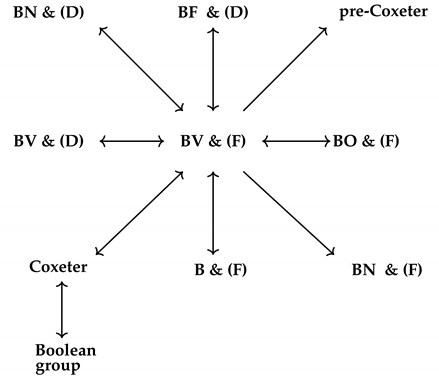
Corollary 4.
The followings are equivalent:
- (i)
- is a -algebra with ,
- (ii)
- is a B-algebra with ,
- (iii)
- is a -algebra with ,
- (iv)
- is a -algebra with ,
- (v)
- is a -algebra with ,
- (vi)
- is a -algebra with ,
- (vii)
- is a Coxeter algebra,
- (viii)
- is a Boolean group.
We provide a diagram describing some relations between -algebras with and its related algebras as follows:
5. Conclusions and Future Works
We introduced the notion of a -algebra, and investigated some relations between -algebras and their related topics. Moreover, by using some additional axioms, we discussed some relations between -algebras with and several algebraic structures with additional axioms. In particular, we have focussed on the axiom , and investigated some relations with several other axioms which are discussed in various different algebraic structures. We found that the role of the axiom is important in studying general algebraic structures.
We will discuss several ideal theories, isomorphism theorems in -algebras, and some applications to fuzzy theory, soft set theory and neutrosophic theory in the sequel. Moreover, we will investigate the axiom for further development of general algebraic structures.
Author Contributions
Conceptualization and Supervision: I.H.H.; Investigation: H.S.K.; Resources: Y.L.L. All authors have read and agreed to the published version of the manuscript.
Funding
This research received no external funding.
Acknowledgments
The authors are deeply grateful to Chang Bum Kim for his valuable suggestions and help. The authors would like to express their great thanks for referee’s valuable suggestions and help.
Conflicts of Interest
The author declares no conflict of interest.
References
- Iséki, K.; Tanaka, S. An introduction to the theory of BCK-algebras. Math. Jpn. 1978, 23, 1–26. [Google Scholar]
- Huang, Y.S. BCI-Algebras; Science Press: Beijing, China, 2006. [Google Scholar]
- Hu, Q.P.; Li, X. On BCH-algebras. Kobe J. Math. 1983, 11, 313–320. [Google Scholar]
- Dudek, W.A. A new characterization of ideals in BCC-algebras. Novi Sad J. Math. 1999, 29, 139–145. [Google Scholar]
- Jun, Y.B.; Roh, E.H.; Kim, H.S. On BH-algebras. Sci. Math. Jpn. 1998, 1, 347–354. [Google Scholar]
- Neggers, J.; Kim, H.S. On B-algebras. Math. Vesnik. 2002, 54, 21–29. [Google Scholar]
- Kim, C.B.; Kim, H.S. On BM-algebra. Sci. Math. Jpn. 2006, 63, 421–427. [Google Scholar]
- Kim, C.B.; Kim, H.S. On BO-algebra. Math. Slovaca 2012, 62, 421–427. [Google Scholar] [CrossRef]
- Walendcziak, A. On BF-algebras. Math. Slovaca 2007, 57, 119–128. [Google Scholar] [CrossRef]
- Kim, C.B.; Kim, H.S. On BN-algebra. Kyungpook Math. J. 2013, 53, 175–184. [Google Scholar] [CrossRef]
- Kim, H.S.; Kim, Y.H.; Neggers, J. Coxeters and pre-Coxeter algebras in Smarandache setting. Honam Math. J. 2004, 26, 471–481. [Google Scholar]
- Kim, C.B.; Kim, H.S. (Pre-)Coxeter algebras and related topics. Math. Slovaca 2010, 60, 33–42. [Google Scholar] [CrossRef]
- Cho, J.R.; Kim, H.S. On B-algebras and quasigroups. Quasigroups Relat. Syst. 2001, 8, 1–6. [Google Scholar]
Publisher’s Note: MDPI stays neutral with regard to jurisdictional claims in published maps and institutional affiliations. |
© 2020 by the authors. Licensee MDPI, Basel, Switzerland. This article is an open access article distributed under the terms and conditions of the Creative Commons Attribution (CC BY) license (http://creativecommons.org/licenses/by/4.0/).