


Abstract
About twenty-five years ago, Horadam and de Launey introduced the cocyclic development of designs, from which the notion of cocyclic Hadamard matrices developed over a group was readily derived. Much more recently, it has been proved that this notion may naturally be extended to define cocyclic Hadamard matrices developed over a loop. This paper delves into this last topic by introducing the concepts of coboundary, pseudocoboundary and pseudococycle over a quasigroup, and also the notion of the pseudococyclic Hadamard matrix. Furthermore, Goethals-Seidel loops are introduced as a family of Moufang loops so that every Hadamard matrix of Goethals-Seidel type (which is known not to be cocyclically developed over any group) is actually pseudococyclically developed over them. Finally, we also prove that, no matter if they are pseudococyclic matrices, the usual cocyclic Hadamard test is unexpectedly applicable.
MSC:
05B20; 05B15; 20N05
1. Introduction
A (binary) Hadamard matrix is a square matrix H with entries whose row (equivalently, column) vectors are pairwise orthogonal. It may be readily checked that every Hadamard matrix must have order 1, 2 or a multiple of 4, as soon as three rows must be pairwise orthogonal. Surprisingly, no other restrictions on the order of a Hadamard matrix are known. Actually, it is conjectured that a Hadamard matrix exists for every order multiple of 4. This is the century-old Hadamard Conjecture.
About twenty-five years ago, the use of cocycles and cocyclic matrices was introduced by Horadam and de Launey as a part of a theory of development of designs [1]. Furthermore, they showed [2] that the cocyclic framework could provide a structural approach in order to resolve the Hadamard Conjecture. This idea is currently supported by the fact that many known constructions of Hadamard matrix families have been shown to be cocyclic, as, for instance, Sylvester matrices, Paley matrices, Williamson matrices or Ito’s type Q matrices (see, for instance, [3,4,5,6,7,8]). On the other hand, two of the most prolific of these families have actually been shown to fail to be cocyclic [6]. Namely, the family of two-circulant core Hadamard matrices [9] and the so-called Goethals-Seidel arrays [10], which are related in turn with supplementary difference sets [11]. This paper figures out a new approach to deal with a cocyclic development of Goethals-Seidel arrays, not over a group, but over a certain family of Moufang loops, for positive integers . This is a particular case of the more general theory, which has recently been proved. That is, the notion of cocyclic matrix may naturally be extended to cover quasigroups [12].
While the study of quasigroups may be dated back at least to Euler’s work on orthogonal Latin squares, as the years went by, the theory of quasigroups was somehow banished by the development of the theory of groups. It is worthwhile noting, in particular, that a well-established cohomology theory for groups exists from the mid-1940s, by means of the seminal works of Eilenberg and Mac Lane [13,14,15]. Yet, surprisingly, no such theory has been fully developed for quasigroups. However, there are some remarkable papers on cohomology for loops (see [16,17,18] and the references therein) and a few for quasigroups [19,20]. For a brief survey on prospective applications of quasigroups and loops, and a panoramic of the state of the art, the interested reader is referred to [21,22,23].
The paper is organized as follows. Some background notions on Hadamard matrices, quasigroups and cocyclic matrices developed over quasigroups are introduced in Section 2. In Section 3, we introduce the notion of coboundary over a quasigroup and we prove that certain triples of elements of a quasigroup over which a Hadamard matrix is cocyclic have to be associative in order to obtain cocyclic elementary coboundaries. This last fact leads us to introduce both concepts of pseudocoboundary and pseudococycle over a quasigroup, and also the notion of pseudococyclic Hadamard matrices. In particular, the existence of pseudococyclic Hadamard matrices over quasigroups that are not loops is illustrated. Finally, in Section 4, we describe Goethals-Seidel arrays as pseudococyclic Hadamard matrices. Moreover, even if the cocyclic Hadamard test is shown to be no longer available for pseudococyclic matrices in general, it is proved that the usual cocyclic Hadamard test actually still applies on Goethals-Seidel arrays.
2. Preliminaries
Let us review some basic concepts and results on Hadamard matrices, quasigroups and cocyclic matrices over quasigroups that are used throughout the paper. We refer the reader to [12,24,25] for more details about these topics.
2.1. Hadamard Matrices
Two matrices with entries are Hadamard equivalent if they are equal up to permutations or negation of their rows and columns. This is an equivalence relation among Hadamard matrices, which we denote .
One of the most prolific methods for constructing Hadamard matrices is via the so-called Goethals-Seidel arrays [10], which consist of -block matrices of the type
for A, B, C and D being -circulant matrices and R being the back circulant permutation matrix having as its first row. This matrix is Hadamard if
where denotes the transpose of and denotes the -identity matrix with ones in its main diagonal, and zeros elsewhere.
Goethals-Seidel arrays are related to certain supplementary difference sets consisting of four subsets, as soon as one attends to the positions in which negative entries occur at the first row, in every block. More concretely, given a finite abelian group of order t, four subsets form a supplementary difference set of parameters , for , if, for every , there are exactly different ordered pairs such that . Consequently, it must be
In particular, taking , such a supplementary difference set leads readily to a Goethals-Seidel array. To this end, the first rows of the matrices A, B, C and D are defined from the subsets , , and in such a way that the i-th entry of the first row of A (respectively, B, C or D) is if and only if belongs to (respectively, , or ).
There exist several methods for constructing Hadamard matrices of Goethals-Seidel type of a given order from suitable supplementary difference sets. Thus, for instance:
- Spence [26] proved their existence for , with q being a prime power, whenever there exists a cyclic projective plane of order and two supplementary difference sets in a cyclic group of order t.
- Whiteman [27] proved their existence for , with p being a prime and a prime power.
- Ðoković [28,29,30,31,32] made use of supplementary difference sets in order to construct Hadamard matrices of Goethals-Seidel type, for all . Together with other authors [33,34], he also dealt with examples for .
In any case, there is still much to do on the subject (see [11] for recent details about this concern).
In general, Goethals-Seidel arrays fail to be cocyclic over a group, as was pointed out in [6]. Recall in this regard that a matrix with entries is cocyclic over a group if there exists a map obeying the cocycle equation
for all , so that the matrix under consideration is Hadamard equivalent to the cocyclic matrix . The map is called a cocycle [1,2] over the group.
This notion is somehow more relaxing than those originally termed in [2], where cocyclically developed matrices of the form and pure cocyclic matrices of the form were distinguished for being a two-cocycle and being an arbitrary function. Notice that a cocyclically developed matrix is Hadamard equivalent to a pure cocyclic matrix.
In the context of Hadamard matrices, the main advantage of cocyclic matrices is that there is a faster way to check whether they are Hadamard or not, the cocyclic Hadamard test [2]. This method consists of checking whether the summation of each row of the matrix is zero, except for the first one if the matrix is normalized (that is, both its first row and first column consist all of ones).
Two matrices with entries are cocyclically equivalent if they are, respectively, cocyclic with respect to a pair of cocycles and over a group , and there exists a map such that
This constitutes an equivalence relation among cocyclic Hadamard matrices, which we denote . No known relation exists between and . In fact, lying in the same -class, one may easily find cocyclic matrices such that the former is Hadamard and the latter is not [2].
Progressing on the ideas and techniques of [3,35,36], a full classification of cocyclic Hadamard matrices up to order 36 was performed in [37], from which we next reproduce in Table 1 the proportion of -classes which have a cocyclic representative over some group. In particular the exact number of nonequivalent Hadamard matrices of order 32 that was calculated in [38,39] is found.

Table 1.
Proportion of -classes with a cocyclic representative over some group.
As highlighted in bold, the proportion decreases significantly from order 24, which suggests that cocyclic matrices developed over groups fail to cover a wide amount of nonequivalent Hadamard matrices. Actually, this is the main motivation of this paper, which deals with the quasigroup development theory, expecting that the proportion of -classes having a cocyclic representative over some quasigroup is significantly greater than that over groups.
2.2. Quasigroups
A quasigroup [40] of order n is a pair formed by a finite set Q of n elements that is endowed with a multiplication · defined so that any two of the three elements in the equation determine in a unique way the third element. From here on, the multiplication sign · is removed from equations whenever there is no risk of confusion. Notice that the multiplication table of every quasigroup of order n constitutes a Latin square of the same order; that is, an array filled with n different symbols so that each symbol occurs exactly once in each row and exactly once in each column. Conversely, every Latin square of order n can be taken as the multiplication table of a quasigroup.
A loop is a quasigroup with unit element e; that is, such that , for all . Every associative loop is a group. A Moufang loop is a loop satisfying any one of the following equivalent identities:
Every Moufang loop with unit element e satisfies the inverse property; that is, for each element , there exists just one element such that and , for all . In particular, for all .
2.3. Cocyclic Matrices Over Quasigroups
As introduced in [12], a (two-dimensional, binary) cocycle over a quasigroup of order is a map satisfying the cocycle Equation (5), for all . Once an indexing of the elements of Q is chosen, the cocycle is uniquely represented by the cocyclic matrix . If the matrix is Hadamard, then the quasigroup must indeed be a loop (see [12], theorem 28). The cocyclic Hadamard test also holds in this case (see [12],Theorem 29).
3. Coboundaries and Pseudocoboundaries Over Quasigroups
In the conclusion section of [12], it was briefly commented that the notion of coboundary of groups cannot be generalized in a natural way for non-associative loops, except for the trivial normalized coboundary. We start this section by showing that such an assessment was not accurate.
Firstly, similarly to the classical notion over groups [1,2], we introduce here the notion of coboundary over quasigroups. A cocycle over a quasigroup is called a coboundary if there exists a map such that
Notice that, from the cocycle equation
Even if this last condition is trivial in case of dealing with groups, this is not so for non-associative quasigroups. Nevertheless, unlike it was indicated in [12], such a condition does not require the map ∂ to be the trivial normalized function. The following example illustrates this fact.
Example 1.
It is known [12] that the following Latin square of order eight constitutes the multiplication table of a non-associative loop over which a cocyclic Hadamard matrix exists.
It can readily be checked that the associative property does not hold in this loop in case of being , but it is satisfied in any other case. Moreover, it can also be checked that, given three elements , then the set coincides exactly with either or . Due to this, every map associated to a coboundary over the loop under consideration must satisfy that and .
Thus, for instance, the following matrix is cocyclic over our non-associative loop, by means of the coboundary associated to the map described by , for all , and , otherwise.
where, from here on, the signs + and represent, respectively, the entries 1 and . Notice, however, that this matrix is not Hadamard. Indeed, from an exhaustive study of cases, it can readily be checked that, whatever the map ∂ is, there does not exist any coboundary over the loop determining a cocyclic Hadamard matrix.
Let be a quasigroup and let . From here on, let be the map defined as , if , and 1, otherwise; and let be the map defined as
We say that a coboundary over a quasigroup is elementary if there exists an element such that . If this is the case, then the cocycle equation implies that
As such, Equation (8) discriminates among potential coboundaries . In order to illustrate this fact, observe that the map constitutes an elementary coboundary over the non-associative loop described in Example 1 if and only if .
Those maps for which Equation (8) does not hold are also of interest in the quasigroup development theory (see Section 3). Due to this, we term pseudocoboundaries to such maps. By extension, we call pseudococycle to any map that is obtained as the product of some pseudocoboundaries , with , and a cocycle , all of them over a given quasigroup . It is represented by the pseudococyclic matrix . Finally, we call pseudococyclic Hadamard matrix to any matrix that is Hadamard equivalent to that one defined by any such pseudococycle. The following example illustrates all these concepts.
Example 2.
By definition, the map is a pseudocoboundary over the non-associative loop described in Example 1, for all . If we denote ϕ the coboundary associated to the map ∂ described in such an example, then the map constitutes a pseudococycle over the mentioned loop. It is represented by the pseudococyclic matrix
In order to illustrate that the map ψ does not satisfy the cocycle equation in general, notice, for example, that
Unlike the cocyclic framework, the following example illustrates the existence of pseudococyclic Hadamard matrices over quasigroups that are not loops.
Example 3.
Let us consider the following Latin square and Hadamard matrix of order four.
The latter is pseudococyclic over the non-associative quasigroup having the former as as multiplication table, by means of the pseudococycle . Notice in this regard that the map constitutes an elementary pseudocoboundary over such a quasigroup, because we have, for instance, that .
Further, the following two examples illustrate that the cocyclic Hadamard test is no longer available for pseudococyclic matrices.
Example 4.
Let us consider the following Latin square and binary matrix of order eight.
The latter is cocyclic over the non-associative loop having the former as multiplication table, by means of a cocycle ϕ. Further, it is readily checked that the maps , and constitute pseudocoboundaries over such a loop, because we have, for instance, that and .
In general, there is no relation between the usual cocyclic Hadamard test and the Hadamard character of a pseudococyclic matrix. In order to illustrate this fact, notice that the pseudococyclic matrix
satisfies the cocyclic Hadamard test, but it is not Hadamard. On the other hand, the pseudococyclic matrix satisfies the cocyclic Hadamard test and it is Hadamard.
The following result holds instead of the classical cocyclic Hadamard test.
Lemma 1.
Let be the pseudococylic matrix related to a pseudococycle over a quasigroup . If , then the and j rows in the matrix are orthogonal if and only if
Proof.
Let . In order to study if , notice that, for each ,
Now, from the cocycle equation, since is a cocycle over the quasigroup , we have that . Further,
Then, the result follows readily from the fact of being
□
Let us remark that Equation (9) is not necessarily related to the summation of row i in , as it is the case in the usual cocyclic framework.
4. An Infinite Family of Pseudococyclic Hadamard Matrices Over Loops: Goethals-Seidel Arrays
In this section, we prove the existence of an infinite family of Moufang loops over which the family of Goethals-Seidel arrays are pseudococyclic. To this end, for each positive integer , let us consider the finite ordered set of elements
Next, let us endow the set with the multiplication · that is described by the -block matrix
where
- , , and are the t-tuples identities:
- , for every t-tuple ; and
- and denote, respectively, the circulant and back-circulant matrices derived from the corresponding t-tuple as first row vector.
It is readily verified that the block matrix so defined is a Latin square of order (see Example 5, which illustrates the case ), where the elements of both its first row and its first column, respectively, index the rows and columns of the array. Hence, the pair is a loop having the element e as unit element. Let us prove that it is indeed a Moufang loop.
Proposition 1.
The pair is a Moufang loop, for all positive integer .
Proof.
Notice that every element is of the form , where and . Here, we are considering and, of course, , for all . Then, the following identities hold from Matrix (10). In all of them, the sum of exponents refers to the addition within the usual cyclic group .
A simple study of cases based on the Equations (15)–(18) enables one to ensure that the loop satisfies all the three Equation (6). In order to illustrate this fact, we show here a pair of cases:
- If , and , then
- If , and , then
□
Remark 1.
It is readily verified that the Moufang loop is a group when . Nevertheless, this is not true for , in which case the loop is non-associative. Thus, observe for instance that
for any . The following result enables one to ensure that the case is, however, worthy to be analyzed. In fact, due to this result, we term the Goethals-Seidel loop to the Moufang loop when .
Proposition 2.
The Goethals-Seidel array of order is pseudococyclic over , for all .
Proof.
Let us prove that, even Goethals-Seidel arrays are not themselves pure pseudococylic, they are Hadamard equivalent to some pure pseudococyclic matrices. To this end, we first prove that, for every , the map defines a pseudocoboundary over the Moufang loop , with the only exception of those maps related to when t is even. Actually, for even t and , a straightforward calculation from Equations (15)–(18) shows that satisfies Equation (8). Consequently, it defines a genuine cocycle over . We may, therefore, suppose that t is odd or . Under such assumptions, let us show a triplet of elements for which Equation (8) fails to hold.
- If (and consequently t may be assumed odd), for some , then
- If , for some , then
- If , for some , then
- If , for some , then
Secondly, let us see how the just mentioned pseudocoboundaries are components of a pseudococycle whose pseudococyclic matrix is the Goethals-Seidel array of order . To this end, let be the matrix that is obtained by negating both the row and column of the matrix that are indexed by h. From here on, we denote such row and column as h-row and h-column, respectively.
From Equation (7), the matrix is of the form of Matrix (10). Moreover, every row i (and column j) in consists of exactly one negative entry, which is located at position , for . Thus, in particular, the negative entry in the first row of appears at the h-column.
As a consequence, from the formal point of view of the symbols (up to sign of the -blocks of Matrix (1), by the moment), Matrix (1) may formally be obtained from the element-wise product of some matrices , just by permuting the - and the -rows, for . We term H to the set of indexes h of such matrices, which is determined by the positions of the s in the first row of Matrix (1).
Now, let us consider the following -matrix with entries that is formed of -blocks of constant signs.
Because of the block structure of both and the multiplication table of the Moufang loop (as we pointed out in Remark 1), checking whether the former is cocyclic over the latter reduces to check whether the matrix
is cocyclic over , which is actually the case (see [2] for instance). Furthermore, it remains unchanged under the permutation of any - and rows, with . Thus, the matrix is cocyclic by means of some cocycle over .
Since we have just considered operations involving both the negation of rows and columns and the permutation of rows, every Goethals-Seidel array is pseudococylic over the Moufang loop. This is due to the fact that it is Hadamard equivalent to the pseudococyclic matrix generated by the pseudococycle , which is defined as
Here, the elements of the subset index those columns of the Goethals-Seidel array whose first entry is negative, as commented before. □
The remainder of this section is devoted to prove that, even if we have just shown that the Goethals-Seidel arrays are Hadamard equivalent to the pseudococyclic (but not cocyclic) matrices of Equation (20), the usual cocyclic Hadamard test actually still applies on these matrices. For the sake of clarity and a better understanding, we next include a broad sketch of the proof:
- In Lemma 1, we have already shown that checking orthogonality of rows and j in the pseudococyclic matrix , for as described in Equation (20), reduces to check whetherforwhere the subset is determined by the indices of those pseudocoboundaries defining .
- In particular, those indices satisfying that are of interest, since they make the difference to readily meet the summation of row i in . In Lemma 2, we show that if and only if precisely one element among and is in H.
- In Lemma 4, we show that these indices are in one to one correspondence with the ends of certain sequences in H (described as maximal -walks in Definition 1) so that either or .
- In Proposition 4, we show that these sequences are preserved by the left action of in such a way that, for each , both and are consecutive components of another sequence in .
- Two cases arise, depending on whether (developed in Lemma 5) or (developed through Lemmas 8, 9, and 10). Whichever is the case, every index with is shown to have a uniquely related index with and .
- As a result, we show in Lemma 12 that Equation (21) is satisfied if and only if the summation of row i in is zero, from which Theorem 1 readily follows.
Let us detail separately each one of the previous stages.
Lemma 2.
Let . Then, if and only if precisely one element among and is in H.
Proof.
This is a straightforward consequence from the definition of in Equation (22). □
Lemma 2 leads us to introduce the notion of -path in a subset of a quasigroup, which is extremely useful for our purposes. In this regard, let be a quasigroup and let . From here on, for each element , let and , respectively, denote the unique elements (non necessarily distinct) in Q such that
They are well-defined because of being a quasigroup. From Equation (8), the map is an elementary coboundary over the quasigroup if and only if , for all . This always holds when the quasigroup is associative (that is, a group). From here on, we refer to these two elements as and , respectively, whenever there is no risk of confusion about both elements .
Definition 1.
Let be a quasigroup and let . Then, an -path in a subset is a sequence , where , for all , and such that (equivalently, , for all non-negative integer . Each one of these components is called a link of the path.
For the convenience of the reader, even if they may be readily derived from the definition above, we explicitly give the relation among consecutive links in a path.
Lemma 3.
Let be a quasigroup and let . Given an element h in a subset , the potential links and in any -path in H are
Eventually, it may be of interest noting the length n of an -path. In such a case, we use the notation -n-path. Further, paraphrasing the usual notation in Graph Theory, we say that an -path is an -cycle when it is closed (that is, ). Otherwise, we call it an -walk. Finally, we say that an -path is maximal if there is no way to extend such a sequence neither to the left nor to the right. Notice that every subset may be partitioned into disjoint maximal -paths. Moreover, the set Q may be partitioned into disjoint -cycles. Further, in case of dealing with a group, all the -cycles are of length one, for all . In this last regard, one may consider the computation of -cycles as a way to measure how far a quasigroup is from being a group.
The following example illustrates how -cycles may be explicitly constructed.
Example 5. 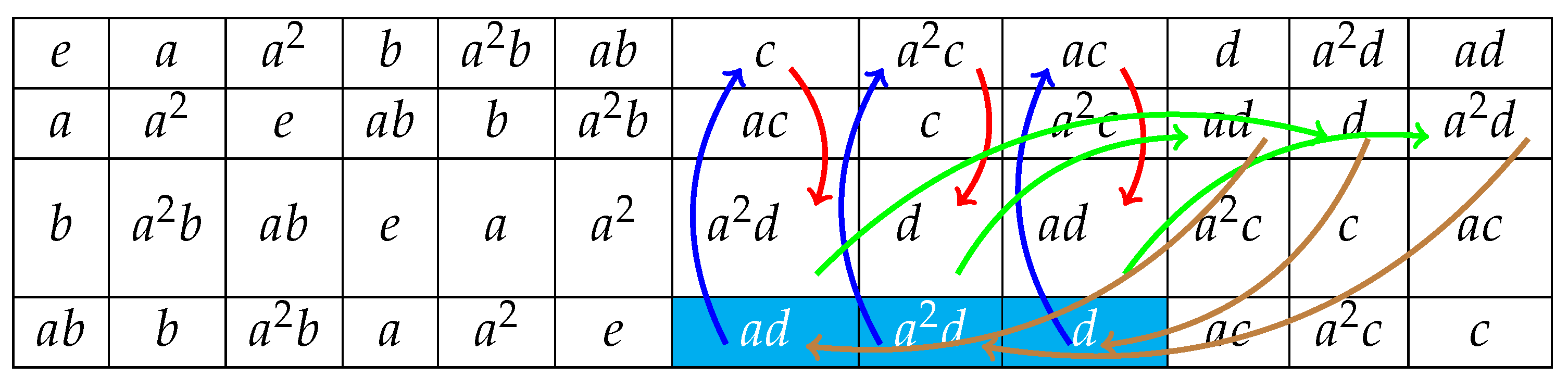
Let us consider the Goethals-Seidel loop , whose multiplication table is the Latin square
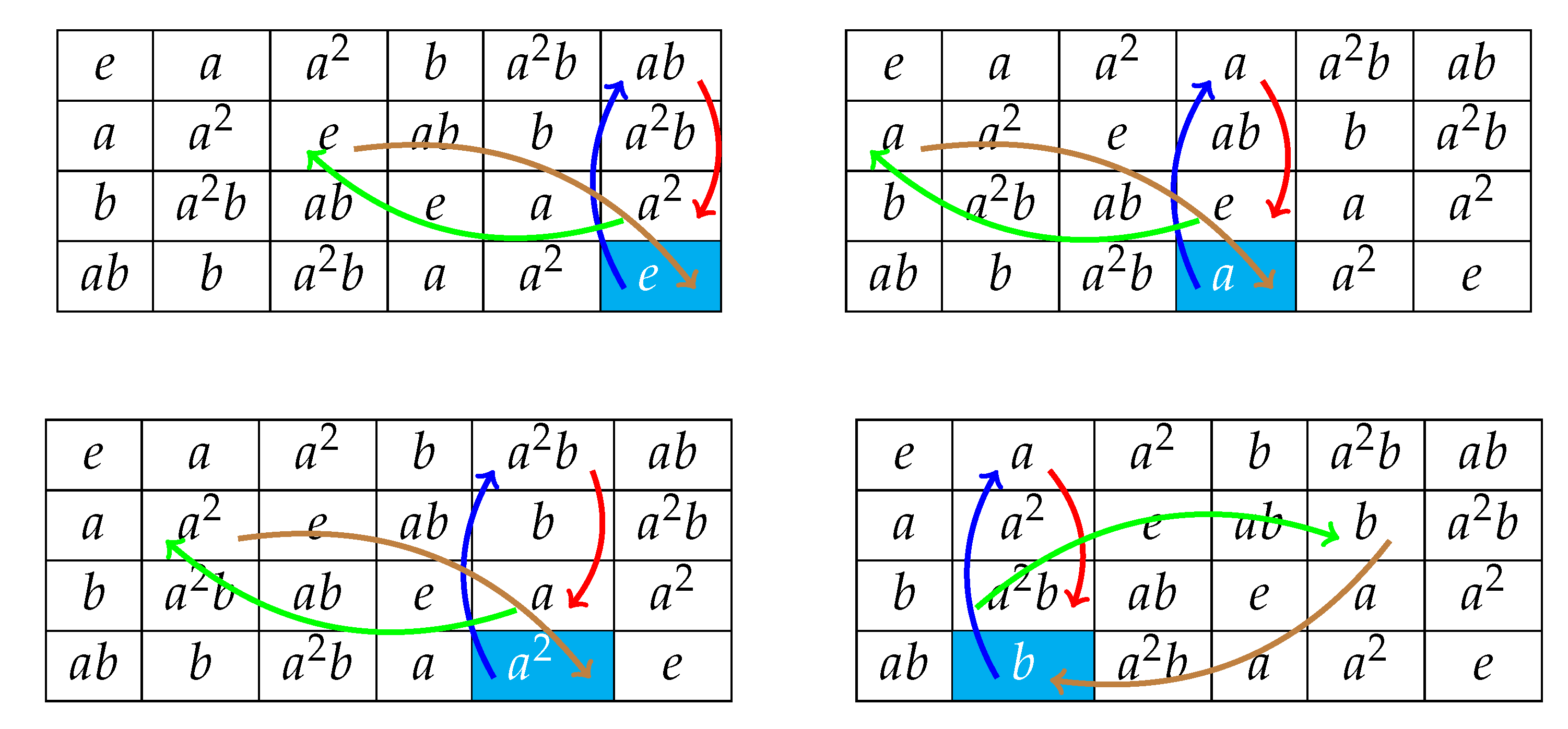
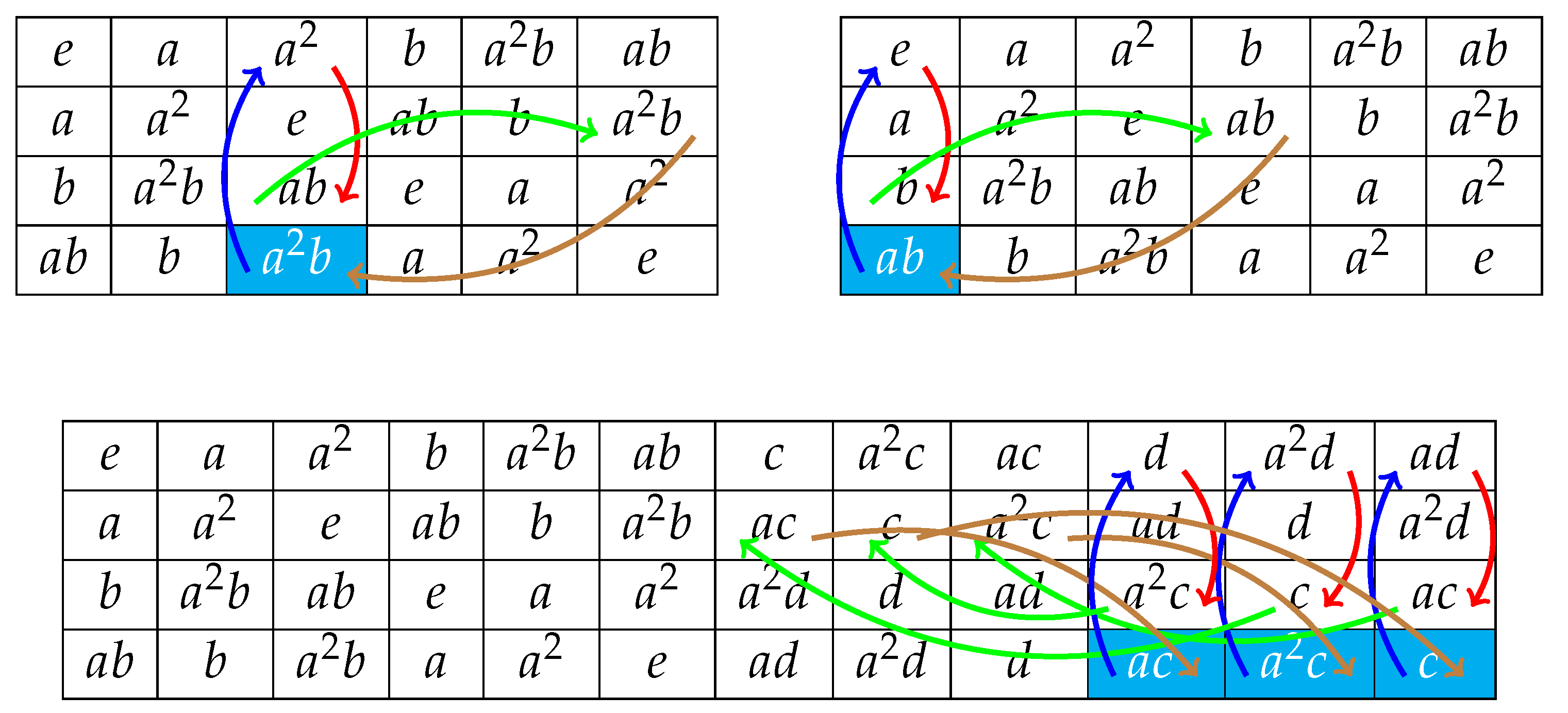
Let us illustrate the computation of all the -cycles in . In order to make it more visual for the reader, we describe all the steps for computing each -cycle in by means of a coloured directed cycle connecting certain cells of the e-, a-, b- and -rows. This directed cycle is defined as follows:
- Firstly, notice that each symbol within the -row is always placed in the same column as the symbol within the e-row, because . We represent this relationship in our coloured directed cycle as a blue arrow from the former to the latter.
- Secondly, since (and hence, ), we add a red arrow from the cell containing the symbol within the e-row to the cell within the b-row that is placed in the same column as the former. This last cell contains the symbol . Next, we add a green arrow from this last cell to the intersection between the a-row and the -column. This last cell contains the symbol .
- Finally, we add a brown arrow from this last cell to that one within the -row containing the symbol .
Due to the Latin square condition and the finiteness of the loop, the output of this procedure is our coloured directed cycle. Its related -cycle is the sequence of symbols in the -row appearing in the same order as they do in the coloured directed cycle. In order to identify such symbols, we colour in cyan the background of the corresponding cells. Thus, for instance, the -cycle containing the element is identified with the coloured directed cycle that is shown in the following array.
More specifically, if , then the non-associative product described in Equation (19) implies that . Now,
In particular, . From the multiplication table, we have that , and hence,
In particular, . From the multiplication table, we have that , and hence,
Hence, the -cycle in containing the element d is the sequence .In a similar way, we obtain that the set may be partitioned into eight -cycles: The already mentioned sequence and the seven sequences
The seven coloured directed cycles related to these last -cycles are represented in the following arrays.
Depending on a given subset , these -cycles might split onto different maximal -walks. For instance, taking , one gets three maximal -paths, namely the -1-cycle and the maximal -walks and .
We now persevere in the analysis of Equation (21). As pointed out in Lemma 2, we focus on the addends corresponding to those indices such that .
Lemma 4.
Let be a Goethals-Seidel pseudococyclic matrix, for as described in Equation (20), and let . Then, the set of indices such that are in one to one correspondence with the ends of the maximal -walks in H, so that either or .
Proof.
In what follows, we refer the reader to Lemma 3 for the notations and . From Lemma 2, every index such that holds precisely one of the following two assertions.
- and . In this case, if we denote , then and hence, h constitutes the bottom end of a maximal -walk in H.
- and . In this case, if we denote , then and hence, h constitutes the upper end of a maximal -walk in H.
Notice that the argument works in both directions. □
Therefore, the study of Equation (21) may be organized in terms of maximal -walks , depending on whether is equal to 1 or . The following result deals with the second case.
Lemma 5.
Under the assumptions of Lemma 4, let be a maximal -walk in H such that . Then, the ends and contribute to Equation (21) with two addends such that .
Proof.
This is a straightforward consequence from the fact that the ends of a maximal walk provide negative signs , as Lemma 4 indicates. □
The case in which the ends of the -walk provide a relation needs a more careful study.
Lemma 6.
Under the assumptions of Lemma 4, let be a maximal -walk in H such that . Then, precisely one element between and is in H. Moreover, it determines uniquely a new maximal -walk in H by means of the left action of .
Proof.
Firstly, notice that any two consecutive links h and (as introduced in Lemma 3) in any -walk in H share a common value , because the matrix is formed by blocks of constant signs (this fact is somehow generalized in Proposition 3).
Secondly, in our case, since the -walk is maximal in H, we have that . However, . Then, it is readily evident from Equation (20) that
where , if , and 1, otherwise. As a consequence, precisely one of the two elements and belongs to H, and hence, a new maximal -walk in H containing such an element is uniquely determined. □
Remark 2.
Lemma 6 introduces a way to determine a new maximal -walk in H from a given maximal -walk in H, with , by means of the left action of , so that just one of the ends of the initial -walk is projected to the new one. From now on and for simplicity on the exposition, we say that the -walk is of type (respectively, ) if it is the bottom end (respectively, the upper end ), the one that is projected on the new maximal -walk in H. Furthermore, since this left action of may indeed be applied on any maximal -walk in H, we also say that the latter is of type (respectively, ) if none of its ends is projected (respectively, its both ends are projected) on the new maximal -walk in H.
In order to show how the procedure of determining new maximal -walks by means of the left action of might be iterated, Proposition 4 describes explicitly such an action on any -path of . To this end, some preliminary results are required. Notice in this regard that, for any appearing in Example 5, both elements and are components of the same triple within the set described in Equations (11)–(14). The same happens for all the components of any given -walk in the mentioned example. Furthermore, notice that the left action of somehow preserves these walks. Thus, for instance, since and , one has that the -walk is projected on the -walk by means of such an action. The following results show how these facts may readily be generalized for every Goethals-Seidel loop.
Lemma 7.
If , then there exists an integer such that .
Proof.
Proposition 3.
Let and let be an -path in a subset of . Let and . Then, there exist a pair of integers such that and .
Proof.
It follows readily from Lemma 7 and the notion of path in a subset of a given quasigroup. □
Proposition 4.
Let be an -path in a subset of , with . Let be pairwise distinct and let . Then, the following assertions hold.
- 1.
- If , with , then the sequence also is an -path in a subset of .
- 2.
- If and exactly one of the following four cases holds, then and both sequences and are -2-cycles in .
- (a)
- , with .
- (b)
- , with .
- (c)
- , with .
- (d)
- , with .
- 3.
- If , then the sequence also is an -path in a subset of , whenever
- (a)
- , with ; or
- (b)
- , with .
Moreover, every -path in a subset of satisfying none of the previous cases coincides indeed with an -1-cycle.
Proof.
Under the assumptions of the first two assertions, one can ensure from Equations (15)–(18) that . Then, since is a Moufang loop, we have from Equation (6) that , for all , because
Thus, in order to prove each one of the first two assertions, it is enough to check that , for all . To this end, we focus on the case . The remaining cases follow similarly, because, from Proposition 3, every has the same form (that is, , , or , with ) than .
Concerning the first assertion, we have that and hence,
Now, concerning the second assertion, we prove separately each one of the four Cases (2a)–(2d).
- In (2a), we have that and hence,Further, since , we have thatNotice that if and only if . In any case, it holds analogously that and hence, both sequences and are -2-cycles, whenever .
- In (2b), we have that and hence,Further,Thus, if and only if . In any case, and thus, both sequences and are -2-cycles, whenever .
- In (2c), we have that and hence,Further,As a consequence, if and only if . In any case, and thus, both sequences and are -2-cycles, whenever .
- Finally, in (2d), we have that and hence,Further,As a consequence, if and only if . In any case, and thus, both sequences and are -2-cycles, whenever .
Let us focus now on the proof of each one of the two Cases (3a) and (3b) of the third assertion.
- In (3a), we have that and hence,Thus, if and only if . If this is the case, we have for each thatIn particular, , for all . Further, we also have for each thatThus, , for all , and hence, the sequence is an -path of a subset of .
- In (3b), we have that and hence,Thus, if and only if . If this is the case, we have for each thatIn particular, , for all . Further, we also have for each thatThus, , for all , and hence, the sequence is an -path of a subset of .
Finally, in order to finish the proof of the last statement of the proposition, it is enough to observe that, for each one of the cases that have not still been considered in the current proof, we have that , for all . □
We are now in conditions to complete the study of Equation (21). To this end, we aim to prove that, under the assumptions of Lemma 6, the pair of ends is uniquely related to another pair of different ends delimiting a maximal -walk in H such that
This new -walk is obtained from the initial one after a finite number of projections by means of the left action of . As commented in Remark 2, for the sake of reading, we make use of brackets and parenthesis for noting which one of the ends of the initial -walk are projected onto the new -walk by means of the action of .
As a final remark, it is convenient to recall that the map of Equation (20) is described as the product of some pseudocoboundaries (those ones that are indexed by the set H) and a cocycle (whose matrix representation is , consisting of -blocks of constant signs). Therefore, checking Equation (23) might eventually require calculating the value of each one of these factors.
In light of Proposition 4, we may distinguish three different cases, depending on the values of the triple . These cases are studied separately in Lemmas 8–10.
Lemma 8.
Under the assumptions of Lemma 6 and Proposition 4 list 1, a maximal -walk in H exists such that Equation (23) holds.
Proof.
Two subcases arise depending on the type ( or ) of the initial -walk.
- 1.
- If the -walk is of type , then its projected maximal -walk by means of the left action of must be of type either or . This is due to the fact that , for all , because , with .In the particular case in which the bottom end is projected (that is, in case of dealing with the type ), it constitutes a foothold to keep on applying once more time the action of . This procedure may be iterated until a projection is achieved providing a maximal -walk of type .
- 2.
- Similarly, if the -walk is of type , then its projected maximal -walk by means of the left action of is necessarily of type either or .In the particular case in which the upper end is projected (that is, in case of dealing with the type ), it constitutes a foothold to keep on applying the action of . This process may be iterated until a projection is achieved providing a maximal -walk of the type .
In both subcases, the iterative procedure finishes, because the subset H is finite and all the resulting -walks are uniquely determined by Lemma 6. Whichever is the case, a maximal -walk in H exists, which preserves the complementary end as compared with the initial projected walk. This implies that
Since , it must be , and hence, Equation (23) holds. □
Lemma 9.
Under the assumptions of Lemma 6 and Proposition 4 list 2, a maximal -walk in H exists such that Equation (23) holds.
Proof.
Attending to Proposition 4, we start from a maximal -1-walk . Furthermore, no matter which among the bottom or the upper end is projected, the projected walk is of the same type as the initial one. Hence,
However, taking into account the possible values for , we have that , and hence, Equation (23) holds. □
Lemma 10.
Under the assumptions of Lemma 6 and Proposition 4 list 3, a maximal -walk in H exists such that Equation (23) holds.
Proof.
This case follows analogously to that of Lemma 8. In particular, once again, two subcases arise depending on whether the bottom or the upper end is projected. No matter or is the case, it is readily checked that under a new action of , any of the -walks in Proposition 4 list 3 projects to another maximal -walk that preserves the opposite end. This is due to the reverse property described in such a proposition.
If the other end is eventually preserved as well, it constitutes a foothold to keep on applying once more time the left action of . This procedure may be iterated until a projection is achieved providing a maximal -walk for which precisely one end is projected by the action of .
The iterative procedure finishes because of being H finite. Furthermore, depending on the parity of the number n of developed projections, one of the following two assertions hold.
- Either and the walks preserve different ends; which implies thatand
- Or and the walks preserve the same ends; which implies thatand
In any case, Equation (23) holds. □
The following result is a straightforward consequence of Lemmas 5 and 8–10.
Lemma 11.
Under the assumptions of Lemma 6, and attending to Equation (21), the set of indices such that may be organized into pairs uniquely determined such that .
Finally, the following lemma supports the sufficient condition of the cocyclic test over Goethals-Seidel arrays, which we show in Theorem 1.
Lemma 12.
Under the assumptions of Lemma 6, Equation (21) holds if and only if the summation of row i in the pseudococyclic matrix is 0.
Proof.
In order to prove that
it suffices to show that both expressions share the same amount of positive and negative addends. Observe in this regard that, if is such that , then the corresponding addends at both sides of Equation (24) are obviously equal. Hence, we can focus on those elements such that . However, Lemma 11 guarantees that such addends come by pairs, which provide summands having opposite signs. □
We are ready to prove that the usual cocyclic test still applies over Goethals-Seidel arrays.
Theorem 1.
Let us consider a positive integer . The Goethals-Seidel array of order is Hadamard if and only if the underlying pseudococyclic matrix of Equation (20) over the Goethals-Seidel loop satisfies the cocyclic Hadamard test.
Proof.
In the proof of Proposition 2, we noticed that the Goethals-Seidel array of order is Hadamard equivalent to the matrix . Since the latter is normalized, a necessary condition for being Hadamard is that the summation of all the elements of its rows (but the first one) is zero, which gives rise to the “only if” condition of the hypothesis. On the other hand, Lemma 12 supports the sufficient condition. □
Example 6.
The pseudococycle gives rise to the following pseudococyclic matrix over ,
Since every row (but the first) sums zero, the matrix is Hadamard.
Remark 3.
The fact that the summation of every row (up to the first) equals zero in the pseudococyclic matrix is equivalent to Equation (4), for . To this end, one takes into account that, for each , the i-row of any pseudocoboundary matrix consists of two negative entries, which are located precisely at the h- and the -columns (except for the h-row, which consists all of s, up to entries at the 1- and h-columns).
5. Conclusions and Further Work
Beyond the work of some of the authors in [12], this paper progresses on the idea of extending the theory of cocyclic matrices over groups, focusing on quasigroups. More specifically, we introduce here the concepts of pseudocoboundary and pseudococycle over a quasigroup, and also the notion of the pseudococyclic Hadamard matrix.
We have also provided some general structures that might be used for studying pseudococyclic matrices over quasigroups. This is the case of -walks.
In particular, Goethals-Seidel arrays have been shown to be pseudococyclically developed over Goethals-Seidel loops. Furthermore, no matter if they are pseudococyclic matrices, the usual cocyclic Hadamard test has been shown to be unexpectedly applicable. Notice that this is an unusual fact, as Example 4 shows.
It is an open question whether some assumption may be imposed in order to generalize this behavior to other families of loops (either Moufang as well or not).
The door to promising new tools for looking for (pseudo)cocyclic Hadamard matrices over loops is open. In particular, the following major problems might be considered.
- Show whether these new (pseudo)cocyclic structures strictly extend the usual cocyclic framework, in the sense that some Hadamard equivalence classes which are known not to be cocyclic over groups are actually (pseudo)cocyclic over some loops.
- Construct some new Hadamard matrices (pseudo)cocyclically developed over loops of orders for which no (cocyclic) Hadamard matrix is still known to exist.
This will be the concern of our future work.
Author Contributions
Conceptualization, V.Á., J.A.A., R.M.F. and F.G.; Data curation, J.A.A., M.D.F., F.G., M.B.G. and A.O.; Formal analysis, V.Á., J.A.A., R.M.F. and F.G.; Investigation, V.Á. and R.M.F.; Methodology, V.Á., M.D.F. and M.B.G.; Software, V.Á. and R.M.F.; Supervision, J.A.A. and F.G.; Validation, M.D.F., M.B.G. and A.O.; Writing—original draft, V.Á. and A.O.; Writing—review & editing, V.Á., R.M.F. and M.D.F. All authors have read and agreed to the published version of the manuscript.
Funding
This work is partially supported by the Research Projects FQM-016 from Junta de Andalucía.
Acknowledgments
The authors want to express their gratitude to the anonymous referees for the comprehensive reading of the paper and their pertinent comments and suggestions, which helped improve the manuscript.
Conflicts of Interest
The authors declare no conflict of interest. The funders had no role in the design of the study; in the collection, analyses, or interpretation of data; in the writing of the manuscript, or in the decision to publish the results.
References
- Horadam, K.J.; de Launey, W. Cocyclic development of designs. J. Algebr. Combin. 1993, 2, 267–290, Erratum J. Algebr. Combin. 1994, 3, 129. [Google Scholar] [CrossRef]
- Horadam, K.J.; de Launey, W. Generation of cocyclic Hadamard matrices. Math. Appl. 1995, 325, 279–290. [Google Scholar]
- De Launey, W.; Flannery, D.L.; Horadam, K.J. Cocyclic Hadamard matrices and difference sets. Discret. Appl. Math. 2000, 102, 47–61. [Google Scholar] [CrossRef]
- De Launey, W.; Smith, M.J. Cocyclic orthogonal designs and the asymptotic existence of cocyclic Hadamard matrices and maximal size relative difference sets with forbidden subgroup of size 2. J. Combin. Theory Ser. A 2001, 93, 37–92. [Google Scholar] [CrossRef][Green Version]
- Horadam, K.J. Hadamard Matrices and Their Applications; Princeton University Press: Princeton, NJ, USA, 2007. [Google Scholar]
- Ó Catháin, P. Group Actions on Hadamard Matrices. MS.c Thesis, National University of Ireland, Galway, Ireland, 2008. [Google Scholar]
- De Launey, W.; Flannery, D. Algebraic Design Theory; American Mathematical Society: Providence, RI, USA, 2011. [Google Scholar]
- Egan, R.; Flannery, D.L. Automorphisms of generalized Sylvester Hadamard matrices. Discrete Math. 2017, 340, 516–523. [Google Scholar] [CrossRef]
- Fletcher, R.J.; Gysin, M.; Seberry, J. Application of the discrete Fourier transform to the search for generalised Legendre pairs and Hadamard matrices. Australas. J. Combin. 2001, 23, 75–86. [Google Scholar]
- Goethals, J.M.; Seidel, J.J. Orthogonal matrices with zero diagonal. Canad. J. Math. 1967, 19, 1001–1010. [Google Scholar] [CrossRef]
- Đoković, D.Ž.; Kotsireas, I.S. Goethals-Seidel difference families with symmetric or skew base blocks. Math. Comput. Sci. 2018, 12, 373–388. [Google Scholar] [CrossRef]
- Álvarez, V.; Falcón, R.M.; Frau, M.D.; Gudiel, F.; Güemes, M.B. Cocyclic Hadamard matrices over Latin rectangles. Eur. J. Comb. 2019, 79, 74–96. [Google Scholar] [CrossRef]
- Eilenberg, S.; MacLane, S. Cohomology theory in abstract groups I. Ann. of Math. 1947, 48, 51–78. [Google Scholar] [CrossRef]
- Eilenberg, S.; MacLane, S. Cohomology theory in abstract groups II. Group extensions with a non-abelian kernel. Ann. Math. 1947, 48, 326–341. [Google Scholar] [CrossRef]
- Eilenberg, S.; MacLane, S. Algebraic cohomology groups and loops. Duke Math. J. 1947, 14, 435–463. [Google Scholar] [CrossRef]
- Johnson, K.W.; Leedham-Green, C.R. Loop cohomology. Czechoslov. Math. J. 1990, 40, 182–194. [Google Scholar]
- Daly, D.; Vojtěchovský, P. Enumeration of nilpotent loops via cohomology. J. Algebra 2009, 322, 4080–4098. [Google Scholar] [CrossRef][Green Version]
- Jimenez, R.; Meléndez, Q.M. On loop extensions satisfying one single identity and cohomology of loops. Comm. Algebra 2017, 45, 3667–3690. [Google Scholar] [CrossRef]
- Smith, J.D.H. An Introduction to Quasigroups and Their Representations; Chapman& Hall/CRC: Boca Raton, FL, USA, 2007. [Google Scholar]
- Lal, R.; Sharma, B.K. Pseudo-cohomology of general extensions. Homol. Homotopy Appl. 2010, 12, 147–165. [Google Scholar] [CrossRef]
- Smith, J.D.H. Loops and quasigroups: Aspects of current work and prospects for the future. Comment. Math. Univ. Carol. 2000, 41, 415–427. [Google Scholar]
- Keedwell, A.D.; Dénes, J. Latin Squares and Their Applications; Elsevier/North-Holland: Amsterdam, The Netherlands, 2015. [Google Scholar]
- Shcherbacov, V. Elements of Quasigroup Theory and Applications; CRC Press: Boca Raton, FL, USA, 2017. [Google Scholar]
- Seberry, J.; Yamada, M. Hadamard matrices, sequences, and block designs. In Contemporary Design Theory: A Collection of Surveys; Dinitz, J.H., Stinson, D.R., Eds.; Wiley: New York, NY, USA, 1992; pp. 431–560. [Google Scholar]
- Bruck, R.H. A Survey of Binary Systems; Springer: New York, NY, USA, 1958. [Google Scholar]
- Spence, E. Skew-Hadamard matrices of the Goethals-Seidel type. Canad. J. Math. 1975, 27, 555–560. [Google Scholar] [CrossRef]
- Whiteman, A.L. Hadamard matrices of order 4(2p + 1). J. Number Theory 1976, 8, 1–11. [Google Scholar] [CrossRef]
- Đoković, D.Ž. Ten new orders for Hadamard matrices of skew type. Publikacije Elektrotehničkog fakulteta. Serija Matematika 1992, 3, 47–59. [Google Scholar]
- Đoković, D.Ž. Ten Hadamard matrices of order 1852 of Goethals-Seidel type. European J. Combin. 1992, 13, 245–248. [Google Scholar] [CrossRef][Green Version]
- Đoković, D.Ž. Five new orders for Hadamard matrices of skew type. Australas. J. Combin. 1994, 10, 259–264. [Google Scholar]
- Đoković, D.Ž. Skew-Hadamard matrices of orders 436, 580, and 988 exist. J. Combin. Des. 2008, 16, 493–498. [Google Scholar] [CrossRef][Green Version]
- Đoković, D.Ž. Supplementary difference sets with symmetry for Hadamard matrices. Oper. Matrices 2009, 3, 557–569. [Google Scholar] [CrossRef]
- Đoković, D.Ž.; Golubitsky, O.; Kotsireas, I. Some new orders of Hadamard and skew-Hadamard matrices. J. Combin. Des. 2014, 22, 270–277. [Google Scholar] [CrossRef]
- Đoković, D.Ž.; Kotsireas, I. A class of cyclic (v; k1, k2, k3; λ) difference families with v ≡ 3 (mod 4) a prime. Spec. Matrices 2016, 4, 317–325. [Google Scholar]
- Flannery, D.L. Calculation of cocyclic matrices. J. Pure Appl. Algebra 1996, 112, 181–190. [Google Scholar] [CrossRef]
- Flannery, D.L. Cocyclic Hadamard matrices and Hadamard groups are equivalent. J. Algebra 1997, 192, 749–779. [Google Scholar] [CrossRef]
- Ó Catháin, P.; Röder, M. The cocyclic Hadamard matrices of order less than 40. Des. Codes Cryptogr. 2011, 58, 73–88. [Google Scholar] [CrossRef]
- Kharaghani, H.; Tayfeh-Rezaie, B. On the classification of Hadamard matrices of order 32. J. Combin. Des. 2010, 18, 328–336. [Google Scholar] [CrossRef]
- Kharaghani, H.; Tayfeh-Rezaie, B. Hadamard matrices of order 32. J. Combin. Des. 2012, 21, 212–221. [Google Scholar] [CrossRef]
- Moufang, R. Zur Struktur von Alternativkörpern. Math. Ann. 1935, 110, 416–430. [Google Scholar] [CrossRef]
© 2019 by the authors. Licensee MDPI, Basel, Switzerland. This article is an open access article distributed under the terms and conditions of the Creative Commons Attribution (CC BY) license (http://creativecommons.org/licenses/by/4.0/).