1. Introduction
Special functions possess a lot of importance in numerous fields of physics, mathematics, applied sciences, engineering and other related research areas including functional analysis, differential equations, quantum mechanics, mathematical analysis, mathematical physics, and so on [
1,
2,
3,
4,
5,
6,
7,
8,
9,
10,
11,
12,
13,
14,
15,
16,
17,
18,
19,
20,
21,
22,
23,
24,
25,
26,
27,
28,
29,
30,
31,
32,
33,
34,
35,
36] and see the references cited therein. For example; Riemann zeta function is closely related with the Bernoulli numbers and its zeros possess a connection with the distribution of prime numbers [
12]. In particular, the family of special polynomials is one of the most useful and applicable family of special functions. Some of the most considerable polynomials in the theory of special polynomials are the Fubini polynomials (see [
9,
15,
16,
17,
36]), the Bernoulli polynomials (see [
2,
5,
6,
7,
11,
13,
29,
31,
32,
33,
34,
35]), the Euler polynomials (see [
2,
5,
6,
7,
11,
27,
29,
31,
32,
33,
34,
35]), the Bernstein polynomials (see [
1,
20]) and the Bell polynomials (see [
3,
4,
18,
19,
22,
23,
24,
25]). Recently, the aforementioned polynomials and their several extensions have been densely studied and investigated by diverse mathematicians and physicists [
1,
2,
3,
4,
5,
6,
7,
8,
9,
10,
11,
12,
13,
14,
15,
16,
17,
18,
19,
20,
21,
22,
23,
24,
25,
26,
27,
28,
29,
30,
31,
32,
33,
34,
35,
36] and see also each of the references cited therein.
Throughout this paper, the familiar symbols , , , and are referred to the set of all complex numbers, the set of all real numbers, the set of all integers, the set of all natural numbers and the set of all non-negative integers, respectively.
The truncated exponential polynomials
are the first
terms of the Mac Laurin series for
([
8]), i.e.,
This polynomial has the following integral representation:
The classical generating function of the truncated exponential polynomials is as follows ([
8])
By means of the aforesaid generating function, one can easily get the following derivative relations:
and
For more detailed information about the truncated exponential polynomials, see [
8] and the references cited therein.
The traditional Pochhammer symbol
(sometimes called the descending factorial, falling sequential product, falling factorial, or lower factorial) is defined by (see [
2,
3,
5,
10,
11,
17,
20,
21,
22,
23,
25,
26,
34])
The
-extension of the usual Pochhammer symbol
is given by (see [
5,
10,
11,
17,
20,
21,
22,
23,
25,
26])
Please note that .
The
difference operator of a function is defined by (see [
11])
The following difference rule holds true ([
11]):
where the notation
denotes the
k times applying the
difference operators.
Let
. The degenerate exponential function
is defined by ([
5,
10,
11,
14,
17,
20,
21,
22,
23,
25,
26])
It is readily seen that
. From (
10), we obtain the following relation
which satisfies the following difference rule
By Equation (
11), we can write
While the truncated exponential polynomials
(
1) are the first
terms of the Mac Laurin series for usual exponential function
, the degenerate truncated exponential polynomials are introduced as the first
terms of the Mac Laurin series expansion of the degenerate exponential function
in (
11) will be given in the next section.
The generating function is a key tool for a family of special polynomials if they have to derive their properties and relations. It is also used in other fields, for example, a study of false positive/negative effects on network robustness [
37] and in statistics as moment generating function [
10].
Carlitz [
5] introduced and studied the degenerate Bernoulli polynomials by means of the degenerate exponential functions as follows:
Then Howard [
14] provided several explicit formulas for the degenerate Bernoulli polynomials and gave a new proof of the degenerate Staudt-Clausen theorem. In the recent years, the degenerate forms for the specials polynomials have been heavily considered and developed by many mathematicians [
5,
10,
11,
14,
17,
20,
21,
22,
23,
25,
26] and see also each of the references cited therein. Duran et al. [
10] considered three extensions of the Stirling polynomials of the second kind by means of the degenerate exponential functions and then showed that these polynomials appear in the expressions of the probability distributions of proper random variables such as degenerate Poisson distribution, degenerate zero-truncated Poisson distribution and degenerate
r-truncated Poisson distribution. Duran et al. [
11] introduced the Gould–Hopper-based fully degenerate poly-Bernoulli polynomials with a
q-parameter and developed their properties and relations. Kim et al. [
17] defined a new class of degenerate Fubini numbers and polynomials and investigated diverse properties of these polynomials and numbers. Kim et al. [
20] introduced the degenerate Bernstein polynomials and acquired their exponential generating function, recurrence relations, symmetric identities, and some connected formulas with generalized falling factorial polynomials, higher-order degenerate Bernoulli polynomials and degenerate Stirling numbers of the second kind. Kim et al. [
21] the degenerate
-Stirling polynomials of the second kind and provided some applications for these polynomials. Kim et al. [
22] defined the degenerate Bell numbers and polynomials and examined various novel relations and formulas. Kim et al. [
23] studied the degenerate
r-Stirling numbers of the second kind and the degenerate
r-Bell polynomials investigated several properties, recurrence relations and formulas by means of umbral calculus. Kim et al. [
25] considered the partially degenerate Bell polynomials numbers and developed their properties and identities. Kim et al. [
26] defined the degenerate Stirling polynomials of the second kind and gave some new identities for these polynomials.
In the family of special polynomials, in the recent years, the truncated forms for polynomials have been worked and investigated by various mathematicians [
8,
9,
13,
27,
33] and see also the references cited therein. Dattoli et al. [
8] introduced the higher-order truncated polynomials which plays a role of crucial importance in the evaluation of integrals involving products of special functions and discussed them within the more general context of the Appell family and the Laguerre family. Duran et al. [
9] considered the two-variable truncated Fubini polynomials and numbers and then investigated multifarious relations and formulas including summation formulas, recurrence relations, derivative property and correlations with the truncated Stirling numbers of the second kind, Apostol-type Stirling numbers of the second kind, the truncated Bernoulli polynomials and truncated Euler polynomials. Hassen et al. [
13] defined the truncated Bernoulli polynomials and derived several properties. Komatsu et al. [
27] considered the truncated Euler polynomials and presented their some properties and relations with the truncated Bernoulli polynomials. Srivastava et al. [
33] examined the truncated-exponential-based Apostol-type polynomials and derived their various properties covering some implicit summation formulas and symmetric identities.
The rest of this paper is structured as follows:
Section 2 provides the definition of the degenerate truncated exponential polynomials and then proves their properties. In
Section 3, the degenerate truncated Stirling polynomials of the second kind are introduced and their elementary properties and relations are examined properly. The
Section 4 deals with the degenerate forms of the bivariate truncated Fubini polynomials and numbers and then investigates several relations and formulas for these polynomials and numbers, which covers several summation formulas, addition identities, recurrence relationships, derivative property and correlations with the degenerate truncated Stirling polynomials of the second kind. The truncated degenerate Bernoulli and Euler polynomials are introduced and multifarious correlations and formulas including summation formulas, derivation rules and correlations with the degenerate truncated Stirling numbers of the second kind are derived in the
Section 5.
Section 6 includes the definition of the degenerate truncated forms of the bivariate Bell polynomials and numbers and also diverse identities and correlations, which includes addition formulas, summation formulas, recurrence relationships, difference operator property and derivative rules are acquired.
Section 7 first supplies the degenerate truncated forms of the classical Bernstein polynomials and then investigates diverse correlations and formulas including several polynomials such as the degenerate truncated Bernstein polynomials, the bivariate
-Fubini polynomials, the bivariate
-Bell polynomials, the
-Bernoulli polynomials, the
-Stirling polynomials of the second kind and the
-Euler polynomials. The last section of this paper analyzes the results obtained in this paper.
2. The Truncated Degenerate Exponential Polynomials
In this section, we consider the degenerate truncated exponential polynomials and then investigate their properties.
We consider the degenerate form of the truncated exponential polynomials, therefore we give the following definition.
Definition 1. The degenerate truncated exponential polynomials are introduced as the first terms of the Taylor series expansion of in (11) at : We choose to call the -exponential polynomials as well as the degenerate truncated exponential polynomials.
We now examine a special case of the aforementioned polynomials as follows.
Remark 1. When , the -exponential polynomials (13) reduces to the truncated exponential polynomials in (1). The classical exponential generating function of the -exponential polynomials are given by the following proposition.
Proof. To find the generating function of the
-exponential polynomials, for
, we consider
which implies the assertion (
14). □
We now give the following proposition.
Proposition 2. The following difference operator rule holds true: Proof. By means of (
14), we observe
which gives the claimed result (
15) by comparing the coefficients of the first and the last series with respect to
z. □
We provide the following recurrence formula.
Proposition 3. The following recurrence relationis valid for . Proof. By Equation (
14), we observe that
which gives
which means the asserted result (
16). □
3. Degenerate Truncated Stirling Polynomials of the Second Kind
In this section, we introduce the degenerate truncated Stirling polynomials of the second kind and analyze their elementary properties and relations.
The Stirling polynomials
and numbers
of the second kind are given by the following exponential generating functions ([
9,
10,
11,
18,
21,
23,
24,
26,
34]):
In combinatorics, Stirling number of second kind
counts number of ways in which
n distinguishable objects can be partitioned into
k indistinguishable subsets when each subset must contain at least one object. The Stirling numbers of the second kind can also be derived by the following recurrence relation for a fixed non-negative integer
([
9,
10,
11,
18,
21,
23,
24,
26,
34]):
where the notation
is mentioned in (
6).
Let
and
. The Apostol-type Stirling polynomials
and numbers
of the second kind is defined as follows ([
28]):
Here is the definition of the degenerate truncated Apostol-type Stirling polynomials of the second kind which we choose to call the Apostol-type -Stirling polynomials of the second kind as follows.
Definition 2. Let x be an independent variable. The degenerate truncated Apostol-type Stirling polynomials and numbers of the second kind are introduced by the following generating functions:and Diverse special circumstances of and are discussed below:
Remark 2. In the case in (20), we attain the -Stirling polynomials and numbers of the second kind and , which are also new generalizations of the usual Stirling polynomials and numbers of the second kind in (17), as follows:and Remark 3. When λ approaches to zero, the Apostol-type -Stirling polynomials of the second kind become the truncated Apostol-type Stirling polynomials of the second kind given by the following series expansion ([10,21]): Remark 4. Substituting in (20), we get the degenerate Apostol-type Stirling polynomials of the second kind defined by ([10,21,23]): Remark 5. Letting in (20), we obtain the degenerate Stirling polynomials of the second kind provided by ([10,21,23]): Remark 6. Upon setting in (20), the truncated Stirling numbers of the second kind reduce to the classical Stirling numbers of the second kind by (17). We now ready to derive some properties of the
. By means of (
20) and (
21), we observe that
Henceforth, we state the following relation.
Proposition 4. The following relation holds true: By Equation (
20), we get
which yields the following result.
Proposition 5. The following summation formula holds true: The Apostol-type -Stirling polynomials of the second kind satisfy the following correlation.
Proposition 6. The following relationis valid for non-negative integers m and n. Proof. In view of Equations (
17) and (
20), we have
which means the asserted result (
27). □
We now provide the following relationship.
Proposition 7. The following relationholds true for non-negative integers m and n. Proof. In view of (
22) and (
25), we have
which presents the desired result (
28). □
We give the following proposition below.
Proposition 8. The following series representationis valid for non-negative integers m and n. Proof. From Equation (
20), we see that
which implies the asserted result (
29). □
4. The Truncated Degenerate Fubini Polynomials
In this section, we perform to introduce and analyze the degenerate forms of the bivariate truncated Fubini polynomials and numbers. We then investigate many relations and formulas for these polynomials and numbers, which covers several summation formulas, addition identities, recurrence relationships and derivative property. We also give some formulas associated with the Apostol-type -Stirling polynomials of the second kind and the -Stirling polynomials of the second kind.
We first remember the usual two variables Fubini polynomials by the following generating function ([
9,
15,
16,
36]):
When
in (
30), the two variables Fubini polynomials
reduce to the usual Fubini polynomials given by ([
9,
15,
16,
17,
36]):
For
, it is not difficult to investigate the following correlations ([
9,
16,
17,
36]):
Substituting
y by 1 in (
31), we have the familiar Fubini numbers
([
9,
16,
17,
36]) below:
For non-negative integer
m, the bivariate truncated Fubini polynomials are defined via the following exponential generating function [
9]:
In the case
in (
34), we then get a new type of the Fubini polynomials which we call the truncated Fubini polynomials ([
9]) given by
Upon setting
and
in (
34), we then attain the truncated Fubini numbers
([
9]) given by the following Mac Laurin series expansion at
:
For detailed information about the applications of the familiar Fubini polynomials and numbers [
9,
15,
16,
17,
36] and see also the references cited therein.
We now define the degenerate form of the bivariate truncated Fubini polynomials by means of the
-exponential polynomials
(
13) as follows.
Definition 3. Let x and y be two independent variables and , The bivariate degenerate truncated Fubini polynomials are defined via the following exponential generating function:where by (13). We choose to call the bivariate -Fubini polynomials in addition to the bivariate degenerate truncated Fubini polynomials.
In the case
in (
37), we then get a new type of the Fubini polynomials which we call the
-Fubini polynomials given by
Upon setting
and
in (
37), we then attain the
-Fubini numbers
defined by the following Taylor series expansion about
:
The bivariate -Fubini polynomials includes extensions of the several known polynomials and numbers that we discuss below.
Remark 7. In (37), upon setting ; and ; and ; , and in the different special cases, the polynomials reduce to the two variables truncated Fubini polynomials by (34); the two variables Fubini polynomials by (30); the usual Fubini polynomials by (31); the familiar Fubini numbers by (33), respectively. We now ready to examine the relations and properties for the bivariate -Fubini polynomials and so, we first give the following theorem below.
Theorem 1. The following summation formulaholds true for non-negative integers m and n. Proof. By (
37), using the Cauchy product rule, we observe that
which provides the asserted result (
40). □
We now provide two addition formulas for the bivariate -Fubini polynomials as follows.
Theorem 2. The following addition formulasandare valid for non-negative integers m and n. Proof. In view of (
37), we get
and
which yields the assertions in (
41) and (
42). □
A relation between and is given by the following theorem.
Theorem 3. The bivariate -Fubini polynomials are given byin terms of the -Stirling polynomials of the second kind for a complex number y in conjunction with and . Proof. By means of (
22) and (
37), we see that
which implies the desired result (
43). □
We now state the following theorem.
Theorem 4. Let . The following identityholds true for with . Proof. By (
25) and (
37), we observe that
which provides the asserted result (
44). □
We now provide difference property for the polynomials as follows.
Theorem 5. The following operator formulaholds true for . Proof. By applying the difference operator
(
12) to both sides of Formula (
37), we attain
and we then have
which implies the claimed difference formula in (
45). □
A derivative formula for the bivariate -Fubini polynomials is as follows.
Theorem 6. The following formulaholds true for . Proof. By applying the derivative operator
with respect to
x to both sides of Formula (
37), we then derive
which gives the assertion in (
46). □
A recurrence relation for the bivariate -Fubini polynomials is stated by the following theorem.
Theorem 7. The following equalitiesandis valid for . Proof. By using the Definition 3, we can write
By virtue of the following equality
we investigate
Therefore, we conclude that
Combining the coefficients of both sides of the last equality, the assertion in (
47) is acquired accurately. □
By means of the Theorem 7, we can compute the n-th bivariate -Fubini polynomials, some of which are determined as follows.
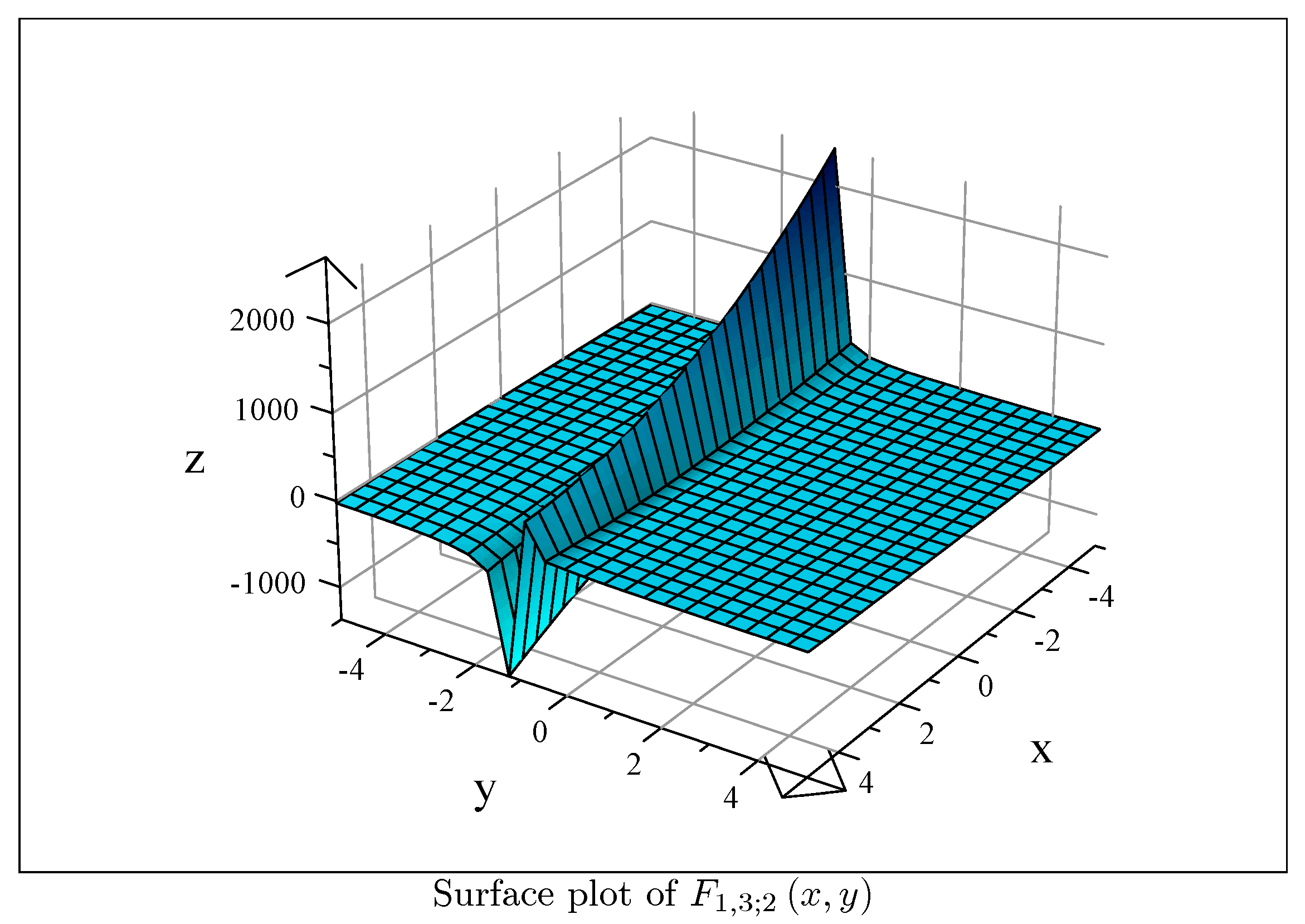
Example 1. Choosing , then we have By using the recurrence Formula (47), we obtainThus, we subsequently acquirewhich implies the following -Fubini polynomials by choosing : Moreover, upon letting
for the polynomials
, we then obtain
which possess the following quirky surface plot in
Figure 1.
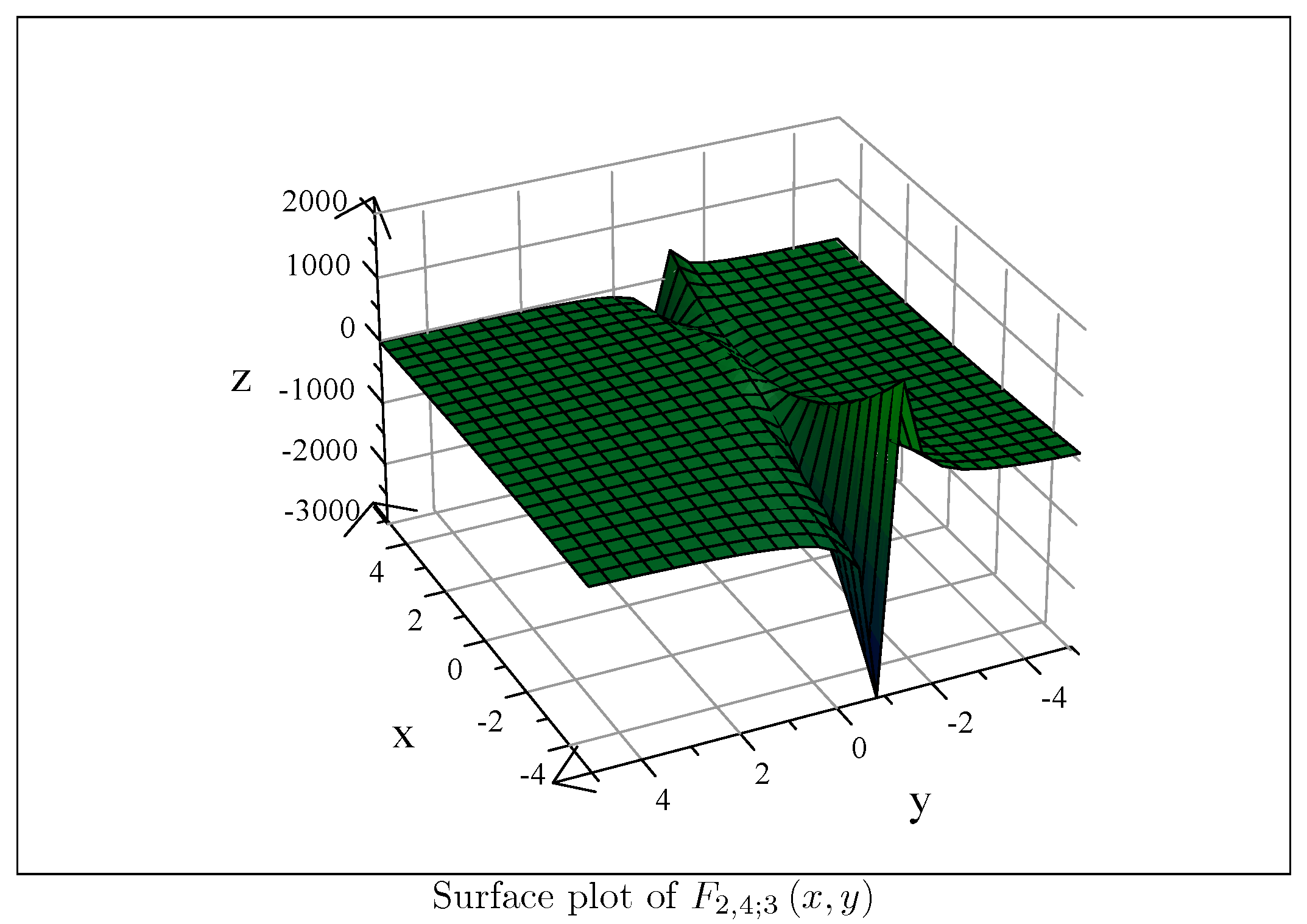
Example 2. By letting in (47), we obtain the following recurrence relation The last formula reveals the following polynomialswhich gives the following -Fubini polynomials by taking : By applying similar method used above, the others can be derived conveniently.
If we choose
for
, we then get
which has the following interesting surface plot in
Figure 2.
Here is a correlation between the bivariate -Fubini polynomials and the degenerate Stirling numbers of the second kind.
Theorem 8. For non-negative integer n and m, we have Proof. By using the formula ([
26])
in conjunction with the Theorem 1, we derive
which completes the proof of this theorem. □
Let
n be a positive integer. The rising factorial for a number
x is given by
([
9,
27]). We note that the negative binomial expansion is given by the following series:
for negative integer
and
, [
9,
27].
Here, we give the following theorem.
Theorem 9. The following relationshipholds true for non-negative integers n and m. Proof. By means of the Definition 3 and in terms of Equations (
26) and (
49), we attain
which gives the asserted result (
50). □
We give the following theorem.
Theorem 10. The following recurrence relationshipholds true for . Proof. With the help of the Definition 3, we see that
Thus, we get
and then
which implies the claimed Formula (
51). □
A linear combination of the bivariate -Fubini polynomials for different x and y values is given by the following theorem.
Theorem 11. Let and . The following relationship holds true: Proof. By Definition 3, we first consider the following product
which yields
Thus, we get
which implies the assertion in (
52). □
5. The Truncated Degenerate Bernoulli and Euler Polynomials
In this section, we introduce the truncated degenerate Bernoulli and Euler polynomials and investigated multifarious correlations and formulas including summation formulas, derivation rules and correlations with the degenerate truncated Stirling numbers of the second kind.
The classical Bernoulli
and Euler
polynomials ([
6,
13,
27,
35]) and the Apostol-type Bernoulli
and the Apostol-type Euler
polynomials ([
2,
7,
31,
33,
34]) are given as follows:
and
The usual degenerate Bernoulli
and Euler
polynomials ([
5,
11,
14,
32]) and Apostol-type degenerate Bernoulli
and Euler
polynomials are given as follows ([
32]):
The truncated Bernoulli polynomials
and the truncated Euler polynomials
are defined by the following exponential generating functions ([
9,
13,
27]):
and
Several degenerate and truncated forms of the Bernoulli and Euler polynomials have been recently studied and investigated by many mathematicians, [
5,
9,
11,
13,
14,
27,
32].
We now introduce the degenerate forms of the truncated Bernoulli and the truncated Euler polynomials by means of the degenerate exponential function in (
11) as follows.
Definition 4. Let x be an independent variable. The degenerate truncated Bernoulli and the degenerate truncated Euler polynomials are defined by the following exponential generating functions:and We choose to call the -Bernoulli and -Euler polynomials besides the degenerate truncated Bernoulli and the degenerate truncated Euler polynomials, respectively.
When
in Definition 4, the
-Bernoulli polynomials
and
-Euler polynomials
reduce to the corresponding numbers called the
-Bernoulli numbers denoted by
and the
-Euler numbers denoted by
:
and
We now perform to derive some properties of the aforementioned polynomials and we first give the following correlations.
Theorem 12. Each of the following summation formulasandhold true. Proof. In view of the Definition 4 and using Formulas (
57) and (
58), we get
and
which completes the proof of the Theorem 12. □
Two addition formulas for the -Bernoulli polynomials and -Euler polynomials are presented in the following theorem.
Theorem 13. The following relationshipsandare valid. Proof. In terms of the Definition 4 and using Formulas (
57) and (
58), we get
and
which implies Formulas (
61) and (
62). □
The immediate special cases of the Theorem 13 is debated below.
Corollary 1. The following explicit relationsandhold true. We now provide difference operator properties for the polynomials and as follows.
Theorem 14. The difference operator formulas for the -Bernoulli and -Euler polynomialshold true for . Proof. By applying difference operator
(
12) to both sides of Formulas (
55) and (
56), respectively, we attain
and
which gives the claimed difference properties in (
65). □
The -Bernoulli polynomials and the -Euler polynomials satisfy the following derivative properties.
Proof. By using the similar proof method in Theorem 6, the proof of (
66) and (
67) can be readily done. We, consequently, choose to omit details involved. □
A recurrence relation for the -Bernoulli polynomials is given by the following theorem.
Theorem 16. The following recurrence relationshipholds true for . Proof. By means of the Definition 4, we see that
Thus, we get
and then
which implies the claimed Formula (
51). □
A summation identity for the -Euler polynomials is presented in the following theorem.
Theorem 17. The following recurrence formulais valid for . Proof. From Definition 3, we can write
Hence, we observe that
and
which means the asserted result (
69). □
We give the following theorem.
Theorem 18. The following formula including the -Bernoulli polynomialsis valid for . Proof. From Definition 3, we obtain
which yields to the following equality:
Thus, we complete the proof just comparing the coefficients of the both sides of the last equality. □
We note that Formula (
70) is an extension of the well-known formula for the familiar Bernoulli polynomials given by ([
6]):
We provide an identity for -Euler polynomials as follows.
Theorem 19. The following identityis true for . Proof. From Definition 3, we obtain
which yields to the following equality:
Thus, we complete the proof just comparing the coefficients of the both sides of the last equality. □
We notice that the identity (
71) is a generalization of the well-known identity for the usual Euler polynomials stated below ([
6]):
Here, we give the following theorem including the -Bernoulli polynomials and numbers as well as the degenerate Stirling polynomials of the second kind.
Theorem 20. The following correlationholds true for non-negative integers n and m. Proof. By means of the Definition 4 and using Equations (
26) and (
57), we attain
which gives the asserted result (
72). □
We also provide a relationship involving the -Euler polynomials and numbers in addition to the degenerate Stirling polynomials of the second kind.
Theorem 21. The following identityis valid for . Proof. By the Definition 4 and using Formulas (
26) and (
58), we attain
which gives the assertion (
73). □
Now, we introduce the
-Bernoulli polynomials
of order
r and
-Euler polynomials
of order
r by the following exponential generating functions:
and
Remark 8. Upon letting in (74) and (75), the -Bernoulli polynomials of order r and -Euler polynomials reduce to the Bernoulli polynomials of order r and the Euler polynomials given by ([35]): Remark 9. When , the polynomials in (74) and (75) reduce to the corresponding numbers, which we call the -Bernoulli and -Euler numbers of order r, respectively, given byand We first give the following correlations.
Proof. In view of (
74) and (
75), we get
and
which completes the proof of the Theorem 22. □
Addition properties of the -Bernoulli and -Euler polynomials of order r are given by the following theorem without proofs.
Proof. By using the generating functions in (
74) and (
75),we can acquire the assertions given by Theorem 23. The details involved are being omitted here. □
A correlation including the -Bernoulli polynomials of order r and the -Stirling polynomials of the second kind is stated below.
Proof. By (
22) and (
74), we investigate
which implies the claimed result (
78). □
The First Few the -Bernoulli Polynomials and -Euler Polynomials
In this part, we perform to derive the first few
-Bernoulli and
-Euler numbers and polynomials by choosing special
m values. We first recall that (
57) and (
58) as given below:
and
which gives the following result for
:
and
Upon setting
in the Mac Laurin series expansions (
57) and (
58), we attain the first few
-Bernoulli numbers subsequently:
and we acquire the first few
-Euler numbers obviously:
In conjunction with the computations performed above and via (
59) and (
60) (with
) given by
and
we can compute the first few
-Bernoulli polynomials:
and we acquire the first few
-Euler polynomials subsequently:
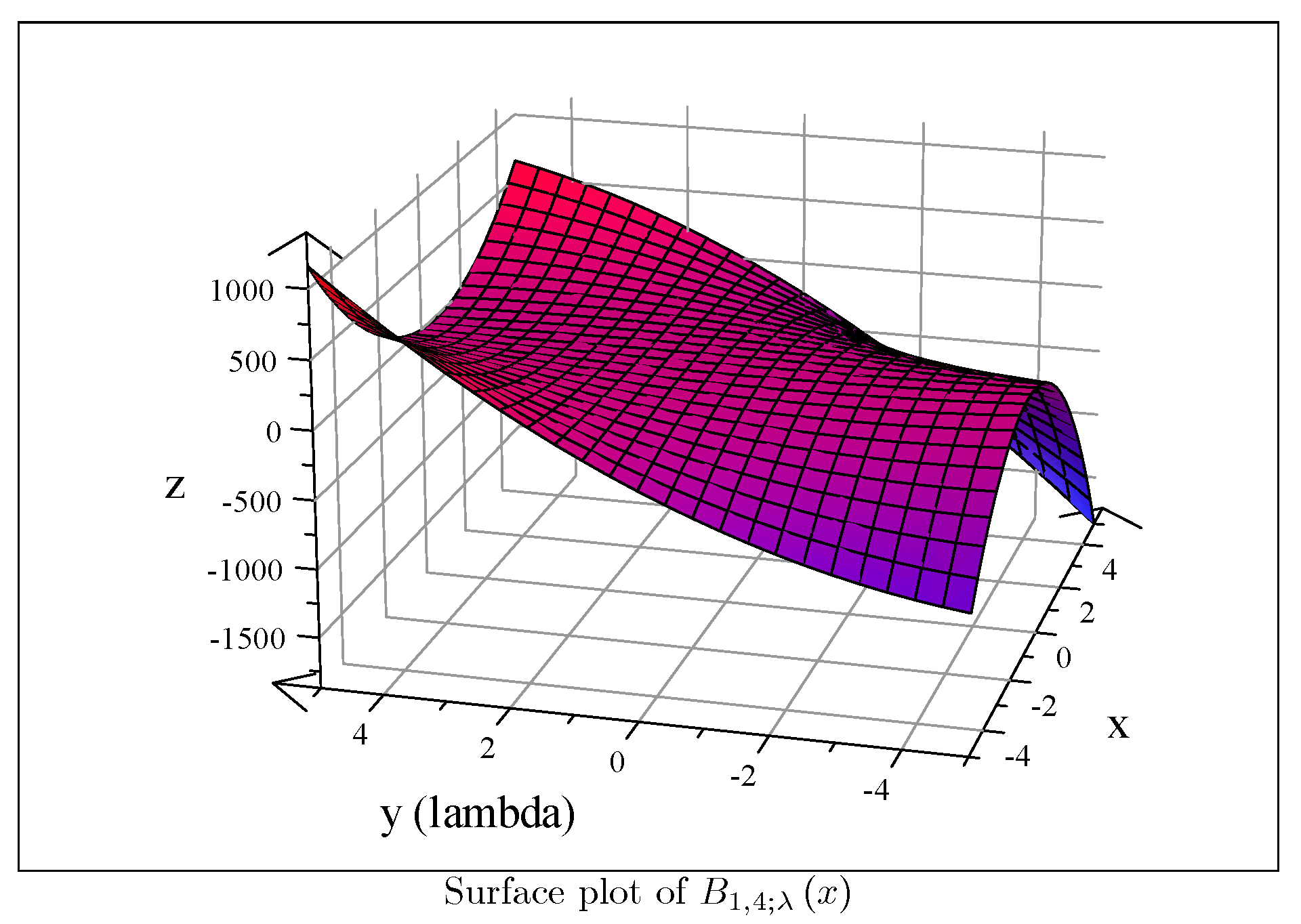
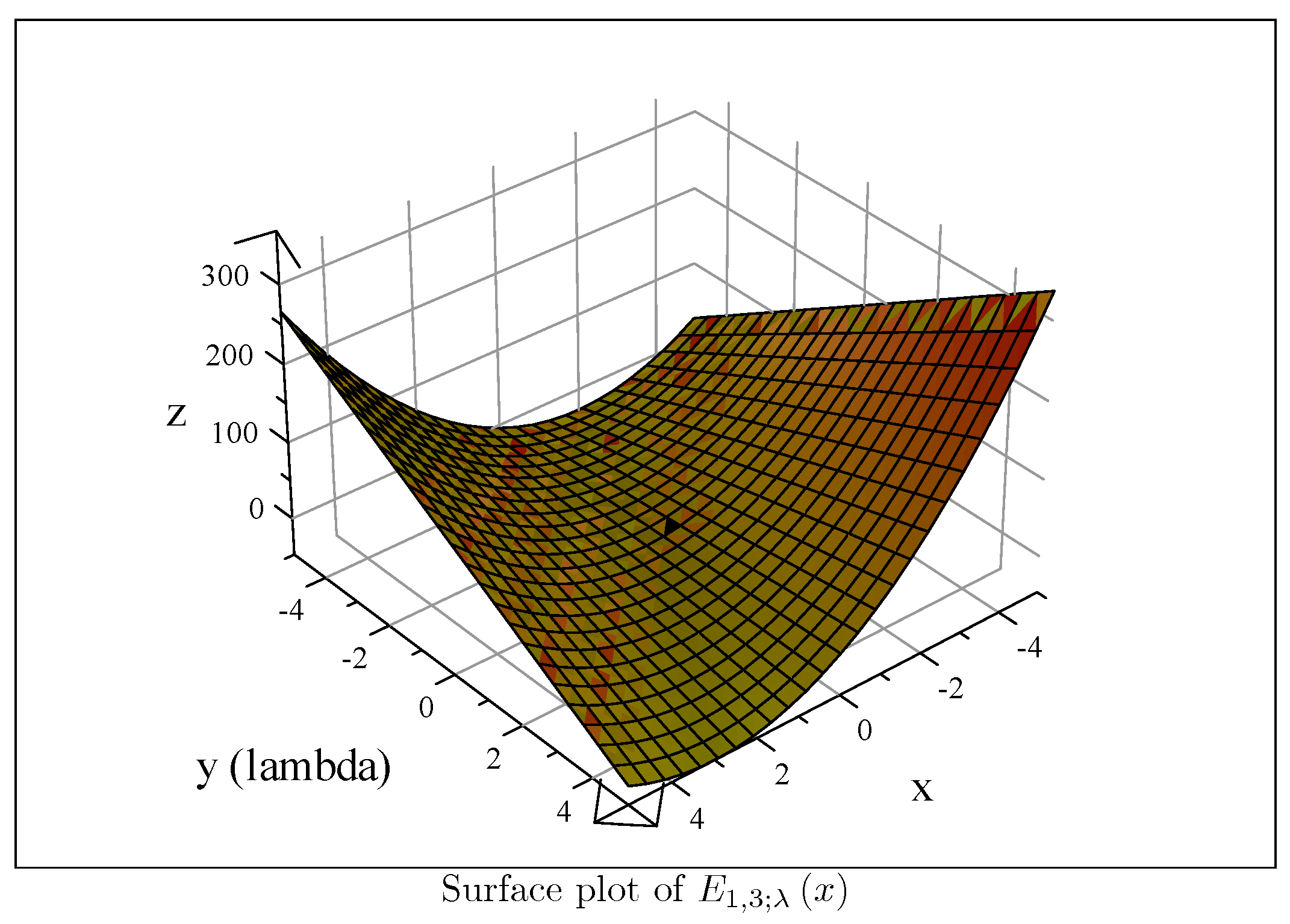
The Detr-Bernoulli and the Detr-Euler polynomials have interesting surface plots in the special values. We would like to show the quirky surface plots of the
and
as given in
Figure 3 and
Figure 4.
6. The Degenerate Truncated Bell Polynomials
In this section, we perform to define and examine the degenerate truncated forms of the bivariate Bell polynomials and numbers. Then, we develop multifarious identities and correlations for these polynomials and numbers, which includes addition formulas, summation formulas, recurrence relationships, difference operator property and derivative rules. Moreover we provide diverse correlations and formulas related to the Apostol-type -Stirling polynomials of the second kind and the -Stirling polynomials of the second kind.
The classical Bell polynomials
(also called exponential polynomials) are defined by means of the following generating function ([
3,
4,
19,
24]):
The classical Bell numbers
are attained by taking
in (
79), i.e.,
and are given by the following exponential generating function ([
3,
4,
19,
24]):
The Bell polynomials introduced by Bell [
3] appear as a standard mathematical tool and arise in combinatorial analysis. Since the first consideration of the Bell polynomials, these polynomials have been intensely investigated and studied by several mathematicians, [
3,
4,
18,
19,
22,
23,
24,
25] and see also the references cited therein.
The usual Bell polynomials and Stirling numbers of the second kind satisfy the following relation ([
3,
4,
19,
24])
The degenerate Bell polynomials are given by the following Taylor series expansion at
as follows ([
18,
22,
23,
25]):
When
in (
82), the polynomials
reduce to the degenerate Bell numbers
with the following generating function
We note that the degenerate Bell polynomials (
81) reduce the classical Bell polynomials (
81) in the following limit case:
The degenerate Bell polynomials and the degenerate Stirling numbers of the second kind satisfy the following correlation ([
18,
22,
23,
25])
Now, we are ready to introduce the bivariate degenerate truncated Bell polynomials, which we choose to call the -Bell polynomials as given below.
Definition 5. Let x be an independent variable and . The bivariate degenerate truncated Bell polynomials are defined by the following exponential generating function: Upon setting
and
in (
85), the bivariate truncated degenerate Bell polynomials reduce to the corresponding numbers
termed the degenerate truncated Bell numbers, which we call the
-Bell numbers:
We now examine diverse special cases of the bivariate -Bell polynomials as follows.
Remark 10. - 1.
When in (85), the polynomials in (85) reduce to the degenerate truncated Bell polynomials in (87), which are also new generalizations of the Bell polynomials in (1), given by - 2.
Upon setting in (85), we get a new generalization of the usual Bell polynomials, which we call the bivariate truncated Bell polynomials (88), shown by - 3.
In the special case and , we acquire a novel extension of the Bell polynomials, which we call the truncated Bell polynomials as follows - 4.
Choosing in (85), we obtain the bivariate degenerate Bell polynomials given below ([23]): - 5.
Setting in (85), we attain the degenerate Bell polynomials in (82) ([18,22,23,25]). - 6.
When in (85), we arrive at the familiar Bell polynomials in (79) ([3,4,19,24]).
We now investigate some properties and formulas of the bivariate -Bell polynomials . Hence, we first provide the following theorem.
Theorem 25. For we have Proof. By means of (
85) and (
87), we get
which gives the asserted result (
91). □
An extension of the well-known correlations in (
81) and (
84) is given below.
Theorem 26. The following relationholds true for . Proof. By the Definition 5 and the Formula (
22), we get
which gives the claimed result (
92). □
We now provide an addition formula for as follows.
Theorem 27. The following summation formulais valid for . Proof. By Definition 5 and the identity (
60), we obtain
which provides the desired result (
93). Henceforth, the proof is completed. □
Two immediate consequences of the Theorem 27 are discussed below.
Corollary 2. For , we haveand We now provide a correlation as follows.
Theorem 28. The following formulaholds true for . Proof. By Definition 5 and Equation (
26), we get
which gives the claimed result (
94). □
We now give a recurrence formula for as follows.
Theorem 29. The following recurrence formulaholds true for . Proof. In view of the Definition 5, we acquire
which gives the asserted result (
95). □
We now give a formula for as follows.
Theorem 30. The following operator formulaholds true for . Proof. In view of the Definition 5, by applying difference operator
(
12) to both sides of Formula (
96), we obtain
which gives the assertion in (
96). □
We now present the following derivation property with respect to x for the bivariate polynomials .
Theorem 31. The following formulaholds true for . Proof. By applying derivative operator
with respect to
x to both sides of Formula (
85), we then derive
which yields the asserted derivative Formula (
97). □
Here is another derivation property for the bivariate polynomials .
Theorem 32. The following relationholds true for.
Proof. By applying derivative operator with respect to
y to both sides of the Formula (
85), then we have
which yields the asserted derivative Formula (
98). □
7. Multifarious Connected Formulas
In this section, we first introduce the degenerate truncated Bernstein polynomials. We then perform to investigate diverse correlations and formulas including several polynomials such as the degenerate truncated Bernstein polynomials, the bivariate -Fubini polynomials, the bivariate -Bell polynomials, the -Bernoulli polynomials, the -Stirling polynomials of the second kind and the -Euler polynomials.
For
, the usual Bernstein polynomials ([
1]) are given by the following generating function:
The degenerate Bernstein polynomials
for
are considered by Kim and Kim [
20] by means of the following generating function to be
We first introduce the degenerate truncated Bernstein polynomials, which we call the -Bernstein polynomials as follows.
Definition 6. For and , the degenerate truncated Bernstein polynomials are defined by the following Mac Laurin series expansion at : Remark 11. In the limit case in (101), we attain a new extension of the classical Bernstein polynomials , which we call the truncated Bernstein polynomials given by Remark 12. When , the degenerate truncated Bernstein polynomials reduce to the degenerate Bernstein polynomials in (100). Hence we arrive at the following theorem including a relation between the -Bernstein polynomials and the -Stirling polynomials of the second kind.
By using (
106) and (
62) in conjunction with (
79), we consider that
Thus, we obtain the following theorem including a correlation covering the -Bernstein polynomials and the -Bell polynomials.
Theorem 34. The following correlation In terms of (
74) and (
85), we see that
Thus, we arrive at the following theorem including the bivariate -Bell polynomials and the -Bernoulli polynomials.
Theorem 35. The following summation equalityis valid. By means of (
37) and (
56)
Therefore, we obtain the following theorem involving the bivariate -Fubini polynomials and the -Euler polynomials.
Theorem 36. The following relationholds true for . An immediate result for Formula (
106) is as follows.
Corollary 3. Setting in (106), we then get a relation between the -Fubini polynomials and the -Euler numbers: Remark 13. The relationships (106) and (107) are extensions of the well-known relation given by ([15]) Hence, we state the following theorem which includes a correlation for the , and .
Theorem 37. The following relationis valid for . By using the generating functions of the
-Bernoulli and the bivariate
-Fubini polynomials in (
37) and (
55), we derive
Thus, we arrive at the following theorem.
Theorem 38. The following relationis valid for non-negative integers m and n. 8. Conclusions
In the present paper, we have considered the degenerate truncated forms of the various special polynomials and numbers and have investigated their several properties and relationships by using the series manipulation method and some special proof techniques indicated in the proof of each of the theorem stated in this paper. We have first introduced the degenerate truncated exponential polynomials and have given their several properties. Then we have defined the degenerate truncated Stirling polynomials of the second kind and have proved their elementary properties and relations. We have also considered the degenerate truncated bivariate Fubini and Bell polynomials and numbers and we then have attained multifarious relations and formulas, which covers several summation formulas, addition identities, recurrence relationships, derivative property and correlations with the degenerate truncated Stirling polynomials of the second kind. Moreover, we have defined the truncated degenerate Bernoulli and Euler polynomials and have provided multifarious correlations and interesting formulas including summation formulas, derivation rules and correlations with the degenerate truncated Stirling numbers of the second. Furthermore, regarding applications, by introducing the degenerate truncated forms of the classical Bernstein polynomials, we have derived several correlations and formulas including the degenerate truncated Bernstein polynomials, the bivariate
-Fubini polynomials, the bivariate
-Bell polynomials, the
-Bernoulli polynomials, the
-Stirling polynomials of the second kind and the
-Euler polynomials. We have also provided several interesting surface plots of the aforementioned polynomials in the special cases. The results obtained in this paper are generalizations of the many earlier results, some of which are involved related references in [
1,
2,
3,
4,
5,
6,
7,
8,
9,
10,
11,
12,
13,
14,
15,
16,
17,
18,
19,
20,
21,
22,
23,
24,
25,
26,
27,
28,
29,
30,
31,
32,
33,
34,
35,
36,
37]. For future directions, we will analyze that the polynomials introduced in this paper can be applied in the theory of umbral calculus and those can be connected with some degenerate probability distributions.