


Abstract
In this paper, we introduce an iterative scheme with inertial effect using Mann iterative scheme and gradient-projection for solving the bilevel variational inequality problem over the intersection of the set of common fixed points of a finite number of nonexpansive mappings and the set of solution points of the constrained optimization problem. Under some mild conditions we obtain strong convergence of the proposed algorithm. Two examples of the proposed bilevel variational inequality problem are also shown through numerical results.
1. Introduction
Bilevel problem is defined as a mathematical program, where the problem contains another problem as a constraint. Mathematically, bilevel problem is formulated as follows:
where S is the solution set of the problem
Usually, (1) is called the upper level problem and (2) is called the lower level problem. Many real life problems can be modeled as a bilevel problem and some studies have been performed towards solving different kinds of bilevel problems using approximation theory—see, for example, for bilevel optimization problem [1,2,3], for bilevel variational inequality problem [4,5,6,7,8,9], for bilevel equilibrium problems [10,11,12], and [13,14] for its practical applications. In [14], application of bilevel problem (bilevel optimization problem) in transportation (network design, optimal pricing), economics (Stackelberg games, principal-agent problem, taxation, policy decisions), management (network facility location, coordination of multi-divisional firms), engineering (optimal design, optimal chemical equilibria), etc. has been demonstrated. Due to the vast applications of bilevel problems, the research on approximation algorithm for bilevel problems has increased over years and is still in nascent stage.
A simple example of the practical bilevel model is a supplier and a store owner of a business chain (supply chain management), i.e., suppose the supplier will always give his/her best output of some commodities to the store owner in their business’s chain. Since both want to do well in their businesses, the supplier will always give his/her best output to the store owner who in turn would like to do his/her best in the business. In some sense, both would like to minimize their loss or rather maximize their profit and thus act in the optimistic pattern. It is clear that, in this example, the store owner is the upper-level decision maker and the supplier is the lower-level decision maker. Thus, in the study of supply chain management, the bilevel problem can indeed play a fundamental role.
In this paper, our main aim is to solve a bilevel variational inequality problem over the intersection of the set of common fixed points of finite number of nonexpansive mappings, denoted by BVIPO-FM, and the set of solution points of the constrained minimization problem of real-valued convex function. To be precise, let C be closed convex subset of a real Hilbert space H, is a mapping, is a real-valued convex function, and is a nonexpansive mapping for each . Then, BVIPO-FM is given by
where is the solution set of
The notation represents the set of fixed points of , i.e., for . Thus, where is the solution set of constrained convex minimization problem given by
The problem (3) is a classical variational inequality problem, denoted by , which was studied by many authors—for example, see in [7,15,16,17] and references therein. The solution set of the variational inequality problem is denoted by . Therefore, BVIPO-FM is obtained by solving , where . Bilevel problem with upper-level problem is variational inequality problem, which was introduced in [18]. These problems have received significant attention from the mathematical programming community. Bilevel variational inequality problem can be used to study various bilevel models in optimization, economics, operations research, and transportation.
It is known that the gradient-projection algorithm—given by
where the parameters are real positive numbers—is one of the powerful methods for solving the minimization problem (5) (see [19,20,21]). In general, if the gradient is Lipschitz continuous and strongly monotone, then, the sequence generated by recursive Formula (6) converges strongly to a minimizer of (6), where the parameters satisfy some suitable conditions. However, if the gradient is only to be inverse strongly monotone, the sequence generated by (6) converges weakly.
In approximation theory, constructing iterative schemes with speedy rate of convergence is usually of great interest. For this purpose, Polyak [22] proposed an inertial accelerated extrapolation process to solve the smooth convex minimization problem. Since then, there are growing interests by authors working in this direction. Due to this reason, a lot of researchers constructed fast iterative algorithms by using inertial extrapolation, including inertial forward–backward splitting methods [23,24], inertial Douglas–Rachford splitting method [25], inertial forward-–backward-–forward method [26], inertial proximal-extragradient method [27], and others.
In this paper, we introduce an algorithm with inertial effect for solving BVIPO-FM using projection method for the variational inequality problem, the well-known Mann iterative scheme [28] for the nonexpansive mappings ’s, and gradient-projection for the function f. It is proved that the sequence generated by our proposed algorithm converges strongly to the solution of BVIPO-FM.
2. Preliminary
Let H be a real Hilbert space H. The symbols “” and “” denote weak and strong convergence, respectively. Recall that for a nonempty closed convex subset C of H, the metric projection on C is a mapping , defined by
Lemma 1.
Let C be a closed convex subset of H. Given and a point , then, if and only if
Definition 1.
For , the mapping is said to be L-Lipschitz on C if there exists such that
If , then, we call T a contraction mapping on C with constant L. If , then, T is called a nonexpansive mapping on C.
Definition 2.
The mapping is said to be firmly nonexpansive if
Alternatively, is firmly nonexpansive if T can be expressed as
where is nonexpansive.
The class of firmly nonexpansive mappings belong to the class of nonexpansive mappings.
Definition 3.
The mapping is said to be
- (a)
- monotone if
- (b)
- β-strongly monotone if there exists a constant such that
- (c)
- ν-inverse strongly monotone (ν-ism) if there exists such that
Definition 4.
The mapping is said to be an averaged mapping if it can be written as the average of the identity mapping I and a nonexpansive mapping, that is
where and is nonexpansive. More precisely, when (7) holds, we say that T is α-averaged.
It is easy to see that firmly nonexpansive mapping (in particular, projection) is -averaged and 1-inverse strongly monotone mappings. Averaged mappings and -inverse strongly monotone mapping (-ism) have received many investigations, see [29,30,31,32]. The following propositions about averaged mappings and inverse strongly monotone mappings are some of the important facts in our discussion in this paper.
Proposition 1
([29,30]). Let the operators be given:
- (i)
- If for some and if S is averaged and V is nonexpansive, then, T is averaged.
- (ii)
- T is firmly nonexpansive if and only if the complement is firmly nonexpansive.
- (iii)
- If , for some and if S is firmly nonexpansive and V is nonexpansive, then T is averaged.
- (iv)
- The composition of finitely many averaged mappings is averaged. That is, if each of the mappings is averaged, then so is the composite . In particular, if is -averaged and is -averaged, where , then, the composite is α-averaged, where .
Proposition 2
([29,31]). Let be given. We have
- (a)
- T is nonexpansive if and only if the complement is -ism;
- (b)
- If T is ν-ism and , then is -ism;
- (c)
- T is averaged if and only if the complement is ν-ism for some . Indeed, for , T is α-averaged if and only if is -ism.
Lemma 2.
(Opial’s condition) For any sequence in the Hilbert space H with , the inequality
holds for each with .
Lemma 3.
For a real Hilbert space H, we have
- (i)
- (ii)
Lemma 4.
Let H be real Hilbert space. Then, and , we have
Lemma 5
([33]). Let and be a sequences of non-negative real numbers, and be a sequence of real numbers such that
where and .
- (i)
- If for some , then, is a bounded sequence.
- (ii)
- If and , then, as .
Definition 5.
Let be a real sequence. Then, decreases at infinity if there exists such that for . In other words, the sequence does not decrease at infinity, if there exists a subsequence of such that for all .
Lemma 6
([34]). Let be a sequence of real numbers that does not decrease at infinity. Additionally, consider the sequence of integers defined by
Then, is a nondecreasing sequence verifying and for all , the following two estimates hold:
Let C be closed convex subset of a real Hilbert space H and given a bifunction . Then, the problem
is called equilibrium problem (Fan inequality [35]) of g on C, denoted by EP. The set of all solutions of the EP is denoted by SEP, i.e., If for every , where A is a mapping from C into H, then, the equilibrium problem becomes the variational inequality problem.
We say that the bifunction satisfies Condition CO on C if the following four assumptions are satisfied:
- (i)
- , for all
- (ii)
- g is monotone on H, i.e., , for all
- (iii)
- for each ,
- (iv)
- is convex and lower semicontinuous on H for each .
Lemma 7
([36]). If g satisfies Condition on C, then, for each and , the mapping given by
satisfies the following conditions:
- (1)
- is single-valued;
- (2)
- is firmly nonexpansive, i.e., for all ,
- (3)
- Fix, where Fix is the fixed point set of ;
- (4)
- is closed and convex.
3. Main Result
In this paper, we are interested in finding a solution to BVIPO-FM, where F and f satisfy the following conditions:
- (A1)
- is -strongly monotone and -Lipschitz continuous on H.
- (A2)
- The gradient is L-Lipschitz continuous on C.
We are now in a position to state our inertial algorithm and prove its strong convergence to the solution of BVIPO-FM assuming that F satisfies condition (A1), f satisfies condition (A2), and is nonempty.
We have plenty of choices for , , and satisfying parameter restrictions (C3), (C4), and (C5). For example, if we take , and , then, , , (), and . Therefore, (C3), (C4), and (C5) are satisfied.
Remark 1.
From (C4) and Step 1 of Algorithm 1, we have that
Since is bounded, we also have
Note that Step 1 of Algorithm 1 is easily implemented in numerical computation since the value of is a priori known before choosing .
| Algorithm 1—Inertial Algorithm for BVIPO-FM |
Initialization: Choose , . Let a positive real constants , and the real sequences , , , , satisfy the following conditions:
|
Remark 2.
Note that the point solves the minimization problem (5) if and only if
where is any fixed positive number. Therefore, the solution set Γ of the problem (5) is closed and convex subset of H, because for the mapping is nonexpansive mapping and solution points of (5) are fixed points of . Moreover, is nonexpansive and hence is closed and convex for each .
Lemma 8.
For a real number with , the mapping is -averaged.
Proof.
Since is L-Lipschitz, the gradient is -ism [37], which then implies that is -ism. So by Proposition 2 , is -averaged. Now since the projection is -averaged, we see from Proposition 2 that the composite is -averaged. Therefore, for some nonexpansive mapping T, can written as
where . Note that, in view of Remark 2 and (8), the point solves the minimization problem (5) if and only if □
Lemma 9.
For each n, the mapping defined in Step 6 of Algorithm 1 satisfies the inequality
where
Proof.
From (C2), it is easy to see that
This implies that
Then,
By the strong monotonicity and the Lipschitz continuity of F, we have
Theorem 1.
The sequence generated by Algorithm 1 converges strongly to the unique solution of BVIPO-FM.
Proof.
Let .
Now, from the definition of , we get
Note that for each n, there is a nonexpansive mapping such that , where for and . Now, using Lemma 4 and the fact that , we have
Let be the sequence of natural numbers such that where . This means that . Thus, by Lemma 4
Using the definition of , (14) and Lemma 9, we get
where . Observe that by condition (C3) and by Remark 1, we see that
Let
Then, (15) becomes
Thus, by Lemma 5 the sequence is bounded. As a consequence, , , , and are also bounded.
Now, using the definition of and Lemma 3, we obtain
Again, by Lemma 3 , we have
Using the definition of together with (14) and Lemma 9, we have
Let us distinguish the following two cases related to the behavior of the sequence , where .
Case 1. Suppose the sequence decrease at infinity. Thus, there exists such that for . Then, converges and as .
From (22) we have
Since () and using condition (C3) and Remark 1 (noting , , and is bounded), from (22) we have
The conditions (C2) and (C5) (i.e., , and ), together with (23) and the fact that , we obtain
Similarly, from (23) and the restriction condition imposed on in (C6), together with conditions (C2) and (C5), we have
Thus, using the definition of together with (24) gives
Moreover, using the definition of and Remark 1, we have
By the definition of together with (25) gives
By the definition of , with the parameter restriction conditions (C2) and (C6) together with (31) and boundedness of , we have
By definition of and , and using (30), for all , we have
and this together with (28), yields
for all . Thus,
for all . Therefore, from (28) and (34)
for all . Moreover, from (24) and (27)
From (C6), we have . Thus, let . Then, using the nonexpansiveness of projection mapping and (C6) of assumption 1 together with (28) and boundedness of ( is bouded and is Lipschitz continuous), we get
Let p be a weak cluster point of , there exists a subsequence of such that as . We observe that because and C is weakly closed. Assume for some . Since and is a nonexpansive mapping, from (35) and Opial’s condition, one has
which is a contradiction. It must be the case that for all . Similarly, using Opial’s condition and (38), we can show that , i.e., . Therefore, .
Next, we show that . Indeed, since and , we obtain that
Since is bounded, there exists such that for all . Thus, in view of (39), we have
From (C2) and Remark 1, we have and . Thus, using Lemma 5 and (41), we get as . Hence, as .
Case 2. Assume that does not decrease at infinity. Let be a mapping for all (for some large enough) defined by
By Lemma 6, is a nondecreasing sequence, as and
In view of for all and (22), for all we have
Thus, from (43), conditions (C3) and (C4), and Remark 1, we have
Similarly,
Using similar procedure as above in Case 1, we have and for , we have
for all . Since is bounded, there exists a subsequence of , still denoted by , which converges weakly to p. By similar argument as above in Case 1, we conclude immediately that . In addition, by the similar argument as above in Case 1, we have . Since , we get .
Using for all and , the last inequality gives
Since , we obtain Moreover, since , we have Thus, together with , gives . Therefore, from (42), we obtain , that is, as .
This completes the proof. □
4. Applications
The mapping , given by for a fixed point , is one simple example of -strongly monotone and -Lipschitz continuous mapping, where and . If for a fixed point , then, BVIPO-FM becomes the problem of finding the projection of p onto . When , this projection is the minimum-norm solution in .
Let BVIPO-M denote the bilevel variational inequality problem over the intersection of the set of common solution points of finite number of constrained minimization problems, stated as follows: For a closed convex subset C of a real Hilbert space H, a nonlinear mapping and a real-valued convex functions for , BVIPO-M is the problem given by
where is the solution-set of
If the gradient of () is -Lipschitz continuous on C, then, for the mapping is nonexpansive mapping and . This leads to the following corollary as an immediate consequence of our main theorem for approximation of solution of BVIPO-M, assuming that SVIP is nonempty.
Corollary 1.
If F satisfies condition (A1), satisfy condition (A2), and the gradient of each (each ) is -Lipschitz continuous on C for all , then, for , replacing each by for all in Algorithm 1 (in Step 4), the sequence generated by the algorithm strongly converges to the unique solution of BVIPO-M.
Let C be closed convex subset C of a real Hilbert space H, is a mapping, is a real-valued convex function, and each is a bifunction for . BVIPO-EM denotes the bilevel variational inequality problem over the intersection of the set of common solution points of a finite number of equilibrium problems and the set of solution points of the constrained minimization problem given by
where is the solution-set of
If each satisfies Condition CO on C for all , then, by Lemma 7 (1) and (3), for each , is nonexpansive and . Applying Theorem 1, we obtain the following result for approximation of solution of BVIPO-EM, assuming that SVIP is nonempty.
Corollary 2.
If F satisfy condition (A1), f satisfy condition (A2), and each satisfies Condition CO on C for all , then, for , replacing each by for all in Algorithm 1 (in Step 4), the sequence generated by the algorithm strongly converges to the unique solution of BVIPO-EM.
Let C be closed convex subset C of a real Hilbert space H, is a mapping, is a real-valued convex function and each for is a mapping for . Now, suppose that BVIPO-VM denotes the bilevel variational inequality problem over the intersection of the set of common solution points of finite number of variational inequality problems and the set of solution points of the constrained minimization problem given by
where is the solution-set of
Note that if each is -inverse strongly monotone on C for all and , then,
- (a)
- is nonexpansive;
- (b)
- is fixed point of iff is the solution of the variational inequality problem VIP, i.e., .
By Theorem 1, we have the following corollary for approximation of solution of BVIPO-VM, assuming that SVIP is nonempty.
Corollary 3.
If F satisfy condition (A1), f satisfy condition (A2) and each is -inverse strongly monotone on C for all , then for , replacing each by for all in Algorithm 1 (in Step 4), the sequence generated by the algorithm strongly converges to the unique solution of BVIPO-VM.
5. Numerical Results
Example 1.

Consider the bilevel variational inequality problem
where Ω is the solution-set of
for , , and F and are given by
where for all ,
is given by for ( is identity matrix) for . Note the following:
- (i)
- F is β-strongly monotone and κ-Lipschitz continuous on , where and .
- (ii)
- is bounded linear operator, ; and is self-adjoint operator.
- (iii)
- The gradient of each (each ) is -Lipschitz continuous on C for all , where and is given by (see [38])
- (iv)
- For each ,where Hence,where and .
- (v)
- 0 is the solution of the given bilevel variational inequality problem, i.e., SVIP().
We set for each and . Therefore,
and the gradient of is L-Lipschitz continuous on C where . We will test our experiment for different dimension N and different parameters.
Take and for each . Thus, F is 1-strongly monotone and N-Lipschitz continuous on . Hence, notice that the positive real constants μ, ς, and are chosen to be , , and . We describe the numerical results of Algorithm 1 (applying Corollary 1) for the positive real constants μ and ς given by and
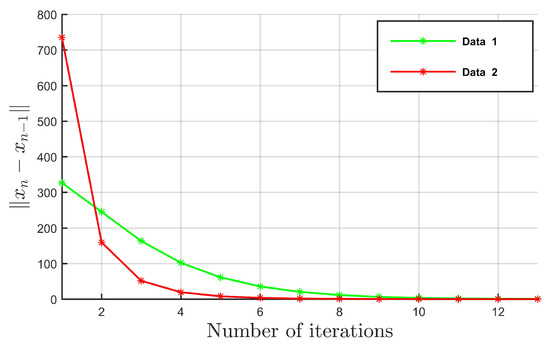
Figure 1.
For and , are for randomly generated starting points and (the same starting points for Data 1 and Data 2).
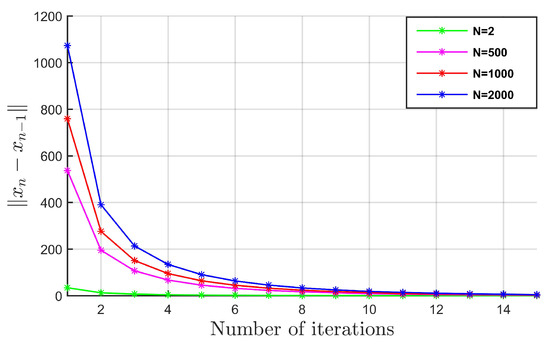
Figure 2.
For Data 3 and for randomly generated starting points and .
Table 1.
For starting points and .
- Data 1.
- , , , , , .
- Data 2.
- , , , , , .
- Data 3.
- , , , , , .
The stopping criteria in Table 1 is defined as .
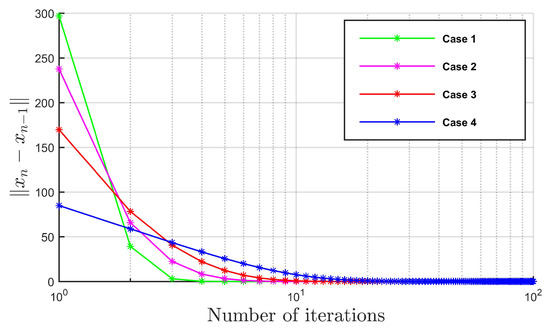
Figure 3 demonstrates the behavior of Algorithm 1 for different parameters (Case 1: ; Case 2: ; Case 2: ; Case 4: ), where , , , , .
Figure 3.
For and starting points and .
From Figure 1, Figure 2 and Figure 3 and Table 1, it is clear to see that your algorithm depends of the dimension, starting points, and parameters. From Figure 3, we can see that the sequence generated by the algorithm converges faster to the solution of the problem for the choice of , where ρ () is very close to 0.
Example 2.
Consider BVIPO-FM is given by
where Ω is the solution set of
for and F, f, and U are given by
where , for all and
We took and . Thus, F is β-strongly monotone and κ-Lipschitz continuous on , where and . The gradient of f is L-Lipschitz continuous on C, where and is given by Moreover, and
Table 2 illustrates the numerical result of our algorithm, solving BVIPO-FM given in this example for different dimensions and different stopping criteria , where the parameters are given in the following: , , , , , .
Table 2.
For starting points and .
For TOL, , , and , the approximate solution obtained after 319 iterations is
6. Conclusions
We have proposed a strongly convergent inertial algorithm for a class of bilevel variational inequality problem over the intersection of the set of common fixed points of finite number of nonexpansive mappings and the set of solution points of the constrained minimization problem of real-valued convex function (BVIPO-FM). The contribution of our result in this paper is twofold. First, it provides effective way of solving BVIPO-FM, where iterative scheme combines inertial term to speed up the convergence of the algorithm. Second, our result can be applied to find a solution to the bilevel variational inequality problem over the solution set of the problem P, where the problem P (the lower level problem) can be converted as a common fixed point of a finite number of nonexpansive mappings.
Author Contributions
All authors contributed equally in this research paper particularly on the conceptualization, methodology, validation, formal analysis, resource, and writing and preparing the original draft of the manuscript; however, the second author fundamentally plays a great role in supervision and funding acquisition as well. Moreover, the third author particularly wrote the code and run the algorithm in the MATLAB program.
Funding
Petchra Pra Jom Klao Ph.D. Research Scholarship from King Mongkut’s University of Technology Thonburi (KMUTT) and Theoretical and Computational Science (TaCS) Center. Moreover, Poom Kumam was supported by the Thailand Research Fund and the King Mongkut’s University of Technology Thonburi under the TRF Research Scholar Grant No.RSA6080047.The Rajamangala University of Technology Thanyaburi (RMUTTT) (Grant No.NSF62D0604).
Acknowledgments
The authors acknowledge the financial support provided by the Center of Excellence in Theoretical and Computational Science (TaCS-CoE), KMUTT. Seifu Endris Yimer is supported by the Petchra Pra Jom Klao Ph.D. Research Scholarship from King Mongkut’s University of Technology Thonburi (Grant No. 9/2561).
Conflicts of Interest
The authors declare no conflict of interest.
References
- Deb, K.; Sinha, A. An efficient and accurate solution methodology for bilevel multi-objective programming problems using a hybrid evolutionary-local-search algorithm. Evol. Comput. 2010, 18, 403–449. [Google Scholar] [CrossRef] [PubMed]
- Sabach, S.; Shtern, S. A first order method for solving convex bilevel optimization problems. SIAM J. Optim. 2017, 27, 640–660. [Google Scholar] [CrossRef]
- Shehu, Y.; Vuong, P.T.; Zemkoho, A. An inertial extrapolation method for convex simple bilevel optimization. Optim. Methods Softw. 2019, 1–19. [Google Scholar] [CrossRef]
- Anh, P.K.; Anh, T.V.; Muu, L.D. On bilevel split pseudomonotone variational inequality problems with applications. Acta Math. Vietnam. 2017, 42, 413–429. [Google Scholar] [CrossRef]
- Anh, P.N.; Kim, J.K.; Muu, L.D. An extragradient algorithm for solving bilevel pseudomonotone variational inequalities. J. Glob. Optim. 2012, 52, 627–639. [Google Scholar] [CrossRef]
- Anh, T.T.; Long, L.B.; Anh, T.V. A projection method for bilevel variational inequalities. J. Inequal. Appl. 2014, 1, 205. [Google Scholar] [CrossRef]
- Anh, T.V. A strongly convergent subgradient extragradient-Halpern method for solving a class of bilevel pseudomonotone variational inequalities. Vietnam J. Math. 2017, 45, 317–332. [Google Scholar] [CrossRef]
- Anh, T.V. Linesearch methods for bilevel split pseudomonotone variational inequality problems. Numer. Algorithms 2019, 81, 1067–1087. [Google Scholar] [CrossRef]
- Anh, T.V.; Muu, L.D. A projection-fixed point method for a class of bilevel variational inequalities with split fixed point constraints. Optimization 2016, 65, 1229–1243. [Google Scholar] [CrossRef]
- Chen, J.; Liou, Y.C.; Wen, C.F. Bilevel vector pseudomonotone equilibrium problems: Duality and existence. J. Nonlinear Convex Anal. 2015, 16, 1293–1303. [Google Scholar]
- Van Dinh, B.; Muu, L.D. On penalty and gap function methods for bilevel equilibrium problems. J. Appl. Math. 2011, 2011, 646452. [Google Scholar] [CrossRef]
- Yuying, T.; Van Dinh, B.; Plubtieng, S. Extragradient subgradient methods for solving bilevel equilibrium problems. J. Inequal. Appl. 2018, 2018, 327. [Google Scholar] [CrossRef] [PubMed]
- Bard, J.F. Practical Bilevel Optimization: Algorithms and Spplications; Springer Science & Business Media: Berlin/Heidelberg, Germany, 2013; Volume 30. [Google Scholar]
- Dempe, S. Annotated Bibliography on Bilevel Programming and Mathematical Programs with Equilibrium Constraints. Optimization 2003, 52, 333–359. [Google Scholar] [CrossRef]
- Apostol, R.Y.; Grynenko, A.A.; Semenov, V.V. Iterative algorithms for monotone bilevel variational inequalities. J. Comput. Appl. Math. 2012, 107, 3–14. [Google Scholar]
- Censor, Y.; Gibali, A.; Reich, S. The subgradient extragradient method for solving variational inequalities in Hilbert space. J. Optim. Theory Appl. 2011, 148, 318–335. [Google Scholar] [CrossRef]
- Khanh, P.D. Convergence rate of a modified extragradient method for pseudomonotone variational inequalities. Vietnam J. Math. 2017, 45, 397–408. [Google Scholar] [CrossRef]
- Kalashnikov, V.V.; Kalashinikova, N.I. Solving two-level variational inequality. J. Glob. Optim. 1996, 45, 289–294. [Google Scholar] [CrossRef]
- Calamai, P.H.; Moré, J.J. Projected gradient methods for linearly constrained problems. Math. Program. 1987, 39, 93–116. [Google Scholar] [CrossRef]
- Su, M.; Xu, H.K. Remarks on the gradient-projection algorithm. J. Nonlinear Anal. Optim. 2010, 1, 35–43. [Google Scholar]
- Xu, H.K. Averaged mappings and the gradient-projection algorithm. J. Optim. Theory Appl. 2011, 150, 360–378. [Google Scholar] [CrossRef]
- Polyak, B.T. Some methods of speeding up the convergence of iteration methods. USSR Comput. Math. Math. Phys. 1964, 4, 1–17. [Google Scholar] [CrossRef]
- Lorenz, D.A.; Pock, T. An inertial forward-backward algorithm for monotone inclusions. J. Math. Imaging Vis. 2015, 51, 311–325. [Google Scholar] [CrossRef]
- Ochs, P.; Brox, T.; Pock, T. ipiasco: Inertial proximal algorithm for strongly convex optimization. J. Math. Imaging Vis. 2015, 53, 171–181. [Google Scholar] [CrossRef]
- Bot, R.I.; Csetnek, E.R.; Hendrich, C. Inertial Douglas–Rachford splitting for monotone inclusion problems. Appl. Math. Comput. 2015, 256, 472–487. [Google Scholar]
- Bot, R.I.; Csetnek, E.R. An inertial forward-backward-forward primal-dual splitting algorithm for solving monotone inclusion problems. Numer. Algorithms 2016, 71, 519–540. [Google Scholar] [CrossRef]
- Bot, R.I.; Csetnek, E.R. A hybrid proximal-extragradient algorithm with inertial effects. Numer. Func. Anal. Opt. 2015, 36, 951–963. [Google Scholar] [CrossRef]
- Mann, W.R. Mean value methods in iteration. Proc. Am. Math Soc. 1953, 4, 506–510. [Google Scholar] [CrossRef]
- Byrne, C. A unified treatment of some iterative algorithms in signal processing and image reconstruction. Inverse Probl. 2003, 20, 103. [Google Scholar] [CrossRef]
- Combettes, P.L. Solving monotone inclusions via compositions of nonexpansive averaged operators. Optimization 2004, 53, 475–504. [Google Scholar] [CrossRef]
- Martinez-Yanes, C.; Xu, H.K. Strong convergence of the CQ method for fixed point iteration processes. Nonlinear Anal. 2006, 64, 2400–2411. [Google Scholar] [CrossRef]
- Xu, H.K. Iterative methods for the split feasibility problem in infinite-dimensional Hilbert spaces. Inverse Prob. 2010, 26, 105018. [Google Scholar] [CrossRef]
- Xu, H.K. Iterative algorithms for nonlinear operators. J. Lond. Math. Soc. 2002, 66, 240–256. [Google Scholar] [CrossRef]
- Maingé, P.E. Strong convergence of projected subgradient methods for nonsmooth and nonstrictly convex minimization. Set-Valued Anal. 2008, 16, 899–912. [Google Scholar] [CrossRef]
- Fan, K. A Minimax Inequality and Applications, Inequalities III; Shisha, O., Ed.; Academic Press: New York, NY, USA, 1972. [Google Scholar]
- Combettes, P.L.; Hirstoaga, S.A. Equilibrium programming in Hilbert spaces. J. Nonlinear Convex Anal. 2005, 6, 117–136. [Google Scholar]
- Baillon, J.B.; Haddad, G. Quelques propriétés des opérateurs angle-bornés etn-cycliquement monotones. Isr. J. Math. 1977, 26, 137–150. [Google Scholar] [CrossRef]
- Tang, J.; Chang, S.S.; Yuan, F. A strong convergence theorem for equilibrium problems and split feasibility problems in Hilbert spaces. Fixed Point Theory A 2014, 2014, 36. [Google Scholar] [CrossRef]
© 2019 by the authors. Licensee MDPI, Basel, Switzerland. This article is an open access article distributed under the terms and conditions of the Creative Commons Attribution (CC BY) license (http://creativecommons.org/licenses/by/4.0/).