


Abstract
In this paper, we study differential equations arising from the generating function of the -Bell polynomials. We give explicit identities for the -Bell polynomials. Finally, we find the zeros of the -Bell equations with numerical experiments.
Keywords:
differential equations; Bell polynomials; r-Bell polynomials; (r, β)-Bell polynomials; zeros MSC:
05A19; 11B83; 34A30; 65L99
1. Introduction
The moments of the Poisson distribution are a well-known connecting tool between Bell numbers and Stirling numbers. As we know, the Bell numbers are those using generating function
The Bell polynomials are this formula using the generating function
(see [1,2]).
Observe that
where denotes the second kind Stirling number.
The generalized Bell polynomials are these formula using the generating function:
(see [2]).
In particular, the generalized Bell polynomials where Z is a Poission random variable with parameter (see [1,2,3]). The -Bell polynomials are this formula using the generating function:
(see [3]), where, and r are real or complex numbers and Note that and . The first few examples of -Bell polynomials are
From (1) and (2), we see that
Compare the coefficients in Formula (3). We can get
Similarly we also have
Recently, many mathematicians have studied the differential equations arising from the generating functions of special polynomials (see [4,5,6,7,8]). Inspired by their work, we give a differential equations by generation of -Bell polynomials as follows. Let D denote differentiation with respect to t, denote differentiation twice with respect to t, and so on; that is, for positive integer N,
We find differential equations with coefficients , which are satisfied by
Using the coefficients of this differential equation, we give explicit identities for the -Bell polynomials. In addition, we investigate the zeros of the -Bell equations with numerical methods. Finally, we observe an interesting phenomena of ‘scattering’ of the zeros of -Bell equations. Conjectures are also presented through numerical experiments.
2. Differential Equations Related to -Bell Polynomials
Differential equations arising from the generating functions of special polynomials are studied by many authors to give explicit identities for special polynomials (see [4,5,6,7,8]). In this section, we study differential equations arising from the generating functions of -Bell polynomials.
Let
Then, by (4), we have
and
We prove this process by induction. Suppose that
is true for N. From (7), we get
From (8), we get
We prove that
If we compare the coefficients on both sides of (8) and (9), then we get
and
In addition, we get
Now, by (10), (11) and (12), we can obtain the coefficients as follows. By (12), we get
It is not difficult to show that
Thus, by (14), we also get
From (10), we have that
and
For in (11), we have
and
By induction on i, we can easily prove that, for
Here, we note that the matrix is given by
Now, we give explicit expressions for . By (18), (19), and (20), we get
and
By induction on i, we have
Finally, by (22), we can derive a differential equations with coefficients , which is satisfied by
Theorem 1.
For same as below the differential equation
has a solution
where
From (4), we have this
By using Theorem 1 and (23), we can get this equation:
Compare coefficients in (24). We get the below theorem.
Theorem 2.
For we have
where
By using the coefficients of this differential equation, we give explicit identities for the -Bell polynomials. That is, in (25) if , we have corollary.
Corollary 1.
For we have
For it follows that equation
has a solution
In Figure 1, we have a sketch of the surface about the solution F of this differential equation. On the left of Figure 1, we give and . On the right of Figure 1, we give and .
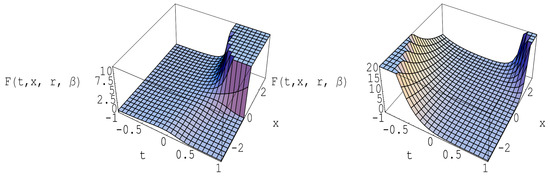
Figure 1.
The surface for the solution .
Making N-times derivative for (4) with respect to t, we obtain
By multiplying the exponential series in both sides of (26) and Cauchy product, we derive
By using the Leibniz rule and inverse relation, we obtain
So using (27) and (28), and using the coefficients of gives the below theorem.
Theorem 3.
Let be nonnegative integers. Then
When we give in (29), then we get corollary.
Corollary 2.
For we have
3. Distribution of Zeros of the -Bell Equations
This section aims to demonstrate the benefit of using numerical investigation to support theoretical prediction and to discover new interesting patterns of the zeros of the -Bell equations . We investigate the zeros of the -Bell equations with numerical experiments. We plot the zeros of the for and (Figure 2).
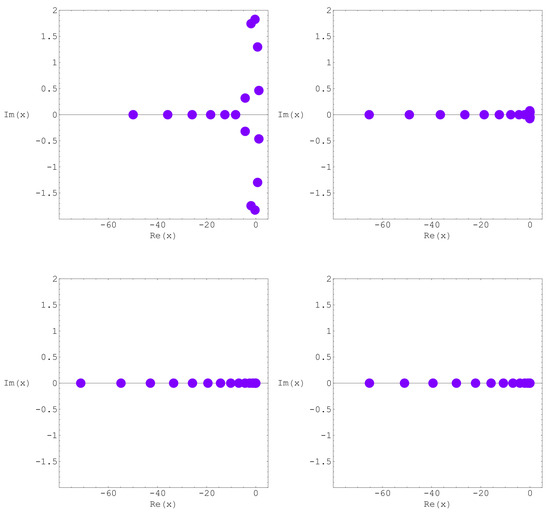
Figure 2.
Zeros of .
In top-left of Figure 2, we choose and , . In top-right of Figure 2, we choose and , . In bottom-left of Figure 2, we choose and . In bottom-right of Figure 2, we choose and .
Prove that , has reflection symmetry analytic complex functions (see Figure 3). Stacks of zeros of the -Bell equations for from a 3-D structure are presented (Figure 3).
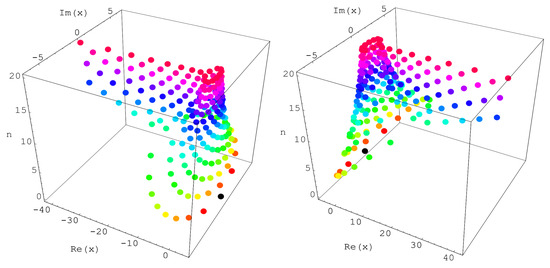
Figure 3.
Stacks of zeros of .
On the left of Figure 3, we choose and . On the right of Figure 3, we choose and . In Figure 3, the same color has the same degree n of -Bell polynomials . For example, if , zeros of the -Bell equations is red.
Our numerical results for approximate solutions of real zeros of the -Bell equations are displayed (Table 1 and Table 2).

Table 1.
Numbers of real and complex zeros of .
Table 2.
Approximate solutions of .
Plot of real zeros of for structure are presented (Figure 4).
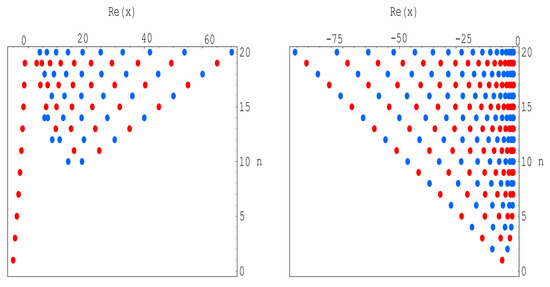
Figure 4.
Stacks of zeros of .
In Figure 4 (left), we choose and . In Figure 4 (right), we choose and . In Figure 4, the same color has the same degree n of -Bell polynomials . For example, if , real zeros of the -Bell equations is blue.
Next, we calculated an approximate solution satisfying . The results are given in Table 2.
4. Conclusions
We constructed differential equations arising from the generating function of the -Bell polynomials. This study obtained the some explicit identities for -Bell polynomials using the coefficients of this differential equation. The distribution and symmetry of the roots of the -Bell equations were investigated. We investigated the symmetry of the zeros of the -Bell equations for various variables r and , but, unfortunately, we could not find a regular pattern. We make the following series of conjectures with numerical experiments:
Let us use the following notations. denotes the number of real zeros of lying on the real plane and denotes the number of complex zeros of . Since n is the degree of the polynomial , we have (see Table 1).
We can see a good regular pattern of the complex roots of the -Bell equations for and . Therefore, the following conjecture is possible.
Conjecture 1.
For and , prove or disprove that
We observe that solutions of -Bell equations has , reflecting symmetry analytic complex functions. It is expected that solutions of -Bell equations , has not reflection symmetry for (see Figure 2, Figure 3 and Figure 4).
Conjecture 2.
Prove or disprove that solutions of -Bell equations , has not reflection symmetry for .
Finally, how many zeros do have? We are not able to decide if has n distinct solutions (see Table 1 and Table 2). We would like to know the number of complex zeros of
Conjecture 3.
Prove or disprove that has n distinct solutions.
As a result of investigating more n variables, it is still unknown whether the conjecture is true or false for all variables n (see Table 1 and Table 2). We expect that research in these directions will make a new approach using the numerical method related to the research of the -Bell numbers and polynomials which appear in mathematics, applied mathematics, statistics, and mathematical physics. The reader may refer to [5,6,7,8,9,10] for the details.
Author Contributions
These authors contributed equally to this work.
Funding
This work was supported by the Dong-A university research fund.
Acknowledgments
The authors would like to thank the referees for their valuable comments, which improved the original manuscript in its present form.
Conflicts of Interest
The authors declare no conflicts of interest.
References
- Mező, I. The r-Bell Numbers. J. Integer. Seq. 2010, 13. Available online: https://www.google.com.hk/url?sa=t&rct=j&q=&esrc=s&source=web&cd=1&ved=2ahUKEwiq6diglPfjAhW9yosBHX4lAo8QFjAAegQIBBAC&url=https%3A%2F%2Fcs.uwaterloo.ca%2Fjournals%2FJIS%2FVOL13%2FMezo%2Fmezo8.pdf&usg=AOvVaw0N25qEl3ROosJgHzsnxrlv (accessed on 10 July 2019).
- Privault, N. Genrealized Bell polynomials and the combinatorics of Poisson central moments. Electr. J. Comb. 2011, 18, 54. [Google Scholar]
- Corcino, R.B.; Corcino, C.B. On generalized Bell polynomials. Discret. Dyn. Nat. Soc. 2011, 2011. [Google Scholar] [CrossRef]
- Kim, T.; Kim, D.S. Identities involving degenerate Euler numbers and polynomials arising from non-linear differential equations. J. Nonlinear Sci. Appl. 2016, 9, 2086–2098. [Google Scholar] [CrossRef]
- Kim, T.; Kim, D.S.; Ryoo, C.S.; Kwon, H.I. Differential equations associated with Mahler and Sheffer-Mahler polynomials. Nonlinear Funct. Anal. Appl. 2019, 24, 453–462. [Google Scholar]
- Ryoo, C.S.; Agarwal, R.P.; Kang, J.Y. Differential equations arising from Bell-Carlitz polynomials and computation of their zeros. Neural Parallel Sci. Comput. 2016, 24, 93–107. [Google Scholar]
- Ryoo, C.S. Differential equations associated with tangent numbers. J. Appl. Math. Inf. 2016, 34, 487–494. [Google Scholar] [CrossRef]
- Ryoo, C.S. Differential equations associated with generalized Bell polynomials and their zeros. Open Math. 2016, 14, 807–815. [Google Scholar] [CrossRef]
- Ryoo, C.S. A numerical investigation on the structure of the zeros of the degenerate Euler-tangent mixed-type polynomials. J. Nonlinear Sci. Appl. 2017, 10, 4474–4484. [Google Scholar] [CrossRef]
- Ryoo, C.S.; Hwang, K.W.; Kim, D.J.; Jung, N.S. Dynamics of the zeros of analytic continued polynomials and differential equations associated with q-tangent polynomials. J. Nonlinear Sci. Appl. 2018, 11, 785–797. [Google Scholar] [CrossRef][Green Version]
© 2019 by the authors. Licensee MDPI, Basel, Switzerland. This article is an open access article distributed under the terms and conditions of the Creative Commons Attribution (CC BY) license (http://creativecommons.org/licenses/by/4.0/).