2.1.
Theorem 1. The lattice graph of is realizable as a convex polytope with vertices.
Proof. We prove it using all possible maximal chains of subgroups of
. It is clear that
is finite cyclic group, thus, for each possible divisor of
n, there exist a unique subgroup of this group, up to isomorphism. This leads us to the set of all subgroups of
;
. Now, the maximal chains: The subgroup
=
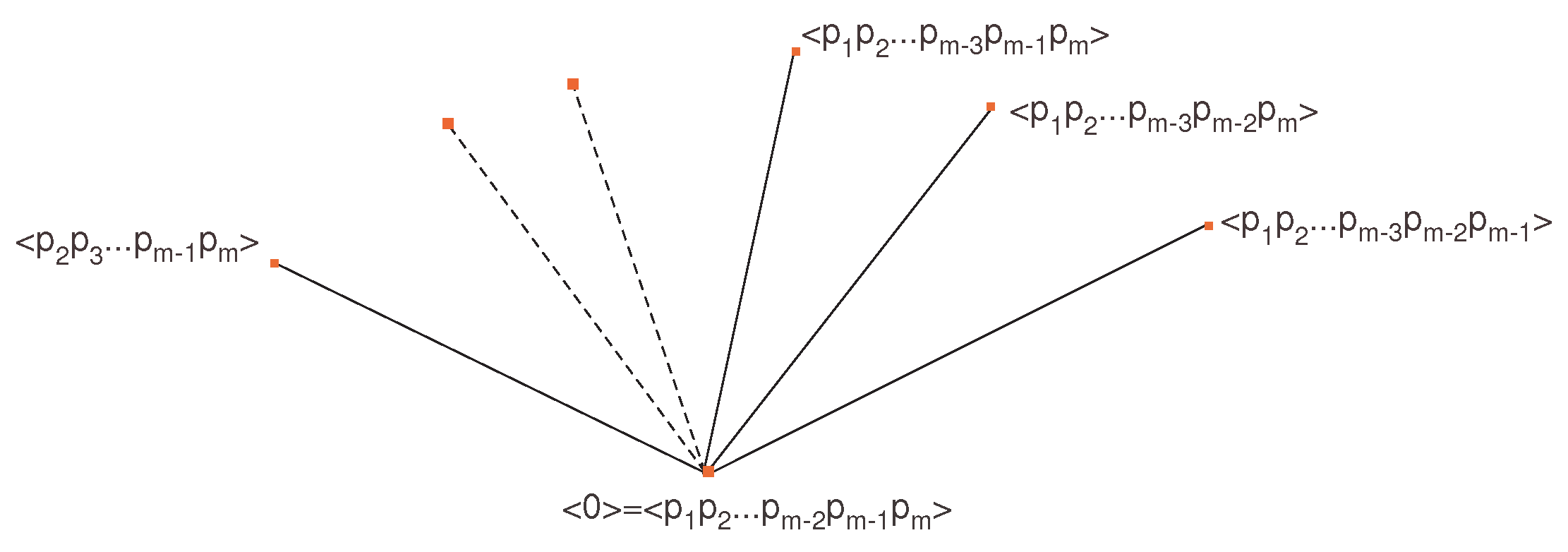
is contained immediately in
m subgroups of
:
=
=
=
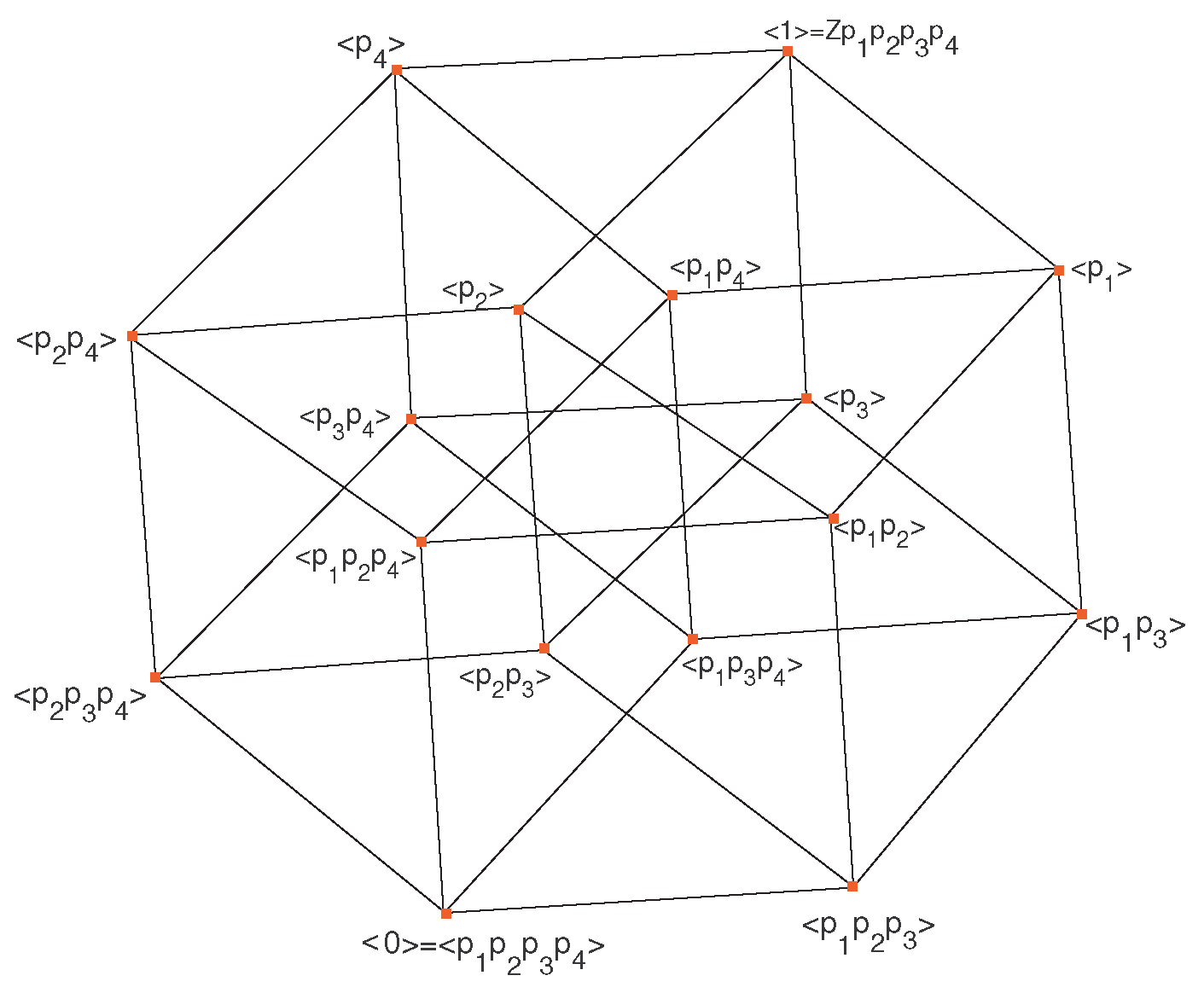
, as shown in
Figure 1.
Each
is contained in
subgroups of
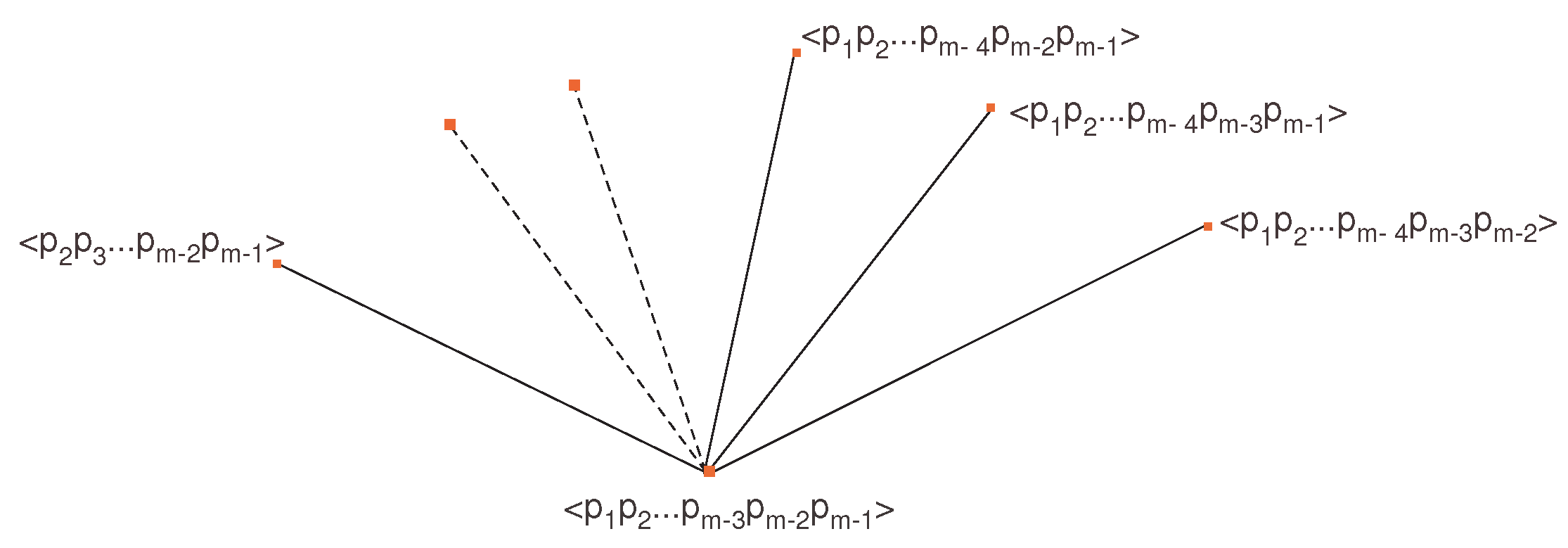
: For instance,
is contained in
,
(see
Figure 2).
Similarly, every
is contained in
subgroups of
:
is contained in
subgroups of
(see
Figure 3).
The process will continue until we receive
,
… at the second last stage. Now, each one of these is contained in
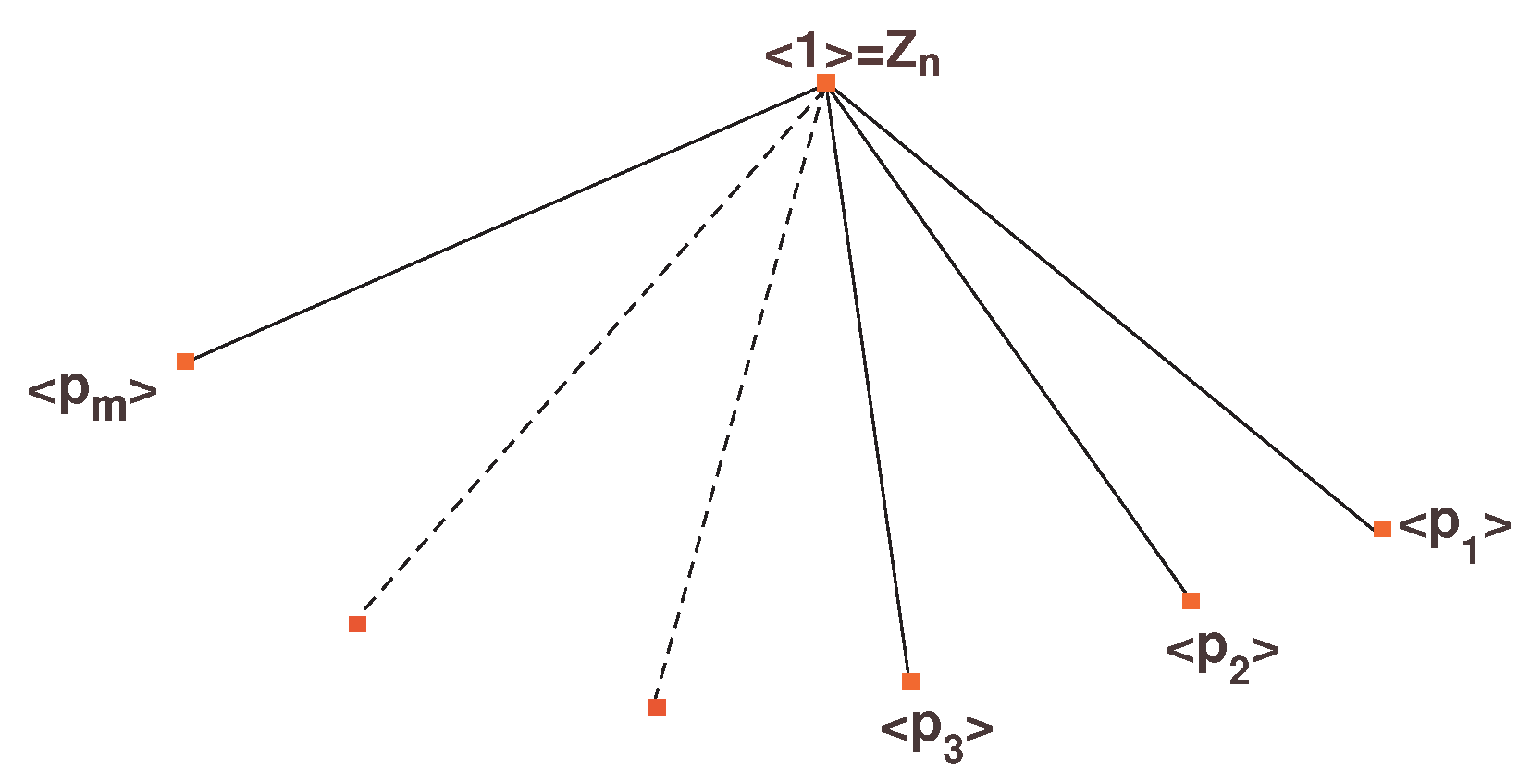
=
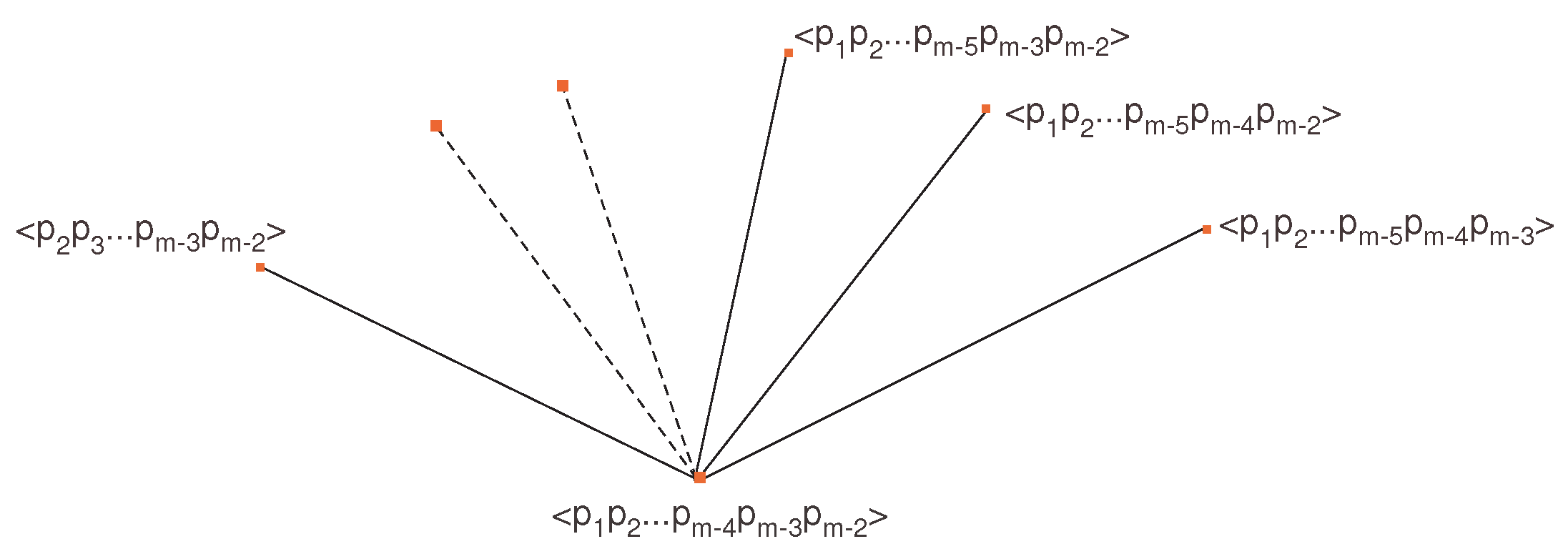
and the process is finished (see
Figure 4).
It is clear that there are
m possibilities of subgroups of
containing trivial group,
possibilities of each of
to be contained in other subgroups of
,
possibilities for each of
to be contained in next subgroups and so on. Thus, by the product rule, the number of all possibilities of maximal chains is
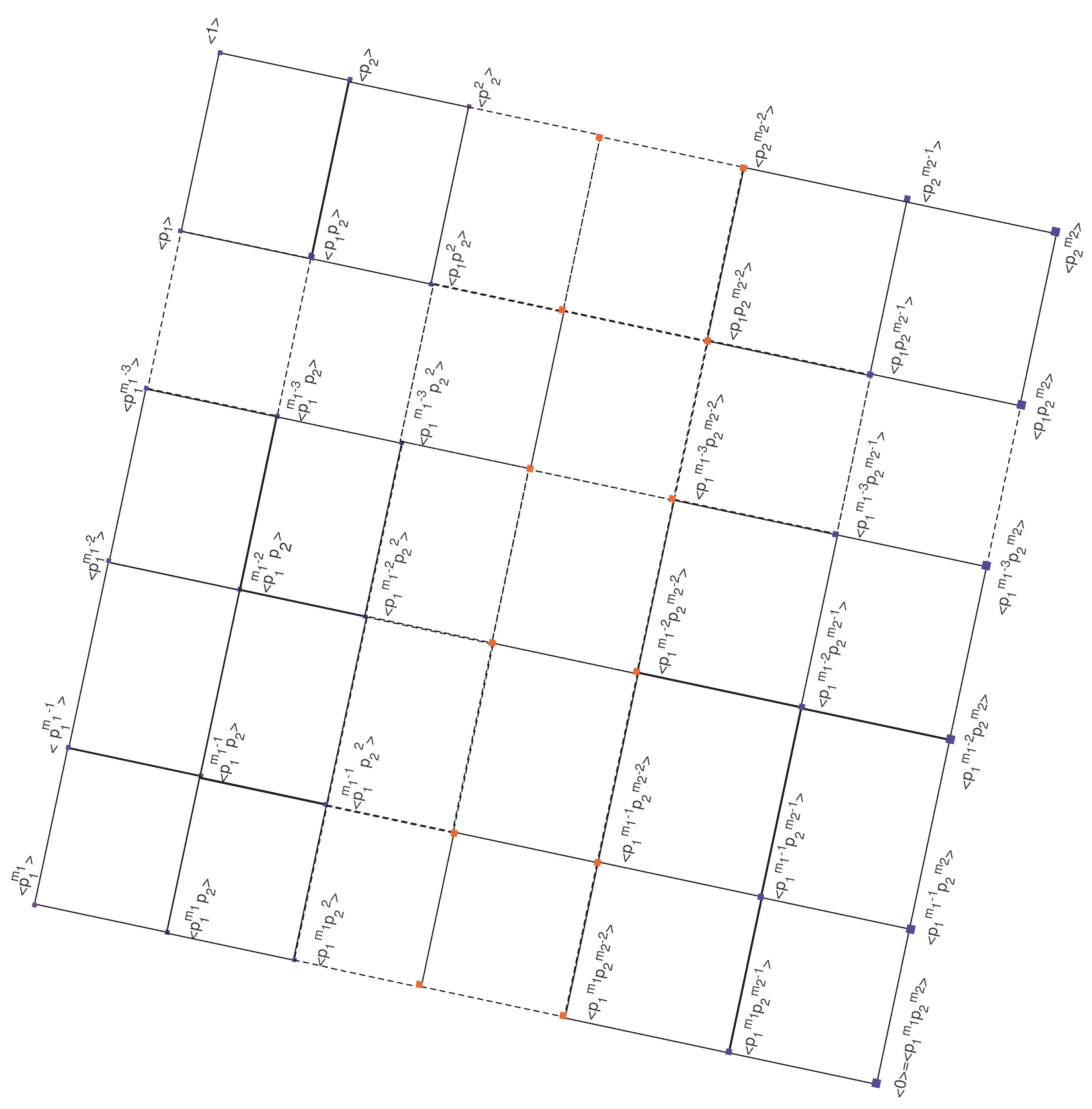
. Now, we put all these chains of subgroup in the plane such that each subgroup is identified to itself occurring in all these series. Thus, the same subgroups that appear in more than one series, appear only as a single vertex of the lattice graph in the plane. This lattice graph starts of at the identity and finishes at
because these subgroups appear in all series. This may have crossings. If we imagine this gluing in
avoiding all crossings in higher dimension, we get a convex polytope with
vertices, one vertex corresponding to each element of
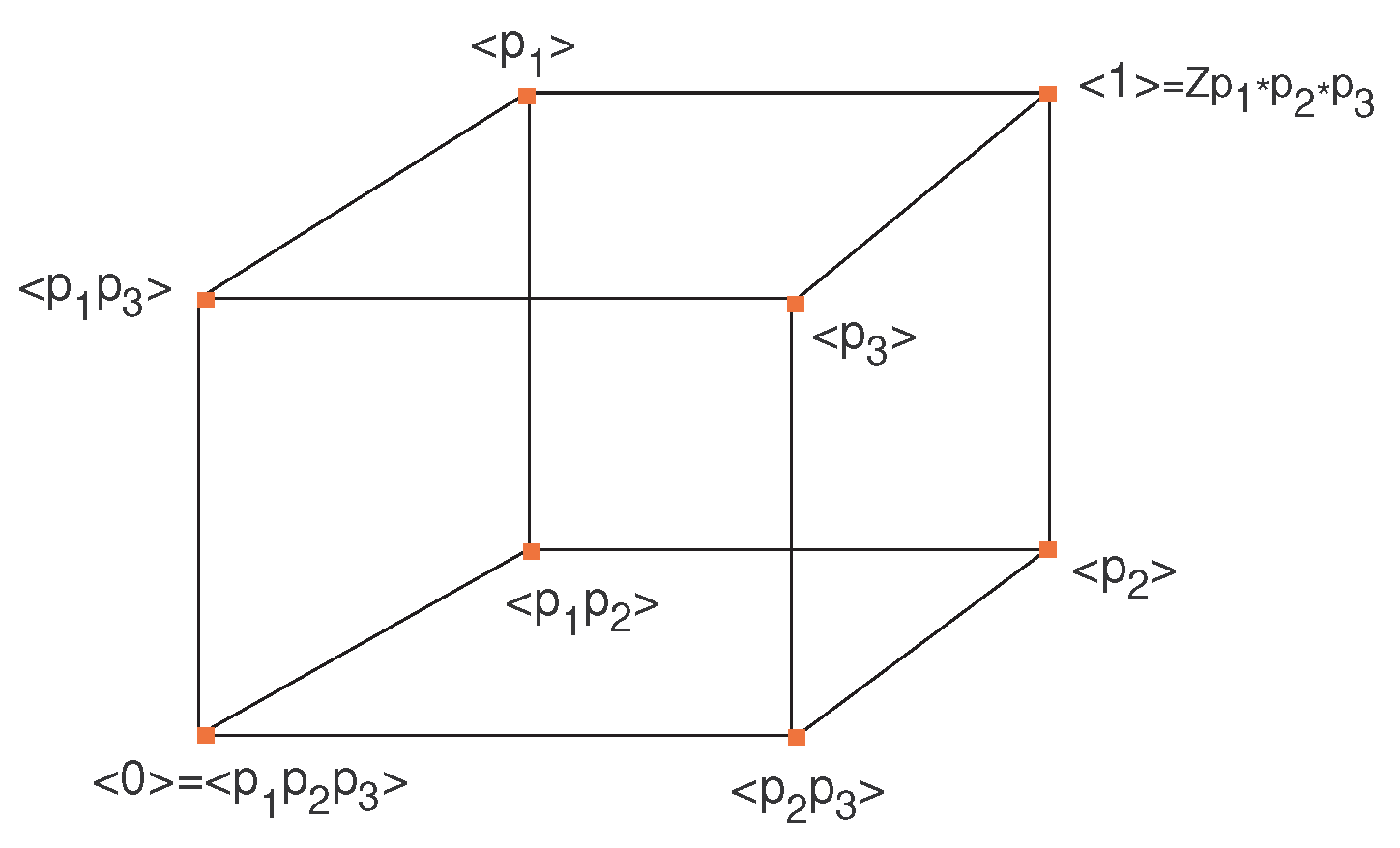
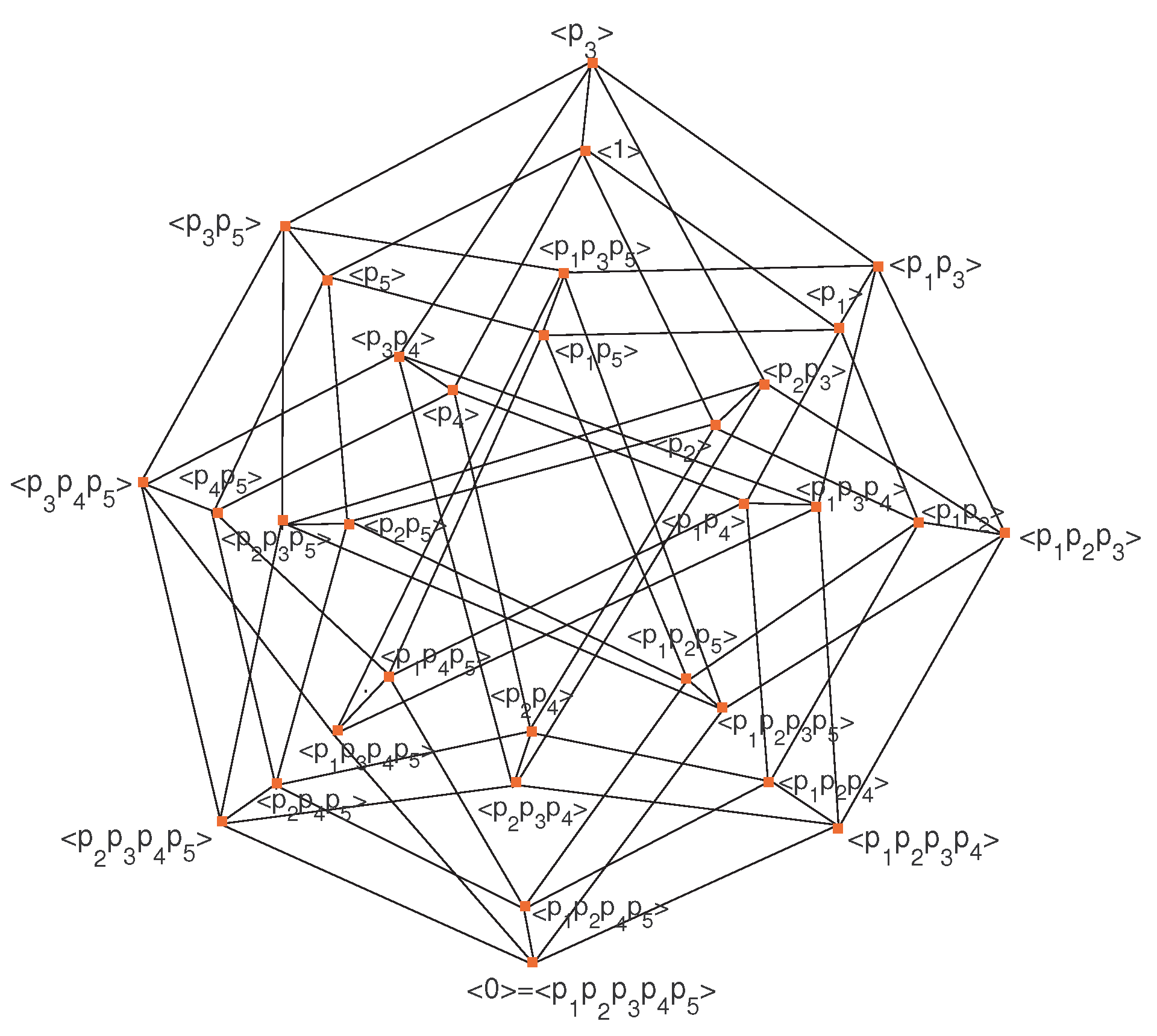
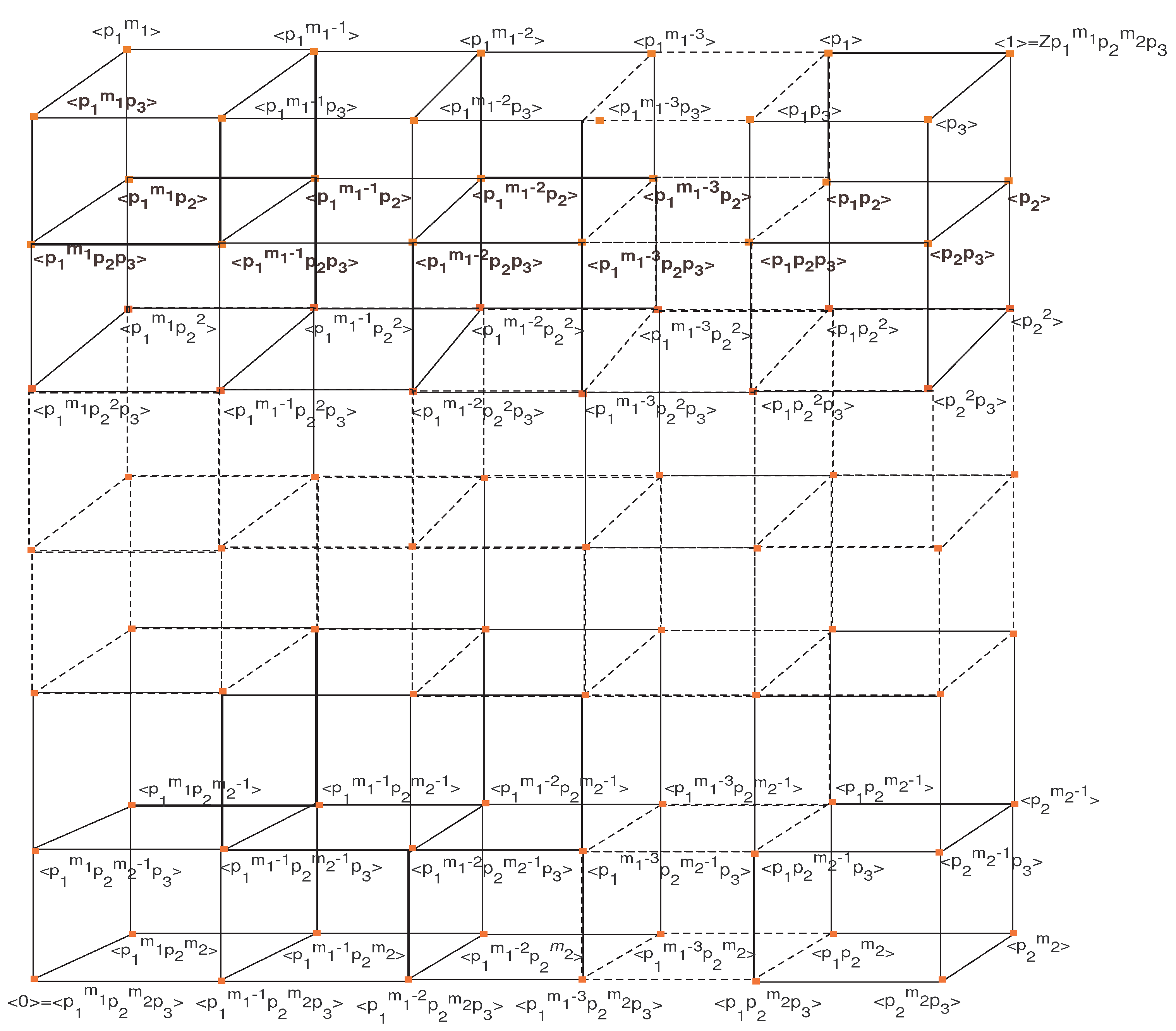
. For instance, the cases for
are shown in
Figure 5,
Figure 6 and
Figure 7, respectively.
Corollary 1. (a) The number of maximal subgroups of is m.
(b) The length of each maximal series is .
(c) The diameter of is m.
(d) is m-regular.
Proof. (a) It is clear that is cyclic, thus, for each divisor, we have a unique subgroup. Prime divisor of n yields maximum quotient, thus these numbers correspond to the maximal subgroups of , which are .
(b) This can be shown by simply counting the number of vertices of along a path from to ; see, for instance, a typical series: .
(c) diam is one less than the length of a maximal series, which is the length of each path from to .
(d) At the first stage, the degree of the vertex is m because it is adjacent to m vertices , in the second stage, as shown in the construction of .
The degree of each vertex at the second stage is m as each vertex is adjacent to vertices lying higher to it and to one vertex lying below it. For instance, is attached with , . Similarly, is m. Continuing this process, we receive that the vertices corresponding to are adjacent to the vertex corresponding to , giving the degree of the last vertex m too. Thus, each vertex of has degree m, and the proof is finished. ☐
Remark 1. It should be remarked that the lattice graph of is a small-world network in which nearly all nodes are not neighbors of one another, but the neighbors of any given node are likely to be neighbors of each other and most nodes can be reached from every other node by a small number of steps. Thus, it is a connected graph [16]. 2.2.
The construction of
is given by using all maximal chains from the set
. The subgroup
is contained immediately in two subgroups
and
which are further contained in
. The subgroup
is contained in
, which is contained in next two subgroups,
and
.
is contained in other two subgroups of
. The process will continue until we receive a subgroup
that is contained in next two subgroups,
and
. Both are further contained in
, which itself is contained in
. This process is continued until we obtain a subgroup
, which is continued in
, and thus we receive a series of subgroups of
; for instance,
. We obtain all other series of subgroups similarly. Now, gluing all maximal series, we obtain the lattice graph of
, as shown in
Figure 8.
From the construction, we reach at the results:
Proposition 1. (a) is planar.
(b) Length of maximal series of is .
(c) The diameter of lattice graph of is .
Proof. (a) This is obvious from the construction of .
(b) Again, this is obvious; see a typical maximal series: .
(c) In this case, the diameter is exactly one less than the number of elements in a maximal series. ☐
2.3. On the Lattice Graph of
The set of subgroups of
is
. The subgroup
is contained immediately in three subgroups
,
and
. The first two of these are contained in
. The subgroup
is contained in
which is further contained in two subgroups
and
. The subgroup
is contained in other two subgroups of
. The process will continue till we receive a subgroup
. It is contained in three subgroups
,
and
. The subgroup
is contained in
. It is contained in
. Continuing this process till we obtain
which is contained in
, and we will receive series of subgroups of
; for instance,
. Similarly, all the remaining subgroups will form other series of subgroups. At the end, gluing the vertices occurring in all maximal series, we obtain the required graph, as shown in
Figure 9.
Proposition 2. The crossing number of is .
Proof. The proof is clear from the
Table 1:
☐
The following proposition relates the number of crossings and number of subgroups of .
Proposition 3. cr.
Proof. We proceed as follows: . However, as in Proposition 2.4, we have, , which leads to the given result. ☐
Similarly, the following corollary provides a link between number of crossings and number of subgroups of .
Corollary 2. cr.
Proof. The result follows immediately from the relation . ☐
Proposition 4. The length of maximal series of is .
Proof. A typical maximal series of subgroups of is , which consists of . Since each maximal series has the same number of elements, we are done. ☐
Proposition 5. The diameter of is .
Proof. The diameter is one less than the length of the maximal series of . ☐
Proposition 6. Girth of the lattice graphs of , , , and is 4.
Proof. If the degree of each vertex of a graph is at least2, then then there exists a cycle. It is clear that the degree of each vertex of L() is 2 except , thus there exists a cycle and the length of shortest cycle is 4. Thus, the girth of L() is 4 except . Similarly, the girth of and is 4. ☐
Finally, the information about the diameter and girth is enclosed in the most general result:
Theorem 2 (The Main Theorem)
. If G is the group , then:
(a) The length of the maximal series of G is .
(b) The diameter of is .
(c)
Proof. (a) The set of subgroups of G is = This set consists of elements; this number is actually the number of divisors of the order of G. Now, take elements of and form a (maximal) series from to . A typical series of such kind is:
This maximal series contains subgroups. Since each maximal series contains exactly the same number of subgroups, the length of maximal series is .
(b) It now follows that the diameter of is , which, in our case, is actually one less than the length of maximal series of G. This completes the proof.
(c)Case I. ()
Consider two typical maximal series of subgroups of G:
.
and
.
On gluing these maximal series in this a way, the subgroup is contained immediately in two subgroups: = and = . Both these are further contained in = , and we obtain a closed path . We can split this closed path in two closed paths, and . For if , we receive a contradiction that there does not exist a closed path of length 3.
Similarly, gluing the vertices occurring in all maximal series, we obtain a graph in which one vertex is joined at least with two vertices which are further joined with another vertex, but these two vertices are not joined with each other. This confirms that the length of shortest cycle is 4.
Case II. ()
In this case, since we receive just a finite path, . ☐
Theorem 3. (a) is Eulerian if m is even and is non-Eulerian if is odd.
(b) is non-Eulerian if and .
(c) is non-Eulerian.
Proof. The proof is given in the following
Table 2:
☐