Abstract
Robust stabilization and controller design for uncertain systems with impulsive and stochastic effects have been deeply discussed. Some sufficient conditions for the considered system to be robustly stable are derived in terms of linear matrix inequalities (LMIs). In addition, an example with simulations is given to better demonstrate the usefulness of the proposed controller design method.
1. Introduction
Analysis and synthesis of dynamical systems with impulsive effects have attracted recurring interest for the past few decades [1,2,3]. The sudden change of system states at a certain point is the characteristic of a pulse dynamic system. Take an example from economics. When higher prices cause inflation, the government may raise the interest rate in real time to quickly reduce the circulation of money in the market, which is a typical pulse phenomenon. For a deterministic case, a large number of conclusions about stability and control for systems with impulsive perturbations can be found; see [4,5,6,7,8] and the reference therein.
However, because science and engineering applications offer stochastic models a great role in many areas, stochastic system theory has received widespread attention. Many basic results of systems without stochastic disturbance have been expanded to stochastic systems [9,10,11,12,13,14,15,16]. At the same time, the theory and application of stochastic differential equations have made great progress because it has played a key role in many fields; for example, option investment, population growth forecast, system control and filtering [17,18,19,20,21]. Among them, Ref. [21] gave a survey of impulsive differential equation theory that has been developed in recent years. Parameter uncertainties appear in stochastic impulsive systems, and exponential stability was analyzed in [22], guaranteed cost control was discussed in [23] and filtering has been dealt with in [24,25]. It should be noted that for uncertain systems with impulsive and stochastic effects, little research has been carried out on robust control, which aroused our interest.
In this note, the studies of robust stabilization and controller design are conducted for an uncertain stochastic system with impulsive effects. Its time-varying uncertain parameters, which appear both in state, control and disturbance part, are supposed to be norm-bounded. An LMI-based sufficient condition is derived for an existing memoryless state feedback controller guaranteeing asymptotic stability and meeting performance.
The note has the following arrangement: Section 2 begins with the problem formulation and reviews some useful definitions and lemmas; Section 3 discusses the robust stability and robust stabilization; Section 4 develops LMI-based controller design method; Section 5 gives an example, which illustrates the applicability of the theoretical results; Section 6 summarizes the full text.
Notations. indicates that a symmetric positive (semi-positive) definite matrix; and represents the transpose and the inverse of X; is the n-dimensional Euclidean space; (respectively, ) is the space of the square-integrable vector functions (respectively, the squares and vector sequences) on ; denotes the Euclidean vector norm; (respectively, ) represents the (respectively, ) norm on ; while indicates the norm in ; is the complete probability space with the sample space and the -algebra of subsets of the sample space; corresponds to the mathematical expectation; the maximum (minimum) eigenvalues of a matrix are represented by ().
2. Problem Description and Preliminaries
We consider the uncertain stochastic system with impulsive effects:
where is the system state, is the controlled output, and is the control input, is the continuous disturbance of . is the discrete disturbance of . is a one-dimensional Brownian motion defined on a complete probability space . are the impulsive time instants and satisfy . Assume that and are known matrices with appropriate dimensions, and and are unknown matrices denoting norm-bounded time-varying parameter uncertainties with the forms:
where and are known constant matrices, and is an unknown time-varying matrix function satisfying
For convenience, abbreviating , , , , , , , , and to , , , , , , x, v, u and w, where , , , , and are considered admissible if both (2) and (3) hold.
Now, we recall some basic concepts about robust stability and stabilization.
Definition 1 ([13]).
The impulsive stochastic system (1) is said to be mean-square stable with , and , if there is a for ∀, when , , such that . If satisfies any initial conditions, then (1) with , and is called mean-square asymptotically stable. And, the system is said to be robustly stochastic stability (RSS for short) if (1) with and is mean-square asymptotically stable for all admissible uncertainties and .
Definition 2 ([13]).
Given a real number , the system is said to be RSS and the performance γ exists, if it is RSS in the sense of Definition 1 and under zero initial conditions, for all and all admissible uncertainties , the inequality holds.
Next, We list two lemmas, which are very important for the discussion in later chapters.
Lemma 1 ([26]).
Let matrices and F with appropriate dimensions satisfying and , then:
- (1)
- For scalar and vectors ,
- (2)
- For ∀ to make ,
Lemma 2 ([27]).
Let be given matrices, where , and , then the following inequalities are equivalent:
- (1)
- (2)
3. Robust Stabilization
In this chapter, we restrict our study to the uncontrolled system (i.e., and in (1)):
First of all, we present some sufficient conditions for RSS of (4) with .
Theorem 1.
Assume there exist two positive scalars , and matrix , such that:
then (4) with is mean-square asymptotically stable.
Proof.
Consider (4) with , that is,
Let ∀, , and matrix be a solution of (5) and (6). Let
For and , Define
Then, along the trajectory of (7) and apply the Itô’s formula [12], we can get
where
Applying (2), (3) and Lemma 1, for ∀,
and
Hence, from (11)–(13), we have
where .
Pre- and post-multiplying (5) by diag , and by means of Lemma 2, we can get that
By Lemma 2 again, is equivalent to (15), which shows is negative-definite. Considering (14), for and ∀, we can obtain
where Therefore
Setting , by using the integration-by-parts Formula [28] for (17), one get
The inequality integral from to t, we yields
In view of (6), pre- and post-multiplying by P, it gives
Then we have
That is,
So, for , by (18) and (20), we prove that
Similarly, we have
These implies for ∀,
Thus, let , we can deduce
which means that (7) is mean-square asymptotically stable. □
We will design a memoryless state feedback controller with the form:
Making the resulting closed-loop system is RSS, is a constant gain.
Applying (23) to (4), generate the following closed-loop systems:
where , , and , in which and .
Invoking by Theorem 1, it gives
Theorem 2.
For the uncertain impulsive stochastic system (24), assume there are , and a matrices , such that:
then (4) is robustly stable with controller (23) and .
In order to synthesize the gain of the controller, we transform (25) into an easy to calculate form. Note
Letting , (25) is equivalent to the following LMI:
where
Remark 1.
Theorem 2 gives a sufficient condition for robust stability of (4), which can be validated effectively by LMIs method. We can also stabilize the feedback gain (4) by solving LMIs.
4. Robust Control
This part is mainly used to study the robust -control problem for (1).
Theorem 3.
For the uncertain impulsive stochastic system (1). Given , if there are , , matrices and Y, such that:
where , then (1) is called have performance level γ under zero initial condition. Under this circumstance, an state feedback controller can be selected by
in which .
Proof.
By substituting (30), (1) becomes
By (28), it is easy to infer that the LMI in (25) holds. Therefore, from the theorem 2, it can be concluded that the closed-loop system (31) is robustly stable. The next, we will prove (31) satisfies
for all nonzero , under zero initial condition.
Let . Pre-and post-multiplying (28) by diag , it gives
For (31), applying the Itô’s formula to , for , we have that
where
Noting and in view of Lemma 1, it can be shown that for ,
and
From (35)–(37), we get
where
It can be inferred that from (33). Thus, combined with (34) and (38), we obtain
Then, the sides of (34) are integrated from to t, we have
By means of (39) and (40), we get
Therefore, for ∀,
where
Because of , it can be deduced from (38)–(42) that
Let . Pre- and post-multiplying (29) by diag , we have
where By (31), we can confirm
That is, relying on (19), we can know
Namely, So, combined with (45), we infer that
Also, we have
From the above inequalities, we deduce
Note the zero initial conditions and (43) over all possible in , it results in
which means that (32) is satisfied. This proof is complete. □
5. An Example
In this chapter, we will provide an example to better illustrate the usefulness of the proposed method.
Example 1.
Consider a two-dimensional uncertain impulsive stochastic system (1) with the following parameters:
Set , using the Matlab LMI Control toolbox, we can get the solutions to LMIs (28) and (29) are as follows:
Therefore, from Theorem 3, the control law can be chosen as:
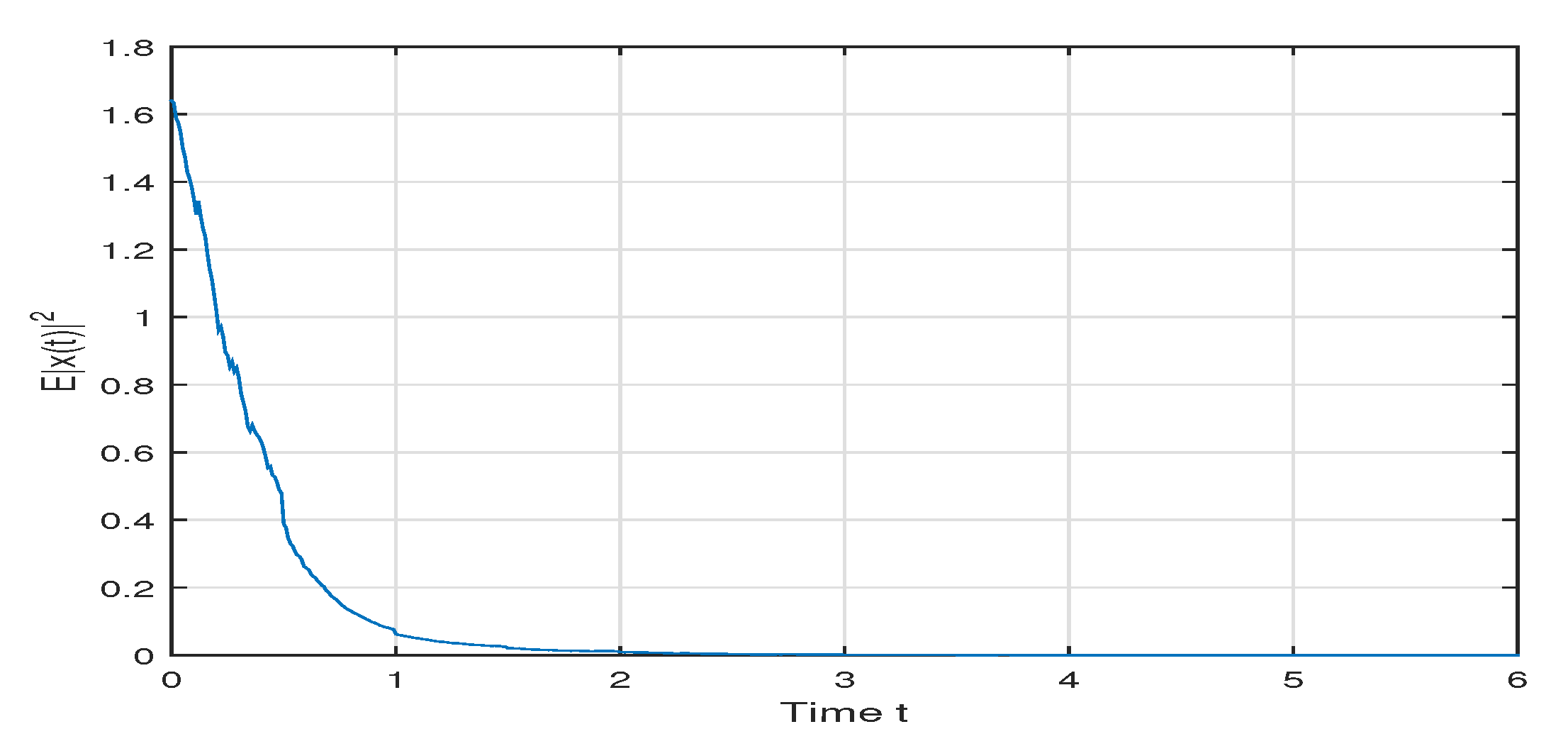
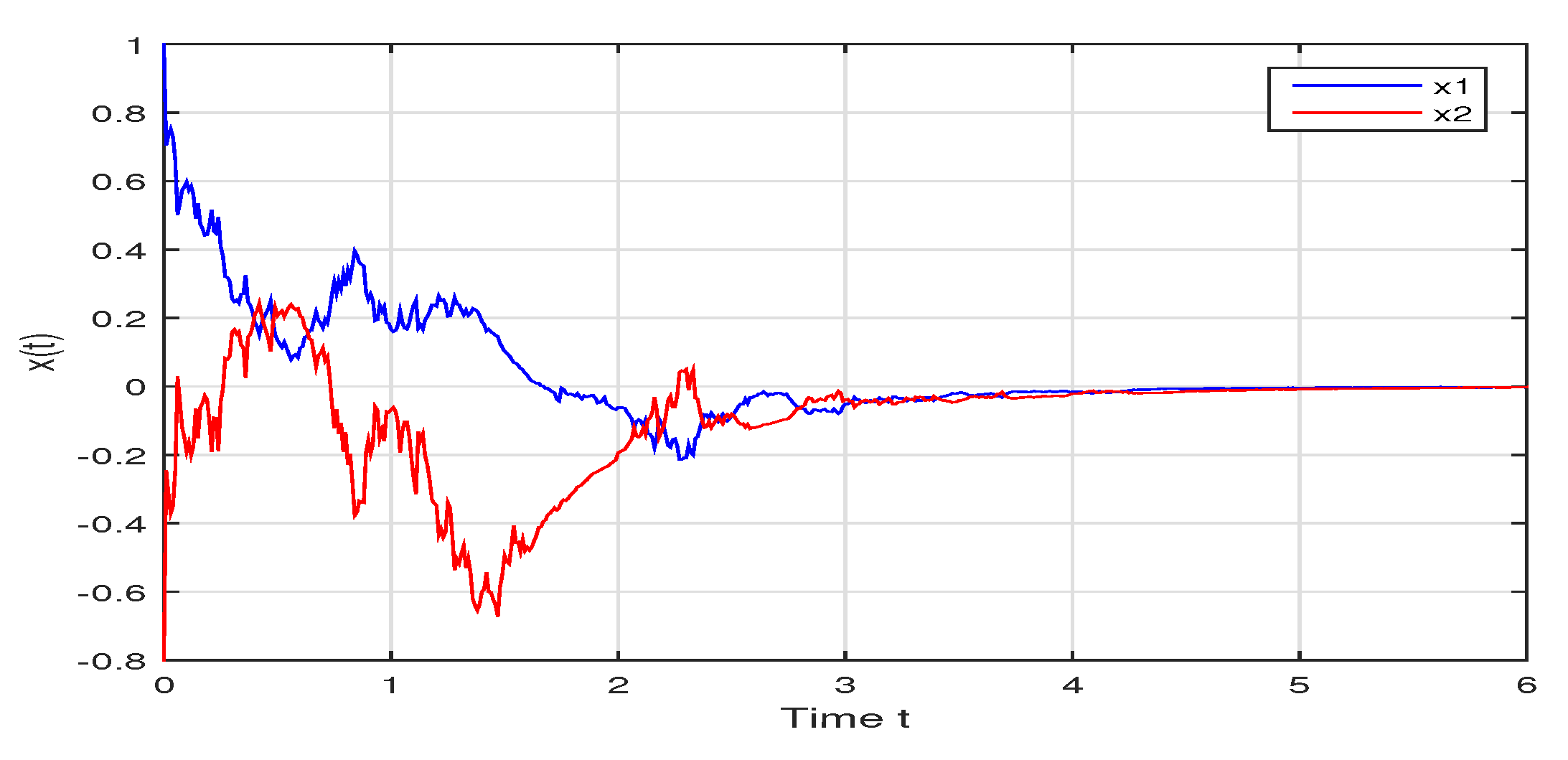
We select initial value and the impulsive interval . Figure 1 depicts the state of the uncertain impulsive stochastic system. It is obvious from Figure 2 that the closed-loop system is mean-square asymptotically stable, where which is the jth sample path.
Figure 1.
State path of Example 1.
Figure 2.
Trajectory of the average value of 1000 sample paths.
6. Conclusions
Robust stabilization and control are considered in this paper for stochastic systems with uncertainties and impulsive effects. As for robust stability and robust stabilization, LMIs-based sufficient conditions have been established. Moreover, we proposed a reasonable controller design method and its effectiveness has been demonstrated by a numerical example.
Author Contributions
Methodology, C.X., T.H. and X.S.; Writing original draft, Z.X.
Funding
This research was supported by National Natural Science Foundation of China under Grants Nos. 61673013 and 61803235, Natural Science Foundation of Shandong Province under Grant No. ZR2016JL022, Key Research and Development Plan of Shandong Province under Grant No. 2019GGX101052.
Conflicts of Interest
The authors declare no conflict of interest.
References
- Yang, T. Impulsive Control Theory; Springer: Berlin, Germany, 2001. [Google Scholar]
- Yang, T. Impulsive Systems and Control: Theory and Applications; Nova Science Publishers: New York, NY, USA, 2001. [Google Scholar]
- Li, X.; Cao, J. An impulsive delay inequality involving unbounded time-varying delay and applications. IEEE Trans. Autom. Control 2017, 62, 3618–3625. [Google Scholar] [CrossRef]
- Li, Z.; Soh, Y.; Wen, C.; Zhai, G. Switched and impulsive systems: Analysis, design, and applications. IEEE Trans. Autom. Control 2006, 51, 2010–2011. [Google Scholar]
- Haddad, W.M.; Chellaboina, V.; Kablar, N.A. Non-linear impulsive dynamical systems. Part II: Stability of feedback interconnections and optimality. Int. J. Control 2001, 74, 1659–1677. [Google Scholar] [CrossRef]
- Guan, Z.; Chen, G.; Ueta, T. On impulsive control of a periodically forced chaotic pendulum system. IEEE Trans. Autom. Control 2000, 45, 1724–1727. [Google Scholar] [CrossRef]
- Cheng, H.; Wang, F.; Zhang, T. Multi-state dependent impulsive control for Holling I predator-prey model. Discret. Dyn. Nat. Soc. 2012, 2012, 181752. [Google Scholar] [CrossRef]
- Li, Y.; Cheng, H.; Wang, Y. A Lycaon pictus impulsive state feedback control model with Allee effect and continuous time delay. Adv. Differ. Equ. 2018, 2018, 367. [Google Scholar] [CrossRef]
- Li, X.; Bohner, M.; Wang, C. Impulsive differential equations: Periodic solutions and applications. Automatica 2015, 52, 173–178. [Google Scholar] [CrossRef]
- Chen, W.; Zheng, W. Input-to-state stability and integral input-to-state stability of nonlinear impulsive systems with delays. Automatica 2009, 45, 1481–1488. [Google Scholar] [CrossRef]
- Karthikeyan, S.; Balachandran, K. Constrained controllability of nonlinear stochastic impulsive systems. Int. J. Appl. Math. Comput. Sci. 2011, 21, 307–316. [Google Scholar] [CrossRef]
- Spiliotis, J.; Tsinias, J. Notions of exponential robust stochastic stability, ISS and their Lyapunov characterizations. Int. J. Robust Nonlinear Control 2003, 13, 173–187. [Google Scholar] [CrossRef]
- Rodkina, A.; Schurz, H.; Shaikhet, L. Almost sure stability of some stochastic dynamical systems with memory. Discret. Contin. Dyn. Syst. 2008, 21, 571–593. [Google Scholar]
- Zhou, S.; Liu, X.; Chen, B.; Liu, H. Stability analysis for a Class of discrete-time nonhomogeneous Markov jump systems with multiplicative noises. Complexity 2018, 2018, 1586846. [Google Scholar] [CrossRef]
- Zhang, W.; Ma, L.; Zhang, T. Discrete-time mean-field stochastic H2/H∞ control. J. Syst. Sci. Complex. 2017, 30, 765–781. [Google Scholar] [CrossRef]
- Tan, C.; Zhang, W. On observability and detectability of continuous-time stochastic Markov jump systems. J. Syst. Sci. Complex. 2015, 28, 830–847. [Google Scholar] [CrossRef]
- Oksendal, B. Stochastic Differential Equations: An Introduction with Application, 5th ed.; Springer: New York, NY, USA, 1998. [Google Scholar]
- Li, C.; Sun, J.; Sun, R. Stability analysis of a class of stochastic differential delay equations with nonlinear impulsive effects. J. Frankl. Inst. 2010, 347, 1186–1198. [Google Scholar] [CrossRef]
- Yang, Z.; Xu, D. Mean square exponential stability of impulsive stochastic difference equations. Appl. Math. Lett. 2007, 20, 938–945. [Google Scholar] [CrossRef][Green Version]
- Perestyuk, M.O.; Chernikova, O.S. Some modern aspects of the theory of impulsive differential equations. Ukr. Math. J. 2008, 60, 91–107. [Google Scholar] [CrossRef]
- Lakshmikantham, V.; Bainov, D.D.; Simeonov, P.S. Theory of Impulsive Differential Equations; World Scientific: Singapore, 1989. [Google Scholar]
- Zhang, Y.; Wang, C. Robust stochastic stability of uncertain discrete-time impulsive Markovian jump delay systems with multiplicative noises. Int. J. Syst. Sci. 2015, 46, 2210–2220. [Google Scholar] [CrossRef]
- Dong, Y.; Wang, Q.; Sun, J. Guaranteed cost control for a class of uncertain stochastic impulsive systems with Markovian switching. Stoch. Anal. Appl. 2009, 27, 1174–1190. [Google Scholar] [CrossRef]
- Xu, S.; Chen, T. Robust H∞ filtering for uncertain impulsive stochastic systems under sampled measurements. Automatica 2003, 39, 509–516. [Google Scholar] [CrossRef]
- Dong, Y.; Sun, J.; Wu, Q. H∞ filtering for a class of stochastic Markovian jump systems with impulsive effects. Int. J. Robust Nonlinear Control 2008, 18, 1–13. [Google Scholar] [CrossRef]
- Chen, W.; Wang, J.; Tang, Y.; Lu, X. Robust H∞ control of uncertain linear impulsive stochastic system. Int. J. Robust Nonlinear Control 2008, 18, 1348–1371. [Google Scholar] [CrossRef]
- Boyd, S.; El Ghaoui, L.; Feron, E.; Balakrishnan, V. Linear Matrix Inequalities in System and Control Theory; SIAM: Philadelphia, PA, USA, 1994. [Google Scholar]
- Mao, X. Stability of stochastic differential equations with Markovian switching. Stoch. Process. Appl. 1999, 79, 45–67. [Google Scholar] [CrossRef]
© 2019 by the authors. Licensee MDPI, Basel, Switzerland. This article is an open access article distributed under the terms and conditions of the Creative Commons Attribution (CC BY) license (http://creativecommons.org/licenses/by/4.0/).