


Abstract
There are several equivalent axioms, which can be used to characterize the positive implicativity in -algebras. In this paper, we investigate interrelationships among such axioms in a more general setting of groupoids, and several aspects regarding their differences in the theory of groupoids.
1. Introduction
Bruck ([1]) published a book, A survey of binary systems discussed in the theory of groupoids, loops and quasigroups, and several algebraic structures. Borvka ([2]) stated the theory of decompositions of sets and its application to binary systems.
The notion of d-algebras which is another useful generalization of -algebras was introduced by Neggers and Kim ([3]), and some relations between d-algebras and -algebras as well as several other relations between d-algebras and oriented digraphs were investigated. Several aspects on d-algebras were studied [4,5,6]. Recently some notions of the graph theory were applied to the theory of groupoids ([7]).
There are several different axioms, which can give equivalent characterizations of the positive implicativity in -algebras. By using other axioms or their induced results, the proofs of their equivalences were obtained in -algebras. It is interesting and useful to investigate these axioms in a more general mathematical structure called groupoids.
In this study, we discuss some relations among such axioms in groupoids, and obtain some results disclosing their differences in the groupoid setting. If we discuss these conditions in -algebras, their delicate differences may not be discovered. Although simple mathematical structures are difficult to deal with in some cases, they can capture essential ideas of some axioms, and provide a starting point of new mathematical structures in future.
2. Preliminaries
A groupoid is said to be a left-zero-semigroup if for all . Similarly, a groupoid is said to be a right-zero-semigroup if for all . A groupoid is said to be a leftoid (resp., rightoid) for f if (resp., ) for a map . For example, if we define a binary operation * by for all , then is a leftoid [8].
A d-algebra [3] is a non-empty set X with a constant 0 and a binary operation “” satisfying the following axioms:
- (I)
- ,
- (II)
- ,
- (III)
- and imply for all .
For brevity, we also call X a d-algebra. In X, we can define a binary relation “≤” by if and only if . For general references on d-algebras, we refer to [4,5,6].
A BCK-algebra [9] is a d-algebra X satisfying the following additional axioms:
- (IV)
- ,
- (V)
- for all .
Example 1 ([6]).
Letbe a set with the following table:
Then,is a d-algebra that is not a-algebra. For general references on-algebras, we refer to [9,10,11].
A -algebra is said to be positive implicative [9] if for all .
Theorem 1 ([9]).
Letbe a-algebra. Then, the following are equivalent:
- (1)
- is positive implicative,
- (2)
- ,
- (3)
- ,
- (4)
- ,
- (5)
- ,
- (6)
for all.
Let be a poset and let S be a subset of X. A full subposet [12] is a poset whose underlying set is S and its poset structure is inherited from . A poset is said to be Q-free [13] if there is no full subposet of which is order isomorphic to the poset . Similarly, a graph is said to be Q-free if there is no full subgraph of which is isomorphic to the graph . A directed graph is said to be a cycle of order n if there are arrows . We denote it by . A complete graph is a graph whose vertices are pairwise adjacent, and we denote it by . For general references on graph theory, we refer to [14].
3. Positive Implicativity
A groupoid is said to be
- positive implicative: ,
- central implicative: ,
- meet implicative: ,
- quasi implicative:
for all .
Proposition 1.
(a) Ifis a leftoid for φ, i.e.,for all, thenis positive implicative.
(b) Ifis a rightoid for φ, i.e.,for all, thenis positive implicative if and only if.
Proof.
(a). Given , we have .
(b). If , then , which shows is positive implicative. Assume is positive implicative. Then, for all . It follows that , proving that . □
Given a graph , a groupoid is said to be a selective groupoid from the graph if
Proposition 2.
Letbe a selective groupoid from a graph. Ifis positive implicative, thenis-free.
Proof.
Assume has as a subgraph. Then, there exist such that
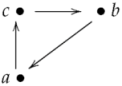
Then, , while , a contradiction. □
Proposition 3.
Any selective groupoidfrom a complete graphis positive implicative.
Proof.
Given , there exist arrows and in , and hence and . It follows that and , proving that is positive implicative. □
Proposition 4.
Letbe selective groupoids and let. Definefor all. Then,is also positive implicative.
Proposition 5.
Letbe a leftoid for φ and letbe a rightoid for ψ such thatfor all. Let. Definefor all. Then,is positive implicative.
Proof.
Given , we have . It follows that
and
This shows that is positive implicative. □
Proposition 6.
Letbe a positive implicative groupoid. Ifis an epimorphism of groupoids, thenis also positive implicative.
Proof.
Given , since is onto, there exist such that . It follows that
proving that is also primitive implicative. □
Proposition 7.
Letbe a positive implicative groupoid and letbe a subgroupoid of. Then,is also positive implicative.
By Propositions 5–7, we obtain the following:
Theorem 2.
The collection of all positive implicative groupoids forms a variety.
4. Central and Meet Implicativity
Proposition 8.
Letbe a leftoid for φ. Then,is central implicative if and only if.
Proof.
Assume that is central implicative. Then, for all . It follows that , proving that . If , then . □
Proposition 8 shows that any leftoid for , where , is positive implicative, but not central implicative.
Example 2.
Letbe the set of all real numbers. Define a binary operation “” on X byfor all. Sincefor any, the groupoidis both positive implicative and central implicative.
Proposition 9.
Letbe a leftoid for φ. Then,is meet implicative if and only if.
Proof.
Assume that is meet implicative. Then, for all . It follows that and hence . If , then . □
By using Propositions 8 and 9, we obtain the following:
Theorem 3.
Letbe a leftoid for φ. Then, the following are equivalent:
- (i)
- is central implicative,
- (ii)
- is meet implicative,
- (iii)
- .
Example 3.
Letbe the set of all natural numbers. Define a mapbyand definefor all. Then, it is easy to see thatis positive implicative. Since, by Theorem 3, it is neither central implicative nor meet implicative.
Proposition 10.
Letbe a rightoid for ψ. Then,is meet implicative if and only iffor all.
Proof.
Given , we have
proving the proposition. □
Corollary 1.
Letbe a rightoid for ψ. Ifis positive implicative, then it is meet implicative.
Proof.
Suppose that is positive implicative. Then, for all . It follows that and hence for all . This shows that for all . By Proposition 10, is meet implicative. □
The converse of Corollary 1 does not hold in general.
Example 4.
Consider. If we definefor all, and defineon X, thenis a rightoid for ψ. Given, we haveand. By Theorem 3 and Corollary 1,is meet implicative, but not positive implicative.
Note that a central implicative groupoid need not be a meet implicative groupoid. Note that every rightoid for is central implicative, since for all . By Corollary 1, we obtain that every positive implicative rightoid for is both central implicative and meet implicative.
Example 5.
Define a binary operation “” onbywhere. Then,is a rightoid for ψ. Given, we have. This shows thatis central implicative, but not meet implicative.
Proposition 11.
Every selective groupoid is both central implicative and meet implicative.
Proof.
Let be a selective groupoid. Given , if , then . If , then , proving that is central implicative. Given , if , then . If , then , proving that is meet implicative. □
Note that selective groupoids need not be positive implicative.
Example 6.
Letbe a set with the following graph: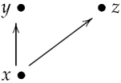
Then, its selective groupoidcan be represented as follows:
Then, it is easy to see thatis both central implicative and meet implicative. Since, it is not positive implicative.
Example 7.
Letbe a leftoid for φ and. Iffor all, then, i.e.,is both central implicative and meet implicative. Note thatneed not be a-algebra. In fact, assume. Then,. Since,does not hold in general.
5. Quasi Implicativity
Proposition 12.
Letbe a leftoid for φ. Then,is quasi implicative if and only if.
Proof.
Assume that is quasi implicative. Then, for all . It follows that , proving that .
If , then , proving that is quasi implicative. □
It is clear that every central implicative groupoid is quasi implicative, but the converse need not be true in general.
Example 8.
Letbe a set withfor allwhere. Then,,andfor all. By Theorem 3 and Proposition 12,is quasi implicative, but not central(meet) implicative.
Proposition 13.
Every rightoid for ψ is both central implicative and quasi implicative.
Proof.
Given , we have , proving that is both central implicative and quasi implicative. □
6. Medial and Positive Implicative Groupoids
A groupoid is said to be medial if for all .
Example 9.
Letbe the set of all real numbers. If we definefor all, thenis both medial and idempotent. It is also a positive implicative groupoid.
Example 10.
Letbe the set of all real numbers and let. Define a mapand define a binary operation “” on X byfor all. Then,is medial. In fact, given, we have
showing thatis medial.
Example 11.
In Example 10, ifis idempotent, thenfor all, which shows that, i.e.,for all.
Note that if is idempotent in Examples 10 and 11, then for all . This shows that is a left-zero semigroup.
Proposition 14.
Ifis an idempotent medial groupoid, then it is positive implicative.
Proof.
If is medial and positive implicative, then for any , we have , proving that is positive implicative. □
Note that the converse of Proposition 14 need not be true in general.
Example 12.
Letbe a poset with the following Hasse diagram: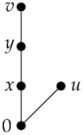
If we define a binary operation “” on X by
then it is easy to see thatis a positive implicative-algebra. Note that, but, which shows thatis not medial. Sincefor all, it is not idempotent.
7. Conclusions
In this paper, we proved that the collection of all positive implicative groupoids forms a variety, and discussed some relations between selective groupoids and the graph theory. We ascertained several relations between the central implicativity and the meet implicativity in groupoids. Moreover, we showed that every selective groupoid is both central and meet implicative, and every idempotent groupoid is positive implicative. For further investigation, we will apply this concept to the semigroup ([8]) of all groupoids defined on a set X related to ordered structures in groupoids ([15]).
Author Contributions
Conceptualization, F.F., H.S.K. and J.N.; Formal analysis, F.F., H.S.K. and J.N.; Writing—original draft, F.F., H.S.K.; Writing—review & editing, F.F., H.S.K. and J.N.
Funding
This work was partially supported by National Natural Science Foundation of China (Program No. 11301415), Natural Science Basic Research Plan in Shaanxi Province of China (Program No. 2018JM1054), Scientific Research Program Funded by Shaanxi Provincial Education Department of China (Program No. 16JK1696), and the Special Funds Project for Key Disciplines Construction of Shaanxi Universities.
Acknowledgments
The authors are deeply grateful to four anonymous reviewers for their valuable suggestions.
Conflicts of Interest
The author declares no conflicts of interest.
References
- Bruck, R.H. A Survey of Binary Systems; Springer: Berlin, Germany, 1958. [Google Scholar]
- Borůvka, O. Foundations of the Theory of Groupoids and Groups; John Wiley & Sons: New York, NY, USA, 1976. [Google Scholar]
- Neggers, J.; Kim, H.S. On d-algebras. Math. Slovaca 1999, 49, 19–26. [Google Scholar]
- Allen, P.J.; Kim, H.S.; Neggers, J. On companion d-algebras. Math. Slovaca 2007, 57, 93–106. [Google Scholar] [CrossRef] [Scilit]
- Allen, P.J.; Kim, H.S.; Neggers, J. Deformations of d/BCK-algebras. Bull. Korean Math. Soc. 2011, 48, 315–324. [Google Scholar] [CrossRef] [Scilit]
- Neggers, J.; Jun, Y.B.; Kim, H.S. On d-ideals in d-algebras. Math. Slovaca 1999, 49, 243–251. [Google Scholar]
- Kim, H.S.; Neggers, J.; Ahn, S.S. A method to identify simple graphs by special binary systems. Symmetry 2018, 10, 297. [Google Scholar] [CrossRef] [Scilit]
- Kim, H.S.; Neggers, J. The semigroups of binary systems and some perspectives. Bull. Korean Math. Soc. 2008, 45, 651–661. [Google Scholar] [CrossRef] [Scilit]
- Meng, J.; Jun, Y.B. BCK-Algebras; Kyungmoon Sa: Seoul, Korea, 1994. [Google Scholar]
- Huang, Y. BCI-Algebras; Science Press: Beijing, China, 2006. [Google Scholar]
- Iorgulescu, A. Algebras of Logic as BCK-Algebras; Editura ASE: Bucharest, Romania, 2008. [Google Scholar]
- Neggers, J.; Kim, H.S. Basic Posets; World Scientific Pub. Co.: Singapore, 1998. [Google Scholar]
- Neggers, J.; Kim, H.S. Modular posets and semigroups. Semigroup Forum 1996, 53, 57–62. [Google Scholar] [CrossRef] [Scilit]
- West, D.B. Introduction to Graph Theory; Prentice Hall: Upper Saddle River, NJ, USA, 2001. [Google Scholar]
- Kim, H.S.; Neggers, J.; So, K.S. Order related concepts for arbitrary groupoids. Bull. Korean Math. Soc. 2017, 54, 1373–1386. [Google Scholar]
© 2018 by the authors. Licensee MDPI, Basel, Switzerland. This article is an open access article distributed under the terms and conditions of the Creative Commons Attribution (CC BY) license (http://creativecommons.org/licenses/by/4.0/).