1. Introduction
A Higgs bundle, as introduced by Hitchin [
1], consists of a holomorphic vector bundle together with a Higgs field—a holomorphic section of the endomorphism bundle twisted by the canonical bundle. The non-abelian Hodge correspondence [
2,
3,
4] establishes that the moduli space of polystable Higgs bundles for a real reductive Lie group
G is homeomorphic to the character variety of representations of the surface fundamental group into
G. The theory has been developed extensively for classical groups [
5,
6,
7] and more recently for exceptional groups [
8,
9].
For real forms of Hermitian type, Higgs bundle theory admits a topological invariant measuring the degree of associated bundles called the Toledo invariant [
10]. The Milnor–Wood inequality [
11,
12], generalized by Goldman [
13] and Domic-Toledo [
14], provides bounds on the Toledo invariant for semistable Higgs bundles. Higgs bundles achieving the maximal Toledo invariant exhibit rigidity phenomena.
The study of Higgs bundles for classical non-compact real forms was first developed by Bradlow, García-Prada, and Gothen in [
5,
6]. In their work [
7], they established the theory for
, the non-compact dual of the special orthogonal group. Their results include Toledo bounds of the form
for semistable bundles; characterization of maximal bundles through Cayley correspondences—for even
, an isomorphism between maximal
-Higgs bundles and
-twisted
-Higgs bundles reflecting tube domain structure; for odd
, a rigidity theorem showing that maximal bundles decompose with Jacobian factors—connectedness results for moduli spaces via Morse-theoretic techniques; and a topological description of character varieties of surface group representations.
Despite this analysis of
, the theory for its universal cover
remained unexplored. Note that the spin group
is the natural setting for spinor representations and spin structures [
15]. While there exists a double covering
with kernel
, the structure of
-Higgs bundles is not merely a lifting problem from
. The fundamental difference lies in the isotropy representation: for
, the maximal compact subgroup is
with isotropy representation given by
decomposing into symmetric and antisymmetric parts; for
, the maximal compact is
with isotropy representation given by spinor representations. This difference in isotropy representations leads to distinct stability conditions, different expected dimensions for moduli spaces, and different rigidity phenomena.
Among all dimensions, the case
occupies a singular position. The complex Lie group
is the unique simple Lie group admitting an outer automorphism group isomorphic to the symmetric group
, arising from the phenomenon of triality discovered by Cartan [
16]. Triality is a consequence of the exceptional symmetry of the
Dynkin diagram, which uniquely among all Dynkin diagrams has three outer vertices of equal status. These three vertices correspond to three distinct but equivalent 8-dimensional irreducible representations: the vector representation
(arising from the natural embedding
) and the two half-spin representations
and
. The triality automorphism, an element of order 3 in
, cyclically permutes these three representations:
. This three-fold symmetry has no analog whatsoever for
with
, where the outer automorphism group is at most
. Triality plays a role in the analysis of the automorphisms of the moduli space of
-Higgs bundles [
17], in the construction of exceptional holonomy metrics [
18], in
supergravity theories [
19], and in the geometry of octonions [
20,
21].
The interaction between triality and real forms of is subtle, as triality is represented by an automorphism of the complex group , but it does not preserve all real forms. In particular, the non-compact real form with maximal compact subgroup satisfies , not . This means that triality, the order-3 automorphism, does not descend to an automorphism of as a real Lie group—it does not preserve the reality conditions defining this real form. Thus, while is governed at the complex level by a symmetry, this does not manifest at the real level.
Nevertheless, triality influences the structure of
through the isotropy representation, and understanding this is central to this research. The Cartan decomposition of the Lie algebra gives
, where
is the Lie algebra of the maximal compact and
is the orthogonal complement. The complexified isotropy representation of
on
satisfies
where
and
are the two 8-dimensional irreducible half-spin representations of
(not to be confused with the half-spin representations of
). This decomposition arises as follows. When we restrict the vector representation
of
to the subgroup
, it decomposes as
. The embedding
corresponds to choosing one of the three outer vertices of the
Dynkin diagram to remove (obtaining the
diagram of
), and this choice is unique only up to triality—the three possible choices are related by the three-fold symmetry of triality. Thus, while triality does not act on
itself, the very structure of the isotropy representation is a manifestation of triality. This creates what we call hidden triality symmetries: geometric structures influenced by triality at the complex level that persist at the real level even though triality itself does not descend.
In this paper, we develop the theory of -Higgs bundles, providing the first extension of the Bradlow–García-Prada–Gothen framework from to its universal cover, and establishing how triality influences this extension. The present work addresses three fundamental questions left open by the existing literature. First, the suitable formulation of Toledo bounds for , given that the isotropy representation is different from that of . Second, if maximal -Higgs bundles exhibit rigidity phenomena analogous to those discovered for , and if so, the way the spin structure (the lifting ambiguity) affects the rigidity. And, third, the way triality manifests in the geometry of -Higgs bundles, given that it is not an automorphism of the real form.
A -Higgs bundle over a Riemann surface X of genus consists of a holomorphic principal -bundle E, together with a Higgs field , where K is the canonical bundle. Using the triality-induced decomposition , the Higgs field naturally decomposes as , where are sections of . This decomposition—forced by triality at the complex level—is the starting point for all of our analysis. We define the Toledo invariant as , where are the rank-8 vector bundles associated via the spin representations.
Our first main result answers the Toledo bound question and reveals the first instance of triality’s influence. Specifically, we prove that for any semistable
-Higgs bundle, the Toledo invariant satisfies
with equality if and only if one of the two components
vanishes identically and the other is an isomorphism (Theorem 2). While for
, the corresponding bound arises from constraints on a single rank-8 bundle, for
, it arises from the sum of degrees of two rank-8 bundles
and
, which are constrained to have equal degrees. The characterization of the maximal case reveals triality’s signature: equality forces one of the two triality-related components
or
to vanish completely, reflecting the two-fold symmetry preserved by
from the three-fold triality symmetry of
.
The second main result establishes rigidity for maximal bundles (Theorem 3). Specifically, we prove that for the maximal Toledo invariant , there exist no stable -Higgs bundles whatsoever: every polystable bundle decomposes due to the forced vanishing of one Higgs field component. Moreover, we establish that the moduli space fibers over the known moduli space via the natural covering map, and the fibers of this fibration are discrete, isomorphic to . Each fiber parametrizes the possible spin structures on X, representing the different ways to lift a given -bundle to a -bundle. This shows that while the spin covering is a group homomorphism, the moduli spaces are related by a fibration with exponentially growing fibers (in the genus). As a consequence, we compute the dimension . This is precisely one dimension less than the expected dimension coming from the isotropy representation . The dimension drop—absent in the generic case but present in the maximal case—quantifies the rigidity phenomenon. This rigidity theorem extends the Bradlow–García-Prada–Gothen rigidity results from to the spin setting, but introducing the novelty of the discrete ambiguity of spin structures.
We also use Morse theory to establish topological properties of the moduli spaces. We prove that is non-empty and connected for and for maximal (Theorem 5). Note that, despite the distinct spin structures creating discrete fibers over the moduli space, the total space remains connected. This extends the Bradlow–García-Prada–Gothen connectedness theorem to the spin setting and shows that spin structure ambiguity does not disconnect the moduli space.
Via the non-abelian Hodge correspondence, we translate the results for Higgs bundles to topological results for surface group representations. We establish that the character variety of reductive representations of the surface group into with Toledo invariant is non-empty and connected for and (Theorem 7). The covering map induces a map on character varieties that is :1 over each representation that lifts. The obstruction to lifting is the second Stiefel–Whitney class, and when this vanishes, the distinct lifts correspond precisely to the spin structure choices.
The analysis of triality’s hidden influence on -Higgs bundles is a key novelty of this research. Triality does not induce an action on the moduli space , as it does not commute with the Cartan involution defining the real form, hence does not preserve the reality conditions that distinguish from other real forms. Nevertheless, the isotropy decomposition is one of three equivalent decompositions related by triality at the complex level (Proposition 19). The vanishing pattern versus in maximal bundles reflects a choice between two of the three triality-related representations (Theorem 8). The fibration structure connecting to can be understood through the triality-induced relationship between the vector and spinor representations (Proposition 9 and Theorem 3). We establish that is the unique case where strictly contains (Proposition 3).
The paper is organized as follows.
Section 2 establishes foundations on
, proves that triality does not preserve the real form, and analyzes the isotropy representation. In
Section 3,
-Higgs bundles are introduced, they are related to
via the covering, and their stability is established. Toledo bounds and rigidity theorems are proved in
Section 4, while connectedness is established in
Section 5 via Morse theory.
Section 6 studies character varieties and representations. The theory of triality’s hidden influence is developed in
Section 7. Some explicit examples, primarily focused on genus-2 curves, are provided in
Section 8 and
Section 9. Finally, the main conclusions of the research are drawn, and several open problems and lines of further research are discussed.
2. The Group Spin*(8) and Triality
We recall the structure of the real Lie group
. This is a non-compact real form of
whose maximal compact subgroup is isomorphic to
. The quotient
is a Hermitian symmetric space of type DIII in Cartan’s classification [
22].
Definition 1. The group is defined as the real form of corresponding to the involutive automorphism whose fixed point set has identity component . Explicitly, it consists of elements satisfying , where is the conjugation with respect to the real structure defining this real form [22]. The Cartan decomposition of the Lie algebra
is given by
where
is the Lie algebra of the maximal compact subgroup
, and
is the orthogonal complement with respect to the Killing form, on which the Cartan involution acts as multiplication by
.
The complexifications satisfy
Proposition 1. The isotropy representation of on decomposes aswhere and are the two inequivalent 8-dimensional irreducible spin representations of . Proof. In [
22], it is proved that the isotropy representation for the symmetric space
is given by the restriction to
of a certain 16-dimensional representation of
.
The Lie algebra has dimension 28. Under the embedding (where ), the orthogonal complement in with respect to the Killing form has dimension 7. However, the isotropy representation space has dimension 16, which corresponds to the tangent space of the symmetric space at the identity coset.
The representation of
obtained by restricting the spin representations of
decomposes into irreducibles [
23]. Specifically, when we restrict the two 8-dimensional half-spin representations
and
of
to
, each restricts to an irreducible 8-dimensional representation of
, which we denote by
and
, respectively. These are the two inequivalent spin representations of
.
The isotropy representation
is isomorphic to
as representations of
, which follows from the structure theory of Hermitian symmetric spaces, as described in [
22]. □
The complex Lie group admits an exceptional outer automorphism of order 3 known as triality. We recall the essential facts.
Theorem 1 (Cartan [
24,
25])
. The group has outer automorphism groupthe symmetric group on three letters. The group is generated by an involution and an element of order 3. In the context of , there is a distinguished involution arising from the double covering , and a distinguished element of order 3 called triality, which we denote by .
The triality automorphism permutes the three 8-dimensional irreducible representations of : the vector representation (arising from the covering ) and the two half-spin representations and .
Proposition 2 ([
23,
25])
. There exists an outer automorphism of order 3 such thatwhere denotes the induced action on representations. The triality automorphism does not preserve the real form .
Proposition 3. The triality automorphism does not stabilize . The outer automorphism group of the real form is Proof. The real forms of
and their outer automorphism groups are classified in [
22]. The real form
corresponds to the symmetric space of type DIII, with maximal compact subgroup
.
The outer automorphism group of a real semisimple Lie group can be computed from the diagram automorphisms of its Dynkin diagram that preserve the real structure. For
, only the involution corresponding to the center
of
preserves the real form, hence
[
26].
To see that
does not stabilize
, observe that
acts on the maximal compact subgroup. If
preserved
, it would induce an automorphism of the symmetric space
. However, under triality,
is not mapped to a subgroup conjugate to itself within
, as can be verified by examining the restricted root systems [
22]. □
Proposition 4. At the complex level, the isotropy representation for the complexified symmetric space admits three equivalent decompositions related by the triality automorphism :
- (1)
Standard spinor decomposition: (the decomposition into half-spin representations of );
- (2)
First triality rotation: Under the triality automorphism τ, we have , where denotes the 7-dimensional representation of obtained by restricting the 8-dimensional vector representation of (which decomposes as under suitable coordinates);
- (3)
Second triality rotation: .
These three decompositions are equivalent as 16-dimensional representations of , but differ as representations when restricted to .
Proof. According to Proposition 2, the triality automorphism acts on the irreducible 8-dimensional representations of via , , .
The isotropy representation for the symmetric space is a 16-dimensional representation of . When restricted to , it decomposes as (where here denote 8-dimensional representations of , as explained in Proposition 1).
Applying to this decomposition permutes the 8-dimensional representations of . However, since is an outer automorphism, it does not preserve the subgroup . Therefore, the rotated decompositions and involve different subgroups conjugate to within .
At the level of (without fixing a subgroup), the three decompositions are equivalent—they are related by the outer automorphism . But when we fix the subgroup (as required to define the real form ), only the standard decomposition is a decomposition like -representations. □
Proposition 5. The triality automorphism τ does not descend to an automorphism of the real form . More precisely, the following is true:
- (1)
The decomposition from Proposition 1 is the unique decomposition of that is compatible with the real form (i.e., preserved by the conjugation defining the real structure);
- (2)
The alternative decompositions from Proposition 4 do not descend to decompositions of the real tangent space of because they are not preserved by the real structure.
Proof. For part (1), the real form is defined by a conjugation on whose fixed points include as the maximal compact subgroup. The isotropy representation must decompose into eigenspaces of the conjugation operator on the complexified tangent space.
According to [
22], the real form
corresponds to the symmetric space of type DIII in Cartan’s classification, whose isotropy representation is given by the spin representations
of
. The reality condition imposed by
relates
and
in a specific way that makes
(the
eigenspace) into the tangent space of the symmetric space.
For part (2), if one of the alternative decompositions from Proposition 4 was preserved by
, then the real form
would correspond to a different symmetric space. However, by Cartan’s classification [
22], the unique real form of
with maximal compact
is
, which has isotropy representation
.
Explicitly, the triality automorphism does not commute with the conjugation defining . If it did, we would have , which would imply . This contradicts Proposition 3, which states that , not (which contains as an element of order 3). □
Remark 1. Despite triality not preserving the real form , it still influences the structure of -Higgs bundles in several ways. First, the decomposition is one of three possible decompositions at the complex level (Proposition 4). The fact that and are related by triality (they are permuted cyclically with the vector representation under ) explains certain symmetries in the moduli space, such as the involution swapping and .
Second, although τ does not act on itself, it does act on the complexification . This induces an action on the moduli space of -Higgs bundles, as studied in [17]. The restriction of this action to the subvariety corresponding to the real form must be compatible with the real structure, leading to discrete symmetries rather than continuous automorphisms. Finally, the failure of triality to descend to means that, unlike the case of -Higgs bundles (where triality induces a -action permuting three equivalent structures), the moduli space has only the -action coming from . This -action corresponds to swapping and , which induces the involution on Higgs bundles, or equivalently, on the Toledo invariant.
There is a natural double covering
obtained by restricting the complex covering
to the real forms. Here
denotes the real form of
studied in [
7], defined by the condition that matrices
satisfy
where
Proposition 6. The covering map is a surjective Lie group homomorphism with kernel , where is the unique nontrivial element in the center of .
Proof. The universal covering of
is
[
26], since both groups have the same Lie algebra and
is simply connected (as it is a real form of the simply connected complex group
).
The kernel of the covering is discrete and central. Since has fundamental group (as is a real form of , which has fundamental group ), we have . This kernel consists of the elements in the center (where is a primitive 4th root of unity) that lie in . According to the structure of real forms, only lies in . □
3. Spin*(8)-Higgs Bundles
Let
X be a compact Riemann surface of genus
, and denote by
K the canonical bundle of
X. We define
-Higgs bundles following [
7].
Definition 2. A -Higgs bundle over X is a pair where E is a holomorphic principal -bundle over X, and φ is a holomorphic section , where is the associated bundle via the isotropy representation of on described in Proposition 1. The section φ is called the Higgs field.
Remark 2. Definition 2 uses the framework developed in [7], applied to the Cartan data , where Θ is the Cartan involution defining the decomposition (
1)
, and B is the Killing form of . Using Proposition 1, the Higgs field decomposes naturally.
Proposition 7. Let be a -Higgs bundle. The Higgs field decomposes aswhere and . Proof. This follows immediately from the decomposition
in Equation (
2) and the functoriality of the associated bundle construction. □
We now provide a description of -Higgs bundles in terms of vector bundles equipped with additional structure.
The representations
of
are both 8-dimensional and irreducible, as can be seen in [
23].
Proposition 8. A -Higgs bundle determines the following:
- (1)
Holomorphic vector bundles and , each of rank 8;
- (2)
Holomorphic sections and , which can be viewed as Higgs fields on and , respectively.
Moreover, the sections satisfy .
Proof. The representations define associated vector bundles of rank .
According to Proposition 7,
. The isotropy action of
on
is by definition the derived action, which embeds
into
. Since
is an irreducible representation of the semisimple Lie algebra
, the image lies in
by Schur’s lemma [
23].
Therefore,
takes values in the subbundle
, which corresponds to traceless endomorphisms of
. We can thus view
where
is the bundle of traceless endomorphisms. The same argument applies to
. □
Remark 3. The determinants and are not independent. Both are associated with the principal -bundle E via one-dimensional representations obtained by taking determinants of the 8-dimensional representations .
We know that the center of is , generated by the element , which is the nontrivial element in the kernel of .
For 8-dimensional spin representations of , the element of the center acts as a scalar. Specifically, for odd n, the spin representations of are -dimensional, and the central element acts as multiplication by , as explained in [23]. For , we have , so acts as on both and . Therefore, when we take determinants, and are one-dimensional representations of that both map the central element to . Since one-dimensional representations are determined by their values on the center (for a semisimple group like ), we have as representations. As line bundles are associated with E, this implies .
The covering map from Proposition 6 induces a relationship between -Higgs bundles and -Higgs bundles.
Recall from [
7] that an
-Higgs bundle over
X is a triple
, where
V is a rank-8 holomorphic vector bundle,
, and
.
Proposition 9. There exists a mapdefined as follows. Given a -Higgs bundle , the vector representation : (obtained by restricting the standard 8-dimensional representation of to the subgroup ) defines a vector bundle of rank 8. The Higgs fields and are obtained by pushing forward φ via the differential of ρ. Proof. The covering
induces a natural map
which extends to a
-equivariant map
where
is the isotropy representation for
.
According to [
7], the isotropy representation for
satisfies
where
is the 8-dimensional vector representation of
.
The map
in (
3) is explicitly described by the relationship between spin and vector representations: the decomposition
maps into
via the Clifford multiplication [
23]. This map is
-equivariant by construction.
Therefore, given , we can apply the induced map on associated bundles to obtain a section of . Identifying with (where ), this section decomposes as as required. □
Lemma 1. Under the identification , the map from Equation (
3)
satisfies: - (1)
The component maps into via Clifford multiplication.
- (2)
The component maps into via the dual Clifford action.
Furthermore, is injective and -equivariant.
Proof. The covering map
at the Lie algebra level is given by
. Since
is a local diffeomorphism (being a covering map), the differential
is a Lie algebra isomorphism. Therefore,
extends to complexifications and preserves the Cartan decompositions, giving
The map restricted to is the differential of the covering , which is the standard 2:1 covering map. The restriction is thus a linear isomorphism onto its image.
To describe
explicitly, we use the relationship between spin and vector representations established in [
23,
27]. The vector representation
of
restricts to
as
.
Under the standard embedding
, elements of the isotropy space
correspond to infinitesimal rotations. The action of the isotropy representation on
is described via the Clifford algebra
acting on spinor representations, as detailed in [
15].
Under the identification
as
-representations, and using the decomposition
together with
from [
7] (Remark 3.1), the map
sends:
Elements to elements in (corresponding to the field),
Elements to elements in (corresponding to the field).
The injectivity of follows because is an isomorphism (as the differential of a covering map), so the restriction to the summand must be injective.
The -equivariance holds because is a Lie algebra homomorphism and is the maximal compact for both and its image in under . □
Proposition 10. Let be a -Higgs bundle with as in Proposition 7. The pushforward of the Higgs field via satisfies the following:
- (1)
The field in the -Higgs bundle is obtained by applying fiberwise to ;
- (2)
The field is obtained by applying fiberwise to ;
- (3)
These pushforwards are compatible with the Higgs field structures: the holomorphicity and integrability of φ imply the holomorphicity and integrability of β and γ.
Proof. Parts (1) and (2) follow from Lemma 1 and the functoriality of the associated bundle construction. Explicitly, the Higgs field is a -equivariant holomorphic section. Applying fiberwise gives a -equivariant section of (where we view E as an -bundle via the covering map).
Since and by Lemma 1, the decomposition pushes forward to with and as required.
For part (3), the integrability of
(which is automatic for Higgs fields on reductive groups, as established in [
4]), means that it defines a holomorphic structure on
compatible with the principal bundle structure. Since
is
-equivariant and is the differential of a holomorphic map, the pushforward
automatically satisfies the integrability conditions for the
-Higgs bundle structure. This is verified explicitly in [
7] (Theorem 3.5), where the correspondence between
G-Higgs bundles for covering maps
is established. □
Corollary 1. In the setup of Proposition 10, we have the following: Proof. This follows immediately from the injectivity of established in Lemma 1 and the decomposition from Proposition 10. Since is injective, if and only if , and similarly for . □
The map is not injective due to the nontrivial kernel of .
Proposition 11. Two -Higgs bundles and satisfyif and only if , where ξ is a principal -bundle over X (i.e., a 2-torsion line bundle), and is the natural image of under the induced isomorphism. Proof. Since
, two principal
-bundles
and
induce isomorphic principal
-bundles if and only if they differ by a
-torsor. Such torsors are classified by
. According to the Kummer exact sequence
we have
, the group of 2-torsion line bundles on
X.
The Higgs field is a section of . If for a 2-torsion line bundle , then there is a natural isomorphism , because the element acts trivially on (since is central and acts as multiplication by in the isotropy representation). Hence and are naturally identified as sections of the same bundle.
Conversely, if , then the induced -bundles are isomorphic, so and differ by a -torsor as required. □
We now define stability for
-Higgs bundles. The general definition of stability for
G-Higgs bundles is given in [
7] in terms of reductions to parabolic subgroups. For
, we translate this into conditions on the vector bundles
from Proposition 8.
Definition 3. Let be a -Higgs bundle, and let be the associated vector bundle. A subbundle is called -invariant if , where we view as in Proposition 8. We define -invariant subbundles of analogously.
For the degree condition, we use the fact that
is Hermitian symmetric but not of tube type, as explained in [
6].
Definition 4. Let be a -Higgs bundle. Set as in Proposition 8. The bundle is called the following:
- (1)
Semistable if for every nonzero proper subbundle that is -invariant, and every nonzero proper subbundle that is -invariant, we have - (2)
Stable if the inequality
(
4)
is strict for all such nonzero proper subbundles. - (3)
Polystable if it is semistable and, whenever equality holds in (
4)
for some pair of nonzero proper -invariant subbundles, there exist complementary -invariant subbundles such that and φ preserves this decomposition (i.e., , , and similarly for ).
Remark 4. Definition 4 is an instance of the general stability criterion given in [7], specialized to with the stability parameter set to zero. Proposition 12. Let be a -Higgs bundle and let be the corresponding -Higgs bundle from Proposition 9. If is semistable (resp. stable, polystable), then is semistable (resp. stable, polystable) in the sense of [7]. Proof. In [
7], it is proved that an
-Higgs bundle
is semistable if and only if for every
-invariant two-step filtration
we have
Let be a -invariant filtration. By the construction in Proposition 9, the bundle is the image of under a natural -equivariant map, since the vector representation of restricted to contains .
More precisely, the restriction of
to
decomposes as
(both summands appearing with multiplicity one, since
) [
23]. Therefore,
as vector bundles.
The filtration
lifts to filtrations
and
in the natural way. The invariance condition established in [
7] translates under the covering to the condition that
are
-invariant in the sense of Definition 3.
Since
(from
), and similarly for the subbundles, the inequality (
5) becomes
which is equivalent to
.
If
is semistable, then according to Definition 4, for all
-invariant subbundles
and
we have
. Since
(this follows from the fact that
and
arise from the isotropy representation of a Hermitian symmetric space, which has degree zero ([
7]), the required inequality holds.
The arguments for stability and polystability follow similarly. □
4. The Toledo Invariant and Maximal Spin*(8)-Higgs Bundles
First, we define the Toledo invariant for
-Higgs bundles, for which we follow the theory of Higgs bundles for real forms of Hermitian type, as developed in [
7].
The maximal compact subgroup
of
is simply connected. Indeed, the compact spin groups
are simply connected for all
, so
is trivial, as established in [
28,
29]. However, the complexified group
has a nontrivial center, which plays a crucial role in the topological classification of principal bundles. The center of
for
is known to be
when
n is odd, as established in [
23,
26]. For
, the center consists of
, where
is the unique nontrivial element mapping to the identity under the covering
.
To define topological invariants for principal -bundles, we use characteristic classes associated with representations. Although is simply connected (so principal -bundles over X would be trivial from a topological perspective if we considered only real bundles), when we complexify to -bundles, the topology is encoded in the first Chern classes of associated vector bundles via representations.
Definition 5. Let be a -Higgs bundle over X. The Toledo invariant of , denoted , is defined bywhere are the vector bundles from Proposition 8. Remark 5. The Toledo invariant is a topological invariant depending only on the topological type of the principal bundle E. Although the fundamental group is trivial, the classification of principal -bundles over X is nontrivial and is determined by characteristic classes of associated vector bundles.
Specifically, the first Chern classes of the associated vector bundles provide topological invariants. The representations and of are 8-dimensional irreducible representations. The weights of these representations can be computed from the root system of type (since has Dynkin diagram ).
According to Remark 3, we have , because the determinant representations of and coincide when we examine their behavior under the center . Specifically, the element acts on both and as multiplication by (this follows from the expression of the action of the central element on spinor representations of odd-dimensional orthogonal groups, as given in [23]). The Toledo invariant thus arises from the sum of first Chern classes , which are characteristic classes of the principal bundle E. Since (as X is a Riemann surface with generated by the fundamental class), the Toledo invariant is an integer.
Proposition 13. Let be a -Higgs bundle and let be the corresponding -Higgs bundle from Proposition 9. Thenwhere is the degree of the vector bundle V, which coincides with the Toledo invariant of as defined in [7]. Proof. According to Proposition 9,
, where
is the vector representation of
restricted to
. This restriction decomposes as
as can be seen in [
23]. Therefore, as vector bundles,
, and hence
According to [
7], the degree
is precisely the Toledo invariant for the
-Higgs bundle
. □
We now establish bounds on the Toledo invariant for semistable -Higgs bundles.
Theorem 2. Let be a semistable -Higgs bundle over a compact Riemann surface X of genus . Then,Moreover, - (1)
If , then is an isomorphism (when viewed as a section of ), and ;
- (2)
If , then is an isomorphism, and .
Proof. According to Proposition 9, every -Higgs bundle gives rise to a -Higgs bundle via the covering . According to Proposition 13, we have .
In [
7] (Theorem 5.1), it is proved that for a semistable
-Higgs bundle
over a Riemann surface
X of genus
, the Toledo invariant satisfies
For
, this gives
. Since
according to Proposition 13, we obtain
, establishing (
6).
For the characterization of the maximal case, we apply the rigidity results from [
7]. Assume
, so
is maximal. According to [
7] (Propositions 3.26 and 3.27), for a semistable
-Higgs bundle with
(which is even), achieving the maximal Toledo invariant implies the following:
- (1)
The symmetric space is of tube type in the classification of Hermitian symmetric spaces;
- (2)
There exists a Cayley correspondence: maximal
-Higgs bundles with
correspond bijectively to
-twisted
-Higgs bundles (where
is the quaternionic unitary group), as described in [
7] (Section 4.1 and Theorem 4.3) for tube-type symmetric spaces;
- (3)
In this correspondence, the field is an isomorphism and defines a symplectic structure on (after choosing a square root of K), while vanishes.
We now verify how these results lift to the setting. According to Proposition 10, the -Higgs bundle satisfies and . According to Corollary 1, if and only if .
To complete the characterization, we must verify that
being an isomorphism implies that
is an isomorphism. Since
as vector bundles (by the decomposition
from Proposition 13), the isomorphism
decomposes as a matrix
According to the structure theory for maximal Higgs bundles on tube-type symmetric spaces established in [
7] (Theorem 4.2) for even
, in the maximal case the decomposition
(which arises from the restriction of representations from
to
) is preserved by the symplectic structure defined by
. This forces the cross-terms
and
to vanish, so
decomposes as a direct sum
. Since
is an isomorphism of rank-8 bundles and
, both
and
must be isomorphisms.
According to the construction in Proposition 10, arises from via the map . Since is injective (Lemma 1), and is an isomorphism, it follows that must also be an isomorphism when viewed as an element of (traceless endomorphisms).
This completes the proof of part (1).
Part (2) follows by the duality symmetry
, which exchanges
and
and correspondingly exchanges
and
, as established by the general structure of the symmetric space [
7] (Section 5). □
Definition 6. A semistable -Higgs bundle is called maximal if .
We now analyze the structure of maximal
-Higgs bundles more precisely. According to Theorem 2 and the duality in [
7], we may assume
without loss of generality.
Proposition 14. Let be a semistable -Higgs bundle with . Then, the following is true:
- (1)
;
- (2)
is an isomorphism as a traceless endomorphism;
- (3)
.
Proof. Parts (1) and (2) follow directly from Theorem 2, part (1).
For part (3), according to Remark 3, we have
as line bundles. Taking degrees,
hence
. According to Definition 5 and the assumption
,
Combining these,
, so
. □
We now prove a rigidity result for maximal -Higgs bundles.
Theorem 3. Let denote the moduli space of polystable -Higgs bundles with , and let denote the moduli space of polystable -Higgs bundles with . Then, the following is true:
- (1)
If , the stable locus in is empty;
- (2)
whose fibers are isomorphic to .
Proof. Let be a polystable maximal -Higgs bundle. According to Proposition 14, and for .
For part (1), suppose
is stable. Since
, every subbundle of
is
-invariant. According to Definition 4, for
to be stable, we require that for all nonzero proper subbundles
that are
-invariant and
that are
-invariant (with at least one nonzero and proper), the strict inequality
must hold.
According to Definition 4 (polystability condition), if the Higgs bundle is polystable, then it is semistable, and whenever for some -invariant subbundles, there must exist a -invariant decomposition.
The pair with forms a -invariant sub-object of in the following sense: the subbundle is preserved by the Higgs field since (automatically as ), and there is no coupling between and according to Proposition 7.
We have
for
. In [
7], it is proved that a polystable
G-Higgs bundle decomposes into stable summands when invariant sub-objects with non-negative degree exist. The presence of the invariant factor
with
forces a decomposition, contradicting irreducibility (which is equivalent to stability).
Therefore, no stable bundles exist in .
For part (2), the fibration is defined by Proposition 9: we map .
According to Proposition 11, two -Higgs bundles and map to the same -Higgs bundle if and only if they differ by a -torsor, i.e., a 2-torsion line bundle in .
According to the Kummer exact sequence
and the long exact sequence in cohomology, we obtain
It is well-known from algebraic topology that
[
29].
Therefore, the fiber of over each point consists of all lifts of the principal -bundle to a principal -bundle, which form a torsor over . □
Remark 6. The fibration in Theorem 3 is not a product fibration in general, since the fibers are torsors (principal homogeneous spaces) rather than vector spaces. However, after choosing a base point (a spin structure), we can trivialize the fibration to obtain Corollary 2. The dimension of is Proof. For
with
, the expected dimension of the moduli space is
, as proven in [
7]. However, ref. [
7] also shows that for maximal
-Higgs bundles, the actual dimension is
due to rigidity.
The discrete fibers
have dimension 0 (they are finite sets of cardinality
). Therefore,
concluding the result. □
Remark 7. The expected dimension for a generic component of the moduli space of -Higgs bundles is , according to Proposition 1. The maximal component has dimension for all , confirming that rigidity occurs.
5. Morse Theory and Connectedness
In this section, we use Morse-theoretic techniques to study the topology of the moduli space of polystable -Higgs bundles with Toledo invariant .
According to the non-abelian Hodge correspondence established below, the moduli space
can be identified with the moduli space of solutions to the
-Hitchin equations. As explained in [
7], for a
-Higgs bundle
, the Hitchin equation for a reduction of the structure group to
(equivalently, a Hermitian metric on the associated bundles) is
where
is the curvature of the Chern connection on
E determined by the reduction, and
is the involution induced by complex conjugation on the Higgs field.
Definition 7. Let be a -Higgs bundle with as in Proposition 7. Suppose is polystable, and let h be the reduction of the structure group to given above. The Hitchin functional is defined bywhere the -norms are computed using the metric on induced by h and a fixed Riemannian metric on X. Proposition 15. The Hitchin functional defined in Definition 7 has the following properties:
- (1)
f is continuous with respect to the analytic topology on ;
- (2)
f is proper, i.e., is compact for every ;
- (3)
The critical points of f (in the sense of Morse–Bott theory, allowing for positive-dimensional critical manifolds) coincide with the polystable -Higgs bundles.
Proof. Part (1) follows from the construction of
as an analytic space via geometric invariant theory and the non-abelian Hodge correspondence, as established in [
4] and extended to real groups in [
7]. The functional
f is defined using the
-norm of the Higgs field and the Yang–Mills–Higgs equations, which depend continuously on the solution in the gauge-theoretic setup.
According to [
4], for a fixed topological type (determined by the Toledo invariant
), the space of solutions to the Hitchin equations forms a complete metric space when equipped with the gauge-equivalence metric. The compactness theorem of [
4] states that a sequence of solutions
to the Hitchin equations with fixed topological type has a convergent subsequence if and only if the norms
remain bounded.
To verify properness, we must show that if , then the sequence leaves every compact set in . According to Definition 7, involves the -norm . If , then , so by Simpson’s compactness theorem, the sequence has no convergent subsequence. This establishes properness of f.
For part (3), the critical point condition
at a point
corresponds to the Hitchin equations being satisfied, as shown in [
1]. According to the non-abelian Hodge correspondence [
2,
4], solutions to the Hitchin equations correspond precisely to polystable Higgs bundles. Therefore, the critical points of
f are exactly the polystable
-Higgs bundles in
.
Note that the critical set may have positive dimension (Morse–Bott phenomenon), which occurs when there are continuous families of polystable bundles, such as
S-equivalence classes or non-rigid deformation spaces. This is compatible with the Morse-theoretic framework developed in [
30] and extended to Morse–Bott theory in [
31]. □
Proposition 16. For each fixed Toledo invariant , the Hitchin functional is a proper function.
Proof. The moduli space
consists of gauge equivalence classes of solutions to the Hitchin equations (
8) with fixed Toledo invariant
. This correspondence between polystable Higgs bundles and solutions to the Hitchin equations is established in [
7]. Under this correspondence, the Hitchin functional
is well-defined on
.
According to the analytic theory established in [
1], for a fixed topological type (determined by
), the space of solutions to the Hitchin equations forms a complete metric space. Moreover, sequences
in
along which
satisfy
.
If
along a sequence of solutions with fixed topological type, then the sequence has no convergent subsequence in
, as shown by the compactness results in [
4]. This establishes that the preimage
is compact for every
, which is the definition of properness.
Therefore, is proper. □
Corollary 3. For each connected component of , the Hitchin functional f attains its minimum.
Proof. Since f is proper according to Proposition 16, the preimage is compact for every . For any connected component , the restriction is proper and continuous, and hence attains its infimum on . Since and is non-empty (according to Theorem 5 below), the minimum exists. □
We now identify the local minima of the Hitchin functional.
Theorem 4. Let be a polystable -Higgs bundle with Toledo invariant τ. Then represents a local minimum of the Hitchin functional f on if and only if one of the following holds:
- (1)
and ;
- (2)
and ;
- (3)
and .
Proof. According to Proposition 12, if is polystable as a -Higgs bundle, then is polystable as an -Higgs bundle with , according to Proposition 13.
As established in [
7], a polystable
-Higgs bundle
with
represents a local minimum of the Hitchin functional for
-Higgs bundles if and only if one of the following holds:
We now establish the correspondence between
and
. According to the construction in the proof of Proposition 9, the differential
induces a
-equivariant map
More explicitly, according to [
23], the restriction of the vector representation
of
to
decomposes as
.
The Lie algebra embeds into via the standard embedding. Under this embedding, an element acts on by skew-symmetric transformations. When we restrict to the subalgebra , the isotropy representation on is obtained by the derivative of the adjoint action.
Note that the decomposition
induces a decomposition
Under the embedding , the isotropy representation space maps into such that the following applies:
The component maps into the space of endomorphisms of that respect the decomposition and act non-trivially on . These correspond to elements in .
The component maps into the space of endomorphisms acting non-trivially on . These correspond to elements in .
More precisely, the action of the isotropy representation on
corresponds to the action of the Clifford algebra
on the spinor representations [
27]. Under the identification
, elements of
act via left Clifford multiplication, which produces elements in
(corresponding to
), while elements of
act via right Clifford multiplication, producing elements in
(corresponding to
).
Therefore, on associated bundles, is obtained from , and is obtained from .
Since
is a Lie algebra isomorphism (the differential of a covering map), the map
is injective. Therefore
Finally, we verify that minimizing the Hitchin functional for is equivalent to minimizing the functional for . According to Definition 7 and the construction in Proposition 9, the metrics on E and V are related by the covering map. The Hitchin functional for and the functional for differ only by a positive constant (depending on the normalization of the Killing form), and hence have the same minima. □
Lemma 2. Let be a separated complex analytic variety (possibly with singularities) equipped with the analytic topology. Assume arises as a coarse moduli space for semistable objects via geometric invariant theory as in [4,32], so that the following is true: - (1)
is of finite type over ;
- (2)
is Hausdorff (in the analytic topology) when restricted to closed orbits (polystable objects);
- (3)
has a natural structure of complex analytic variety, possibly with quotient singularities.
Let be a proper continuous function with respect to the analytic topology. If the set of minimais non-empty and connected, then is connected. Proof. We follow the Morse-theoretic argument adapted to the context of moduli spaces of Higgs bundles, as developed in [
1,
33].
Since
is constructed via geometric invariant theory as a moduli space of semistable objects (in our case, polystable
-Higgs bundles), by [
4,
32],
has the structure of a complex analytic variety, possibly singular, and possibly non-separated. However, the properness of
f ensures that
has a coarse moduli space structure that is Hausdorff at the level of closed orbits (polystable objects), which suffices for the topological argument below.
Suppose for contradiction that is disconnected, say , where and are non-empty, disjoint, open, and closed subsets in the analytic topology on .
Since is continuous and proper, the restrictions and are also proper continuous functions.
By properness, for each
, the preimages
are compact for every
. In particular, by taking
C sufficiently large, we can ensure these preimages are non-empty. By continuity,
attains its infimum on
. Define
Both infima are attained, so there exist
and
with
and
.
Without loss of generality, assume
. The global minimum value of
f on
is
. The set of global minima is
According to Proposition 15, the Hitchin functional f satisfies the conditions of Morse–Bott theory: its critical set precisely consists of polystable Higgs bundles, and the critical values correspond to the -norms of Higgs fields at critical points. A key observation is that f is not merely proper but also satisfies the Palais–Smale condition when restricted to components of fixed topological type (Toledo invariant). This means that every sequence in with bounded and has a convergent subsequence.
For the Hitchin functional on moduli spaces of Higgs bundles, the following property holds (see [
33]): If
contains critical points at two distinct critical values
, then there exist gradient flow lines connecting neighborhoods of the critical sets at value
to neighborhoods of critical sets at value
. In particular, the sublevel set
is connected to the sublevel set
for sufficiently small
.
We now consider two cases. First, suppose . Then . Consider the sublevel set . According to the intermediate value theorem for proper continuous functions on analytic varieties, this sublevel set is non-empty, closed, and contains . Since , we have , so the sublevel set lies entirely in .
Since , there exists with . The Morse-theoretic gradient flow structure would imply the existence of flow lines from (or nearby critical points) to the minimum set in , but these flow lines cannot cross from to since the two sets are disjoint and open. However, the properness of f and the structure of moduli spaces ensure that isolated components must contain their own minima. The key insight is that the minimum set being connected forces all components containing the global minimum to be connected together, leading to a contradiction with the Morse flow structure.
Second, suppose
. Then, both
and
contain points where
f attains its global minimum
m. Thus:
Since
and
are disjoint open sets, and both intersections
are non-empty (because
), the set
is a disjoint union of two non-empty closed subsets. Therefore,
is disconnected, contradicting the hypothesis.
In the first case with , the Morse-theoretic structure implies that the component would need to connect to via gradient flows, contradicting their disjointness. In the second case with , we obtain a direct contradiction to the connectedness of . Therefore, our assumption that is disconnected must be false, and hence is connected. □
We can now prove the main connectedness result.
Theorem 5. The moduli space is non-empty and connected in the following cases:
- (1)
.
- (2)
(maximal Toledo invariant).
Proof. For case (1), according to Theorem 4, part (3), the local minima of f on are precisely the polystable -Higgs bundles with a vanishing Higgs field.
Such objects correspond to polystable principal
-bundles
E a with trivial Higgs field. According to Definition 5, the condition
means
where
.
Using the argument in the proof of Theorem 2, we have . Therefore, .
The locus of minima can thus be identified with the moduli space of polystable principal -bundles E over X such that .
We know that the moduli space of polystable principal
G-bundles over
X with fixed topological type is connected for any semisimple complex group
G, as proved by Ramanathan [
32]. Applying this to
with the topological constraint
, we conclude that the locus of minima is connected.
As can be seen in [
30], if
is a proper Morse function on a manifold
M (or more generally, a proper continuous function on a space with reasonable topology), and the locus of minima is connected, then
M is connected. Since
f is proper according to Proposition 16 and the locus of minima is connected, we conclude that
is connected.
For non-emptiness, note that he trivial bundle with satisfies , hence defines a point in . This concludes case (1).
For case (2), according to symmetry (replacing
by
induces an isomorphism
, as proved in [
7]), we may assume
.
According to Theorem 4, part (1), the local minima are characterized by . According to Proposition 14, for such bundles we have
According to Proposition 12 and [
7], the polystability of
as a
-Higgs bundle is equivalent to the polystability of the corresponding
-Higgs bundle
where
and
is determined by
.
The condition that
is an isomorphism (coming from
being an isomorphism) means that
defines a symplectic form on
(after choosing a square root
). According to [
7], the locus of such
corresponds to polystable symplectic bundles, and the moduli space is connected.
More precisely, the moduli space
of maximal
-Higgs bundles is connected [
7].
According to Theorem 3, part (2), we have a fibration
with discrete fibers isomorphic to
.
Since the base is connected and path-connected (being a real algebraic variety with connected components that are path-connected), and the fibers are discrete, any two points in can be connected as follows: project to the base, connect by a path in the base (which exists by connectedness), and lift the path (which is possible since the fibers are discrete and the fibration is locally trivial according to Proposition 11). Therefore, is path-connected, hence connected.
Finally, for non-emptiness, note that polystable symplectic bundles exist on any Riemann surface, according to the work of Ramanathan [
34]. According to the correspondence in [
7], these give rise to maximal
-Higgs bundles, which lift to
-Higgs bundles according to Theorem 3. □
Remark 8. Lemma 2 is applied to as follows:
- (1)
Analytic structure:
According to the construction of moduli spaces of Higgs bundles via geometric invariant theory [4] and the non-abelian Hodge correspondence [2,4], the space is a (possibly singular) complex analytic variety.- (2)
Properness of the Hitchin functional: According to Proposition 15, the Hitchin functional f: is proper and continuous.
- (3)
Connectedness of the minimum set:
For , the minimum set consists of Higgs bundles with , which correspond to semistable vector bundles of degree zero. The moduli space of such bundles is known to be connected [32,35]. For (maximal Toledo invariant), Theorem 4 identifies the minimum set with specific Higgs bundles characterized by or vice versa. The connectedness of this minimum set follows from the Cayley correspondence and the connectedness of related moduli spaces (specifically, moduli of symplectic bundles), as established in [35] and [7] (Theorem 5.2).
Therefore, according to Lemma 2, the moduli space is connected for and .
6. Representations of Surface Groups
Let
denote the fundamental group of the Riemann surface
X with a choice of basepoint. According to the standard presentation,
Definition 8. The representation variety of Γ
into isThe group acts on by conjugation. The character variety is the orbit space Definition 9. A representation ρ: is called reductive if the Zariski closure of in is a reductive subgroup.
Let denote the subset of reductive representations.
Definition 10. Let ρ: be a reductive representation. The representation ρ determines a flat principal -bundle over X. According to the Cartan decomposition (1), there exists a reduction of the structure group to the maximal compact subgroup [2]. This reduction determines a principal -bundle . The Toledo invariant of ρ, denoted , is defined bywhere are the spin representations from Proposition 1. Remark 9. The Toledo invariant is well-defined and independent of choices. Different reductions to differ by a gauge transformation, which does not change the degrees of associated bundles.
We denote by
the subset of reductive representations with Toledo invariant
. The following result is a special case of the results in [
36] applied to
. The theorem establishes a correspondence between polystable
G-Higgs bundles over
X and reductive representations
:
modulo conjugation.
Theorem 6 (Non-abelian Hodge correspondence [
36])
. There exists a homeomorphism of real analytic varieties The correspondence in Theorem 6 maps a polystable
-Higgs bundle
to the monodromy representation of the flat connection
, where
h is the reduction to
given by the solution to the Hitchin equations (
8) (existence guaranteed by [
7]).
The preservation of the Toledo invariant follows from the construction: the flat bundle associated with coincides topologically with the holomorphic bundle E, hence the characteristic classes (and thus ) agree on both sides.
Theorem 7. The character variety is non-empty and connected in the following cases:
- (1)
;
- (2)
(maximal Toledo invariant).
Proof. This follows immediately from Theorems 5 and 6, since the homeomorphism (
9) preserves connected components. □
Corollary 4. The character variety has exactly one connected component. The character variety has exactly one connected component.
Proof. This is a direct consequence of Theorem 7. □
Remark 10. The connectedness of contrasts with the case of studied in [37]. For , the maximal component has multiple connected components distinguished by topological invariants related to the Cayley correspondence. The difference arises because of the following: For , which is of tube type, the Cayley partner is [7]; For , also of tube type, the Cayley partner involves additional discrete invariants (Stiefel–Whitney classes).
For , the lifting from adds discrete fibers (Theorem 3), but these do not disconnect the total space because the base is connected.
The covering map from Proposition 6 induces a map on character varieties.
Proposition 17. The covering induces a mapthat is over each point (i.e., each representation that lifts to has exactly distinct lifts). Proof. Given a representation , the composition is a representation into . This defines a map on representation varieties, which descends to the character varieties.
According to the non-abelian Hodge correspondence (Theorem 6), this map on character varieties corresponds to the map from Proposition 9.
According to Proposition 11, the preimage
of any point consists of
-Higgs bundles differing by 2-torsion line bundles, which are parametrized by
This group has cardinality
. □
Corollary 5. A reductive representation lifts to a representation if and only if the second Stiefel–Whitney class of the associated flat -bundle vanishes. When , there are exactly such lifts, corresponding to choices of spin structure.
Proof. According to the obstruction theory for spin structures developed in [
15], a principal
-bundle (or
-bundle) admits a lift to a
-bundle (or
-bundle) if and only if the second Stiefel–Whitney class
vanishes.
For a Riemann surface X of genus g, we have . If , the set of lifts is a torsor over , which has cardinality .
The correspondence between flat bundles and representations (via the monodromy) preserves the obstruction class , hence the lifting problem for bundles is equivalent to the lifting problem for representations. □
7. Triality and Hidden Symmetries
Although the triality automorphism does not preserve the real form according to Proposition 3, it has important structural consequences for the moduli space through its action on the complexified group and the isotropy representation.
Recall from Proposition 2 that there exists an outer automorphism
of order 3 such that
where
is the 8-dimensional vector representation and
are the 8-dimensional half-spin representations of
.
Proposition 18. The triality automorphism τ does not induce an automorphism of , preserving the real structure.
Proof. An outer automorphism
of a complex reductive group
G induces an automorphism of the moduli space of polystable
G-Higgs bundles (viewed as complex algebraic varieties) by twisting the principal bundle structure via
, as proved by Gothen [
31].
The moduli space
consists of
G-Higgs bundles for
, which satisfy a reality condition with respect to the Cartan involution
defining the real form. This reality condition, established in [
7], requires that the Higgs field
satisfies compatibility conditions, with the real structure determined by
.
According to Proposition 3, the triality automorphism does not commute with the Cartan involution . Specifically, as automorphisms of . Therefore, applying to a -Higgs bundle produces an object that satisfies the reality condition for a different real form of (namely, the conjugate real form ), not for itself.
Consequently, does not induce a map . □
We now analyze how the isotropy representation is related to triality.
Proposition 19. The isotropy representation of from Proposition 1 satisfies the following properties:
- (1)
Under the embedding , the restriction of the vector representation decomposes as - (2)
Each of the three 8-dimensional representations , , of restricts to as a direct sum of two 8-dimensional irreducible representations.
- (3)
The decompositions in part (2) are permuted by the triality automorphism τ.
Proof. Part (1) was established in the proof of Proposition 13.
For part (2), we use the branching rules for . The Dynkin diagram of is of type , with four nodes: one central node of degree 3, and three outer nodes corresponding to the three fundamental representations , , , each of dimension 8.
The embedding corresponds to removing one of the outer nodes from the diagram, obtaining a diagram (the type of ).
The representation theory of
admits precisely two inequivalent irreducible 8-dimensional representations, which are the two half-spin representations [
23]. We denote these by
and
(the same notation as in Proposition 1, as they are indeed these representations).
According to the structure of fundamental representations for orthogonal groups, when we restrict each of the three 8-dimensional representations of
to
, each decomposes as a direct sum of two 8-dimensional representations of
. Since there are only two inequivalent 8-dimensional irreducible representations of
(namely
and
), each restriction must be of the form
for
[
23].
For part (3), the triality automorphism
permutes the three outer nodes of the
Dynkin diagram cyclically (see [
24]). Since the embedding
is defined by fixing one of these outer nodes, applying
changes which node is fixed, and hence changes the embedding. Since the three 8-dimensional representations
,
,
correspond to these three nodes, and each restricts to
, the triality automorphism permutes these decompositions. □
Remark 11. Proposition 19 shows that the decomposition corresponds to a specific choice among three equivalent decompositions related by triality. Each choice corresponds to the following:
Reducing from to by fixing one of the three fundamental 8-dimensional representations;
Viewing -Higgs bundles as lifting from -Higgs bundles where the vector representation is used.
This choice is essential for defining the Toledo invariant (Definition 5) and the stability condition (Definition 4).
We now investigate how triality structure manifests in the maximal case.
Theorem 8. Let be a maximal -Higgs bundle with . Then the following is true:
- (1)
The vanishing (Proposition 14) means that the Higgs field concentrates in the component of the decomposition .
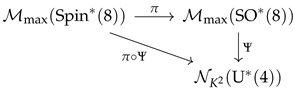
- (2)
The fibration from Theorem 3 fits into a diagram where Ψ is the Cayley correspondence from [7] (Theorem 4.3).
Proof. Part (1) is immediate from Proposition 14. Indeed, according to Theorem 2, for maximal bundles with , we have , and is an isomorphism. Therefore, vanishes on the factor and is an isomorphism on the factor.
For part (2), we construct the diagram explicitly. According to [
7], for
(which is even), there exists a Cayley correspondence isomorphism
where
denotes the moduli space of polystable
-twisted
-Higgs bundles with vanishing Toledo invariant (in the twisted sense).
The Cayley correspondence works as follows: a maximal -Higgs bundle with and an isomorphism determines a symplectic structure on (after choosing a square root of the canonical bundle). The symplectic vector space of rank 8 with a compatible complex structure defines a -structure. The -twisting comes from the relationship between the original bundle V and the twisted bundle .
The map is the fibration from Theorem 3, part (2), given by the covering map from Proposition 9.
The composition
is obtained by first projecting to
-Higgs bundles, then applying the Cayley correspondence. This gives the commutative diagram (
12). □
Although triality does not act on , there is a symmetry that does act.
Proposition 20. There is an involution defined by . This involution exchanges and (similarly for ), and corresponds to the outer automorphism in from Proposition 3.
Proof. The map
clearly defines an involution on the set of
-Higgs bundles. According to Definition 4, if
is semistable, then
is also semistable (the stability condition (
4) is symmetric under
). Therefore,
descends to the moduli space.
Since according to Proposition 7, we have . The involution exchanges the signs of both components.
According to Definition 5, since the Toledo invariant depends only on E, not on . However, according to Theorem 4, the Higgs field structure determines which component vanishes in the maximal case: for , we have , while for , we have . Applying exchanges these conditions, which is consistent with .
To see that
corresponds to the outer automorphism from
, we use the correspondence with
. According to Proposition 9,
where
. According to [
7] (Proposition 3.17), the involution
corresponds to the outer automorphism of
, which lifts to an outer automorphism of
according to Proposition 6. □
8. Examples
In this section, we provide examples to illustrate the results established in the previous sections. We focus on the case of genus .
We begin by computing the expected and actual dimensions of the moduli spaces for various values of the Toledo invariant .
Proposition 21. The actual dimension of depends on τ as follows:
- (1)
For generic τ with : ;
- (2)
For maximal τ with : by Corollary 2.
The dimension drop in the maximal case quantifies the rigidity phenomenon.
Proof. For part (1), in [
7], it is proved that the expected dimension of the moduli space of
G-Higgs bundles for a real form
G of Hermitian type is
, where
is the complexified isotropy representation. According to Proposition 1,
with
, hence
.
Part (2) is Corollary 2. The dimension drop of from the expected value to the actual value reflects the rigidity imposed by the maximal Toledo condition established in Theorem 3. □
As an example, we analyze the moduli space for in detail.
Proposition 22. For , the moduli space consists of -Higgs bundles with . According to Theorem 5, this moduli space is non-empty and connected, with dimension 16.
Proof. Connectedness follows from Theorem 5, part (1). The dimension is according to Proposition 21, part (1). □
Proposition 23. The locus of minima of the Hitchin functional on for is Proof. According to Theorem 4, part (3), the minima for satisfy . The condition translates to according to Definition 5. According to the proof of Theorem 2 (specifically the equality ), this becomes , hence . □
Example 1. Let be the trivial bundle,Then, is the trivial rank-8 vector bundle, with . Similarly, with . Hence , and . We now analyze maximal -Higgs bundles for .
Proposition 24. For , the maximal Toledo invariant is . The moduli space is non-empty, connected, and has dimension .
Proof. According to Theorem 2, for . The dimension formula from Corollary 2 gives . Non-emptiness and connectedness follow from Theorem 5, part (2). □
Proposition 25. For and , every polystable -Higgs bundle satisfies the following:
- (1)
and : is an isomorphism;
- (2)
;
- (3)
is polystable but not stable.
Proof. Parts (1) and (2) follow from Proposition 14 specialized to . Part (3) follows from Theorem 3, part (1), which establishes that the stable locus in is empty for . □
Example 2. For , according to Theorem 3, the fibrationhas fibers isomorphic to , which has cardinality . This means that each polystable maximal -Higgs bundle with admits exactly 16 distinct lifts to -Higgs bundles, corresponding to the 16 elements of . We make the fibration from Theorem 3 explicit.
Proposition 26. For genus g and maximal Toledo invariant , the fibrationhas the following properties: - (1)
Both spaces have dimension ;
- (2)
Each fiber is the discrete set with elements;
- (3)
Both spaces are connected.
Proof. The dimension
in part (1) follows from Corollary 2 (for
) and from [
7] (for
). Part (2) is Theorem 3, part (2) (the group
has rank
[
29,
38], hence cardinality
). Finally, for part (3), connectedness of
is Theorem 5, part (2), and connectedness of
is proved in [
7]. □
Remark 12. In the situation of Proposition 26, the number of lifts of an -Higgs bundle to is , where g is the genus of X.
We translate the results to surface group representations via the non-abelian Hodge correspondence.
Proposition 27. Let be the fundamental group of X. The character varieties of reductive representations with Toledo invariant τ satisfy the following:
- (1)
is connected with dimension ;
- (2)
is connected with dimension ;
- (3)
The covering map from Proposition 17 is :1 over each point in the image (i.e., over each representation that lifts).
Proof. Parts (1) and (2) follow from Theorem 7 combined with Theorem 6, which establishes the homeomorphism . The dimensions are preserved under this homeomorphism.
Part (3) follows from Proposition 17. According to Corollary 5, a representation : lifts to if and only if the second Stiefel–Whitney class of the associated flat bundle vanishes. When , there are exactly distinct lifts, corresponding to elements of . □
Example 3. For with :
The character variety has dimension 16 and is connected;
The maximal character variety has dimension 15 and is connected;
Each representation that lifts has exactly distinct lifts to .
The trivial representation for all has Toledo invariant and lies in .
9. Example of Maximal Spin*(8)-Higgs Bundles
We now provide an explicit construction of maximal -Higgs bundles in the case .
Let X be a compact Riemann surface of genus . According to Theorem 2, a maximal -Higgs bundle has Toledo invariant . According to Proposition 14, a maximal bundle with satisfies the following:
To construct such a bundle explicitly, we proceed as follows. We require a rank-8 vector bundle over X with . One explicit choice is to take , where are line bundles with . For concreteness, let and (line bundles associated with distinct points ), and (trivial line bundles). Then, .
Alternatively, for a less split bundle, we could take
where
W is a rank-4 bundle with
, constructed via an extension
We need , where denotes traceless endomorphisms, such that is an isomorphism.
For , the canonical bundle K has degree . We can write , where D is a canonical divisor of degree 2. According to Riemann–Roch, , so K has a 2-dimensional space of sections.
For
to be an isomorphism, we require that at each point
, the endomorphism
is invertible. Since
is traceless, it cannot be a scalar multiple of the identity. We construct
as follows. Choose a basis
for
(fiberwise) and a nonzero section
. Define
by the
matrix
where the matrix is skew-symmetric (hence traceless) and consists of four
blocks
.
This matrix has rank 8 at every point where , which is generically everywhere (since is a nonzero section of K). Therefore, defines an isomorphism as required.
The vector bundles and arise as associated bundles from a principal -bundle E. Given with and using (Remark 3), we deduce as well.
The bundle E is determined (up to isomorphism) by its associated vector bundles and the compatibility conditions. According to the theory of principal bundles, -bundles over X are in bijection with isomorphism classes of collections of vector bundles (one for each representation) satisfying compatibility conditions coming from tensor products and direct sums of representations.
For our purposes, we simply define
E to be the principal
-bundle determined by the pair
, where
(as abstract rank-8 bundles of degree 2) and the compatibility
is satisfied. Such a bundle exists by the general theory of reductions of structure groups (see [
34]).
By construction, is a -Higgs bundle with , which is maximal according to Theorem 2.
To verify polystability, we apply Proposition 12: the bundle is polystable as a
-Higgs bundle if and only if the corresponding
-Higgs bundle
is polystable. According to Corollary 1,
(since
) and
is determined by
. Since
is an isomorphism,
is an isomorphism, which is precisely the condition for maximal
-Higgs bundles to be polystable, as established in [
7].
Remark 13. The example above provides one explicit point in the moduli space for . According to Corollary 2, this moduli space has dimension for .
To describe a family of examples parametrizing an open subset of , one would need to vary (1) the choice of splitting type for (e.g., varying the line bundles in the decomposition ), (2) the choice of Higgs field satisfying the isomorphism condition, and (3) the choice of spin structure, i.e., the choice of lift from an -bundle to a -bundle.
The discrete fiber for accounts for 16 distinct spin structures over each fixed point in .
10. Conclusions
We have studied Higgs bundles for the real Lie group , the universal cover of . This work extends the results of Bradlow, García-Prada, and Gothen on -Higgs bundles to the spin group setting. Specifically, we establish the structure of the moduli spaces of polystable -Higgs bundles. We have proven Toledo bounds, characterized maximal Higgs bundles through rigidity theorems, established connectedness results via Morse theory, and translated these geometric results to surface group representations through the non-abelian Hodge correspondence. The Toledo bound we establish shows that semistable bundles satisfy constraints reflecting the distinction of the isotropy representations compared to .
The rigidity phenomenon for maximal -Higgs bundles represents one of the main contributions of the paper. We have shown that maximal bundles contain no stable points and that their moduli space fibers over the moduli space with discrete fibers parametrized by spin structures.
We have also analyzed how triality influences -Higgs bundles despite not being an automorphism of the real form. Triality does not act on the moduli space because it does not preserve the reality conditions, yet the isotropy representation governing the Higgs field structure is shaped by triality. This makes exceptional among classical real forms, as it is the unique case where the outer automorphism group of the complexification is strictly larger than that of the real form.
The connectedness results established here, combined with the non-abelian Hodge correspondence, yield corresponding statements about character varieties of surface group representations into . The connectedness in the maximal case shows that all maximal representations belong to a single connected component.
Several directions for future research emerge from this work. First, while we have established connectedness for vanishing and maximal Toledo invariants, the topology of moduli spaces for intermediate values remains to be determined. We conjecture that these spaces are non-empty and connected for all admissible , with expected dimension for generic values—one dimension more than the maximal case, reflecting the absence of rigidity constraints. The Betti numbers should be computable via Morse theory applied to the Hitchin functional: for half-maximal values , we expect distinguished strata corresponding to bundles where one of or is partially degenerate, yielding dimensions intermediate between and , while for generic the Poincaré polynomial should interpolate smoothly between (moduli of -bundles with vanishing Higgs field) and (rigidity case). Developing explicit Morse theory for intermediate to identify critical set stratifications, Morse indices, and normal bundles to strata would require understanding when and can simultaneously be nonzero under the semistability condition—the regime not covered by our main theorems.
Second, while triality does not act as an automorphism of
, there may be weaker forms of symmetry manifesting in derived categories or in cohomology of the moduli spaces. Although triality acts on the complexification of
inducing a
-action on the moduli space of
-Higgs bundles [
17], the restriction of this action to the subvariety corresponding to the real structure defining
may yield discrete symmetries or special fixed-point loci in
, relationships between triality-related components of the complexified moduli space that meet along
, or geometric interpretations relating the decomposition
to hidden structures. Whether triality induces structure on Betti numbers, Hodge structures, or characteristic classes—particularly in the context of the exceptional isomorphism
with its three inequivalent 8-dimensional representations—remains open and could reveal hidden symmetries in the moduli space topology.
Third, the Cayley correspondence for identifies maximal bundles with -twisted -Higgs bundles. Our results show that this lifts to a relationship involving via the covering , but the precise nature of the lifted correspondence and whether it admits an interpretation independent of projection to remains unknown. Understanding this would clarify how spin structures interact with the tube-type symmetric space structure of .
Finally, via the non-abelian Hodge correspondence,
corresponds to the character variety of reductive surface group representations
with Toledo invariant
. For such representations, studying the geometry of associated equivariant harmonic maps
(where
is the universal cover of
X) and how the maximal Toledo invariant
relates to minimal surface theory could provide additional geometric insight. Understanding the analytic properties of these maps for intermediate
would illuminate the structure of character varieties and potentially lead to new rigidity phenomena. The presence of spin structures parametrized by
introduces additional discrete complexity.