1. Introduction
A wide range of natural phenomena can be modeled by nonlinear partial differential equations, with parameters and functional forms typically derived from experimental observations. Such mathematical formulations provide a rigorous framework for understanding the underlying dynamics of these systems and have consequently drawn substantial attention from both mathematicians and physicists. Numerous analytical, semi-analytical, and numerical approaches have been developed to obtain various classes of exact and approximate solutions. These contributions have played a pivotal role in advancing research across diverse scientific disciplines, including engineering, biology, population ecology, plasma physics, solid-state physics, fluid mechanics, quantum mechanics, thermodynamics, and nonlinear optics, among others. Some of the most prominent techniques for constructing wave solutions include the Darboux transformation [
1], the bilinear method [
2], the extended generalized
-expansion method [
3], the extended
-expansion method [
4], the extended auxiliary function method [
5,
6], Lie point symmetries, reductions, conservation laws [
7], the multiple exponential functions method [
8], the modified Sardar-sub equation method [
9], the bifurcation theory of planar systems method [
10,
11], the extended direct algebraic method [
12], a complete discriminant system method [
13], the Hamiltonian mechanics framework [
14], the compact difference method [
15], etc.
By combining differential equations with fractional differentiation theory, the distinctive impact of fractional derivatives on natural phenomena has been revealed—offering an alternative to classical differentiation, which relies on integer-order derivatives. The fractional-order differential operator is more suitable in situations where infinite variations are present and their effects cannot be ignored. Additionally, the fractional-order operator enables different predictions of motion and provides a more comprehensive framework, as it includes integer-order derivatives as a special case. The theory of fractional differentiation has been extensively developed, and various fractional operators have been introduced, such as the Riemann–Liouville, Caputo, Grunwald–Letnikov and Weyl operators [
16], the conformable derivative [
17], the Katugampola operator [
18], the truncated
M-fractional operator [
19], the Atangana–Baleanu operator [
20] and others, each of which has its strengths and weaknesses. A great deal of research has been conducted on famous equations into which fractional differentiation is introduced, such as the truncated
M-fractional derivative [
21,
22], conformable derivative [
23]. Riemann–Liouville operator [
24] and Lioville–Caputo [
25].
The qualitative behavior of solutions to fractional partial differential equations differs substantially from that of their classical counterparts due to the nonlocal nature of fractional operators. Time–fractional derivatives introduce memory effects that cause solutions to relax more slowly, while space–fractional derivatives generate heavy-tailed profiles. These properties lead to richer dynamical behavior, including slower propagation fronts, and solution profiles that may be less smooth than in the integer-order case. To properly describe such solutions, several notions of solvability are employed. A strong solution is sufficiently smooth so that all fractional derivatives appearing in the equation are well defined in the classical sense. A weak solution satisfies the fractional PDE in an integral or variational form, typically after multiplying by test functions and integrating by parts [
26,
27]. A mild solution is defined via the associated integral formulation, often using the fractional semigroup or resolvent operator, and is constructed through convolution with kernels such as the Mittag–Leffler function [
28]. These different concepts of solutions allow one to treat the reduced regularity, memory dependence, and anomalous behavior intrinsic to fractional dynamical systems.
Physical and Biological Motivation for the Truncated M-Fractional Model
The choice of the truncated M-fractional derivative in modeling ionic wave propagation along microtubules is motivated by its mathematical properties and their relevance to the biophysical behavior observed in intracellular environments. Unlike classical fractional operators (e.g., Riemann–Liouville or Caputo), which introduce strong non-local memory effects and heavy-tailed profiles, the truncated M-fractional derivative is designed to capture short-range memory and moderate anomalous diffusion phenomena that are particularly relevant in the crowded, viscoelastic cytoplasm of living cells.
Microtubules are dynamic cytoskeletal structures that exhibit viscoelastic mechanical properties and are surrounded by a heterogeneous, crowded medium. Ionic waves traveling along microtubules are influenced by the following:
Short-range memory effects: Due to the viscoelastic nature of the cytoplasmic matrix, wave propagation retains a finite memory of past states over short timescales, rather than the infinite memory associated with classical fractional models.
Anomalous drift and diffusion: Experimental studies suggest that intracellular transport and signal propagation often exhibit sub-diffusive or weakly super-diffusive behavior, which can be captured by fractional operators with tunable order p.
Finite interaction ranges: The truncated nature of the M-fractional operator aligns with the finite correlation lengths of interactions in biological media, avoiding unrealistic long-range dependencies.
The truncated M-fractional derivative, defined via the truncated Mittag-Leffler function, preserves key differentiation rules (product, chain, quotient) and reduces to the classical derivative when . This makes it particularly suitable for modeling systems where memory effects are present but decay over finite intervals, the fractional order p can be tuned to reflect the degree of viscoelasticity or disorder in the medium, and analytical tractability is desired for deriving exact or semi-analytical solutions.
Thus, our model bridges a gap between purely integer-order models (which ignore memory) and strongly non-local fractional models (which may overestimate memory effects). By using the truncated M-fractional framework, we aim to provide a more physiologically relevant description of ionic wave dynamics in microtubules, capturing essential features such as memory, anomalous wave spreading, and tunable dispersion, all of which are observed in experimental biophysical studies of intracellular transport and signaling.
Our aim in this study is not simply to apply the dynamical systems approach, but rather to systematically unify and extend the analysis of the nonlinear time-space fractional model of shallow water waves in a weakly nonlinear dispersive media by employing a Hamiltonian framework and bifurcation theory tools.
The structure of this work is organized as follows: In
Section 2, preliminaries including truncated
M-fractional derivatives and a wave transformation are presented as well as phase portrait analysis of the dynamical system corresponding to the governing model.
Section 3 is devoted to deriving fractional wave solutions to the dynamical system. In
Section 4, the graphical and physical illustrations of the effects of the fractional order and the involved physical parameters on the solution profiles are presented. In
Section 5, we investigate the quasi-periodic and chaotic behavior of the governing equation under the influence of an external force.
Section 6 summarizes the main points in a conclusion.
2. Preliminaries
To have a self contained article we state the definition and basic concepts for Truncated M-fractional differentiation.
2.1. Truncated M-Fractional Differentiation
The application of the truncated M-fractional derivative operator addresses certain limitations of various fractional operators, like the chain, quotient and product rules, as well as the mean value theorem. First, the truncated M-fractional derivative operator relies on the definition of the Mittag–Leffler function.
Definition 1 ([
19])
. The truncated Mittag–Leffler function of one parameter is defined asfor and
.
In the following, a type of truncated M-fractional derivative of order p is stated:
Definition 2 ([
19])
. Let be a function of truncated Mittag–Leffler with , and let , . A truncated M-fractional derivative of order p for f is defined asfor all .
The significant properties of the truncated M-fractional differentiation are listed below.
Theorem 1 ([
19])
. Let be p-truncated M-fractional differentiable functions for , and let . Then the following rules are verified:- 1.
.
- 2.
, for all .
- 3.
.
- 4.
.
- 5.
where c is a constant.
- 6.
, for differentiable f.
- 7.
, if f is differentiable at .
2.2. The Model of Weakly Nonlinear Dispersive Shallow Water Waves
The nonlinear differential equation describing weakly nonlinear shallow water waves and governing ionic wave propagation along microtubules in living cells is
where
represents either the displacement or the velocity of the water particles,
refers to the gravitational force and
is the wave height. This equation is used to model wave propagation in weakly dispersive and nonlinear media. It has been investigated by numerous researchers to explore the behavior of wave dynamics inside microtubes. In [
29], a set of traveling wave solutions of Equation (
3) has been evaluated by the method of the extended Jacob elliptic function expansion. In [
30], the Adomian decomposition and modified Riccati-expansion methods are used in Equation (
3). The solutions obtained have been utilized to establish the initial and boundary conditions. In [
31], the Paul Painlevé approach has been used on Equation (
3) to achieve impressive solitary wave solutions. In [
32], Lie group analysis has been applied to build solitary wave solutions by using the extended direct algebraic method. In [
33], the auxiliary equation and Sardar sub-equation approaches have been utilized to Equation (
3) and a family of different types of solutions has been constructed.
In this paper, we study a fractional-order model in the truncated M-fractional derivative concept.
This work is motivated by the critical need for realistic models of ionic wave propagation along microtubules in living cells, where weakly nonlinear dispersive media and memory effects are substantial. We introduce a nonlinear time-space fractional weakly nonlinear dispersive water wave model to address this gap; namely, we consider
where
, for
and
, is the truncated
M-fractional derivative of order
p. In [
34], an extended direct algebraic method is applied to a fractional model (
4) with Atangana–Baleanu in the sense of Riemann–Liouville and the truncated
M-fractional derivative, and different types of soliton solutions have been obtained. The weakly nonlinear shallow water wave partial differential equation plays a significant role in the physical nonlinear phenomena in ocean science, because the exact solutions are extensively used in ocean engineering and applied science [
34].
Equation (
3) often yields smooth solutions, and the wave propagation has a well-defined speed, while the solutions of fractional Equation (
4) often exhibit heavy tails (infinity variations), and slower or faster spreading, and the analytical solutions are more complex. Such a sort of fractional operator has permitted us the generalization of the classical partial differential model. A truncated M-fractional derivative is a part of the family of fractional derivatives because their order is a real number
, and they are designed to generalize the concept of differentiation to non-integer order. It reduces to the ordinary derivative when
, and agrees with fractional calculus axioms. But it does not produce strong nonlocal memory effects.
In this study, a wave transformation is employed to reduce Equation (
4) to an ordinary differential equation corresponding to a dynamical system. We study a bifurcation of the system, which leads us to construct a variety of new analytical solutions generalizing and extending previously known results and restoring them when
p tends to 1. We investigate how variations in the fractional-order and physical parameters affect wave solution profiles. Finally, we study the quasi-periodic and chaotic behavior of the dynamic system.
2.3. Bifurcation Analysis of the Related Dynamical System
First, we apply a fractional wave transformation based on the order of the fractional differential operator, as defined within the neoteric concept of truncated
M-fractional differentiation. Namely, we take
where
are real constants and
is a real function of
that relates to the truncated
M-fractional operator. Utilizing the definition and properties of the truncated
M-fractional differentiation, one obtains
where ′ refers to the ordinary derivative with respect to
. Inserting Equation (
6) into Equation (
4), we get
Integrating Equation (
7) once with respect to
and set
to reduce the order, we have
where
k is the integration constant. This is the point of analyze Equation (
8) using bifurcation theory of dynamical system. Therefore, if we insert
, Equation (
8) is equivalent to the planner dynamical system
where
System (
9) is conservative when
and
-Hamiltonian with the Hamiltonian function
The first integral, which is called also in the literature as a conserved quantity, for Equation (
9) admits the form
where
v is the value of the first integral which takes a constant value through any phase orbit.
Second, to analyze the phase portrait of Equation (
9) and know how the system develops, the equilibrium points play a key role in understanding the long-term behavior of the system [
35]. The equilibrium points can be obtained by setting
and
, which yield
and
. Hence we have three situations:
If , then one equilibrium point follows; where .
If , then two equilibrium points follow; where .
If , there are no equilibrium points.
To shed light on the system behavior when it is near that point, the stability of the equilibrium points describes whether small perturbation from equilibrium causes the system to return to the equilibrium, move away from it, or exhibit another behavior. The Jacobian matrix of Equation (
9) at a point
is
and the related eigenvalues are given by
Therefore, at the equilibrium point
,
, indicating that
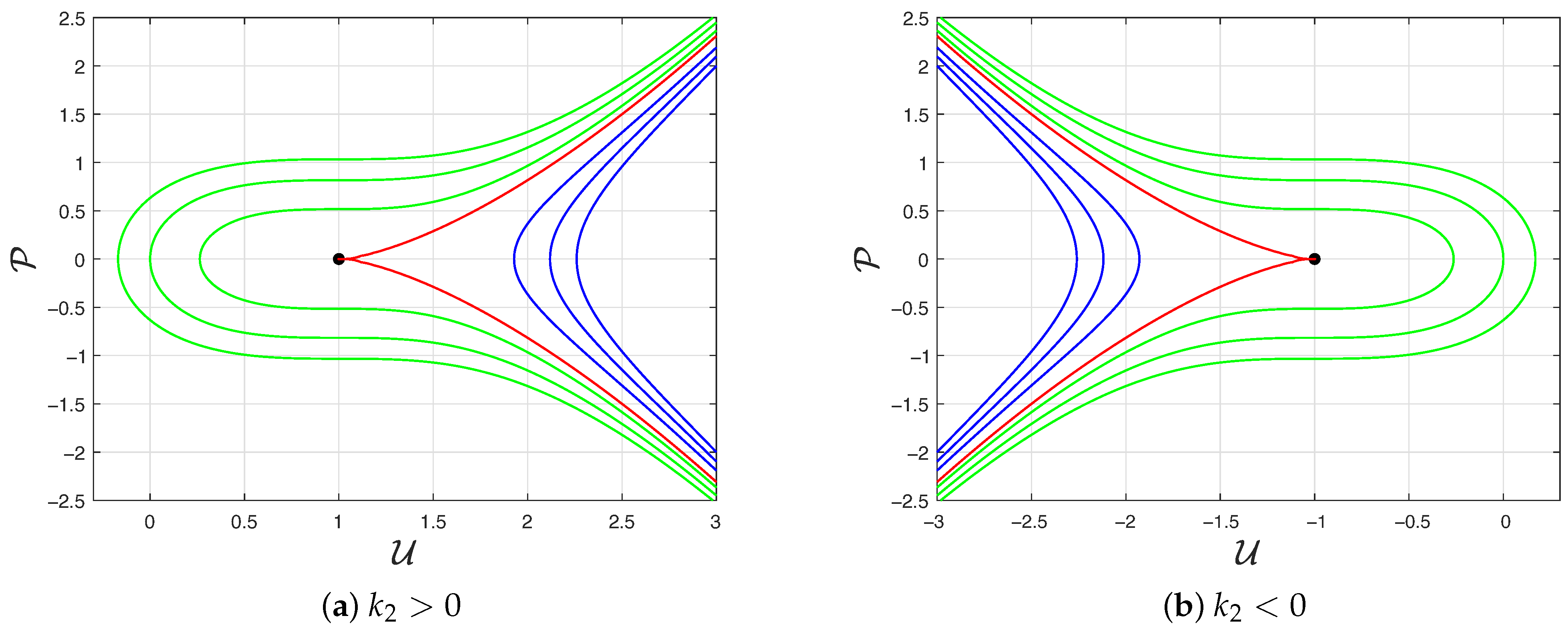
is a planar cusp singularity, in the case that
as shown in
Figure 1. While in the case that
,
at the equilibrium point
, indicating that
is a saddle point, and
at the equilibrium point
, indicating that
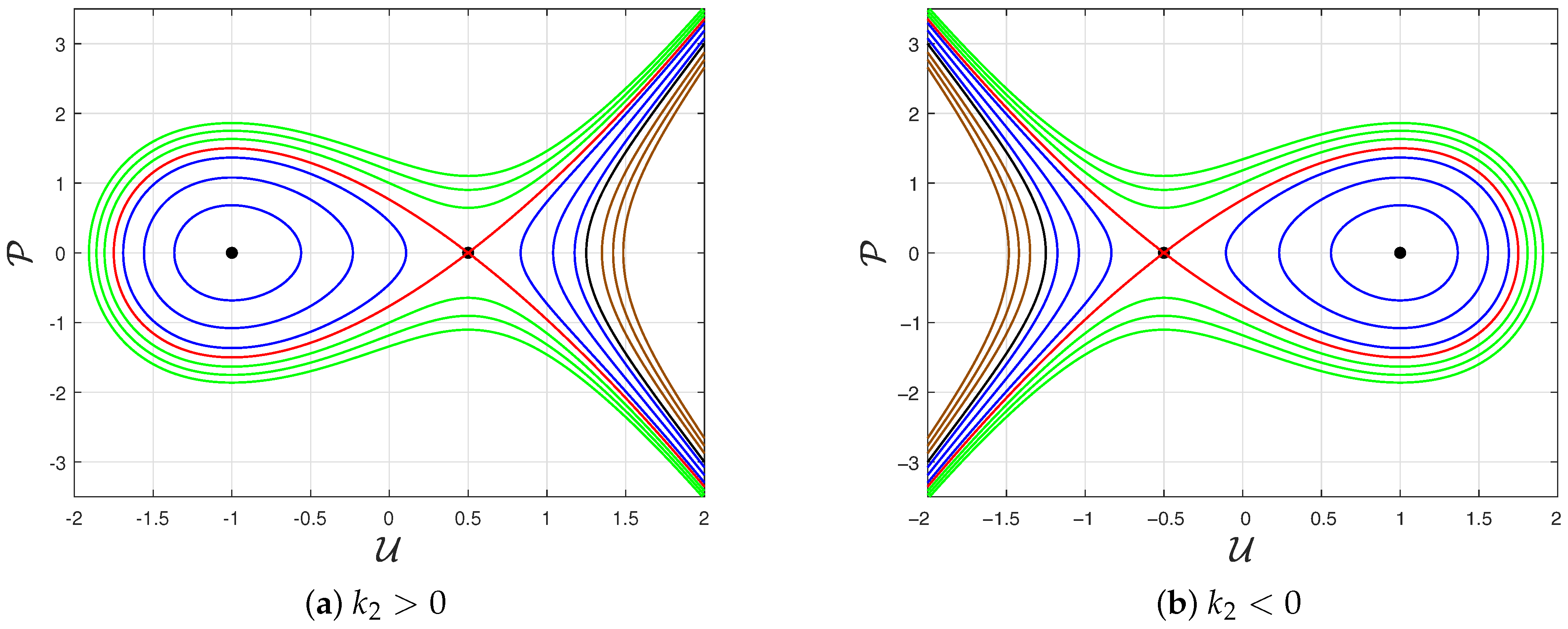
is a center point. The phase plane of Equation (
9), in this case, is shown in
Figure 2 which provides a homoclinic orbit (in red) at the equilibrium point
, a family of periodic orbits (in blue) around the equilibrium point
, and a series of unbounded orbits outside the unique separatrix layer.
Each point in the phase plane represents a possible state of the system, and the orbits show how the system’s state changes. A bifurcation occurs when a small change in a system’s parameters causes a qualitative change in its structure. The significant values of the parameter
v are those calculated at the equilibrium points, namely,
The bifurcation analysis performed above provides the structural foundation for the remainder of this study. In particular, the equilibrium points, phase portraits, and conserved quantity determine the admissible propagation regions in phase space. These regions are not merely mathematical artifacts; they directly specify where physically meaningful ionic wave solutions can exist. In the next section, we exploit this bifurcation structure to systematically construct exact fractional wave solutions, ensuring that each solution corresponds to a real, dynamically admissible propagation regime.
3. Derivation and Consistency of Fractional Solutions
Guided by the phase-plane structure and real propagation regions identified through bifurcation theory, we now derive explicit fractional traveling wave solutions. Each solution corresponds to a specific class of phase orbits—periodic, solitary, or unbounded—and therefore inherits a clear dynamical interpretation. This approach ensures consistency between the mathematical solutions and the underlying wave dynamics relevant to ionic propagation along microtubules.
The conserved quantity (
12) can be rewritten as
where
It follows, by integrating both sides, that
where
is a constant. Calculating the integration in Equation (
17) requires careful consideration when selecting the range of parameters involved. However, based on the bifurcation theorem discussed in the previous section, it is possible to determine the appropriate parameter ranges that ensure the existence of real propagation regions.
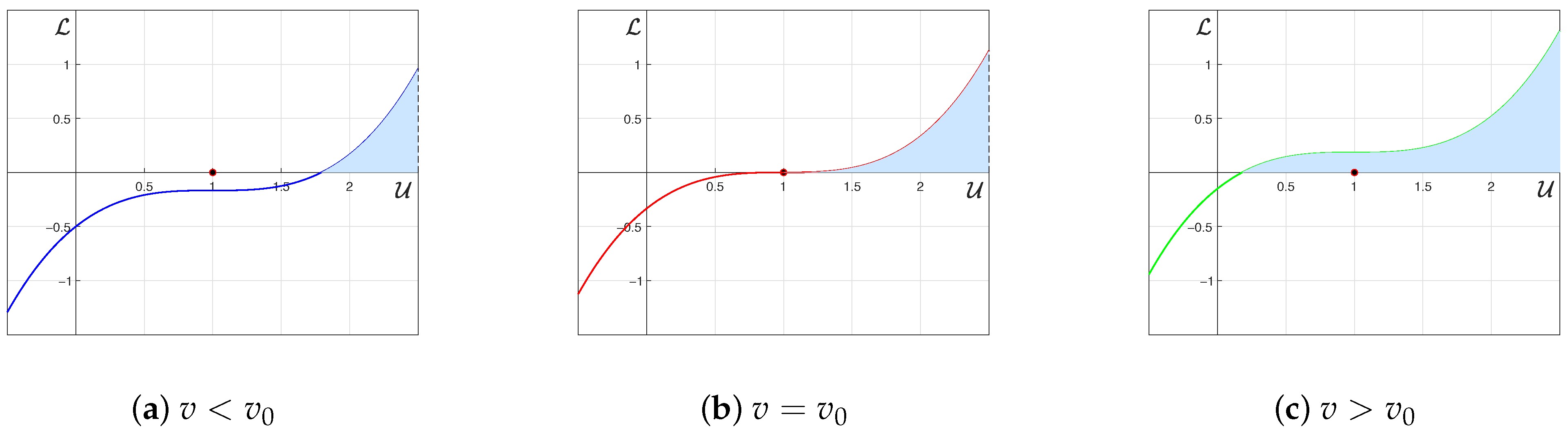
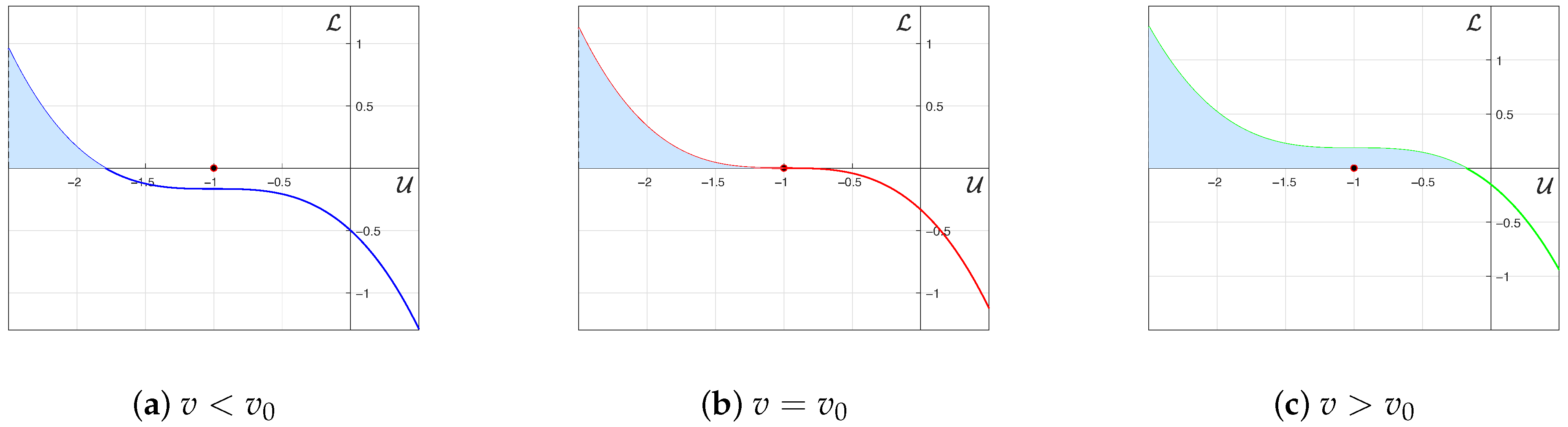
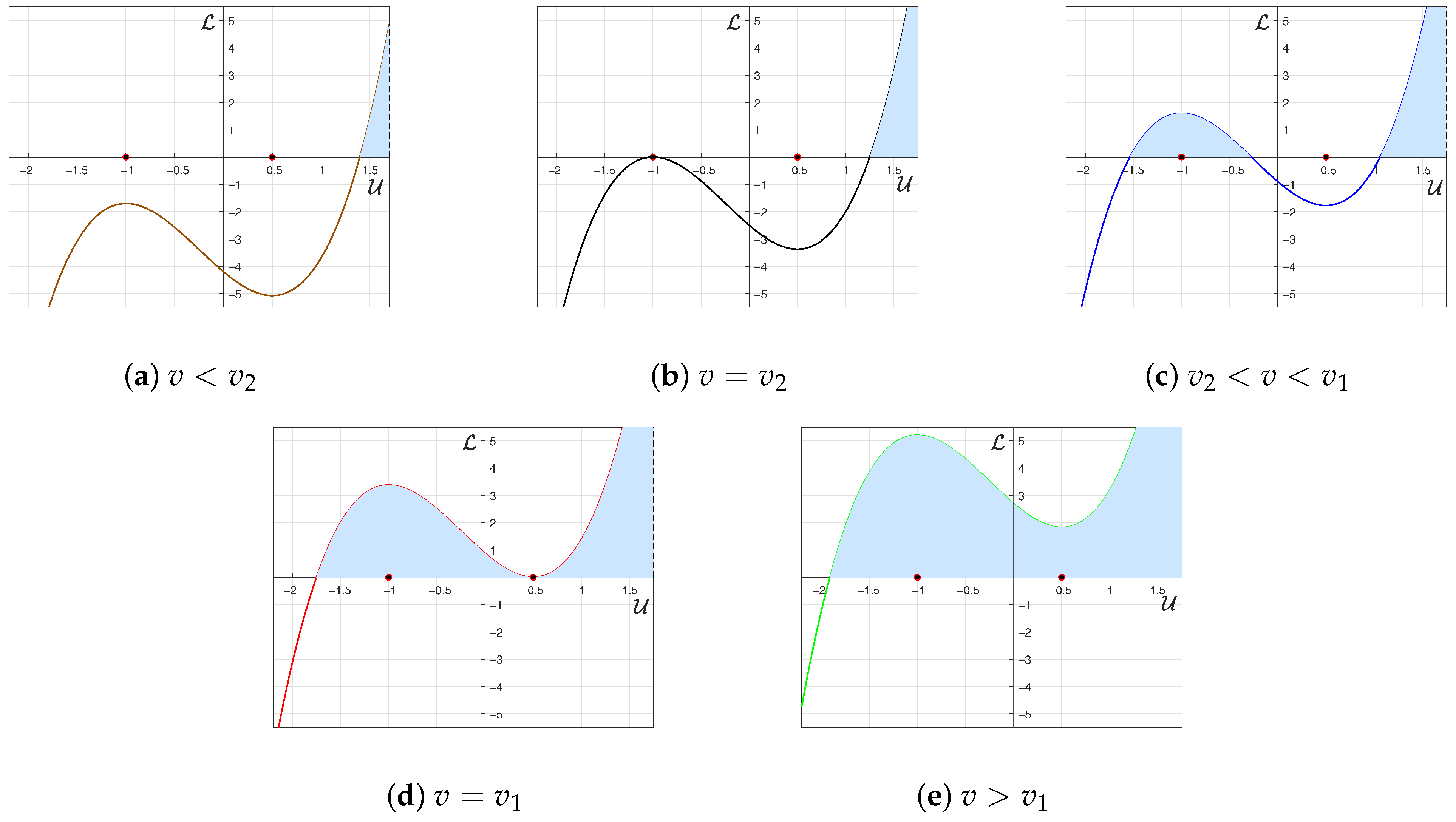
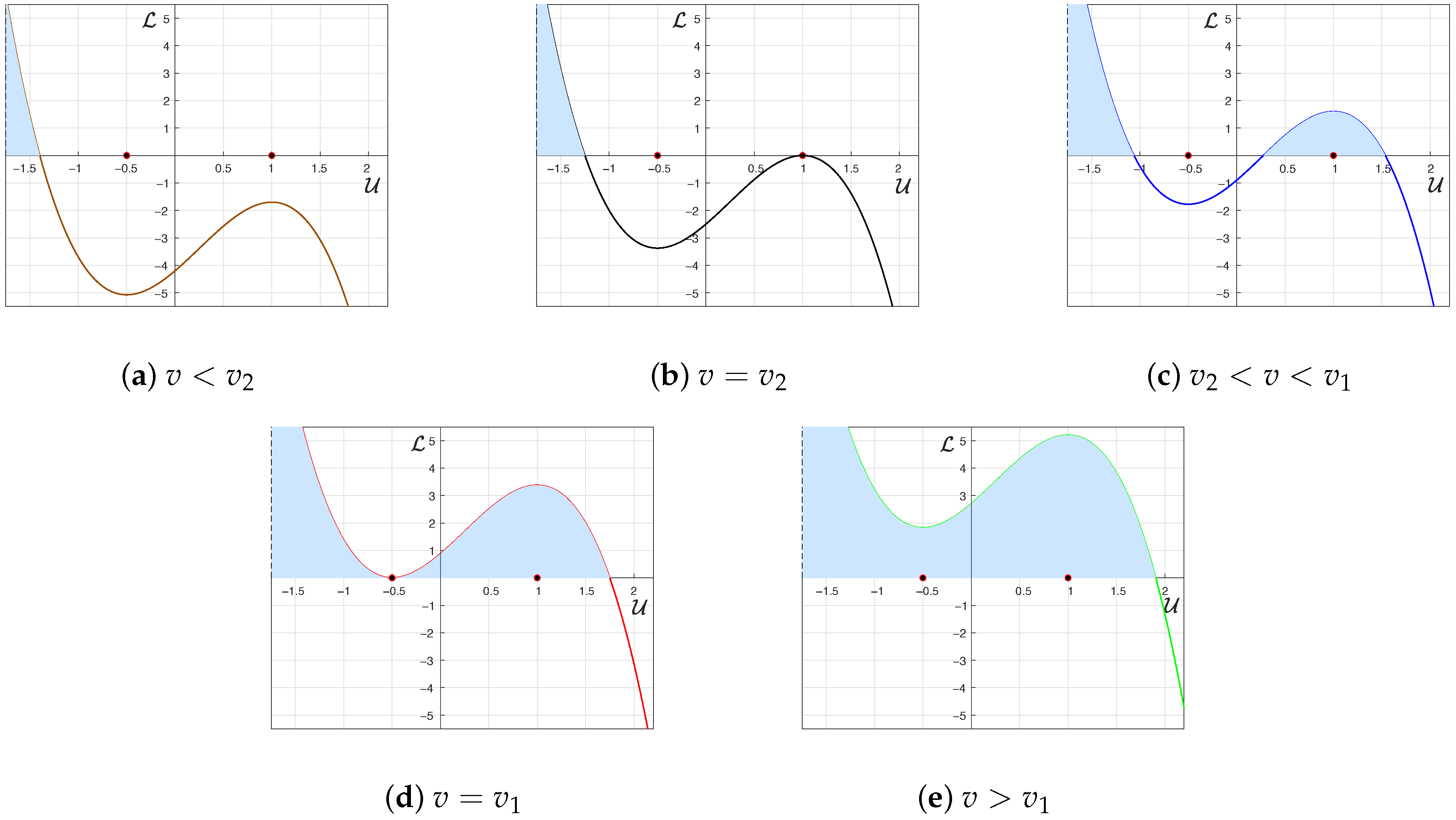
Figure 3,
Figure 4,
Figure 5 and
Figure 6 show the curves of the function
at all possible values of the parameter
v about the bifurcation values
and
. The curves are related to their corresponding orbits included in the phase portrait with the same colors. This provides an idea of discovering the regions within which the integration is possible and guaranteeing real propagation, in addition to knowing the subregions on which the solution is bounded.
Theorem 2. If system (9) has a solution , then is also a solution. In light of Theorem 2, and to avoid redundancy of solutions and reader fatigue, we focus only on cases where . According to bifurcation analysis above, we have the following:
- Case
A:
. In this case, from
Figure 1a, the system has an orbit at
, in red, separating two blue and green families of orbits when
and
, respectively.
For
, the blue curve of
in
Figure 3a intersects
-axis in a point, say
, where
and in this case,
, where
and
are complex conjugated numbers. Calculating the integration in Equation (
17) over the interval
with
, we obtain a novel solution of Equation (
8) given by
where
is an elliptic Jacobi function [
36], and
.
For
, the red curve of
in
Figure 3b intersects
-axis in the equilibrium
. In this case,
. Calculating the integration in Equation (
17) over the interval
with
, we get
For
, the green curve of
in
Figure 3c intersects the
-axis in a point less than
, and we obtain a solution in the same structure as the solution in Equation (
18) but with a different amplitude, period, and phase shift. The regions of real propagation in the case that
are illustrated in
Figure 4a–c, within which another set of solutions can be derived according to Theorem 2.
- Case
B:
. In this case, from
Figure 2a, the system has two efficient orbits in red and black, at
and
, respectively, separating three families of orbits related to the value of
v: the brown family of unbounded orbits, the blue family of periodic and unbounded orbits and the green family of unbounded orbits as
,
and
, respectively.
For
, both of the brown and green curves of
in
Figure 5a and
Figure 5e intersect the
-axis in a point, and consequently, an analogous solution in Equation (
18) is obtained but, of course, with a different amplitude, period, and phase shift.
For
, the black curve of
in
Figure 5b intersects the
-axis in the equilibrium
and a point
. In this case,
. The integration in Equation (
17) over the interval
with
implies
For
, the blue curve of
in
Figure 5c intersects the
-axis in three points, say
and
, and in this case,
. If we assume
, then there are two separated intervals of real propagation
. The integration in Equation (
17) over the first interval
with
gives a novel solution of Equation (
8) given by
While the integration over the second interval
with
, creates a novel solution in the form
where
is an elliptic Jacobi function [
36].
For
, the red curve of
in
Figure 5d intersects the
-axis in the equilibrium
and
, where
. In this case,
and there are two intervals of real propagation
. Calculating the integration in Equation (
17) over the intervals
and
with
and
, respectively, we get
and
Let us verify the consistency of the solutions we obtained by applying the degeneracy technique. As
, the periodic solution in Equation (
21) is expected to degenerate into the soliton solution in Equation (
23), as well as the singular solution in Equation (
22) is expected to degenerate into the singular solution in Equation (
24). To prove this, we refer to the phase plane of system (
9) in
Figure 5, and observe that as
, the family of periodic orbits approaches the homoclinic orbit in red, as well as the family of unbounded orbits in blue approaches the unbounded separatrix orbits in red. In this case,
and
, and by substituting into solutions in (
21) and (
22), we obtain, respectively,
and
which, after some simple calculations, are exactly the soliton solution to Equation (
23) and the singular solution to Equation (
24), respectively, since
and
.
Similarly, the real propagation regions for the case
are illustrated in
Figure 6a–e, within which an additional family of solutions can be obtained in accordance with Theorem 2.
Remark 1. In [29], the authors used the extended Jacobian elliptic function expansion method, which presupposes the solution in the form of a sum of specific elliptic functions. By applying the modified Riccati-expansion method and Adomian decomposition method [30], a set of trigonometric and hyperbolic function solutions are derived. The Paul–Painleve approach [31] has been used to achieve new solitary wave solutions in exponential form. In [32], Lie group analysis and the new extended direct algebraic approach are used to build a wider family of solitary wave solutions, including trigonometric and hyperbolic functions. A similar set of solutions is established by the auxiliary equation approach, the Sardar subequation approach and the extended direct algebraic approach [33,34]. In contrast, in our approach, the elliptic-function solutions are derived analytically rather than being assumed in advance. 4. Graphical and Physical Illustrations of Solutions
While the analytical solutions obtained in the previous section characterize the possible waveforms, their physical relevance emerges through their dependence on the fractional order and key system parameters. In this section, we illustrate how variations in these parameters deform the wave profiles and propagation regions. Such deformations provide insight into how environmental heterogeneity and intracellular conditions may influence ionic wave propagation in biological microtubules.
Assume and . In this case, , ; the equilibria are and , at which and .
Therefore, by taking
, it follows that
and
, and hence, by taking
, the periodic solution in Equation (
21) and singular solution in Equation (
22) are reduced to the forms
and
respectively.
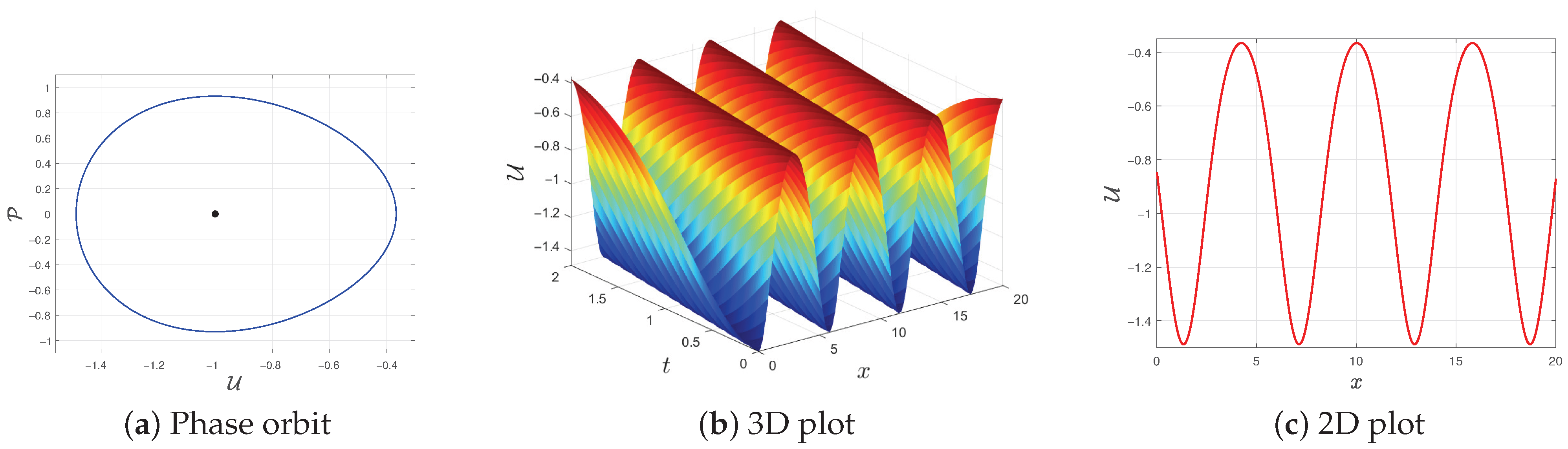
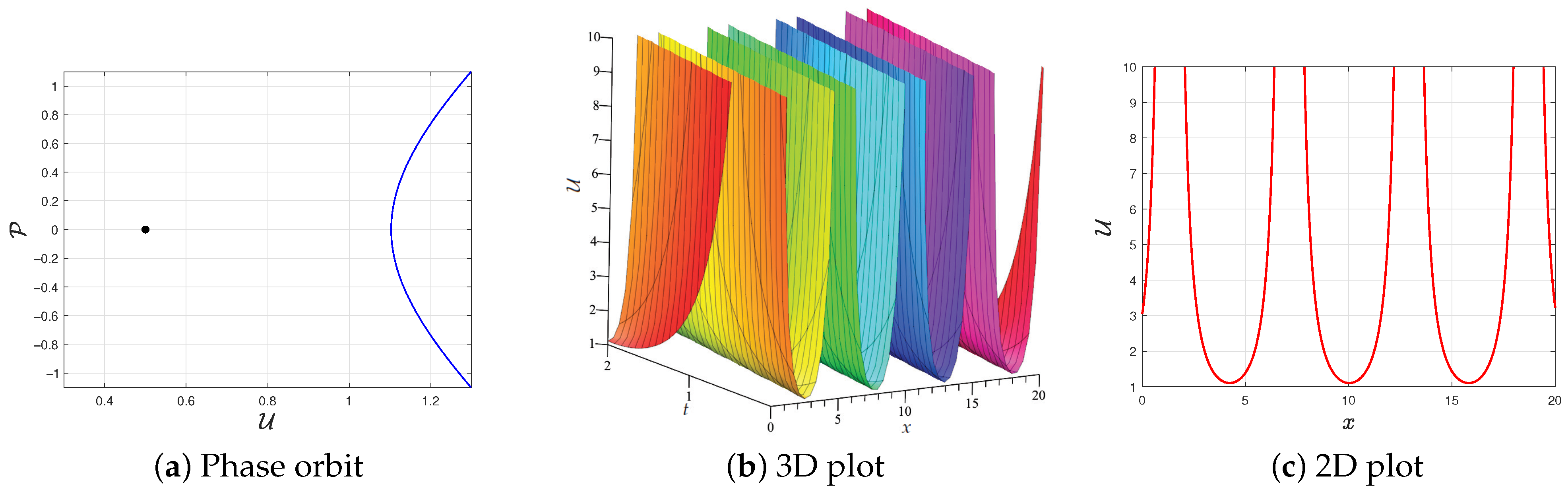
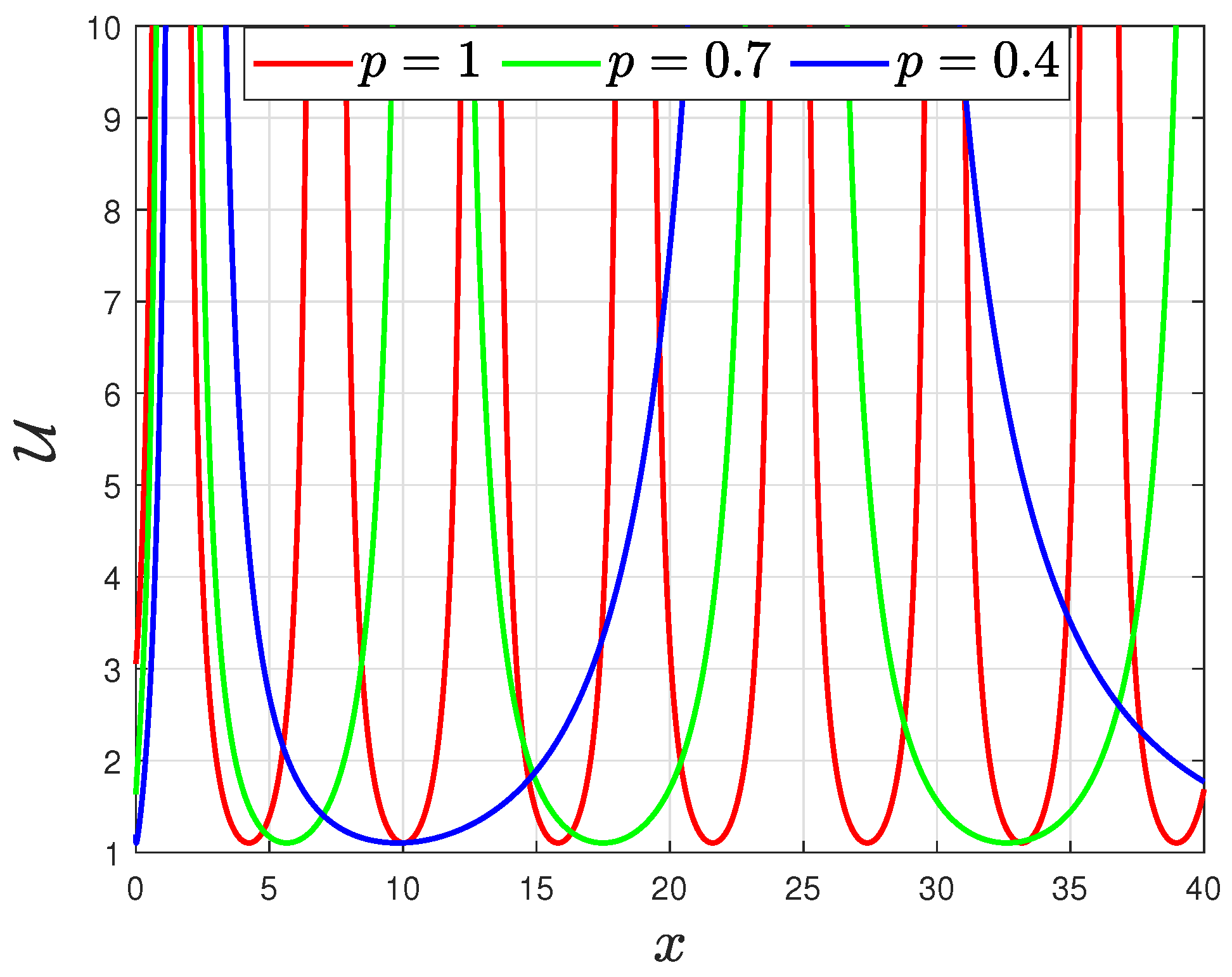
Figure 7a–c and
Figure 8a–c show the phase orbits with the structures of the corresponding periodic solution to Equation(
27) and singular one to Equation (
28) in both 3D and their 2D projections when
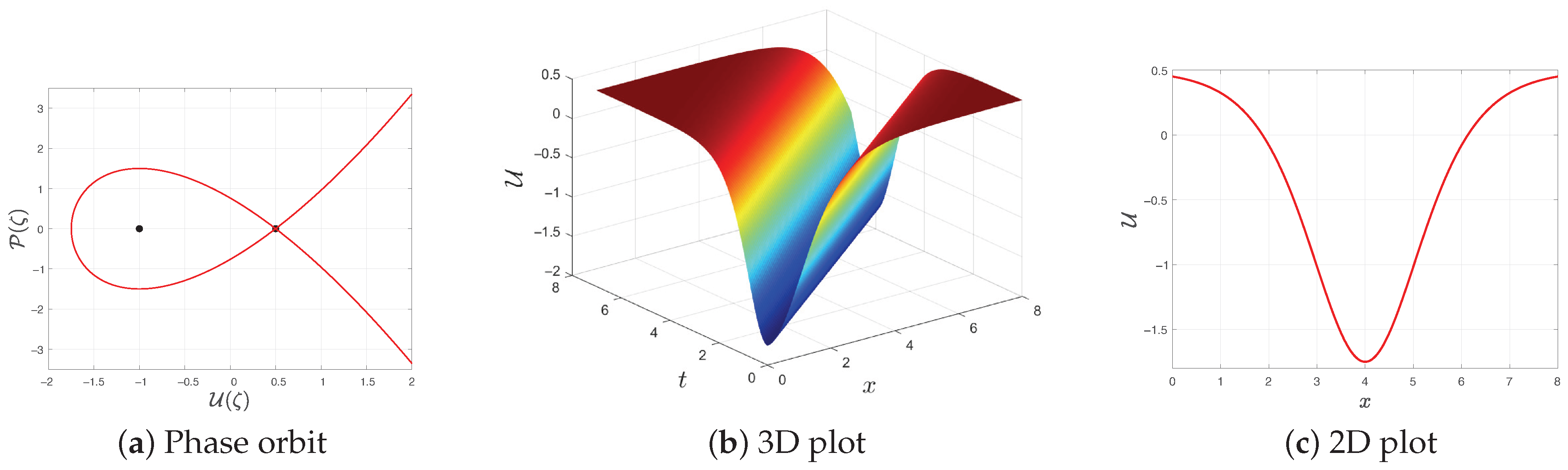
, in the case that
. The period of solution to Equation (
27) is
, where
is the complete elliptic integral of the first kind.
On the other hand, by taking
, with the same values of the parameters, it follows that
and so, the soliton solution in Equation (
23) is reduced to the form
Figure 9 shows the structure of Equation (
29) in both 3D and its 2D projection when
in the case of
.
To realize the impacts of both the fractional order and the involved parameters on the solutions profiles, it is more convenient to consider bounded solutions, namely, the Equations (
21) and (
23) above.
4.1. Impact of the Fractional Order
In this subsection, we show the impact of the fractional order p by varying it through the interval . It is instructive to compare the present truncated M-fractional model with the classical case (). In the classical limit , the model reduces to the standard weakly nonlinear dispersive wave equation, yielding fixed propagation regions and rigid wave profiles determined solely by the physical parameters. In contrast, the truncated M-fractional operator introduces a continuous fractional order that allows smooth deformation of the wave structure.
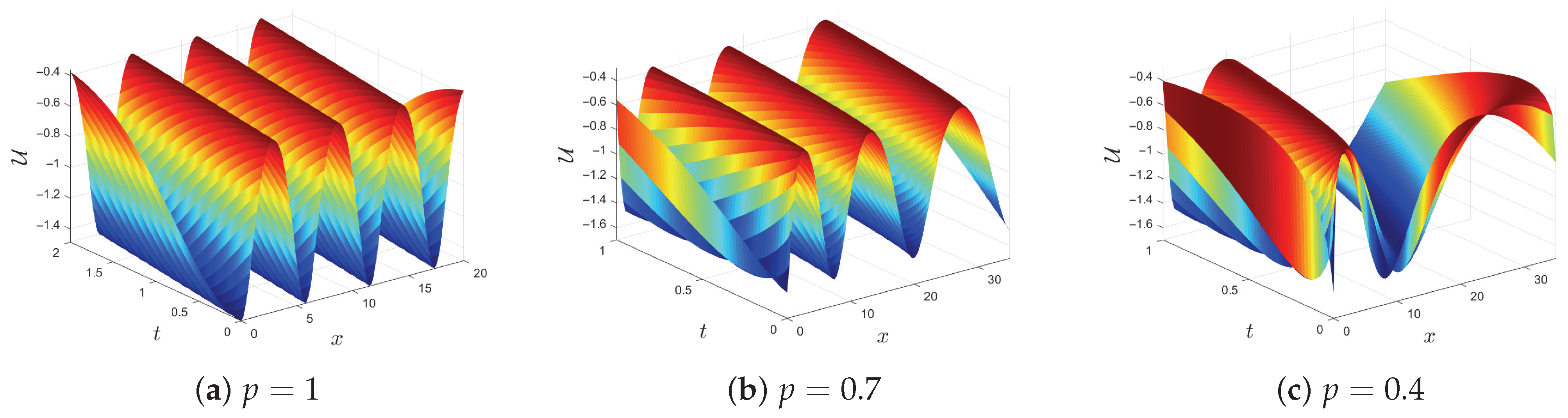
Figure 10a–c show the impact of the fractional order
p on the 3D periodic Equation (
27) by taking
compared to
and
, respectively.
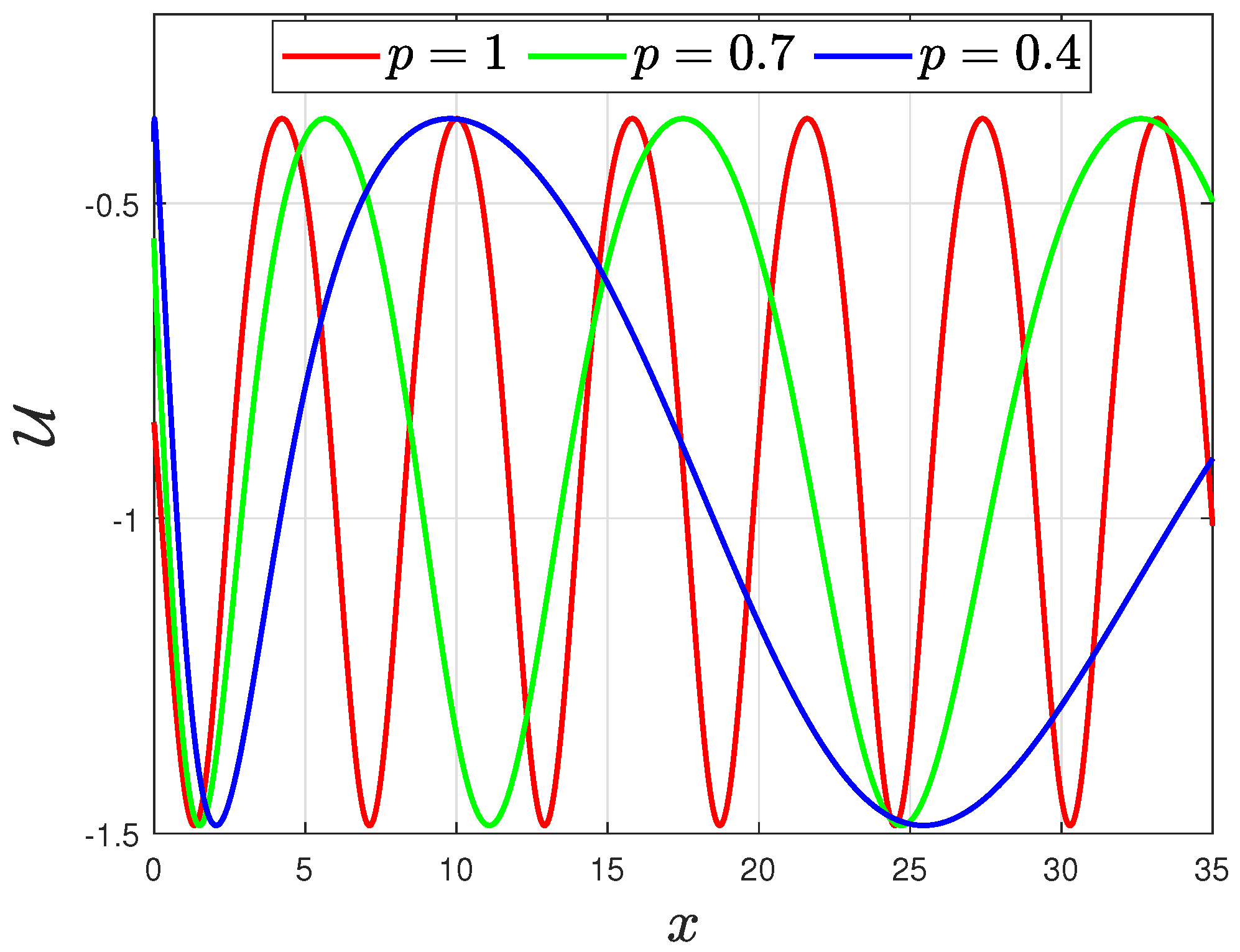
Figure 11 provides the 2D representation in the
plane for the same values of
p as in
Figure 10 by fixing
. We observe that the further the fractional operator
p moves away from 1 and close to zero, the wave loses its regular periodicity so that the wavelength gradually increases, while the wave height remains constant and is not affected by varying
p.
On another note,
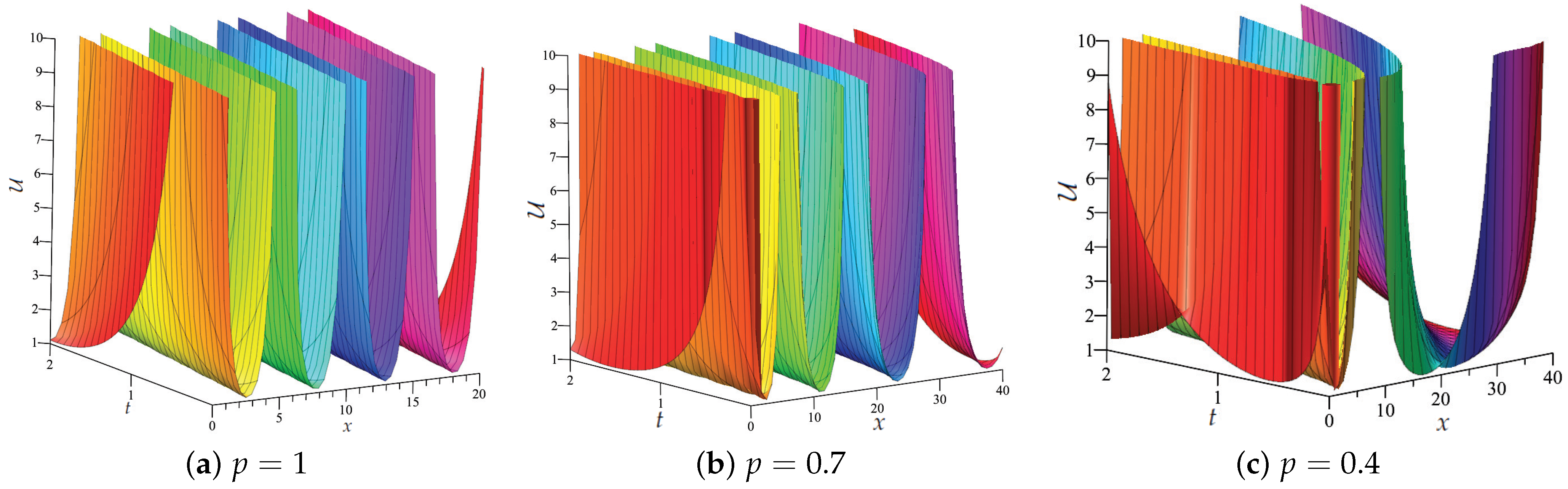
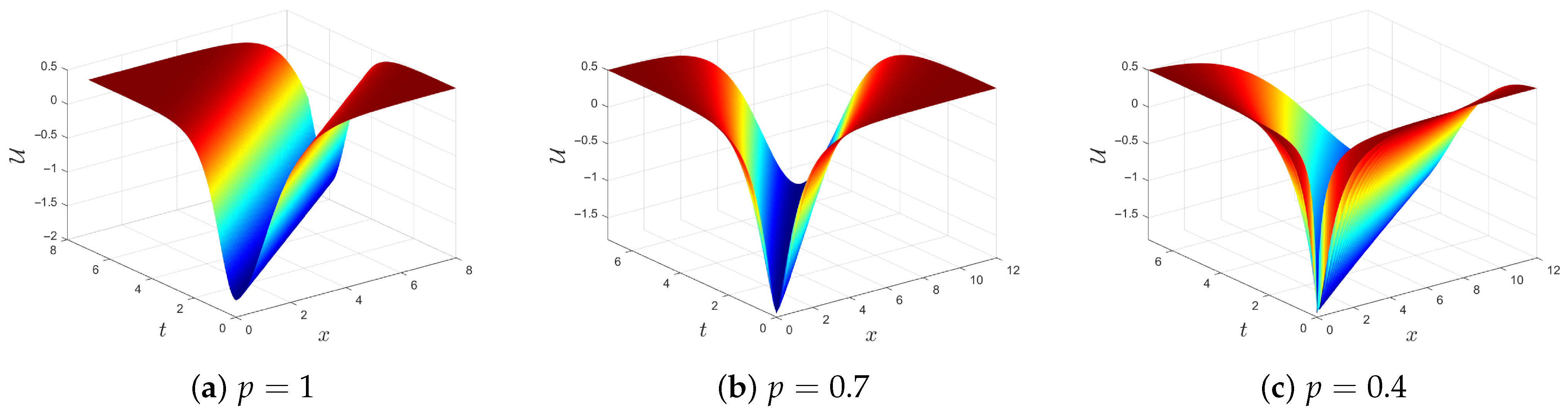
Figure 12a–c illustrate how the order
p affects the 3D Equation (
28) for the cases
compared to
and
.
Figure 13 presents the corresponding 2D profiles in the
x-
plane for the same values of
p with
t fixed at 1. The plots indicate that as
p decreases from 1 toward zero, the wave becomes wider and gradually, loses its regular wave shapes.
Finally,
Figure 14a–c show the impact of the fractional order
p on the 3D Equation (
29) by taking
compared to
and
, respectively.
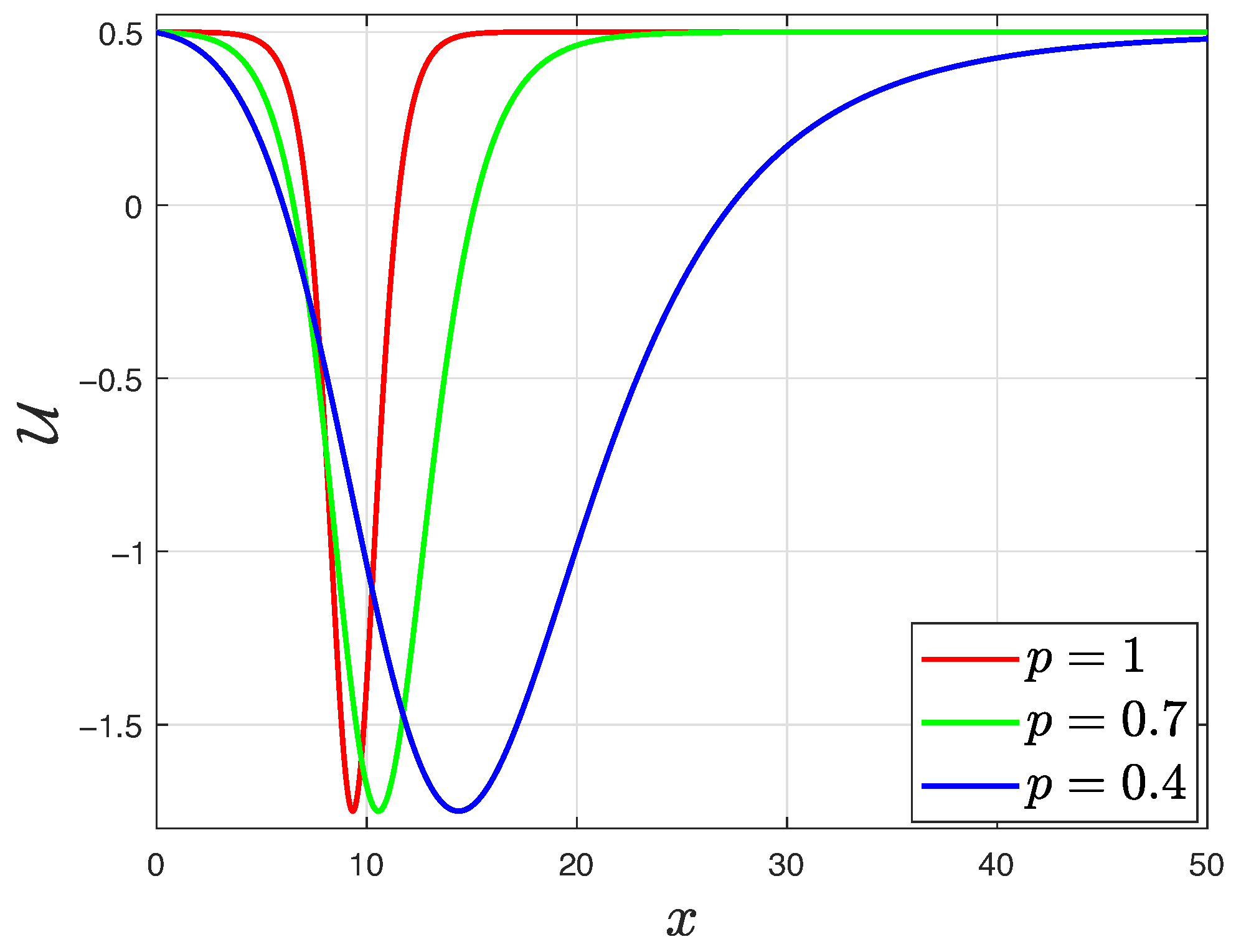
Figure 15 provides the 2D representation in the
x-
plane for the same values of
p by fixing
. It is observed that as the value of fractional order
p moves further from 1 and gets closer to zero, the width of the soliton wave increases while maintaining a constant wave height.
As demonstrated in
Figure 10,
Figure 11,
Figure 12,
Figure 13,
Figure 14 and
Figure 15, decreasing
p leads to wider wave profiles and enlarged real propagation regions while preserving wave amplitude. Such behavior cannot be captured by the integer-order model. From a biological viewpoint, this added flexibility may correspond to experimentally observed variability in ionic wave propagation along microtubules, where heterogeneity, molecular interactions, and environmental fluctuations can modify wave spreading and localization without necessarily changing wave intensity.
4.2. Impacts of the Key Physical Parameters
This subsection is devoted to seeing the influences of the gravitational force
and wave height parameter
upon both periodic and solitary waves in Equations (
27) and (
29) above, with
p fixed at 1.
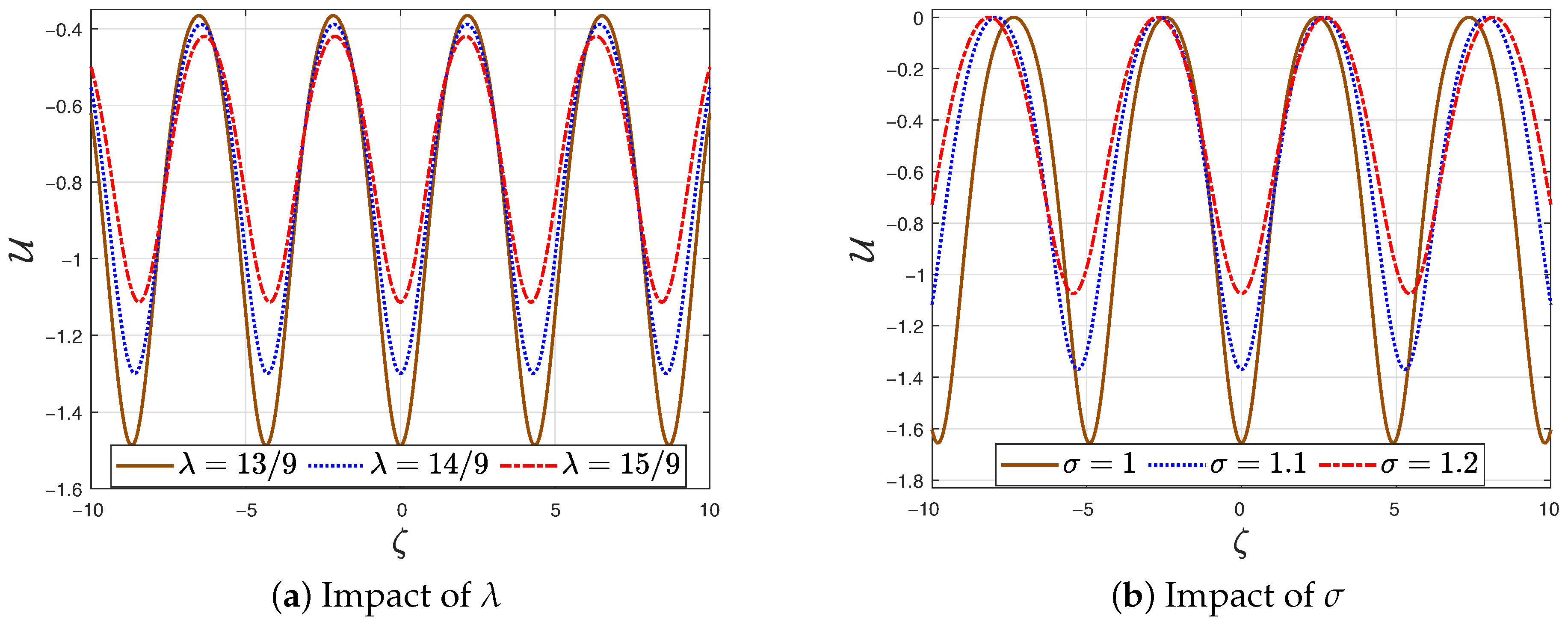
Figure 16a shows the effect of
on the periodic wave. It illustrates that as the gravitational force
gradually increases (we took
and
), the wave compresses, leading to a decrease in both the wavelength and the wave height due to a reduction in the amplitude and wave period.
In contrast,
Figure 16b shows that the wave is affected also by changes in the
parameter. As
increases (we took
and
), the wavelength expands, leading to a wider wave and a longer wave period. Additionally, the wave height decreases, reducing its overall amplitude.
On the other hand,
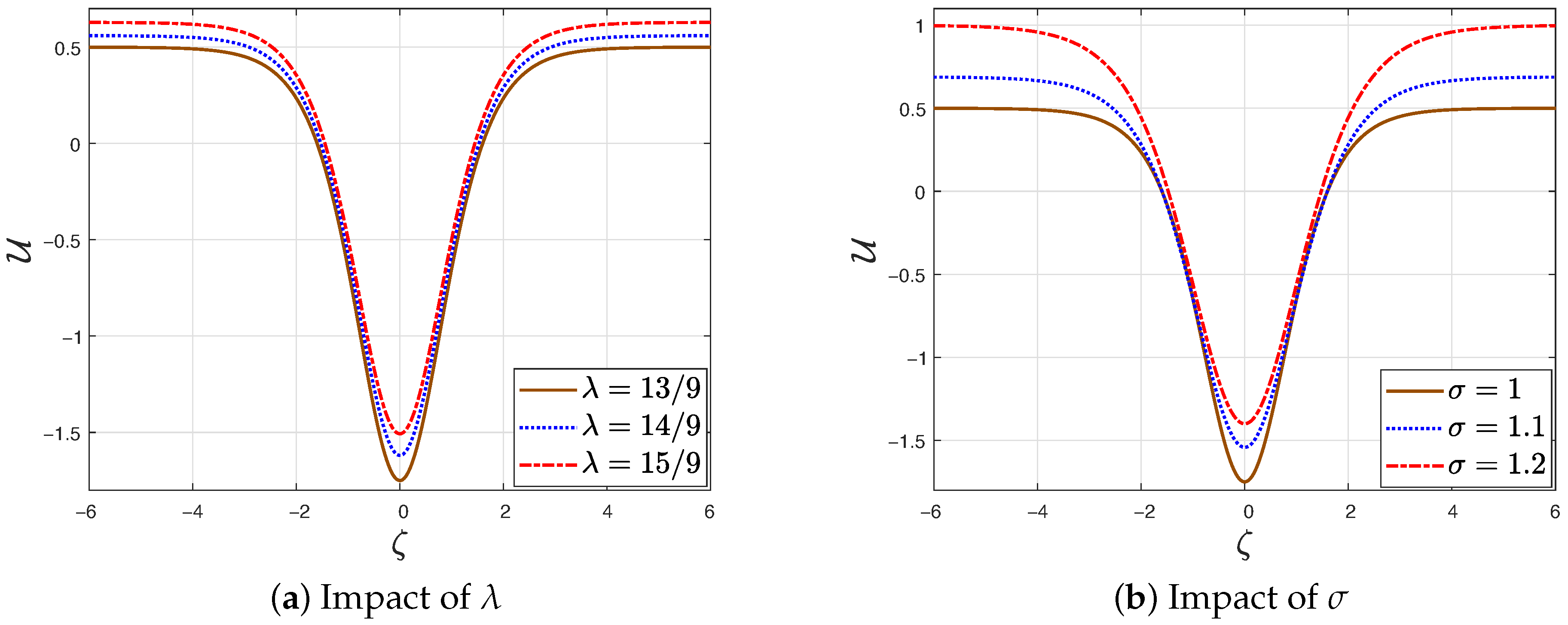
Figure 17a shows that the solitary wave is not significantly affected by changes in the gravitation parameter
. The only noticeable effect is the wave being shifted without any other alterations.
Conversely,
Figure 17b shows that the solitary wave is affected by changes in the
parameter. As
increases, the width of the wave expands, and the wave height also changes so that
arises.
5. Quasi-Periodic Dynamics and Chaotic Behaviors
The periodic and solitary wave solutions discussed above describe ordered regimes of ionic wave propagation. However, biological systems are often subject to external perturbations and fluctuating stimuli. Motivated by this, we now examine how the previously identified propagation regimes respond to external forcing, and how their underlying bifurcation structure facilitates transitions from regular motion to quasi-periodic and chaotic dynamics. Quasi-periodicity is a property of a dynamical system characterized by a recurring pattern that lacks exact repetition, combining regularity with an element of unpredictability. This occurs when the dynamical system involves two or more incommensurate frequencies. On the other hand, the system is chaotic if it is sensitive to initial conditions, where it exhibits irregular and non-periodic behavior, and never settles into a recurring pattern. In this section, we investigate the quasi-periodic and chaotic behavior of the studied model. To recognize that, let an external force, chaotic term,
be added into Equation (
4), it takes the form
So, applying the same steps as in
Section 2, we obtain
where
. The dynamical system from Equation (
9), yields the perturbed system
where
. The constants
f and
are the frequency and intensity of the additional force. Initially,
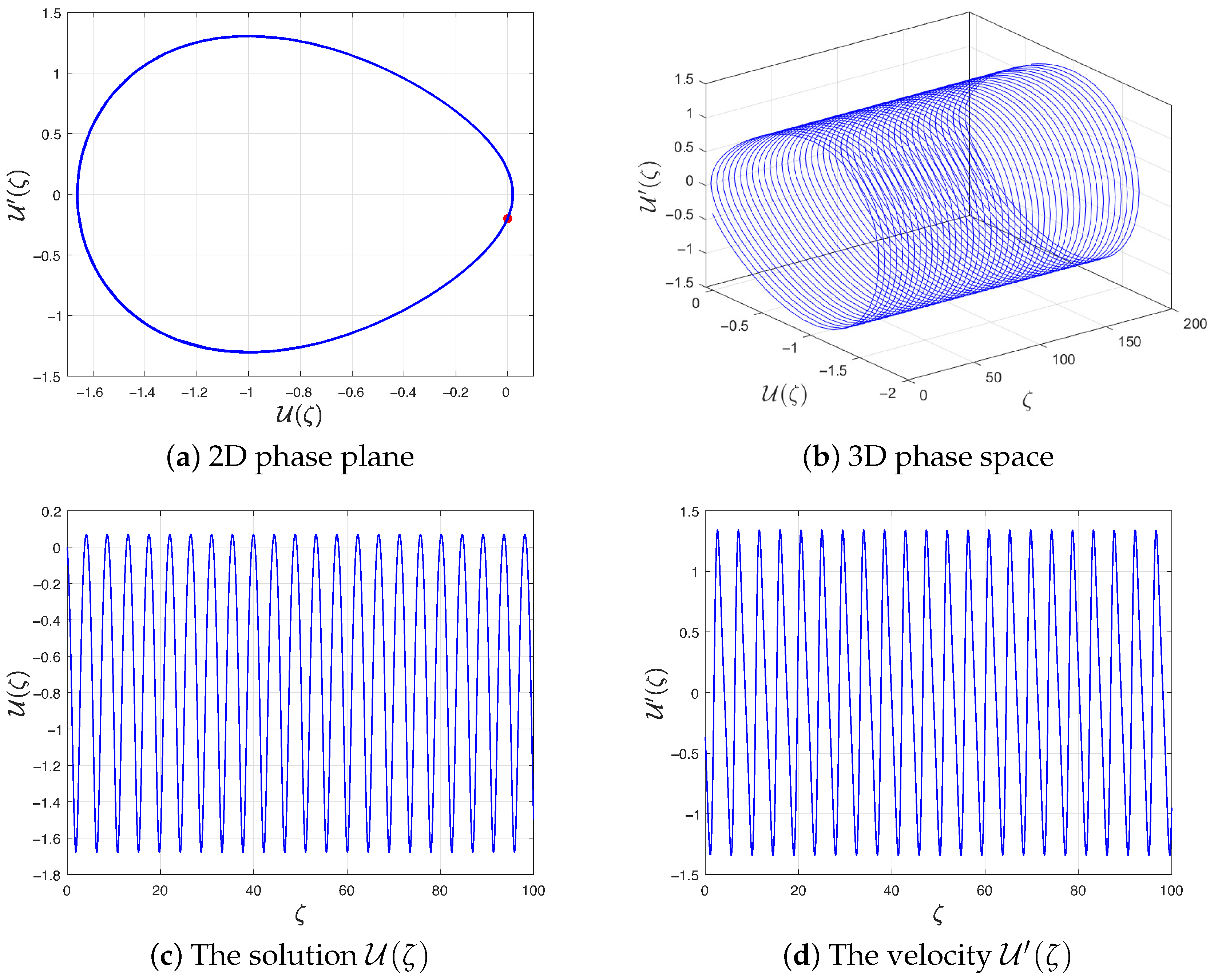
Figure 18 refers to the behavior of the periodic solution of the unperturbed system, that is, in the absence of external force, by taking
and
with the initial condition
.
Figure 18a,b show the 2D phase plane and 3D phase space representations, while
Figure 18c,d show the periodicity of both functions
and
, respectively.
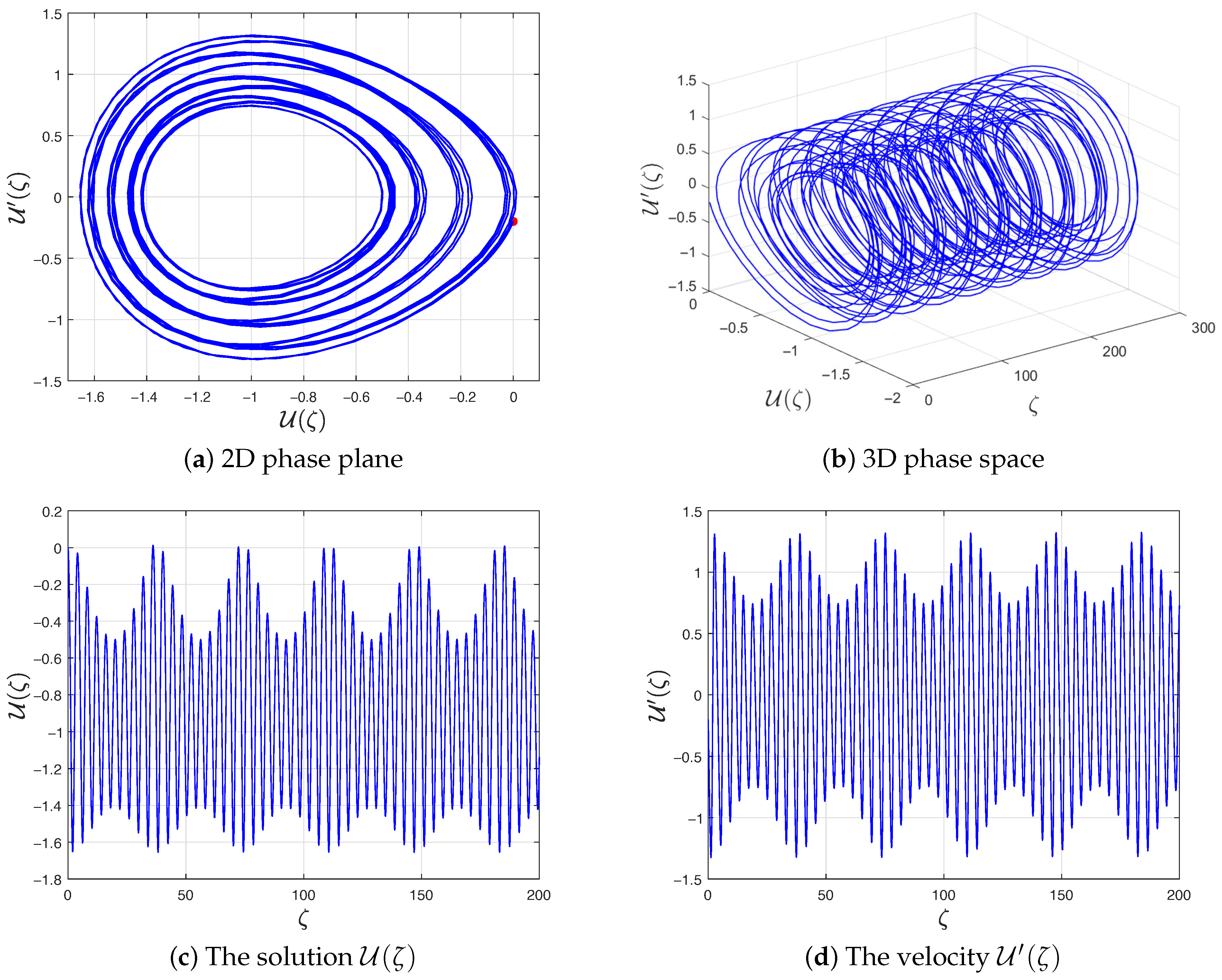
In contrast, when the external force is considerable, the regular periodic motion is missing, and it turns to quasi-periodic. When
and
, with the above values of parameters and the same initial condition,
Figure 19 shows the wave-like periodic behavior of the perturbed system from Equation (
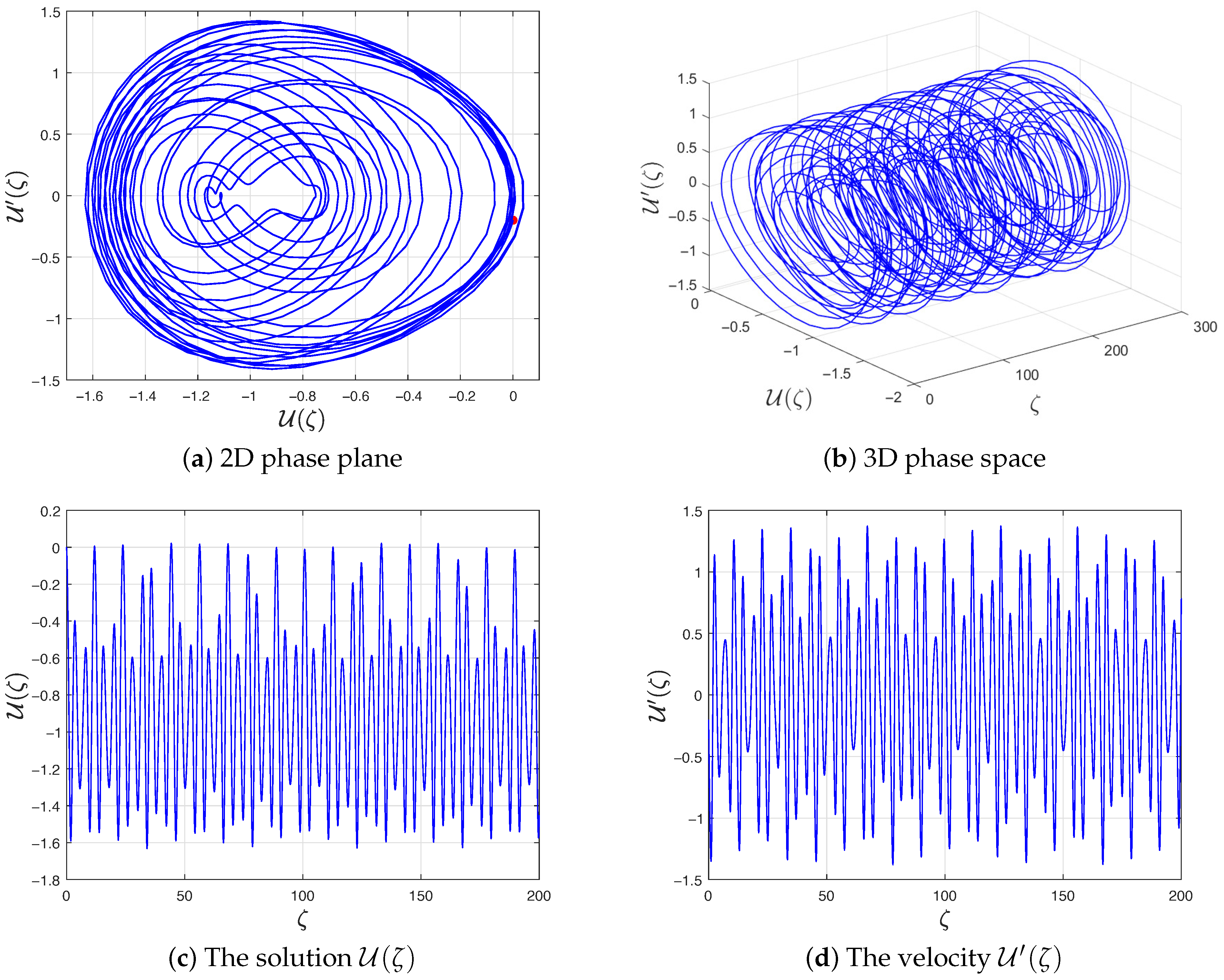
30). Finally, for certain limit values of the frequency
f and intensity
of the additional force, the motion completely loses its periodic nature, leading to unpredictable chaotic behavior as represented in
Figure 20a–d.
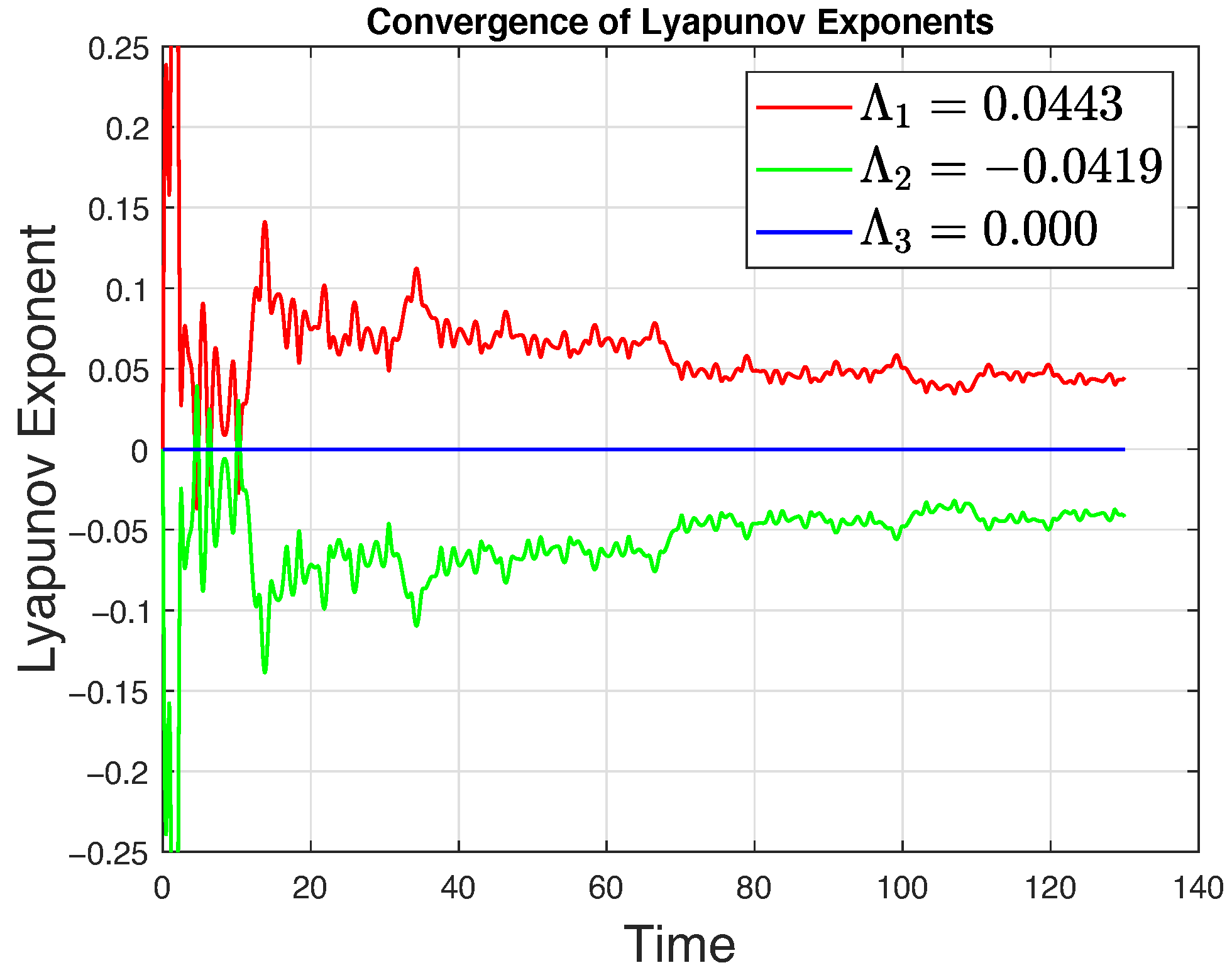
We now evaluate the Lyapunov exponents of Equation (
32) using the same parameter values as in
Figure 20. These exponents, computed numerically, serve as a powerful indicator for assessing the stability and potential chaotic behavior of complex dynamical systems. Their correct interpretation, however, requires a thorough understanding of the system’s internal dynamics, since Lyapunov exponents are highly sensitive to the system’s specific properties. The Lyapunov exponents of the perturbed system are presented in
Table 1.
Figure 21 presents the time-domain analysis of the Lyapunov exponent
. A positive exponent
signifies chaotic behavior, whereas a negative one
indicates stability or convergence.
In particular, the emergence of a positive Lyapunov exponent under external forcing indicates strong sensitivity to initial conditions, implying that ionic wave propagation becomes highly irregular and less predictable. This behavior reflects a loss of robustness of coherent ion-wave transport when the system is subjected to sufficiently strong external perturbations. From a biological perspective, this suggests that external stimuli (such as electromagnetic or mechanical forcing) can significantly alter or disrupt ordered ionic signaling along microtubules. Conversely, the bounded chaotic regime also implies that, by appropriately tuning the forcing amplitude and frequency, one may achieve partial controllability of the wave dynamics, potentially switching between regular, quasi-periodic, and chaotic transport modes.
6. Conclusions
In this study, we have investigated the fractional model of shallow water waves in a weakly nonlinear dispersive media, which plays a crucial role in describing the propagation of ionic waves along microtubules in living cells. Motivated by the localized and heterogeneous nature of intracellular ionic transport, we employ the truncated M-fractional derivative as a phenomenological tool to model short-range memory and anomalous drift effects that are not adequately captured by either classical or strongly nonlocal fractional operators. A fractional wave transformation reduced the model to a third-order differential equation formulated as a conservative Hamiltonian system. The stability of the equilibrium points was analyzed, and the corresponding phase portraits were constructed. Utilizing the dynamical systems approach, a variety of exact fractional solutions were derived. This analysis emphasized the regions of real propagation of the waves from both physical and mathematical perspectives. The influences of fractional order and key physical parameters on the solution profiles were investigated and graphically illustrated. The results revealed that as p decreases from 1 toward zero, the periodic wave gradually loses its regular periodicity, leading to an increase in its wavelength, while the solitary wave becomes wider. During the variation in p, the height of both waves remains unchanged. Concerning the gravitational parameter , it is observed that as gradually increases, the periodic wave compresses, resulting in a reduction in both the wavelength and the wave height, while as gradually increases, the wavelength expands with a decrease in the wave height. Taken together, the bifurcation structure, exact fractional solutions, and chaotic regimes form a unified framework that links mathematical dynamics to the robustness, adaptability, and controllability of ionic wave propagation in biological systems. The proposed methodology can be extended to other evolution equations that can be formulated as conservative dynamic systems possessing conserved quantities. The future work will focus on analyzing chaotic regimes with control strategies with more quantification and extending the framework to other fractional operators and physical applications.