1. Introduction
The theory of approximation has long been a fundamental area of research in mathematical analysis and has provided the basis for many developments in numerical analysis and functional analysis. One of the main frameworks in this field is the use of positive linear operators, which play a central role in approximating continuous functions over both bounded and unbounded intervals.
In recent years, there has been growing interest in constructing generalized and modified forms of classical operators that preserve certain test functions or their linear combinations. Such modifications are often intended to improve approximation properties or to adapt the operators to weighted function spaces. In this direction, new types of Szász–Mirakyan operators have been introduced in the literature [
1].
A significant milestone in this line of research was the contribution of King [
2], who introduced a modification of the Bernstein operators that preserves quadratic test functions and inspired many subsequent studies. Similarly, Duman and Özarslan [
3] proposed Szász–Mirakyan-type operators on the interval
with improved approximation properties. Further generalizations and related results concerning Bernstein and King-type constructions were reported in [
4,
5,
6].
Szász–Mirakyan operators and their various modifications have been extensively studied, particularly because of their ability to reproduce exponential functions. Acar et al. [
7] introduced a version that preserves both the constant function and the exponential function
, obtaining corresponding approximation results. Other exponential-preserving forms were analyzed in [
8,
9], further extending the scope of these constructions. More recently, ref. [
10] studied extended Beta-type Szász–Mirakyan operators under weighted settings, providing new insights into their approximation behavior.
However, the classical Szász–Mirakyan operators are not suitable for approximating integrable functions. To overcome this limitation, Mazhar and Totik [
11] proposed an integral modification in the Durrmeyer sense, defined by
Later studies, such as [
12,
13], examined related extensions, including the generalized Baskakov–Durrmeyer–Schurer and exponential-type operators on unbounded intervals.
Parallel developments have also emerged for operators based on Appell, Beta, and Gamma structures, offering different perspectives on integral and exponential modifications of Szász–Mirakyan and Durrmeyer operators.
Ayman-Mursaleen et al. [
14] proposed integral forms based on Appell polynomials, while Nasiruzzaman et al. [
15] introduced generalized
–Szász–Gamma operators. These constructions show that polynomial and gamma-type modifications can improve approximation flexibility, especially on unbounded intervals.
In a related direction, ref. [
16] presented results on wavelet-type Baskakov operators preserving quadratic functions, showing improved approximation behavior.
These studies show an increasing interest in exponential and integral generalizations and give a broader view of the behavior of these operators.
Following these developments, Deniz, Aral, and Gupta [
17] introduced a Szász–Mirakyan–Durrmeyer-type operator that reproduces both the constant function and
for a fixed parameter
:
where
Direct verification shows that
for all
and for all
Throughout the paper, the notation has been harmonized to ensure consistency across the weighted and unweighted settings, and the index
n used in the classical literature has been replaced by
m for uniformity.
The operators , designed to reproduce exponential functions, are naturally suited for analysis in exponentially weighted spaces. These operators offer computational advantages, particularly in evaluating exponential moments. Unlike the classical Szász–Mirakyan–Durrmeyer operators, which are defined in the standard unweighted setting, the present work focuses on their behavior in these weighted spaces. Such a setting allows a more realistic treatment of functions with exponential growth, which frequently arise in applications of approximation theory.
The purpose of this paper, inspired by the approach in [
17], is to study the weighted approximation properties of these operators and to extend previous results by analyzing their behavior in such weighted settings. By applying a Korovkin-type theorem adapted to exponential weights, several weighted approximation results are established. Furthermore, using suitably defined moduli of continuity, we derive quantitative estimates describing the rate of uniform convergence in exponential norms.
Considering the large number of operator constructions in approximation theory, this study emphasizes the analytical significance of the proposed operator, which bridges classical and weighted frameworks by incorporating exponential reproduction.
Finally, to illustrate the theoretical results, a section is devoted to the numerical examples, where tables and graphs demonstrate the efficiency of the proposed operators in the weighted setting.
3. Weighted Approximation
To analyze the behavior of the modified Szász–Mirakyan–Durrmeyer operators in exponential weighted spaces, we first recall some basic notions related to weighted approximation and operator norms. These concepts clarify how the operators act on functions with exponential growth and provide the foundation for establishing convergence results in the weighted setting.
In this section, we construct a framework for weighted approximation using exponential weight functions and derive direct approximation theorems of Korovkin type. We focus on the exponential weighted spaces and , examine the boundedness of the associated operators, and prove convergence theorems that describe their asymptotic behavior as
Assume that for
the functions
are continuous on
and satisfy
with the additional property that they are unbounded. Define
where
I is an unbounded interval. Also, let
denote the corresponding spaces of continuous functions defined on
The space
is referred to as a weighted space, and with the
-norm it becomes a Banach space.
A positive linear operator L acting on the space is said to map this space into whenever the function belongs the
- 1.
Consider a positive linear operator
. In this situation, its operator norm can be expressed as
- 2.
Let
be a sequence of positive linear operators
. Assume that there exists a constant
such that,
for all
. If, in addition, the condition
is satisfied, then the operator norms
form a uniformly bounded sequence.
Theorem 1. Assume that . Let be a family of positive linear operators acting between the spacesMoreover, these operators satisfyfor . Under these assumptions,holds for every (see [18]). It should be noted that the findings presented in Theorem 1 concerning operators that preserve exponential functions were obtained under the framework of a single weight function. In contrast, the goal of this section is to formulate a direct approximation theorem within a weighted setting, complemented by a weighted variant of the Korovkin-type result. The statements established here pertain to exponential weighted function spaces equipped with different types of weight functions. More precisely, we focus on the exponential weighted space
where
is fixed. This space consists of all real-valued functions on
that satisfy
for some positive constant
, with the weight given by
. We also denote by
the collection of continuous functions belonging to
When endowed with the norm
this space becomes a normed linear space.
Let denote the class of functions for which exists as a finite constant.
In what follows, we describe the precise assumptions ensuring that the operator family acts from into and, moreover, does so with operator norms that remain uniformly bounded across all
Lemma 4. Assume that We work with the sequence of positive linear operators which map the weighted space into . Throughout our analysis, we require that their operator norms remain uniformly bounded; that is, is controlled by a constant independent of
Proof. The representation given in (
2) confirms that the family
consists of positive linear operators. Moreover, we have
which shows that each operator
indeed sends functions from
into the space
In addition, for every
we obtain
Using the classical inequality
for
, we obtain
for
we get
Function
attains its maximum value at
. Thus,
□
Remark 1. The boundedness of the operator norms holds under the natural parameter restrictions and . These assumptions, together with sufficiently large values of m guarantee thatwhich ensures that the supremum in the definition of the operator norm remains finite. If these conditions are not satisfied (for instance, when ), the exponential term does not decay and the norm may become unbounded. Hence, these restrictions together with taking m sufficiently large are essential for the validity of the uniform boundedness result. Theorem 2. Assume that For every function we obtain Proof. We make use of the general result stated in Theorem 1. In line with this theorem, we now verify that the operator meets the necessary requirements. Specifically, we show that
For
and
this conclusion follows directly from Lemma 1. When
the desired convergence is guaranteed by the relation established in (
8). □
Remark 2. This theorem demonstrates that the sequence of modified Szász–Mirakyan–Durrmeyer operators provides uniform convergence in exponential weighted spaces. Hence, for every function , the operators reproduce the given function in the weighted norm as This result confirms the validity of the operators in the exponential framework and forms a basic step for the subsequent quantitative estimates. Moreover, this theorem not only establishes the convergence of the operator defined between two different weighted spaces but also reveals the structural behavior of the test functions within these weighted spaces.
Corollary 1. Let for some Under these conditions, the operators satisfy Moreover, this pointwise convergence becomes uniform when restricted to any compact interval with
Theorem 3. Assume that For each we obtain Proof. For each
First expression in the inequality vanishes as
, which follows directly from Corollary 1. Applying Lemma 1, we observe that for any fixed
and the right-hand side approaches zero when
m becomes large. Finally, by selecting
sufficiently large, the remaining term in the inequality can be made arbitrarily small. □
6. Numerical Results
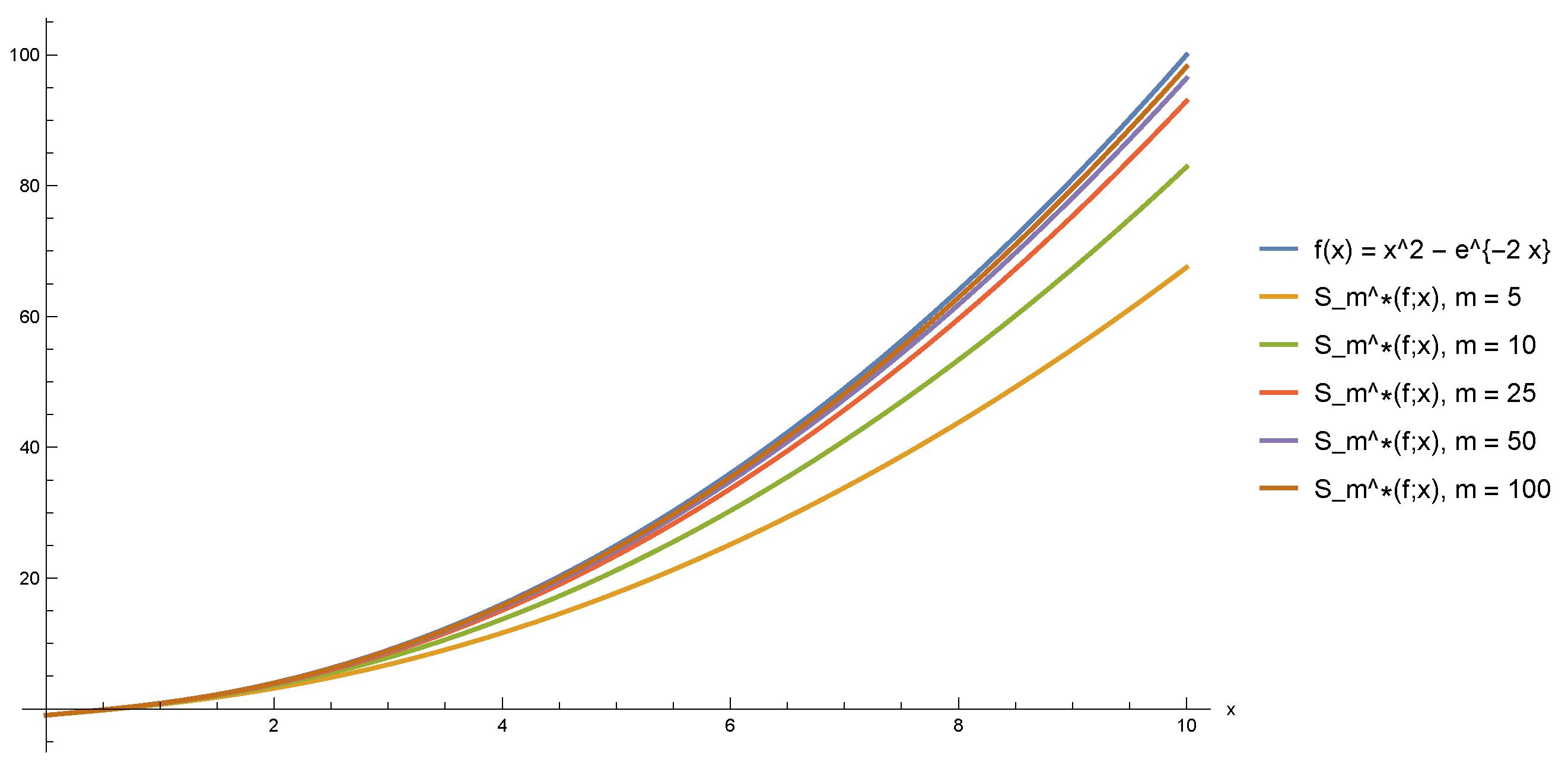
This section is devoted to numerical examples which illustrate the theoretical results obtained in the previous sections. For this purpose, we use several graphs generated with the Mathematica software package. In all computations, the parameter is fixed. We consider the test function , where x belongs to the interval , since the operators are defined only for non- negative values of
Figure 1 shows the graphs of the function
(blue line) together with its approximations
for
(orange line),
(green line),
(red line),
(purple line) and
(brown line).
It can clearly be seen that, as m increases, the curves of become almost indistinguishable from the graph of Hence, a larger value of m provides a better approximation, confirming the convergence behavior of the operators.
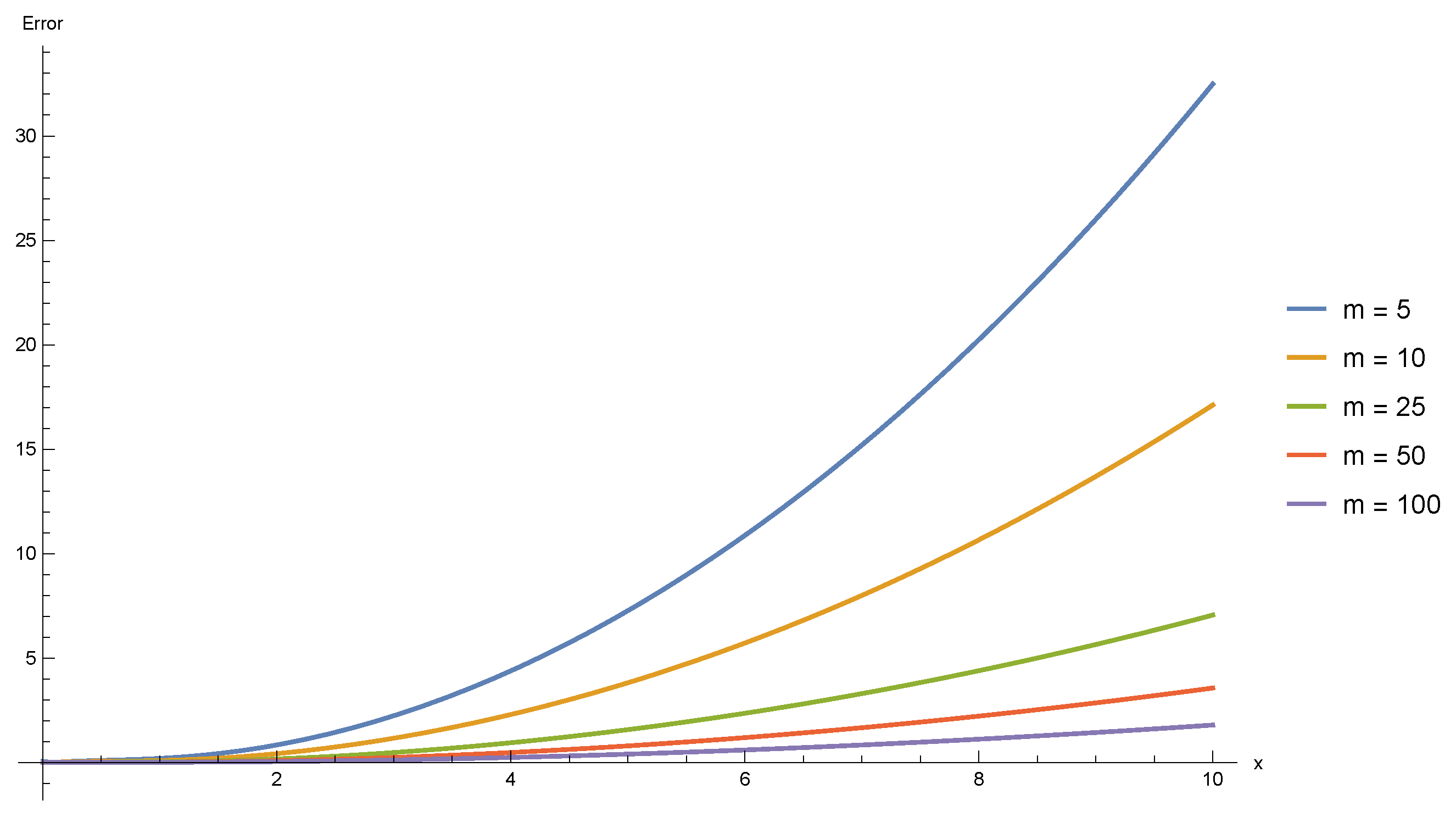
Figure 2 presents the absolute errors
for the same values
,
and 100 on the interval
As expected, the error decreases as m increases, and the operator shows the best approximation over the entire interval.
The decrease in error is consistent with the theoretical rate of convergence obtained from the central moments of the operators.
Finally,
Table 1 presents the numerical error values
at the discrete points
and 4.
For each fixed x, the error decreases monotonically as m increases, once again supporting the theoretical findings on the convergence of
Overall, the numerical and graphical results are in good agreement with the analytical results derived earlier.