1. Introduction
Inverse spectral problems concern the recovery of differential operators from spectral data such as eigenvalues or eigenfunctions. Since the classical work of Ambarzumyan, Borg, Levinson, Gelfand, and Levitan [
1,
2,
3,
4], this area has grown into an important branch of analysis and mathematical physics.
In recent decades, this research field has remained highly active. Numerous researchers, including V.A. Yurko, V. Pivovarchik, S.A. Buterin, N.P. Bondarenko, S. Avdonin, C.F. Yang, and many others, continue to expand its boundaries and contribute to both the classical and generalized Sturm–Liouville problems, particularly with regard to uniqueness theorems, reconstruction algorithms, and stability of solutions. Over the past two decades, the theory has been extended to more general structures known as quantum (metric) graphs. A quantum graph consists of multiple edges, each treated as an interval and connected at vertices, with differential operators such as the Sturm–Liouville operator defined on the edges and appropriate coupling conditions imposed at the vertices. Quantum graphs provide a mathematical model for wave propagation on networks and have found applications in physics, chemistry, engineering, and spectral geometry (see [
5] for a survey and [
6,
7,
8,
9,
10,
11] for further references).
Among these developments, inverse spectral problems on star-shaped graphs have received particular attention. Bondarenko [
12] obtained uniqueness theorems for partial inverse problems of Sturm–Liouville operators on star-shaped graphs, where one seeks to reconstruct unknown data on a selected edge from spectral information and known data on the remaining edges; Avdonin and Kravchenko [
13] proposed numerical algorithms for the self-adjoint case on a star-shaped graph; more recently, Shieh, Tsai, and Wu [
14] studied nonlocal Sturm–Liouville operators with frozen arguments on star-shaped graphs and proved uniqueness theorems for the corresponding partial inverse problems. However, despite these advances, a constructive numerical reconstruction algorithm for the frozen-argument case has not been available.
The aim of this paper is to fill this gap. We develop and implement a numerical algorithm for reconstructing an unknown potential on one edge of a star-shaped graph with frozen arguments, using known potentials on the other edges together with the partial spectral data. Several numerical experiments are provided, covering both smooth and piecewise continuous potentials.
To precisely formulate the problem under consideration, let
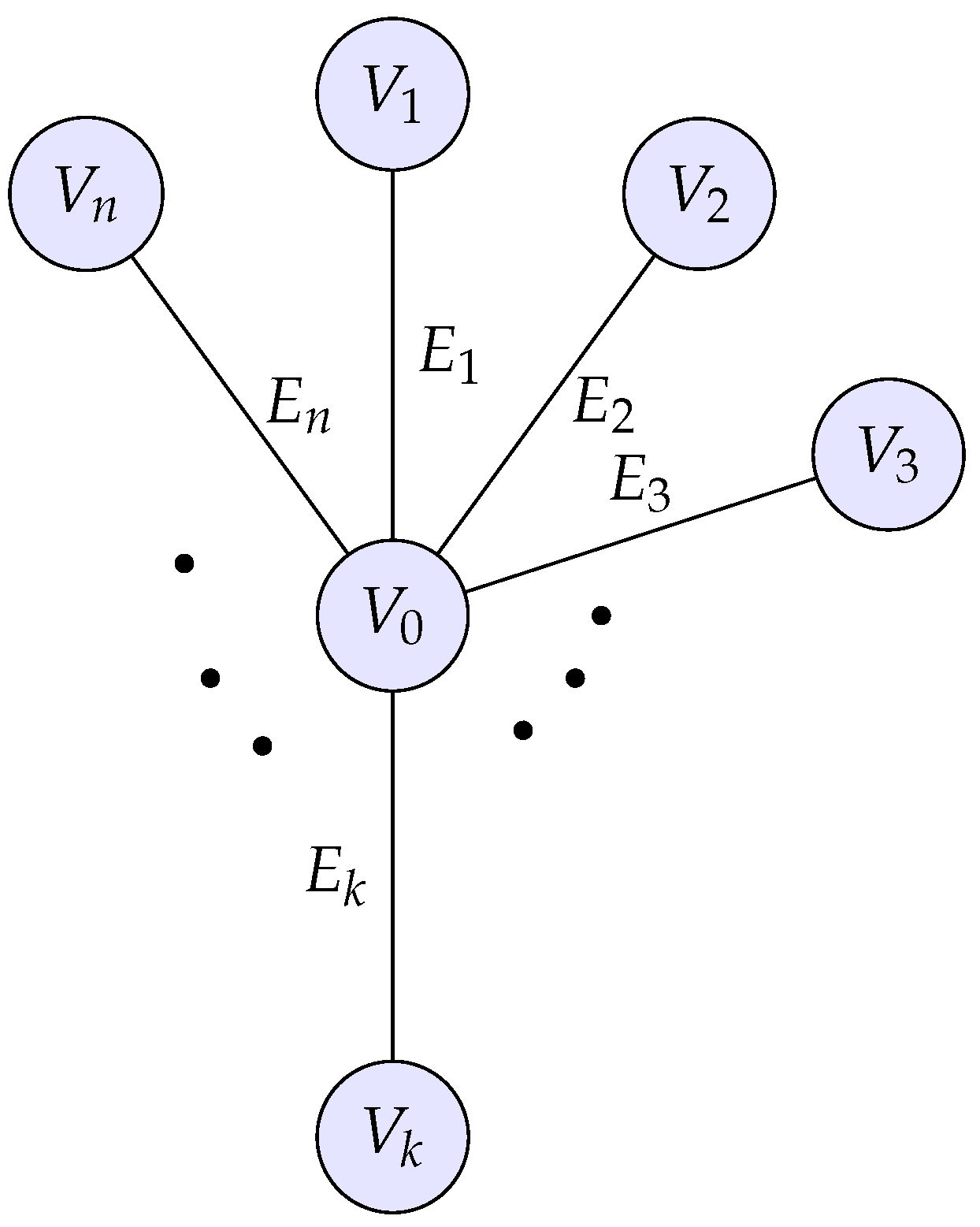
(see
Figure 1) be a star-shaped graph with equal edges of length
;
consists of edges
and vertices
where
is the inner vertex and
is an outer vertex which is connected to
by
Each edge
is parameterized by the variable
the vertex
corresponds to the point
, and the vertex
corresponds to
.
In the graph, each edge
is equipped with an ordinary Sturm–Liouville equation
or a nonlocal Sturm–Liouville equation
where
is a real-valued
-function on
. Let
denote the set of frozen arguments on edge
Briefly, we denote
We agree that if
then the differential equation on
is an ordinary Sturm–Liouville equation. Denote
the boundary problem on
which consists of the differential system
associated with boundary conditions
and Kirchhoff conditions
A number
is an eigenvalue of (
3)–(
5) if there exist non-trivial functions
which satisfy (
3)–(
5). The purpose is to retrieve the potentials
from the information of the eigenvalues of (
3)–(
5).
The remainder of this paper is organized as follows:
Section 2 presents the necessary preliminaries and
Section 3 introduces the numerical algorithm and provide simulation results, followed by a concluding discussion.
2. Preliminaries
In this section, we introduce the basic notation used throughout the paper along with preliminary results. We also briefly discuss a characteristic feature of nonlocal Sturm–Liouville problems, namely, the possible lack of uniqueness of solutions. As an illustration, consider the boundary value problem
For
this problem admits more than one linearly independent solution, which highlights the non-uniqueness phenomenon in nonlocal settings.
As such, the analysis of inverse spectral problems relies heavily upon the construction of the characteristic function associated with the operator. In the case of star-shaped graphs, the characteristic function can be constructed from the differential operators defined on individual edges. For this purpose, we recall the following lemma.
Lemma 1 ([
14]).
Denote as the solution ofassociated with the initial condition Denote ; then, satisfies the integral equationfor . Otherwise,where is an undetermined constant which can be chosen as either 0 or 1 depending on the specific form of and the value λ. For consistency, we denote
the characteristic function of
associated with Dirichlet boundary conditions
and denote
the characteristic function of
associated with Dirichlet–Neumann boundary conditions
According to [
15],
and
Then, the characteristic function of (
3)–(
5) is stated in the following theorem.
Theorem 1 (Theorem 2.4, [
14]).
The characteristic function of is At the end of this section, several preliminary results that will be used in the subsequent analysis are presented. In fact, the characteristic functions allow the following integral forms (refer to [
12,
14]):
for
and
for
The functions
and
are derived from suitable substitutions into Equations (8) and (9), and play essential roles in reconstructing the characteristic function. Readers can refer to [
12,
14,
16] for details.
3. Reconstruction Algorithm and Numerical Experiments
The uniqueness theorems for both ordinary and nonlocal Sturm–Liouville problems on star-shaped graphs have been established in [
12,
14]. Moreover, a numerical method for the ordinary Sturm–Liouville problem on star-shaped graphs was implemented in [
13]. In this work, we focus on the nonlocal problem on star-shaped graphs. The characteristic function and behavior of eigenvalues shall be used to solve our inverse problem.
Theorem 2 ([
14]).
Suppose that the problem consists of l ordinary Sturm–Liouville equations at edges and nonlocal Sturm–Liouville equations, where Then, the characteristic function of iswhere Moreover, the spectral set consists of sequences whereand Proof. Set
. Using standard asymptotic analysis (as
) on (13), we have
Applying Rouché’s theorem near integers and half-integers together with the local Taylor expansions of
and
yields
which are (15) and (14), respectively. □
The asymptotic forms (14) and (15) ensure that and form Riesz bases in , since they are quadratically closed to and separately.
In this section, we shall solve the following inverse problem.
(IP 1). Given , , reconstruct an approximated potential on the edge
Next, we briefly describe how one can determine the potential for the setting of the problem. Given two sequences of eigenvalues
which satisfy (14) and (15),
and (10) then leads to
To solve the inverse problem (IP 1), we assume the following conditions:
- (i)
for all .
- (ii)
has no solution in
There are two cases we want to deal with.
Case (1): Under condition (ii),
determines
uniquely (refer [
15] for details). Equations (12) and (17) yield
Let
Then, by (14) and (15),
in (17) has the following estimates:
For the two cases of Equation (18),
and
, multiplying them by
and
, respectively, we can obtain the following two estimates:
and
The last two estimates allow for subsequent approximation procedures.
We define the inner product
on
Because
and
are real-valued functions and
is a Riesz base for
(refer to [
14,
17]),
and
can be uniquely determined by Equation (18). In particular, if
consists of one single point, then the potential can be reconstructed analytically according the following theorem.
Theorem 3. ; then, can be uniquely determined by and two sequences which satisfy the asymptotic behavior in (14) and (15).
Proof. We shall write
and
According to [
14] and Equation (
18),
and
can be determined uniquely. As indicated in [
14,
16,
18],
and
where we assume
; otherwise, the forms of
and
will be a little different, though the arguments following are the same. Equations (22) and (23) yield
and
Hence,
Because the functions
and
are fully known, we can directly determine
on the intervals
and
. By iteratively applying the third case in (26), we can subsequently recover
on
, then on
and so on, moving backwards. This iterative procedure ultimately reconstructs
on the entire interval
. This completes the proof. □
On the other hand, if
contains more than one argument point, then (22) and (23) fail to hold; hence, the potential
has no the simple representation. However,
can be reconstructed theoretically by using (18) and the Riesz basis property of a system of vector functions (refer to [
14] for details).
For approximation, we write
where
Plugging (27) into (18),
that is,
where
and
Then,
can be solved from (29). Comparing (8) and (12), we obtain
Substituting
in (30) with
, we have
Equation (31) facilitates the derivation of an approximation of the sine series of
i.e.,
Alternatively, an approximation of
can be obtained through the following:
Hence,
For convenience, we call (34) the
C-Series.
Case (2): For this case, (11) and (17) yield
According to (14),
Similar to Case (1), we can obtain
. Then, we can solve
to obtain the Dirichlet–Neumann spectrum
corresponding to potential
On the other hand, we also solve
to obtain the Dirichlet spectrum
corresponding to
Then,
and
can uniquely determine
Alternatively, the Weyl function for
is
which can also help to reconstruct
Before presenting the numerical experiments, we briefly outline the algorithm for approximating
and
. The procedures for
and
are analogous, and are consequently omitted (see Algorithm 1).
| Algorithm 1 Algorithm for obtaining approximation of and |
| Step 1: Using (29), construct a coefficient matrix whereStep 2: Using (29), construct a vector whereStep 3: Solve the linear system Then,Step 4: Using Equation (32) or (34), reconstruct an approximation of potential function . |
In the following, we provide several numerical examples computed using Mathematica 14.1 with WorkingPrecision = 30. Next, we shall present some numerical experiments.
Example 1. Let and We pick the following two sequences of approximated (computed) square root of eigenvalues from the spectral set of the nonlocal problem on a three-edged graph. Note that the computed eigenvalues are inexact due to the use of numerical solvers; therefore, we treat them as noisy measurements.
Case 1: Assuming
,
and
are known a priori, for this case, we obtain the recovered potentials
or
The list of coefficients
is presented below (
Table 1 and
Table 2).
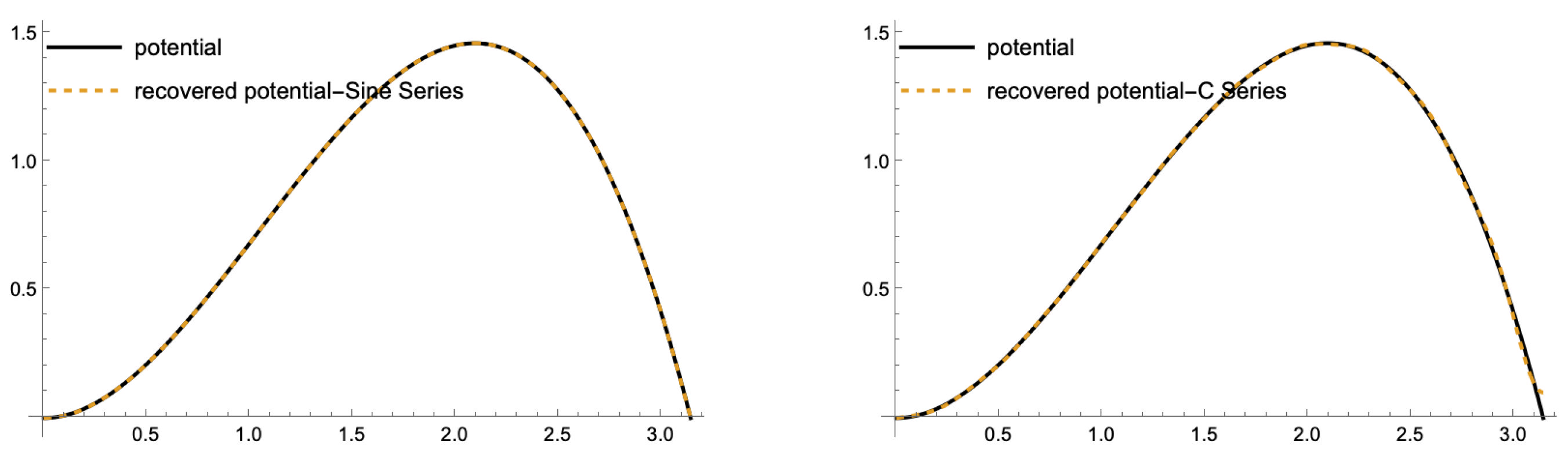
The comparison between the exact potential
and the recovered potential is illustrated in
Figure 2. It is evident that
is smooth and vanishes at both endpoints. The approximation closely matches the exact potential, which can be attributed to the appropriateness of the chosen bases in (32) and (34).
Case 2: Assuming
,
, and
are known a priori, for this case we obtain the recovered potentials
or
The list of coefficients
is presented below (
Table 3).
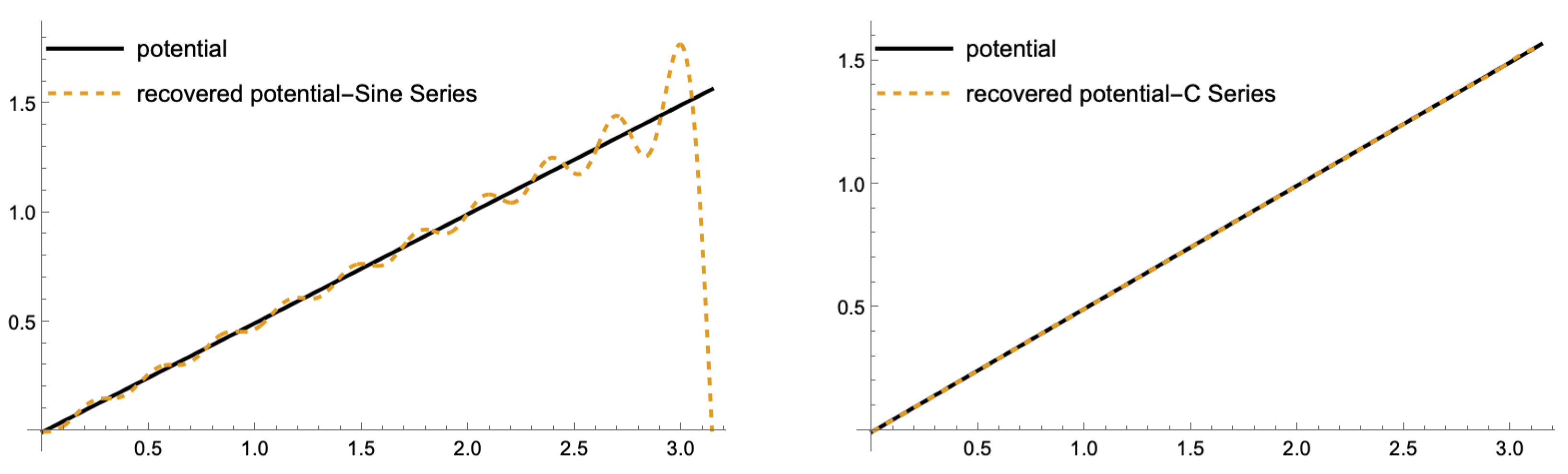
The comparison between the exact potential
and the recovered potential is illustrated in
Figure 3.
Notice that the sine series approximation is not as good as that of the C-Series for this case. The sine series approximation tends to be inaccurate near the endpoints, a phenomenon often attributed to the Gibbs effect.
Case 3: Assume that
and
are known a priori and that
In this case, the Sturm–Liouville operator on edge
reduces to an ordinary form. To recover
both the Dirichlet eigenvalues and Dirichlet–Neumann eigenvalues are required. To this end, we must first compute the functions
and
which are then used to determine the Dirichlet and Dirichlet–Neumann spectral data. For this case, we take
We immediately obtain the coefficients
by applying the linear system in (35) for
Hence,
which leads to the conclusion that
Finally, we shall present a case in which the potential is not continuous at some point inside
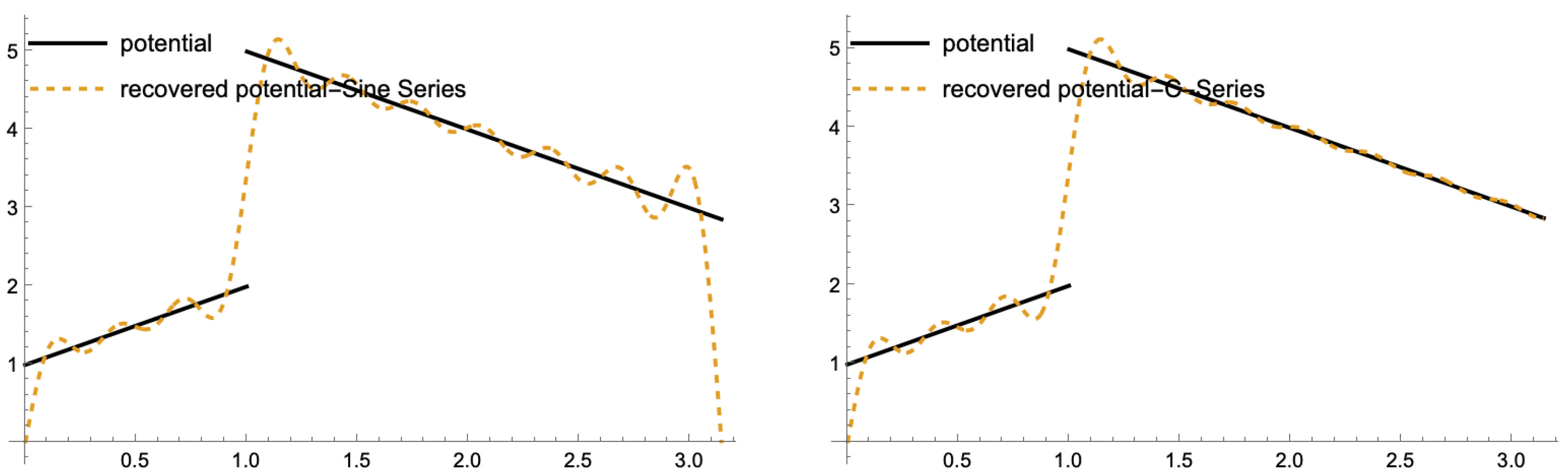
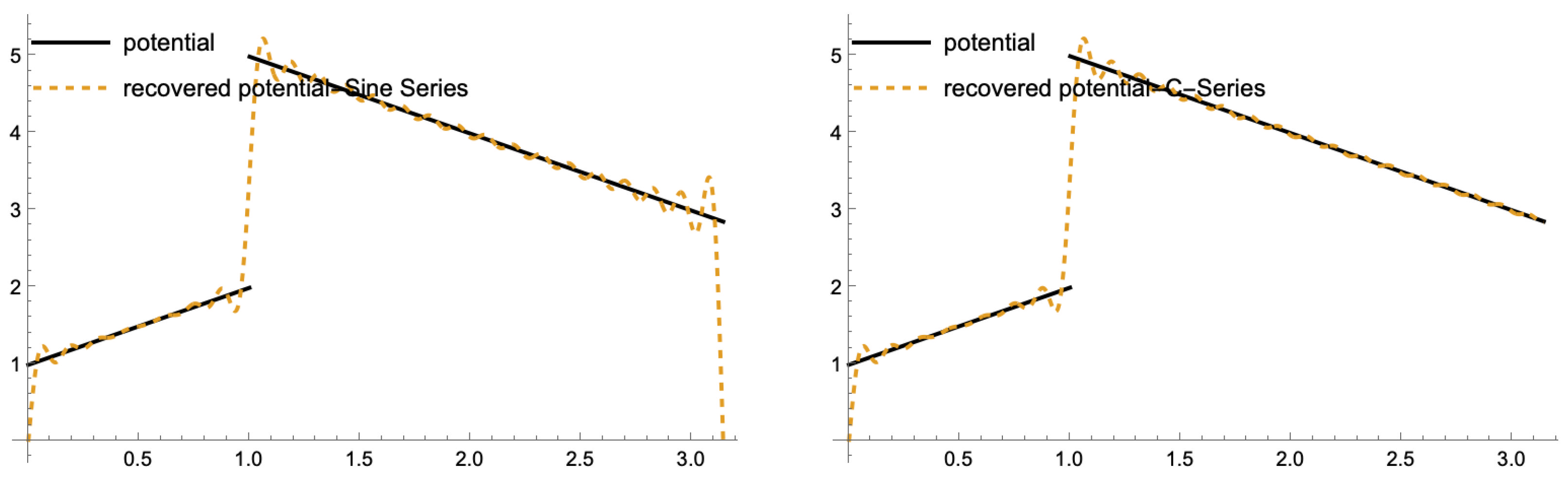
Example 2. In this example, we take , andis a piecewise continuous function. Again, the picked computed eigenvalues are as below (Table 4). Using forty computed eigenvalues to recover the potential yields the approximation shown in
Figure 4, which is clearly unsatisfactory. To enhance the reconstruction accuracy, we can increase the number of eigenvalues to
The resulting approximation displayed in
Figure 5 shows an improvement.
The reader might wonder whether our theory and algorithm can be extended to the case of star graphs with unequal edge lengths. The answer is affirmative. Although we omit the technical details here, interested readers are encouraged to explore this extension independently.