


Abstract
This article is concerned with qualitative and quantitative refinements of the concepts of the log-convexity and log-concavity of positive sequences. A new class of tempered sequences is introduced, its basic properties are established and several interesting examples are provided. The new class extends the class of log-balanced sequences by including the sequences of similar growth rates, but of the opposite log-behavior. Special attention is paid to the sequences defined by two- and three-term linear recurrences with constant coefficients. For the special cases of generalized Fibonacci and Lucas sequences, we graphically illustrate the domains of their log-convexity and log-concavity. For an application, we establish the concyclicity of the points for some classes of Horadam sequences with positive terms.
Keywords:
tempered sequence; log-convexity; log-concavity; log-balancedness; Fibonacci numbers; Lucas numbers; concyclic points MSC:
05A20; 11B83; 11B37; 11B39
1. Introduction
Geometric sequences belong to the simplest and best-known sequences. They are fully characterized by only two values, the initial value, and the quotient of any two successive terms , . When both and q are nonnegative integers, the resulting geometric sequence often has a combinatorial representation, i.e., it appears as the enumerating sequence of a family of combinatorial structures characterized by a nonnegative integer parameter n often interpreted as the structure size. The best-known example is the, probably apocryphal, story of the seemingly modest reward claimed by the inventor of the game of chess. There are many versions; we encourage the reader to take a look at entry 1256 in [1] for a nice summary.
The constant sequence of the quotients of successive terms of geometric sequences has a remarkably regular behavior and it fully characterizes the behaviors of all the geometric sequences with the same quotient q. It is natural to ask whether something similar can be said about sequences whose quotient sequences have less regular behaviors. There are several ways the regularity of constant sequences can be disturbed. The simplest one is to dispense with the property of being constant, but keep the property of being monotonic. In that way, we arrive at the sequences whose quotient sequences are either monotonically increasing or monotonically decreasing. Indeed, both classes of sequences turn out to be well known and well researched: For sequences with positive terms, those with increasing quotient sequences are known as logarithmically convex and those with decreasing quotient sequences as logarithmically concave sequences. (The reasons for involving logarithms will become clear shortly. From now on, we will refer to such sequences as log-convex and log-concave, respectively). Because geometric sequences separate log-convex from log-concave sequences, they could be called logarithmically straight or logarithmically flat, as, indeed, the logarithms of values of a geometric sequence with positive terms all lie on the same straight line when plotted against the index n.
Hence, log-convexity and log-concavity can be interpreted as qualitative refinements of the property of deviating from a geometric sequence, i.e., from a constantly increasing rate. These refinements are not exhaustive, as there are other types of behaviors of quotient sequences. The best-known example is, certainly, the Fibonacci sequence, whose quotient sequence exhibits an oscillating behavior, with no three consecutive terms being monotonous. Such sequences will be called log-Fibonacci in the rest of this paper.
The logarithmic behavior of sequences (and, more generally, functions) makes them suitable for use in the mathematical modeling of many natural, technical, and social phenomena. It is known, for example, that log-convex sequences play an important role in probability, where the log-convexity of the sequence provides a sufficient condition for the infinite divisibility of a discrete random variable X [2,3]. Also, both log-concave and log-convex sequences are of interest in economics and finance. For example, the log-convexity of the discount function is equivalent to decreased impatience [4]. There are also applications in quantum physics [5], pharmacokinetics [6], mathematical biology [7,8] and other areas. In all those applications, the more we know about the used sequences, the more precisely we can tune them to suit the task. For example, we might wish to know not only whether a given sequence is log-convex (a qualitative property), but also by how much. Hence, one might also be interested in quantitative refinements of the log-behavior of sequences and in creating a scale measuring to what degree a sequence possesses a given property.
One possible way to construct such a scale is to consider sequences whose quotient sequences grow, but not too fast. This idea was first investigated in the context of Motzkin numbers [9], giving rise to the introduction of so-called log-balanced sequences almost two decades ago [10]. In this paper, we extend this idea by looking at the sequences whose quotient sequences are decreasing, but not too fast. In that way, we complete andsymmetrize the results in reference [10]. The new concept of tempered sequences provides a unifying context and a natural framework for investigating the effects of the quantitative refinement of their log-behavior on the suitability of those sequences for use in various models.
In the next section, we introduce and formally define all the relevant concepts. Along the way, we state and prove a number of basic results for log-convex and log-concave sequences. Then, we introduce the tempered sequences, the main topic of this paper. We provide the motivation, place them in the context of previous research and provide some examples. In Section 3, we investigate log-concave tempered sequences, counterparts to the better-known and more researched log-convex tempered sequences known as log-balanced sequences. Section 4 is concerned with the log-behaviors of generalized Fibonacci and Lucas sequences as representatives of sequences defined by two-term linear recurrences with constant coefficients. In Section 5, we look at sequences defined by such recurrences of the length three. For sequences given by certain three-term recurrences, there is a useful criterion to check whether they are log-concave or log-convex tempered. Then, in the penultimate section, we come back to the Fibonacci and Lucas sequences and show that some results of the concyclicity of points in the plane given by ratios of successive terms can be generalized to some classes of Horadam sequences. In that way, we generalize Kocik’s result [11] on the concyclicity of Fibonacci-related points to generalized Fibonacci points. The paper is concluded by a short section recapitulating our findings and indicating some open questions.
2. Definitions and Preliminary Results
In the rest of this paper, we consider only positive infinite sequences , . We start by formally defining the types of sequences from the introduction.
A sequence of positive numbers is log-convex if and log-concave if . Geometric sequences satisfying are called log-straight or log-flat. If sgn, the sequence is called log-Fibonacci.
We will be mostly interested in the logarithmic behaviors of sequences for large values of n. If there exists such that the sequence is log-convex (log-concave) for all , we say that is ultimately log-convex (ultimately log-concave). Throughout the paper, wherever there are some problems with the finite initial portions of the considered sequences, the log-behavior is to be understood in the ultimate sense.
If a sequence with positive terms is either log-convex or log-concave, we say that it is log-definite; otherwise, it is log-indefinite.
Clearly, for positive sequences, taking the logarithm of both sides of the defining inequality shows that the sequence of logarithms of the terms of a log-convex (log-concave) sequence is a convex (concave) sequence, while dividing the inequality by yields the increasing (decreasing) behavior, respectively, of the quotient sequence . The first part of this observation explains the names, while the second one allows us to switch between the defining inequalities and the behaviors of the quotient sequences. Geometric sequences are at the same time log-convex and log-concave. The above definitions can be given in a stronger form, using strict inequalities, but we do not need it here.
The literature on the log-convexity and log-concavity of sequences is vast. The results from two standard references, [12,13], have been extended in several directions in recent years. For some recent developments, we refer the reader to [14,15,16,17,18] and the references therein. Most of the more recent references are concerned with developing and refining methods introduced since the beginning of this century [15,19] and applying them to various classes of combinatorial sequences. Many basic results, however, can be established by elementary means and we state some of them here for the reader’s convenience.
2.1. Basic Properties
Lemma 1.
Sequence is log-concave for all .
Proof.
Let and be two log-definite sequences. If both of them are either log-convex or log-concave, we say that they have the same log-behavior. Otherwise, we say that their log-behaviors are opposite.Observe that
and this ends the proof. □
Lemma 2.
If two log-definite sequences, and , have the same log-behavior, then their product sequence has the same log-behavior.
Lemma 3.
The first of the above results is a direct consequence of the fact that the sum of two convex functions (and, hence, sequences) is itself convex. The second claim follows from the first and from the fact that the sequence of the reciprocal values of a log-definite sequence is a log-definite sequence of the opposite log-behavior. The following results are direct corollaries and we omit the proofs.If and are two log-definite sequences with opposite log-behaviors and with positive, then the sequence of their term-wise quotients has the same log-behavior as that of .
Corollary 1.
Let be a log-convex sequence. Then the sequences and are log-convex for all and .
Corollary 2.
Let be a log-concave sequence. Then, the sequences and are log-concave for all and .
Next, we state some results for the sums and differences of log-definite sequences. It turns out that the symmetry present in definitions is not preserved for both types of log-definiteness. First, we show that the sequence of the partial sums of a log-concave sequence is itself log-concave.
Lemma 4.
Let be a log-concave sequence. Then the sequence of its partial sums is log-concave.
Proof.
Now, the first and the last terms on the right-hand side are obviously nonnegative. For any other term, , its negativity would imply , contradicting our assumption that is a log-concave sequence and, hence, its quotient sequence is decreasing. So, the whole right-hand side is nonnegative and the claim follows. □
The analogous claim for log-convex sequences is generally not true. A simple example is provided by the sequence , which is log-convex, but the sequence of its partial sums, the sequence of harmonic numbers, , is log-concave. It suffices to notice that is concave and, hence, also log-concave.Another example, related to the Fibonacci numbers, will appear naturally in one of the following sections. We refer the reader to [18] for a more detailed study of sequences that preserve log-convexity under the partial sum operation.
Further evidence of the non-trivial relationship between log-definiteness and the addition operation is provided by the fact that the sum of two log-convex sequences is always log-convex, but the sum of two log-concave sequences is not necessarily log-concave. The first claim follows from the fact that a log-convex sequence (or, more generally, function) must be convex and convexity is preserved by the summing operation. This can be formalized as follows.
Lemma 5.
The sum of two log-convex sequences is a log-convex sequence.
Log-concavity, on the contrary, does not imply concavity (it suffices to consider the sequence , which is log-concave and convex); hence, the above argument cannot be used. We refer the reader to [20] for a thorough discussion on conditions under which linear combinations of log-concave sequences remain log-concave. Here, we prove some special cases that will be useful in the rest of the paper.
Lemma 6.
Let be a positive log-concave sequence. If is concave, i.e., if , then the sequence is log-concave for all . If the sequence is convex, then the sequence is log-concave for all such that it remains positive.
Proof.
Let us first look at the concave case.
because both terms on the right-hand side are nonnegative. The convex case follows along the same lines and we omit the proof. □
Lemma 7.
Let be two positive real numbers. Then the sequence is log-convex and the sequence is log-concave.
Proof.
The first claim generalizes in a straightforward way to the case of more than two summands.Let us denote and . Then,
Because for all positive a and b, both claims follow. □
Corollary 3.
Let , be positive distinct real numbers. Then the sequence is log-convex.
Corollary 4.
Let and . Then, the sequence is log-Fibonacci.
Proof.
Again, by denoting , we obtain
The expression in parentheses on the right-hand side is always positive, as is the term , while the term alternates in sign. Hence, the whole right-hand side alternates in sign and the claim follows. □
2.2. Tempered Sequences
In this subsection, we consider two quantitative refinements of log-convexity and log-concavity. Both are based on the rate of the change in the quotient sequence . The first one, the log-balancedness, was introduced for log-convex sequences in [10]. It was motivated by observation that such sequences provide important examples in white-noise theory [21]. We recall here the original definition.
A log-convex sequence is log-balanced if the sequence is log-concave. For log-balanced sequences, their quotient sequences are increasing but not too fast: The defining condition translates into the terms of quotient sequences as
Log-balanced sequences turned out to be a rich class, containing many combinatorially interesting sequences. It suffices to mention the Catalan numbers, Motzkin numbers, Schröder and Delannoy numbers, Fine numbers and many others [10,22]. Further, it was shown that the property of being log-balanced is preserved under several operations on sequences [17,18,23]. Curiously enough, none of the papers dealing with log-balanced sequences looked at the sequences satisfying the symmetric (or the dual) property: What can be said of a sequence that is log-concave, but the sequence is log-convex? Clearly, such sequences should also have well-behaved quotient sequences, decreasing, but not too fast. There is every reason to expect that the class of such sequences will contain interesting and non-trivial examples.
In order to effectively investigate this question, we first need a terminology that will emphasize the common properties of such sequences while enabling us to distinguish between their two types of log-behaviors.
A sequence of positive numbers is tempered if its quotient sequence satisfies
The choice of the name tempered reflects the property of their quotient sequence having a moderate rate of change balanced by the opposite behavior of the second quotient sequence, hence possessing “a due mixture or balance of different or contrary qualities”, as quoted in a dictionary definition ([24], p. 1025).
Clearly, the above definition encompasses log-balanced sequences as a special case: Log-balanced sequences, as defined in reference [10], are log-convex tempered sequences. Log-concave tempered sequences, i.e., log-concave sequences such that the sequence is log-convex, have received no attention so far. They are the main topic of the following section.
In terms of the second quotient sequence the property of being tempered is expressed as
If, in addition, a tempered sequence is also log-definite, then the second quotient sequence is convergent and its limit is equal to one.
Proposition 1.
If a tempered sequence is log-convex, then its second quotient sequence tends to one from above. If a tempered sequence is log-concave, then its second quotient sequence tends to one from below.
The above result shows that geometric sequences with a positive quotient, having the second quotient sequence constant and equal to one, are the natural limiting case for both types of log-definite behaviors.
We conclude this section by providing examples of non-tempered sequences. It can be easily checked that the second quotient sequence of the sequence is constant and equal to four. In fact, for every , there is a sequence, , whose second quotient sequence is constant and equal to . Then, sequences with non-constant second quotient sequences converging to can be easily constructed, e.g., as . There are also sequences whose second quotient sequences grow without bounds. An example is provided by . We invite the reader to construct further such examples.
From the above results, one can conclude that tempered sequences are the first natural step in the hierarchy of the growth behaviors of positive sequences.
3. Log-Concave Tempered Sequences
Log-convex tempered sequences have been widely investigated under the name of log-balanced sequences and it was shown that many combinatorially interesting sequences belong to this class. In this section, we look at their log-concave counterparts and show that the class of log-concave tempered sequences is also rich enough to be interesting. Some, which are representatives of sequences given by three term recurrences, will be given in Section 5.
Proposition 2.
Any increasing log-concave sequence is (ultimately) tempered.
Proof.
Let be an increasing log-concave sequence. Then its quotient sequence is a decreasing sequence and bounded from below. Hence, it tends toward a positive limit . Let us denote by the quotient sequence of the sequence . Clearly, . We consider the difference
Because the sequence is convergent, the differences between the successive elements must tend to zero. Hence, there exists such that for all . Then for ,
because is increasing and, hence, . So, the sequence is increasing and is log-convex and the claim follows. □
As could be expected, a dual claim is valid for log-convex sequences.
Proposition 3.
Any decreasing log-convex sequence is (ultimately) tempered.
Proof.
Let be a decreasing log-convex sequence. Then its quotient sequence is increasing and bounded from above by 1; hence, it must be convergent. Let denote the quotient sequence of the sequence . Clearly, . Consider the difference
Again, because is convergent, there is an such that . Then the numerator in the rightmost fraction must satisfy and, hence, . So, the sequence is log-concave and the claim follows. □
Further examples can be obtained by observing the essential duality of our definitions. For any sequence whose log-balancedness has been established in [10,17,18] and in other references, the sequence is log-concave and tempered. The following two examples, belonging to this type, were not previously considered.
Proposition 4.
For , the odd-indexed Fibonacci numbers and , the even-indexed Lucas numbers, the sequences and are log-concave and tempered.
Proof.
It is well known that the log-definiteness of standard Fibonacci and Lucas sequences depends on the parity of n, so that and are log-concave, while and are log-convex. Therefore, we only need to check whether is a log-concave sequence. This follows easily from for all and from Cassini’s identity, . For , we have
This proves the first claim.
Similarly, because is log-convex, we only need to prove that is a log-concave sequence. Here, we use for and to obtain
and get the second claim. □
Proposition 5.
Sequences , and , , are log-concave and tempered.
Proof.
By Corollary 2, the sequence is log-concave. In proving that is log-convex, we use two facts: first, for all and second, (Cassini’s identity). For , we have
This proves the claim for .
The proof for is similar, using the facts for all and . □
If and are two log-concave tempered sequences, then so is the sequence of their term-wise sums . The next observation is also valid.
Lemma 8.
If the sequence of positive numbers is log-concave tempered, then the same holds for the sequence .
Proof.
Because is log-concave, the quotient sequence is decreasing. Then yields also , which proves that is log-concave. The assumption on the log-convexity of gives . Now,
This is equivalent to the log-convexity of and the claim follows. □
Concerning the question of the log-behavior of a product of two sequences, we have two results. The first gives sufficient conditions for the product of two log-concave sequences being tempered.
Proposition 6.
Let and be two log-concave sequences and and be their respective quotient sequences. Let . If is an increasing sequence, then is a log-concave tempered sequence.
Proof.
If and are log-concave, so is their product sequence . Notice that is exactly the quotient sequence of . If it increases, then is log-convex. Hence, is a log-concave tempered sequence. □
The next result gives sufficient conditions for the product of a log-concave tempered sequence and a log-convex sequence being, itself, tempered.
Proposition 7.
Let be a log-concave tempered sequence, be a log-convex sequence and and be their respective quotient sequences. Let . If is a decreasing sequence, then is a log-concave tempered sequence.
Proof.
Because is log-concave tempered and is log-convex, we have and . The assumption on ensures the log-concavity of . Further,
This is equivalent to the log-convexity of . □
4. Log-Behaviors of Generalized Fibonacci and Lucas Sequences
Geometric sequences, serving as the starting point in our considerations, most naturally appear as solutions of simple, maybe even the simplest possible, recurrences, , with a given , most often set to one by convention. The next simplest case, the sequences satisfying two-term linear recurrences with constant coefficients, already display the full spectrum of possible log-behaviors. We investigate them in this section.
The best-known and the most commonly studied sequences satisfying two-term linear recurrences with constant coefficients are, without doubt, the Fibonacci and the Lucas numbers. They both satisfy the simplest non-trivial two-term recurrence , differing only in the initial conditions. For the Fibonacci numbers, denoted by , we set and , while for the Lucas numbers , we take and . It is well known (see, for example, [25]) that both sequences can be expressed in closed form in terms of the Golden ratio and its negative reciprocal via Binet’s formulae:
The following result is a direct consequence of Binet’s formulae and Corollary 4 in the previous section.
Corollary 5.
Both the Fibonacci and the Lucas sequences are log-Fibonacci.
In general, the Fibonacci and the Lucas numbers are representative of a broader class of sequences given by two-term recurrences with constant coefficients. Some of their properties are shared by the whole class, as observed and explained in [26].
Given two real numbers, p and q, and the initial terms and for , we consider the sequence defined by the two-term linear recurrence with constant coefficients
The set of all such sequences is denoted by , where we suppress the dependence on the initial conditions. Technically speaking, , the Horadam sequence defined by the coefficients p and q and the initial terms a and b. We restrict our attention, here, to , the sequences from with positive terms.
The sequence that starts with and continues with is called a Fibonacci sequence in and is denoted by .
For the initial terms , the resulting sequence is called a Lucas sequence in and is denoted by . The usual Fibonacci and Lucas sequences are and , respectively.
We first determine the areas of the different types of log-behaviors of generalized Fibonacci and Lucas sequences in the space of parameters p and q.
4.1. Log-Behavior
In [15], Došlić and Veljan showed that the log-behavior of a positive sequence given by a two-term linear recurrence with constant coefficients is fully determined by the log-behavior of its first three terms. They proved the result, using the so-called calculus method. Here, we offer an alternative proof by induction.
Proposition 8.
Let . For and , the logarithmic behavior of is determined by the logarithmic behavior of its first three terms.
Proof.
Let and . Let be its quotient sequence. We prove by induction that is an increasing sequence. The base case holds by assumption. Assume that there is an such that . Now,
because both factors are negative.
The proof for the other case is similar. □
For and , all the sequences in are log-Fibonacci, including and . The claim in Proposition 8 applies directly to , but not to , because . Hence, in the Fibonacci case, we consider , where is the left shift operator given by .
Next, we quote a result solving the problem of the positivity of sequences given by two-term linear recurrences with constant coefficients.
Proposition 9.
This quoted result is attributed to [28] in reference [16], which also considers a generalization to recurrences with non-constant coefficients that are nonnegative and linear functions of n, but we do not need the more general result here. The next corollary gives positivity conditions for generalized Fibonacci and Lucas sequences.(Theorem 1.1 in [27]) Suppose for real numbers p and q, and real initial terms and . Let the discriminant, , of its characteristic equation be positive so that it has two real roots and . The sequence is nonnegative if and only if
- (i) and or
- (ii) and .
Corollary 6.
Generalized Fibonacci and Lucas sequences are positive if (i) and or (ii) , and .
For and , all the sequences in are log-Fibonacci, including and .
The case is more structured.
Proposition 10.
Let , and . Then, the generalized Fibonacci sequence, , is log-concave. The generalized Lucas sequence, , is log-convex for and geometric for .
Proof.
The assertion for follows directly from Proposition 8, applied to , and , because
In the case of a sequence , , and . The condition holds if and only if , i.e., only if . For , the sequence is geometric. □
Figure 1 shows the areas of the log-definiteness of sequences and in the -plane.
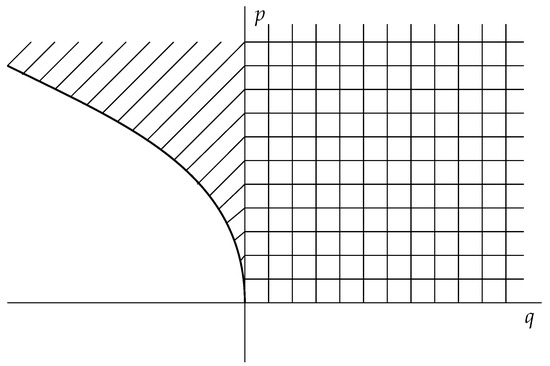
Figure 1.
Areas of log-concavity for , log-convexity for (stripes) and log-Fibonacci (grid) for and .
According to the result in Proposition 10, we can immediately classify many combinatorial sequences with respect to their log-behaviors.
Corollary 7.
The next sequences are log-concave:
- 1.
- ;
- 2.
- ;
- 3.
- ;
- 4.
- (the Chebyshev polynomial of the second kind, );
- 5.
- .
Proof.
- 1.
- is the generalized Fibonacci sequence, ;
- 2.
- The Mersenne sequence, , is the generalized Fibonacci sequence, ;
- 3.
- is the generalized Fibonacci sequence, ;
- 4.
- The Chebyshev polynomial of the second kind is the generalized Fibonacci sequence, , ;
- 5.
- is the generalized Fibonacci sequence, .
□
We leave it to the interested reader to find more examples of log-definite generalized Fibonacci and Lucas numbers.
4.2. Conditions for Being Tempered
Now, we give sufficient conditions for sequences to be tempered.
Proposition 11.
Let and assume . If and for all then is log-convex and tempered.
Proof.
According to Proposition 8, the conditions , and ensure that is log-convex. The inequality gives the base case for the assertion . Next, we assume that for all . So, and, therefore, . Note that
The assertion now follows because
is positive. □
Proposition 12.
Let and assume . If and for all , then is a log-concave tempered sequence.
Proof.
As we know, the conditions , and guarantee the log-concavity of . Furthermore, ensures . Assume for all . So, , which means . Now,
results in
The latter expression is positive if for . Because has a maximum value of 2, yields the statement. □
5. Some Remarks on Sequences Given by Three-Term Linear Recurrences
In this section, we consider positive sequences given by three-term linear recurrences with constant coefficients
and initial terms , and for given real numbers p, q and r, , a, b and c. By , we denote the set of all such sequences with positive terms.
In order to examine the log-definiteness of a sequence, , we consider its quotient sequence . It satisfies the non-linear recurrence relation , with the initial values , and for . Further, suppose there are positive real numbers and such that for all . Observe that
Having this, we can state sufficient conditions for the monotonic behavior (increase or decrease) of , i.e., the log-definiteness of .
Proposition 13.
Let and let be its quotient sequence. If and either
- 1.
- , and or
- 2.
- , and ,
then is log-convex.
Proof.
In both cases, we prove by induction that the quotient sequence is increasing. The condition ensures the base case. For the induction step, suppose there is some such that . Then and . From this, for case 1, and give , so . Consequently, is an increasing sequence and this ensures log-convexity of . Similarly, for case 2, , and result in . □
There is a similar statement for the sufficient conditions for the log-concavity of .
Proposition 14.
Let and let be its quotient sequence. If and either
- 1.
- , and or
- 2.
- , and
then is log-concave.
In case , with , the log-behavior of the sequence is completely determined by increases or decreases in the first three terms of the quotient sequence, . This is in agreement with the corresponding result for sequences defined by two-term recurrences (Proposition 8).
Proposition 15.
Let with , and and let be its quotient sequence. If , then is log-convex. If , then is log-concave.
Proof.
We prove both claims by induction. In case , suppose for some . Then together with
gives . The proof of the other claim is similar. □
This result helps to provide sufficient conditions for the temperedness of log-definite sequences given by three-term recurrences, with , and . First, observe that the terms of the quotient sequence for are and that the terms of the quotient sequence for are .
Lemma 9.
Let , with , and . Its quotient sequence is
- 1.
- Log-convex tempered if and only if and ;
- 2.
- Log-concave tempered if and only if and .
As before, if there exists such that is log-convex (log-concave) tempered, we say that is ultimately log-convex (log-concave) tempered.
Using the result in Lemma 9, we can readily prove that some Fibonacci-related sequences are log-definite and tempered. Besides the usual two-term recurrence, , , Fibonacci numbers satisfy many higher-order linear recurrences with constant coefficients. This is, in particular, the three-term recurrence , , with and .
Corollary 8.
The sequence is log-concave tempered.
Proof.
Consider the sequence , A000071 in OEIS [29]: . It satisfies the three-term recurrence , . Its quotient sequence satisfies . Further, . So, is, indeed, ultimately a log-concave tempered sequence. □
Another example of a log-concave tempered sequence is Leonardo numbers. The sequence of Leonardo numbers is defined by the recurrence relation
Catarino and Borges [30] showed that , . The sequence of Leonardo numbers is ultimately log-concave tempered. To show this, we are free to use Lemma 9 because Leonardo numbers satisfy the linear recurrence relation . We show this later in a more general case.
Corollary 9.
The sequence of Leonardo numbers is log-concave tempered.
Proof.
We have the following sequence: . Let . It is easy to check that and . So, is log-concave tempered. □
There is a generalization to Leonardo numbers given in [31]. For a fixed positive integer k, the generalized Leonardo numbers, , are given by
with . Obviously, . Furthermore, , [31]. Using this identity, we prove that the sequence of generalized Leonardo numbers satisfies the linear recurrence . Indeed,
Now, we use Lemma 9 and prove that the sequence of generalized Leonardo numbers is ultimately log-concave tempered.
Corollary 10.
The sequence of Leonardo numbers is log-concave tempered.
Proof.
The sequence starts with
For , 5 and 6, the members of its faction sequence are
We have and . This proves the claim. □
There are recent results by Zhao [32] for the logarithmic behaviors of generalized Leonardo numbers. One of them is that irrespective of k, the sequence of the reciprocals of generalized Leonardo numbers is log-balanced (log-convex tempered). The proof of that fact (Theorem 1 in [32]) can be less technical if we apply the results of the previous corollary.
Corollary 11.
The sequence is log-convex tempered.
Proof.
Let , and be as in Corollary 10. Then, implies . Similarly, gives . So, the result simply follows.
Let us just mention that the discordance between the first member of this result and Zhao’s result is just notational. Namely, in [32], the author defines the elements of a quotient sequence by . This is unlike here, where . □
The result in Lemma 9 is quite operative for all positive sequences given by the recurrence , . In the notation of the OEIS list of linear recurrences with constant coefficients [33], these are recurrences of type , . The list contains nearly one hundred sequences just of the type , not to mention others. Provided that the combinatorial sequences are with positive terms, Lemma 9 gives the method to determine if they are tempered. Thus, for example, the sequence A057960: of the number of three-choice paths along a corridor of width 5 and length n, starting from one side, is log-convex tempered (log-balanced) starting from the first quotient term. The sequence A157725: is also an example of an ultimately log-convex tempered sequence. The sequence A154691: is log-concave tempered from the first quotient term. The sequence A045883: of the number of rises (drops) in the compositions of , with parts in , is ultimately log-concave tempered.
There are numerous examples of tempered sequences, either log-convex or log-concave, for lists of recurrences of type , . We leave the verification of this to the interested reader.
Our results could be, in principle, extended also to sequences satisfying linear recurrences (with constant coefficients) of arbitrary lengths.
6. Ford Circles for Generalized Fibonacci Sequences
In this section, we consider a visualization of the subsequences of the quotient sequences of generalized Fibonacci sequences. We show that points with coordinates are concyclic for all the sequences in . In this way, we extend Kocik’s results for the concyclicity of such points for the Fibonacci numbers [11] to all the sequences in . Kocik proved that for , points all lie on a circle .
We state and prove a similar theorem for . The crucial point in the proof is the validity of the Cassini identity for generalized Horadam sequences. This can probably be found in many articles, but we cite here the result by Yazlik and Taskara in [34]. The authors defined the generalized k-Horadam sequence in the following way: For any positive real number k and and scalar-valued polynomials such that , the generalized k-Horadam sequence, , is defined by
with initial conditions and . Theorem 5 in [34] states the following: For ,
As mentioned before, a generalized Fibonacci sequence equals a Horadam sequence, i.e., . So, with , , and , the result transforms to
the Cassini identity for generalized Horadam sequences.
Proposition 16.
Let be a Fibonacci sequence, . Then, the points are concyclic and belong to a circle with its center at and a radius of .
Proof.
The sequence results in the points
One can determine the equation of a circle through the first three points by solving
This is a circle with its center at and the radius (r) . We claim that all the points belong to that circle, i.e., that for ,
Now,
After multiplying by , we obtain . This is equivalent to
Because , we must check whether
This is the Cassini identity for generalized Horadam sequences. From this, we conclude that the generated points are, indeed, concyclic. □
The result we have just established can be extended to more general sequences and to more general conical sections.
7. Concluding Remarks
In this paper, we have revisited the problem of the growth rates of log-definite combinatorial sequences. We have introduced the class of tempered sequences, which encompasses the well-researched log-balanced sequences and puts them in a symmetric relationship with log-concave sequences with the same behavior of the second quotient sequence. Particular attention has been paid to the sequences defined by short (two- and three-term) linear recurrences with constant coefficients, such as, e.g., the generalized Fibonacci and Lucas sequences. Besides considering their log-behaviors, we have shown that certain families of points in the plane, whose coordinates are given as the ratios of successive elements of such sequences, are concyclic, thus generalizing the results by Kocik to Ford circles for Fibonacci sequences.
There are still several interesting questions to which we have no answer. The first thing to do would be to consider two-term recurrences with polynomial coefficients and refine the results in reference [35]. It would be of interest to investigate positivity and determine the areas of particular log-behaviors of sequences defined by full three-term linear recurrences with constant coefficients. A closely related problem would be to look at non-homogeneous linear recurrences of length two, such as the ones considered in Kocik’s paper on lens sequences [36]. Then, are there any tempered sequences whose second quotient sequences do not converge to 1? Could the property of temperedness be relevant for establishing infinite log-convexity/infinite log-concavity [37]? What can be said about Stieltjes moment sequences [38] and/or about sequences satisfying multivariate linear recurrences with constant coefficients [39,40]? Further, it would be interesting to know whether Kocik-type concyclicity results can be established for all the Horadam sequences with positive elements. Finally, one could look at non-tempered sequences. Some investigations are currently underway and we hope to be able to report new results soon.
Author Contributions
Methodology, T.D. and B.K.; Investigation, T.D. and B.K. All authors have read and agreed to the published version of the manuscript.
Funding
T. Došlić gratefully acknowledges the partial support of the Slovenian ARIS via program P1-0383, grant no. J1-3002 and by the COST action CA21126 NanoSpace.
Data Availability Statement
No new data were created or analyzed in this study.
Acknowledgments
We thank the anonymous referees for their careful reading and useful suggestions.
Conflicts of Interest
The authors declare no conflicts of interest.
References
- Pickover, C.A. The Math Book: From Pythagoras to the 57th Dimension; Sterling: New York, NY, USA, 2009; p. 102. [Google Scholar]
- Milenkovic, O.; Compton, K.J. Probabilistic transforms for combinatorial urn models. Combin. Probab. Comput. 2004, 13, 645–675. [Google Scholar] [CrossRef]
- Warde, W.D.; Katti, S.K. Infinite divisibility of discrete distributions II. Ann. Math. Stat. 1964, 42, 1088–1090. [Google Scholar] [CrossRef]
- Prelec, D. Decreasing Impatience: A Criterion for Non-stationary Time Preference and ’Hyperbolic’ Discounting. Scand. J. Econ. 2004, 106, 511–532. [Google Scholar] [CrossRef]
- Klauder, J.R.; Penson, K.A.; Sixdeniers, J.M. Constructing coherent states through solutions of Stieltjes and Hausdorff moment problems. Phys. Rev. A 2001, 64, 013817–013835. [Google Scholar] [CrossRef]
- Weiss, M. Theorems on log-convex disposition curves in drug and tracer kinetics. J. Theor. Biol. 1985, 116, 355–368. [Google Scholar] [CrossRef]
- Došlić, T.; Svrtan, D.; Veljan, D. Enumerative aspects of secondary structures. Discr. Math. 2004, 285, 67–82. [Google Scholar] [CrossRef]
- Stein, P.R.; Waterman, M.S. On some new sequences generalizing the Catalan and Motzkin numbers. Discrete Math. 1979, 26, 261–272. [Google Scholar] [CrossRef]
- Došlić, T. Some new inequalities for Motzkin numbers. Math. Ineq. Appl. 2002, 5, 171–174. [Google Scholar] [CrossRef]
- Došlić, T. Log-balanced combinatorial sequences. Int. J. Math. Math. Sci. 2005, 4, 507–522. [Google Scholar] [CrossRef]
- Kocik, J. Fibonacci numbers and Ford circles. arXiv 2020, arXiv:2003.00852v1. [Google Scholar]
- Brenti, F. Unimodal, log-concave and Pólya frequency sequences in combinatorics. Mem. Amer. Math. Soc. 1989, 81, 413. [Google Scholar] [CrossRef]
- Stanley, R. Log-concave and unimodal sequences in algebra, combinatorics and geometry. Ann. N. Y. Acad. Sci. 1989, 576, 500–535. [Google Scholar] [CrossRef]
- Došlić, T. Seven (lattice) paths to log-convexity. Acta Appl. Math. 2010, 110, 1373–1392. [Google Scholar]
- Došlić, T.; Veljan, D. Logarithmic behavior of some combinatorial sequences. Discret. Math. 2008, 308, 2182–2212. [Google Scholar]
- Liu, R.-L.; Zhao, F.-Z. New Sufficient Conditions for Log-Balancedness, With Applications to Combinatorial Sequences. J. Integer Seq. 2018, 21, 18.5.7. [Google Scholar]
- Zhang, T.-T.; Zhao, F.-Z. Some Sufficient Conditions for the Log-Balancedness of Combinatorial Sequences. J. Integer Seq. 2016, 19, 16.6.8. [Google Scholar]
- Zhao, F.-Z. The log-balancedeness of combinatorial sequences. Sarajevo J. Math. 2015, 11, 141–154. [Google Scholar] [CrossRef]
- Liu, L.; Wang, Y. On the log-convexity of combinatorial sequences. Adv. in Appl. Math. 2007, 39, 453–476. [Google Scholar]
- Gross, J.L.; Mansour, T.; Tucker, T.W.; Wang, D.G.L. Log-Concavity of Combinations of Sequences and Applications to Genus Distributions. SIAM J. Discrete Math. 2015, 29, 1002–1029. [Google Scholar]
- Asai, N.; Kubo, I.; Kuo, H.-H. Bell numbers, log-concavity and log-convexity. In Classical and Quantum White Noise; Accardi, L., Kuo, H.-H., Obata, N., Saito, K., Si, S., Streit, L., Eds.; Kluwer Academic Publishers: New York, NY, USA, 1999. [Google Scholar]
- Deutsch, E.; Shapiro, L. A survey of the Fine numbers. Discr. Math. 2001, 241, 241–265. [Google Scholar]
- Zhao, F.-Z. On the log-convexity of the difference sequence of a log-convex sequence. Sarajevo J. Math. 2022, 16, 153–162. [Google Scholar]
- The Wordsworth Concise English Dictionary; Wordsworth Editions Ltd.: Hertfordshire, UK, 1994.
- Koshy, T. Fibonacci and Lucas Numbers with Applications; John Wiley & Sons: Hoboken, NJ, USA, 2001. [Google Scholar]
- Kalman, D.; Mena, R. The Fibonacci Numbers: Exposed. Math. Mag. 2003, 76, 167–181. [Google Scholar]
- Liu, L.L. Positivity of three term recurrent sequences. Electron. J. Comb. 2010, 17, # R57. [Google Scholar]
- Halava, V.; Harju, T.; Hirvensalo, M. Positivity of second order linear recurrent sequences. Discret. Appl. Math. 2006, 154, 447–451. [Google Scholar] [CrossRef][Green Version]
- Sloane, N.J.A.; The OEIS Foundation Inc. The On-Line Encyclopedia of Integer Sequences. 2020. Available online: http://oeis.org (accessed on 18 February 2025).
- Catarino, P.; Borges, A. On Leonardo numbers. Acta Math. Univ. Comen. 2020, LXXXIX, 75–86. [Google Scholar]
- Kuhapatanakul, K.; Chobsorn, J. On the generalized Leonardo numbers. Integers 2022, 22, #A48. [Google Scholar]
- Zhao, F.-Z. The log-behavior of some sequences related to the generalized Leonardo numbers. Integers 2024, 24, #A82. [Google Scholar]
- Sloane, N.J.A. OEIS, Index Entries for Linear Recurrences with Constant Coefficients. Available online: https://oeis.org/wiki/Index_to_OEIS:_Section_Rec#order_03 (accessed on 12 February 2025).
- Yazlik, Y.; Taskara, N. A note on generalized k-Horadam sequence. Comput. Math. Appl. 2012, 63, 36–41. [Google Scholar]
- Xia, E.X.W.; Yao, O.X.M. A criterion for the log-convexity of combinatorial sequences. Electron. J. Combin. 2013, 20, #P3. [Google Scholar]
- Kocik, J. Lens sequences. J. Integer Seq. 2020, 23, 20.11.6. [Google Scholar]
- Wang, Y.; Zhu, B.X. Log-convex and Stieltjes moment sequences. Adv. Appl. Math. 2016, 81, 115–127. [Google Scholar] [CrossRef]
- Sokal, A.D. A simple algorithm for expanding a power series as a continued fraction. Expo. Math. 2023, 41, 245–287. [Google Scholar] [CrossRef]
- Bousquet-Mélou, M.; Petkovšek, M. Linear recurrences with constant coefficients: The multivariate case. Discrete Math. 2000, 225, 51–75. [Google Scholar] [CrossRef]
- Leinartas, E.K. Multiple Laurent Series and Difference Equations. Sib. Math. J. 2004, 45, 321–326. [Google Scholar] [CrossRef]
Disclaimer/Publisher’s Note: The statements, opinions and data contained in all publications are solely those of the individual author(s) and contributor(s) and not of MDPI and/or the editor(s). MDPI and/or the editor(s) disclaim responsibility for any injury to people or property resulting from any ideas, methods, instructions or products referred to in the content. |
© 2025 by the authors. Licensee MDPI, Basel, Switzerland. This article is an open access article distributed under the terms and conditions of the Creative Commons Attribution (CC BY) license (https://creativecommons.org/licenses/by/4.0/).